
 Vos Iz Neias
The PA’s Draft Constitution: A Document Built on a Lie And the Legal Response Israel Should Be Making
By Rabbi Yair Hoffman
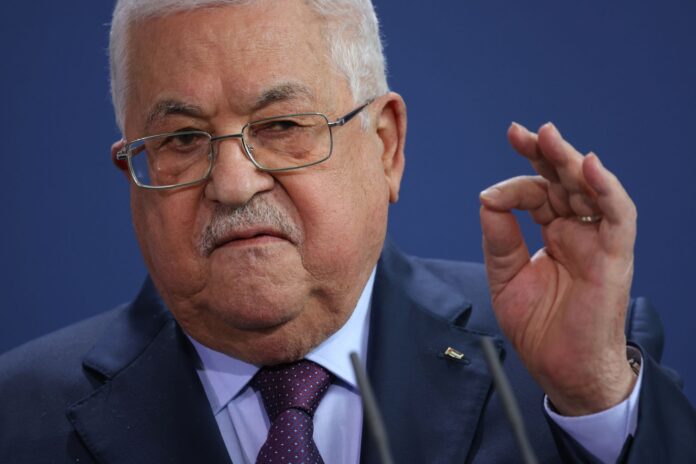
Earlier this week, Palestinian Authority President Mahmoud Abbas ordered the publication of a draft constitution for a Palestinian state. The PA’s official news agency, WAFA, announced the move with considerable fanfare. The document was presented as a step toward statehood, democracy, and the rule of law.
But when one actually reads the 153-article constitution, a very different picture emerges. This is not a document about building a state. It is a document about erasing a people. Specifically, it is a systematic attempt to deny, obscure, and ultimately eliminate any trace of Jewish connection to Jerusalem—the city that has been the heart of Jewish life, prayer, and yearning for over three thousand years.
The omissions are not accidental. They are deliberate. And they represent, in constitutional form, the very same historical revisionism that has poisoned the prospects for genuine peace for decades.
Israel’s response should not be silence. It should be a clear, comprehensive, and unapologetic articulation of the Jewish people’s legal, historical, and spiritual claim to Jerusalem and to its holiest site—Har HaBayis, the Temple Mount.
What the PA Constitution Actually Says
Article III of the draft constitution declares Jerusalem the “capital of the State of Palestine” and its “political, spiritual, cultural, and educational center.” It commits the state to “preserving its religious character and protecting its Islamic and Christian sanctuaries.”
Read that sentence carefully. Islamic sanctuaries. Christian sanctuaries. That’s it.
There is not a single mention of Judaism, Jewish holy sites, or the Jewish people anywhere in the entire constitution. Not in Article III. Not in any other article. Jerusalem’s “religious character” is defined exclusively in Islamic and Christian terms. The Jewish connection to Jerusalem—which predates both Islam and Christianity by centuries and millennia respectively—has been written out of existence.
Article III goes further, asserting that “any measures to change its character or historical identity are considered null and void according to international law.” The irony is breathtaking. The PA is invoking international law to freeze in place a status quo that itself violates international law—one in which Jewish historical and religious rights to Jerusalem are systematically denied.
Article IV establishes Islam as the official religion of the state, with Islamic Sharia principles serving as the “primary source for legislation.” While Article XXVII references equality without discrimination based on religion, and Article XXXVII affirms freedom of worship for “followers of monotheistic religions,” the omission of Judaism by name—while Islam and Christianity are specifically protected—speaks volumes.
Enshrining “Pay-for-Slay” in a Constitution
Perhaps even more troubling than the historical erasure is Article XXIV, which commits the state to “provide protection and care for the families of martyrs, wounded, and prisoners, and those released from the occupation prisons.” Article XLIV reinforces this, calling for “comprehensive care” for these families.
This is the PA’s notorious “pay-for-slay” policy—a program that provides financial stipends to families of convicted terrorists—now elevated to constitutional status. The message is unmistakable: terrorism against Jews is not merely tolerated; it is constitutionally honored.
A constitution that enshrines financial rewards for terrorism while simultaneously erasing the victims’ connection to the land is not a blueprint for peace. It is a blueprint for perpetual conflict.
The Preamble: Liberation Language, Not Peace Language
The constitution’s preamble describes the document as “an extension of the liberation journey from occupation” and characterizes the Israeli presence as a “colonial settlement occupation.” It speaks of “displacement and ethnic cleansing” and “genocide” in Gaza and the West Bank.
This is not the language of a people preparing for statehood alongside their neighbor. This is the language of a movement that views the very existence of the Jewish state as illegitimate. The word “colonial” is particularly revealing, as it implies that Jews are foreign interlopers in the land of Israel—a land where Jewish sovereignty was established a thousand years before the Common Era.
Article I reinforces this framing by declaring Palestine “part of the Arab homeland” and affirming that “the Palestinian people are part of the Arab nation.” The constitution does not envision a state living in peace beside Israel. It envisions an Arab state that denies Israel’s legitimacy.
Even Hamas Objects—But for the Wrong Reasons
In a revealing twist, Hamas official Bassem Naim denounced the draft constitution—not because it erases Jewish history, but because it doesn’t go far enough. He called it a “failed attempt by the PA to save itself from the developments of history” and declared that “the people under occupation do not write constitutions according to the standards of the occupier.”
He urged Palestinians to “write in blood and unity the document of our complete freedom and our return.” The competing visions of the PA and Hamas are not between moderation and extremism; they are between two different versions of the same fundamental rejection of Jewish sovereignty.
How Israel Should Respond: The Legal Case for Jewish Sovereignty
Israel’s response to this document should not be a shrug or a press release. It should be the forceful, detailed, and unapologetic presentation of the legal case for Jewish sovereignty over Jerusalem and the Temple Mount.
That case rests on at least ten independent legal grounds, each of which is sufficient on its own and which together constitute an overwhelming argument under international law.
1. One Thousand Years of Prior Sovereignty
The Jewish people exercised continuous sovereignty over Jerusalem and the Temple Mount for approximately one thousand years—from King David’s establishment of Jerusalem as the national capital (circa 1000 BCE) through the destruction of the Second Beis HaMikdash by Rome in 70 CE, with autonomous presence continuing through the Bar Kokhba revolt in 135 CE. This included every attribute of statehood recognized under international law: the construction and maintenance of two national Temples, centralized government, minting of currency, foreign relations, and a comprehensive legal system through the Sanhedrin.
Under the doctrine of uti possidetis juris, the last lawful sovereign retains legal title unless that title is legitimately transferred through a recognized legal mechanism. No subsequent power—Roman, Byzantine, Arab, Crusader, Mamluk, Ottoman, or British—ever acquired the Temple Mount through any such legitimate mechanism.
2. Conquest Does Not Confer Title
A foundational principle of international law—indeed, a jus cogens norm—is that territorial acquisition by force does not confer legitimate sovereignty. This is codified in Article 2(4) of the United Nations Charter and reaffirmed by the International Court of Justice. The Roman conquest of Jerusalem was an act of military aggression against an existing sovereign state. The destruction of the Beis HaMikdash was an act of cultural annihilation. Every subsequent ruler inherited a chain of title rooted in this original illegitimate seizure. As the legal maxim states: nemo dat quod non habet—no one can give what they do not have.
3. The San Remo Resolution (1920)
The San Remo Conference of April 1920 incorporated the Balfour Declaration into binding international law, providing that Palestine would be placed under a Mandate giving effect to “the establishment in Palestine of a national home for the Jewish people.” This resolution has the force of a treaty. It encompassed all of Palestine—including Jerusalem and the Temple Mount—with no exceptions or reservations. It has never been legally superseded, revoked, or annulled.
4. The League of Nations Mandate (1922)
The League of Nations Mandate for Palestine explicitly recognized “the historical connection of the Jewish people with Palestine and the grounds for reconstituting their national home in that country.” The word “reconstituting” is legally critical—it acknowledges that the Jewish national home was being restored, not created from nothing. The Mandate imposed binding obligations on the international community to facilitate this restoration.
5. Article 80 of the United Nations Charter
When the UN succeeded the League of Nations, Article 80(1) of the Charter expressly preserved all rights recognized under existing Mandates. Sometimes called “the Palestine Clause,” this provision guarantees that the rights recognized in the 1922 Mandate remain legally operative. It can only be overridden by a Charter amendment requiring a two-thirds vote of the General Assembly and ratification by two-thirds of Member States, including all permanent Security Council members. No such amendment has ever been proposed.
6. The Illegality of Jordan’s Occupation (1948–1967)
Jordan’s seizure of the Old City during the 1948 war was an act of illegal military aggression. Its subsequent annexation was rejected by virtually the entire international community—even the Arab League refused to recognize Jordanian sovereignty. During those 19 years, every Jewish resident was expelled, 58 synagogues were destroyed, Jewish gravestones from the Mount of Olives were used as paving stones and latrines, and Jews were entirely denied access to the Kosel and the Temple Mount in direct violation of the 1949 Armistice Agreement. Because Jordan never held legitimate sovereignty, it could not transfer it to any successor. Any derivative claim is legally void.
7. The Right of Self-Determination
The Jewish people constitute a “people” under international law by every accepted criterion. Their right to self-determination necessarily encompasses sovereignty over their holiest site. The comparative analysis is straightforward: for Islam, Mecca and Medina are holier than Jerusalem. For Christianity, the Church of the Holy Sepulchre holds primary significance. Only for the Jewish people is the Temple Mount the singular, irreplaceable center of religious and national identity.
8. Freedom of Religion
The current prohibition on Jewish prayer at the Temple Mount violates Article 18 of the Universal Declaration of Human Rights, Article 18 of the International Covenant on Civil and Political Rights, and Israel’s own Basic Law. No other holy site in the democratic world imposes a comparable prohibition on the worship of the faith to which it is most sacred. This restriction originated not in any legal process but in a unilateral political decision by Defense Minister Moshe Dayan in 1967, which was never ratified by the Knesset.
9. Adverse Possession Does Not Apply
Some argue that centuries of non-Jewish control extinguished Jewish claims. This fails for multiple reasons. The claim was never abandoned—three times daily, Jews faced Jerusalem and prayed for restoration. Every Pesach Seder concludes with “L’Shanah HaBa’ah B’Yerushalayim.” Every Jewish wedding includes the breaking of a glass in mourning for the Churban. Jewish communities maintained a continuous physical presence in Yerushalayim, Tzfas, Teverya, and Chevron through every period of foreign rule. Possession acquired by force cannot ripen into legal right, and the chain of possession was neither peaceful nor continuous.
10. Restitution and Defensive Recovery
International law requires the return of wrongfully taken property. Israel’s reunification of Jerusalem in 1967 was a lawful act of self-defense—not conquest—following Jordan’s unprovoked shelling of West Jerusalem. Territory recovered in a defensive war from an illegal occupier does not carry the same constraints as territory taken in an offensive war. Israel’s recovery of the Temple Mount was, in legal terms, a liberation.
Conclusion: The Time for Silence Is Over
The PA’s draft constitution is not merely a political document. It is an act of historical warfare—an attempt to establish, in constitutional stone, the erasure of Jewish connection to Jerusalem. It claims to protect the city’s “religious character” while deliberately excluding the oldest and deepest religious connection to the city. It invokes “international law” while violating its most fundamental principles.
For too long, the Jewish people’s response to such erasure has been muted—relying on the assumption that the historical record speaks for itself. But when a constitutional document seeks to codify a lie, silence becomes complicity.
The legal case for Jewish sovereignty over Jerusalem and the Temple Mount rests on a thousand years of prior sovereignty, binding international treaties, the principles of self-determination, religious freedom, restitution, and the elementary rule that theft cannot generate title. These are not religious arguments (though those exist as well). These are arguments grounded in the very international law that the PA claims to invoke.
Dovid HaMelech made Yerushalayim the capital of the Jewish nation three thousand years ago. Shlomo HaMelech built the first Beis HaMikdash there. For two thousand years of galus, we have turned toward it in tefillah, mourned its destruction, and declared our intent to return. The PA’s draft constitution cannot erase what is written in the stones of Yerushalayim, in the words of Tehillim 137, and in the hearts of every Jew who has ever whispered: “Im eshkacheich Yerushalayim, tishkach yemini.”
If I forget you, O Yerushalayim, let my right hand forget its skill.
We have not forgotten. We will not forget. And it is time the world heard our case.
The author can be reached at [email protected]