

By Rabbi Yair Hoffman
Every so often, big companies realize that things are not working so well and they need to retool. With all of the current anti-semitism perhaps it is time to retool our davening a bit – that is to emphasize something that has always been there – but to focus more on it. The concepts below are based on what this author feels is the most important Siddur that has been published in over one hundred years – since the Otzer HaTefilos siddur was published in 1914 – Siddur Ruach Nachon by Rabbi Shmuel Dov Eisenblatt.
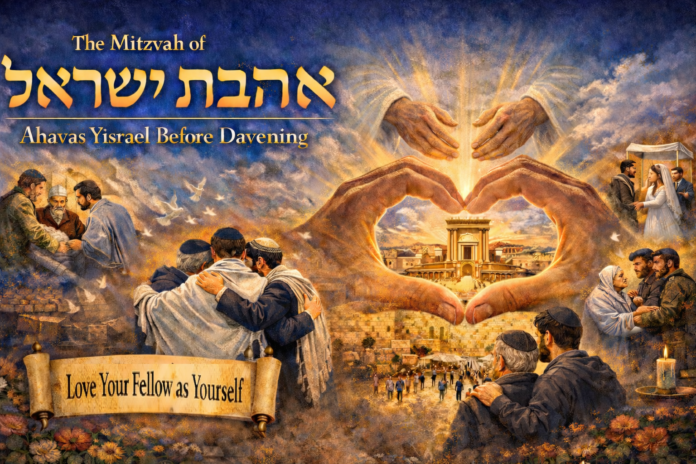
The main idea is that before standing in prayer before HaKadosh Baruch Hu, a person must first resolve to truly fulfill what Hashem commanded us in His Torah (Vayikra 19:18): “Love your fellow as yourself.”
R’ Chaim Vital makes this point emphatically in Sefer HaKavanos (Derushei Kodem HaTefillah, Derush 1). Before arranging one’s Tefillah — one must first accept upon himself the mitzvah of loving fellow Jews. Only through this will his prayer ascend as an inclusive prayer encompassing all of Israel. Only then can it rise upward. Only then can it bear fruit.
Furthermore, those who study Torah together must see themselves as one body. Each person must view himself as a single limb among his companions. If any one of them is in distress — whether from illness or any other cause — all must share in that distress. They must pray for him. In all of one’s prayers, one must include one’s fellow. All matters of love between companions must be attended to.
The Scope of the Mitzvah
This mitzvah is not a standalone obligation. It encompasses the entire fabric of interpersonal mitzvos: “You shall not hate your brother in your heart.” “You shall love the convert.” “You shall not take revenge.” “You shall not bear a grudge.” “With righteousness shall you judge.” “You shall not stand idly by the blood of your fellow.” “You shall not curse the deaf.” “Before the blind do not place a stumbling block” (Vayikra 19; Oraysa, chapter 2).
When a person awakens himself to love his fellow, he simultaneously arouses himself to fulfill every one of these obligations. This means loving every Jew — regardless of background or affiliation — as he loves himself.
This love, when sincere, transforms one’s entire davening.
A] Feeling the Pain — and the Joy — of Others
Praying Over Their Suffering
This love moves a person to feel the pain of the klal and pray over their suffering.
We find this with Moshe Rabbeinu at the very beginning of his life. The Torah tells us (Shemos 2:11) that “he went out to his brothers and saw their burdens.” Rashi and Sforno explain: he directed his eyes and heart to feel their distress. He chose to look. He chose to feel.
The Gemara (Shabbos 67a) teaches that even a tree that fails to produce fruit is marked with red dye (sikra) so that passersby who see it will daven for it. A metzora , embarrassing though his situation is, must announce his condition so that others will pray for him. The Mishnah in Middos (2:2) records that people would pray for mourners to be comforted and for those who were excommunicated to merit to correct their ways (see also Magen Avraham 215:16; Aruch HaShulchan 215:61). Bearing the burden of one’s fellow is one of the 48 qualities through which Torah is acquired (Avos 6:6).
Rejoicing in Their Good Fortune
This love also moves a person to genuinely rejoice in the good fortune of others. As Dovid HaMelech declared: “The humble shall hear and be glad” (Tehillim 34:3). “Those who fear You shall see me and be glad” (119:74; see Rashi, Bechoros). This includes reciting the appropriate brachos when encountering another’s good fortune. These are lessons rooted in love.
Transforming One’s Kavvanah
When a person does this, something remarkable happens. Most of our tefillos are phrased on behalf of others. Virtually every prayer formula is expressed in the plural. When you genuinely care about the people you are praying for, your kavvanah becomes real and heartfelt.
It is proper to pray over the distress of the Shechinah itself, which is in exile from among the people. One should not merely go through the motions. Rather, one should distribute among them thanksgiving and blessings. One should be among those who give thanks and who bless.
In every section of the Amidah — the granting of understanding, the healing of the sick, every blessing — and especially at its conclusion, one should direct his heart to the welfare of all of Israel. Not merely his own needs. Everything we pray for — the abundance of the years, the gladness of the heart, every source of joy — should be directed toward all of Israel. Even when reciting the name of Hashem, one should sense the distress felt on behalf of others. This is the concept of Rofei Choleh — the Healer of the sick — with comfort. The words are no longer just words. They become a genuine plea for people you actually care about.
The Sin of Failing to Pray for Others
This love also saves a person from a grave sin. The Gemara in Brachos (12b) actually teaches this explicitly: “Whoever is able to ask for mercy on behalf of his fellow and does not do so is called a sinner.” If he is a Torah scholar, the obligation is even greater. He must exert himself to pray on their behalf.
One should pray even regarding troubles that befall others. This is itself the concept of praying for the return of the Shechinah. One should be among those who, as it were, wear sackcloth over the troubles of Israel. Praying specifically over their troubles. On their behalf.
Here is a remarkable principle: one who prays for others while experiencing similar distress himself is answered first. But make sure that that is not the reason to do it.
As the navi declares (Yeshayahu 63:9): “In all their afflictions, He was afflicted.” The Shechinah itself shares in Israel’s pain. She never ceases to seek mercy and compassion on their behalf. The result? The spirit of rest and comfort descends upon the one who prays for others (Yerushalmi; see also Rav Yaakov Skvira on “A-Kelokim, Tefillah“; Radvaz, Parashas Vayeira, chapter 34).
B] Shattering the Self-Centered Perspective
This love shatters a person’s narrow view of himself. Instead of seeing himself as the center of his own little world, he begins to grasp how small one individual truly is within the vast tapestry of creation. The prayers he offers on behalf of the community take on far greater meaning and urgency.
The Baal HaTanya (Perek 32) makes a striking point:. A person whose prayer goes unanswered may find that the very reason is this: his fellow’s welfare was not on his mind. His heart and intellect were not elevated to include his fellow.
Think about it. If your Tefillah goes unanswered, consider: perhaps it is precisely because you were consumed by your own distress. Perhaps you failed to think about whether another person was also suffering. Perhaps you should have prayed for him. The Torah commands (Vayikra 19:18): “You shall love your fellow as yourself.”
The tzaddik is different. He is not merely preoccupied with his own distress. All of his prayers and supplications are established on behalf of many, in abundance.
The Torah promises (Devarim 13:18): “And He will give you mercy and be compassionate to you.” Those who show compassion to others are shown compassion from Heaven.
And even if a matter does not constitute personal distress for an individual — yet he feels for others — the Gemara still teaches (Berachos 12b) that a person is warned regarding his obligation to pray on behalf of others. How much more so when it costs him nothing!
C] Merging with the Prayers of All Israel
This love enables a person to merge his personal tefillos with the prayers of all of Klal Yisrael. Together, they are elevated as something truly pleasing before Hashem. Together, they can actually bear fruit.
A person should not be like one who lives comfortably and honorably among others yet fails to concern himself with their needs. Their clothing. Their food. Their water. Their sustenance. All the necessities of the community and its welfare. Every individual who lacks resources.
Such a person worries only about himself in his prayers. He does not recognize that he is a member of the greater community. It is not sufficient to think only about the general needs of the community and about peace (Tomer Devorah 3:19). One should reflect even more deeply about the virtue of communal prayer. He must see himself as included in the tzibbur — as a limb within the body (Yerushalmi, Nedarim 9, daf 4).
D] Bonding with Klal Yisrael and Drawing Close to Hashem
The Requirement of Unity
This love draws a person into a deep bond with the totality of the Jewish people. It brings him closer to HaKadosh Baruch Hu Himself.
The Sefer HaKavanos explains this (Derush Birchos HaShachar). The Yerushalmi teaches (Pesachim, chapter 4) that the mitzvos require Kohanim, Levi’im, and Yisrael together in a quorum. This is the essential point of inclusive unity in prayer (see also Kitzur Kavanos L’Ramchal, p. 65).
Love of Fellow Jews Opens the Channel to Hashem’s Love
The Ba’al Shem Tov taught a profound insight (Nesiv HaKedushah, in the name of Otzar HaChaim). The verse “Love your fellow as yourself — I am Hashem” should be read as a single, continuous statement.
Love one another — and in that same measure, the love of HaKadosh Baruch Hu will be revealed to you. Your manner of conduct in loving each other is the very channel through which Hashem’s love flows back to you.
One Entity, One Root
All of Israel are one entity. They are rooted in the Shechinah, which is the source of all Jewish souls. She is called “Kneses Yisrael” — the Congregation of Israel — because she gathers all of Israel before HaKadosh Baruch Hu (Zohar, Tikkunei Zohar 21a; Ramchal, chapter 9).
Israel is like a tree with many branches but one single life-force flowing through all of them. Sometimes they are unified. Sometimes they are separate. But the root is one.
Without this connection to the Shechinah, it is impossible to enter before the King. The one who prays and includes all of Israel associates himself with the Shechinah — the very root. Through this, he finds himself standing close before the King (Kavanos 18, pp. 1–4; Derush HaMelech, chapter 4, Sifsei HaTefillah).
Yaakov Avinu and the Twelve Tribes
The Sefer Charadim writes that Yaakov Avinu blessed all twelve tribes only after removing jealousy and hatred from their hearts. He brought them to teshuvah. He unified them as one person with one soul.
Without this, it is impossible to receive the blessing of unity. HaKadosh Baruch Hu does not rest His Shechinah where there is discord (Reishis Chochmah; Zohar HaKadosh, section Alef).
The Deeper Meaning of Shema Yisrael
This, say the Mekubalim, is the deeper meaning of Shema Yisrael. The word “Shema” means to gather — as in “And Shaul gathered the people” (Shmuel I 15:4).
When we recite Shema, we should envision ourselves gathering together with all of the congregation of Israel. We declare in love and with one heart, without jealousy or hatred: “Hear, O Israel!” All of us now accept upon ourselves the yoke of Hashem. “Hashem is our God, Hashem is One.”
Based on the verse (Yeshayahu 45:3, 21): “All of them are called by one name.” Each person’s intention should be that every individual arrive at his proper place in the complete harmony of a wondrous integration. In this way, he completes the rectification of the individual through the rectification of the world. Each person must reach the state of completion.
The 613 Mitzvos — Only Through Unity
As the Sefer Chaim Shmuel explains (chapter 19): “Love your fellow as yourself” — because your fellow is at your side. He is like you. In your wholeness, you are one. There is no one else but you yourself. Like a single entity whose parts complement each other.
This mitzvah encompasses all 613 mitzvos. No single individual can fulfill them all alone. It is only the collective of Israel, united, that embodies the complete Torah. That is the very essence of life.
Blessing Flows Only Where There Is Peace
Finally, the Sefer Charadim writes further that the matter of brachos contains a hidden teaching regarding peace.
The attribute of strict justice (middas ha’din) governs the boundary between kindness and judgment. The essence of blessing is an abundance that overflows beyond that boundary toward goodness.
When the attribute of peace is present — the attribute of chesed — an abundance of blessing flows that surpasses the boundary of nature. But where there is enmity, the flow is blocked.
This is why a shaliach tzibbur who has enemies — or anyone toward whom others bear enmity — should not lead the prayers. Such a person lacks the power to arouse the blessing. The blessing can only flow where there is peace and unity.
As we stand today in the shadow of rising hatred from without, let us ensure that we are not undermined by indifference from within. The Siddur Ruach Nachon reminds us of what the great Mekubalim and Poskim have always known: Tefillah without ahavas Yisrael is like a neshamah without a guf — it has no vessel through which to rise.
Before we utter a single word of the Amidah, before we cry out to Hashem for protection, for parnassah, for refuah — we must first open our hearts to one another. Feel another’s pain. Rejoice in another’s simchah. See ourselves not as isolated individuals whispering private requests, but as living limbs of one body standing before the Ribbono Shel Olam.
If we truly want our tefillos to pierce the heavens, we must first ensure that our hearts are not walled off from our fellow Jews on earth. The channel is clear: love one another — and in that same measure, Hashem’s love flows back to us. In these difficult times, this is not merely a lofty ideal. It is the most urgent and practical retooling we can do.
The author can be reached at [email protected]