
 Vos Iz Neias
The Horrifying Chillul Hashem in Bnei Brak and Why We Must Stop the Bleeding
By Rabbi Yair Hoffman
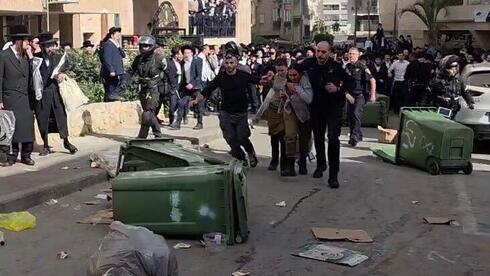
On Sunday afternoon, images emerged from Bnei Brak that sent shockwaves throughout the Torah world and beyond. Two female IDF soldiers—who, according to multiple reports, were not military police at all, but commanders from the Education and Youth Corps making a routine home visit to one of their soldiers—were surrounded by a mob of over a thousand people on Chagai Street. They were chased, screamed at, and called “Nazis.” Attempts were made to physically assault them. Police had to rush in to extract them from the crowd. During the ensuing mayhem, rioters overturned a police patrol car and set a police motorcycle ablaze. Tefillin and a siddur that had been inside the motorcycle were found charred in the wreckage.
Let us be clear and unequivocal: What happened in Bnei Brak was a horrifying chillul Hashem—a desecration of G-d’s Name of staggering proportions. It is a chillul Hashem that reverberates across multiple categories identified by the Rishonim and by Chazal, and it demands unqualified condemnation.
What the Torah and Chazal Tell Us
The Torah commands every Jew: “Lo sechalalu es shaim kodshi”—“You shall not desecrate My holy Name” (VaYikra 22:32). The Rambam (Yesodei Torah 5:4) explains that chillul Hashem is the very opposite of Kiddush Hashem. The SMAG (#2) and SMaK (#85) rule that when a Jew’s actions cause gentiles to say, “The Jews have no Torah”—this constitutes chillul Hashem. When the world watches footage of a Jewish mob chasing two young women down a street, overturning police vehicles, and setting motorcycles on fire—what do they say? What conclusions do they draw about the Torah and those who study it?
The Gemara in Yuma (86a) teaches that when a talmid chacham behaves in a manner that causes people to talk negatively—even if the behavior is not technically a sin—it is a chillul Hashem. How much more so when the behavior involves actual violence, destruction of property, and terrorizing young women? Rav Yochanan teaches us that in the realm of chillul Hashem, “perception is reality.” It does not matter what the rioters believed their cause to be. The world perceived Jews in religious garb attacking female soldiers and burning police property. That perception is now seared into the global consciousness.
Furthermore, anyone who sins and causes others to sin—choteh umachti es harabbim—is actively being mechalel shaim Hashem (Rashi, Yuma 86a). The rioters did not act in isolation. Their frenzy drew in others, amplified the desecration, and made the broader Chareidi community a target of vilification—precisely the opposite of what the Torah demands of us.
Gedolei Yisroel Have Spoken
HaGaon HaRav Yitzchak Yosef, the former Rishon L’Tzion, responded with extraordinary sharpness. He declared that the rioters are guilty of chillul Hashem and invoked the pasuk, “Deracheha darchei no’am v’chol nesivoseha shalom”—the Torah’s ways are ways of pleasantness and all its paths are peace. Rav Yosef ruled that the rioters “must be denounced and expelled from the camp.” Rabbis Dov Lando and Moshe Hillel Hirsch also both forbade Yeshiva students from protesting.
While the Satmar Rebbe zt”l, as well as numerous Gedolim in Eretz Yisroel, understood the idea of protest as Kiddush Hashem (VaYoel Moshe Shalosh Shavuos Siman 113-114), as did the Brisker Rav zt”l, there were two indisputable Gedolei HaDor who did not share this view: Rav Moshe Feinstein zt”l and Rav Aharon Kotler zt”l. They were deeply attuned to the possible repercussion of Chillul Hashem. But even the Satmar Rebbe would have been horrified by this. This has been told to me by the biggest Chassidim of the Satmar Rebbe zt”l.
In the 5748 edition of HaPardes Volume III page 9, the views of Rav Aharon Kotler zt”l and Rav Moshe Feinstein zt”l are cited regarding the idea of protests. The American Moetzes Gedolei Torah at the time felt that protests were highly counter-productive. Instead, they opted for the time-tested method of shtadlanus. This method has been used effectively for centuries.
In the 5753 edition of HaPardes (Vol. IV p. 25), Rav Moshe Feinstein zt”l also came out strongly against the idea of protests regarding atrocities done to graves by archaeologists, and instructed the Agudas HaRabbonim to send a strongly worded telegram to then PM Yitzchok Rabin. He also stated that strong condemnations should be made from each shul.
In light of these tragedies—these unmistakable directional signals—perhaps it is time to heed the clear guidance of these towering Gedolim. Rav Moshe and Rav Aharon were universally acknowledged as the preeminent Poskim and leaders of their generation. Their view that shtadlanus is the proper path, rather than public protests that risk Chillul Hashem and endanger lives, deserves our most serious consideration.
Rav Eliezer Menachem Shach zt”l was also aware of some of the repercussions and extreme measures that protestors take. He spent time and effort clarifying to his followers that at all times protestors must act with the utmost derech eretz—like true Bnei Torah.
Shas chairman Aryeh Deri likewise condemned the violence unequivocally, stating that these acts “are completely contrary to the path of the Torah, harm the broader Chareidi tzibbur, cause a chillul Hashem, and inflict serious damage on the just struggle on behalf of the olam haTorah.” His message was pointed: “Leave our camp!”
These are not the words of secular politicians or anti-religious commentators. These are Torah leaders and representatives of the Chareidi world itself, recognizing the enormity of what occurred.
The IDF Has Not Been Blameless
In the interest of fairness, it must be acknowledged that the IDF’s treatment of Chareidi soldiers has, at times, been nothing short of disgraceful. This context does not justify what happened in Bnei Brak—nothing could—but it explains the depth of frustration simmering within the community.
Just recently, Channel 14 reported a deeply disturbing series of incidents involving Chareidi recruits serving in a designated religious track within the IDF. According to multiple testimonies from the soldiers themselves, their commanders subjected them to a pattern of deliberate humiliation designed to degrade their religious identity and personal dignity.
Following a seven-kilometer fitness run approximately two weeks prior to the report, the commanders accused the recruits of not having performed the run to standard. As punishment, they ordered the Chareidi soldiers to strip down to their underwear and lie on their backs on their beds inside the tent. For young men raised in a culture of tzni’us, where modesty is a deeply held Torah value, this was not merely a harsh military punishment—it was a calculated attack on their religious sensibilities. The recruits reported feeling profoundly degraded. Making matters worse, the commanders involved reportedly attempted to cover up the incident entirely.
In a separate incident, one of the commanders entered the shul on the base during Shacharis—during the morning prayers—and demanded that several soldiers stop davening and perform push-ups in the middle of tefillah. The sheer contempt embedded in this act is staggering. Entering a place of prayer and ordering soldiers to do physical exercises during their conversation with the Ribbono Shel Olam is not a matter of military discipline. It is an act of religious harassment, plain and simple.
Following these incidents, some of the recruits were summoned to a meeting with the base commander and a colonel, where they were informed that the command staff had been replaced and the offending commanders suspended. The IDF Spokesperson confirmed that the incident was immediately investigated and that the commander in question was disciplined by the head of the Personnel Directorate and removed from his position.
These abuses are real, they are painful, and they are unacceptable. The Chareidi community has every right to feel outraged by them. But—and this is the critical point—outrage must be channeled through Torah-appropriate means.
Peaceful Protest—Yes. Violence—Never.
There is nothing wrong with peaceful, dignified protest. The Torah world has a right—indeed, an obligation—to advocate for the protection of its young men in the military. Demonstrations that are orderly, respectful, and conducted with derech eretz can be a legitimate vehicle for making the community’s voice heard. Tefillah gatherings, public statements from Gedolim, political advocacy, and legal action are all appropriate responses to genuine grievances.
But the moment—the very moment—that a protest descends into violence, into the chasing and terrorizing of young women, into the destruction of property, into the burning of a motorcycle that contained tefillin and a siddur—at that moment, the protest has not merely crossed a line. It has become the problem. It has become a chillul Hashem that dwarfs whatever grievance it sought to address.
And when our own engage in such horrifyingly ugly behavior, any protests in the vicinity must stop immediately. To continue protesting while such acts are taking place is to become complicit in the chillul Hashem. Whenever it is possible to minimize a chillul Hashem, we are obligated to do so—this principle is found throughout the poskim (see, for example, Chasam Sofer, OC Vol. I #61). Continuing to demonstrate while fellow Jews are overturning police cars and setting fires does not minimize the chillul Hashem—it amplifies it beyond measure.
The Gemara (Kiddushin 40a) teaches: Ain makifin b’chillul Hashem—Hashem does not extend credit when it comes to chillul Hashem. The consequences are immediate. We cannot afford to let this continue.
A Call to the Torah Community
We live in an era when the eyes of the world are upon us. Every act of a visibly Jewish person is scrutinized, recorded, and broadcast globally within minutes. The Pri Megadim warns us that dishonesty can convert the very Torah a person has learned into an instrument of chillul Hashem. How much more does violence accomplish this terrible transformation?
The Chareidi community’s legitimate concerns about the draft, about the IDF’s treatment of religious soldiers, and about the preservation of the olam haTorah are deeply important. But they must be advanced through means that bring honor to Hashem’s Name, not shame. The path forward is the path described by Shlomo HaMelech: Deracheha darchei no’am v’chol nesivoseha shalom.
We must demand of ourselves a higher standard. We must hold our community accountable when that standard is violated. And we must ensure that the next time the world hears about the Jews of Bnei Brak, it is because of an act of extraordinary Kiddush Hashem—not because of images that make us weep with shame.
The author can be reached at [email protected]