
 Vos Iz Neias
For First Time Since 1967, Jerusalem’s Borders May Be Pushed Further North
JERUSALEM (VINnews) — A planning initiative which is being promoted in the community of Adam (Geva Binyamin) north of Jerusalem seemingly continues the policies being implemented by the government in recent years. However, although the plan is officially presented as an expansion of Adam, in practice it represents a move that extends the capital’s area beyond the 1967 lines for the first time since the Six-Day War. The implication is a de facto application of sovereignty and an enlargement of the city’s territory.
The plan includes the construction of hundreds of housing units on land that is detached from Adam’s existing neighborhoods and which currently has no direct access from the community. In the past, the possibility of building a bridge to connect the designated construction area to Adam was considered. However, the current design creates territorial continuity within Jerusalem’s boundaries and effectively expands the Neve Yaakov neighborhood, which currently numbers about 30,000 residents, northward towards the town of Adam. According to the plan, the project is intended for the charedi population.
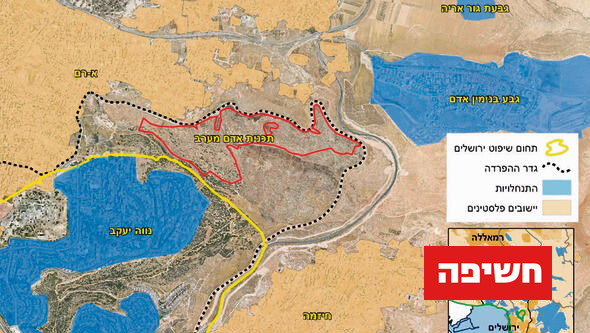
Connection between Neve Yaakov and the town of Adam (Geva Binyamin)
The planned transportation route also strengthens the connection to the city. The access road to the site begins in Neve Yaakov and returns to it, meaning that in practice this is a move that enlarges Jerusalem’s municipal jurisdiction. A step of this kind has not been carried out since 1967, when the city’s borders were expanded following the war.
The plan is being advanced via the “Judea and Samaria track,” a more efficient and faster procedure, particularly after the organizational changes implemented by Smotrich in the Civil Administration with the establishment of the Settlement Administration. These structural changes created a mechanism that significantly shortens planning processes.
According to assessments, and in line with the administrative reality shaped in recent years, the plan is expected to be implemented within a few years. Smotrich has altered the government’s working patterns in construction planning in Judea and Samaria, replacing lengthy bureaucratic procedures with accelerated approval tracks that speed up the authorization and implementation of new projects.