
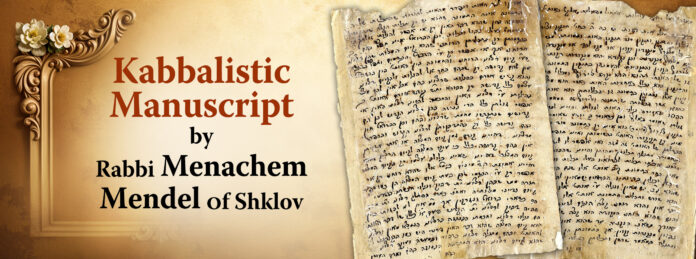

The Remarkable Life of Rabbi Menachem Mendel of Shklov zt”l
By Rabbi Yair Hoffman
The 30th of Shevat—Rosh Chodesh Adar—marks the yahrtzeit of one of the most consequential figures in modern Jewish history: Rabbi Menachem Mendel of Shklov (c. 1740–1827). This year, 5787, marks 199 years since his passing. Yet despite the passage of nearly two centuries, the seeds he planted continue to bear fruit in ways that are visible every time one walks through the streets of Yerushalayim.
Who was this remarkable man? A devoted talmid of the Vilna Gaon, a profound master of Kabbalah, a tireless communal leader, and a man of extraordinary courage—he accomplished what many considered impossible. After Ashkenazi Jews had been forcibly expelled from Yerushalayim and barred from returning for nearly a century, it was Rav Menachem Mendel who re-established the Ashkenazi community in the Holy City. An Anglican clergyman from Ireland named W. B. Lewis who visited Eretz Yisroel in 1824 described him as “the most learned Jew in all of Syria.” His story deserves to be far better known than it is.
The City of Shklov and Its Golden Era
To understand Rav Menachem Mendel, one must first understand the world from which he emerged. Shklov sits on the banks of the Dnieper River—Europe’s fourth-longest waterway—in what is today the Mogilev region of Belarus, approximately twenty miles north of Mogilev and over a hundred miles east-northeast of Minsk. In Rav Menachem Mendel’s day, the stretch of the Dnieper running past Shklov flowed between raised, sometimes steep banks overgrown with dense forests, with the river itself ranging from several hundred to over a thousand feet wide. Its position on a major trade route linking Russia with Western Europe made Shklov a natural commercial hub.
This was no ordinary shtetl. For centuries, Shklov had been part of the Polish-Lithuanian Commonwealth, and Jews had received a charter to settle there as early as 1668. With the first partition of Poland in 1772, Shklov was annexed by the Russian Empire—and this change proved to be an unexpected boon. During its subsequent “Golden Era”—roughly from 1772 until the Napoleonic invasion of 1812—Shklov became a thriving economic and cultural center. A visiting diplomat in 1699 had noted that Jews were “the richest and most influential class of people in the city.” By the late 1790s, approximately 2,500 Jews lived in Shklov, constituting around 80% of the local population.
The city boasted a renowned yeshiva established by Rav Binyamin Rivlin (1728–1812), a close disciple and associate of the Vilna Gaon, who trained a generation of scholars devoted to the Gaon’s approach to Torah study. In 1783, the first Jewish printing house in all of Belarus was established in Shklov, and the town soon became the largest center of Hebrew printing in Eastern Europe. Prominent Jewish merchants, including the political leader Nosson Nota Notkin and the great patron of scholarship Yehoshua Zeitlin, called Shklov home. It was a place where Torah scholarship and worldly engagement coexisted, where the intellectual vigor of the Lithuanian Misnagdic tradition was at its zenith. Indeed, in early 1772, Shklov was the first community in Eastern Europe to officially pronounce the followers of Chassidism as heretics.
Family and Early Life
Menachem Mendel Ashkenazi was born around 1740 in Shklov. His father, Rav Baruch Bendet, served as a maggid (itinerant preacher) in the towns of Losek (Lyaskavichi) and Nesvizh. The family traced its lineage to Rav Yehudah Yeidel, the Av Beis Din of Kovali and author of the Kol Yehudah, who recorded a family genealogy tracing back to Rebbi Yehudah HaNasi. From his earliest years, Menachem Mendel displayed extraordinary devotion to Torah learning, and it was this quality that would eventually bring him into the orbit of the greatest Torah luminary of the age.
At the Feet of the Vilna Gaon
The Vilna Gaon, Rav Eliyahu ben Shlomo Zalman (1720–1797), is universally acknowledged as one of the towering figures of Jewish intellectual history. He mastered every area of Torah—Talmud, Halachah, Kabbalah, grammar, mathematics, and the natural sciences—and his influence on the world of the Lithuanian yeshiva endures to this day.
The Gaon kept only a small circle of close disciples. He slept very little and spent virtually every waking moment immersed in Torah study. To be admitted into his inner circle was a rare privilege. The Gaon’s own sons wrote that in his later years, two brothers from Shklov—Rav Binyamin and Rav Menachem Mendel—drew especially close to him. Rav Menachem Mendel served the Gaon during what he described as “two years less a third”—approximately twenty months—together with his older brother Rav Simcha Bunim.
The Gaon cherished Rav Menachem Mendel greatly and revealed to him the innermost secrets of his heart, including many teachings of Kabbalah. The Gaon studied with him Mishnayos of the entire Seder Taharos, as well as Sefer Mishlei (Proverbs) with his own explanations. Rav Menachem Mendel wrote down everything he learned from the Gaon, and the Gaon was pleased with the precision of his writing.
Rav Menachem Mendel’s own description of his time with the Gaon is breathtaking in its intensity. He wrote in the introduction to one of his Kabbalistic works: “I served my Rebbe with all my strength. In those two-years-less-a-third, I did not move away from him day or night. Wherever he went, I went, and wherever he lodged, I lodged too.” He continues that it was only the Gra’s merit that enabled him to go up to Eretz Yisroel, where he lived first in Tzfas and then in Yerushalayim.
In his introduction to the Gaon’s commentary on Mishlei, Rav Menachem Mendel wrote with breathtaking reverence: “And if a man were to live a thousand years, he would not be able to reach the edge of the greatness of the Gra.”
The Gaon chose Rav Menachem Mendel as his scribe, entrusting him with committing his chiddushim to writing. Rav Menachem Mendel also meticulously recorded many of the Gaon’s personal practices and customs. Notably, he sat together with the Gaon on the Seder night and afterward wrote down all the divrei Torah he had heard, eventually producing the Haggadah Shel Pesach with the Gaon’s commentaries. He also recorded in painstaking detail the Gaon’s complete order of the Seder night.
Rav Menachem Mendel later recounted a remarkable scene from the Gaon’s final period. The Gaon was nearing the completion of his commentary on Shir HaShirim. Together with his son and Rav Menachem Mendel, he entered a secluded room and instructed them to close the windows and shutters. After lighting many candles in honor of the Torah, the Gaon dictated his last chiddushim while Rav Menachem Mendel sat and wrote them down. Then, raising his eyes heavenward, the Gaon thanked HaKadosh Boruch Hu for enabling him to reach the light of the entire Torah in its entirety. The Gaon immediately warned the others present not to disclose this “slip of the tongue” to anyone—the Gaon had not intended to reveal the extent of his attainment. It was only after the Gaon’s passing in 1797 that Rav Menachem Mendel shared this account with his friend, Rav Yisroel of Shklov, who published it in the introduction to his Pe’as HaShulchan.
Preserving the Gaon’s Legacy in Print
After the Gaon’s passing in 5558 (1797), Rav Menachem Mendel threw himself into a sacred task: arranging, editing, and publishing the Gaon’s writings. Working alongside the Gaon’s sons, he labored for approximately nine years, producing a remarkable series of publications. The Hebrew Wikipedia article on Rav Menachem Mendel provides us with the precise chronology:
The very first work published was the Gaon’s commentary on Mishlei (Proverbs), printed in Shklov in the year of the Gaon’s death itself. In 5561 (1801), they published the Gaon’s annotations on Seder Olam Rabbah and Seder Olam Zuta. In 5562 (1802), Rav Menachem Mendel published the Gaon’s Tzuras Ha’Aretz and Tavnis HaBayis. In 5563 (1803), they published the Gaon’s commentary on Shulchan Aruch, Orach Chaim, which Rav Yisroel of Shklov had arranged. In 5564 (1804), Rav Menachem Mendel published the Gaon’s commentary on Pirkei Avos and the other minor tractates, preceded by an introduction from Rav Menachem Mendel himself, recounting the wondrous qualities of the Gaon.
After the printing house in Shklov closed, Rav Menachem Mendel moved to Horodna (Grodno), where he continued his work. In 5565 (1805), he published the Haggadah Shel Pesach with the Gaon’s divrei Torah and minhagim. In 5566 (1806), he published the Gaon’s commentary on Sefer Yetzirah and his commentary on Shulchan Aruch, Yoreh De’ah.
The sefer Mishlei with the Gaon’s commentary, acclaimed and accepted by Jewry worldwide, was written solely by Rav Menachem Mendel. However, he honestly noted that not all the explanations were the Gaon’s exact words: “There are some things that I understood from the Gaon’s hints, and after writing them, I asked if I had expressed his opinion, and he nodded his head to me.” This candid admission reflects both his intellectual honesty and his intimate access to the Gaon’s mind.
The Perilous Journey to Eretz Yisroel
The Vilna Gaon himself had yearned deeply to settle in Eretz Yisroel. He attempted the journey at least once but was forced to turn back—some say he made it as far as Odessa before the voyage proved impossible. Though the Gaon never fulfilled this dream, he planted within his disciples an unquenchable desire to do so.
In 5568 (1808), the Gaon’s disciples were inspired to make the journey. Known as the Perushim—from the Hebrew word meaning “to separate,” reflecting their desire to separate from the spiritual impurities of European society—they organized into what they called Chazon Tzion (“Vision of Zion”), based on three core principles: rebuilding Yerushalayim as the acknowledged Torah center of the world, aiding and speeding the ingathering of the exiles, and expanding Jewish settlement throughout the Land of Israel.
Rav Menachem Mendel led the first wave. The subsequent two groups arrived in 1809, led respectively by Rav Sa’adya ben Rav Nosson Nota of Vilna and Rav Yisroel of Shklov. In total, approximately 500 men, women, and children made the journey.
The journey was harrowing. The year was 1808—Europe was convulsed by the Napoleonic Wars. Napoleon had recently defeated Prussia and was tightening his grip on the continent through the Continental System; the French Emperor’s eventual invasion of Russia in 1812 would devastate the very regions these emigrants were leaving behind, including Shklov itself, which was pillaged by Napoleon’s army. The travelers set out from Shklov on foot and by horse and wagon, heading south and west to Constantinople (modern-day Istanbul), the glittering capital of the Ottoman Empire, which at the time controlled the entire eastern Mediterranean, including Eretz Yisroel. From Constantinople they sailed across the Mediterranean to the port of Akko (Acre), a fortified coastal city on the northwest shore of Eretz Yisroel that had withstood Napoleon’s siege just nine years earlier in 1799. The entire odyssey took approximately fifteen months, and the travelers endured terrible hardships, including intermittent starvation.
Settling in Teveryah and Tzfas
Upon arriving in Eretz Yisroel, Rav Menachem Mendel and the Perushim first reached Teveryah (Tiberias), situated on the western shore of the Kinneret (Sea of Galilee), some 700 feet below sea level—one of the lowest inhabited places on earth. At the time, all of Eretz Yisroel was part of the Ottoman Empire, which had ruled the region since 1516. The land was divided administratively into several districts (sanjaqs) under the broader province governed from Damascus. Ottoman governance was often indirect and inefficient—local strongmen, tax collectors, and military governors wielded enormous power, and the Jewish communities were largely dependent on the goodwill—or at least the indifference—of local authorities. In Teveryah, Chassidim from an earlier aliyah were already residing. Disputes with the Chassidim prompted the Perushim to move on to Tzfas (Safed).
Tzfas was perched high in the Upper Galilee mountains, at an elevation of nearly 3,000 feet—a dramatic contrast to the subtropical heat of Teveryah far below. The city had been a renowned center of Kabbalistic study since the sixteenth century, when the Arizal, Rav Yosef Karo, and other great sages had made it the spiritual capital of the Jewish world. By 1808, however, the glory days of the mekubalim were long past, and the Jewish community—numbering several thousand Sephardim and a smaller contingent of Chassidim—lived in difficult circumstances under Ottoman rule.
Many of the Perushim had wished to settle in Yerushalayim—the holiest city—but this was effectively impossible. Under Ottoman rule, Yerushalayim held a special status. The Ottomans recognized the city’s profound religious significance to Muslims, Christians, and Jews alike, and managed an intricate system of privileges and access rights to the various holy sites. But the city’s governors exercised considerable arbitrary power, and the dhimmi status of Jews and Christians made them vulnerable to exploitation. Since 1720, Ashkenazi Jews had been specifically banned from living there. The reason: nearly a century earlier, a group of approximately 500 Ashkenazi Jews led by Rav Yehudah HaChassid had arrived in Yerushalayim. Days after their arrival, Rav Yehudah HaChassid died, and his followers, leaderless and impoverished, fell deeply into debt to local Arab creditors. In 1720, the creditors set fire to the Ashkenazi synagogue (which became known as the “Hurva”—the “Ruin”), expelled the Ashkenazim, and forbade them from returning. For nearly a hundred years, any Ashkenazi Jew who dared enter Yerushalayim risked imprisonment as a guarantor for these ancient debts. The few Ashkenazim who managed to remain survived only by disguising themselves in Sephardic dress.
In Tzfas, Rav Menachem Mendel established battei midrash for Torah study and tefillah and quickly assumed leadership of the Ashkenazi-Perushim community, which numbered around 150 persons. Beyond the spiritual work, he also stood at the forefront of efforts to secure the physical welfare of the immigrants, working tirelessly to obtain funding from abroad and various forms of relief.
From Tzfas, he maintained a steady correspondence with Rav Yisroel of Shklov, urging him to act on behalf of the community’s economic consolidation and encouraging him to make aliyah himself.
Life in Tzfas, however, was far from peaceful. The philosophical and halachic conflicts with the Chassidic community created significant tension. As a result, Rav Menachem Mendel drew closer to the Sephardi Rabbanim and their beis midrash, a diplomatic move that would serve him well in his later efforts in Yerushalayim.
Plague, Devastating Debt, and the Decision to Go to Yerushalayim
In 5573 (1813), a devastating plague swept through Tzfas, killing many of the Gaon’s disciples. The catastrophe plunged the community into enormous financial debt, and Rav Menachem Mendel was forced to borrow staggering sums at high interest from non-Jewish lenders to keep the community afloat.
The plague, which ultimately claimed the lives of approximately 80% of Tzfas’s Jewish community, prompted a fateful decision. In 5576 (1816), Rav Menachem Mendel uprooted from Tzfas and went up to Yerushalayim—a journey of roughly ninety miles southward through the mountainous spine of the country, from the cool heights of the Upper Galilee, past the fertile Jezreel Valley, through the rolling hills of the Shomron (Samaria), and up into the Judean highlands. This move was driven by his deep yearning to dwell in Tzion—and it was made against the wishes of Rav Yisroel of Shklov, who was also a leader of the Tzfas community and felt the move was premature.
Joining Rav Menachem Mendel was his close associate, Rav Avraham Shlomo Zalman Tzoref, who would later play a heroic role in the struggle to rebuild the Hurva. The Yerushalayim they entered was a small, walled city enclosed within the Ottoman-era fortifications rebuilt by Suleiman the Magnificent in the sixteenth century. Perched in the Judean hills at an elevation of approximately 2,500 feet, the city’s total population was perhaps 10,000 to 12,000—mostly Muslims, with a substantial Christian minority and a smaller Jewish community that was overwhelmingly Sephardic. Local governance was notoriously corrupt, with Ottoman officials extracting heavy taxes and arbitrary fees from vulnerable non-Muslim communities. Within a few months, the new Ashkenazi community numbered approximately twenty souls, most of whom had come from the Perushim community of Tzfas.
Rebuilding the Ashkenazi Community of Yerushalayim
Rav Menachem Mendel was the first person to re-establish the Ashkenazi community in Yerushalayim after the disastrous expulsion following the debts of Rav Yehudah HaChassid’s followers. Through his good connections with various Christian figures, he succeeded in reaching an arrangement regarding the old debt, and from that point on, Ashkenazi settlement in Yerushalayim was permitted.
The diplomatic achievement was remarkable. Rav Menachem Mendel’s men sent representatives all the way to Istanbul—the seat of the Ottoman Sublime Porte, over a thousand miles from Yerushalayim—to negotiate directly with the imperial authorities. The Ottoman bureaucracy was labyrinthine, and navigating it required patience, connections, and no small amount of funds for the inevitable bribes and fees. After approximately five years of sustained effort, they succeeded in securing a royal decree (firman) annulling the debts owed by the previous—entirely unrelated—Ashkenazi community from a century earlier. They then obtained additional legal documents from local and international Islamic and civil authorities recognizing them as the lawful heirs to the property rights of the abandoned Ashkenazi compound.
Initially, the community rented the courtyard that had housed the yeshiva of Rav Chaim ben Attar, the Ohr HaChaim HaKadosh, where they davened on weekdays. They did not yet have permission to daven there on Shabbosos and Yomim Tovim, and so they davened in a corridor between the four Sephardi synagogues, near the Beis HaKnesses HaRamban.
Between the years 5580–5584 (1820–1824), Rav Menachem Mendel worked intensively, together with Rav Avraham Shlomo Zalman Tzoref, to obtain legal recognition of Ashkenazi ownership over the site of the Hurva synagogue. When their efforts were crowned with success, they built their beis midrash there.
Rav Menachem Mendel’s warm relations with Sephardi leaders proved invaluable throughout this process. The Rishon L’Tzion, Rav Shlomo Moshe Suzin, aided him significantly—and the Sephardi leaders, who maintained good relations with the Muslim authorities, interceded on behalf of the Ashkenazim. These alliances reflected genuine mutual respect that transcended communal boundaries.
The Hardships of the Holy City
The physical conditions were harrowing. A Christian traveler who visited Yerushalayim during this period left a vivid account in his diary. He first expressed admiration for Rav Menachem Mendel’s extraordinary love and fear of Hashem, noting that there was none like him in Torah greatness in the entire world. He then addressed his readers directly: “I would like my readers to know, and perhaps have an insight, of the troubles that befall the Jews of Jerusalem.”
He then described a terrifying episode: One night, as Rav Menachem Mendel was preparing for sleep, he was startled by harsh pounding at his door. Before he could reach it, the door splintered and armed soldiers of the Arab militia burst in, sabers drawn. They seized him by his beard, dragged him outside, and threw him and several family members into prison.
The terrified captives were told that if ten gold kissim (coins) were not paid as ransom, they would be tortured—their captors threatened to press hot iron rods to their heads and screw sharp nails into their palms.
The anguished Jews of Yerushalayim gathered what little they had. After much haggling, the ransom was reduced to four and a half kissim of gold—but even this was difficult to raise. The community sold almost all their personal belongings to secure the release of their beloved leader. The gentile writer concluded: “Perhaps now you’ll have an idea of the suffering endured by those European Jews who leave house and home to live in the holy city of Jerusalem. They immediately became prey to the wild beasts around them.”
Remarkably, even after such harrowing experiences, Rav Menachem Mendel was neither dispirited nor dejected. On the contrary, he continued to encourage other talmidei chachamim—disciples of the Vilna Gaon who yearned to learn Torah in the Holy Land—to leave Europe and make the journey, assuring them it was worthwhile despite the hardships.
A Master of the Hidden Torah
Rav Menachem Mendel was not only a communal leader and activist; he was a profound mekubal (Kabbalist) in his own right. According to Rav Yisroel of Shklov, Rav Menachem Mendel composed approximately ten deep works of Kabbalistic scholarship while living in Eretz Yisroel. His approach to Kabbalah combined the teachings of the Arizal with the Kabbalistic traditions he had received directly from the Gaon, and his writings are characterized by abundant gematrios, in a style reminiscent of Rav Avraham Abulafia. As a result, his works are written in a cryptic, enigmatic style that requires considerable effort to decipher.
Remarkably, the Gaon continued to appear to Rav Menachem Mendel in dreams after his passing, and divrei Torah communicated in these dreams were incorporated into his seforim.
His most celebrated work is Mayim Adirim, a commentary on the Idra Zuta (a section of the Zohar), which also includes a Kabbalistic commentary on Megillas Rus. First printed in Premishla in 5645 (1885), it became immediately renowned among mekubalim of all backgrounds. According to the mekubal Rav Shmuel Landau of Sandova, one of the greatest of the Belzer Chassidim, the Divrei Chaim of Sanz kept the sefer in constant use on his table for several years—without even knowing who its author was, but cherishing it and using it continually. Fascinatingly, the sefer was also published under the name Menachem Tzion, attributed to Rav Menachem Mendel of Vitebsk. The sons of Rav Chaim Halberstam of Sanz testified in their haskamah that their father kept this sefer constantly on his table, thinking it was indeed by the Rav of Vitebsk. The demand for the work was so great that it was printed twice in a single year, in both Vilna and Galicia.
His other works include: Derech HaKodesh (on Sefer Bris Menuchah); Raza D’Meheimnusa, a spiritual autobiography; a commentary on Mishnas Chassidim; Drushim Al Seder HaHishtalshelus, on the Kabbalistic order of Creation; a commentary on sections of the Zohar; Tmunas Ha’Osiyos, Kabbalistic explanations of the Hebrew letters; Sefer HaPli’ah; and Sefer HaTzimtzum. Six of these works were published in two volumes under the title Kisvei HaGRMa”M z”l in Yerushalayim in 5761 (2001), based on a manuscript that was discovered in a storage room in the Meah Shearim neighborhood after having been thought lost. The publication was prepared by HaRav Shmuel Aryeh Stern of Yerushalayim.
The Gaon’s Approach to Kabbalah and Pshat
Rav Menachem Mendel articulated a foundational principle of the Gaon’s approach: he wrote in his commentary on the Gaon’s explanation of Mishlei that as long as a person does not know the sod—the Kabbalistic meaning of a passage—he cannot fully understand the pshat, its literal sense. Only once he has learned the sod can he then truly understand the pshat. He added that the Gaon himself confirmed he never explained a single pasuk in Tanach until he had first understood its meaning according to Kabbalah. Similarly, Rav Yisroel of Shklov reported in the introduction to his Taklin Chadtin that he heard from Rav Menachem Mendel that every chiddush the Gaon developed on Mishnayos Seder Taharos was formulated only after he had understood the subject through the prism of Kabbalah.
Extraordinary Revelations from the Gaon
Rav Menachem Mendel preserved several extraordinary accounts of the Gaon’s greatness. He related that the Gaon once told him that if the heretical philosopher Aristotle were to come before him, the Gaon could bring down the sun, moon, and planets onto his table and prove that it is Hashem who rules and directs the celestial bodies—not impersonal forces of nature running their own course. The Gaon added that Shimon HaTzaddik, who had lived in Aristotle’s era, could have done the same but never had the opportunity, as the philosopher had no intention of listening.
Rav Menachem Mendel was shocked into awed silence. But the Gaon reassured him: “What’s the great wonder? With the mention of one of the holy Sheimos, I would be able to carry this out.” The very fact that the Gaon shared such things with Rav Menachem Mendel speaks volumes about the stature the Gaon attributed to his devoted talmid.
What Motivated the Aliyah?
The question of what truly motivated Rav Menachem Mendel and the Perushim has been the subject of significant scholarly debate. Dr. Arie Morgenstern has argued that the aliyah had messianic motivations—that Rav Menachem Mendel viewed the immigration as an action to be carried out in conjunction with various Kabbalistic intentions he had developed based on the Gaon’s teachings, in order to hasten the Geulah. Some sources suggest he viewed the rebuilding of the Hurva as having Kabbalistic significance—a tikkun that would contribute to the rebuilding of the entire city and pave the way for the ultimate redemption.
Other scholars, most notably Professor Yisrael Bartal, disagree, arguing that messianic considerations did not play a role in the motivations for the aliyah. Professor Immanuel Etkes has similarly noted that Rav Menachem Mendel’s own autobiographical testimony is devoid of explicit messianic language, emphasizing instead the establishment of centers for Torah learning in the Holy Land.
What is beyond dispute is that Rav Menachem Mendel’s vision was rooted in the Gaon’s own deep yearning for Eretz Yisroel and his teaching about the centrality of Torah study in the Holy Land. In his own words, Rav Menachem Mendel sought to establish Torah learning in the Land which “had been taken over by foreigners and gentiles.”
His Passing and Enduring Legacy
Rav Menachem Mendel of Shklov passed away on the 30th of Shevat, 5587 (February 27, 1827) in Yerushalayim. He was buried on Har HaZeisim (the Mount of Olives), near the grave of the Ohr HaChaim HaKadosh—the very man in whose yeshiva courtyard Rav Menachem Mendel had first established his community in Yerushalayim. The proximity of these two great souls in their final resting place seems deeply fitting.
Among his greatest students were Rav Yitzchak Aizik Chaver and Rav Shmuel Mo’ed. The poetess Chaya Levy is counted among his descendants.
After his death, his son Rav Nosson Nota succeeded him as leader of the Perushim congregation in Yerushalayim. Rav Nosson Nota had immigrated with the first wave of the Gaon’s students, and he continued his father’s work—though he faced his own share of difficulties, including slander and disputes over funding for the rebuilding of the Hurva.
The small synagogue built on the Hurva site by 1837—named Menachem Tzion in Rav Menachem Mendel’s memory, and also evoking the brachah “Baruch Atah Hashem, Menachem Tzion U’voneh Yerushalayim” according to Nusach HaGra—eventually grew into the magnificent Hurva Synagogue. In 1831, Muhammad Ali Pasha of Egypt conquered Palestine and Syria from the Ottomans, and under Egyptian rule the Ashkenazim gained further concessions. With the support of the Russian and Austrian consuls, and after raising funds, construction of a more substantial synagogue began. When the Ottoman Turks regained control of the region in 1840, they did not alter the status quo, and the Ashkenazi presence continued to grow—especially after a devastating earthquake destroyed Tzfas in 1837, killing some 4,000 members of its Jewish community and sending many refugees southward to Yerushalayim. The Hurva eventually became the most important Ashkenazi synagogue in all of Eretz Yisroel. By 1857, the Perushim community in Yerushalayim had grown to 750 people.
In a broader sense, the Perushim laid the foundations for much of the dramatic renewal and expansion of Jewish life in Yerushalayim that continues to this day. They spread the teachings of the Vilna Gaon, established kollelim, were instrumental in building the first neighborhoods outside the Old City walls—including Nachalas Shivah and Mishkenot Sha’ananim—and eventually founded the great neighborhood of Meah Shearim. Dr. Arie Morgenstern has argued that their settling in Yerushalayim in 1816 ensured that by 1860 there was a Jewish majority in the Holy City—a majority that has been maintained continuously to the present day.
Remarkably, Israeli President Reuven Rivlin was among the notable descendants of these early pioneers—his ancestors were part of the Rivlin family that played a central role in the Perushim movement from its very inception in Shklov.
Conclusion
As we approach the 199th yahrtzeit of Rav Menachem Mendel of Shklov, his story speaks to us with remarkable power. He absorbed the Gaon’s teachings, preserved them for posterity, and then carried them across continents to plant them in the rocky soil of Ottoman Yerushalayim. He endured plague, persecution, imprisonment, and poverty. He navigated complex relationships with Chassidim, Sephardim, Ottoman officials, and local populations. He mastered the deepest levels of Kabbalistic wisdom while simultaneously engaging in the most practical matters of communal governance and international diplomacy.
And through it all, he never lost sight of the mission the Gaon had entrusted to his generation: the rebuilding of Torah life in the Holy Land, and the renewal of the Jewish presence in its eternal capital.
Today, when hundreds of thousands of Jews live and study Torah in Yerushalayim, it is worth remembering that this reality can be traced back, in no small measure, to a handful of determined souls led by a quiet mekubal from a small city in White Russia—a man who held onto his Rebbe’s hand and never let go.
■
The author can be reached at [email protected]