
 Vos Iz Neias
Prediction Market Points to Late-March Window for Possible Iran Strike, Diverging From Israeli Ex-spy Chief’s Warning
WASHINGTON (VINnews) — A leading online prediction market is signaling that traders see a potential military strike on Iran as more likely later next month rather than in the coming days, diverging from a public warning by former Israeli intelligence chief Amos Yadlin.
Yadlin, a retired major general who once headed Israel’s Military Intelligence Directorate, said in a television interview Wednesday that he would reconsider plans to fly abroad over the weekend because of heightened regional tensions. His remarks fueled speculation in Israel that a significant development could be imminent.
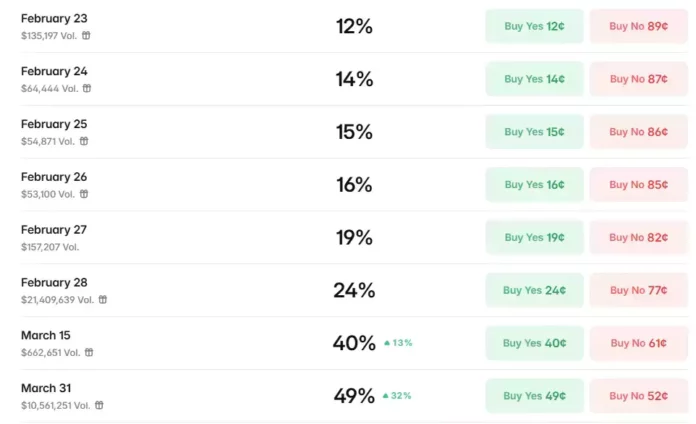
But data from Polymarket, a cryptocurrency-based forecasting platform, suggests traders are not pricing in an immediate strike. Instead, the highest concentration of bets has centered on the possibility of military action occurring by the end of March.
As of Wednesday, contracts tied to a strike by March 31 showed sharply increased trading activity and rising implied odds, while markets tied to earlier dates reflected lower probabilities. On prediction platforms, prices fluctuate based on how much participants are willing to wager on a given outcome, often serving as a real-time gauge of collective expectations.
Prediction markets do not guarantee outcomes and can shift quickly in response to new information. Still, they are closely watched by analysts for signals about how informed traders assess geopolitical risks.
Neither U.S. nor Israeli officials have publicly indicated that military action against Iran is imminent. Diplomatic efforts and public messaging have continued alongside persistent tensions over Iran’s nuclear and regional activities.
The divergence between Yadlin’s caution and market pricing underscores the uncertainty surrounding the situation — and the difficulty of forecasting when or whether military escalation might occur.