
 Yeshiva World News
TINDERBOX: U.S. Assembles Massive Naval and Air Force Presence in Gulf as Tensions With Iran Rise
The United States is rapidly assembling one of its largest military concentrations in the Middle East in years, signaling that Washington is preparing for the possibility of major conflict as negotiations with Iran falter.
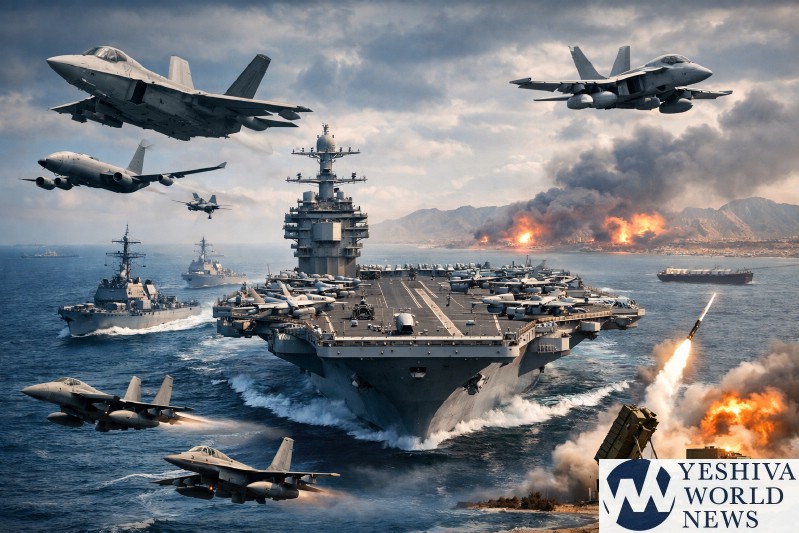
President Donald Trump has ordered the deployment of the USS Gerald R. Ford, the world’s largest and most advanced aircraft carrier, to the region, along with a sweeping array of fighter jets, refueling aircraft, and warships.
The nuclear-powered carrier and its strike group departed the Atlantic earlier this week and are heading toward the Mediterranean via the Strait of Gibraltar. Once in position, the Ford will join the USS Abraham Lincoln strike group already operating in the Middle East.
Together, the two carriers form the backbone of a growing American show of force aimed at deterring Tehran and preparing for possible military action.
The Ford is capable of carrying more than 75 aircraft, including F-35C stealth fighters, F/A-18 Super Hornets, and EA-18G Growler electronic warfare jets. It is escorted by three destroyers — USS Bainbridge, USS Mahan, and USS Winston Churchill — giving the carrier group substantial offensive and defensive firepower.
The buildup extends far beyond aircraft carriers.
U.S. officials and independent flight trackers report that more than 50 additional fighter jets were moved to the region this week, including F-16 Falcons, F-22 Raptors, and F-35 stealth aircraft. The Pentagon has also deployed a large fleet of aerial refueling tankers, allowing U.S. aircraft to conduct extended missions deep into Iranian territory.
The aircraft are being positioned across several regional bases, including facilities in Jordan, the United Arab Emirates, and Saudi Arabia.
In addition to the two carrier groups, the U.S. now has four destroyers operating in the Arabian Sea, three patrolling the Strait of Hormuz, one in the Red Sea, and two combat ships in the Persian Gulf. The expanded fleet gives Washington the ability to control key shipping lanes and provide missile defense for U.S. forces and regional allies.
The current posture would allow the U.S. to conduct sustained air operations, target hardened facilities, and defend American forces and partners against retaliation. Stealth aircraft could penetrate Iranian air defenses, while refueling tankers would enable long-range missions.
Iran has warned that any U.S. attack would trigger widespread retaliation, including against Israel. Tehran has also threatened American troops and allies and has recently conducted live missile drills near the Strait of Hormuz, a critical artery for global oil shipments.
(YWN World Headquarters – NYC)