
 Vos Iz Neias
Rabbi Avrohom Kalmanowitz zt”l on his Yahrtzeit: A Life of Torah, Leadership, and Rescue
By Rabbi Yair Hoffman
The FBI agents had come with a serious purpose. Rabbi Avrohom Kalmanowitz zt”l had been transferring money illegally into enemy-occupied territory — circumventing Treasury Department regulations, ignoring warnings, defying federal law. The agents confronted him. The evidence was plain. This was a criminal matter.
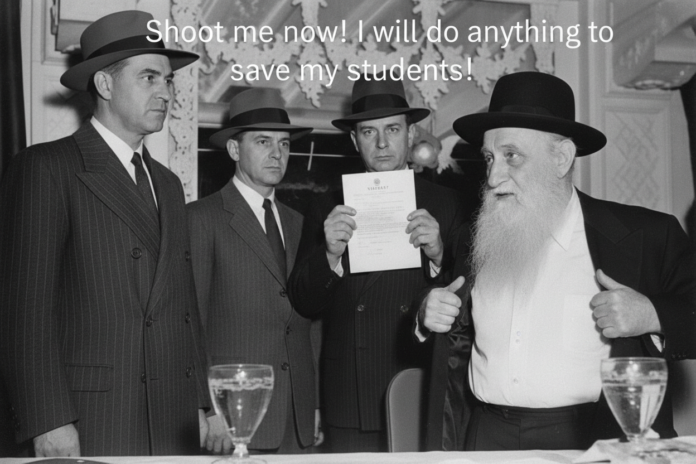
The Rabbi looked at them. Then, without a word, he opened his shirt, bared his chest, and said: “Shoot me now. These students are like my children. I would do anything to save them.”
The FBI agents walked away sheepishly. [The above photo is, of course, an illustration.]
It is difficult to imagine a more perfect introduction to the man. In that single gesture — the unbuttoned shirt, the absolute moral clarity — you have Rabbi Avrohom Kalmanowitz entire. He was neither reckless nor naive about consequences. He simply operated from a different set of calculations than the men who had come to question him. When Jewish lives were at stake, the laws of the United States government were not the highest authority in the room. The laws of the Torah were. And the Torah said: you do whatever it takes.
The agents left. Rabbi Kalmanowitz went back to transferring money. Rav Kalmanowitz zatzal was a true hero who saved the remnants of European gadlus in Torah, but he also had a fascinating character, as seen from the FBI interaction. More on that later.
His yahrtzeit falls on the 2nd of Adar — a date that invites reflection on a life that burned with the intensity of the month itself, a month associated with the reversal of decrees and the salvation of an entire people. His actions personified the triumph of mesiras nefesh over the cold machinery of destruction.
It is a fitting day for the yahrtzeit for a man who spent his greatest years fighting, just as Mordechai and Esther did, to reverse a decree of annihilation against his people — and who, unlike so many others, refused to let propriety, legality, or personal safety stand in his way.
Origins and Early Life: A Family of Torah
Rabbi Avrohom Kalmanowitz was born on March 8, 1887, in the shtetl of Delyatichi in the Minsk province of Belarus. His father, Rabbi Aharon Aryeh Leib Kalmanowitz, was himself a talmid chacham and rav of several Jewish communities — a man who exerted a major and lasting influence on his son’s formation and his understanding of what it meant to be a servant of Klal Yisrael.
From his earliest years, it was clear that Rav Avrohom was destined for greatness. He studied first at the Telshe yeshiva in Lithuania and then, at age sixteen, entered the yeshiva of Eishishok under Rav Zundel Hutner. It was at age eighteen that he made his way to the crown jewel of the mussar world — the yeshiva of Slabodka.
Formed in Slobodka: The Alter’s Influence
At Slabodka, under the towering influence of the Alter, Rav Nosson Tzvi Finkel, Rabbi Kalmanowitz was shaped in the deepest ways. The Alter recognized his student’s qualities from the outset and arranged something remarkable: he paired young Avrohom to learn b’chavrusa with his own son, Rav Moshe Finkel zt”l (grandfather of a remarkable Far Rockaway resident]. This was a singular honor, a statement of the Alter’s confidence in a student he believed capable of matching his own son’s level.
The Slabodka approach to mussar elevated the dignity and inner greatness of every human being — Gadlus HaAdam, the greatness of man. For the Alter, Torah was not merely an intellectual discipline but a pathway to becoming a person of complete humanity and responsibility for others. This philosophy became the animating force of Rabbi Kalmanowitz’s entire life. One can trace a direct line from the Alter’s teachings in Slabodka to the frenzied, boundary-crossing rescue activism that would define his greatest years.
He received rabbinic ordination from four of the era’s preeminent authorities: Rav Moshe Mordechai Epstein of Slabodka, Rav Raphael Shapiro of Volozhin, Rav Eliezer Rabinowitz of Minsk, and Rav Eliyahu Baruch Kamai of the Mir — a constellation of gedolim whose collective haskama spoke to the breadth and depth of his scholarship.
Marriage and Distinguished Yichus
In 1913, Rabbi Kalmanowitz married Rochel, granddaughter of the great Rav Betzalel HaKohen of Vilna. Rav Betzalel HaKohen was a distinguished dayan in the Vilna rabbinical court and the author of the Talmudic commentary Mareh Kohen, which appears in all printed editions of the Talmud. Rav Kohen’s teshuvos were reprinted a number of years ago. This author’s great-great grandfather, Rav Yaakov Kantor, was the chief shochet of Vilna and was very close with him. That Rabbi Kalmanowitz’s household was connected to this legacy of meticulous halachic scholarship added yet another dimension to a home that breathed Torah from every corner.
The Early Rabbinate: Rakov, World War I, and Arrested by the Bolsheviks
Rabbi Kalmanowitz’s first major rabbinic post was in Rakov, a town in the Grodno region with a vibrant Jewish community. Even in these early years, his instinct to mobilize for Jewish welfare manifested dramatically. When Rakov was flooded with thousands of refugees fleeing Russia with the outbreak of World War I, Kalmanowitz founded a rescue organization that furnished food and clothing.
His activism during the Bolshevik Revolution went further still, and at personal cost. During the Bolshevik Revolution, he aided Jews arrested by the Bolsheviks and was subsequently arrested and imprisoned in Minsk. This was not the last time he would court danger in the service of his fellow Jews, but it was an early and formative test of his courage. He emerged unbroken and only more determined.
Tiktin: Building Torah and Stopping a Pogrom
In 1929, Rabbi Kalmanowitz accepted the position of Rav and Av Beis Din of Tiktin — the historic Polish town of Tykocin, whose Jewish community traced its roots back centuries. He established a yeshiva in that town and was a member of the Moetzes Gedolei HaTorah of World Agudath Israel
To understand the world Rabbi Kalmanowitz inhabited in Tiktin, one must appreciate the political context of interwar Poland. The Jewish community lived in a precarious position — legally emancipated but socially embattled, existing within a Polish state simultaneously asserting its national identity and struggling with powerful currents of antisemitism. Economic boycotts of Jewish businesses were organized by nationalist movements. Pogroms and violent incidents occurred with disturbing regularity. American Jewish magazines actually sent people to Poland trying to figure out what could be done to battle the poverty and the horrifying level of anti-Semitism. The situation worsened markedly after the death of Marshal Józef Piłsudski in 1935, who had maintained a degree of restraint toward the Jewish minority. As authoritarian nationalist movements grew stronger across Europe, modeling themselves on fascist templates from Italy and Germany, and as the Nazi example demonstrated that organized state persecution of Jews was both possible and internationally tolerated, Polish antisemitism grew bolder and more violent.
It was into this environment that one remarkable episode stands out from Rabbi Kalmanowitz’s years in Tiktin. Local anti-Semitic elements organized and planned a pogrom against the Jewish community. Rabbi Kalmanowitz discovered the plot and intervened directly — stopping the pogrom before it could begin. But the instigators, thwarted and furious, slandered him to the local authorities, and Rabbi Kalmanowitz was ultimately forced to flee Tiktin for Bialystok. His own safety was the price he paid for protecting his community — a pattern that would repeat itself on a far larger stage.
One eyewitness, the author Chaim Shapiro zt”l, captured his presence in a memorable vignette about a fire that broke out one motzaei Shabbos. The Jewish firemen were half-asleep; the Polish firemen were half-drunk; wooden houses were at mortal risk. Then Rabbi Kalmanowitz appeared — still wearing his knee-high boots gleaming from their erev Shabbos polish, his velvet yarmulke tilted to one side, like a field marshal on a battlefield. He dismissed the fire chief and took personal charge. Pole and Jew alike obeyed his orders instantly. Amid the panic and confusion, the Rav stood out as a tower of calm stability and authority. It was the same commanding presence he would bring to the corridors of Washington just a few years later.
Agudas Yisrael, the Kollel, and the Vaad Hayeshivos
Beyond his role as a mara d’asra, Rabbi Kalmanowitz was a builder of Torah infrastructure on a national scale. He was a member of the Moetzes Gedolei HaTorah of World Agudath Israel and a leading figure in Agudas Yisrael of Poland — the great Orthodox political and communal movement that sought to represent Torah Jewry in the political arena. In the rough-and-tumble world of Polish Jewish politics, Agudas Yisrael operated alongside Zionist parties, the socialist Bund, and various other factions, each competing for representation in the Polish Sejm and in communal governing bodies. Rabbi Kalmanowitz navigated this complex landscape with both principle and pragmatic skill, advocating for Jewish religious rights and for the network of Torah institutions under increasing pressure.
His partnership with Rav Chaim Ozer Grodzinski of Vilna was one of the defining relationships of his rabbinic career. In 1928, Rav Kalmanowitz helped Rav Chaim Ozer Grodzinski found a kollel in Vilna called Ateret Zvi and served as rosh kollel for its first year of operation. Afterwards he helped move it to Otvotsk, where it operated until 1934. He also assisted Rav Chaim Ozer in running the Vaad Hayeshivos, the central organization that provided financial support to the entire network of European yeshivos — learning, in these years, the architecture of large-scale communal organization and resource mobilization that would prove indispensable when the world went dark.
The Mir Connection: Honorary President
In 1926, Rav Eliezer Yehuda Finkel, the Rosh Yeshiva of the Mir — whose father was none other than the Alter of Slabodka himself — approached Rabbi Kalmanowitz with a request. The Mirrer Yeshiva was in dire financial straits, and Rav Finkel needed a man of stature, energy, and connections to help place it on sound footing. The two traveled together to the United States on a fundraising mission, and Kalmanowitz was elected honorary president of the Mir yeshiva and began fundraising for this institution in the United States.
For Rabbi Kalmanowitz, the connection was not merely institutional — the Mir and its people were family. He knew its roshei yeshiva, its mashgichim, its bochurim. He understood that the yeshiva represented not just an educational institution but a living embodiment of the Slabodka tradition in which he himself had been formed. This bond — personal, institutional, and ideological — would drive him to extraordinary acts in the years to come. And the Mir would ultimately repay that bond in a manner as profound as the debt itself.
The Political Storm Gathers: Europe on the Eve of Destruction
To understand what Rabbi Kalmanowitz faced when war came, one must appreciate the political catastrophe that had engulfed European Jewry across the 1930s. Hitler y”s had come to power in Germany in January 1933, and within years the Nazi program of persecution, expropriation, and dehumanization of Jews had become state policy. The Nuremberg Laws of 1935 stripped German Jews of citizenship. Kristallnacht in November 1938 — triggered by the shooting of a German diplomat by Hershel Grynspan, whose family had been among the 17,000 Polish Jews violently expelled from Germany — announced that a new and more murderous phase had arrived. Jewish businesses were burned, synagogues torched, men dragged to concentration camps.
In Poland, the political situation for Jews worsened steadily throughout the decade. The economy, already devastated by the Great Depression, was marked by widespread anti-Jewish boycotts and official quotas limiting Jewish university enrollment and professional participation. When Germany and the Soviet Union signed the Molotov-Ribbentrop Pact in August 1939 — secretly agreeing to divide Poland between them — the fate of millions of Jews was sealed by the stroke of two pens in Berlin and Moscow.
On September 1, 1939, the Nazi armies invaded Poland from the west. Within weeks, the Soviet Union invaded from the east. Jewish communities of Poland, caught between two totalitarian powers, faced destruction from two different directions simultaneously. The Nazis brought racial genocide; the Soviets brought the persecution of religion, the nationalization of all property, and deportations to Siberia.
It was in this crucible that Rabbi Kalmanowitz and thousands of other Torah leaders fled eastward toward Vilna — which, in one of the war’s early providential moments, had briefly and unexpectedly been transferred to Lithuanian sovereignty, creating a narrow window of relative safety. Rav Chaim Ozer Grodzinski, from his sickbed in Vilna, served as the guiding light for the thousands of refugees who flooded the city. It was with his blessing — and with the precious American passport Rabbi Kalmanowitz had acquired during his fundraising years — that he traveled to New York via Sweden, arriving in April 1940.
The Mir’s Miraculous Escape: The Curaçao Visa Operation
Before departing for America, Rabbi Kalmanowitz worked urgently on behalf of the Mirrer Yeshiva, which had also escaped to Vilna. The story of how the yeshiva ultimately escaped is one of the most extraordinary providential narratives of the entire Holocaust — and Rabbi Kalmanowitz’s name and reputation stand at its very center.
On June 15, 1940 — just days after Germany had overrun France and the Netherlands, while the Battle of Britain was beginning — the Soviet Red Army crossed into Lithuania and began incorporating it into the USSR. For the Jewish refugees, this meant the imminent closure of all foreign consulates, the nationalization of all private businesses, and the aggressive persecution of religious life. Every avenue of escape seemed sealed. As Rav Eliezer Yehuda Finkel himself expressed: “This is so horrible. The entire world is closed to us, and the storms raging over Europe are arriving here.”
It was into this desperate situation that a remarkable chain of providence unfolded. A Dutch businessman named Jan Zwartendijk — appointed acting consul of the Netherlands to Lithuania just one day before the Soviet invasion — began issuing a remarkable document to desperate Jewish refugees. In what became known as the Curaçao visa scheme, he inscribed into passports a statement that no visa was required to enter the Dutch Caribbean island of Curaçao. Critically, he omitted the second half of the standard diplomatic text noting that the Governor’s permission was still required — permission that was almost never granted. The document was technically accurate but deliberately incomplete, creating the appearance of a valid destination where none truly existed.
In a frantic two-week period from roughly July 22 to August 3, 1940 — before the Soviets closed all foreign consulates — Zwartendijk issued over 2,345 such “visas,” working at furious pace first by hand and then through a rubber stamp he had made. Among the recipients were the entire Mirrer Yeshiva, 79 rabbanim, 341 yeshiva students, and thousands of other Jews desperate to flee.
But the Curaçao visa was only one link in a chain. The refugees also needed Japanese transit visas from Chiune Sugihara, the Japanese consul in Kaunas — and, crucially, they needed money for the Trans-Siberian Railway tickets that would carry them across the vast expanse of the Soviet Union to Vladivostok and thence by ship to Japan.
The person who negotiated directly with Sugihara for the Mirrer Yeshiva was a young bochur named Reb Moshe Zupnik — sent by Rav Leib Malin on behalf of the yeshiva, arriving in a borrowed suit because it was the only presentable one available. When Sugihara challenged him and demanded to know how 300 yeshiva students could possibly support themselves in Japan, Reb Moshe answered without hesitation: “We have an office in the United States run by Rabbi Kalmanowitz, and he assured us money and ships when we get to Japan. So, don’t worry about it. We just want to go through Japan.” When Sugihara pressed for proof, Reb Moshe explained that because they were enemies of the Russian government, all communications with Rabbi Kalmanowitz were conducted in code — and then pledged that the yeshiva would leave Japan within two weeks.
With extraordinary siyata d’Shmaya, Sugihara agreed. The transit visas were issued. Rabbi Kalmanowitz’s name — and the trust it carried — was the decisive factor in convincing a Japanese consul to defy his own government and issue visas to an entire yeshiva.
But a name alone was not enough. The money had to actually arrive. The Trans-Siberian Railway tickets had to be purchased — in American dollars, which were illegal to possess in Soviet territory, creating a double layer of danger for everyone involved. Here, Rabbi Kalmanowitz acted with the same urgency and disregard for obstacles that would define his entire rescue career. Together with Rav Moshe Feinstein, Reb Shraga Feivel Mendelevitch, and Mr. Irving Bunim, he arranged to send the money from America. The tickets were purchased. The bochurim, in constant fear that the journey was some Soviet trap, boarded the trains. The money secured ensured the survival of the entire Mirrer Yeshiva and hundreds of others, as well as the gedolim Harav Eliezer Yehuda Finkel, Harav Aharon Kotler, Harav Reuvain Grozovsky, Harav Avrohom Yaffen, and an additional 100 rabbanim — the great figures who succeeded in transplanting the Torah centers of Europe onto the soil of Eretz Yisrael and America after the war.
The critical wire transfer required Treasury Department approval at a moment when bureaucratic delays could mean the expiration of visas and the loss of lives. Rabbi Kalmanowitz set out on Shabbos for Washington, where he contacted John Pehle — later the head of the War Refugee Board — and explained the urgency of the life-and-death request. Pehle, a non-Jew, was so impressed by the Rabbi that he immediately arranged the wire transfer.
Without Rabbi Kalmanowitz’s money and contacts, there were no tickets. Without Shanghai, the Mirrer Yeshiva — today one of the largest and most distinguished yeshivos in the world, with thousands of students in its batei medrash in Jerusalem — would almost certainly have perished. Every talmid who has ever learned in the Mir carries within him something of what Rabbi Kalmanowitz made possible.
Illegal Money Transfers — and the FBI
The wire transfer to Japan was not an isolated act of financial audacity. Throughout the war years, Rabbi Kalmanowitz transferred money into enemy-occupied territories repeatedly, before such transfers were legally permitted — and even after the FBI made clear that he was being watched. Even before the U.S. government approved the legality of sending “free currency” into enemy-occupied territory, Kalmanowitz sent money overseas, ignoring illegalities and FBI threats of arrest.
It was this pattern that led to the confrontation described at the opening of this article. When FBI agents came to him over his illegal transfers and presented their case, Rabbi Kalmanowitz did not dissemble, negotiate, or apologize. He opened his shirt. He bared his chest. He told them to shoot him now — because these students were like his children, and he would do anything to save them.
The agents walked away.
There is a profound theological statement embedded in that gesture. Rabbi Kalmanowitz was not merely making a dramatic point. He was, in the language of halacha, performing the ultimate act of mesiras nefesh — the surrender of one’s life for what is right. He was saying: my life is worth less than the lives I am trying to save. Take it if you want. But you will not stop me.
The FBI did not take him up on the offer. And he did not stop.
A Dramatic Shabbos Interruption
One Shabbos, Rabbi Kalmanowitz was in Manhattan, mid-speech at a large shul during a Vaad Hatzala fundraising address, when urgent telegrams arrived at his home. His son, Rav Shraga Moshe, determined they constituted pikuach nefesh and scrambled to reach his father. A candy store owner next door was enlisted to interrupt the Rabbi during his address — something almost unthinkable in the formal decorum of that world. Rabbi Kalmanowitz stepped off the platform without hesitation, absorbed the information, and set everything necessary in motion. The speech could wait. Lives could not.
Joining the Vaad: Plunging into the Fight
Upon arriving in America in April 1940, he immediately plunged into rescue work. In the winter of 1940, Kalmanowitz joined the Vaad Hatzalah, headed by Rabbi Eliezer Silver, and became a key figure in that organization. The Vaad was led by three of the greatest Torah sages then in America: Rav Eliezer Silver of Cincinnati, Rabbi Kalmanowitz, and — after his own miraculous rescue in 1941 — Rav Aharon Kotler. Together these three men formed a triangle of ferocious, Torah-driven activism that defined the Orthodox response to the Holocaust.
“When He Cried, Even the State Department Listened”
The physical presence Rabbi Kalmanowitz brought to government offices became legendary. Tall, regal-looking, with a flowing white beard and the bearing of a sage from another world, he walked the corridors of the Treasury Department and the State Department carrying his ever-bulging briefcase of letters and telegrams, pursuing officials into hallways and waiting rooms. He wept openly and without apology. He pounded his cane on floors. He pleaded with the raw urgency of a man who understood that every delay was measured not in hours but in lives.
Dr. Joseph Schwartz, chairman of the Joint Distribution Committee’s European Executive Council, captured it unforgettably: “There was a rabbi with a long white beard. When he cried, even the State Department listened.”
Congressman Emanuel Celler of Brooklyn recalled an encounter that illustrated both his method and his fire. The Rabbi came to him looking aged and frail, leaning on his cane, tears streaming down his cheeks: “Can’t you understand? There are millions — millions! — being killed. We have to save them. Isn’t there something you can do, Mr. Celler?” When Celler tried to counsel patience, the old man transformed before his eyes — becoming, in Celler’s words, “an angry, energetic firebrand,” pounding his cane and declaring: “If six million cattle had been slaughtered, there would be greater concern.”
The Day the News Arrived: Fainting at the Cable
In August 1942, the Polish underground sent reports through Switzerland confirming the systematic mass deportation of Warsaw’s Jews to extermination camps. The Sternbuchs forwarded the cable to Rabbi Kalmanowitz immediately. According to the testimony of Alex Weisfogel, Rabbi Kalmanowitz fainted in the middle of the telephone conversation upon hearing the horror being reported.
But he did not stay on the floor. On September 3, the day he received the cable, Rabbi Kalmanowitz pressured R. Stephen S. Wise to come to the Vaad office to discuss the ongoing slaughter. When Wise arrived the following day, Rabbi Kalmanowitz insisted that he invite representatives from all 34 major national American Jewish organizations to an emergency meeting to be held two days later on September 6 — marking the first and only time representatives from all of the major national American Jewish organizations gathered in one room together to discuss the rescue of European Jewry. Jewish Action
The Morgenthau Breakthrough: Tears, Fainting, and Action
Among the most consequential relationships in American Jewish history during the Holocaust was the Vaad’s engagement with Treasury Secretary Henry Morgenthau Jr. To understand this relationship, one must appreciate the political landscape within which it unfolded. Morgenthau occupied a unique position in the Roosevelt administration — a Jewish cabinet secretary with the President’s ear, whose Treasury Department controlled the licensing of financial transactions, including the transfer of funds to enemy-occupied territory. The State Department under Breckinridge Long had been actively obstructing rescue efforts — suppressing information about the mass murders, blocking fund transfers, and delaying visas with bureaucratic torpor that amounted, in practice, to complicity. Morgenthau represented a potential counterweight to this obstruction — if he could be reached and moved to act.
In mid-1943, the heads of Vaad Hatzalah met with Morgenthau for the first time. Rabbi Kalmanowitz, and lay leader Irving Bunim pleaded with him to change American policy that had thus far done little to prevent the destruction of European Jewry. Irving Bunim, fluent in English, served as primary spokesman.
Over subsequent meetings, Rabbi Kalmanowitz deployed every tool available to him. He successfully gained the support of Secretary Morgenthau after crying uncontrollably in his office; Morgenthau helped him gain access to State Department officials.
But the most dramatic encounter transcended even tears. On one occasion, Rabbi Kalmanowitz deliberately caused himself to faint at the feet of Treasury Secretary Morgenthau in an effort to convey the gravity of the situation — and he succeeded. Whether this was a calculated act of desperate theater or a genuine collapse of a man carrying impossible weight — or both — it worked. Morgenthau was shaken to his core. The sight of this white-bearded sage, this emissary from a world being destroyed, collapsing to the floor in his office was something no government official could process with bureaucratic detachment. His secretary, who understood fluent Yiddish and later wihed to marry Morgenthau had overheard Rav Kalmanowitz say to Irving Bunim, “Nu, how was my acting job?” That secretary wisely decided to keep this little tidbit from her boss, Morgenthau. She later said, “IF I would have told him, Mr. Morgenthau would never trust another Rabbi again!”
And that alliance, forged by Rabbi Kalmanowitz unique character and acting job, bore direct and historic fruit. Morgenthau’s own Treasury staff presented him in January 1944 with an 18-page document detailing the State Department’s deliberate obstruction of rescue efforts. Morgenthau went directly to President Roosevelt. The result was the establishment of the War Refugee Board on January 22, 1944 — which went on to save hundreds of thousands of lives, including those rescued by Raoul Wallenberg in Budapest. That board was born in significant measure from the pressure applied by Rabbi Kalmanowitz and the Vaad.
The Rabbis’ March on Washington
On October 6, 1943 — three days before Yom Kippur — more than 400 rabbis marched through Washington, D.C., to the Capitol, the Lincoln Memorial, and the White House. Rabbi Kalmanowitz was among them, lending his stature and his burning sense of mission to the most visible mass demonstration of Orthodox Jewry in American history. The march was opposed by some of the most prominent figures in the American Jewish establishment, who feared it would embarrass President Roosevelt. Their obstruction did not succeed. The rabbis marched.
Shabbos in Washington: Pikuach Nefesh as a Way of Life
Rav Kalmanowitz openly worked on Shabbat on several occasions by fundraising in synagogues, filling out forms, and riding in taxis to government and institutional offices on Shabbat to obtain approvals and funds. The same man who would not dream of violating Shabbos for his own convenience desecrated it without hesitation when Jewish lives hung in the balance. But as we know, this is no desecration. As one historian noted, the greatest Eastern European rabbis then in America — Rav Aharon Kotler and Rav Avrohom Kalmanowitz — violated the Sabbath on numerous occasions for vital rescue activities having nothing to do with yeshivas. This was not hypocrisy — it was the precise and courageous application of halacha at its most demanding.
Bombing Auschwitz: The Plea That Went Unheeded
In the spring and summer of 1944, as the Nazis deported Hungarian Jews to Auschwitz at the rate of 12,000 souls per day, Rabbi Kalmanowitz threw himself into a desperate new campaign: pleading with the American government to bomb the railway lines leading to the death camp. In September 1944, Rabbi Kalmanowitz called a War Refugee Board official at home from New York and transmitted an urgent cable from the Sternbuchs: deportations from Budapest to Auschwitz had resumed, with twelve thousand Jews already deported. He requested that the railroad junctions between Budapest and Silesia be bombed immediately — and stated that, despite the Shabbos, he was ready to take a train to Washington that very day if necessary to ensure immediate action. The plea was ultimately rejected. It remains one of the most agonizing what-ifs of the Holocaust.
The Musy Negotiations and the February 1945 Meeting
As the war entered its final phase, new rescue possibilities emerged through the “Musy Negotiations” — former Swiss Federal President Jean-Marie Musy acting as intermediary to ransom Jewish prisoners from German concentration camps. Shortly before Purim in February 1945, Irving Bunim arranged for an urgent meeting with Morgenthau, accompanied by Rabbi Aharon Kotler and Rabbi Avrohom Kalmanowitz. They requested official U.S. government approval to transfer funds through American agents in Switzerland for a payment of close to a million dollars to the Germans in exchange for releasing Jews from concentration camps.
Morgenthau’s initial response was a flat refusal. But Rav Aharon Kotler challenged him with words of such directness and moral force that Morgenthau relented. He rose to the occasion and enabled the Vaad Hatzalah to continue the negotiations, directly bringing about the release of 2,000 Jewish women from Ravensbrück.
A Colleague’s Testimony: “Nothing Stood in His Way”
A colleague wrote at the time: “Nothing stood in his way during that period. When it was a matter of rescue, he repudiated all normal channels. There were no rulers, ministers or honorables, no wealthy men and no important ones. The law of the land did not exist. On more than one occasion, he committed genuinely criminal offenses in order to save a Jewish life. He could not understand all those whose minds were filled with endless reckonings.”
That last phrase is devastating. While organizations calculated the political cost of action and deferred to bureaucratic process, Rabbi Kalmanowitz simply acted. He sent money illegally — and when the FBI came, he bared his chest. He used coded cables to circumvent State Department censorship. He bribed when necessary. He wept when that was what was needed. He fainted at the feet of cabinet secretaries. Whatever was required, he did.
The Four in the Morning Semicha
The totality of his commitment reshaped every aspect of his daily life. A prominent businessman, Mr. Rubin Schron, recalled going to receive semicha from Rav Kalmanowitz. The only time available was four in the morning — because every other hour of every day was consumed by rescue and hatzalah work. The lesson it taught stayed with him for life.
Hunting Eichmann: A Pioneer of Postwar Justice
Rabbi Kalmanowitz’s activism did not end with the war. In 1953, he wrote what appears to have been the first public request ever submitted to the U.S. government for information about the whereabouts of a Nazi war criminal. In a letter to President Eisenhower, he wrote: “I respectfully bring to your attention that the infamous Nazi mass murderer, Karl (Adolf) Eichmann, was seen travelling on the Damascus train in the company of the notorious Mufti and the Nazi General Katzmann… I, personally, being connected with many rescue endeavors during the war and coming in contact with living witnesses, have substantial proof about this man’s heinous acts of willful murder against untold thousands. May I therefore appeal to you, Mr. President, in the name of democracy and human decency, to use your power of office to apprehend this mass murderer.” This letter predated Eichmann’s capture by the Mossad by seven years.
Rebuilding: The Mir in America — A Debt Repaid
After the war, Rabbi Kalmanowitz arranged for the transport of the entire Mirrer Yeshiva from Shanghai to the United States. He procured a former Coast Guard base in the Rockaways to house the initial wave of refugee talmidim and faculty.
The Mirrer Yeshiva’s leadership understood with complete clarity that their survival was bound up with Rabbi Kalmanowitz in a way that transcended ordinary institutional relationships. He had been their president and fundraiser since 1926. He had arranged their escape. He had sent the money that purchased their freedom across the Soviet Union. He had sustained them through five years in Shanghai. He had arranged their transport to America. His name had been the very guarantee that persuaded Chiune Sugihara to issue the visas in the first place.
When the time came to build the American Mir, the yeshiva’s leadership made a decision that spoke eloquently of their gratitude: they gave Rabbi Kalmanowitz the American branch of the Mirrer Yeshiva. He was appointed Rosh Yeshiva — not merely as an honorific, but as a genuine recognition that the American Mir was, in the most profound sense, his. He had created the conditions for its survival. He had staked his name, his freedom, and his life on it. It was right and just that he should lead it.
He served as Rosh Yeshiva of the Mirrer Yeshiva in Brooklyn from 1946 until his passing in 1964 — eighteen years of building, teaching, and continuing the chain of Torah transmission that he had worked so desperately to preserve. The yeshiva that grew from those postwar beginnings became one of the flagship institutions of American Torah Jewry, and the parent of the great Mir in Jerusalem that today numbers in the thousands.
Every talmid who has ever learned in the Mir — in Brooklyn, in Jerusalem, in any of its branches — is in some measure an inheritor of what Rabbi Kalmanowitz built, saved, and transmitted.
Legacy
Rabbi Avrohom Kalmanowitz passed away on the 2nd of Adar, February 15, 1964, in Brooklyn, New York — in the city and in the yeshiva he had built from the wreckage of a destroyed world. He was born in a shtetl in Czarist Belarus, shaped in the greatest yeshivos of Lithuania, built Torah communities across interwar Poland, and then spent the most crucial years of his life fighting — with tears, with brilliance, with illegality when necessary, with the full force of his being — for the survival of his people.
His name was invoked before a Japanese consul to secure visas for an entire yeshiva. His money purchased the Trans-Siberian Railway tickets that carried hundreds of Torah scholars to safety. His tears moved the Secretary of the Treasury of the United States. His deliberate fainting at the feet of a cabinet secretary shook a government into action. His Shabbos journeys to Washington were ruled pikuach nefesh and acted upon without hesitation. And when the FBI came to his door over his illegal money transfers, he opened his shirt and told them to shoot him.
They walked away. He went back to work.
This author has been enamored with the history and story of the Mir Yeshiva for over four decades. Three of my Rebbeim were Alter Mirrers who escaped on account of Rav Avrohom Kalmanowitz. I once had a talmid who, although was associated with the Mafia, had a heart of gold and was kovaya itim laTorah every morning attending my Gemorah shiur in Briarwood, Queens. I told him the story of the Mir’s escape to Shanghai. The Talmid was fascinated by the entire story and, wished to produce a movie about it. He had the financial resources and contacts to make it happen.
Unbeknowns to me at the time, he approached Rav Kalmanowitz’s son, Rav Shraga Moshe Kalmanowitz, who declined. When asked why, he responded, “Because I know that in order for such a movie to succeed you will have to include something inappropriate, and I cannot have that associated in any way with what my father had accomplished.”
On his yahrtzeit, the 2nd of Adar, we remember a man who understood that when Jewish lives are at stake, there is only one reckoning that matters: Lo saamod al dam rei’echa — do not stand idly by the blood of your fellow. He did not stand idly by. He threw himself into the breach with everything he had. Rav Kalmanowitz is buried in Sanhedria cemetary, not far from this author’s zaide.
Yehi zichro baruch.
The author can be reached at [email protected]