
 Vos Iz Neias
While Preaching Diplomacy, Iran Is Shoring Up Nuclear And Missile Facilities
JERUSALEM (VINnews) — Approximately eight months after the end of the “12-Day War” (Operation “Rising Lion”), Iran stands at a historic and strategic crossroads, according to a report by Maariv’s foreign affairs correspondent.
According to analysis by the Alma Research Center, Tehran has adopted a differential rehabilitation doctrine toward its core capabilities, combining displays of diplomatic openness toward the West with accelerated rebuilding of its air defense systems, ballistic missile program, and the fortification of damaged nuclear facilities, while deepening activity underground.
Alongside negotiations taking place in Oman and Geneva, Iran is demanding that discussions focus solely on the nuclear issue in order to secure sanctions relief, even as it works to restore its missile array. The U.S. military has raised its alert level in the region, and the range of possibilities spans from a diplomatic arrangement to military escalation. The remaining open question: will Tehran choose a deal or gamble on resilience in the face of an attack and declare a “divine victory”?
At the same time, Israel’s strategy over the past two years, which shifted from containing Iran’s proxy forces to directly targeting Iran, succeeded in neutralizing Hezbollah’s second-strike threat in Lebanon and Syria’s air defense systems in Syria. This opened a direct flight corridor enabling aerial freedom of action over Iran, leading to the destruction of roughly two-thirds of Iran’s ballistic missile launchers and damage to between one-third and one-half of its missile arsenal, which had been estimated at about 2,000 missiles before the war.
The updated February 2026 analysis indicates an Iranian effort to transform the physical damage inflicted on its missile infrastructure into a strategic catalyst for recovery. Concurrently, Iran is working to protect the remnants of its nuclear program and rebuild its detection and air defense capabilities. Recent reports suggest Iran is conducting a large-scale engineering operation to seal tunnel entrances at the nuclear complex in Isfahan, accelerating work at the “Pickaxe Mountain” facility south of Natanz, which may house centrifuges at significant depth, and establishing sanctions-bypassing supply chains from China to restore solid-fuel stockpiles for missiles.
According to Israeli assessments, the June 2025 war delayed Iran’s nuclear program by several years but did not eliminate its scientific expertise or its stockpile of uranium enriched to 60%, amounting to approximately 400 kilograms. It remains unclear whether this material is accessible to the regime or buried beneath the ruins of the three primary sites: Fordow, Natanz, and Isfahan. The International Atomic Energy Agency assessed after the war that the material had not been relocated. A central lesson for Tehran appears to be transferring the program’s remnants into hardened underground facilities shielded from international oversight and satellite surveillance.
Iran’s leadership must balance investment in military reconstruction with acute domestic crises: inflation nearing 60%, collapsing basic services, and widespread protest waves driven by economic deterioration. According to the analysis, the regime has chosen unprecedented repression. Between January and February 2026, the crackdown reportedly reached its peak, with the mass killing of over 30,000 civilians in an attempt to stabilize the government.
In February 2026, unusual developments were identified in Isfahan. Satellite analysis points to a massive logistical operation to seal entrances to underground facilities in order to protect them from strikes and prevent surprise inspections. Two entrances were covered by enormous mounds of earth using heavy engineering equipment, while the northern entrance remained open and reinforced with layered protective barriers designed to block direct penetration by cruise missiles.
The assessment is that the active entrance is being used to transfer sensitive equipment and centrifuges for the establishment of protected production lines deep within the mountain. At the destroyed surface site, a new roof was constructed over the steel framework, apparently to conceal centrifuge component manufacturing from satellite observation. Excavation at the “Pickaxe Mountain” facility south of Natanz is estimated at depths of 80–100 meters into granite rock, likely intended to ensure resilience against bunker-busting munitions. The site is believed to be designed to house thousands of advanced centrifuges.
Meanwhile, at the Parchin military site, underground concrete infrastructure has reportedly been completed to contain an explosion chamber for high-explosive testing, a critical component in developing nuclear detonation mechanisms.
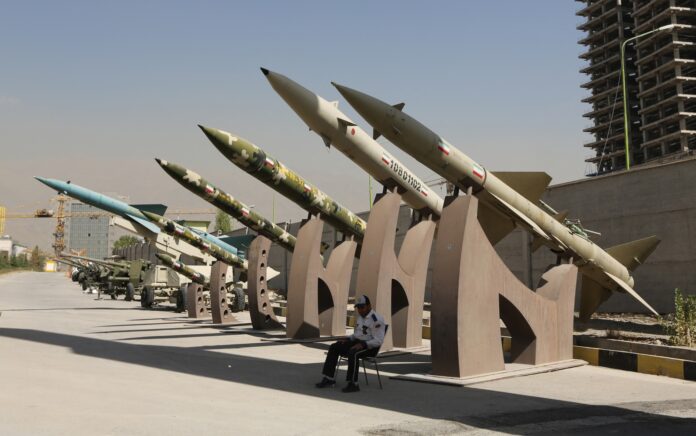
Iran’s medium-range ballistic missile force, the backbone of its deterrence strategy, suffered heavy attrition, though underground infrastructure survived and allows for recovery. Before the war, Iran had aspired to an arsenal of 8,000 missiles. By early 2026, only about 1,000–1,200 missiles remained operational, along with roughly 100 mobile launchers deemed serviceable, down from 480 prior to hostilities. Nineteen of 25 primary launch bases were attacked, yet subterranean assets endured. One of the major achievements cited was the destruction of 293 launchers, including 95 buried in collapsed tunnel shafts, significantly degrading Iran’s operational flexibility.
The destruction of mixers used in solid-fuel production crippled Iran’s ability to manufacture advanced missiles, forcing a return to liquid-fuel systems, which require lengthy preparation and are more vulnerable. To circumvent the crisis, Iran is attempting to import components and chemicals from China through smuggling networks. In the past, shipments of sodium perchlorate were documented at Bandar Abbas in quantities sufficient for approximately 800 missiles. In December 2025, U.S. forces reportedly seized a vessel en route from China carrying cargo intended for the Islamic Revolutionary Guard Corps.
At the same time, Iran has deepened its involvement in the CRINK alliance (China, Russia, Iran, and North Korea). China purchases roughly 90% of Iran’s oil exports, generating billions in revenue, while barter-based trade systems bypass sanctions. Iran manufactures loitering munitions in Russia, Russia is expected to supply Su-35 fighter jets, and Rosatom is projected to construct four new nuclear reactors in Iran.
The weakening of Hezbollah and Hamas has compelled Iran to shift its focus toward Yemen, Iraq, and international terror networks operated by the Quds Force. The Houthis have emerged as Iran’s central proxy, disrupting global trade routes while continuing low-intensity attacks on Israel.
Meanwhile, Irans’ covert Quds Force Unit 11000 is reportedly engaged in planning attacks against Israeli and Jewish targets worldwide, relying on local criminal networks and mercenaries. Among the recent plots thwarted was an alleged attempt to assassinate Israel’s ambassador in Mexico. In January 2026, the European Union designated the Islamic Revolutionary Guard Corps as a terrorist organization.