
 JBizNews
Mortgage Rates Climb to 6.51%, a Nine-Month High, as Iran War and Inflation Squeeze Spring Buyers
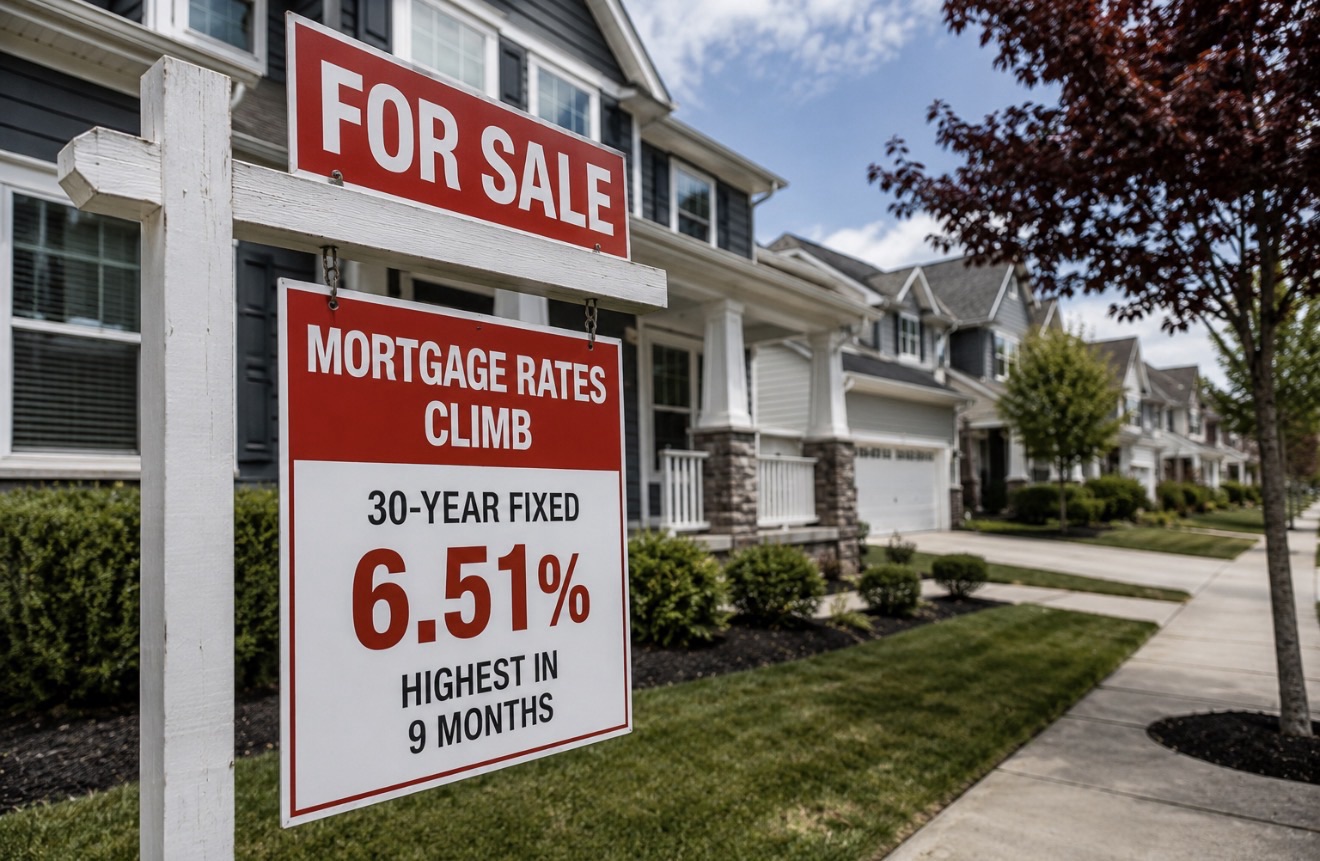
The cost of buying a home in America just got sharply more expensive. Freddie Mac reported Thursday morning that the average 30-year fixed-rate mortgage climbed to 6.51% for the week ending May 21, up from 6.36% a week earlier and the highest level in roughly nine months. A year ago, the same rate stood at 6.86%.
The jump, announced in Freddie Mac’s weekly Primary Mortgage Market Survey, lands at the worst possible moment for the housing market. Spring is the season when most American families try to close on a home before summer moves and the new school year. Instead, buyers are watching their monthly payments climb week by week with no clear ceiling in sight.
Sam Khater, chief economist at Freddie Mac, framed the shift bluntly in the release accompanying the data. He urged aspiring buyers to shop multiple lenders, noting that comparing quotes can save thousands as rates fluctuate. It was a quiet acknowledgment that the friendly rate environment many had banked on for 2026 has slipped away.
Other industry trackers showed conditions even tighter than Freddie Mac’s headline figure suggests. The Mortgage Bankers Association put the average 30-year rate at 6.56% through last Friday, a seven-week high. Mortgage News Daily, which tracks daily lender pricing rather than weekly averages, showed rates around 6.65% to 6.67% mid-week. Zillow’s lender survey pegged the average closer to 6.73%.
The driver is no mystery. The 10-year Treasury yield, the benchmark mortgage rates track most closely, has jumped roughly 15 basis points over the past week to about 4.6%. Bond investors are pricing in two related shocks at once: persistent inflation, after the April consumer price index showed prices rising 3.8% annually, and the economic fallout from the ongoing U.S.-Iran war, which has pushed oil prices sharply higher and rippled through the cost of everything from gasoline to manufactured goods.
Bob Broeksmit, president and CEO of the Mortgage Bankers Association, said higher Treasury yields continued to push mortgage rates higher through the prior week, weighing on affordability and application activity. Purchase applications have softened in step with the climb.
Inside the Federal Reserve, the calculation has flipped. Just months ago, futures markets were pricing in cuts to the federal funds rate before year-end. Now, traders see essentially no chance of a 2026 cut and rising odds that the Fed’s next move could be a hike. That marks one of the more dramatic policy reversals of the cycle and reflects how seriously policymakers are taking the inflationary pressure from the oil-price spike tied to the Middle East conflict.
For households, the math is unforgiving. At 6.51%, the monthly principal-and-interest payment on a $400,000 loan runs about $2,529, versus $2,492 at 6.36% just one week earlier and $2,624 had rates climbed to 7%. Mortgage originators say a return to the 5% range is what would actually unlock the sidelined buyers who have been waiting since 2022. That five-handle now looks distant.
The supply side offers little relief. Lawrence Yun, chief economist at the National Association of Realtors, said following the trade group’s latest existing-home sales release that inventory remains tight at a 4.4-month supply — well below the six months considered balanced. Existing-home sales ticked up just 0.2% in April to a 4.02 million annual pace, with the median price up 0.9% year over year to $417,800. Yun warned that unless supply meaningfully increases, home price growth could outpace wage growth and further erode the homeownership rate.
That leaves first-time buyers caught in the familiar squeeze: prices that won’t come down because inventory won’t come up, and financing costs that won’t come down because inflation won’t come down. Many are simply waiting. Nicholas Barta, division president at Security First Financial, said borrowers have psychologically adjusted to the mid-to-high-six range in a way they had not during the 2022–2023 spike, but the qualification math at 7% remains punishing.
For the spring season, the damage may already be done. Buyers who started shopping in March on the assumption that the Federal Reserve would soon cut, and that the 30-year would drift back into the high fives, are recalibrating in real time. Sellers are recalibrating too. Listings that sat through April at aspirational prices are starting to see cuts, particularly across parts of the South and West where inventory has loosened the most.
The path forward depends on factors well outside the housing market. A de-escalation in the Iran conflict and a meaningful drop in oil prices would pull Treasury yields lower and pull mortgage rates with them. A second inflation surprise in the May CPI report, due next month, would do the opposite. For now, the housing market is once again hostage to forces playing out thousands of miles away.
© 2026 JBizNews. All Rights Reserved. Reproduction or distribution without written permission is prohibited.