
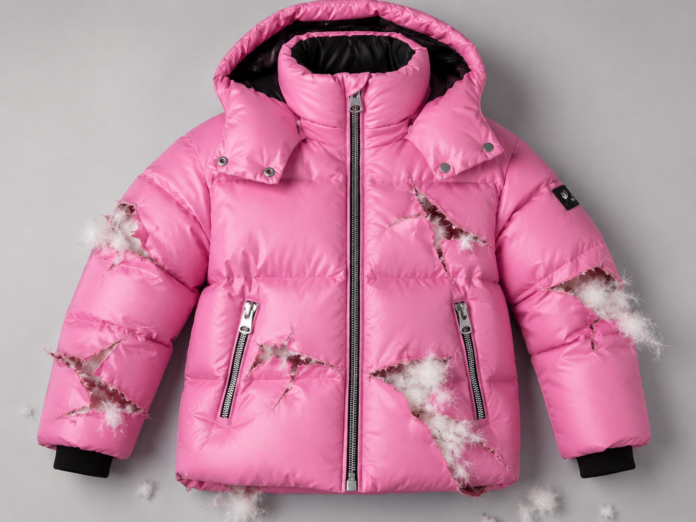

NEW YORK (VINNEWS/Rabbi Yair Hoffman) It happened in the winter. A fifth-grade girl, who, it seems had a bit of a temper,well, actually, more than a bit – got into some kind of altercation with a classmate. Whatever the exact circumstances were, in the course of it she damaged the classmate’s coat.
The coat was an expensive one — a Mackage ‘JESSE’ lustrous light down jacket for kids — which currently sells for roughly $550 new (Mackage lists the kids’ 8–14 size at $550). The damaged girl’s family wanted to know: who, if anyone, is obligated to pay for the ruined jacket? Is it the child herself? Would it be her parents? The school perhaps? Or maybe the teacher? And is the answer any different ‘before Heaven’ than it is in a beis din?
The Short Answer
As a matter of strict halacha, the girl herself is exempt, because a minor who caused damage (‘katan she’hizik’) is not obligated to pay — this is true even though she has a temper and even though the damage was real and expensive.
Her parents are also not obligated by strict law to pay for what she did, and neither is the teacher or the school, because the halacha does not treat them as legal ‘guarantors’ who must pay for a child’s damage. So a beis din would not force anyone to write a $550 check.
However, that is far from the end of the matter. There is a strong and widely-cited obligation ‘beyond the letter of the law’ (lifnim mishuras hadin) for the parents to make good the loss. This is so that their daughter — and they themselves — ‘go out with clean hands before Heaven’ (latzeis yedei Shamayim). Many families in this situation do pay, in full or in part, and the poskim view that as the proper and pious thing to do.
In addition, the parents should use this as a chinuch moment: teach the child that what she did was wrong, and — if she has money of her own — have her contribute a meaningful sum toward the loss so that she feels the seriousness of what happened. And it is proper for the child, once she grows up, to do teshuvah for the damage.
In short: no one is legally forced to pay, but the right thing — and what the poskim encourage — is for the family to make the victim whole, and to turn the episode into a lesson.
Why the Child Herself Does Not Have to Pay
The Source: A Minor Who Damages Is Exempt
So why is it that the young girl in question does not have to pay – even eventually?
There is an explicit Mishnah in Bava Kama (83b): ‘A deaf-mute (cheresh), an imbecile (shoteh), and a minor (katan) — it is a bad thing to have dealings with them: one who injures them is liable, but if they injure others, they are exempt.’ In other words, if an adult damages a child’s property, the adult pays; but if a child damages someone else’s property, the child is exempt from paying. This is codified as halacha in the Shulchan Aruch (Choshen Mishpat 424:8).
The reason is that at the moment of the damage, a minor is not a ‘bar da’as’ — not legally a responsible, understanding adult. The Torah simply does not impose a monetary obligation on someone who is not yet of age, even if the damage was deliberate and even if the child clearly knew that she was doing something wrong. Having a temper, or acting out of anger, does not change this: the exemption flows from her legal status as a minor, not from any claim that she ‘didn’t mean it.’
Does She Have to Pay Once She Grows Up?
The Rishonim (early authorities) argued about a follow-up question: is the exemption only temporary — lasting until she becomes an adult — or is she permanently free of the debt even after she grows up?
The lenient view (she never has to pay): The Rosh, and following him the Pilpula Charifta, held that a minor who damaged is exempt forever, even after reaching adulthood. The Rosh derived this from a case near Rav Nachman (Kesubos 85a), reasoning that a minor is simply not ‘a child of punishments’ — not subject to legal accountability — for acts done in childhood.
The stricter view (she must pay when grown): The Ohr Zarua, based on Rashi’s commentary in Bava Kama (98b), held that a minor who damaged is obligated to make good the loss once he or she grows up.
The Ohr Zarua’s view rests on four classic proofs, which the later achronim examine and largely push off: (1) the case where Rafram compelled Rav Ashi to pay for a promissory note he had burned as a child (explained away by the Shita Mekubetzes, the Pilpula Charifta, and the Maharam Padua, siman 90, as either a ‘dina d’garmi’ ruling or a case where Rav Ashi was already thirteen); (2) the case of the goring ox whose minor owner must pay (limited to that specific case by ‘tikkun ha’olam’); (3) a proof from Yoshiyahu HaMelech (see Nachal Yitzchak, siman 7); and (4) a proof from the ‘keren’ and ‘chomesh’ obligations of a minor girl who ate terumah (Nachal Yitzchak in the name of the Mareh HaPanim on the Yerushalmi).
In each case the later poskim show the proof is not decisive.
The bottom line: the plain sense of the Shulchan Aruch (CM 424:8) follows the lenient view of the Rosh — the minor is exempt from strict-law payment even after she grows up. Rav Ovadya Yoseph (Yabia Omer Choshen Mishpat vol. 8) discusses these proofs at length and reaches the same practical conclusion. So a beis din will not extract the money from her, neither then nor later.
Part Two: Are the Parents Obligated?
By strict law, no. The poskim state clearly (see the discussion in ‘HaYashar VeHaTov’ and the Shevus Yaakov cited there) that there is no established obligation on a father to ‘guard’ his child so that the child does not cause damage, in the way that one is obligated to guard one’s ox or one’s fire. A child is not the father’s ‘property’ in the sense that would make the father automatically liable. So the parents cannot be forced in beis din to pay for damage their daughter caused.
But there are real moral obligations on the parents, which the poskim take seriously and which, in practice, are where this case actually ends up:
- Paying ‘beyond the letter of the law’ (lifnim mishuras hadin). Both source-works stress that even though there is no forced payment, it is proper for the parents to make good the loss. Various Poskim explain the Rafram/Rav Ashi episode itself as a ‘beyond the letter of the law’ matter, on the model of the porters’ case in Bava Metzia (83a) — ‘so that you walk in the way of the good people.’ Note that the authorities dispute whether ‘lifnim mishuras hadin’ can be enforced (the Rosh and Rabbeinu Yerucham hold it cannot be forced; it is a matter of individual choice) — but that it is the right thing to do is not in dispute.
- Chinuch — teaching the child. The Sefer Choshen LaMa’aseh (a fascinating work exploring matters of Choshain Mishpat Teshuvah 98) rules that the parents should teach the child that her deed was wrong, in order to steer her away from repeating such behavior. Given that this girl ‘has a temper,’ this is not a side point — it is arguably the most important part of the response.
- Having the child contribute from her own money. The same sefer citing HaGaon Rav Baruch Serga shlit”a, rules that if the child has money of her own — gift money from parents or grandparents and the like — the parents should take a meaningful sum from it toward the loss, specifically so that she ‘feels the seriousness of her deed.’ There is no problem of ‘theft’ in taking this money, because a child supported at her father’s table holds such gift-money in a way that is really tied to the father. This is a chinuch device, not a legal collection — but it is both permitted and encouraged.
- Modern-day discipline in place of ‘striking.’ The Shulchan Aruch (CM 424:5) and Mishnah Berurah in OC speak of ‘striking’ a child who damages so that he not become accustomed to it. Rav Serga and the responsum note that in our times, when we do not use that method, the appropriate substitute is another form of consequence — which is exactly what having her pay from her own money accomplishes.
Part Three: What About the Teacher or the School?
The teacher and the school are exempt by strict law. The Sefer Choshen LaMa’aseh rules directly on this point: the Torah does not consider the teacher (melamed) a ‘shomer’ — a legal guardian — over the children with respect to this kind of damage. A teacher’s job is to teach, not to serve as a bailee responsible for every item of clothing and property the students bring to school. So no monetary claim lies against the teacher or the school for the ruined jacket.
(If a school has its own written policy or a signed agreement making it responsible for damage between students — which is a matter of contract, not of this halacha — that would be handled separately. Absent such an agreement, there is no claim.)
Part Four: The Obligation ‘Before Heaven’ (Latzeis Yedei Shamayim)
There is a separate question, distinct from who can be forced to pay in beis din: is there a duty ‘in the laws of Heaven’ to make the victim whole? Here too the poskim are divided.
The view that there is such an obligation: The Shevus Yaakov (vol. 1, siman 177) holds that even though a minor who damaged is exempt in beis din, he is nonetheless obligated ‘before Heaven’ to make it good. He proves this from the Rema, in the name of the Terumos HaDeshen (siman 62): a person who transgressed in childhood needs to do teshuvah after growing up, and the core of that teshuvah is to appease the person he wronged and make good the damage. The Chiddushei HaRash”sh (Sanhedrin 55b) reaches the same conclusion.
The view that even the ‘before Heaven’ duty is waived: The Chai Adam and others read the Shulchan Aruch as exempting the minor even from the ‘before Heaven’ obligation from the essential law, leaving only the ‘beyond the letter of the law’ recommendation. The Shu”t Yabia Omer (CM vol. 8) leans this way as well: strictly speaking the minor is exempt, but because a ‘mark of wrongdoing’ came about through her, it is proper for her to take some atonement (kapparah) upon herself.
Practically, the streams converge: whichever way one rules on the technical ‘before Heaven’ question, everyone agrees it is proper and praiseworthy for the loss to be made good and for the child to do teshuvah when she is older. The Nachal Yitzchak adds a striking reason: since even a minor is included in mitzvos and is being educated toward the whole body of halacha — including ‘do not steal’ and ‘do not damage’ — there is real spiritual weight to making things right, even though the strict monetary claim does not bind her.
Applying All of This to the Damaged Mackage Jacket
Step 1 — The claim in beis din: If the victim’s family were to bring the case to a beis din demanding $550, the din is that the fifth-grade girl is exempt (she is a minor), her parents are exempt (no obligation to guard against a child’s damage), and the teacher and school are exempt (a teacher is not a shomer for this). No party can be compelled to pay the full price of the jacket.
Step 2 — What should actually happen: The strongly encouraged path — supported by both source-works — is that the girl’s parents make good the loss beyond the letter of the law, so that their daughter goes out with clean hands before Heaven and the wronged family is not left absorbing an expensive loss. Because the item was genuinely valuable (around $550) and the damage was real, this is exactly the kind of case where menschlichkeit and the guidance of the poskim point toward paying rather than standing on the technical exemption.
Step 3 — The chinuch piece (especially given her temper): Whatever the parents decide about the full payment, they should (a) make clear to their daughter that what she did was wrong; and (b) if she has any money of her own, have her contribute a meaningful portion toward the jacket — not because a beis din forces it, but so she feels the weight of what she did and is less likely to repeat it. For a child with a known temper, letting the episode pass with no consequence would itself be a failure of chinuch.
Step 4 — Assessing the amount fairly: If the parents do choose to make good the loss, the fair figure is the actual loss in value — which is not automatically the full $550 retail price. If the coat can be repaired (a torn seam, a replaced zipper, a cleaned stain), the cost of repair is the right measure. If it is genuinely ruined, then the replacement value of a comparable coat — accounting for the fact that it was already used, not brand-new — is the fair number. In money matters like this it is worth having a neutral, respected person or a rav help the two families settle on a reasonable figure rather than fighting over the sticker price.
Conclusions
- A minor who damages is exempt from paying in the laws between adam l’chaveiro – man and man — by all opinions, while she is a minor. Her temper and the deliberateness of the act do not change this.
- Whether she must pay once she grows up is a dispute of the Rishonim; the plain sense of the Shulchan Aruch (CM 424:8) exempts her even then, and that is the accepted practical ruling.
- The parents are not obligated by strict law (there is no duty to ‘guard’ a child against causing damage), and the teacher/school are not obligated (a teacher is not a ‘shomer’ for this).
- Whether there is an obligation ‘before Heaven’ is also disputed, and the plain sense of the Shulchan Aruch leans toward exemption — but everyone agrees it is proper for the loss to be made good and for the child to do teshuvah when older.
- Beyond the letter of the law, it is proper for the parents to make good the loss; and it is proper to use the child’s own money (if she has any) and to teach her, so she feels the seriousness of what she did.
- If payment is made, the fair amount is the true loss in value (repair cost, or the replacement value of a comparable used coat), not necessarily the full retail price — ideally settled with the help of a rav or a neutral third party.
The author can be reached at [email protected]