

 Vos Iz Neias
Bill To Freeze Draft Arrests Faces Opposition In Knesset And From Sephardic Rosh Yeshivos
JERUSALEM (VINnews) — The Knesset’s Foreign Affairs and Defense Committee approved a contentious bill that seeks to temporarily freeze the arrests of charedi draft evaders, on Sunday, ahead of its final required plenum readings to become law.
The approval came after the Knesset’s legal advisory team had issued severe warnings regarding the advancement of the legislation that has been pushed by the charedi parties.
The legal advisory warned in its opinion on Sunday that the legislation lacked balance and could effectively exempt haredim from IDF service, failing to advance “equality in sharing the burden.” It added that the legislation “practically exempts” charedim from the IDF.
The Knesset’s legal advisor, Sagit Afik, also warned the panel ahead of the vote that the legislative process undertaken to advance the bill was improper.
Despite this, the bill advanced in the committee by a vote of eight lawmakers in favor and seven against, and the approval is subject to a request for revision.
The bill stipulates that from the decided date of commencement until the end of 90 days, no arrest, investigation, or enforcement proceedings will be taken for failure to serve.
The government has presented its stance that arresting yeshiva students who evade military service has undermined efforts to encourage broader enlistment among charedi men, and therefore, the freeze of arrests would be beneficial.
Opponents and Afik have argued that the bill is unbalanced largely because it only calls for halting the arrests of draft evaders without including any sanctions on them.
Meanwhile, in a strongly worded letter that has now been published, signed by prominent Sephardic rosh yeshivos and dayanim, led by Rabbi Moshe Tzedaka, head of Porat Yosef Yeshiva, the rabbis also express firm opposition to the proposed law. They write, among other things: “This law contains all of the same mechanisms and dark methods that existed in the previous draft law, which was intended to destroy the Torah world.”
The rabbis sharply criticize the law’s stringent oversight mechanisms and the reporting requirements it would impose on yeshiva heads regarding students’ absences. They write: “The law requires yeshiva heads to become despicable informers, God forbid.”
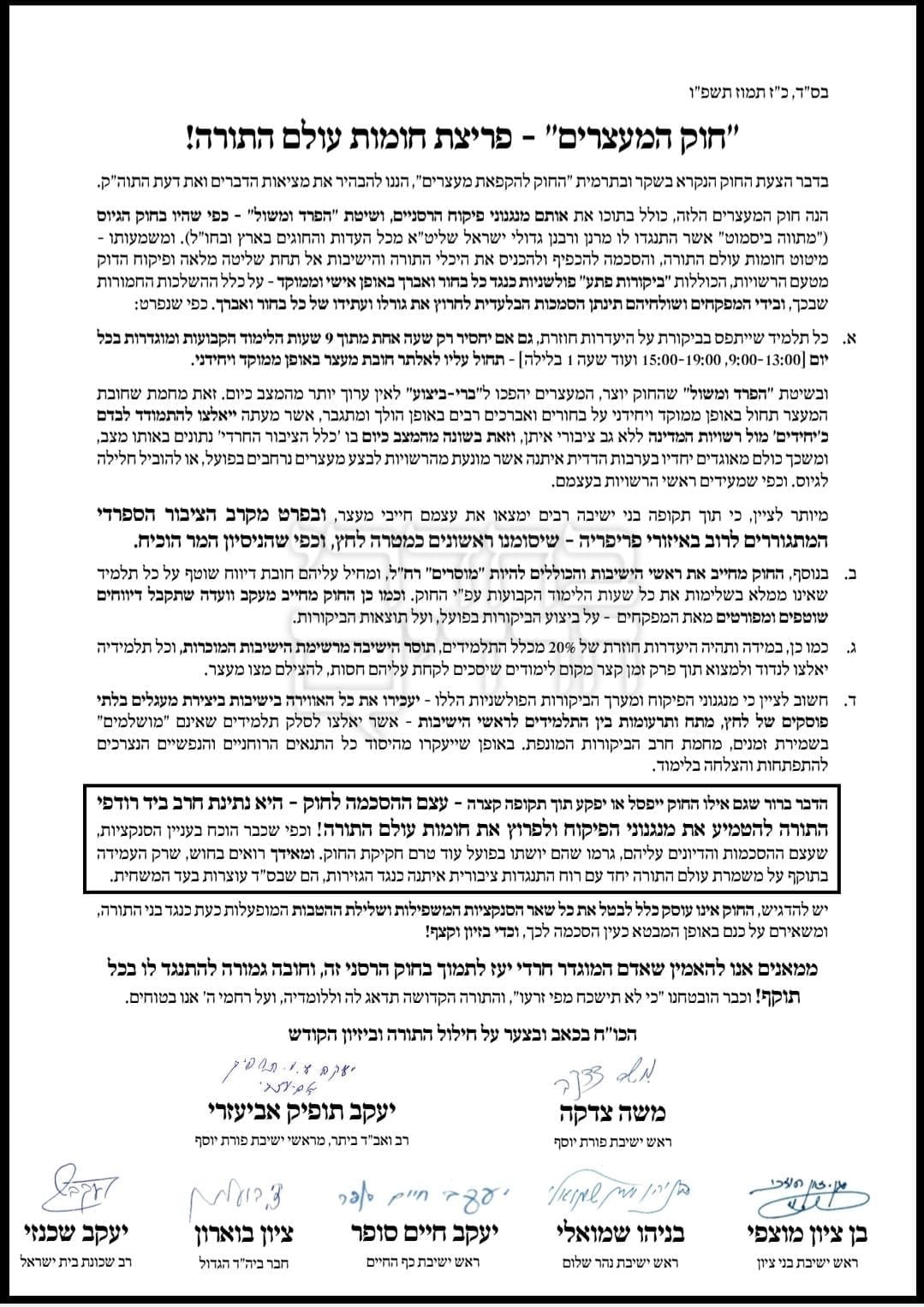
The letter continues: “This law includes all of the same mechanisms and dark methods that were part of the previous draft law, which was intended to destroy the Torah world [and which, only through God’s mercy, was ultimately shelved. When its details were presented to the rabbis, the overwhelming majority of the leading Torah sages and rabbinic authorities, from all communities and circles in Israel and abroad, opposed it].”
The rabbis argue that the new proposal, presented as a law “to prevent arrests”, would once again place the Torah world under full government control:
“Under the proposed new law, ‘to prevent arrests,’ they again seek, in a paternalistic manner, to bring the Torah world under their complete control. Every yeshiva would be subject to frequent, intrusive surprise inspections directed at each individual student. A student who is found to have repeatedly missed even one hour out of the nine mandatory study hours each day [9:00 a.m.–1:00 p.m., 3:00–7:00 p.m., plus one additional hour at night] would immediately become subject to arrest.”
The letter continues: “Using a strategy of ‘divide and conquer,’ once a student is absent, he will be forced to face the state authorities alone, without the support of the broader community [and some may foolishly claim, ‘he brought it upon himself,’ which is, of course, untrue]. This differs from the current situation, in which the entire charedi community shares the same status and stands united, a reality that in most cases prevents the authorities from carrying out mass conscription or arrests.”
The rabbis further write: “As stated, the law requires the appointment of inspectors and intrusive, rigorous oversight mechanisms that will monitor each individual student personally, in detail and with precision, alongside data verification and cross-checking with various government ministries.”
They also object to the reporting obligations imposed on yeshiva administrators: “Not only that, but the law requires yeshiva heads to become despicable informers, G-d forbid, obligating them to continually report every student who is absent. [If repeated absences reach 20%, in addition to sanctions imposed on the yeshiva head, the entire yeshiva and all of its students will be removed from the approved list and forced to find another institution willing to accept responsibility for them within a short period of time. Otherwise, they too will become subject to arrest.]”
The letter adds: “It goes without saying that the provisions of this law will poison the atmosphere within the yeshivot and fundamentally alter their character. They will uproot the basic spiritual and emotional conditions necessary for spiritual growth and success in Torah study, while leaving in place all of the existing humiliating sanctions and the denial of benefits imposed on yeshiva students.”
The rabbis conclude: “We refuse to believe that anyone who identifies as Haredi would dare support this destructive and harmful law, which is expected to increase arrests and cause many to end up in the military.”