
 Vos Iz Neias
Inspiring Story: How A Filipino Child In Tel Aviv Found His Identity In The Jewish Faith
JERUSALEM (VINnews) Yosef “Howie” Danow sits down, takes a deep breath, and smiles. He has just returned from a visit to London, but as far as he is concerned, “There’s nothing like being in Israel.”
The familiar phrase, spoken by so many Israelis after landing back at Ben Gurion Airport, carries a much deeper meaning when it comes from Yosef Danow. Born as Howie, Yosef has one of the most complex, painful, and inspiring life stories imaginable. His journey, from a child without a clear identity to embracing Judaism, is not only deeply personal but also reflects important questions about Israeli and Jewish society.
Yosef’s story, as told to Kikar Hashabat, begins with the courageous decision of his biological mother. She left the Philippines to work in Israel as a housekeeper, hoping for a new beginning. Soon after arriving, she discovered she was pregnant.
Rather than sending her back home, her employers, a secular Jewish family in North Tel Aviv, made an unusual decision: they invited both mother and child to live with them and helped raise him.
“They became my mother and father in every sense,” Yosef recalls. “To this day, I call them Mom and Dad. My adoptive father passed away when I was sixteen, and I recite Kaddish for him. I grew up with a biological mother, an Israeli mom and dad, and brothers and sisters who looked nothing like me. That was my normal.”
Although the family was not religious, Yosef describes them as exceptionally kind and generous. But while home was filled with love, life outside was very different.
“The moment you leave the house in North Tel Aviv, and you’re the only Filipino child around, everyone notices.” Already in first grade, he experienced racism and bullying. At home, his appearance was irrelevant; outside, it defined him. He endured social exclusion and even a complete class boycott.
“You always feel like people are whispering behind your back. There’s never any peace. It’s a thought that never stops tormenting you.”
He felt that he belonged nowhere. Israelis didn’t fully accept him. When he visited the Philippines, he felt like an outsider there as well. Nor did he connect to his mother’s Christianity. When his mother took him to church, the young boy would quietly pray in his own words: “I don’t know who You are, but I know You’re there, and You’re One, not three, One.”
Growing up in a secular environment, Yosef says that most of what he learned about Judaism came through negative media portrayals – protests, scandals, and religious coercion.
“If I hadn’t converted, I could easily have become a pro-Palestinian activist,” he admits candidly. “I was full of anger. I kept asking, ‘Why am I here?’ Against all odds, I ended up in this tiny country, surrounded by a language and culture I wasn’t sure I belonged to.”
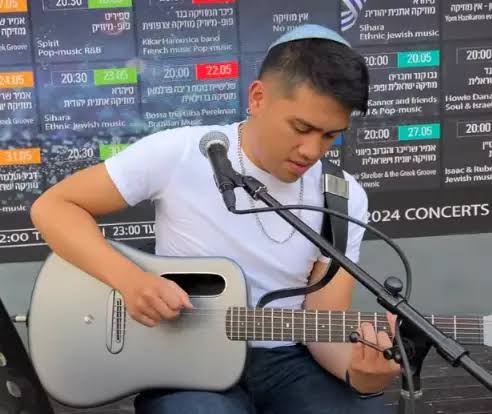
Music became the one place where Yosef truly felt at home. There were no labels there, only talent and emotion. He performed on the streets and in bars before an Instagram video led him, at age 17, to the Israeli television competition The Next Star, where he advanced to the semifinals despite performing with laryngitis.
But fame left him empty. Looking back at his performance of “Take Me to Church,” he says something essential was missing. To explain what he means, he tells a story about one of his vocal students:
He brought two one-liter bottles of chocolate milk to a lesson and told the student to drink both before singing the song. The student eventually became nauseated and refused even a sip of water.
Yosef then explained: “That’s exactly what this song represents. When we fill ourselves with flashy, attractive content that’s ultimately empty, there’s no room left for something healthy and meaningful.”
He realized he didn’t want to become a hollow celebrity. But to create meaningful music, he first needed to know who he was. His greatest personal crisis came during his military service. He enlisted partly to avoid disappointing his mother and partly to prove that he deserved to exist.
Instead, he sank into depression. When fellow soldiers spoke about serving because “this is my country” and “these are my people,” Yosef couldn’t honestly say the same.
“Living wasn’t enjoyable,” he recalls. “I struggled with depression and suicidal thoughts.”
He explains his thinking at the time: “I didn’t choose to be born into this reality. I didn’t choose to be the Filipino kid in Tel Aviv. So if I couldn’t choose how to live, I could at least choose whether to exist or not. That became the one decision I felt completely in control of.”
Toward the end of his service, he enrolled in Nativ, an educational program that teaches Jewish and Israeli identity to soldiers who are not officially recognized as Jewish. He initially joined simply to escape routine military life. “I told them immediately: I’m not here to keep Shabbat or convert.”
But something changed. Studying alongside soldiers of Russian, Ethiopian, Iranian, and Japanese backgrounds, people who also struggled with questions of belonging, he began learning Jewish history.
He also explored the history of his adoptive mother, a Holocaust survivor. Gradually, the pieces fit together.
“Suddenly I realized: I didn’t choose to be here, I was chosen to be here. What are the chances that a Filipino boy would be born in North Tel Aviv, be raised by a Holocaust survivor’s family, and end up in the Israeli army? Every detail of my life had purpose.”
He came to believe that without the Jewish people’s history and survival, his own life would not have unfolded as it did.
Even before formally converting, Yosef says he already felt Jewish. Like the biblical Ruth, who first declared “Your people shall be my people” before saying “Your God shall be my God,” Yosef says his connection began with belonging to the Jewish people.
“I wasn’t a Christian who became Jewish. I was a Filipino who chose the Jewish people.” He says he came to understand Judaism not merely as a religion but as a peoplehood and a way of life.
“We don’t keep Shabbat because we’re religious. We keep Shabbat because that’s how we express our Jewish identity.” He chose the Hebrew name Yosef, after the biblical Joseph, who was also separated from his family, lived in a foreign land, and ultimately reconciled with his brothers.
Yosef describes his conversion as the happiest moment of his life. “It wasn’t only happiness. It was validation. Every part of my life suddenly made sense in retrospect. I reached the greatest place in the world, I became a Jew.”
Today, he is married and building a Jewish home in Israel. He continues to create music that, in his words, carries spiritual depth. He performs for Jewish communities in Israel and abroad and teaches vocal coaching.
Yet he says he still encounters racism. Ironically, he explains, many of the remarks he hears today, such as “Filipino, go home”, come from within some religious Jewish communities.
Rather than responding with bitterness, however, he says he sees it as his mission to challenge superficial judgments and encourage people to look beyond appearance and ethnicity to recognize the human soul within.