
 Matzav
Sinwar Believed Israel Might Use Nuclear Weapons—But Ordered October 7 Attack Anyway, Newly Revealed Memo Shows
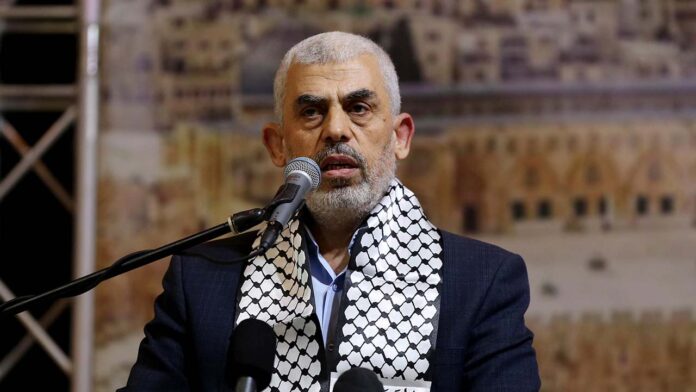
A newly disclosed handwritten document by slain Hamas leader Yahya Sinwar reveals that he believed Israel might respond to a massive Hamas assault with a nuclear strike on Gaza—yet he nevertheless pressed ahead with planning the October 7, 2023, massacre.
The document, dated August 2022, was obtained by the Meir Amit Intelligence and Terrorism Information Center, with portions published Sunday by Israel’s Channel 12. While another Sinwar document surfaced last year, the newly released material contains significant details that had not previously been made public.
According to the report, Sinwar meticulously outlined an ambitious battle plan that envisioned an invasion on a far greater scale than what ultimately took place. His blueprint called for 25 simultaneous breaches of the Israel-Gaza security fence, with each breach carried out by a “well-trained” force of 100 terrorists tasked with seizing 25 key junctions along the border.
The plan also assigned 2,210 terrorists to attack 221 smaller communities throughout southern Israel, while another 1,600 were designated to assault eight larger population centers. Sinwar further allocated 1,200 terrorists to strike Israeli cities and another 2,000 to attack military installations. Altogether, his envisioned invasion force totaled roughly 10,000 terrorists, though he wrote that no individual participant would know the operation’s full scope.
In reality, the October 7 invasion involved far fewer attackers. According to Israel Defense Forces estimates, approximately 5,600 terrorists crossed into Israel that day, including roughly 3,500 Hamas operatives, about 580 members of Palestinian Islamic Jihad, and another 1,400 armed Gazans.
Among Sinwar’s written instructions was a chilling directive targeting Israeli civilians. “The goal is to expel the settlers with their vehicles,” he wrote, referring to residents of southern Israel. He instructed that “priority” should be given to children and women, while ordering that “the men aged 17-50 are to be taken hostage” and that “all phones must be taken, along with any additional documents they are carrying on their person.”
Channel 12 reported that the documents demonstrate Sinwar fully understood the enormous risks associated with launching such an attack. According to the report, he acknowledged that there was no guarantee Iran—or its regional terror proxies, including Hezbollah—would join Hamas in the war, despite Hamas’s apparent expectation that they would.
The memo also shows that Sinwar anticipated an overwhelming Israeli response. He wrote that Israel would “not hesitate to use all means and weapons at its disposal” following the massacre, adding, “They may even use an atomic bomb, no less.”
Even so, Sinwar believed Hamas could exploit the initial shock of the assault. “But first, it will be surprised by the attack and enter into chaos,” he wrote, describing the invasion as “a campaign of life or death,” while calling for “a popular operation of returning to the villages and recapturing them symbolically.”
Although Israel is widely believed to possess nuclear weapons, it has never officially acknowledged having such an arsenal and remains outside the Nuclear Non-Proliferation Treaty.
The newly released excerpts follow another Hamas document made public by the Meir Amit Intelligence and Terrorism Information Center in October 2025. That earlier document, also written by Sinwar, detailed plans to deliberately create “horrifying images” during the October 7 massacre and broadcast the atrocities live to maximize psychological impact.