
 JBizNews
Lazard Says New Gas Power Costs Hit 15-Year High as Solar Jumps 18 Percent
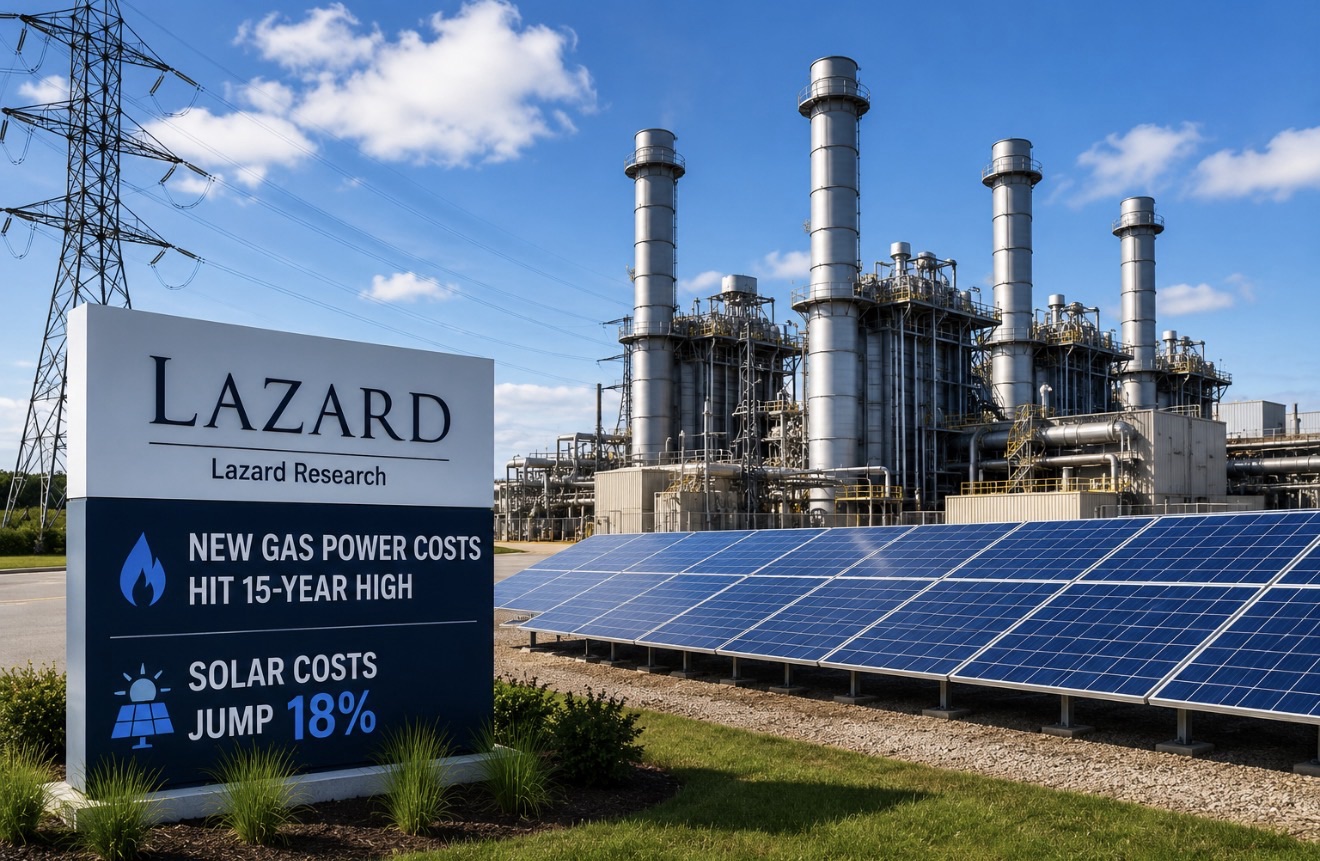
On Monday, Lazard, Inc. (NYSE: LAZ) released the 19th edition of its Levelized Cost of Energy+ report and delivered a blunt message to anyone building a power plant in America: everything costs more now. The lifetime cost of electricity from a new combined-cycle natural gas plant has climbed to its highest level in 15 years, and the cost of new utility-scale solar jumped 18 percent in a single year. George Bilicic, Vice Chairman of Investment Banking and Global Head of Lazard’s Power, Energy & Infrastructure Group, said the report captures a market defined by unprecedented demand growth, rising costs across all technologies, and an intensifying focus on reliability and affordability.
The numbers are stark. Lazard’s average estimate for the lifetime cost of power from a new combined-cycle gas plant rose to $90 per megawatt-hour from $78 a year earlier — a 15.4 percent jump, and the highest figure in a data set that goes back to 2009. The full range now runs $51 to $129 per megawatt-hour. Gas peaking plants, the units utilities fire up on the hottest afternoons, climbed to an average of $210 per megawatt-hour.
Solar did not escape. Unsubsidized utility-scale solar rose to $40 to $98 per megawatt-hour from $38 to $92, with the average landing at roughly $69 versus $58 last year. Onshore wind moved to $37 to $99 per megawatt-hour from $37 to $86. Standalone battery storage reversed years of declines, with a 100-megawatt, four-hour system now costing roughly $210 to $292 per megawatt-hour — up about 27 percent from 2020 levels.
Why costs are climbing
Samuel Scroggins, Managing Director and Head of Renewables & Sustainable Infrastructure at Lazard, pointed to a stack of pressures hitting at once: higher capital costs, interest rates that have stayed elevated, tariff costs passed straight through to buyers, and the expense of rebuilding supply chains away from China toward Southeast Asia and domestic suppliers. Foreign Entity of Concern restrictions have cut off access to cheap Chinese battery cells, forcing manufacturers to reroute and repay.
Inflation has not helped. The U.S. consumer price index rose 4.2 percent in the 12 months through May after cooling for much of 2025. Tensions around the Strait of Hormuz have pushed shipping costs higher and kept energy and commodity markets volatile. Silver, a core input in solar cells, has surged in price.
On the gas side, the bottleneck is physical. Roughly three companies — GE Vernova, Siemens Energy, and Mitsubishi Heavy Industries — build most of the world’s large-frame turbines, and their order books are full. GE Vernova CEO Scott Strazik told investors in April that the company’s backlog grew by more than $13 billion quarter over quarter and that it expects at least 110 gigawatts of combined gas turbine backlog and slot reservation agreements by the end of 2026. Siemens Energy is carrying a record order backlog of about €136 billion. Delivery windows at the major manufacturers now stretch into the next decade.
What it means for businesses and ratepayers
This is where the report stops being an energy story and becomes an economics story. Lazard said rising costs to replace generation increase the value of every plant already connected to the grid — a direct benefit to utilities sitting on existing nuclear, coal, and gas assets. As of March 2026, the U.S. had 57 operating nuclear plants with 97 reactors and 219 coal-fired plants with 462 generators, according to the Energy Information Administration. Those plants are running more often as demand rises, letting owners spread fixed costs over more output.
Demand is the engine behind all of it. The EIA said in January that U.S. electricity demand is on track for its strongest four-year growth stretch since 2000, driven by data centers, manufacturing, and electrification. Scroggins called it “an era where speed is power,” saying value is shifting to whoever can deliver capacity fastest.
For commercial and industrial customers, higher build costs eventually show up in rates. Utilities recover construction spending through the bills that manufacturers, warehouses, supermarkets, and office landlords pay every month. When the cheapest new plant on the board costs 15 percent more than it did last summer, that gap does not disappear — it gets passed down.
Lazard was clear that renewables remain the lowest-cost new-build option on an unsubsidized basis and are still expected to make up most near-term capacity additions, largely because they can be built quickly. Scroggins noted that despite the 18 percent increase, utility-scale solar costs are still 81 percent below where they stood in the report’s first edition. Community and commercial solar runs roughly $88 to $197 per megawatt-hour.
The short-term picture is uncomfortable: every path to new power costs more, and gas costs are expected to keep rising. The longer-term picture is that companies able to secure electricity — through contracts, on-site generation, or location decisions — will hold an advantage over those still waiting in line.
JBizNews Desk | New York © JBizNews.com All Rights Reserved. Reproduction or distribution without written permission is prohibited.