
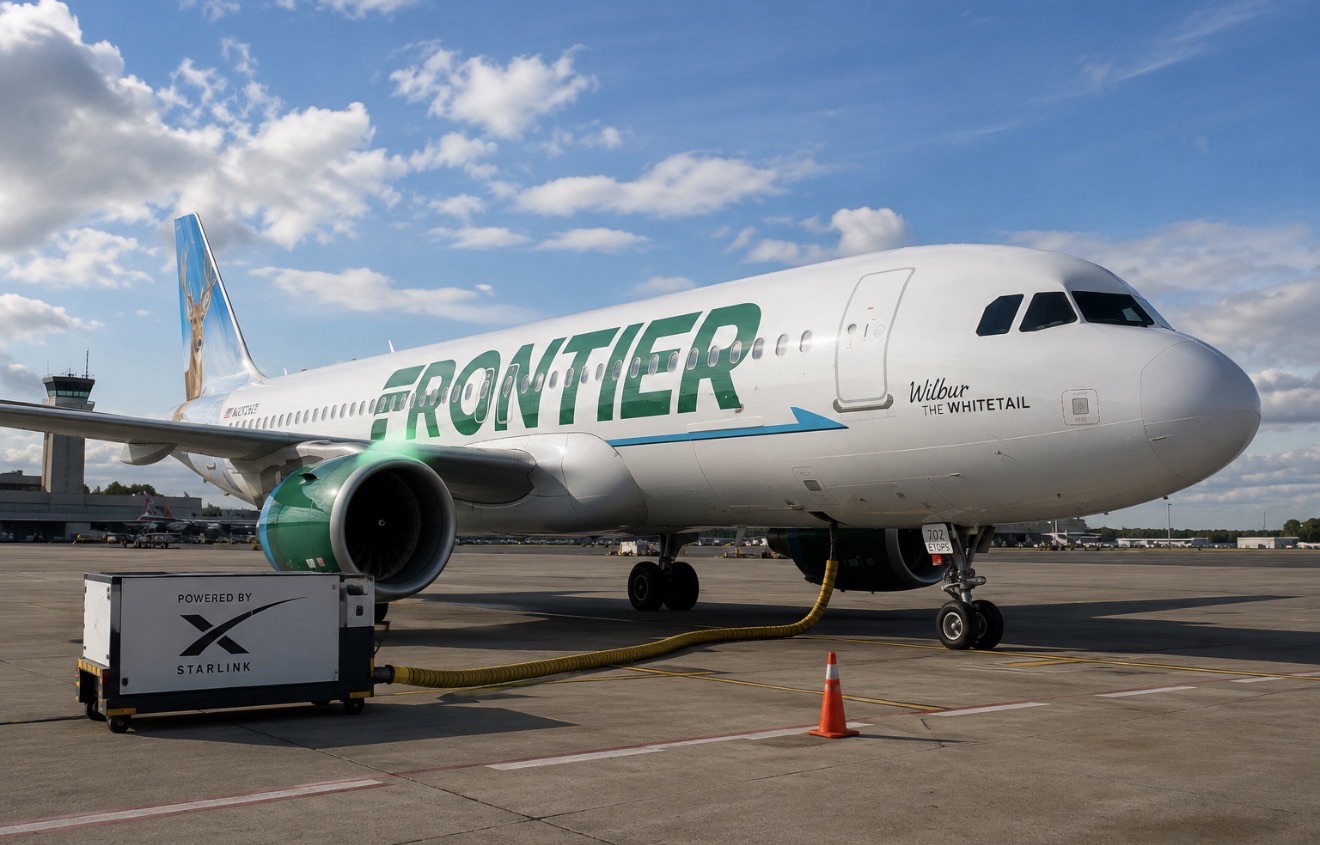

Frontier Airlines said Tuesday it will bring SpaceX’s Starlink satellite internet to its planes starting in early 2027, ending its long holdout on in-flight Wi-Fi and marking one of the largest connectivity deals yet for Elon Musk’s rocket-and-satellite company.
According to a statement from the airline’s Denver headquarters, Frontier, which trades on the Nasdaq under the ticker ULCC, expects its first Starlink-equipped aircraft to enter service in early 2027. The airline said it plans to become the first U.S. carrier to offer passengers access through Starlink’s new managed connectivity platform, providing high-speed, low-latency internet capable of HD streaming, online gaming and productivity from gate to gate.
Chief Executive Jimmy Dempsey said the airline continues investing in products and services that matter most to customers while maintaining its low-fare strategy. He described reliable onboard connectivity as another step toward improving the overall travel experience for Frontier passengers.
The agreement stretches well beyond Frontier itself. Through airlines backed by private equity firm Indigo Partners — including Frontier Airlines, Wizz Air, Volaris, JetSMART and Cebu Pacific — Starlink service is expected to be installed on more than 1,000 aircraft, making it one of the largest airline connectivity commitments announced to date.
Bill Franke, Managing Partner of Indigo Partners, said the agreement will allow the group’s airlines to provide dependable high-speed internet across their combined fleets while enhancing the customer experience. Frontier currently operates approximately 175 aircraft and has roughly 150 additional Airbus aircraft on order, giving the airline significant room for future expansion.
The move represents a notable strategic shift for Frontier.
For years, the ultra-low-cost carrier resisted installing onboard Wi-Fi, with former Chief Executive Barry Biffle frequently citing equipment weight, fuel consumption and installation costs as reasons the investment did not fit Frontier’s business model. The economics of satellite connectivity, however, have changed dramatically as Starlink’s low-Earth-orbit network has demonstrated faster speeds, lower latency and lighter equipment than many earlier systems.
The Starlink rollout also forms part of Frontier’s broader effort to attract higher-spending travelers. In recent months the airline has announced plans to introduce first-class seating, enhance its loyalty program and offer additional premium travel options as competition intensifies among low-cost carriers.
Industry analysts note that while ultra-low-cost airlines built their reputations around offering the cheapest fares possible, ancillary revenue has become increasingly important. Premium seating, loyalty memberships, baggage fees and onboard services now generate substantial portions of airline profits, making reliable high-speed internet another valuable product that carriers can monetize.
One unanswered question remains pricing.
Until recently, airlines adopting Starlink generally offered the service free to passengers, with SpaceX reportedly encouraging carriers to bundle connectivity into the overall travel experience rather than charging separately. That approach changed when Copa Airlines introduced paid access for certain travelers through Starlink’s new Managed Services platform.
Frontier has not yet disclosed whether Starlink internet will be complimentary, included for elite loyalty members or sold as a premium add-on. The airline said additional details will be announced closer to the system’s launch.
The agreement further strengthens Starlink’s rapidly expanding presence in commercial aviation.
Earlier this year American Airlines announced plans to install Starlink across more than 500 Airbus narrow-body aircraft beginning in 2027. United Airlines and Southwest Airlines have also committed to the satellite internet service, while Delta Air Lines selected Amazon’s competing satellite connectivity platform.
Industry estimates indicate Starlink has now secured commitments from roughly 40 to 50 airlines worldwide, positioning the satellite network as one of the dominant providers of next-generation in-flight connectivity.
For SpaceX, each airline agreement provides recurring subscription revenue through its Starlink division while expanding another fast-growing commercial business beyond launch services and government contracts. Analysts have increasingly viewed Starlink as a major long-term earnings driver because airline, maritime and enterprise customers provide stable recurring cash flow.
For travelers, the announcement promises significantly faster internet service on a carrier long associated with basic, no-frills flying. For Frontier, it represents another step toward balancing its low-cost identity with premium features designed to generate higher-margin revenue in an increasingly competitive airline industry.
As passenger expectations continue evolving, airlines increasingly view onboard connectivity not as a luxury but as an essential part of the travel experience. Frontier’s decision signals that even the nation’s largest ultra-low-cost carriers believe fast, reliable internet has become a competitive necessity rather than an optional amenity.
JBizNews Desk | New York
© JBizNews.com All Rights Reserved. Reproduction or distribution without written permission is prohibited.