

New York (VINNEWS/Rabbi Yair Hoffman) There is a bill in Congress called the Sunshine Protection Act. If it passes, the whole country would stay on daylight saving time all year long. The clocks would never change again.
In the summer, nothing would feel different. Summer would be exactly the way it is now.
Winter would be a different story. Winter sunsets would come an hour later, and that is exactly what the supporters of the bill want. But there is a second half to that trade. If the sun sets an hour later, it also rises an hour later. In most of the country, the sun would not come up until well after 8:00 AM. In some places it would be closer to 9:00 AM. That late sunrise is where all the objections come from.
The Orthodox Position: Two Arguments, One Cause
Rabbi A. D. Motzen is the national director of government affairs for Agudath Israel of America. He was recently quoted saying that the Orthodox Jewish objection has two parts. The first is safety — children walking to school and standing at bus stops in the dark. The second is religious practice. Both problems come from the same single fact: the late winter sunrise.
The safety worry is not new. It is the same worry that turned the public against permanent daylight saving time back in the 1970s. Parents of every background still raise it today.
The religious problem is more specific. Jewish law sets the earliest times that morning prayers may be said. Most of those times depend on sunrise. In general, services cannot start much before the sun comes up. So the rule is simple: the later the sun rises, the later services must start.
Now add up the pieces. Morning prayers take time. The commute to work takes time. If services cannot begin until after 8:00 AM, getting to work on time becomes very hard, and for many people impossible. The other outcome is just as bad. Shuls in the affected cities would have trouble finding ten men for a daily minyan at all.
This is not a new position. Agudath Israel, the Orthodox Union and the Rabbinical Council of America all raised these same concerns in 2022, right after the Senate passed the Sunshine Protection Act. Motzen recently told Jewish Insider that the plan this year is the same one: explain the problem to members of Congress who simply do not know how Orthodox practice works. He said lawmakers have listened.
Agudath Israel is not pushing for permanent standard time either. Motzen is not asking Congress to pick his side. He is asking Congress to do its homework. If the clocks are going to be locked, he says, then policymakers should look carefully at what daylight saving time would do, compare it to what permanent standard time would do, and compare both to leaving things alone. What the observant Jewish community does not want is dark winter mornings created on purpose by a law.
The Orthodox objection rests on two time markers in Jewish law. Neither one is a custom. Neither one is a preference. Both are tied to where the sun actually is in the sky. That is the key point, and it is worth saying plainly: changing the clock does not move the sun.
Netz hachama means sunrise. It is the moment the top edge of the sun first appears over the eastern horizon. In Jewish law it is the anchor of the morning. It is the ideal moment to begin Shemoneh Esrei, the central prayer of Shacharis. A minyan that is timed so Shemoneh Esrei starts exactly at sunrise is called a vasikin minyan. The name comes from the Gemara in Berachos (9b), which praises the vasikin — the especially careful and pious Jews of earlier generations — for davening this way. Netz matters for other things too. It opens the window for mitzvos that belong to the daytime, and it closes the window for mitzvos that belong to the night.
Misheyakir means “from when he can recognize.” It is the earliest moment a person may put on tallis and tefillin. In a real bind, it is also the earliest one may daven Shacharis. The Mishnah (Berachos 9b) does not define it with a clock. It defines it with an eye test: there is enough light when a person can recognize someone he knows slightly from about four amos away, or tell the blue techeiles thread of his tzitzis apart from the white ones. Misheyakir comes after alos hashachar, the very first light of dawn, and before netz. In practice it works out to somewhere between 35 and 60 minutes before sunrise. The exact number depends on which custom a community follows and on how far north the city is.
So the morning runs in this order. First alos hashachar, the first light. Then misheyakir, when there is enough light to recognize a face, and tallis and tefillin become permitted. Then netz hachama, sunrise, the ideal moment for Shemoneh Esrei.
Now put a law on top of that order. If a statute pushes sunrise to 8:20 AM, misheyakir slides to about 7:45 and netz lands at 8:20. A man cannot put on tefillin before 7:45 and still catch a 7:30 train. The clock is something people invented. Netz and misheyakir are not.
The December Numbers
The effects land first on New York. About a million and a half Jews live here, the largest Jewish population anywhere outside Israel.
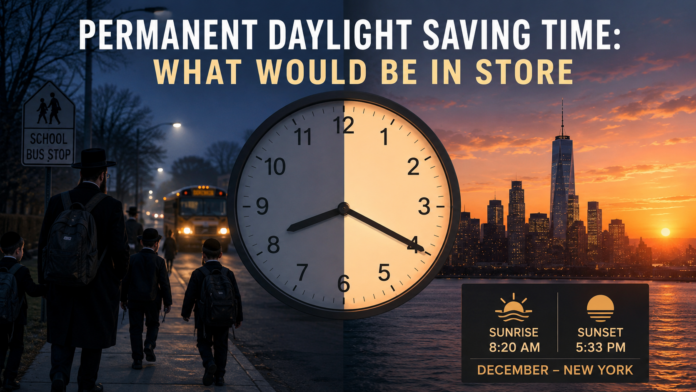
New York. In late December under permanent daylight saving time, the sun would rise around 8:20 AM and set around 5:33 PM. With netz at 8:20, misheyakir would fall near 7:45. A vasikin minyan would be starting Shemoneh Esrei after most of Manhattan was already at work. Candle lighting would move from about 4:11 PM to about 5:11 PM. The rough stretch would run from the middle of November to the end of January.
The cities below show something important. New York is not the worst case, and it is not where this bill came from.
Denver. Denver sits at 105°W, near the western edge of the Mountain time zone. That alone puts its clock about forty minutes behind the real position of the sun, before anyone touches daylight saving time. In late December the sun would come up around 8:20 AM — almost exactly the same as New York, but for a completely different reason. Farther west it gets worse, in Grand Junction and the towns near the Utah border. Sunset would be around 5:38 PM. A child at a 7:40 AM bus stop would be standing there in full darkness.
Miami and the Florida peninsula. Florida is where this bill started, and Florida is the exception. It sits far enough south that the seasons do not swing as hard. December sunrise would be around 8:07 AM and sunset around 6:35 PM. For the frum communities in Miami Beach, Boca Raton and Hollywood, this is the mildest version of the problem anywhere in the country.
California. Los Angeles would see sunrise around 7:59 AM and sunset around 5:48 PM. That is about twenty minutes earlier than New York, which means the Pico-Robertson and Valley kehillos would feel this less than the Five Towns would. San Francisco would see sunrise around 8:25 AM. Redding and Eureka would be closer to 8:35. The California legislature approved a ballot measure in 2018 that authorized the switch. Eight years have gone by and nothing has come of it.
The Bus Stop Question
The safety concern is not a guess. The country already ran this experiment, more than fifty years ago, in 1974.
Congress passed permanent daylight saving time that January, during the Arab oil embargo. About 79 percent of the public supported it. Within a few weeks, Florida reported eight schoolchildren killed in early-morning traffic.
Whether the law actually caused those deaths was argued about then and is still argued about now. A later review by the National Bureau of Standards found the statistics were weaker than the newspaper coverage had made them sound. But the political damage was immediate. Papers ran photographs of first-graders waiting at the curb under streetlights. The governor of Florida called for repeal. By October, public support had fallen to about 42 percent, and Congress repealed the law. The experiment lasted less than ten months.
Today’s research points in both directions at once. Dark mornings move the danger to the morning commute. Bright evenings reduce the danger during the evening commute — and the evening commute has always been the deadlier one, because there are more cars on the road, drivers are tired, and alcohol is more of a factor. Researchers at Rutgers and at the Insurance Institute for Highway Safety have argued that year-round daylight saving time would actually lower the total number of pedestrian deaths for exactly that reason.
But a total is only an average, and an average hides who pays. The danger does not disappear. It moves. It moves west, from the eastern edge of each time zone to the western edge. And it moves down in age, from adults driving home to children walking. Children in Denver, Redding and Indianapolis would carry the cost. Adults in Miami would collect the benefit.
The Halachic Consequences
For the Orthodox community, a sunrise at 8:20 AM is not an annoyance. It is a head-on collision with the workday.
Netz at 8:20 puts misheyakir near 7:45 and vasikin Shemoneh Esrei at 8:20. A man who has to be at a desk in Manhattan by 9:00 could not daven vasikin. He could not even put on tefillin at misheyakir and still make a 7:30 train.
That leaves him two choices, and neither is good. He can daven alone on the train. Or he can rely on the lenient opinions for alos hashachar, which the poskim allow when there is no other option but do not want anyone using as a regular practice. For roughly ten weeks every year, a large part of the community would be forced into the b’dieved — the fallback — by an act of Congress.
There is a way out, though, and the yeshivos are the ones who can build it.
The obvious move is to daven earlier. That move makes everything worse. A yeshiva davening at 7:15 AM under permanent daylight saving time in December would be davening before alos hashachar according to most opinions. The prayers would be too early to count.
The answer runs the other way: daven later, and put learning first.
Here is what that looks like. The building opens at 7:15 AM for a halacha seder — forty-five minutes on Mishnah Berurah, on hilchos tefillah, on the practical halachos that most bochurim pick up in pieces and almost never see taught in order. Shacharis follows at 8:15 or 8:20, right at netz, with tefillin at the proper zman and in daylight. First seder starts at 9:15.
That schedule is not just damage control. Look at what it produces:
- Davening at netz, which most mosdos want and few actually manage
- A daily halacha seder that many yeshivos have wanted for years and could never fit into the schedule
- Bochurim who arrive at davening awake, instead of rolling out of bed into it
- Elementary school students leaving the house in daylight, because school starts at 9:00
That last one deserves attention. It solves the bus-stop problem inside the community without waiting for Congress to do anything. A school that starts at 9:00 AM has no children standing at a bus stop at 7:30. Whatever happens to the national clock, a community still controls its own schedule.
The Erev Shabbos Ledger
Now the other side of the ledger, and it is the strongest argument the bill has.
Late-December candle lighting in New York would move from about 4:11 PM to about 5:11 PM. That extra hour would mostly end the mid-winter scramble of leaving the office at 2:45. Chanukah licht at 5:30 instead of 4:30 would mean fathers are home to light them. For working families this is not a small thing. It is fifty-two Fridays a year entered b’menucha, calmly, instead of under pressure.
So here is the full accounting. Fifty-two Erev Shabbosim gained. Roughly fifty winter mornings lost. The difference is that the mornings can be recovered by changing schedules. The Fridays cannot be recovered any other way.
The Legislative History
The Sunshine Protection Act passed the Senate on March 15, 2022, by unanimous consent. That procedure requires no debate, no roll call and no senator going on record. Senator Marco Rubio of Florida made the request. Nobody objected. The whole thing was over in under a minute.
Several senators later admitted they had not realized the vote was happening. Senator Tom Carper said he would have objected if he had known. A bill that would rearrange the daily schedule of 330 million people passed the Senate without a single word of discussion.
Then it went to the House and stopped cold. Representative Frank Pallone chaired the Energy and Commerce subcommittee that handles it, and he refused to move it forward. His reason was not that he liked the current system. His reason was that a hearing had convinced him Congress had not actually decided which direction it wanted to go. That objection has held in every Congress since. To be clear about the order of events, since coverage often gets it backwards: the bill passed the Senate, not the House. It has been reintroduced in the 118th and 119th Congresses and has not moved.
Right now the language is riding inside the Motor Vehicle Modernization Act of 2026. The House has not taken it up. Under the Sunshine Protection Act, any state that does not exempt itself before the law takes effect would be locked onto the time it currently observes between March and November. Hawaii and most of Arizona would likely stay exempt, since they already keep standard time all year.
Who Wants This
Supporters. Retail is out in front. The National Association of Convenience Stores has pushed to extend daylight saving time for decades, and its logic is simple. A driver heading home in daylight stops and buys something. A driver heading home in the dark just goes home. The golf industry has put a number on its interest: hundreds of millions of dollars for every extra month of evening light. The candy industry spent years pushing to extend daylight saving time past Halloween so trick-or-treating would happen in daylight and kids would collect more. That is not a rumor — it is a documented part of the legislative history of the 2005 Energy Policy Act, which extended daylight saving time by four weeks at industry request.
Opponents. The sleep medicine field, which wants permanent standard time and considers permanent daylight saving time the worst of the three choices. Farmers, quietly — they work by the sun no matter what the clock says, but rural districts worry about long, dark bus routes. The airlines, which do not want their international schedules scrambled. And parents, who have no lobby and have never needed one. The 1974 reversal was not organized by anybody. It took nine months.
The Half-Hour Proposal
There is another bill floating around this year. It would make “half-daylight saving time” permanent. Instead of moving sunrise and sunset a full hour later in the winter, the Daylight Act of 2026 would move the clocks forward by thirty minutes and then leave them alone forever.
Agudath Israel does not support that one either. Motzen’s objection is practical rather than religious: it would make time zones even more confusing than they already are.
The Impasse
Congress has exactly three choices. Keep switching twice a year. Lock the clocks on daylight saving time. Or lock them on standard time.
Here is the trap. Most people agree the switching should stop. But the group that wants it to stop cannot agree on where to stop. Business wants daylight saving time. The medical world wants standard time. Neither side can put together a majority. So the switching continues by default — and switching is the one outcome that nobody is actually asking for.
The structure of the law makes it worse. Under the Uniform Time Act, a state is allowed to opt out of daylight saving time on its own, which is what Arizona and Hawaii did. But a state may not adopt daylight saving time permanently without Congress approving it first. Nineteen states have already passed laws making daylight saving time permanent, all of them waiting on Congress. That is a lot of pressure with nowhere to go, which explains both why this issue keeps coming back and why it never gets settled.
The West Coast is another wall. California, Oregon and Washington have each looked at permanent daylight saving time and each said no. The reason is the arithmetic. A December sunrise in Seattle under daylight saving time would land near 9:00 AM. No Washington State delegation is going to vote to send children to school in that. And without the West Coast, supporters cannot reach the sixty votes they need in the Senate.
Prospects. The most likely thing to break the deadlock is an energy crisis. That is what produced the 1974 law, and it is the only force that has ever pushed past the objections. A presidential push is also possible. The issue does not split along party lines at all, which in this Congress makes it either uniquely easy to pass or completely orphaned. The third possibility is a compromise nobody has bothered to write: permanent daylight saving time paired with a federal requirement that school start times move to match. That single amendment would erase the bus-stop objection, split the sleep researchers, and still hand retail the evenings it wants. It has been sitting there for four years without a sponsor.
Assessment
The bill is sold on June and paid for in December. The cost does not fall evenly. It falls on children at the western edge of each time zone, and on people whose obligations are set by the sun instead of by the clock.
The Orthodox community is in that second group by definition. That is exactly why Agudath Israel is asking for careful thought rather than for a particular answer. Weigh the options honestly, and do not create dark winter mornings by accident.
The yeshivos, for their part, are left with something better than a complaint. They are left with a plan. Halacha seder at 7:15, Shacharis at netz, first seder at 9:15 — a schedule better than what most mosdos run right now, arrived at for a reason that has nothing to do with davening. Any institution that prepares for it will end up davening vasikin as a matter of routine.
And if the bill never passes — which fifty-two years of legislative history suggests is the more likely outcome — the halacha seder is still worth having.