
 Matzav
New York Times Fights DOJ Subpoenas in Showdown Over Air Force One Leak Investigation
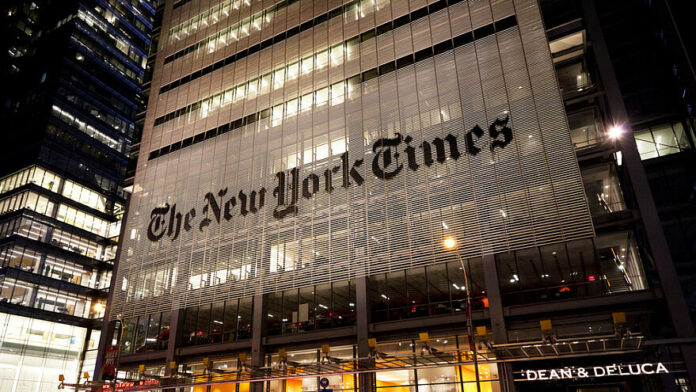
The New York Times asked a federal court on Wednesday to block Justice Department subpoenas issued to several of its reporters, setting the stage for a high-profile legal battle over press freedom and the government’s effort to uncover the sources behind leaked information concerning security concerns involving the new Air Force One.
In a statement accompanying the newspaper’s legal challenge, David McCraw, the Times’ senior vice president and deputy general counsel, argued that the administration’s actions were intended to retaliate against the newspaper.
“As we set out in our motion, these subpoenas are brought in bad faith to punish The Times for its coverage,” David McCraw, the newspaper’s senior vice president and deputy general counsel, said in a statement.
“They violate the constitutional rights of The Times and its journalists.
“We are going to court to defend our journalists’ rights to report freely on the administration and to provide the public with stories that matter,” McCraw’s statement said.
The motion was filed under seal in the U.S. District Court for the Southern District of New York, where the reporters were ordered to appear before a federal grand jury under subpoenas served last Friday.
Although the newspaper initially anticipated that five reporters would receive subpoenas, only three journalists were ultimately served.
The subpoenas, which were delivered directly to the reporters’ homes, represented a significant escalation in the Trump administration’s campaign to identify the sources of classified leaks. Press freedom advocates quickly criticized the move as an attempt to intimidate journalists and news organizations.
The latest development follows an earlier incident this year in which FBI agents searched the home of a Washington Post reporter and seized her electronic devices as part of a separate leak investigation.
At the center of the dispute is reporting by The New York Times concerning security issues involving the newly commissioned Air Force One aircraft.
The aircraft, which was gifted by Qatar and later underwent approximately $400 million in upgrades and modifications by the Trump administration, recently entered active service.
However, when President Trump departed last week for the NATO summit in Turkey, he traveled aboard an older Air Force One rather than the newly upgraded aircraft.
Citing anonymous sources, the Times reported that the Secret Service had urged Trump to use the older aircraft because the newer jet lacked certain advanced defensive capabilities, including anti-missile systems.
Trump publicly rejected those reports on social media, dismissing claims that security concerns played any role in the decision.
The Justice Department has defended its decision to subpoena the reporters, insisting that its investigation is focused on the unauthorized disclosure of classified information rather than on journalists themselves.
“to be clear, reporters are not the targets, those leaking classified information are.”
“We value and appreciate the important role that the press plays in this country,” the department said after the Times reported it had received the subpoenas.
“But DOJ also plays an important role to make sure that the people entrusted with our nation’s secrets do what they’re supposed to do with that information, which means not sharing classified information,” the DOJ said.
During his Senate confirmation hearing on Wednesday, acting Attorney General Todd Blanche defended approving the subpoenas.
“The Department of Justice requires that I authorize it, which I did.
“And those reporters: we’re not targeting reporters, they’re material witnesses,” he said.
When Sen. Peter Welch questioned whether prosecutors intended to force reporters to identify confidential sources, Blanche responded by emphasizing that the investigation concerns classified information.
“No, the question we want to ask them is who provided them with classified national security information, which everybody in this body should want to protect.”
Over the years, the Justice Department has repeatedly revised its internal guidelines governing leak investigations involving members of the press.
Although administrations from both parties have at times obtained journalists’ phone records during national security investigations, compelling reporters to testify before a grand jury about confidential sources has remained an exceptionally uncommon step.
In April 2025, then-Attorney General Pam Bondi rescinded a Biden administration policy that barred the secret seizure of journalists’ phone records during leak investigations, restoring broader investigative powers that many media organizations had strongly opposed.
The revised policy once again authorized prosecutors to use subpoenas, court orders, and search warrants to identify government officials responsible for making “unauthorized disclosures” to reporters.
Bondi’s directive also stated that members of the news media are “presumptively entitled to advance notice of such investigative activities,” while requiring that subpoenas be “narrowly drawn.”
The memo further instructed that search warrants include “protocols designed to limit the scope of intrusion into potentially protected materials or news gathering activities,” the memo stated.
Earlier this year, FBI agents searched the home of Washington Post reporter Hannah Natanson, who covers the Trump administration’s restructuring of the federal government, during an investigation involving a Pentagon contractor accused of improperly removing classified documents.
{Matzav.com}