
 Yated Ne'eman
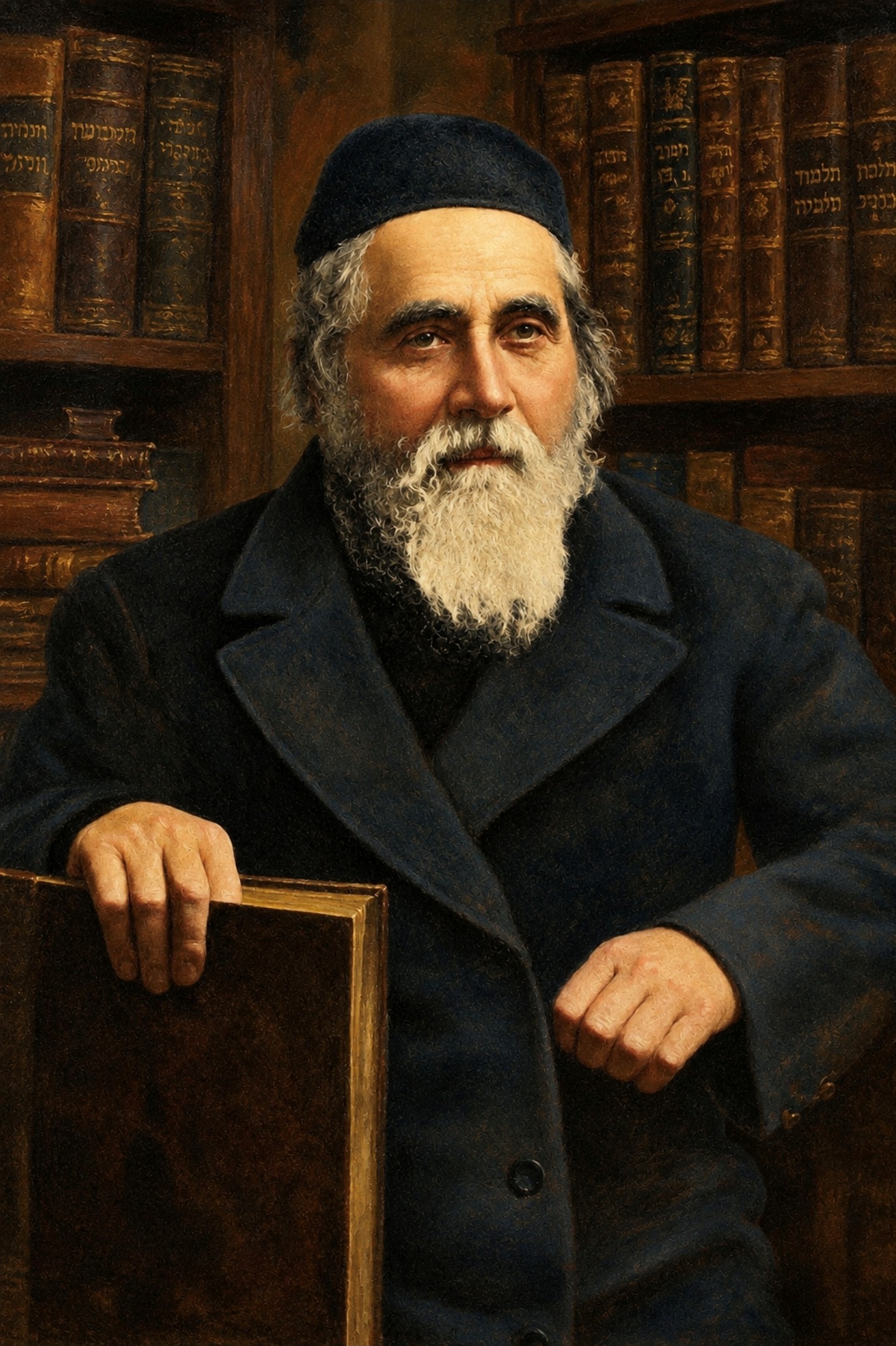
WHEN TORAH BECAME FIRE: One Hundred Years Since the Petirah of Rabbeinu Meir Simcha Hakohen of Dvinsk zt”l
One Hundred Years Since the Petirah of Rabbeinu Meir Simcha Hakohen of Dvinsk zt”l, the Ohr Someiach, Whose Torah Burned and Whose Heart Embraced Klal Yisroel
Daled Elul 5686. Daled Elul 5786. One hundred years have passed since the petirah of one of the great giants whom Hakadosh Boruch Hu planted in Klal Yisroel in the later generations, Rav Meir Simcha Hakohen of Dvinsk, author of the Ohr Someiach on the Rambam and the Meshech Chochmah on the Torah. A century has gone by, generations have changed, entire worlds have risen and disappeared, yet his Torah has lost none of its freshness. In a bais medrash where a difficult Rambam is being learned, where a halacha appears to resist the simple structure of the sugya, where a few words of the Rambam seem to demand an accounting, the Ohr Someiach is opened almost as a matter of course. And when parshas hashovua arrives, and the familiar pesukim are once again placed before the ben Torah, the Meshech Chochmah has the remarkable power to show that a posuk one has known since childhood may contain a halachic foundation, a historical observation, a penetrating understanding of human nature, and an entire world of machshovah, all joined with the precision of Torah.
Yet a hundredth yahrtzeit demands more than another appreciation of the seforim. There comes a point when one must turn from the printed page to the man who stood behind it and ask what sort of person could have produced such Torah? What was the secret of Rav Meir Simcha? How did one person combine such mastery of Shas, Rambam and the entire breadth of Torah, a memory that could reach back across decades, a depth that astonished the greatest talmidei chachomim of his generation, and at the same time a heart of unusual softness toward the ordinary Yid? How could the same man who could become so absorbed in a sugya that an entire night passed without his awareness devote a long hour to a husband and wife whose home was breaking apart? How could the same mind that could build a ma’arocha in the deepest areas of Torah understand that a five-year-old child sitting in a room might accomplish more than every argument that had been presented to his parents? How could the Sar HaTorah rise from his chair and dance around a table with an ordinary couple because shalom had returned to their home? How could a man of such powerful daas know that in the middle of a serious machlokes the correct thing might be to rise and leave the room before anger entered the discussion? And how could one of the treasures of Klal Yisroel refuse to leave a city under bombardment because there were poor Yidden who had no means with which to flee?
The more one studies the episodes of his life, the clearer it becomes that these were not separate qualities gathered within one unusual personality. There was not a Rav Meir Simcha of the sugya and another Rav Meir Simcha of the street. There was one Rav Meir Simcha, and there was one source. Torah had not remained with him as an acquisition of the mind. Torah had become the very form of his life. It determined the manner in which he learned and the manner in which he thought, but it also determined the manner in which he looked at a Yid, the way he spoke to someone who had failed, the way he conducted an argument, the way he entered a troubled home, and the way he understood the responsibility of a rov toward those who could give him nothing in return. Rav Meir Simcha did not merely possess Torah. Torah had taken possession of him.
WHEN THE HOUSE IS BURNING
There are many stories through which one may describe the hasmodah and ameilus baTorah of Rav Meir Simcha, but perhaps none gives the matter its proper definition as clearly as the moshol related by the Rogatchover Gaon at the levayah. The Rogatchover said that his father had been disabled throughout his life and had been confined to a wheelchair. His physical condition was such that two men were required to lift him from his chair, and this was the reality known to the family year after year. When the Rogatchover was a child, a fire suddenly broke out in their home. The flames spread rapidly, smoke filled the house, and those present attempted to carry his father to safety. He refused to leave, insisting that his little daughter was still upstairs and had to be rescued first. They told him that the upper floor was already burning, that there was no time, and that if he did not allow them to remove him immediately, he too would be lost in the fire.
Then, before the astonished eyes of those standing there, the man who could not rise from his wheelchair stood up and ran up the stairs like a healthy young man. A short while later he came back down, carrying his daughter, wrapped in a blanket, in his arms. Those who witnessed it could scarcely understand what they had seen. His father looked at them and explained the matter in a few words, “When a fire is burning, a person discovers kochos he never knew he possessed.” The Rogatchover related the story at Rav Meir Simcha’s levayah and needed to add very little. This, he was saying, was the key to Rav Meir Simcha’s ameilus. His learning always had the appearance of a man whose house was burning. The tiredness that ordinarily limits a person, the distractions that occupy him, the question of comfort and convenience, all these belong to a world in which there is no fire. When there is a fire, hidden kochos are suddenly summoned. For Rav Meir Simcha, there was always a fire in the house, and the fire was Torah.
One may apply to him the words of the novi (Yirmiyohu 23:29), “Halo koh devari ka’eish, ne’um Hashem.” Torah is compared to fire not only because fire illuminates. Fire compels. Fire creates a reality in which indifference is no longer possible. A person does not stand beside a burning house and say that today he is not in the proper mood, that he has not slept enough, or that he would prefer to deal with the matter tomorrow. The very existence of the fire demands all that is within him. Something of this was already evident in Rav Meir Simcha as a child. It is related that at approximately ten years of age, the shamosh entered the bais medrash in the early hours of the morning and found the young Meir Simcha standing upon a ladder near the seforim shelves, a sefer in his hand, entirely absorbed in learning. The shamosh was startled because the child stood in the same place and in the same position in which he had seen him on the previous evening. When he asked when he intended to come down, Meir Simcha looked at him in genuine surprise and said, “What? They already said Borchu after Maariv?” He had not undertaken a special all-night seder, and he had not fought a dramatic battle against sleep. He had simply ceased to notice the passage of time.
After his marriage, while living in Bialystok, Rav Meir Simcha would learn for exceedingly long hours in the Gemilus Chesed shul. His manner was to walk back and forth in the bais medrash with a gemara in his hand, turning the sugya over in his mind. One night, people encountered him walking through the street without his jacket, the gemara still in his hand. When they called his attention to the fact that he was outside, it became clear that he had never noticed leaving the bais medrash. His feet had continued into the street while his mind had remained entirely inside the sugya. There is a temptation, when hearing such stories, to attribute everything to natural gifts, and undoubtedly Rav Meir Simcha possessed extraordinary gifts. His memory was already renowned in his youth, and his mental powers were of an order that few could approach. Yet another story reveals that the gift was not the secret. The gift was the kli. What filled that kli was relentless ameilus and a refusal to allow Torah to pass through him without becoming part of him.
THE SECRET OF A MEMORY THAT SPANNED DECADES
Rav Shlomo Zalman Auerbach related, concerning Rav Shlomo Yehudah Plotchinsky, the father of Rav Eliezer, who had a regular chavrusa seder with the Ohr Someiach. On one occasion, in the middle of learning, Reb Shlomo Yehudah presented a kushya that had no direct connection to the sugya before them. Rav Meir Simcha listened and remarked that he seemed to recall having dealt with that very question more than thirty years earlier, when he had written an entire ma’arocha on the matter. He directed that a certain notebook be taken from the cabinet and indicated where it should be opened. When the passage was found, Rav Meir Simcha asked that it not be read aloud to him. He began to say over the ma’arocha himself while the other talmid chochom followed inside the handwritten text. The words were almost exactly as they had been written more than three decades earlier.
The natural reaction to such an episode is astonishment. A ma’arocha written thirty or thirty-five years earlier had remained in his mind almost word for word. Yet shortly thereafter there was a knock at the door, and Rav Meir Simcha understood that someone required his attention. Before rising from the gemara, he repeated the two lines of Rashi they were then learning. He reviewed them once, then a second time, then a third time, and only afterwards went to the door. When he returned, his chavrusa could no longer contain his question. A short while earlier, he said, the rebbi had repeated an entire ma’arocha from more than thirty years ago, yet now the rebbi found it necessary to chazer two lines of Rashi three times merely because of an interruption of a few minutes.
Rav Meir Simcha answered with the posuk (Mishlei, 23:5), “Hasa’if einecha bo ve’einenu.” Then he said with wonder, “What? Torah, about which it says ‘Hasa’if einecha bo ve’einenu,’ one can leave without chazering it at least three times?” In that answer lies the difference between the way we see the story and the way Rav Meir Simcha saw it. We look at the result and marvel at the memory of thirty-five years. Rav Meir Simcha pointed to the process. The ma’arocha had not been written once and preserved by some miraculous natural faculty. It had remained alive through chazorah, through return, through the unwillingness to be meisiach daas from Torah. The secret of Rav Meir Simcha’s memory was not merely that he remembered more. It was that he permitted himself to forget less.
This gives a penetrating meaning to the words of Chazal concerning Dovid Hamelech. The Gemara in Maseches Sotah, daf 35, says, “Mipnei mah ne’enash Dovid, mipnei shekara l’divrei Torah zemiros, shene’emar zemiros hayu li chukecha beveis megurai.” Dovid called divrei Torah zemiros, and subsequently stumbled in the matter of transporting the Aron, which was placed upon a wagon rather than being carried in the manner commanded for the bnei Kehos. The posuk says (Tehillim 119:44), “Zemiros hayu li chukecha b’veis megurai,” while concerning the carrying of the klei hakodesh the Torah says (Bamidbar 7:9), “Bakoseif yisa’u.”
One may explain the middah k’neged middah as follows. A zemirah is something that eventually flows with ease. The melody is already known, the words come naturally, and the person sings without effort. Torah too can become a shirah within a person, but before it becomes shirah, it must be carried. It demands shoulder, burden, yegiah, and repetition. Only after “Bakoseif yisa’u” can there be the ease of “Zemiros hayu li chukecha.” Torah does not arrive upon a wagon. It is acquired through carrying. Rav Meir Simcha’s astonishing memory was not the replacement for ameilus. It was the fruit of ameilus.
For us, the lesson is both simpler and more demanding than we often wish it to be. We look for methods to retain more, to cover more, to remember a larger amount of material, and there is certainly a place for systems and methods. But the first answer remains chazorah. When a person finishes a daf, he should spend a few minutes saying over what he has learned. When he hears a shiur, he should review its central points. When a chiddush has become clear to him, he should not allow it to be merely an encounter of one afternoon. Chazorah is not only a technique against shikcha. It is an expression of value. When something is precious, one is reluctant to part from it.
TO THINK IN TORAH
One of the distinctive features of the Meshech Chochmah is that its author does not merely gather mekoros and place them beside one another. He appears to enter the world of the posuk itself and to see the people who stand within it. The circumstances are real to him. Responsibility is real. Human emotion is real. The consequences of an action are real. Therefore, a halachic detail, a historical circumstance, a Midrash, and a subtle observation about the human mind may all become part of one explanation, not as separate decorations placed upon the posuk, but because Rav Meir Simcha saw no division between Torah and the reality that Torah describes.
Thus he asks why Hakadosh Boruch Hu accepted the korban of Hevel and did not accept the korban of Kayin. The Torah does not spell out explicitly what was lacking in Kayin’s offering. Rav Meir Simcha notes the distinction between fruit of the earth and sheep. Produce of the field grows to a considerable extent on its own. A flock requires the shepherd to feed, water, guard, and care for it. Hevel therefore did not merely take an object that belonged to him and bring it before Hakadosh Boruch Hu. He brought something into which he had invested himself. The essential point is not merely what was placed upon the mizbeiach, but what of the giver was contained within the gift. In a korban, Hakadosh Boruch Hu does not look only at what a person has given. He looks at how much of the person himself is inside what he has given.
The same derech is seen in his explanation of why Noach was permitted to eat meat although Adam Harishon had not been granted that permission. Noach had spent an entire year in the teivah caring for the animal world. He fed the animals, attended to them, and lived for their needs. Once man had expended himself for the animal world, a new relationship existed between them. So too, Rav Meir Simcha asks why Yosef brought Yaakov Avinu and his family down to Mitzrayim during the famine rather than simply sending food regularly to Eretz Canaan. The answer is rooted in Yosef’s actual position as ruler of Mitzrayim and guardian of its grain reserves. To send great quantities of the national food supply outside the country during a famine could have been interpreted as a betrayal of the responsibility entrusted to him.
These are not merely attractive explanations. They reveal the manner in which Rav Meir Simcha learned. Inside a posuk he saw living people, with duties, pressures, fears, obligations and consequences. It is perhaps not accidental that one who saw people so clearly inside Torah also saw them so clearly when they stood before him.
AFTER THE CHET HA’EIGEL, HE IS YOUR BROTHER
A particularly revealing example appears in the different language employed by the Torah regarding the obligation to assist with a burdened animal. In Parshas Mishpotim the Torah refers to “chamor sona’acha,” the donkey of the person whom you hate, while in Sefer Devorim the Torah speaks of “chamor achicha,” your brother’s donkey. Rav Meir Simcha points to the difference in time. Parshas Mishpotim was given before the chet ha’Eigel. Sefer Devorim was spoken after the chet ha’Eigel. Before a person has himself experienced failure, it is easier for him to look at another Yid who has fallen and to define him by that failure. After the chet ha’Eigel, after Klal Yisroel itself had learned what it means to fall from a great height, the language changes. He is no longer merely sona’acha. He is achicha. After a person knows that he too can fall, it becomes far more difficult to hate another Yid because he has fallen.
This was not a Meshech Chochmah that remained inside a sefer. There was once a man in Dvinsk who had been accustomed to daven before the amud in Rav Meir Simcha’s bais medrash. A rumor began to circulate that the man smoked on Shabbos. Apparently, someone confronted him about it, and he was deeply hurt, and he ceased coming to the bais medrash. Rav Meir Simcha noticed his absence and asked the shamosh what had happened. When he heard the story, he immediately sent for the man. There was no interrogation, no demand for an admission, no public rebuke. Rav Meir Simcha said to him, “Certainly the rumor that you smoke on Shabbos is not true. Therefore return and daven before the amud as you always did.”
The chochmah of the sentence lies in what Rav Meir Simcha chose to give the man. He gave him a way back. He did not define him according to what was being said about him. He told him, in effect, that in the eyes of the rov he still belonged to the bais medrash and still belonged before the amud. There is a form of tochacha that pushes a person into the identity of the aveirah attributed to him, and there is a form of tochacha that places before him the person he can still be. Rav Meir Simcha chose the second.
The same approach appeared when young men who were not shomrei Torah u’mitzvos would enter his bais medrash on Yom Tov. Some of the members of the kehillah wished to prevent them from coming inside. Rav Meir Simcha objected. A Yid who has entered a bais medrash has already taken a step, and one does not destroy the first step because it is not yet the last. His words were simple and contained an entire derech in chinuch, “At first they will answer Amein, and afterwards they will daven.”
A KOHEIN WHO PURSUED SHALOM
One of the most moving areas in the life of Rav Meir Simcha was his involvement in shalom between husband and wife. Chazal say in Maseches Nedarim, daf 66b, “Umah la’asos shalom bein ish le’ishto amrah Torah Shemi shenichtav bikedusha yimacheh al hamayim.” In the Mishnah in Maseches Sotah 1:4, the same principle is expressed: that for the sake of restoring shalom between husband and wife, the name of Hakadosh Boruch Hu, written in kedusha, is erased upon the water. Rav Meir Simcha was a kohein, and the Mishnah in Maseches Avos, 1:12, immediately comes to mind, “Hevei mitalmidov shel Aharon, oheiv shalom v’rodeif shalom, oheiv es habriyos um’ekorvon laTorah.” In his life, the words “verodeif shalom” were not an expression of general goodwill. He pursued shalom in the literal sense.
A husband and wife once came before him when the husband was determined to divorce his wife. Rav Meir Simcha sat with them for a long period of time, speaking, explaining, and attempting to restore proportion to what had become a bitter conflict. Eventually the husband agreed to withdraw from the divorce, and the couple made peace. One might have expected Rav Meir Simcha to give them a brocha and return to his learning, but he did something that reveals how seriously he regarded the moment. The Sar HaTorah rose from his chair and danced around the table with the husband and wife, singing with them in joy because a Jewish home had been saved. He later explained that he wished the reconciliation itself to be fixed in their memory as a moment of simcha, not merely as the conclusion of an unpleasant dispute.
On another occasion, a couple came before him who had already decided to separate. They had a small child, approximately five years old. Rav Meir Simcha spoke with the parents at length and realized that the words were accomplishing nothing. At that point he ceased addressing the parents and turned to the child. He placed the boy upon his lap, played with him, and began speaking to him. According to one version, he told the child that his parents were preparing to make him like an orphan, but that he should not worry because if they separated, he could come to Rav Meir Simcha and Rav Meir Simcha would care for him. Suddenly the parents saw something that the quarrel had concealed from them. They saw their child. They began to cry and announced that they would remain together, and once again Rav Meir Simcha rose to dance.
There was geonus in what happened in that room, but it was not the geonus of finding a stronger taanah. Rav Meir Simcha understood that the room already contained too many taanos. What was missing was not another argument, but another view. Anger had narrowed the world of the husband and wife until only the point of dispute remained visible. Rav Meir Simcha widened the picture. He placed the child, the home, the years, and the consequences back inside it.
On yet another occasion, a husband continued to insist upon divorce despite everything Rav Meir Simcha told him. Finally Rav Meir Simcha said, “Look into the beautiful eyes of your wife. Do not be hasty in your decision. If you separate from her, the day may come when you will miss her and regret what you have done.” The words entered the husband’s heart, and he withdrew from his decision. There is something almost startling in hearing such a sentence from one of the great gedolei Torah of the generation, and precisely there lies part of its meaning. Rav Meir Simcha was not occupied at that moment with what language was expected from the Sar HaTorah. He was occupied with what might save a Jewish home. If Hakadosh Boruch Hu permits His holy Name to be erased for the sake of shalom between husband and wife, the personal kavod of the rov cannot be treated as more precious than that shalom.
TO KNOW WHEN NOT TO SAY THE LAST WORD
True strength of character is not measured only in a person’s ability to state his daas. At times it is revealed by his ability to stop before his daas becomes mixed with anger and personal kavod. One of the remarkable stories in this regard occurred at the rabbinical conference in Petersburg, where the gedolei Yisroel debated the demands of the Russian government that rabbonim acquire knowledge of the Russian language and certain general studies. The issue was regarded as one with serious consequences for the future of the rabbonus in Russia. Rav Meir Simcha and other gedolim stood on one side, while the Chofetz Chaim and Reb Chaim Brisker stood on the other.
On one occasion, the Chofetz Chaim came to discuss the issue with Rav Meir Simcha, and the conversation became sharp. Both men held powerful convictions because each believed that the matter involved kavod haTorah and the future of Klal Yisroel. In the middle of the discussion, Rav Meir Simcha suddenly rose and left the room. He had not exhausted his arguments and had not changed his position. He sensed that the discussion was becoming heated and that anger might enter, and therefore he ended it. The Chofetz Chaim later expressed great admiration for his middos.
Chazal say in Maseches Avos 4:1, “Eizehu gibor, hakoveish es yitzro.” The difficulty is that in an argument there is often a subtle point at which the subject itself changes. At first two people are debating the issue. Later, almost without noticing, each is debating his own need to prevail. It no longer pains him only that the other person is mistaken. It pains him that the other person refuses to acknowledge that he is right. Rav Meir Simcha had the strength to maintain a firm daas and, at the same time, the clarity to identify the moment when emes might begin to become entangled with personal kavod. There are times when gevurah means standing one’s ground, and there are times when greater gevurah means leaving the room before saying the final word.
“AS LONG AS NINE REMAIN, I WILL BE THE TENTH”
During World War I, Dvinsk became an area of severe fighting. Because of its military fortress, the city and its surroundings were subjected to heavy bombardment. Those who possessed the means to leave attempted to do so, and the city gradually emptied. Those who remained were, to a large extent, those who had no choice. Poor families, women whose husbands had been taken into military service, and people without money or connections remained behind while danger drew closer. It was only natural that those around Rav Meir Simcha urged him to leave. He was one of the gedolei hador. His Torah belonged to all of Klal Yisroel, and there appeared to be every reason for him to place himself beyond the danger.
His answer was one of those sentences in which an entire conception of rabbonus is revealed. “I will not abandon my brothers in an eis tzarah. As long as nine Yidden remain in the city, I will be the tenth for the minyan.” A Rav is not merely the tenth man when the bais medrash is full, and hundreds wish to stand near him. The test of leadership is what occurs when most people have gone, and those who remain are precisely those who have no ability to leave. Rav Meir Simcha remained because they remained.
He strengthened the people in emunah and bitachon, attended to their needs, and showed particular concern for the women whose husbands had been drafted. He knew the addresses of soldiers at the front and would assist their wives in writing to them. Rav Meir Simcha and his rebbetzin themselves lived in privation and at times had to chop wood with their own hands in order to heat their home, yet funds that reached him were distributed to others who had suffered through the war.
One may see here the answer to what can appear, at first glance, to be a contradiction. The same man who would not leave two lines of Rashi without chazering them three times was prepared to interrupt his learning when a Yid required him. In truth, there is no contradiction. A person who truly learns Torah does not become less aware of the Yid standing at the door. He comes to understand that the Yid standing at the door may now be part of the sugya Hakadosh Boruch Hu has placed before him.
THE TWO VERTLACH FROM KRYNICA
In the summer of 5685, two of the great Torah personalities of the generation found themselves staying in the same inn in the health resort town of Krynica, Rav Yitzchok Zev Halevi Soloveitchik, the rov of Brisk, and Rav Meir Simcha Hakohein of Dvinsk. Both had come to the resort for rest and recuperation, and during the days they spent there they spoke together in divrei Torah and exchanged chiddushim. It is related that when the Brisker Rav returned home, he brought with him two particular vertlach that he had heard from Rav Meir Simcha and would repeat them with marked hispa’alus.
Something is fitting in the fact that these two chiddushim remained with the Brisker Rav. They are sharp and exact, built from a diyuk in the words of Torah, yet in both cases the lomdus reveals something hidden within the human being. One vort finds the subtle pleasure of the neshomah within the halachos of brachos. The other finds the necessity of hope within the halachos of golus. Both contain a precision that belongs entirely to the bais medrash and, at the same time, an understanding of man that could only have come from someone who saw Torah and life as one reality.
“HAPA’AM ODEH ES HASHEM”
In the names given by Leah to her first four sons, the Torah records a distinct progression. Concerning Reuven, she says (Bereishis 29:32-35), “Ki ra’ah Hashem be’oni.” Regarding Shimon, “Ki shama Hashem ki senuah anochi.” Regarding Levi, “Hapa’am yilaveh ishi eilai.” Only at Yehudah does Leah say, “Hapa’am odeh es Hashem.”
Chazal already teach that the names of the shevatim express more than the circumstances of their birth. In Bereishis Rabbah (71:3), Reb Yosi bar Chanina says, “Shemoseihen na’im uma’aseihen na’im, eilu haShevatim, Reuven, re’u bein bein habonim, Shimon, shome’a bekol Aviv shebaShomayim.” The names themselves contain a remez to the essence and future purpose of the shevatim.
Rav Meir Simcha explains that Reuven corresponds to re’iyah, sight, Shimon to shemiyah, hearing, and Levi, whose name is rooted in levayah and connection, to the sense of touch. A person can receive great pleasure through sight, hearing, and touch, yet there is no specific birkas hanehenin recited upon the pleasure itself. The sense of rei’ach is different. The Gemara in Brachos, daf 43b, derives from the posuk “Kol haneshomah tehallel Kah,” “Eizehu dovor shehaneshomah nehenes mimenu ve’ein haguf neheneh mimenu, hevei omer zeh harei’ach.” Fragrance is described as a pleasure of the neshomah, and upon that pleasure Chazal established a brocha.
Now the seder becomes clear. Yehudah is the shevet from which Melech Hamoshiach will come, and concerning Moshiach the novi says in Yeshayah 11:3, “Vaharicho b’yiras Hashem.” Reuven corresponds to sight, Shimon to hearing, Levi to touch, while Yehudah, the source of Moshiach, corresponds to fragrance. Therefore precisely at Yehudah does Leah say, “Hapa’am odeh es Hashem,” because here appears the sense upon whose enjoyment a person makes a brocha and gives hoda’ah.
The beauty of the chiddush lies not only in the correspondence between four names and four senses. Rav Meir Simcha sees the brocha on fragrance as an expression of the neshomah encountering a pleasure too subtle to be described in ordinary physical terms. And in Moshiach himself the ordinary senses are not sufficient. His judgment will not be merely “lemar’eh einav” and not merely “lemishma aznav.” There is a deeper perception, “Vaharicho beyiras Hashem.” Halacha, Midrash, the names of the shevatim, the halachos of brachos, the nature of the neshomah and the nevuah concerning Moshiach become one structure.
AN IR MIKLOT WITHOUT HOPE
The second vort concerns the din of arei miklot. The Mishnah in Makkos 2:4 says, “Leheichan golin, le’arei miklot, l’shalosh shebe’eiver haYarden veleshalosh sheb’Eretz Canaan.” The Mishnah adds, “Ad shelo nivcheru shalosh sheb’Eretz Yisroel lo hayu shalosh shebe’eiver haYarden koltos, ad sheyehu sheshtan koltos ke’achas.”
The din requires explanation. Moshe Rabbeinu had already designated three cities in eiver haYarden, as the posuk states (Devarim 4:41), “Az yavdil Moshe shalosh arim be’eiver haYarden mizracha shemesh.” There was no deficiency in their designation. The other three cities had not yet been chosen only because Eretz Yisroel had not yet been conquered and divided. Why should the cities already properly designated not begin functioning immediately as arei miklot?
Rav Meir Simcha answers by considering the position of the rotzeiach b’shogeg. A person who enters an ir miklot must remain there until the death of the Kohen Gadol. Even if years of golus lie before him, there remains one possibility in his mind. The Kohen Gadol may die, and he may return home. The golus contains punishment and kapporah, but it does not remove hope.
At that point in history, however, there was a certainty. Hakadosh Boruch Hu had already declared that Elazar Hakohein would be among those responsible for dividing Eretz Yisroel, as the posuk says (Bamidbar 34:17), “Eileh shemos ha’anashim asher yinchalu lachem es ha’aretz, Elazar Hakohen viYehoshua bin Nun.” Until the conquest and division of the land were completed, Elazar could not die. Had the cities of eiver haYarden begun receiving rotzchim immediately, the person entering the ir miklot would know from his first day that there was no possibility of leaving for the entire period of conquest and division.
Rav Meir Simcha writes that ordinarily the rotzeiach “Mekaveh tamid shema yamus hakohein hamoshiach veyeitzei bemisaso,” whereas in these circumstances he would be “meya’eish lachzor ad hisnachel ha’aretz.” He concludes, “Lachein bechai gavna shelo yihiyeh lo tikvah lashuv teikef, lo amrah Torah liglos.”
The chiddush is sharply lomdish, but its inner point is striking. The Torah commands golus. It does not command yi’ush. A person may be required to remain within the walls of the ir miklot for years, yet somewhere within his world there must remain the possibility of return. The ir miklot may close the person inside a place, but it is not meant to close hope out of his future. Perhaps this explains why the Brisker Rov retained these two vertlach with such hispaalus. In the first, Rav Meir Simcha found the pleasure of the neshomah within hilchos brachos. In the second, he found the hope of the person within hilchos golus. The lomdus does not become less exact because it sees the human being. On the contrary, the human being himself emerges from the exactness of the din.
THE TEFILLAH ON THE EMBANKMENT
One of the most powerful accounts concerning Rav Meir Simcha was preserved in the testimony of Isser Harel, who later became head of the Mossad and who had lived in Dvinsk as a child. He recalled a year in which a severe thaw occurred in the regions feeding the Dvina River, while the river around Dvinsk and further downstream remained covered with thick ice. Water and enormous blocks of ice accumulated, the river rose, and the embankment protecting the city came under severe pressure. Residents began moving to upper floors and rooftops because they feared that the embankment would break and the city would be flooded.
In the early hours of Shabbos morning, the danger reached its height. Frightened people ran into the bais medrash and announced that the water was about to break through. Rav Meir Simcha rose from his place while still wrapped in his tallis and walked out of the bais medrash. The people followed him. He climbed onto the embankment and stood there in tefillah. Isser Harel testified that as a child he stood only a few steps away. During the tefillah, the ice began to move, a passage opened for the water, the river level fell, and the danger passed. The child standing there remembered throughout his life the image of Rav Meir Simcha wrapped in his tallis, standing before the rising river and davening for an entire city.
There is an extraordinary element in the story, but perhaps there is another point that deserves equal attention. Why did the people follow him? The answer had been written during decades before that Shabbos morning. Rav Meir Simcha had stood with them in the less dramatic hours of life. He had stood with the poor, the widow, the soldier’s wife, the troubled husband, the frightened child, the young Yid who had drifted away, and the family that had nowhere to flee. When a rov stands with his people through the ordinary difficulties of life, they know whom to follow when the river rises.
“YACHSHOV KI BERLIN HI YERUSHALAYIM”
One cannot speak of Rav Meir Simcha without mentioning the celebrated and chilling passage in the Meshech Chochmah in Parshas Bechukosai. On the posuk (Vayikra 26:44), “Ve’af gam zos bihyosam b’eretz oyveihem lo me’astim v’lo ge’altim l’chalosam l’hofer brisi itam,” Rav Meir Simcha describes a recurring process in the history of Klal Yisroel in golus. A Jewish community reaches a new country after persecution and displacement. It begins again, builds botei medrash and kehillos, raises families, develops institutions, and gradually becomes established. After generations, the sense of impermanence weakens. The foreign country no longer feels foreign. The awareness of golus becomes less immediate, until a generation may arise that begins to see the land in which it lives not merely as a place of residence, but as its essential homeland.
Rav Meir Simcha explains that Yaakov Avinu did not wish to be buried in Mitzrayim because he did not want his descendants to regard Mitzrayim as the place to which they truly belonged. A Yid may build in golus, learn Torah in golus, and prosper in golus, but one awareness must remain. His roots are elsewhere. Within this discussion, Rav Meir Simcha writes the words that later history caused generations to read with a shudder (Meshech Chochmah, Vayikra, 26:44), “Yachshov ki Berlin hi Yerushalayim.”
There is no need to describe the words as a literal nevuah in order to appreciate their depth. Rav Meir Simcha identified a spiritual and historical process. The danger of golus does not arise only when a Jew is persecuted. There is another danger when he becomes so comfortable that the very consciousness of golus disappears. Yet the Meshech Chochmah does not end with despair. The entire passage is part of an explanation of the survival of Klal Yisroel, which is shaken and displaced, yet returns again and again to its Torah and rebuilds.
There is a remarkable connection between this and the story of Rav Meir Simcha’s memory. To the individual, the posuk says (Mishlei 23:5), “Hasa’if einecha bo ve’einenu.” One cannot be meisiach daas from Torah. In the Meshech Chochmah, Rav Meir Simcha places a similar demand upon Klal Yisroel as a nation. Just as the individual cannot allow Torah to disappear from his consciousness, the nation cannot allow its identity to disappear from its consciousness. There is a shikcha of information, and there is a shikcha of who one is.
WHEN TORAH MAKES A PERSON MORE GENTLE
There is a question that emerges from all these stories and perhaps deserves to stand at the center of the entire portrait. What is Torah meant to do to a person? A man may learn much and, because he understands quickly, becomes impatient with someone who understands slowly. He may be exacting in mitzvos and therefore find it difficult to tolerate someone still standing far away. He may be convinced that his position is correct and therefore react with impatience to anyone who disagrees. Knowledge itself does not automatically refine the person who possesses it.
With Rav Meir Simcha, the movement was in the opposite direction. The greater his Torah became, the greater became the space within him for another Yid. He knew how to state a strong daas, yet also how to rise and leave before anger entered the conversation. He could become so absorbed in a sugya that he did not know whether it was night or morning, yet a knock at the door could still summon him to the needs of another person. He was known throughout the Torah world as the Sar HaTorah, yet he saw no contradiction in dancing around a table with a simple couple because their home had been saved.
Chazal say in Moed Koton, daf 17a, “Im domeh harov l’malach Hashem Tzevakos, yevakshu Torah mipihu, ve’im lav, al yevakshu Torah mipihu.” A malach is a shaliach. He possesses no personal cheshbon in the fulfillment of his shlichus. He does not ask what preserves his position or what enhances his image. He asks what the shlichus requires. Perhaps this was among the deepest secrets of Rav Meir Simcha’s gadlus. He did not use Torah in order to build the figure of Rav Meir Simcha. He allowed the figure of Rav Meir Simcha to disappear before whatever Torah demanded of him at that moment. If the sugya demanded his night, he gave it the night. If a Yid required his hour, he gave him the hour. If shalom required his kavod, the kavod was placed aside. If emes required him to stop speaking, he left the room.
ONE HUNDRED YEARS LATER
A hundred years after his petirah, we do not expect to become Rav Meir Simcha. To stand before such a figure merely in order to measure ourselves against him would lead only to distance. But the small actions from which the gadlus was built do belong to us. From the astonishing memory we need not take the ma’arocha remembered after thirty-five years. We can take the two lines of Rashi reviewed three times before answering the door. From the Petersburg conference we need not take upon ourselves the questions confronting the gedolei hador. We can take the moment in an ordinary argument when we realize that another sentence will not establish the truth and will only preserve our kavod. From the stories of shalom bayis we can learn that anger narrows the picture and that sometimes the task is not to answer the argument, but to restore everything the argument has caused us to stop seeing.
And from Dvinsk during the war we are left with one sentence whose demand is not limited to rabbonim or gedolei Yisroel. “As long as nine Yidden remain in the city, I will be the tenth for the minyan.” Every community has its nine. Every family has them. There is the person whom others have already left behind, the bochur with whom conversation has become difficult, the lonely elderly Yid, the person whose life is not going well, the one who cannot offer status or benefit in return for the attention he receives. Leadership begins in the willingness not to ask who else will stay, but whether I will stay.
THE LIGHT THAT REMAINS
The names of Rav Meir Simcha’s seforim acquire another meaning when viewed against his life. Ohr Someiach. Meshech Chochmah. Light and chochmah. The chochmah remains printed on the pages and is learned in every generation, but the ohr was not confined to the seforim. His own life contained hardship, bereavement, poverty, and the heavy burdens of rabbonus, yet those who encountered him remembered warmth, humor, concern, and the ability to bring people close. It was not the light of a person who had never known darkness. It was the light of a person who had known darkness and refused to allow it to determine what he would give to others.
Perhaps no posuk is more fitting with which to conclude than the words of the Navi concerning the true kohein (Malachi 2:6), “Toras emes haysah befihu v’avlah lo nimtza bisfasov, b’shalom uv’mishor halach iti, v’rabim heishiv mei’avon.” In those words one can almost see the figure of Rav Meir Simcha Hakohein of Dvinsk. Torah was in his mouth, shalom was in his path, and the Yid was in his heart.
One hundred years have passed since daled Elul 5686. The Ohr Someiach remains open. The Meshech Chochmah remains open. The chiddushim are repeated, the questions are asked, and his Torah continues to speak in botei medrash throughout the world. But perhaps the true measure of a yahrtzeit is not only that the sefer remains open. It is whether something of the person who wrote it remains open within us. One more chazorah before moving on. One less word spoken in anger. One Yid brought near instead of pushed away. One Jewish home strengthened. One person whom others have abandoned who discovers that someone has remained beside him. And when the place has emptied, when the easier choice is to leave, and when it seems that only nine remain, to remember the words of the great rov of Dvinsk and to be able to say them ourselves.
“I will be the tenth.”