
 Yated Ne'eman
Trump and Iran’s Leaders Locked in a Battle of Wills Over the Strait of Hormuz
When American and Israeli warplanes struck across Iran on February 28, 2026, Trump administration officials privately predicted the fighting would be over within six weeks. Nearly six months later, that timeline now looks ridiculously unrealistic. A 60-day ceasefire with Iran that was to begin in mid-June with the re-opening of the Strait of Hormuz to all commercial shipping traffic was broken by Iran before the ink on the signed Memorandum of Understanding (MOU) had enough time to fully dry, while the strait, the maritime chokepoint through which roughly a fifth of the world’s oil and gas had been flowing, remained closed creating a global energy crisis.
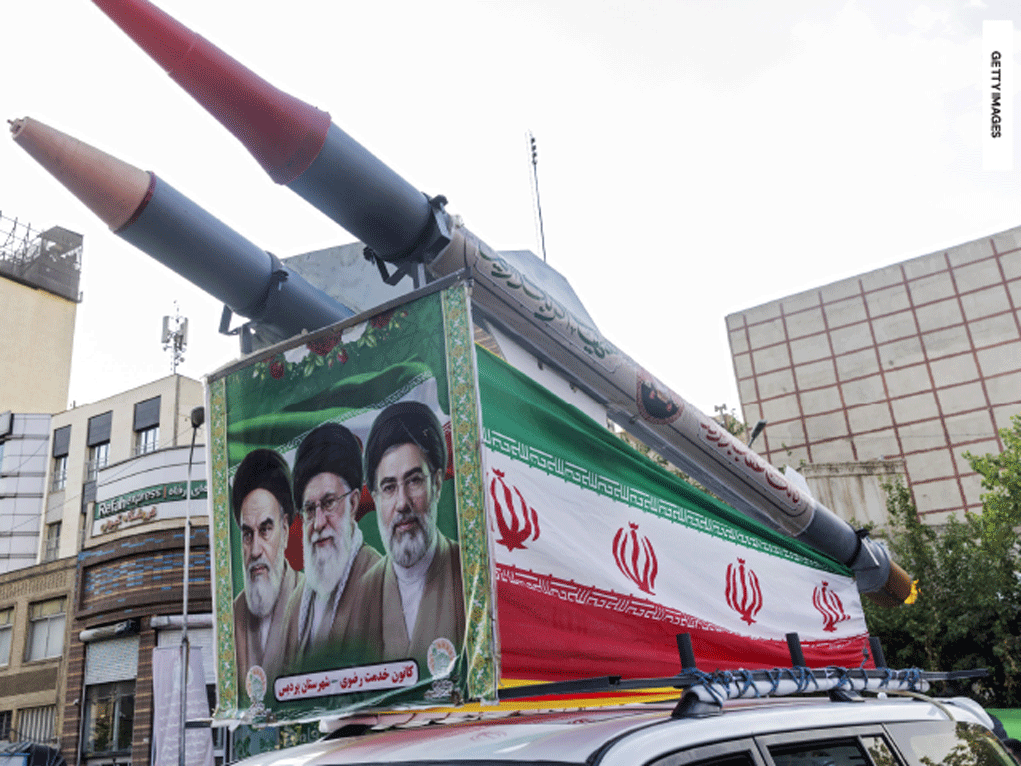
As a result, Iran’s disputed control over the strait has now replaced its nuclear weapons program as the most immediate point of contention in a conflict that has quietly evolved from a battle between each side’s military capabilities into a test of each side’s endurance and will to outlast the other.
This is no longer a war being fought primarily with ballistic missiles, drones, and airstrikes. It has now become a war of attrition, fought with economic sanctions, naval blockades, proxy skirmishes, rumors about the negotiations of peace deals through third parties that never seem to materialize, and mind games being played by both governments, each one betting that the other will crack first.
Trump’s Strategic Bet: Squeeze Iran’s Economy Until It Breaks
President Trump has, for now, stepped back from threats to order fresh strikes by the warplanes and ships of the U.S. Central Command on Iranian territory. In their place, his administration has doubled down on its application of the tools of economic warfare against Iran. Treasury Secretary Scott Bessent has to implement additional sanctions on Iran’s Islamic regime harsher than any imposed before, and Defense Secretary Pete Hegseth has confirmed that the U.S. Navy is prepared to sustain its current blockade of Iranian ports in the Persian Gulf for as long as it takes to force Iran to meet Trump’s demands.
Trump is now apparently willing to pay the political price for this economic war of attrition against Iran, even if it means that the Republican Party will lose its majority control of one or both houses of Congress in November’s midterm election. He made that clear last week when he told the American people that he now expects them to continue to absorb the cost of higher gasoline prices — now around $4 a gallon, as a price that they must be willing to pay to deny Iran the possibility of obtaining a nuclear weapon, and framed that economic pain as a necessary patriotic sacrifice rather than a result the failure of his war policy against Iran.
The logic behind Trump’s strategic shift is straightforward. Rather than risk the lives of more American servicemen or kindling a wider regional war through the renewed bombing of the remaining targets on the ground in Iran, Trump has switched to a new strategy. He is now determined to continue choking off Iran’s flow of oil export revenue, forcing it to further deplete its cash reserves and closing its remaining trade routes until the suppressed unrest still bubbling beneath the surface of Iranian society bursts out once again. He hopes that this will be able to do what more U.S. and Israeli airstrikes could not: break the spirit and grim determination of Iran’s new hardline leaders to withstand the current U.S. military and economic siege for as long as it takes.
Trump Waiting for Iran’s Society to Crack Once Again Under Pressure
Iranian society has already cracked once under pressure. Starting at the end of last December, street demonstrations in cities across Iran continued to grow during the first week in January. They were driven by the despair of Iran’s citizens over their country’s economic free-fall, with no end in sight, and their growing anger at the Islamic regime’s repression of all public expressions of criticism or dissent.
This erupted into mostly peaceful street protests, to which the regime reacted with an unprecedented lethal military crackdown. Iran’s Supreme Leader, Ayatollah Ali Khamenei, personally ordered his Supreme National Security Council to “crush using any means necessary” anyone involved in the demonstration with extreme violence and no mercy.
It began on January 8 with a government-imposed, total internet and international telephone communications blackout, accompanied by the deployment of the Islamic Revolutionary Guard Corps (IRGC) troops alongside tens of thousands of mobilized members of the IRGC-controlled Basij civilian militia. These armed thugs opened fire from rooftops and public buildings into crowds of demonstrators using rifles, shotguns, heavy machine guns, and live ammunition. Over the next two days, while the rest of the world was unable to see what was going on inside Iran, it has been estimated, based upon information from Iranian health ministry officials, by various independent sources, human rights organizations and Iranian opposition groups in exile that as many as 36,500 unarmed Iranian civilian protesters were murdered in the streets by agents of their own government following the orders of the regime’s top officials. Iranian security forces also raided hospitals across the country to kill or arrest Iranian civilians who were recovering from the injuries that they suffered at the hands of regime thugs during the street demonstrations.
During the weeks that followed the street protests, as many as 50,000 more protesters were arrested and held in prisons indefinitely. In addition to ordinary citizens and neighborhood demonstrators, they included university students and teachers, children and minors as young as 13, medical professionals and doctors who treated wounded protesters, as well as defense lawyers and journalists. Thousands of them have been prosecuted in Iran’s Revolutionary Courts without being given access to independent legal counsel. Many have received lengthy prison sentences, and according to Amnesty International, at least 39 people have been executed based upon their coerced confessions to capital crimes.
The Iranian Regime Change That Never Came
Because of this unrest, both President Trump and Israeli Prime Minister Binyomin Netanyahu believed that the deadly airstrikes that targeted and killed dozens of Iran’s top leaders on February 28, the opening day of the war, would lead to a popular uprising supported by millions of Iranian civilians that would overthrow and replace the Islamic regime with one that would agree to President Trump’s terms. Chief among these demands would be the dismantling of Iran’s nuclear weapons program, followed by strict limitations placed upon its ballistic missile program and an end to its support of its terrorist proxy groups across the region, including Hezbollah, Hamas and the Houthis.
U.S. and Israeli officials appeared to believe that the decapitation of Iran’s political and military leadership on the first day of the war, followed by five weeks of intensive air strikes that wiped out most of Iran’s military capacity, would leave the regime leaderless and in confusion, while reigniting the street protests that had been suppressed in January. Taken altogether, Trump and Netanyahu were hoping for, and half expecting to see, a popular nationwide uprising across Iran that the remnants of the Islamic regime would not be able to contain.
However, such an uprising did not take place, in part because the Islamic regime had, beginning in 2022, carefully prepared detailed plans to deal with such a contingency under the leadership of Ari Lanjani, the secretary of Iran’s Supreme National Security Council. The plans called for the violent suppression of any popular revolt by Iranian citizens in response to an external attack. The Iranian regime’s plans were reportedly modeled after the brutal tactics used by the government of Communist China to carry out the 1989 Tiananmen Square massacre of pro-democracy Chinese demonstrators.
Trump Learned Hard Lessons From the Failure of the MOU
President Trump has apparently learned the appropriate lessons from the quick collapse of the Memorandum of Understanding that he signed in June with the Iranian regime. Its goal was to reopen the Strait of Hormuz and relieve the pressure on global energy markets and American consumers due to the elevated prices for crude oil and gasoline at the pump because of Iran’s largely successful effort to interrupt the flow of oil from the Persian Gulf.
The rise of gasoline prices across the United States to an average of about $4.00 a gallon has become a serious political liability for Trump and Republican candidates running for seats in the House and Senate in the upcoming midterm elections on November 3.
Iran leaders claim that they have effectively closed the Strait of Hormuz to crude oil tankers trying to transport oil to clients around the world from other Persian Gulf producers, and that they intend to maintain permanent control over the strait, which has long been considered to be international waters through which ships of all nations are legally entitled to free passage, unmolested.
Trump’s Energy Secretary Insists That More Oil Is Getting Through the Strait
However, the Trump administration’s Energy Secretary, Chris Wright, insisted in public statements last week that the strait is far more open to passage by oil tankers carrying crude oil from other Persian Gulf producers than the elevated current prices on global oil markets of around $80 a barrel would indicate.
Wright claimed that U.S. Navy-escorted tankers pushed Gulf oil exports through the strait to above 20 million barrels on August 8 — up to four times larger than the estimates of 5-7 million barrels per day reported by independent global shipping tracking firms like Kpler. In addition, some of the millions of barrels a day of crude oil from Saudi Arabia and the United Arab Emirates that is no longer passing through the Strait of Hormuz is now flowing through overland pipelines to ports on the Red Sea and the Gulf of Oman to reach global markets. In addition, other oil-producing nations around the world, including the United States, are boosting their rate of oil production as fast as they can to ease the global shortage.
On Monday, President Trump told White House reporters that the U.S. has total control over the strait and that “we’re taking out millions of barrels of oil a week. The strait is open, and the oil prices are coming down, and they will continue to come down unless we decide to do something more drastic [militarily against Iran] than what we’ve been doing,” he added. But unfortunately for American consumers, Trump’s latest claim that the flow of oil through the strait has been restored has not been accepted by global oil markets, which is why the current global market price for crude oil remains above $80 a barrel, compared to roughly $60 a barrel before the U.S-Iran war started.
On Monday, Secretary Wright insisted that the average daily volume of oil moving through the strait in recent days is actually around 9 million barrels a day, and that the discrepancy between his estimate and those reported by firms like Kpler, is because many of the U.S. Navy-escorted oil tankers travelling through the strait have turned off their electronic tracking signals and are sailing through little-used shipping lanes to evade detection and attack by elements of Iran’s Islamic Revolutionary Guard Corps (IRGC).
Wright told Fox News that more oil is passing through the Strait of Hormuz than the commercial data trackers realize, and that only the Trump administration has an accurate count of oil tankers leaving the region because “ours aren’t estimates; we have the actual data.” In a post on his X social media account, Wright further explained that “Many private businesses undercount the number of ships leaving the Strait of Hormuz due to ships moving covertly through the waterway.”
Increases in Oil Prices Filter Through the Entire Global Economy
The difference between these estimates is important because the price of crude oil on the global market is set based upon the total volume of oil that is available on any given day. Daily changes in the price of crude oil are a major factor in setting the price for all forms of energy used around the world. That includes the cost of electricity produced by the burning of fossil fuels, oil-fired home heating systems, the transportation of groceries and other consumer goods by fossil fuel-burning trucks, ships, trains, and planes, and many other segments of the economy.
As a result, the more crude that is moving through the Strait of Hormuz on any given day, the more affordable the price of energy is everywhere and for everyone, including tens of millions of Americans who will be voting in November. They are now struggling to pay the cost of gas at the pump for their cars because it is now roughly a dollar per gallon (or about 30%) higher than it was when Trump took office last year, mostly because of the restrictions now being imposed by both sides on tanker traffic passing through the Strait.
Other Factors Driving the Current Global Energy Shortage
Other factors contributed to the current historically high prices for all kinds of fossil fuels. One of them was the Biden administration’s green energy policies and its open war against American fossil fuel producers. It adopted policies that deliberately inhibited the growth of domestic fossil fuel production. It also forced the closure of many fossil fuel-powered power plants and attempted to replace them with less reliable and more expensive solar and wind energy.
Furthermore, the Biden administration’s war against the domestic fossil fuel industry, and the sanctions it imposed on Russia after it invaded Ukraine in 2022, led to a political backlash from American consumers against the sharply increased cost of gas at the pump. In reaction, President Biden then decided to artificially reduce gas prices by holding an emergency sale of 180 million barrels of crude oil to be taken from this country’s Strategic Petroleum Reserve (SPR).
As a result, when the Trump administration was faced with a real shortage in global oil supplies due to Iran’s decision to close the Strait of Hormuz, the amount of oil left in storage at the SPR, less than half of its total capacity, was deemed to be insufficient to replace Persian Gulf oil if the strait were to remain closed for an extended period of time.
Yet another unexpected global development which has contributed to the recent sharp increases in the prices of diesel oil and jet fuel has been the success of Ukraine’s recent campaign to use long-range drones to attack Russia’s main oil refineries. This has further reduced global supplies of those fuels and driven up their price, which is now being passed on in higher airline ticket prices and the increased cost of shipping all kinds of goods by truck.
All of these cost increases impacting American consumers have created a new political issue, the so-called “crisis of affordability.” It is an issue that Democrat candidates, starting with New York City’s progressive mayor, Zohran Mamdani, have been able to use effectively against Trump-supporting Republican candidates in recent elections across the country as well as in the upcoming campaign for the midterm elections in November.
Before the U.S. war with Iran started on February 28, an average of more than 130 ships a day were able to cross the strait unmolested, transporting a wide variety of goods, including fertilizer, aluminum, helium, liquefied natural gas, as well as about 20 million barrels-a-day of crude oil. But last week, according to the tracking data from Kpler, a total of only 95 ships were able to transit the strait. In addition, the gap between Trump’s claim that the U.S. Navy has restored much of the normal flow of crude oil through the Strait of Hormuz and the fact that the price of gas at the pump is still elevated raises the still unanswered question of which side’s estimate is more accurate. It has also begun to damage Trump’s credibility, even in the eyes of some of his MAGA supporters.
More Oil Producers Planning to Bypass the Strait of Hormuz
Regardless of the outcome of the current dispute between Iran and the United States over who is in control of the Strait of Hormuz, the extended disruption in the flow of crude oil from the Persian Gulf has already resulted in the start of far-reaching, long-term changes in the global oil supply. With the closure of their normal oil shipment routes through the Strait of Hormuz, some of the Persian Gulf’s other main oil producers have begun diverting millions of barrels of the crude oil they produce daily into existing overland pipelines that lead to seaports that bypass the Strait of Hormuz, including Saudi Arabia’s East-West pipeline leading to the port of Yanbu on the Red Sea, and another overland oil pipeline in the United Arab Emirates (UAE) leading to the port of Fujairah on the Gulf of Oman. Other Middle East nations, including Israel, are also now making plans to build new pipelines to provide alternatives for transporting oil across the region, which could eventually eliminate altogether the need to get Iran to permit the Strait of Hormuz to reopen to unrestricted oil tanker traffic.
But that permanent solution to the current stalemate between Trump and Iran’s leaders is still years away. In the meantime, both sides in the conflict are now playing a waiting game. The Iranians are apparently counting on the growing domestic political pressure on Trump to reopen the strait to reduce gas prices and force him to give in to their demands before the upcoming midterm elections. Meanwhile, after having first considered and then rejected the option of launching another wave of American military airstrikes on Iran’s most crucial remaining economic and infrastructure targets, Trump has apparently decided to step up the pressure on Iran’s failing economy with increased sanctions while maintaining the existing U.S. naval blockade of Iran’s ports.
Many believe that this course of action is likely to be more effective at breaking the current stalemate and undermining the Islamic regime than Trump carrying out his many threats to resume U.S. military attacks on Iran. That is because Iran’s current leaders appear to be ready to withstand any amount of additional damage those attacks would inflict, because the welfare of Iran’s people is apparently of little or no concern to them.
Trump’s Latest Threats to Take Over the Strait of Hormuz Permanently
Meanwhile, in his latest public statements about the future of the conflict, Trump has mused, apparently half-jokingly, about declaring the Strait of Hormuz to be U.S. territory. More seriously, President Trump has threatened to bomb Oman, a longtime American ally in the region, because Oman’s leaders had been negotiating a deal with Iran’s leaders to share the economic benefits from their control over both sides of the strait.
That threat, which Trump delivered last week during a Fox News phone interview, marks the second time this year Trump has turned on Oman’s leaders, after accusing them in May of quietly discussing toll arrangements for the strait with Iran.
Trump said once again during that phone interview that the U.S. naval blockade of Iran is working, and that although the Iranians may be good “poker players,” they are suffering economically.
Meanwhile, in a separate conversation with Fox News correspondent Trey Yingst, Trump said that, “If Oman gets in the way [of his efforts to deal with Iran], we’ll bomb the [expletive] out of them.”
According to Yingst, Trump also said that Iran should “wave the white flag of surrender,” but the president indicated he did not have a timetable for ending the war.
Both Trump and Iran’s leaders have stated publicly that there are no direct or indirect talks currently in progress between them to resolve the conflict through negotiation, or any prospects for their resumption in the near future. Instead, each of them now appears prepared to wait until the other side blinks first.
Iran’s Leaders Ready to Hunker Down, Bleed the West, Rebuild the Military in the Shadows
Obviously, the Iranians never considered the Memorandum of Understanding (MOU), which both sides in the conflict signed in June, to be a serious attempt to fashion a lasting peace agreement to end the conflict. Instead, they viewed it as a subtle attempt by the U.S. and Israel to relieve the pressure on the global economy generated by the interruption of the flow of oil from the Persian Gulf, while the two allies quietly prepared to launch another and even larger attack on Iran with the ultimate goal of achieving regime change in Tehran. Therefore, rather than making any serious effort to end the conflict through negotiations and diplomacy, the hardline leaders of the Islamic regime, acting in the name of a new Supreme Leader who has yet to make his first live public appearance, decided to use the MOU’s 60-day ceasefire window to rearm and prepare for the next round of fighting against the U.S. and Israel, which they believe to be inevitable.
Those preparations have been extensive. Senior officers of the IRGC have been given greater authority over Iran’s regular military. Hardened veterans of the long and bloody Iran-Iraq war during the 1980s have been given top security posts. Iran’s ballistic missile and drone production operations, which have recovered much faster than expected from the extensive damage they suffered during the five weeks of U.S. and Israeli airstrikes earlier this year, are being further accelerated in preparation for another round of fighting. Finally, Iran is stepping up its counterintelligence operations in response to the deep penetration of Iran’s political, military, and security establishments by Israeli intelligence agents, which was revealed by the amazing precision of the Israeli airstrikes that decapitated the top ranks of the Islamic regime’s political and military leadership during the first days of the war.
Iran Used the MOU Ceasefire to Prepare for the Next Stage of the War
According to the Wall Street Journal, Arab state intelligence agencies have reported that the IRGC has used the period of relative calm created by the Memorandum of Understanding to lay the groundwork with its terrorist allies around the region to step up their attacks, including sending IRGC advisers to Iraq, Yemen and Lebanon to discuss their coordinated attack plans.
For example, intercepted IRGC communications sent to its commanders operating in areas controlled by Yemen’s Houthis reveal that Iran was planning to step up its long-running confrontation with Saudi Arabia by launching attacks on Saudi ports and energy facilities in coordination with the Iranian-backed Iraqi Shiite militias. For that purpose, the IRGC advisors in Yemen supervised the redeployment of the missiles, naval weapons, and drone launchers it has been providing to the Houthis to positions overlooking the Saudi shipping routes in the Red Sea, as well as detailed target lists and advice on how the Houthis could protect themselves from the likely Saudi retaliatory strikes.
The result of that Iranian planning effort was an escalation of the fighting in late July, when the Houthis attacked Yemeni government forces backed by Saudi Arabia and declared the Bab al-Mandeb Strait, which the Saudis had begun using as a substitute for the Strait of Hormuz for exporting their oil, to be closed to shipping from Saudi Arabia, and then carried out those threats by firing upon Saudi ships.
As the Iranians had planned, at around the same time, the Iran-backed Shiite militias in Iraq began launching drone attacks on major oil facilities in Saudi Arabia.
In addition, during the lull which started with the signing of the MOU, IRGC leaders threatened nearby Gulf states that they would launch attacks to destroy their energy facilities if the U.S. were to hit similar sites in Iran, and to back up that threat, the IRGC also sent the leaders of those Gulf states copies of the detailed targeting information that they would use to attack those energy facilities.
During the MOU lull in the conflict, Iran also escalated its direct attacks on American troops across the region. It fired five ballistic missiles at a base the U.S. military was using in Jordan, just two weeks after another Iranian strike at a base in Jordan killed three U.S. service members.
Iran’s Missile Attacks Have Become More Effective
American allies in the Gulf were also dismayed when they realized in July that the number of Iranian attacks was growing. At the same time, the Iranian missiles became more effective at evading U.S. missile defense systems, and began hitting their targets in Jordan, Kuwait and Bahrain more precisely. Some weapons experts attribute this improvement to Iran’s decision to use its most advanced ballistic missiles for these attacks because they can maneuver while in flight to avoid missile interceptors trying to shoot them down, while others claim that it is due to Russia’s decision to provide Iran with more accurate targeting information from its surveillance Earth satellites.
When the fighting spilled over into the first two weeks of August, the IRGC launched strikes at six United Arab Emirates ships as they tried to transit the Strait of Hormuz.
IRGC officials have made no effort to keep their attack plans secret. During a recent interview with Iran’s state-controlled Tasnim news agency, IRGC spokesman General Hossein Mohebbi boasted, “We took full advantage of the [MOU] ceasefire period. We enhanced our capabilities, accelerated our missile production rate and improved missile accuracy.”
Iran’s New Crop of Hardline Leaders
Meanwhile, earlier this month, a sweeping overhaul of Iran’s top leadership was carried out in the name of Iran’s new Supreme Leader, Mojtaba Khamenei. Its apparent goal is to keep Iran on a war footing, while maintaining its current confrontation with Trump, and keeping a tight lid on the threat of renewed domestic unrest as economic conditions in Iran continue to deteriorate due to the U.S. sanctions and blockade.
Mohsen Rezaei, who was an IRGC commander during the Iran-Iraq War and who is known to favor expanding Iran’s military operations against its neighbors, has been put in charge of Iran’s Supreme National Security Council. Hossein Taeb, who ran a lethal crackdown on anti-Islamic regime street protesters in 2009, is now once again in command of the notoriously violent Basij civilian militia. Taeb has also been given a mandate to expand Iran’s domestic surveillance operations to expose and plug the intelligence leaks that Israel has been so successfully exploiting.
The goal of this overhaul of Iran’s top leadership is obvious, analysts say. Mojtaba Khamenei, or whoever is really in charge of Iran’s government these days, is preparing simultaneously for a new round of military attacks that Iran’s leaders expect from the U.S. and Israel, probably sometime after the U.S. midterm election in November, and the threat of renewed domestic unrest and street protests as the economic conditions and quality of life in Iran continue to deteriorate.
War Could Break Out Again at Any Moment
Meanwhile, the recent expiration of the 60-day ceasefire called for by the now-defunct Memorandum of Understanding has, according to a New York Times analysis by Erika Solomon, “left the region in a state of uncertainty that could erupt into full-scale war again at any moment.”
The analysis also suggests that Iran’s new leadership “is still struggling to devise a sustainable strategy for deterring Washington. . . as Tehran seeks a way to end the war without giving up the strategic leverage it has gained. . . through control over the Strait of Hormuz.”
If Mojtaba Khamenei really is in charge of Iran’s new government, then it would appear that by initiating new attacks on shipping in the Strait of Hormuz he has demonstrated a much greater willingness to directly confront the U.S. and Israel militarily than his father ever did.
Iran’s leaders currently appear to believe they now hold a significant negotiating advantage over Trump, thanks to their de facto ability to keep the Strait of Hormuz closed to oil tanker traffic, as well as Trump’s declining domestic popularity as the midterm elections approach. They are also prepared for a lengthy military conflict with the U.S., because they are confident that they will be able to absorb the pain much better than the American people, who, they believe, will eventually demand that Trump bring the unpopular war to a close.
Iran’s Three-Point War Strategy
Iran’s current operational strategy for dealing with the threat from the United States has three interlocking parts.
First, Iran’s leaders are determined to maintain their current chokehold over the Strait of Hormuz, and to advertise their power by attacking any tankers that attempt to transit the strait without Tehran’s permission, which often includes paying a hefty toll for what should be free passage through international waters. At the same time, they are keeping traffic through the strait at a small fraction of its prewar volume, forcing the U.S. Navy into the costly and open-ended jobs of policing the waterway while shepherding civilian ships through the narrow waters within easy attack range of Iran’s missiles, drones and gunboats.
Second, Iran’s leaders are trying to avoid any unintentional confrontation with the U.S. military that would invite renewed American airstrikes before they are prepared for them. Meanwhile. Iran has been quietly authorizing their regional proxies, including the Houthis in Yemen and the Shiite militias in Iraq, to open new fronts in the fighting, including the threat of Houthi attacks upon ships in the Bab al Mandeb Strait at the southern entrance to the Red Sea, and Iraqi militia attacks on military bases in the Gulf states where large numbers of U.S. soldiers and their military equipment are stationed. Using their proxies in this way permits Iran to demonstrate the vulnerability of American troops in the region without leaving its fingerprints on every attack. In addition, the recent success Iran has enjoyed in using its most advanced ballistic missiles to attack the oil facilities of its Persian Gulf neighbors shows that they have learned how to defeat the American missile defense systems stationed in those countries, and that even the American military is unable to completely protect them.
Third, Iran’s leaders will try to use their old tactics of dragging out negotiations with the U.S. and its allies that are designed to ultimately go nowhere while buying more time for Iran to recover from the severe damage it has suffered from the repeated attacks by the U.S. and Israel over the last year.
In the Calm Before a New Larger Storm
Similarly, Iranian officials close to its negotiating team have described the current relative lull in the conflict not as a step toward peace, but rather as the calm before a much larger storm that they believe is coming. They are therefore using this lull to rebuild their depleted missile stockpiles, restore damaged infrastructure, and find new ways to get around the American sanctions on its economy and oil exports. Furthermore, Iran’s leaders believe that they can absorb the costs of the current war of economic attrition with the U.S. for much longer than Trump can sustain domestic political support for an indefinite blockade on Iran as fuel prices climb and Democrats seize on the war as a potentially winning campaign issue in the November midterm elections.
Crucially, Iran’s strategy is a high-stakes bet, based more upon their assumptions about American politics and President Trump’s ability to withstand pressure than their own high threshold for enduring economic pain, while keeping a tight lid on the rising levels of domestic resentment against the Islamic regime’s repressive rule.
Iran’s hardline leaders have argued that they cannot trust the current American president because he has launched two wars against Iran over the past year while the U.S. and Iran were involved in active negotiations. They also point to the fact that during his first term as president, Trump unilaterally withdrew the United States from the 2015 nuclear deal that the Obama administration signed with Iran.
Two Strategies on a Collision Course
What emerges from these considerations is that each side has demands for ending the war that are incompatible with the essential interests of the other side. Trump wants to avoid the need to launch new airstrikes against Iran; he still needs to find a way to force Iran to capitulate by releasing its chokehold over the Strait of Hormuz, hopefully before the midterm election.
But Iran’s leaders are now convinced that showing any sign of weakness by giving in to Trump’s demands, for either the re-opening of the strait or the dismantling of Iran’s nuclear weapons program, could lead to their regime’s internal collapse.
As the current lull in the conflict continues, Iran’s leaders have a strong motivation to provoke another round of U.S. retaliatory airstrikes, either through more attacks on tankers trying to transit the strait under the protection of the U.S. Navy, or by encouraging more missile and drone strikes on U.S. troops stationed in the region by Iran’s proxy forces. That is because Iran’s leaders need to maintain their narrative of “resistance” to American aggression to continue suppressing domestic opposition by appealing to the patriotism of Iran’s population.
The strategies being used by both sides carry serious risks. If Iran keeps attacking ships in the strait and encouraging its proxies to attack U.S. troops in the region, while Trump continues refusing to take the bait by refraining from retaliating militarily, it could reverse Iran’s narrative by showing it to be the aggressor rather than the victim in this conflict. That could help President Trump convince more of America’s traditional allies to join a “coalition of the willing” to complete the military defeat of Iran and re-open the Strait of Hormuz.
On the other hand, if Trump decides to follow through on his many threats to order fresh retaliatory strikes on Iran or expand the U.S. naval blockade of its ports, he risks giving Iran’s hardline leaders the pretext that they have been looking for. Iran’s leaders would like to justify launching a pre-emptive attack, either on U.S. interests in the region or directly against Israel, which they will then characterize as the “great confrontation” against the “Great Satan” [the U.S.] and the “Little Satan” [Israel] that they have been promising to do for decades.
Meanwhile, both sides appear to be preparing to fight a much longer and more damaging war of attrition than either one of them had anticipated when the current conflict started six months ago, and, sadly, there are still no likely prospects in sight for ending the war anytime soon.