

I grew up around politicians. I’m not saying it as a point of pride, and I don’t want to say it was a necessary evil. But it was epes, “necessary.” Opening a yeshiva in a dilapidated abandoned mansion smack in the middle of an otherwise pristine neighborhood was not easy. The neighbors on those “Tree Streets” were WASPS and Jews who were running from Judaism, in the Woodmere of the mid-1950s. Back then, they did not want to see the type of people who now fill the many shuls along the streets of the Five Towns. They did not want to see boys learning in a yeshiva.
In 1956, my father, Rabbi Binyomin Kamenetzky zt”l, moved to Woodmere. Not too far away, Lynbrook and Valley Stream had only recently taken down the signs at their park entrances that listed, in order, no dogs, blacks, or Jews. They had removed the signs from their parks, but they had not taken them out of their hearts.
So, my father found Uncle Pete. Peter DiSibio was the Republican leader in Inwood, and he was the first stop for anyone with a problem. When a neighbor warned my father not to bring “those fellows from Brooklyn with the peyos” into Woodmere, my father combed my sisters’ hair so that long black strands hung down the sides of their faces, and said, “I am sorry to tell you, but all of my children have peyos. However, they are girls.”
Somehow the yeshiva in the middle of a residential block, diagonally across from a WASP country club, stayed there for eight years. It took a kind gentile politician to ensure that.
I have seen a good many politicians since. So, when Nassau County Executive Bruce Blakeman, whose friendship goes back to the time his father, Robert, was a NYS Assemblyman, arranged seats for me and my kids to attend the president’s visit to Nassau County’s Police Training Academy, I walked in with the composure of a man who has seen the drill. I did not know that I would be treated specially as I milled around the auditorium, until a man I did not recognize shouted to me. He pointed to four chairs two rows in front of the stage, and said, “Rabbi Kamenetzky, you have your names on those seats back there.”
Truth be told, it was a Friday afternoon event, and although it was only 25 minutes from my house, and the Gemara in Brachos tells us to run to see the kings of the nations, I still had some hesitation. Friday events are always concerning. And being in a big room with a president who has had three attempts on his life can also be a bit edgy.
My fears were unfounded. I saw the president, and I learned a few lessons, and I got a column out of it as well.
Wrong number one. I walked in braced for a sea of Red Necks d’Oraisa, rowdy and rude Trumpnickers, but I found myself sitting among quite a number of welcoming gentiles and many Yidden as well. Everybody was friendly and peaceful, and my beard and yarmulka were not only revered but uplifting to them as well.
Wrong number two. I expected a highly tight, austere event, where getting out of your seat would mean shotguns raised at you. Despite the fact that there were about 500 police officers and state troopers in the crowd, it was a very relaxed atmosphere. The barriers were flimsy; there were a few burly fellows near the front of the stage, but otherwise, no one stopped me from going over to the county executive, who was sitting with the FBI director and attorney general and a couple of personalities in the entertainment world of whom I have never heard.
There were speeches after speeches. Congressmen, the inspector general for the Department of Labor, the FBI director, the newly appointed attorney general of the United States, and a host of political candidates. Of course, they were highlighted by the best speaker of them all (in my opinion), the Republican candidate for governor, Bruce Blakeman. They all spoke from the same podium. It seemed simple. A large wooden podium with a lectern on top, draped in black. No logo. No symbol. Nothing about it changed.
The rhetoric was Republican, and the bashing of socialism, crime, and chaos echoed on and on.
But as much as I like Bruce, I and the few thousand people there did not come for that. We came, and we all waited for the main speaker — the president of the United States.
After the speeches ended. We were waiting a good twenty minutes. Music was playing from speakers. No orchestra. No mezamrim. Maybe someone set up an mp3. It didn’t matter. They did not come for the band, the ambience, the skyboxes. Just for one person alone. When would the president come?
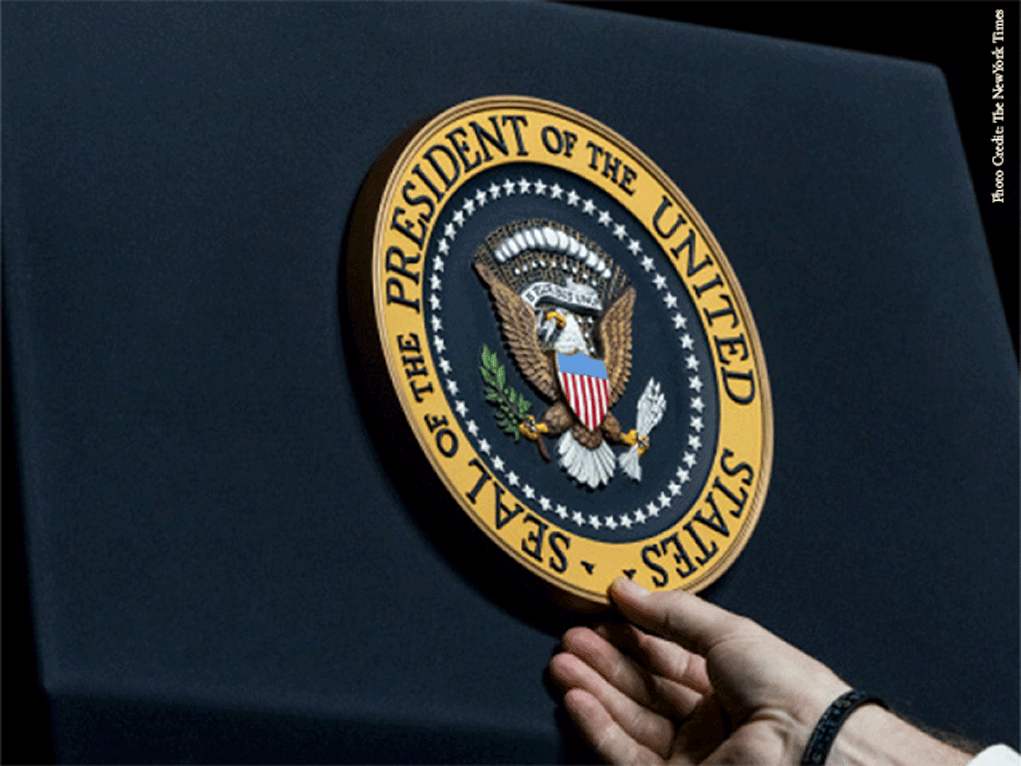
Suddenly, two people who must have done it a thousand times came toward the podium in one choreographed motion. They checked it. Pushed against it. Swept it. And then they altered it in a way that distinguished it from the way it looked for the first two hours of the event. They placed the presidential seal on it. And then there was a hush.
And the room changed.
Nobody announced a thing. Not a word was said. A disc went onto a piece of wood, and every person in that hall understood in the same instant that this was real. The president was coming.
My mind flashed back to Shacharis that morning. That morning davening was a bit longer. We waited through Shacharis. Through Hallel. Through leining. Through Mussaf. And then it came. The shofar. The announcement. The King is coming. The King is in the field.
It was a little move up there on the stage in Garden City. But that small move hushed the crowd. No one was allowed to speak behind that seal until the president did. And only after he spoke did he invite others to stand with him behind that seal. As the author of Parsha Parables and having heard King mesholim all my life, my mind went racing.
Oh, the mesholim.
What came before was only an introduction. Now the president himself was coming.
For two hours, important people had spoken. Government officials. Law-enforcement leaders. Candidates. Dignitaries. Each had his moment at the microphone. But suddenly the seal appeared, and everyone understood: what came before was the introduction. Now the president himself was coming.
He walked on to the stage. Nobody asked us to put away our cell phones. There was no sign asking for silence, no gabbai banging on a table, no reminder that we were in the presence of someone important. Nobody needed one.
The president walked into the room, and we knew. We knew where to look. We knew whom to listen to.
And once again I thought of shul. Da lifnei Mi atah omeid. Halevai.
Of course, instead of the band playing “Yomim,” there were raucous chants of USA! USA!
And then total silence. Awe.
The king began. Of course, his flippant humor, sarcasm, and wit were ever-present. Then he got serious. Indeed, he began to speak about values. About police. About open borders and about crime. And then he spoke about something personal.
There was a woman in that room whose son had been murdered. She was broken.
The president mentioned her plight. He told her story, and he called out to her. But the most protected man in the room was surrounded by agents, barriers, and layers of security. She could not simply come up to him. There were protocols.
So the President left the stage. He came down to her. And he consoled her with an embrace.
The man for whom everyone had waited left the stage and descended. And I thought again: Oh, the mesholim. And I will leave it at that.
Da lifnei Mi atah omeid. Those words are not an instruction to be quiet. They are an instruction to know. Because when you really know before Whom you are standing, nobody has to tell you to be quiet. Oh, the mesholim.
We speak of the Ribbono Shel Olam as Melech Malchei HaMelachim. We spend Elul preparing for the coronation of the King. On Rosh Hashanah we tremble as we say HaMelech. There is distance. There is awe.
And yet the same King of all kings tells us something almost impossible to comprehend: Karov Hashem lechol korav. He comes close.
Indeed, Elul itself is described not as the frightened subject somehow penetrating the palace, but as HaMelech basadeh. The King leaves, as it were, the palace. He comes out into the field, to where ordinary people are standing. To people who are imperfect. To people who might never imagine that they could gain entrance to the throne room.
The King comes to them.
The seal was on the podium, but the president can come down from the stage.
And if a little seal placed on a podium can change an entire room because everyone suddenly realizes that the president is about to appear, what should the sound of the shofar do to us?
The seal has been placed on the podium. The King is coming.
Just Saying.