

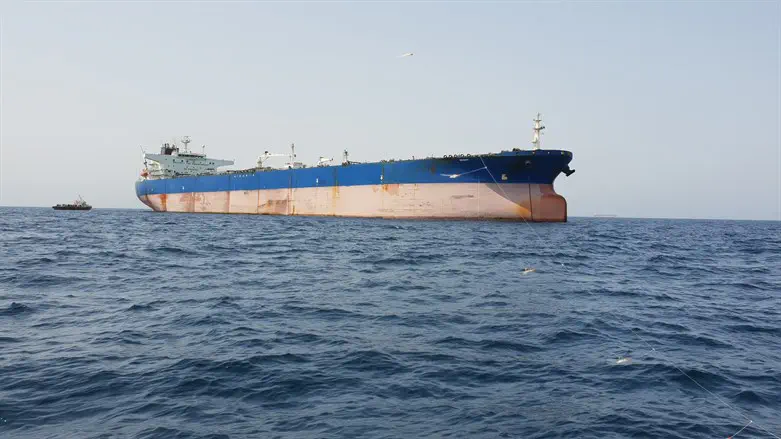
The US military has established a shipping corridor through the Strait of Hormuz that is allowing millions of barrels of oil to reach global markets despite the ongoing conflict with Iran, two US officials told Axios on Wednesday.
The operation has been running for several weeks, with approximately 15 to 20 tankers traveling through the southern channel of the strait each night along Oman's coast. US officials estimate that nearly 10 million barrels of oil per day, about half the pre-war volume, are now leaving the strait.
The operation is aimed at easing one of the conflict's most significant economic consequences: the disruption of global oil supplies and the resulting rise in crude prices. Although exports remain below their previous levels, US officials said the corridor is having a noticeable impact on global supply.
The US military is not only escorting tankers carrying oil out of the Gulf. It is also facilitating the movement of empty tankers from the Arabian Sea into the Gulf, allowing them to load oil at regional ports before returning through the strait.
"We have been controlling the southern lane of the Strait of Hormuz for two months now. The Islamic Revolutionary Guard Corps can be a nuisance, but they don't control the strait. We do," one US official with direct knowledge of the operation told Axios.
The task force overseeing the operation is based at the Army headquarters in Fort Bragg, North Carolina, and coordinates with Gulf countries. It prepares daily schedules for both loaded tankers leaving the Gulf and empty vessels entering to collect additional oil.
The ships are organized into separate outbound and inbound groups and travel through the southern channel during designated time windows under US military guidance. US Air Force fighter aircraft provide protection against Iranian drones and cruise missiles.
According to the US officials, the operation became possible after a two-week US Central Command campaign weakened Iran's radar and maritime surveillance capabilities.
Iran's ability to monitor traffic through the southern channel has since been reduced to several reconstructed radar systems and "spotters" aboard small Islamic Revolutionary Guard Corps fast boats.
US officials said Iran is largely "blind" to the precise location of ships and has therefore launched drones and cruise missiles toward areas where vessels are believed to be traveling.
Some ships have been struck, although US forces have intercepted many of the Iranian attacks. One US official said American forces shot down eight Iranian drones and two cruise missiles earlier this week.
Over the past two weeks, between 15 and 20 tankers have reportedly passed through the southern channel each night. Daily oil exports have gradually increased and are now approaching 10 million barrels.
On some nights, as many as 15 million to 20 million barrels have been transported from the Gulf. More than 20 vessels were scheduled to transit the channel on one night this week, potentially carrying approximately 15 million barrels of oil.
The report came as President Donald Trump told reporters the strategic significance of the Strait of Hormuz could diminish as the US and other countries expand alternative energy infrastructure.
"Record numbers of pipelines are being built. So I think the Hormuz Strait is not going to be quite as important as it was in the past," Trump said.
He also emphasized that maritime traffic through the waterway was continuing.
"We’ll see what happens. Right now, the strait is open. A lot of boats are coming through. People aren't reporting that, and that may slow down a little bit, at some point, but right now, a lot of boats are coming through."
Trump subsequently announced what he described as an unprecedented economic campaign against Iran, accusing Tehran of failing to take advantage of opportunities to reach an agreement with Washington.
"No one has given the Islamic Republic of Iran a greater opportunity to make a Deal than me. TRAGICALLY, for them, they have failed to take it," he wrote on Truth Social.
"Therefore, today, I am announcing the MOST CRUSHING ECONOMIC OPERATION EVER TAKEN AGAINST ANY COUNTRY! This will be Economic Warfare and Isolation on an unprecedented scale."
Trump claimed Iran's military had already suffered extensive damage.
"Their navy is gone, their air force is destroyed, their military factories are now rubble, their currency is worthless, and their country is hanging by a thread."
He also threatened countries and entities that continue providing economic support to Tehran.
"Today, I am also announcing that ANY country that allows its financial institutions, businesses, airports, or government entities to provide any type of lifeline to Iran will itself face TREMENDOUS Economic Consequences."
Trump called for an end to oil smuggling and other mechanisms that could provide Iran with financial support.
"Oil smuggling, swap lines, cash transfers, exchange houses, ship registries, front companies - It all needs to stop NOW. You know who you are."
Describing the campaign as "an ECONOMIC D-DAY," Trump called on US allies to join Washington in isolating Iran.
"This will be an ECONOMIC D-DAY, and we need all of our Allies to stand with the United States of America to isolate, and defeat, the Iran threat."
Trump concluded by reiterating that Iran would not be permitted to obtain nuclear weapons.
"These maniacs are on the ropes, and these HISTORIC MEASURES will cripple them and their ability to project terror worldwide. IRAN WILL NEVER HAVE A NUCLEAR WEAPON."