
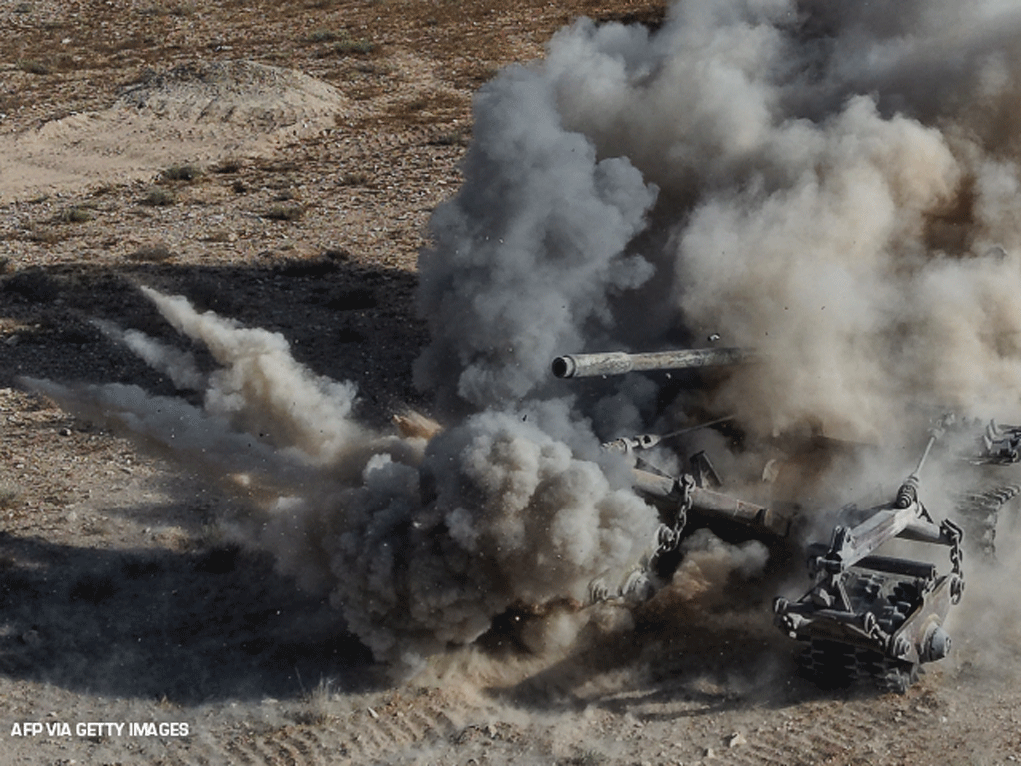

Last week the Israeli air force bombed the semi-demolished Abu al-Duhur military airfield in northern Syria, cratering the runway and destroying adjacent warehouses in order to make the base unusable. The attack was triggered by an Israeli intelligence report warning that Turkey was about to install a radar-guided air defense unit on the base, located near the Syrian-Turkish border, to be manned by Turkish troops. This would pose a threat to the Israeli warplanes which have been openly operating for the past 18 months in Syrian airspace.
The installation of such an anti-aircraft system at the Syrian base would violate a U.S.-brokered agreement reached shortly after the fall of the Assad regime in December 2024, under which both Syria’s current Turkish-backed transitional government, led by President Ahmed al-Shaarq, a former al Qaeda terrorist leader, and Israel’s government agreed to maintain the current military status quo on Syrian territory.
The agreement permits Israeli troops to continue their occupation of a security zone just inside Syria’s southern border, including both sides of Mt. Hermon. Israel has also launched hundreds of air strikes on targets in Syria since December 2024. Many of them were intended to protect the minority Druze communities in southern Syria, which have come under repeated attacks by pro-Syrian government Sunni militia forces armed with Syrian army tanks and other military vehicles.
But Israel’s critics have noted that by acting in defense of the Syrian Druze minority, the IDF has been able to justify the expansion of its military footprint in southern Syria and occupy the strategic high ground, weakening the control of that part of Syria by the transitional government led by al-Shaarq in Damascus.
Maintaining The Benefits Of The Status Quo Agreement In Syria
The status quo agreement also allows Israeli warplanes to continue patrolling Syrian airspace, looking for signs of terrorists seeking to use the area as a base for attacks on Israel’s northern border. The status quo agreement obligated the interim Syrian government not to introduce any new military forces or installations to fill the power vacuum that was created with the collapse of the Assad regime, or that could pose a security threat to Israel’s northern border or to its forces now manning the Israeli security zone inside southern Syria.
Shortly after the Israeli air force raid took place, Prime Minister Netanyahu’s office issued a statement declaring that Syria had been on the verge of violating a “status quo agreed with Israel in security matters,” and that allowing Turkish troops to deploy at the Syrian airbase would threaten Israel’s security.
Netanyahu later said that prior to launching the air strike, Israel had issued a warning to Turkey’s government against engaging in any military activity in Syria. “We made our message [to Turkey] clear: Don’t,” Netanyahu declared in a statement.
Over the weekend, Israel’s Defense Minister, Israel Katz, confirmed the statements from the prime minister’s office. Katz said that, “Following several discussions that Prime Minister [Netanyahu] and I held with IDF leaders and the various other Israeli security officials, it was agreed that before approval was given for the Israeli airstrike on the Syrian airbase, a direct warning would be issued to the Syrian regime at the highest levels first in an attempt to prevent [Turkey’s military] move, and that is what was done.”
Katz also said that “at the same time, the intelligence [about the imminent Turkish military move in Syria] was conveyed to the relevant authorities in the United States,” to give President Trump advance warning about a possible Israeli air strike.
However, Katz continued, “After the notification to the Syrian government went unanswered, the prime minister and I authorized the IDF to carry out the strike, which was carried out successfully,” Katz said. He then added that “[Turkish President Recep Tayyip] Erdogan was caught with his hand in the cookie jar and was forced to back down” from his plan to install a Turkish military-operated air defense system at the Syrian base.
Katz also accused the Netanyahu-led coalition’s domestic political opponents of “zigzagging” in their criticism of the Israeli air strike on the Syrian airbase. The opponents initially accused Netanyahu of ordering the air strike to bolster his image as a strong Israeli leader ahead of the October 27 Knesset election. According to Katz, Netanyahu’s political opponents and the biased critics in the Israeli news media initially said that “the strike in Syria was superfluous and carried out for political considerations.”
Getting No Response, Israel Delivers The Message In A Different Way
But that was before Doron Spielman, the spokesman for the government’s National Public Diplomacy Directorate, released a video late last week which clearly explained the information that justified the air strike and sounded the alarm over indications that Turkey intends to expand its military presence in Syria. Spielman also noted that Netanyahu had stated clearly that Israel would not permit Turkey’s military to push south [inside Syria] toward Israel’s border, and that once Syria brushed off repeated warnings, Israel had to “deliver the message in a different way” via air strikes.
Katz said that “After it was made clear [by Spielman] that the IDF recommended the strike based upon clear intelligence information, and [that] the political echelon had carefully weighed and reached the decision, Netanyahu’s critics moved to an alternative narrative. They then said that the statements by the prime minister and the defense minister about Erdogan, and the warning that Israel will not allow Turkey to entrench itself in Syria and endanger its security, were dangerous.”
Katz mocked Netanyahu’s critics for warning that Israel “must not anger Erdogan, as if [by ordering the air strike] we went out for some evening stroll that has nothing to do with anything; as if Erdogan [who has become one of Israel’s most outspoken opponents] is actually some Zionist enthusiast. Luckily they [Netanyahu’s critics in Israel] have no influence today on anything,” Katz said. He then added, “We very much hope for the sake of Israel’s security that they will not reach positions of influence with such positions in the future [after the upcoming Knesset election] either.”
It was also reported that several days prior to the Israeli air strike on the Syrian base, Roman Gofman the head of Israel’s Mossad security service, had conducted a two-hour, in-depth phone conversation with Syrian Foreign Minister Asaad al-Shaibani to convey Israel’s concerns about reports that a delegation of Turkish military contractors had visited the Syrian airbase, presumably to prepare for the installation of the air defense system there.
According to a Saudi Arabian news report, during that same conversation, the Syrian foreign minister revealed a plan to deploy advanced Turkish-made combat drones at the Abu al-Duhur airbase, ostensibly for use against the remnants of ISIS forces in Syria. The Mossad chief then reportedly responded by warning that any new drone deployment at Abu al-Duhr would be viewed as an attempt to turn it into a forward operating base threatening Israeli security and would not be tolerated.
When Turkey’s President Erdogan First Turned Against Israel
Turkish President Erdogan’s vehement public criticism of Israel dates back to the May 31, 2010 incident when Israeli naval commandos intercepted a flotilla of six ships organized by a pro-Palestinian “humanitarian” organization, and led by the Turkish-flagged passenger vessel MV Mavi Marmara. The ships were trying to break Israel’s blockade of Gaza, which was imposed after Hamas had begun launching missiles from there at nearby Israeli communities.
When Israeli commandos dropped from helicopters to board the Mavi Marmara, they were immediately attacked by dozens of Palestinian terrorists armed with clubs, metal pipes, and knives, who had been posing as international civilian peace advocates. Several of the Israeli commandos were wounded, and they were forced to defend themselves by opening fire using live ammunition, killing ten of the terrorists.
The Mavi Marmara incident created a serious crisis in Israel-Turkey diplomatic relations, which had been very cordial before Erdogan became Turkey’s prime minister in 2003. Until that time, Israel had been serving as one of the Turkish military’s primary sources for high-tech armaments.
Erdogan’s diplomatic attacks on Israel escalated further after he became Turkey’s first directly elected president in 2014. Since then, Erdogan has dismantled several democratic aspects of Turkey’s government, which has become much more authoritarian in nature. He has also shifted Turkey’s diplomatic stance, giving up on Turkey’s failed efforts to qualify for membership in the European Union, and focusing instead on strengthening Turkey’s influence over its Middle East neighbors, based in part upon his embrace of the Palestinian national cause, and his open hostility to Israel.
Erdogan’s Early Connections To The Muslim Brotherhood
Erdogan’s affinity for the Palestinian cause can be traced back to his deep ideological, political, and logistical ties with the Muslim Brotherhood, the parent organization of Hamas, going back to Erdogan’s days as an Islamic student activist in the 1970s. Erdogan was elected mayor of Istanbul in 1994, but in 1998, he was convicted of inciting religious hatred and temporarily banned from participating in Turkish politics.
Following the 2011 uprisings of the so-called Arab Spring, Erdogan aggressively championed the new Egyptian government led by Muslim Brotherhood activist Mohamed Morsi. After Morsi’s government was overthrown in 2013 by the leader of the Egyptian army, General Abdel Fattah el-Sisi, Erdogan turned Turkey into the primary sanctuary for exiled Egyptian Muslim Brotherhood leaders. To this day, under Erdogan’s rule, Turkey continues to host several international Muslim Brotherhood-linked organizations which are seen as a security threat by the governments of Egypt, Saudi Arabia, and the United Arab Emirates (UAE).
After having helped al-Sharaa’s forces to overthrow Bashar Assad’s despotic regime, Erdogan is now trying to use his enhanced influence over Syria to establish Turkey as the new leader of the Sunni Muslim nations in the Middle East. His latest move in that direction was the recent signing of a mutual defense pact by Turkey, Saudi Arabia, and Pakistan. This is in addition to Turkey’s ongoing membership in NATO, in which it maintains the second-largest standing armed forces after the United States.
The mutual defense pact’s signing took place shortly after Saudi Arabia’s de facto ruler, Crown Prince Mohammed bin Salman, resisted President Trump’s efforts to get the Saudis to join the Abraham Accords with Israel, on the grounds that Israel still rejects the formation of a Palestinian state.
In 2016, Israel and Turkey signed a reconciliation agreement mediated by the United States, which was supposed to restore normal diplomatic ties between the two former allies, but Erdogan has continued to attack Israel and accuse it of committing genocide against the Palestinian population in its war against Hamas in Gaza at every opportunity.
Erdogan Has Taken In The Hamas Leaders Who Have Left Qatar
Erdogan has invited Hamas’ international leaders who had been living in Qatar to move into Turkey, and has been sharpening his anti-Israel rhetoric almost daily.
Last week, Turkey’s Defense Ministry denied that a Turkish military delegation had visited the airbase, just a day after Syrian foreign minister al-Shaibani publicly confirmed in an interview with the Axios news site that such a visit had taken place.
But the Syrian foreign minister denied that there were any plans for a Turkish military deployment there. Al-Shaibani said that the visit by the Turkish military officials was nothing more than the continuation of the “ongoing military cooperation” between two allies which share a common border.
Meanwhile, in a weekend news interview with Israel’s Channel 12, Israel’s Foreign Minister Gideon Sa’ar declared that Israel has “no interest in [a military] escalation with Turkey. We are committed to preserving the status quo,” Sa’ar said, but he then added: “We will not accept the establishment of Turkish [military] bases in Syria.”
He explained that Israel has noted how Iran has infiltrated Lebanon and Gaza to attack Israel, and that the Israeli government will not tolerate “that same situation to develop with Turkey in Syria.”
Sa’ar emphasized that Israel “always prefers” diplomatic solutions to military ones, and reiterated that Israel has no intention of escalating tensions with Turkey. Israeli officials have held several rounds of direct talks with officials of Syria’s interim government, which have led to an agreement to establish an intelligence-sharing mechanism designed to avoid the unintentional outbreak of conflicts between them.
Turkey Again Calls For Netanyahu’s Arrest
Sa’ar made the statement after the Turkish government issued another warrant for the arrest of Prime Minister Netanyahu last week, based upon the false accusation that he had ordered the commission of the crime of “genocide” against the civilian population of Gaza, a charge that the Israeli government has vigorously denied. Turkey also said that it would ask Interpol [the international police force] to issue a “red notice,” which is a request to police forces worldwide to locate and provisionally arrest a wanted person pending their extradition to the country where they would be put on trial.
In response to Turkey’s issuance of the warrant, Netanyahu’s office issued a statement declaring that Turkish President Recep Tayyip Erdogan “now seeks to extend his aggression against Israel into Syria. Israel will not tolerate it.” The statement reiterated previous accusations made against Erdogan, calling him “an antisemitic dictator who has massacred Kurds [living in Turkey and Syria], harbors Hamas terrorists, occupies half of Cyprus, and jails record numbers of [Turkish] journalists and politicians who oppose him.”
One of the most irritating factors in the reaction to Israel’s air strike on the Syrian airbase was comments made by the U.S. Ambassador to Turkey, Tom Barrack, who also serves as President Trump’s special envoy to Syria and Iraq.
Tom Barrack’s grandparents were Lebanese Christians who arrived in the U.S. in 1900. He was trained as a lawyer and made his fortune as a private equity investor. He has also developed close ties to the Saudi royal family. Barrack has been a close personal friend of Donald Trump going back for more than 40 years. He has served Trump as a major campaign fundraiser and as an informal advisor, and chaired Trump’s 2017 inaugural committee.
U.S. Ambassador Accused Israel Of Trying To Start A War With Turkey
During a wide-ranging podcast interview with Mario Nawfal, a Lebanese-Australian entrepreneur, Barrack accused Israel of launching the attack on the Syrian base to draw Turkey into an armed conflict, and offered two possible theories to explain why the attack was launched.
“One theory is they were just baiting Turkey, and it’s a very aggressive, but maybe well-received, pre-election concept,” Barrack said, implying that it was a politically motivated attempt by Prime Minister Netanyahu to burnish his credentials as a strong Israeli leader ahead of the Knesset elections scheduled for October 27.
Barrack then said, “The other theory is that between the IDF, the Mossad and the Prime Minister’s Office there was a miscommunication,” suggesting that an Israeli attack on a foreign country was launched by accident.
During the podcast, Ambassador Barrack also cast doubt on the Israeli intelligence report that Turkey was preparing to move some of its military assets to the Syrian military airport at Abu al-Duhur. He said that there was no U.S. intelligence to indicate that Turkey was planning such action.
According to a Times of Israel report, Ambassador Barrack has a long history of speaking “off the cuff” and pontificating on developments in the Middle East, making comments based on his personal opinion that do not necessarily reflect the Trump administration’s foreign policy positions.
U.S. Envoy Rejects Trump’s Recognition Of Israel’s Right To The Golan
In reaction to the podcast, Defense Minister Katz said that Barrack’s remarks were “full of inaccuracies.” Katz also said that Barrack’s statements included “positions that contradict the position of U.S. President Trump.” Specifically, Barrack claimed that, “In the Golan, with Syria, they still occupy the Golan against the U.N. resolutions, against all the international order, which has said the Golan is Syria’s [territory].”
Israel captured the Golan Heights from Syria during the 1967 Six Day War and refused to return it when the war was over because Syria had been using the high ground to launch artillery bombardments at Israeli farmers as they tended their fields in the valleys across northern Israel. Soon after the Israeli government annexed the Golan Heights, on December 17, 1981, the U..N Security Council passed Resolution 497 declaring the Israeli annexation of the Golan Height to be “null and void,” and calling for Israel to withdraw from the occupied Syrian land to the pre-1967 border with Syria. However, Israel refused to comply, and, 38 years later, in March 2019, President Trump signed a proclamation formally stating that the U.S. recognizes Israel’s sovereignty over the Golan Heights.
Barrack’s inaccurate interview statements were harshly criticized by Laura Loomer, a controversial far-right social media conspiracy theorist, who called upon Barrack to resign his ambassadorship because “he does not understand U.S. foreign policy and supports the wrong side.”
Barrack’s podcast statements were also blasted in an editorial published by the New York Sun, which said that he rushed to condemn Israel for the strike, “before anyone at Washington had time to assess the situation.”
The New York Sun editorial also noted that Barrack falsely claimed in several interviews with Israeli television reporters that because Turkey had not been notified of the Israeli air strike in advance, its jets could have come into conflict with Israel’s warplanes over Syrian territory, even though Turkey denied that any of its aircraft were present at the Syrian airfield that was bombed.
Trump’s Ambassador Is Acting Like Erdogan’s Man In Washington
The editorial cited a statement by Sinan Ciddi, the director of Turkey studies at the Foundation for Defense Democracies, who described Barrack as “his own man” whose agenda and opinions often track closely with Turkey, which helps to explain why he was so quick to condemn the Israeli air strike. The same editorial also noted that President Trump did not criticize the air strike in an interview with Israel’s Channel 12 last week, suggesting that American intelligence agrees with Israel in suspecting that Turkey does intend to stage a military buildup in Syria. The editorial concluded that, “One way to bolster Syria’s independence from Turkey is to name an American ambassador to Damascus, rather than rely on an ‘envoy’ [like] Mr. Barrack [who] seems like Mr. Erdogan’s man at Washington, rather than the other way around.”
In the wake of that criticism, Barrack conceded in a statement to the Associated Press that his comment about the Golan during the podcast interview did not reflect current “United States policy on the Golan [recognizing Israel’s sovereignty over it, which] was set by President Trump in 2019 and is unchanged.” Nevertheless, he still insisted that Israel’s occupation of the territory goes “against all of the international order, which has said the Golan is Syria’s [territory].
During his podcast interview, Ambassador Barrack did confirm the reports of a prior extended conversation between Mossad chief Gofman and Syrian Foreign Minister al-Shaibani, and he speculated that it might have led to a mistaken order to attack the Syrian air base.
Harmful Speculation By Trump’s Ambassador To Turkey
“Perhaps the Mossad director was conducting a really serious backchannel [discussion] that he wasn’t finished with, perhaps he wasn’t satisfied with, that he was going to come back the next week and have another discussion,” Barrack said.
“And in the meantime,” Barrack continued, “an [Israeli] commander someplace, based on what they thought their intelligence reading was, thought ‘we need to move quickly, and we need to move now,’” and ordered the air strike.
Barrack did add that, “to Israel’s credit,” it told the U.S. six days before the strike that it had intelligence indicating “there might be Turkish movement into this site.
“We all did our due diligence. We went back to our respective intelligence agencies. [But] the answer we got is, no, that [Turkish move of military assets] is not happening,” Barrack said.
The American ambassador then speculated further that, “Probably the most likely [explanation] is that [Israel] picked up some conversations of some contemplated strategy of the Turks increasing a training program on that site,” Barrack said, and noted that the current status quo arrangements don’t forbid Turkish efforts to “openly train and supply and help the Syrian government” in areas like the air base that lie near the two countries’ shared border.
In a separate interview with the Jerusalem Post, Barrack said that in order to prevent further military incidents, the U.S. will try to establish a deconfliction mechanism between Israel, Turkey, and Syria. Barrack said that the current government in “Syria has demonstrated itself to be a responsible and stable sovereign neighbor, and a carefully structured de-escalation arrangement would contribute significantly to greater calm and predictability across the region.”
In an independent analysis by the Kikar Shabbos, a chareidi digital news portal, of the rising tensions between Israel and Turkey, it noted that “Turkey has become a key ally of the new regime in Damascus in recent months, by assisting in training the Syrian army and rebuilding its infrastructure. Israel fears that a permanent Turkish military presence in Syria would change the regional balance of power, especially if Turkey deploys an advanced radar air defense system in Syria that could significantly limit the Israeli air force’s freedom of action.”
The Kikar Shabbos analysis also noted that according to Turkish Justice Minister Akin Gurlek, Turkey has launched a new investigation against 35 Israeli servicemen in Israel’s navy for their role in the latest incident this May in which the Turkish-supported Global Sumud Flotilla, made up of 50 ships supposedly carrying aid for Palestinians, came under Israeli fire and were boarded by Israeli commandos off the coast of Cyprus. This thereby prevented the ships from penetrating Israel’s blockade of Gaza’s ports. In addition, 430 pro-Palestinian “activists” aboard those ships were first taken into custody by Israel and then were deported.
Gurlek also declared that Turkey will use all available legal mechanisms to ensure Israel is held accountable for its crimes in Gaza.
Netanyahu’s office also issued a statement predicting that, “[Turkish President] Erdogan’s pathetic attempt to intimidate the leaders and soldiers of Israel, the only true democracy in the Middle East, will go nowhere.”
Turkey’s Growing Military Footprint In Syria
Meanwhile, Israel Hayom published a report based upon an interview with a source in western Syria claiming that “Turkey’s footprint in the region has grown significantly more pronounced,” particularly in the area surrounding the strategic port cities of Latakia and Tartus on Syria’s Mediterranean coast.
The same source said that “Officials representing Turkish intelligence and the Turkish military are playing in Syria as if it were their private playground. This manifests [itself] in Turkish vehicles, some of which are armored, that soldiers are using to move around the [Syrian] roads.” The source also said that Syrian agents have been buying up real estate on behalf of Turkish businessmen in the residential portions of the same two Syrian port cities.
However, the source reported that the Syrian economy has yet to recover from its long civil war and that, “All classes [of Syrian citizens] are suffering [because] there is no security and there are economic hardships. We are heading into the unknown [and] no one knows where the fools who seized power [in Damascus] are taking us.”
According to the Israel Hayom report, the first signs of an expanding Turkish military presence in Syria became evident immediately following the collapse of the Assad regime. It cited contemporary newspaper reports from that era of Turkish troops entering western Syria’s Latakia province with engineering equipment to establish a new military outpost, as well as Turkish military reinforcements being deployed in Aleppo province in March of last year, increasing tensions with local Kurdish forces.
Today, a year and a half after the fall of the Assad regime, the footprint of Turkish forces on the ground in Syria, the Israel Hayom report says, continues to expand. This past July, Al-Araby, a Qatar-based broadcast news network, released footage of a convoy of Turkish military trucks and armored vehicles advancing toward the eastern Syrian city of Deir ez-Zor.
Turkey Digging In At Its Syrian Bases
The British-based Syrian Observatory for Human Rights reports that Turkish military forces have not abandoned a single outpost that they have established in Syria over the past 18 months. Instead, the Turks have been actively digging in, fortifying their new bases by erecting concrete blast walls, digging defensive trenches, and building up earthen berms.
The recent Turkish military expansion in Syria included a July visit to the port of Latakia by a flotilla of Turkish warships, accompanied by the commander of Turkish Naval Forces, who carried out an inspection of Latakia’s military port facilities and held high-level meetings with his Syrian navy counterparts.
Soon after the Assad regime collapsed in December 2024, the Israeli Navy systematically destroyed the bulk of the Syrian naval fleet to prevent the ships from falling into the hands of radical Syrian Islamist factions. Now Israeli intelligence indicates that the interim Syrian government wants to reconstitute its naval capabilities, raising fears that Syrian President Ahmed al-Sharaa will ask for Turkey’s help in rebuilding Syria’s maritime strength.
Israel’s ambassador to the United States, Yechiel Leiter, emphasized in an interview with the Jerusalem Post that, “We are not seeking escalation or war with either Turkey or Syria. But a red line was crossed,” when Turkish military officials paid a visit to the Syrian airbase, which required an Israeli military response.
Leiter said that he was one of the participants at the January 2026 meeting in Paris during which the understandings of the status quo agreement between Israel, Syria and Turkey were reconfirmed. Other officials who participated in that meeting included Syrian Foreign Minister Asaad al-Shaibani, U.S. Syria envoy Tom Barrack, then-Israel National Security Council chief Gil Reich, and Netanyahu’s military secretary Roman Gofman, who is now the Mossad director.
The Status Quo In Syria Has Worked Well So Far
According to Leiter, “The freeze [status quo agreement] means that just as the Turks don’t move, neither do we [Israel] — and they don’t force us to withdraw. And it is important to understand that while we are sitting on only 78 square miles in the [southern] Syria security zone, the Turks have carried out a creeping annexation of 3,500 square miles in northern Syria over the past several years — [representing] about 5% of [Syria’s] territory.”
Leiter emphasized that the status quo agreement has largely been successful in preventing conflict in Syria, and that the Trump administration wants it to continue, “which is why even Trump did not condemn the [Israeli air] strike,” Leiter said.
The Israeli ambassador also said that, “It is clear to us that the Syrians do not want a confrontation with us. That is why we are telling the Turks not to create conflicts.”
Leiter also said, “There is more than one indication that the [military] move planned by Turkey was imposed on the Syrians,” against their will, including the fact that the Syrian and Turkish accounts were in conflict over whether or not a Turkish military delegation had visited the Syrian airbase.
“While Syrian Foreign Minister Shaibani acknowledged that there had been a Turkish delegation in Syria several days before the strike, the Turks denied it.” Leiter then recommended that, “They [Syrian and Turkish officials] should sort it out among themselves.”
Israel Willing To Talk Peace With Syria Again But Not Turkey
Leiter also said that a resumption of direct Israeli-Syrian talks was desirable if the conditions are right. “The negotiations can be renewed. We want to continue the face-to-face dialogue that we previously held with the Syrians,” he declared.
But that is not necessarily the case with Turkey’s current government. Leiter said, “We are certainly open to dialogue with them, but according to statements by senior [Turkish] officials, they would prefer to wipe Israel off the map.”
He was referring to repeated accusations by Turkish President Erdogan that Israel has been committing war crimes, as well as the recent statement by Turkish Foreign Minister Hakan Fidan declaring that “Israel is a stain on humanity.”
Leiter’s response to those claims was to note that, “At a time when Turkey is hosting Hamas leaders and transferring funds to Hezbollah and Hamas, Iran’s [allies] against Israel, it is not appropriate for them to begin expanding their influence in Lebanon and Syria.”
Leiter expressed his disappointment that, “Under the current circumstances, Turkey cannot be a force that helps calm the region. I wish we could return to the situation of several decades ago [when there were cordial] relations between Jerusalem and Ankara. Then, we would be open to Turkish influence in the region. But it is not logical for Turkish influence in the region to [be allowed to] grow while Turkey is funding terrorist organizations.”