

Thoughts on What Goes Through the Minds of Parents on the First Day of School
It is official! In case you haven’t noticed, the new school year is here.
It is staring us in the face. Walk into any store and you will be faced with aisles of spankingly fresh school supplies. Open any advertising circular and you will be inundated with ads for new uniforms. New school shoes. New seforim. New briefcases, backpacks, school supplies…
Parents are rushing around, shopping shoulder to shoulder in jam-packed stores, trying to outfit each child with all the “things” they need to start the year on the right foot (even if it means waiting on line for hours and hours to have the perfect shoe fit on their darling child’s foot!).
The nervous energy is there. The rush, the adrenaline, the pump… But there is also something else, something beneath the surface, a feeling of…anxiety?!
I was recently speaking to a prominent mashgiach, and we were discussing the anxiety that accompanies so many parents, children, bochurim, girls and boys as they enter the new school year and the new zeman.
There is so much hope, so much fear and trepidation, and yes, a great deal of anxiety. Will she find friends — good friends with whom she will grow? Will he “click” with his rebbi? Will he find his place in this new yeshiva? Will she feel loved and valued or just like another number who has to comply? Will he finally be turned on to learning and find pleasure and geshmak in a good sevara or a good kushya? Will he feel valued for who he is, not for who they want him to be?
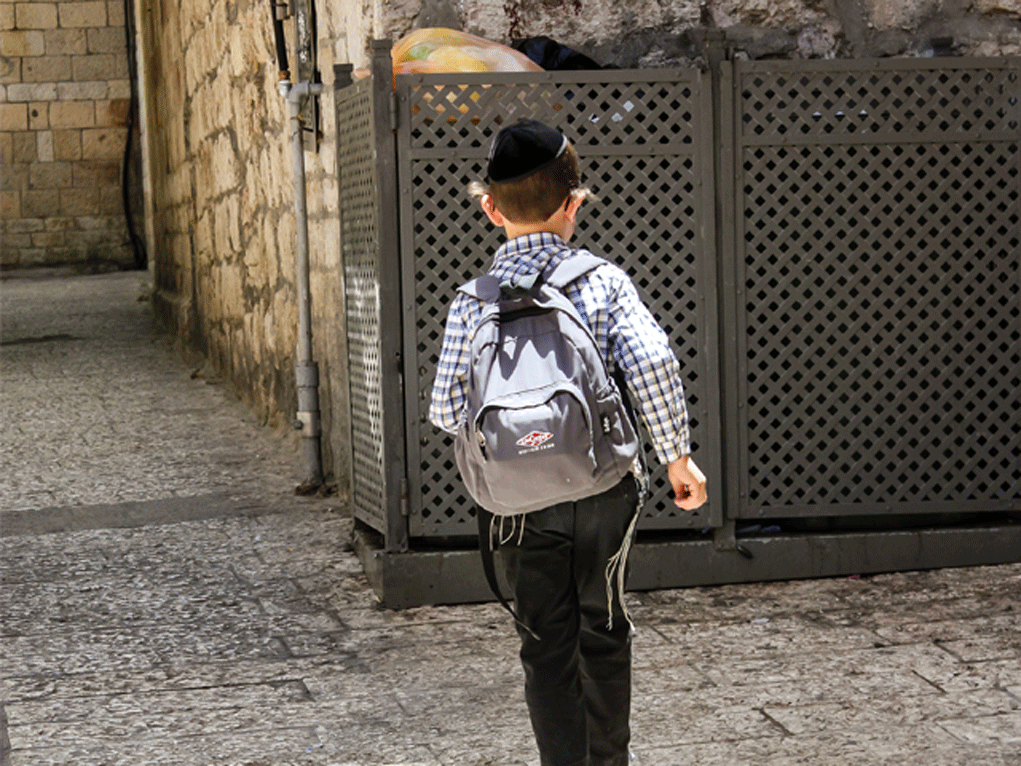
As parents send their children off, as they drive their bochurim to yeshiva with their heavy Gemaros and kovetzim, as their girls go out to the bus in freshly starched uniforms with new backpacks, what are they thinking?
What is an Eis Ratzon?
The mashgiach shared with me a vort that he would say to his talmidim and their parents that I think is equally applicable to both the students and parents, boys and girls, bochurim and Bais Yaakovs. It was a vort that the mashgiach of Lakewood, Rav Matisyohu Salomon, once said in a pesichas hazeman shmuess.
Rav Matisyohu cited the famous Zohar Hakadosh that says that when Yidden open the aron kodesh, it is an eis ratzon, an opportune time. Because it is an eis ratzon, the Zohar instituted that we daven the tefillah of Brich Shmei when the aron kodesh is open. The tefillah of Brich Shmei contains very powerful tefillos and bakashos for everything that we need.
The question Rav Matisyohu asked is: What is an eis ratzon? What creates an eis ratzon? And why does the Zohar say that davka the time of pesichas ha’aron, when we take the Sefer Torah out of the aron, is such an eis ratzon?
Rav Matisyohu answered that when the aron kodesh is opened and we take out the Torah, what does a Yid feel? A Yid, with a Yiddishe heart, feels one thing: “I want Torah!” Every Yid knows, when all is said and done, that it is Torah that he wants. Torah is the only thing that matters. Yes, he needs money, he needs a lot of things, but ultimately, everything that he needs is also only for Torah.
What Does a Yid Do With Gelt?
There is a famous vertel that people say, I think from Rav Levi Yitzchok of Berditchev. Someone commented that during the Yomim Noraim, when a Yid says, “Uvechein tein pachdecha,” he is really saying, “Uvechein = gelt, tein = gelt, pachdecha = gelt.” Upon hearing this, Rav Levi Yitzchok commented, “Okay, but don’t stop there. What is the Yid really doing with the gelt? He is paying s’char limud, he is paying for bussing, he is paying so that he can buy tzorchei Shabbos and Yom Tov. When you kvetch out the gelt, what you really get is ruchniyus — Torah!”
When the Yid Wants Torah, Hashem Wants to Give It to Him
So, when the aron kodesh opens and a Yid sees the Sefer Torah, his first feeling is, “I want Torah.” When Hashem sees that what a Yid really wants is Torah, Hashem says, “This Yid wants Torah and I want to give it to him.”
That is the definition of an eis ratzon.
An eis ratzon is a time when the deep ratzon of a Yid for Torah arouses, in turn, Hashem’s ratzon to give him the Torah that he so wants.
That being said, what does someone do when there is an eis ratzon? The answer, of course, is that he davens. That is the definition of an eis ratzon: when your deepest hope and desire are exactly the same thing as that which Hashem wants from us, and that very deep ratzon therefore arouses Hashem’s ratzon.
This Eis Ratzon Is Not Just for Parents
If I were a mashgiach, a menahel, a rebbi, a teacher or a mechaneches, I would tell my talmidim or talmidos: “I want you to think about what your parents were thinking this morning and last night and in the days running up to the beginning of the school year or zeman. I want you to stop and imagine their ratzon, their whispered tefillos, their deepest aspirations, which were that: ‘My Yankele or my Saraleh should have a year filled with ruchniyus, with simcha, with shteiging, growth in avodas Hashem, growth as a Yid, growth in yiras Shomayim and in bein adam lachaveiro and bein adam laMakom.’”
Can we even begin to understand how deep the retzonos of your parents are for your success as Yidden and ovdei Hashem? It is impossible to properly quantify and encapsulate the many tefillos and the depth, fervency and yearning inherent in the tefillos that parents daven for their children as the school year begins.
All of those deep tefillos are seen and heard by Hashem, and when Hashem sees the deepest, most innermost and powerful desire of a parent — when Hashem sees that, ultimately, what really matters to parents is their children’s spiritual future, that they should be good, well-rounded ovdei Hashem and baalei Torah — He certainly says, “If they have such a ratzon, then I have such a ratzon to give it to them.”
That is why the beginning of a zeman and the beginning of a school year are undoubtedly among the great moments of eis ratzon, when all our tefillos can be answered. During those first few days or even weeks of the school year, our efforts in tefillah need to be increased,
With that understanding, I think it is similarly important for the bochurim and girls themselves, the talmidim and talmidos, no matter how old they are, to also realize: “If my mother and father — even if they don’t say it outright — are thinking so much about my hatzlocha, are davening so much for my hatzlocha, and are so deeply tapped into this eis ratzon at the beginning of the year, perhaps now is also the time for me to daven — yes, for me, the child, bochur or girl, to also tap into this eis ratzon and beg Hashem to fulfill our deepest desires for growth in Torah and as ovdei Hashem, because if you really want it, then Hashem wants to give it even more!”
Let’s take this eis ratzon of pesichas ha’aron, the pesicha of a new year of learning, to truly daven and tap into Hashem’s ratzon, because when our ratzon and His ratzon are the same, that is the key to everything.
Let’s pack our spanking-new briefcases, our crisp and clean notebooks and binders, and fill them with our tefillos, so that we can “walk” into the new school year not only with new shoes and new clothing, but with a new, fresh start.