
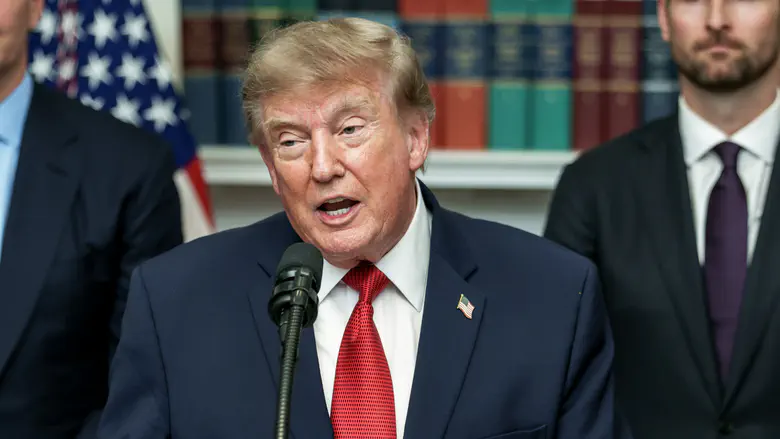

US President Donald Trump said on Sunday that Iran cannot be allowed to obtain a nuclear weapon, arguing that preventing Tehran from acquiring one justifies the US campaign against the Islamic Republic.
In an interview with Trey Gowdy on Fox News, Trump described Iran as the world's leading state sponsor of terrorism and said its nuclear ambitions pose an unacceptable threat.
"Iran is a number one leading state sponsor of terror, you've heard that many times, in the whole world. They cannot have a nuclear weapon," Trump said.
The President said he has repeatedly been challenged over whether military action against Iran was necessary, but argued that the answer becomes clear when the possibility of Tehran possessing a nuclear weapon is considered.
"I have numerous people say, ‘Well, did you have to do it?’ And then I say, ‘Do you think it's okay for Iran to have a nuclear weapon?’ Nuclear weapon is massive destruction. You know, take what you see and multiply it times 100. And everybody says no."
Trump said the US campaign against Iran has been highly effective, pointing in particular to the naval blockade and economic measures imposed on Tehran.
"The blockade has been unbelievable. The financial hits that we're giving them, we're hitting them very hard. Never, nobody's ever been hit like this," he said.
Trump characterized Iran as "a failing nation" and said he was prepared to allow events to determine how the conflict ends rather than insisting on a formal agreement.
"And at the right point, we'll either win or they'll do something. But I don't mind winning, just winning. I don't need a signature on a piece of paper," Trump said.
The President also claimed that Iran's military capabilities had been severely degraded.
"But we're doing very well. Their Navy's gone. Their Air Force is gone. Their leaders are gone. All of their anti-aircraft, I mean, it's all wiped out."
Trump acknowledged that Iranians are "tough people" and "smart people," but sharply criticized the country's leadership. "But they're very evil," he said.
The President also accused Iranian authorities of carrying out widespread violence against protesters, saying, "They killed 52,000 protesters as of three months ago. And sadly, they've added very substantially to that list."
"Even people that aren't protesting, they go into the houses and they take them and they shoot them," Trump added.
He argued that Iran obtaining a nuclear weapon would have catastrophic consequences for Israel and the broader Middle East.
"These are very violent, evil people. And if they had a nuclear weapon, Israel would be gone. If I weren't president, Israel would be gone. There would be no Israel and there would probably be no Middle East," Trump stated.
He pointed to Iran's attacks against several Gulf countries after fighting began as evidence that Tehran had lost support from governments that had previously maintained neutral relations with it.
"And the way you know that is people that were sort of neutral got along with them for years. As soon as the shooting started, they started aiming at Saudi Arabia, at Qatar, at UAE, at Bahrain, at Kuwait. They were aiming. Everybody was shocked. I was surprised," he said.
Trump said he viewed Iran's loss of regional support as significant because countries that had previously remained neutral might otherwise have been threatened if Tehran had obtained nuclear weapons.
"I thought it was a very good thing because they lost all of the support that they had. They had a certain amount of support. They were, let's say, neutral, largely neutral. That means that if they would have had a nuclear weapon, they would have fired it," Trump said.
"So I think the Middle East would have essentially been gone. But Israel definitely would have been gone," added the President, who warned the threat could ultimately have extended beyond the region.
"And I guess we would be next or Europe or someplace. But no, you cannot let them have a nuclear weapon. And they won't have a nuclear weapon."
The interview with Trump aired hours after a US strike on Iranian military targets on Larak Island that reportedly killed two people and wounded two others.
The Islamic Revolutionary Guard Corps (IRGC) threatened retaliation for the strike, and later fired missiles towards US bases in Jordan.
The US strikes marked the first such strikes inside Iran since late July, when Trump paused a two-week US military campaign in the strategic waterway.
Last week, Trump said that the US Navy had cleared all mines from the international waters of the Strait of Hormuz.
"I have just been informed by the United States Navy that all mines have been removed and/or detonated from within the International Waters of the Strait of Hormuz. Iran has been notified that any ship or boat placing new mines will be immediately and systematically destroyed," Trump wrote on Truth Social.
He added, "Through Space Force, we are watching every square inch of the Strait, as we are, also, with Pickaxe Mountain and the already destroyed three other Nuclear sites. There is a Zero Tolerance policy on mine placement in full force and effect."
Later, Iranian Deputy Foreign Minister Kazem Gharibabadi said that Tehran considers itself to still be at war and warned that the Strait of Hormuz will not reopen until several conditions are met.
"We are still in a state of war, and the Strait of Hormuz will remain closed," Gharibabadi said, in comments quoted by Iranian media, while stressing that reopening the strategic waterway would require an end to the conflict on all fronts, the lifting of the blockade and a resolution of the situation in Yemen.
"The reopening of the Strait of Hormuz will only happen in exchange for ending the war on all fronts, lifting the blockade, and resolving the situation in Yemen."