

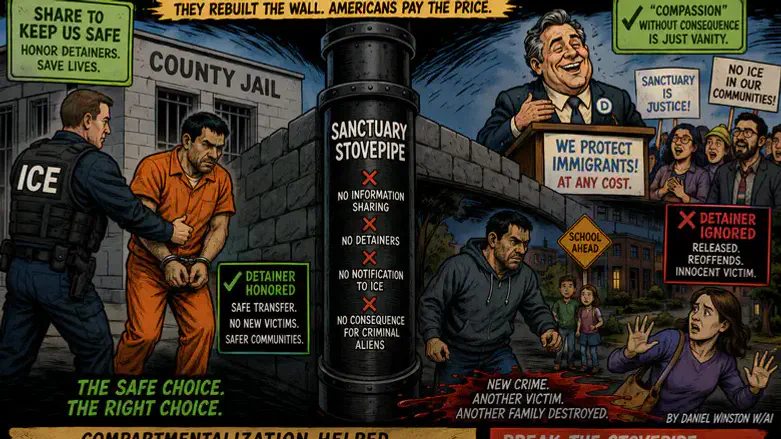
The word stovepipe entered public vocabulary after September 11, 2001, and it described something specific. A stovepipe is a vertical channel with no side branches. Information travels straight up inside one agency and never moves sideways to the other agencies that need it. The 9/11 Commission found that the American intelligence and law enforcement community had built dozens of them, each one defensible on its own terms, and that the cumulative effect was a government that theoretically knew a great deal while institutionally knew nothing. That blind spot was all the terrorists needed to murder close to 3000 Americans in one day.
The most consequential of these barriers had a name. Inside the Justice Department it was simply called the wall, a set of procedures separating intelligence collection from criminal investigation. It was not built by fools or by people indifferent to American lives. It was built by serious lawyers worried about a real problem, which was the possibility that foreign intelligence surveillance authorities might be misused to build ordinary criminal cases against Americans. The concern was legitimate. The people who raised it were sincere.
Consider what the wall actually produced. By early 2000, the Central Intelligence Agency knew that a man named Khalid al-Mihdhar held a valid American visa and that his associate Nawaf al-Hazmi had flown into Los Angeles. That information sat in one channel while the Federal Bureau of Investigation, which had the domestic authority and the manpower to find two men living openly in San Diego, sat in another. When the Bureau finally began looking in late August of 2001, a criminal investigator who wanted to join the search was told he could not, because the information had come from the intelligence side. He wrote back that people were going to die because of the line being drawn.
Two weeks later they did. Mihdhar and Hazmi boarded American Airlines Flight 77 and flew it into the Pentagon.
The bipartisan conclusion drawn from this catastrophe was that the operating principle of American security had to shift from need to know toward need to share. Congress passed the Intelligence Reform and Terrorism Prevention Act, created the Director of National Intelligence and the National Counterterrorism Center, lowered the wall through the PATRIOT Act, and stood up Joint Terrorism Task Forces and fusion centers across the country whose entire purpose was to force federal, state, and local officials into the same room looking at the same information. The lesson was understood to be permanent.
Compartmentalization by default kills people. Sharing is not a bureaucratic nicety. It is the whole job.
Which brings us to the governors, mayors, county executives and state attorneys general who now hold celebratory press conferences to proudly announce that their jurisdictions will not share information with federal immigration authorities, will not honor detainer requests, and will not notify Immigration and Customs Enforcement when a foreign national in their custody is about to walk out the door. They have rebuilt the wall. They have rebuilt it deliberately, publicly, and with an air of moral achievement that the Justice Department lawyers of the 1990s never permitted themselves. Those lawyers at least understood they were making a tragic tradeoff. Today’s officials do not think they are trading anything at all. They remain astonishingly jubilant even if the illegal aliens pose severe clear and present danger to their own constituents.
Understand the mechanism, because the mechanism is where the harm lives. An ICE detainer is a request that a jail hold a removable alien for up to forty eight hours past the point of release so that federal officers can take custody inside a secure facility. That is the safest transfer imaginable. The subject is already in handcuffs, already searched, already accounted for, in a controlled environment, with no innocent bystanders. A sanctuary policy does not prevent that arrest. It relocates it. The alternative to a jailhouse transfer is not the absence of enforcement. It is officers going out to find the same man on a residential street, at his workplace, outside a school, in an apartment building full of neighbors and children. Every jurisdiction that refuses the transfer is choosing the second scenario over the first and then expressing the highest outrage when the second scenario looks the brutal way it inevitably looks on CNN.
And in the interval between release and rearrest, some number of these individuals commit new crimes. The ones who do are not statistical abstractions, and their victims are overwhelmingly the residents of the very neighborhoods these policies solemnly claim to protect. A man released from a county jail over a federal request does not travel to the mayor’s block.
Gad Saad has given a name to the mental operation that makes this possible. In The Parasitic Mind and in his subsequent work on what he calls suicidal empathy, Saad describes a pathology in which a genuine and admirable human capacity, the ability to feel another’s suffering, is decoupled from any capacity to reason about consequences.
Empathy without a governor does not stop being empathy. It becomes a mechanism that selects for whoever is most vividly present to the imagination and discards everyone who is merely statistically probable. The deportable defendant is vivid. He has a face, a family, an attorney, a press release, a group of enthusiastic and well organized protestors. His future victim is not vivid, because she does not exist yet. She is a probability distribution, and probability distributions do not generate feeling or breathless news coverage.
This is why the sanctuary official can glandularly experience refusal as compassion and justice. He is not weighing two groups of human beings and choosing one. He is seeing one group and failing to perceive that the other is there.
The 9/11 wall worked exactly the same way. The civil liberties concern was vivid, concrete, and articulable by name. The passengers of Flight 77 were an abstraction until the horrific moment they were not.
There is an argument on the other side, and it is the same argument that built the first wall. Defenders of these policies say that cooperation with federal immigration enforcement makes immigrant communities afraid of all police, which suppresses the reporting of domestic violence, wage theft, and worse.
Note the structure. A real and sympathetic harm is identified, a barrier is erected to prevent it, and the costs of the barrier are never counted because they land on people who cannot be named in advance. The Justice Department lawyers of the 1990s made this exact move and were sincere while making it.
The argument also does not reach the practice it is used to defend. A woman who calls 911 to report her husband is not in the custody pipeline. A detainer applies to someone already arrested, already booked, already charged. Nothing about honoring that request touches the witness, the victim, or the caller. The two situations have been fused rhetorically because the fusion is politically useful, not because the mechanism connects them in reality.
And the fear itself is substantially manufactured by the officials who then invoke it. When a mayor holds a press conference to announce that his city will resist federal immigration enforcement, he is broadcasting to every immigrant within earshot that contact with any government office carries deportation risk. He generates the chilling effect, measures it, and presents it as the justification for the policy that produced it.
The stovepipe is back and its heart is as black and vacuous as deep space. It has a communications office now, and a flag, and a theory of itself as holding a superordinate moral stand. The men who built the first one had the decency to know what they were doing was dangerous. Those who are operating version 2.0, are either clueless or couldn’t give a damn about how many Americans it kills. Either way, they should be seen as the danger they are to their constituents who should vote the rascals out of every office from which they perpetrate this unforgivable offense.
