

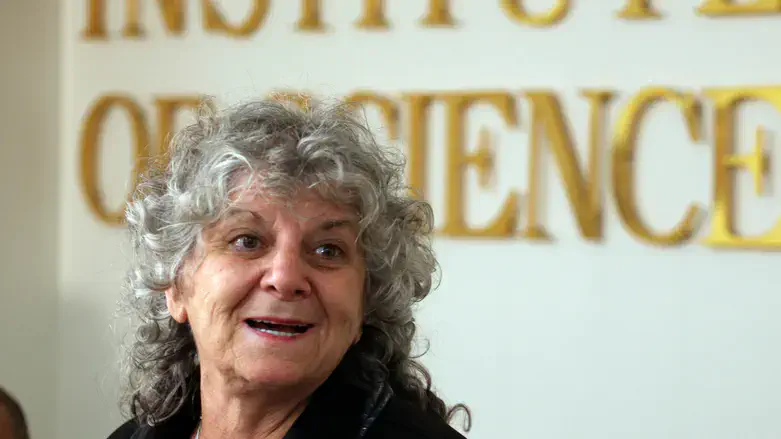
Prof. Ada Yonath, winner of the 2009 Nobel Prize in Chemistry and the Israel Prize, has died at the age of 87. Yonath, a senior researcher in the Department of Chemical and Structural Biology at the Weizmann Institute of Science, devoted her professional life to deciphering the structure and active mechanism of the ribosome - the cellular component responsible for producing proteins.
Her decades of research paved the way for understanding how antibiotic drugs bind to bacterial structures and for developing new medical treatments against antibiotic-resistant bacteria, one of the major challenges facing modern medicine.
Israeli President Isaac Herzog eulogized her and said: “I am deeply saddened to learn of the passing of Professor Ada Yonath, Nobel laureate in Chemistry, Wolf Prize laureate, Israel Prize laureate, and one of the leading researchers in the history of Israeli science."
“Anyone who followed Professor Yonath’s scientific journey knew that she was an international trailblazer, and a pioneer who proved that curiosity, dedication, and unwavering determination can push back the frontiers of human knowledge. Her groundbreaking discoveries changed the face of science and brought great honor to the State of Israel.
“Professor Yonath lived out that very aspiration, serving as an inspiration to countless women and men alike. We will remember her for her modesty, the originality of her thinking, and as a role model and inspiration to generations of scientists in Israel and around the world.
“I send my deepest condolences to her family, her colleagues at the Weizmann Institute of Science, her students, and the entire scientific community. May her memory be a blessing."
Weizmann Institute President Prof. Alon Chen eulogized her: “Ada was an extraordinary scientist who was not afraid to choose a path that others thought impossible and to pursue it with determination, curiosity and courage for decades. Her breakthrough in ribosome research transformed our understanding of one of the most fundamental processes of life and opened new possibilities in the fight against antibiotic resistance. But Ada’s legacy is even greater than her scientific achievements.
“She showed generations of female and male scientists what can be achieved when one dares to ask big questions and refuses to give up on the relentless search for answers. Ada was an ‘Institute Professor’ - the highest rank awarded by the Institute to a select group of distinguished scientists - and she continued researching and publishing, maintaining an active laboratory and conducting scientific collaborations right up until her final days," he added.
The beginning of Yonath’s academic journey in the late 1970s was met with considerable skepticism from the international scientific community. At the time, the prevailing assumption was that the complex ribosome system could not be crystallized for investigation using X-ray crystallography. Yonath later recalled the reaction she received at the time: “People called me a fantasist."
Despite repeated failed attempts around the world, Yonath and her team conducted some 25,000 experiments before succeeding in producing the first ribosome crystals in 1980. Over the following two decades, Yonath refined her methods, including developing cryo-bio-crystallography - a technique based on rapid freezing that prevents crystals from being destroyed during irradiation.
The research reached a milestone in 2000, when teams led by Yonath at the Weizmann Institute and the Max Planck Institute in Germany deciphered, for the first time, the complete three-dimensional structures of the subunits of the bacterial ribosome. The scientific journal Science named the discovery one of the ten leading scientific achievements of that year. A year later, her research demonstrated how antibiotics bind to the bacterial ribosome and inhibit protein production, an insight that helped reveal the mechanisms by which disease-causing bacteria develop resistance.
Yonath was born in Jerusalem in 1939 to a family of limited means. After her father died during her childhood, she worked from a young age to help support her family while completing her education. She earned her bachelor’s and master’s degrees from the Hebrew University of Jerusalem and completed her doctorate at the Weizmann Institute in 1968. Following postdoctoral studies in the United States, she established Israel’s first protein crystallography laboratory at the Weizmann Institute in 1970.
Over the years, she headed scientific departments, directed research centers and was a member of numerous national and international academies, including the U.S. National Academy of Sciences, the Israel Academy of Sciences and Humanities and the Pontifical Academy of Sciences at the Vatican. In addition to the Nobel Prize, she received numerous prestigious honors, including the Israel Prize, the Wolf Prize, the EMET Prize and honorary doctorates from dozens of universities around the world.
Despite the extensive international recognition she received, Yonath once said that the title dearest to her heart was a “World’s Best Grandma" certificate given to her by her granddaughter, Noa.
Prof. Yonath is survived by her daughter, Dr. Hagit Yonath, director of an internal medicine department at Sheba Medical Center, and her granddaughter.