

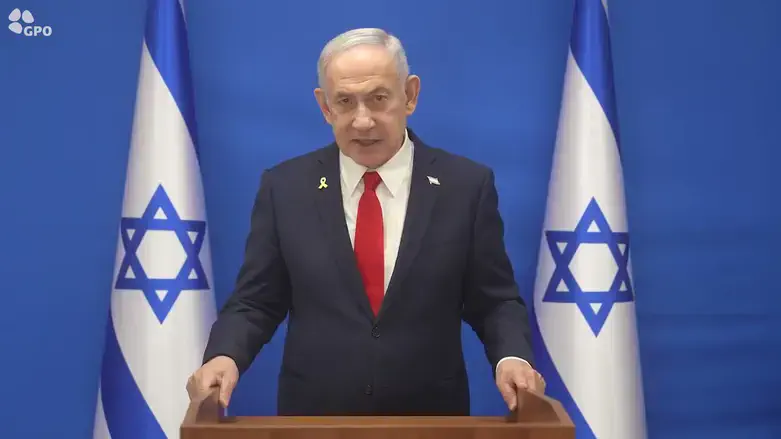
One of the most recurring refrains that resonates in the Bibiphobic echo chamber that overhangs much of the political debate in Israel is the allegation that “Bibi has ruined the country."
Indeed, the incessant repetition of the charge has given it almost axiomatic status for the anti-Netanyahu crowd- as if it were a self-evident truth requiring little substantiation on the part of its purveyors to establish its veracity.
Indeed, a wideranging array of achievements runs starkly counter to this grave accusation.
Impressive, if still incomplete, security accomplishments
In the realm of security, many of the facts are largely well established in the public domain, so I will not dwell on them in any great detail.
Virtually all of the pre-October enemy leadership, devoted openly to the destruction of the Jewish state, has been “dispatched into the hereafter", sending a clear message that following in their footsteps could be a risky path to tread. The array of those no longer with us includes the bloodthirsty Sinwar brothers, the once elusive Mohamed Deif, the hedonistic plutocrat Ismail Haniya, the boastful Hasan Nasrallah, and the brutal theocrat Ayatollah Ali Khamenei, along with a long entourage of cronies and henchmen. And the list gets longer daily.
On the battlefield, sustained IDF action has brought Syria to the brink of disintegration, but most importantly, has decoupled it from Hezbollah and Iran, effectively disrupting the longstanding Shi’a arc linking Iran to Lebanon.
In Lebanon itself, Hezbollah, although still a formidable force, is no longer viewed as the protector of Lebanon, but by many as the enemy of Lebanon.
In Gaza, much of the enclave lies in ruins, with 60-70% of it under the control of the IDF, and with the prospect of large-scale emigration of the inhabitants gaining momentum-albeit sluggishly.
In Iran, much of the infrastructure-physical and human-on which its nuclear program was based, has been eliminated and, at the very least, set back for years.
Emphasis on Economics
But a word of caution is called for here.
Initial operational successes, although necessary, can turn out to be fleeting and ephemeral. Perhaps the starkest example of that is the case of Nasrallah's predecessor, Abbas al-Musrawi, who was eliminated by the IDF in Lebanon in 1992, a measure that brought the arguably even more murderous Nasrallah to power, as well as resulting in a series of lethal terror attacks on Israeli personnel and installations - particularly in Buenos Aires.
However, for the remainder of the analysis, the focus will be on the economic performance of the country under the Netanyahu government-particularly in the post-October War period-which has received far less media attention than that allotted the security sphere.
Significantly, Israel’s overall economic performance has outstripped virtually all other leading Western economies across a wide range of major indicators.
GDP per capita:
Indeed, while traditional Western European economies have faced prolonged stagnation, Israel maintained a top-tier global position, with its GDP per capita rising to almost $70,000-surpassing major Western economies such as Germany, France, Japan, Canada and the UK-and even the petro-rich UAE.
The exchange rate:
The country’s economic robustness is reflected in the strength of its currency. Indeed, the demand for the shekel has propelled it to be one of the world’s strongest currencies in recent years. Moreover, despite the war and gloomy prospects that abounded in its immediate wake, the shekel has risen dramatically against the US dollar (around 36%) - from a low of just over 4 to under 3 to the dollar! Likewise. It has appreciated substantially against the Euro (over 18%) and Sterling (over 17%)
Direct foreign investment (FDI)
Direct foreign investment in the country has soared since the post-October War. Indeed, Israel has led the world in attracting foreign investments relative to GDP (which of course also contributed to the demand for the shekel and its high rate of exchange)
Moreover, cross-country comparison of FDI as a percentage of gross fixed capital formation shows that international investors see Israel as a distinctly profitable place in which to invest: Thus, in Israel, the rate of FDI in gross fixed capital formation is 13,7% over twice the overall World rate of 5,3% and three times that of the developed economies (4,7%) and of the US (4.4%).
The growth rate of GDP per capita:
In terms of the growth of GDP per capita (as distinct from the absolute levels discussed above), over the last three decades-for most of which Netanyahu was Prime Minister-in Israel this has been +275%, easily surpassing the US (215%) and almost doubling that of the UK and the EU (147% and 147% respectively)
Flawed but successful
Of course, none of this is to suggest that Netanyahu is above all reproach. Indeed, for all his manifest merits, he is a leader with undeniable faults, who has not done many things that he should have, and done many things that he shouldn’t have.
However, whatever those undeniable shortcomings are, they are apparently far fewer than any of his even remotely relevant rivals.
Accordingly, when coming to decide on how to cast one’s ballot in the upcoming elections, it would seem prudent to heed the well-known dictum: If it works, don’t fix it.
Martin Sherman spent seven years in operational capacities in the Israeli defense establishment. He is the founder of the Israel Institute for Strategic Studies (IISS), a member of the Habithonistim-Israel Defense & Security Forum (IDSF) research team, and a participant in the Israel Victory Project.