
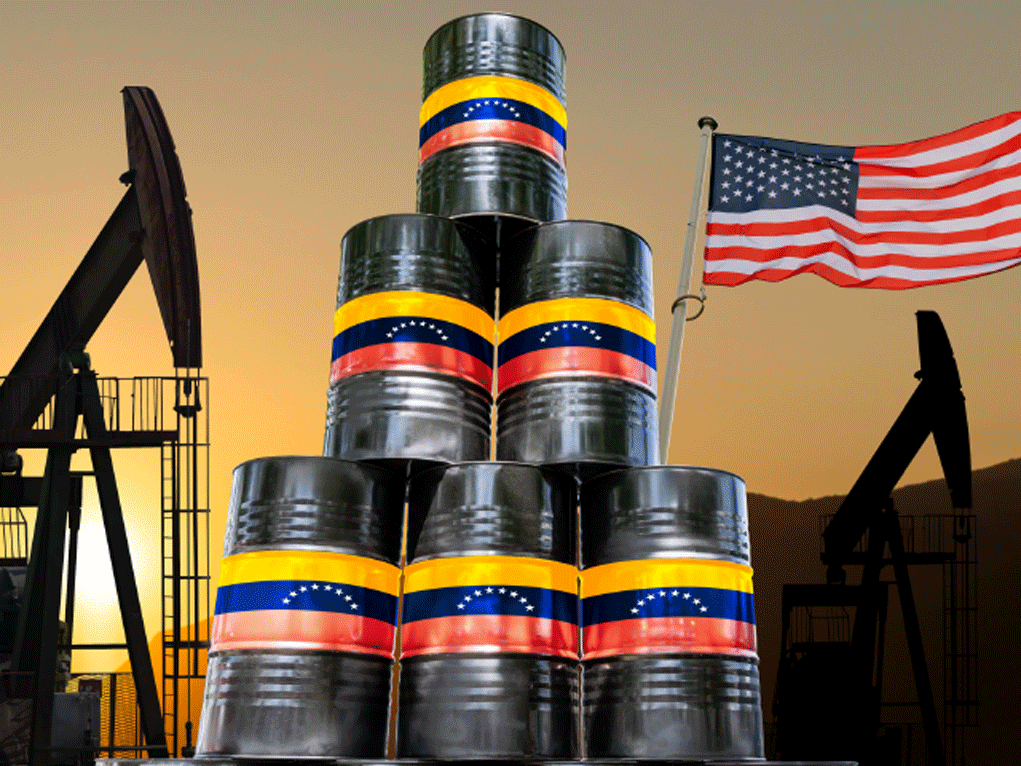

Last week, President Trump announced that he has reached a deal with Venezuela’s interim government, giving the U.S. effective ownership of over 65 billion barrels of that country’s proven oil reserves, effectively more than doubling America’s domestic oil reserves, which had stood at about 46 billion barrels.
Since January 3, when the American military forcibly ousted Venezuela’s corrupt former president, Nicolás Maduro, and his wife, the United States has been dictating Venezuela’s government policies that are being carried out by Maduro’s former vice president, Delcy Rodriguez, acting as Venezuela’s interim president.
She had been given little choice. Trump has said that he had warned her a few hours after Maduro was arrested that, “If she doesn’t do what’s right, she is going to pay a very big price, probably bigger than Maduro.” The deposed Venezuelan president is now being held in the federal Metropolitan Detention Center, located in downtown Brooklyn, New York, along with his wife, Cillia Flores, who is being held in a separate unit of the same facility.
Heeding that warning, since taking office in January, Rodriguez has complied with all of Trump’s requests, out of self-interest in protecting her own personal safety, as well as her disputed position as Venezuela’s unelected interim president.
President Trump announced the Venezuela oil deal in a social media post in which he declared, “At my direction, Secretary of State Marco Rubio, and Secretary of War Pete Hegseth, working closely with highly respected interim president of Venezuela, Delcy Rodriguez, and, through a partnership with private business, have secured majority U.S. control of more than 65 billion barrels of proven oil reserves in Venezuela, at no cost to the American taxpayer.
“This historic transaction more than doubles American oil reserves, greatly increases our oil supply, and will substantially lower gas prices for all Americans, long into the future, while helping to continue to set Venezuela on a course toward tremendous success and great prosperity,” the president wrote on Truth Social.
Secretary of State Marco Rubio, who has played a major role in guiding Venezuela’s new pro-American government, said on social media that the oil deal Trump announced will “bring nearly $100 billion in private investment, support thousands of high-paying jobs, and drive the reconstruction of Venezuela’s economy.” Rubio also called it a “huge win” by securing a new supply of low-cost oil for the entire Western Hemisphere and eventually lower gas prices significantly for American consumers.
Venezuela’s New Interim President Defends Her Deal With Trump
Interim president Rodriguez praised the deal as a “historic agreement” in a statement on X. She predicted that it will “have a significant impact on our nation’s revival,” based upon expectations that it will generate over $209 billion in new tax revenue for the Venezuelan government. She also said that, “These investments will contribute not only to the recovery and modernization of our industry, but also to our country’s economic growth, the energy security of our hemisphere and greater stability in international markets.”
She publicly thanked Trump, Rubio and the U.S. government for their efforts to reach the agreement. But she also insisted, despite all of the indications to the contrary, that “There is something that must be made absolutely clear: Venezuela retains the ownership and sovereignty over its resources, while it uses capital, technology, and operating capacity to leverage the recovery of a strategic industry hard hit by [U.S.] sanctions.”
It was hard to believe that this was the same woman who made a speech in 2024, as Maduro’s vice president, in which she lambasted María Corina Machado, the leader of Venezuela’s democratic opposition by accusing her of seeking to “hand over the [country’s] oil, natural gas and gold” to her “masters” in Washington, D.C., “and trample on our historical dignity.”
Rodriguez has come under severe criticism by Venezuela’s opposition leaders for committing the same sin of agreeing to give the U.S. government an ownership share in the expansion of Venezuela’s oil industry. Her critics claim the deal violates Venezuela’s constitution, adopted by the government of Hugo Chavez in 1999, which gives ownership of the country’s oil deposits exclusively to the state and does not permit them to be sold. The same critics have also been clamoring for the U.S. to pressure Rodriguez, who they claim is leading an “illegitimate interim government,” into holding new and free national elections.
Trump ordered the U.S. military to seize Maduro and his wife in January from a Venezuelan military base in Caracas and bring them to the U.S. to stand trial in an American court for masterminding Venezuela’s massive drug smuggling operations.
Venezuela Refugees Criticize Rodriguez For Selling Out Her Country
Many members of the opposition to Maduro’s regime, including some of the seven million Venezuelan refugees now living abroad, have angrily accused Trump of legitimizing Rodriguez and her unelected government in exchange for gaining control by the U.S. over Venezuela’s oil.
“It’s an operation that’s absolutely unconstitutional because it’s an illegitimate government,” said Diego Arria, a former Venezuelan cabinet minister and ambassador who is now living in exile in the U.S. He noted that before Maduro’s seizure by the U.S. military in January, Rodriguez and the other members of her government, with whom Trump is now working so closely, were wanted by his own federal law enforcement agencies for drug trafficking and other crimes.
Rafael Ramírez, the former head of Venezuela’s state-owned oil company, Petróleos de Venezuela S.A. (PDVSA), who now lives in exile, accused Rodriguez of “driving a dagger straight into the heart of the homeland” by agreeing to a “neocolonial” transaction with President Trump. Ramirez described the deal as a historic act of surrender, negotiated in secret, which cedes control of Venezuela’s oil to a foreign power.
The day after the deal was announced, dozens of left-wing pro-Maduro protesters marched through the streets of Caracas carrying banners that read: “We are neither a colony, nor a backyard,” and “Yankees go home!”
Since the effective American takeover of Venezuela, the Trump administration has been encouraging America’s largest oil companies to return and begin investing again in that country’s oil infrastructure.
Trump promised to rebuild and rejuvenate Venezuela’s oil fields that had long been neglected and mismanaged under Maduro’s rule, and that of his predecessor, the charismatic Hugo Chavez. Trump also said, shortly after Maduro’s ouster, that he would make sure that under Venezuela’s new leadership, which he would choose personally, the American people would share in the profits from the development of Venezuela’s huge oil reserves, which would also finance that country’s recovery.
Details of the new arrangement for exploiting Venezuela’s oil reserves are slowly coming to light. According to a Wall Street Journal report, after months of secretive negotiations by U.S. officials meeting with their counterparts in Caracas, the outlines of the deal emerged from a phone call between Trump and Rodríguez a few days before it was announced last week. It took an additional few days to work through the details of how to implement the unusual agreement.
The U.S. Government’s Shady New Partner In Venezuela
It grants a private company, which is now jointly owned by the U.S. government and Venezuelan businessman Alejandro Betancourt, a 100-year lease for 17 oil fields across Venezuela with at least 65 billion barrels in proven crude oil reserves.
Betancourt has previously served as a broker in Venezuelan government energy deals under the Maduro and Chavez regimes. More recently, he served as an intermediary for the U.S. with Venezuela’s oil industry for much smaller deals. He also reportedly has close ties to interim president Rodríguez.
There is also a darker side to his past. Over the past decade, Betancourt has been the subject of multiple investigations around the world on charges of money laundering, including in the United States, but he has never been indicted or faced trial for that crime.
In November 2025, British police arrested Betancourt in London, where he had been living, due to an extradition request from Switzerland and an international arrest warrant based upon allegations that he engaged in money laundering and embezzled over $1 billion from the Venezuelan government. After his arrest, Betancourt was released on bail while his Swiss extradition request was being adjudicated by British courts. However, in May of this year, Swiss prosecutors withdrew their extradition request at the request of the Trump administration and the Justice Department, so that Betancourt could help the U.S. to negotiate oil deals with the new Venezuelan government.
Betancourt’s North American Blue Energy Partners (NABEP) company is currently the second-largest private oil producer in Venezuela, after Chevron. It has been producing nearly 200,000 barrels of oil over the past two years. With the new U.S. deal announced by Trump, NABEP has now become the world’s second-largest corporate holder of proven oil reserves, after Saudi Arabia’s Aramco.
U.S. Has Won Control Of Venezuelan Oil For Pennies On The Dollar
The U.S. government holds a 55% share of the private company, split between 35% passive equity ownership in NABEP, and the right to purchase 20% of the oil to be produced by the joint venture at NABEP’s cost of production.
Reportedly, the U.S. investment in NABEP would be arranged through the Pentagon’s Office of Strategic Capital, which is authorized to issue so-called penny warrants. These warrants are defined as an equity instrument that gives the holder the right to buy shares of a company at a nominal price, often just one penny ($0.01) or close to zero, in transactions that are deemed by that office to serve U.S. national security interests. In this case, the warrants will enable the Defense Department, on behalf of the U.S. government, to acquire partial equity ownership in Mr. Betancourt’s private business without the need to make a significant capital investment.
Trump Promises To Use The Deal To Restock Depleted U.S. Oil Reserves
According to a U.S. official, as the company generates more oil from Venezuelan oil fields, some of it will be used to refill the depleted U.S. Strategic Petroleum Reserve (SPR), thereby justifying the deal’s required national security component.
The SPR was initiated by the federal government in 1975 in reaction to the Arab oil embargo which followed Israel’s victory in the 1973 Yom Kippur War. It consists of underground storage tanks in Texas and Louisiana with a total capacity of 714 million barrels, and was set aside for use in a national oil shortage emergency. However, in 2022, President Joe Biden announced that he was going to release 180 million barrels of oil from the reserves even though there was no supply shortage. His purpose was to lower the global market price of crude oil and the domestic price of gas at the pump. Those prices had been deliberately raised by the Biden administration’s climate-change-induced war on domestic fossil fuel production and had become a major political problem for Biden and his fellow Democrats when the nationwide average cost of gas at the pump reached $5 a gallon.
On the other hand, President Trump’s order for the withdrawal of 172 million barrels of oil from the SPR in March of this year was part of a coordinated global response to the shortage created by Iran when it began attacking the ships passing through the Strait of Hormuz carrying 20% of the global supply of crude oil from the Persian Gulf. Because of the additional withdrawals ordered by Trump, SPR crude oil inventories have now fallen below 300 million barrels, the lowest levels since 1983. This historically low level of oil reserves is seen as a potential threat to U.S. national security and has made the replenishment of the SPR one of Trump’s top long-term energy priorities.
This unusual business arrangement, pioneered by President Trump, in which the U.S. government becomes an active investor in a strategically significant private company, was apparently the result of the relatively little progress Trump had achieved since Maduro’s removal in getting U.S. companies to invest their own funds in developing Venezuela’s oil potential, rather than relying on taxpayer dollars. Trump believes that the addition of a portion of Venezuela’s vast crude oil reserves and their subsequent development will strengthen America’s energy independence and create a major new source of tax income and jobs for the American economy.
Why Some U.S. Oil Companies Are Reluctant To Return To Venezuela
However, according to the Wall Street Journal, some American oil company executives who are now willing to consider investing in Venezuela’s oil fields find the prospect of competing with a U.S.-backed private company with a huge stake in Venezuela’s oil fields to be a daunting business proposition.
Ed Hirs, for example, an energy economist at the University of Houston, asks, “Why is the U.S. subsidizing and building a major competitor to the U.S. oil patch [industry]?”
There is also the possibility that the legality of the deal just announced between interim president Rodriguez and Trump might later be successfully challenged in court by a newly elected Venezuelan government.
Critics of Trump’s Venezuela oil deal also point out that it will likely take years before any new American oil company investments in Venezuela’s dilapidated oil fields increase Venezuela’s oil output sufficiently to bring down the cost of gas at the pump significantly for American consumers.
Former U.S. Diplomat Asks What Trump’s Quid Pro Quo Is
Francisco Palmieri, a former U.S. State Department diplomat who once served as chief of mission and acting U.S. ambassador to Venezuela’s neighboring country of Colombia, said that Trump’s willingness to work with Betancourt, whom he described as someone “loathed by almost all sectors in Venezuela,” undermines the credibility of the new oil deal.
Palmieri said that he also worries that the new agreement could enable the interim Venezuelan government to delay elections and remain in power indefinitely in order to ensure that the unusual terms of the new arrangement are carried out.
Palmieri also asked, “What is the quid pro quo?” Trump wanted from the interim government in return for providing it with the lifeline that the oil deal represents. “If it’s just the U.S. continuing to exercise total control over the regime, it just means that the United States owns more and more of [whatever] happens in Venezuela over the next few years.”
Palmieri and many other critics of the new oil deal have also acknowledged the urgent need for Venezuela to attract more private foreign investments to repair and upgrade its dilapidated oil industry. However, in order to do that, measures must first be taken to address the legitimate concerns of U.S. oil companies about the long-term safety of any such new investments based upon the history of oil industry takeovers by two different previous Venezuelan governments.
In the Wall Street Journal editorial board’s own harsh critique of Trump’s Venezuela oil deal, it notes that there are other more promising energy-producing areas in South America, such as deep wells in Guyana and oil shale deposits in Argentina, that are likely to yield significant results far sooner than the long-neglected oil fields of Venezuela.
Trump Criticized For Propping Up Another Venezuela Dictator
The editorial also disapproves of Trump’s decision to prop up a corrupt foreign dictator like Delcy Rodriguez, just because she is willing to do whatever he tells her to, in return for agreeing to keep her in power, while putting off indefinitely democratic elections to choose a legitimate leader for Venezuela.
However, David Blackmon, who is a senior contributor to Forbes magazine, argues that Trump’s long-term deal to develop Venezuela’s oil makes sense strategically because that oil will eventually be needed to replace domestic U.S. production from exhausted shale fields in Texas and North Dakota. He also says that Trump’s deal “is not about near-term impacts to lower oil and gasoline prices,” and agrees that it “will likely take 7-10 years to bring [Venezuela’s additional oil] into production.”
Instead, Blackmon believes that Trump saw an opportunity to replace America’s limited current oil reserves with a source from a nearby “country that will reportedly remain under U.S. control for 100 years.” In addition, Blackmon believes that the worst of the Iran-generated global oil crisis due to its attempts to close the Strait of Hormuz is now behind us, while admitting that, it “could have been worse — much worse. The U.S. has been able to avoid some of the terrible impacts the crisis has wrought on other nations thanks to its high degree of energy security,” even though that may be of little comfort to losing Republican candidates on the morning after the midterm elections.
Why The U.S. Will Need Venezuela’s Oil In The Future
Blackmon notes that the most pressing shortage facing America’s energy industry today is the lack of sufficient refining capacity, due to onerous environmental regulations, that matches the light oil that American shale fields have been mostly producing recently. Canada had balanced that shortage by supplying U.S. refineries with the heavy crude on which they work best from oil sands in Alberta province. But now that Canada is turning increasingly hostile to the United States, Blackmon says we can look forward to increasing supplies of Venezuela’s heavy crude reaching U.S. refiners to serve as an ideal replacement.
Finally, Blackmon observes, Trump’s 100-year oil lease deal with Venezuela was also meant to foster the return of dominant American influence over the countries in Central and South America, like Cuba and Venezuela, which have been infiltrated by agents from our enemies in Russia and China, and which previous American presidents have neglected for far too long.
However, once more Venezuelan oil does start to become available in significant quantities, it will be a boon for many oil refineries along America’s Gulf coast and in the Midwest which were designed specifically for the purpose of breaking down Venezuela’s very heavy crude oil into such high-demand products as diesel fuel, which is currently suffering from a worldwide supply shortage and price spike.
Trump Used The Same Argument To Bolster American Chip Makers
Trump made a similar economic and national security argument in defending the necessity for last year’s agreement under which the U.S. government took a 9.9% equity stake in the Intel corporation. He contended that the deal was necessary to bolster America’s domestic infrastructure for the development and mass production of cutting-edge computer chips, which will be crucial to maintaining America’s global economic leadership in the face of a growing technological challenge from China.
Today, 60% of the total global production capacity for semiconductors is located in Taiwan, whose independence is threatened by communist China. In addition, Taiwan currently produces 90% of the world’s most advanced computer chips.
However, thanks in large part to encouragement from President Trump, the Taiwan Semiconductor Manufacturing Company (TSMC), which builds most of the cutting-edge processors for global technology giants like Apple, Nvidia, and AMD, has committed to design and mass-produce the next three generations of its most advanced computer chips at a new research and development center and factories it will build in Phoenix, Arizona.
Two U.S. Oil Companies Can’t Forget Their Previous Losses In Venezuela
Trump has also been actively lobbying the heads of America’s largest oil companies to make major investments to upgrade and modernize Venezuela’s oil fields and share in the profits. While, according to the Wall Street Journal, negotiations by Chevron to make a big investment in Venezuela’s oil fields are nearly complete, most other major oil companies have been reluctant to come forward. That is mainly due to the experiences of ExxonMobil and ConocoPhillips, whose lucrative oil operations in Venezuela were nationalized by then-president Chavez in 2007. Instead of staying on to continue operating under Venezuela’s national oil company, PDVSA, ExxonMobil and ConocoPhillips chose to abandon the country, taking their badly needed capital, advanced oil field technology, and operational management skills with them.
Almost two decades later, the two companies are still seeking billions of dollars in restitution from the government of Venezuela, and are reluctant to risk getting burned again, despite President Trump’s assurances that the U.S. government will be in a position to protect their interests this time.
To encourage oil companies to invest in Venezuela again, the U.S. Treasury Department has lifted its previous sanctions on Venezuela’s oil industry, which were imposed when the U.S. government still considered Venezuela to be a rogue state, working with America’s enemies, Russia and China, to turn its neighbors in the Western Hemisphere against the United States.
In addition, interim president Rodriguez recently signed legislation which made it legal under Venezuelan law for private partnerships like the one just formed between NABEP and the U.S. government to manage the country’s oil resources and production.
At a White House event in January of this year, ExxonMobil CEO Darren Woods explained why his company was so reluctant to consider the new oil-production “opportunity in Venezuela” that had been newly created by America’s removal of Maduro. Woods recalled that in addition to Chavez’s nationalization in 2007, the company’s operations were also taken over in 1976, although at that time, Exxon (before it merged with Mobil) and other foreign operators were compensated by Venezuela’s government for their losses and stayed on under contract to provide technical services.
Nevertheless, Woods said, ExxonMobil still considers Venezuela to be “uninvestable” until changes are made to the country’s legal and economic system to protect foreign investments.
“We’ve had our assets seized there twice. To reenter a third time would require some pretty significant changes from what we’ve historically seen here and what is currently the state,” Woods said. But that was before Venezuela’s interim president Rodriguez signed the new law empowering private oil companies.
Other New Oil Deals With Venezuela Now In The Works
Chevron is the only big U.S. oil company that has been active in Venezuela in recent years. It currently has three joint oil ventures operating in the country with PDVSA, and it is reportedly considering adding two more now that Venezuela’s government is effectively operating under U.S. control. Spain-based Repsol and Italy-based Eni are the only other major global oil companies with operations in Venezuela today.
Hunt Oil, a U.S. “wildcat” oil exploration company with a long history of developing new oil fields far from U.S. shores, was the first new U.S. company to sign an agreement with PDVSA to pump Venezuelan oil in August.
Several other new production deals between Venezuela and other U.S. oil and gas companies are expected to be closed in the coming days under the leadership of Trump’s Energy Secretary Chris Wright.
Not all of Venezuela’s recent oil deals involve American partners. A couple of weeks ago, XRG, the investment arm of the UAE’s Abu Dhabi National Oil Company, said that it has partnered with BP (formerly known as British Petroleum) and a Qatari company to produce natural gas in Venezuela’s offshore Loran natural gas field with roughly 4 trillion cubic feet of proven natural gas reserves. The Shell oil company is already producing natural gas at the nearby Dragon natural gas field off the coast of Venezuela.
Halliburton, which is one of the largest U.S. companies providing oil-field services, is also reportedly in talks to bring some of its drilling and support equipment to Venezuela. Its participation will be crucial to the success of the newly announced U.S.-backed oil venture, because some of the 17 new oil fields to be developed in Venezuela currently have no existing infrastructure or electricity. That means that billions of dollars will have to be invested there before oil drilling can even begin.
The Slow Collapse Of Venezuela’s Oil Industry
Before Chavez’s takeover as president of Venezuela in 1999, Venezuela’s oil fields, operated largely by American oil companies, had been producing about 3.5 million barrels of oil each day. But that number began dropping to roughly 1.1 million barrels of oil today when Chavez fired nearly 20,000 experienced engineers, managers, and technicians who had been operating the oil fields after they went on strike in 2002. Chavez retaliated against the striking oil field workers by replacing them with his political followers who lacked the technical expertise and training needed to run the highly complex industry.
After seizing the American oil operations in 2007, instead of reinvesting the increased profits from Venezuela’s oil exports to maintain the health of the industry through the replacement and upgrading of its pipelines and refineries, Chavez diverted most of the oil money to fund his massive social spending programs and to support communist Cuba and other anti-American revolutionary regimes throughout Latin America. Meanwhile, Venezuela’s oil infrastructure fell into severe disrepair, drastically reducing its ability to extract crude oil from the country’s proven reserves of 300 million barrels, the largest in the world, according to the U.S. Energy Information Administration.
When Chavez died of natural causes in 2013, his vice president, former bus driver and union leader Nicolás Maduro, won a special election to take over as president. He continued to implement Chavez’ socialist and revolutionary policies. When Venezuela’s badly mismanaged economy finally began to fail, leading to severe shortages of food and medicine, and a drastic drop in the people’s standard of living, Maduro turned autocratic to retain his grip on power.
Maduro responded to widespread street protests by ordering the ruthless repression of all dissent and ruling by decree, stripping Venezuela’s popularly elected National Assembly of all power and authority. From then on, Maduro remained in power due to the support of the corrupt leaders of the country’s military and the practice of wholesale election fraud. His regime became notorious for human rights abuses, rampant corruption, censorship, and state-sponsored drug smuggling operations into the United States.
Venezuela’s Painful Transition From Prosperity To Poverty
Venezuela, which had long been South America’s most prosperous country due to its oil wealth, had become the continent’s poorest. During the height of the crisis, from 2015 to 2019, except for a privileged few, the people of Venezuela suffered from severe economic hardship, widespread starvation, and a sharp spike in infant mortality, eventually causing seven million refugees to flee from the country.
Another factor that led to the sharp decline in Venezuela’s oil production capacity is the fact that most of Venezuela’s crude oil is very heavy. Its thickness and consistency are comparable to that of asphalt. In order to get the oil to flow more freely, which is necessary to extract it from wells and transport it through pipelines, Venezuelan crude needs to be heated by injections of steam and diluted with lighter oils and chemicals.
Prior to Trump’s decision to order the U.S. military to arrest Maduro and his wife on January 3 and bring them to the U.S. to stand trial for drug smuggling, he authorized a campaign by the U.S. military to intercept and destroy at sea small boats loaded with illegal drugs that were on their way to the United States. Trump justified the campaign based on the fact that about one hundred thousand American citizens were being killed each year by overdoses of the illegal drugs being smuggled into the country.
Venezuela Deal Is Part Of Trump’s Revival Of The Monroe Doctrine
Trump also argued that, for national security reasons, the United States had to reassert its traditional dominance over the countries of Central and South America, under the so-called Monroe Doctrine. That doctrine was first established by President James Monroe in 1823 in his State of the Union message to Congress. It warned European powers not to interfere in the affairs of the Western Hemisphere. Trump is now applying the doctrine to both Russia and China, which have been working to increase their support for and influence over leftist-leaning Latin American countries, including Cuba and Nicaragua as well as Venezuela.
Trump has also used his influence over Venezuela to boost his drive to establish U.S. energy dominance through his “drill, baby drill” policies encouraging U.S. energy companies to maximize their production from American domestic fossil fuel reserves.
America’s need to secure its energy independence was first demonstrated during the 1973 Arab oil embargo, which resulted in a nationwide American shortage of gasoline. It led to soaring crude oil prices, long lines across America of cars waiting for gas at the pump, and the advent of “stagflation,” a ruinous combination of uncontrolled inflation and stagnant growth that hobbled the American economy.
The 1973 energy shortage also led to largely ineffective and unpopular federal policies. They included the imposition of largely counterproductive price controls, a nationwide 55-mile-per-hour speed limit on interstate highways designed for travel at 65 miles per hour, expensive federal programs to subsidize the adoption of inefficient solar energy, and mandatory conservation measures designed to reduce the use of fossil fuel energy by American consumers.
Understanding Venezuela In The Context Of Trump’s Maga Agenda
Trump’s efforts to reclaim America’s historic influence over Venezuela’s oil assets are also consistent with his larger MAGA (Make America Great Again) domestic economic and foreign trade policies. Altogether, they are designed to reverse the long-term decline in America’s economic strength due to traditional U.S. foreign trade policies, which deliberately put U.S. businesses and products at an unfair disadvantage in the global marketplace in the name of encouraging free trade.
Trump has argued that his tariff policies will remedy decades of unfair trading practices that were responsible for the loss of millions of high-paying U.S. jobs to foreign competitors and gradually hollowed out America’s once strong domestic industrial base.
Trump has also boasted about the large trade deals that he has negotiated since the start of his second term with foreign companies and countries. In the months and years ahead, these deals will result in trillions of dollars’ worth of new commitments of foreign investment in the U.S. economy, as well as huge foreign purchases of U.S.-made goods and agricultural products.
Trump claims that these deals are a measure of the long-term success of his economic policies. He has also argued that this success will become more apparent to the American people as the new factories that are being built because of these new foreign investments come online and begin hiring large numbers of Americans. This, in turn, will naturally result in rising wages and new economic opportunities for working class American, and enable more of them to achieve the traditional American dream, which rewards hard work with economic success and a higher standard of living.
Trump’s Foreign Investment Track Record
These are the five largest new foreign investment commitments to support the growth of the American economy that Trump has either negotiated or encouraged since returning to the White House in January 2025:
The United Arab Emirates (UAE) announced in May, 2025, in conjunction with the White House, a $1.4 trillion long-term investment commitment to a variety of projects located in the United States, which will make the UAE the largest single foreign investor in the growth of the American economy.
Saudi Arabia has announced a new commitment to invest $600 billion in sectors of the American economy, including energy, defense, new technologies, infrastructure, and the mining of strategic critical minerals.
One specific project that will be supported by a $20 billion investment by the Saudi-based DataVolt company will be the construction of new artificial intelligence (AI) data centers across the United States. The Saudi investment will also build the new energy infrastructure to generate the electricity needed to run the new data centers without further burdening the existing U.S. electrical power grid or raising utility costs to American consumers.
SoftBank, the large Tokyo-based multinational holding company, is focused on investments in technology, AI, telecommunications (including part-ownership of T-Mobile), and energy. SoftBank is a major participant in Project Stargate, which has announced plans to invest up to $500 billion in building up America’s AI infrastructure, in partnership with leading American high-technology companies, including OpenAI and Oracle. Project Stargate is expected to become the largest single new investment in the American economy, using both domestic and foreign financing, to be announced during Trump’s second term.
Rebuilding America’s Vital Computer Chip Industry
The latest commitment announced in July by the Taiwan Semiconductor Manufacturing Company (TSMC) to invest $265 billion to build 12 new semiconductor manufacturing and packaging facilities in Phoenix, Arizona, as well as supporting research and development, is already well underway.
The first of the new TSMC factories in Phoenix has begun mass production of the latest generation of 4-Nanometer computer chips. Construction of the second TSMC factory in Phoenix, which will produce the next generation of 3-Nanometer chips, has already been completed, and it is expected to start volume production at some time during 2027. TSMC has also broken ground on a third factory in Phoenix that is expected to begin producing even more advanced 2-Nanometer computer chips before the end of this decade.
The first TSMC factory in Phoenix currently employs more than 3,500 workers. That number is expected to increase exponentially as its two other factories start production, and local suppliers expand their operations to meet TSMC’s increasing demands for support of its Phoenix operations. In addition, TSMC officials say that they expect to build as many as 12 new manufacturing and packaging facilities in the U.S., which will help to achieve Trump’s goal of making the U.S. industrial base much self-sufficient in supplying its needs for these vital components.
The U.S. government’s Commerce Department has announced that during 2025, the first year of Trump’s second term as president, its SelectUSA foreign direct investment program has resulted in the investment of a total of $139 billion in new American business deals that have resulted in the creation of 32,000 more American jobs.
The current White House list of Trump-inspired new foreign investments in the U.S. economy also includes $600 billion from the European Union (EU), $17 billion from the Persian Gulf state of Bahrain, and $6.1 billion from Ireland, as well as an additional $25 billion UAE investment in American data centers and their energy infrastructure.
President Trump has also claimed the credit for several specific large new investments by foreign companies announced since the start of his second term.
Making More American Prescription Drugs, Automobiles And Jetliners
Thanks in part to Trump’s efforts to get the pharmaceutical industry to bring down the cost of prescription drugs to Americans consumers, and his threat to impose higher tariffs on their drugs made in foreign factories, Switzerland-based Roche pharmaceuticals has announced a $50 billion program, over the next five years, to expand its domestic operations in Oregon, North Carolina, Pennsylvania, Massachusetts and several other states, that will result in the creation of more than 12,000 new American jobs.
Novartis Pharmaceuticals, which is also Swiss-based, is best known for its introduction of the popular GLP-1 medication Ozempic for the treatment of diabetes and obesity. It has also recently finalized its own $23 billion plan to build seven new production facilities in the states of California, Texas, Florida, and North Carolina.
The South Korean-based auto company Hyundai has also announced plans for a new $26 billion investment in the United States by 2028, in an effort to escape President Trump’s imposition of sharply increased tariffs on foreign-made vehicles. Hyundai will use the money to scale up production at its existing plant in rural Bryan County, Georgia, to a rate of 800,000 vehicles a year, upgrade its other factories in Alabama and Savannah, Georgia, and build a new steel mill in Louisiana to give its factories a new source of tariff-free American steel with which to build its vehicles for the American market.
Trump also claims that his influence led to major recent purchases of U.S.-made goods and energy by foreign companies and governments that have also bolstered the overall U.S. economy. They include the purchases by Qatar Airways of $96 billion worth of new Boeing airliners, and by the UAE’s Etihad airline of $14.5 billion worth of Boeing airliners, all of which will be powered by jet engines manufactured in the U.S. by General Electric.
While some of these new investment plans and purchases of American goods for which Trump has claimed the credit are more significant to the long-term growth of the U.S. economy than others, the aggregate picture is one of an American economy which is attracting significant foreign investment to create new American jobs.
Thanks to Trump’s tax-cutting and regulation-reducing economic policies, America is now actively rebuilding its long-neglected industrial base. Trump has also reversed America’s decades-long slow economic decline, which was accompanied by the loss of millions of good-paying American jobs to unfair foreign competition and outsourcing by American manufacturers.
Trump’s Big Picture — Will American Voters See It?
Taken together with Trump’s latest move to secure America’s long-term energy independence through the deal to tap Venezuela’s vast oil reserves, these accomplishments should enable Trump and Republican candidates in the upcoming November midterm election to present voters with a persuasive picture of an American economy being primed for future success and to defend its status as the world’s largest and strongest economy for many years to come.