

 OSINT613
Could Saudi Arabia Quietly Turn to an Israeli Pipeline if the Red Sea Crisis Deepens?
Saudi Arabia’s oil export network is facing growing pressure. Houthi attacks have turned the Bab el-Mandeb into a far riskier shipping lane. Tankers are already taking longer routes, insurance premiums have risen, and voyages to Europe now take significantly more time and cost millions more.
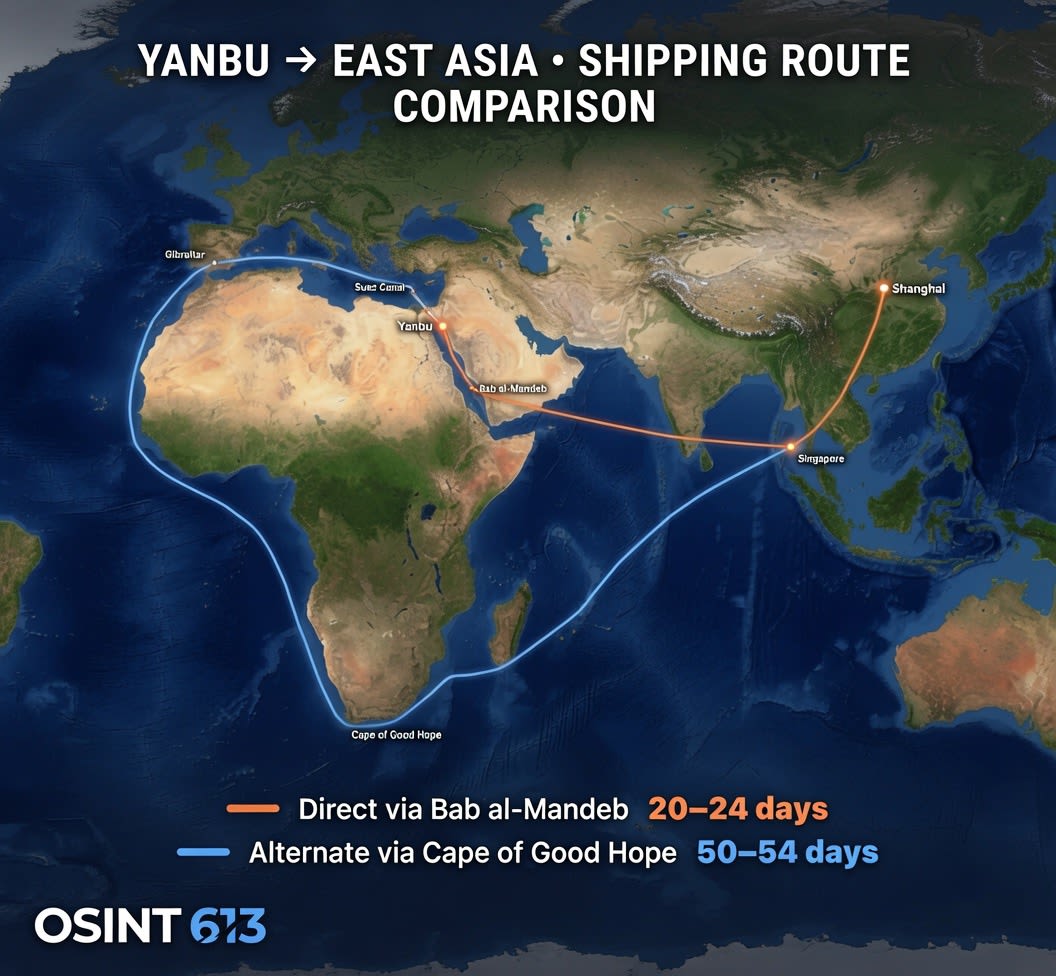
Much of the attention has centered on Saudi Arabia’s East West Pipeline, which carries crude from the Eastern Province to Yanbu on the Red Sea, avoiding the Strait of Hormuz. That solves only part of the problem.
Once the oil reaches Yanbu, it still has to leave the Red Sea. If Bab el-Mandeb becomes too dangerous for regular tanker traffic, another export route is needed.
One already exists.
A Pipeline Built for Red Sea Oil
The Europe Asia Pipeline, better known as the Eilat Ashkelon Pipeline or Trans Israel Pipeline, runs 254 kilometers from Israel’s Red Sea port of Eilat to Ashkelon on the Mediterranean coast.
It was built in 1968 and 1969 as a joint venture between Israel and Imperial Iran under Shah Mohammad Reza Pahlavi. Its purpose was to transport Iranian crude arriving at Eilat across Israel before it was loaded onto tankers bound for Europe, bypassing the Suez Canal.
Javier Blas, a prominent Bloomberg energy columnist, highlighted that the project was important enough to appear in a President’s Daily Brief prepared for the White House. In April 1968, the CIA reported that Israel was about to begin construction of a 42 inch pipeline linking Eilat on the Gulf of Aqaba with Ashkelon on the Mediterranean, specifically to bypass the Suez Canal. The agency expected the first phase to carry about 20 million tons of oil annually, eventually expanding to between 50 million and 60 million tons a year by around 1975.
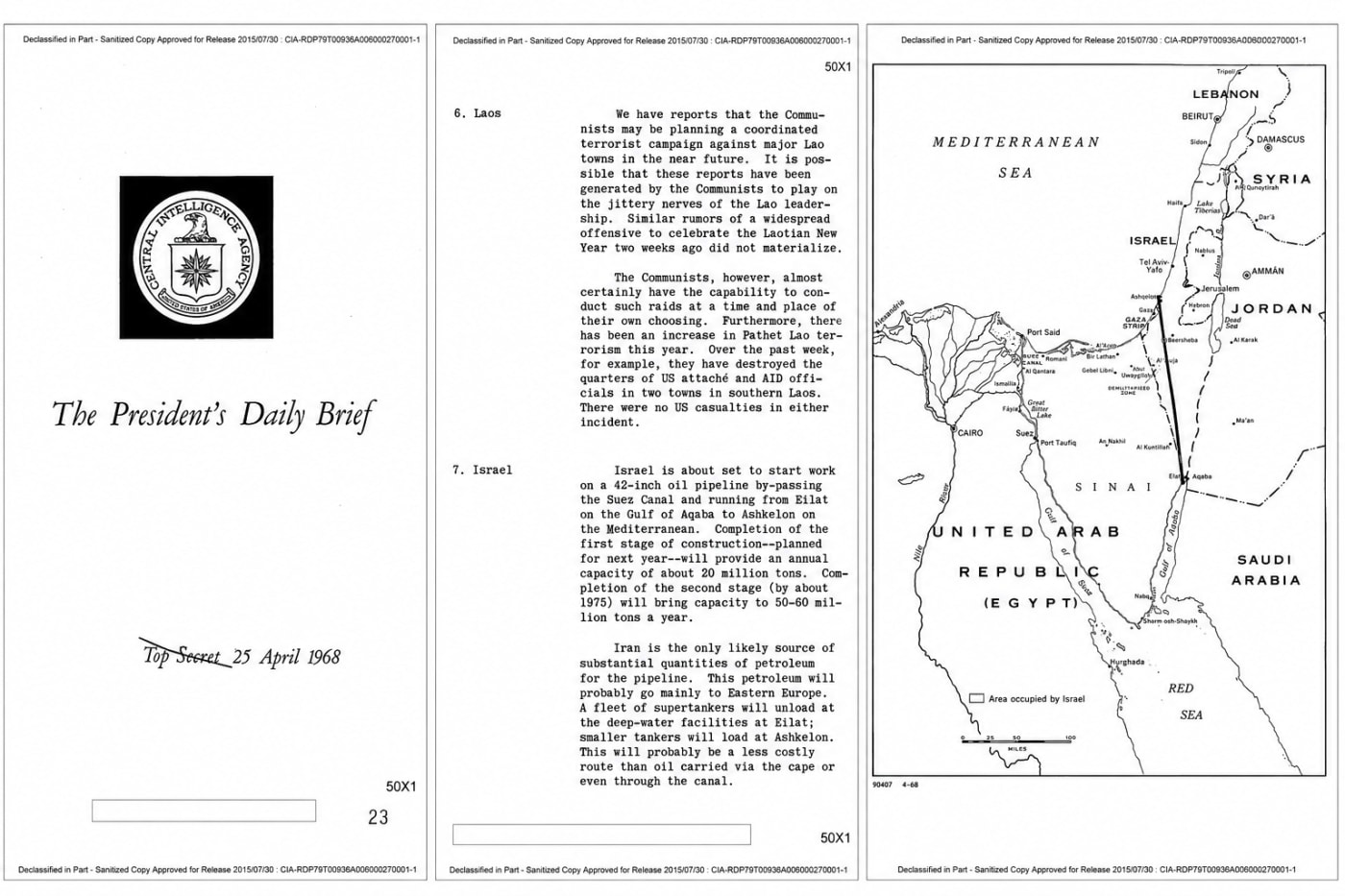
The CIA also assessed that Iran would be the pipeline’s primary supplier. It expected supertankers to unload crude at Eilat’s deep water terminal before the oil crossed Israel by pipeline and was reloaded onto smaller tankers at Ashkelon, primarily for shipment to Eastern Europe. The assessment concluded the route would likely be cheaper than transporting crude through the Suez Canal or around the Cape of Good Hope.
After the 1979 Iranian Revolution, Tehran severed ties with Israel and Israel assumed full control of the pipeline, now operated by the Europe Asia Pipeline Company.
In 2003, the system was upgraded for full bidirectional operation, allowing crude to flow in either direction depending on market demand. Today, its primary northbound route from Eilat to Ashkelon remains its highest capacity configuration.
The infrastructure remains in place and was designed for exactly this type of transit.
How Saudi Arabia Could Use It
Saudi crude would first travel through the Kingdom’s East West Pipeline to Yanbu.
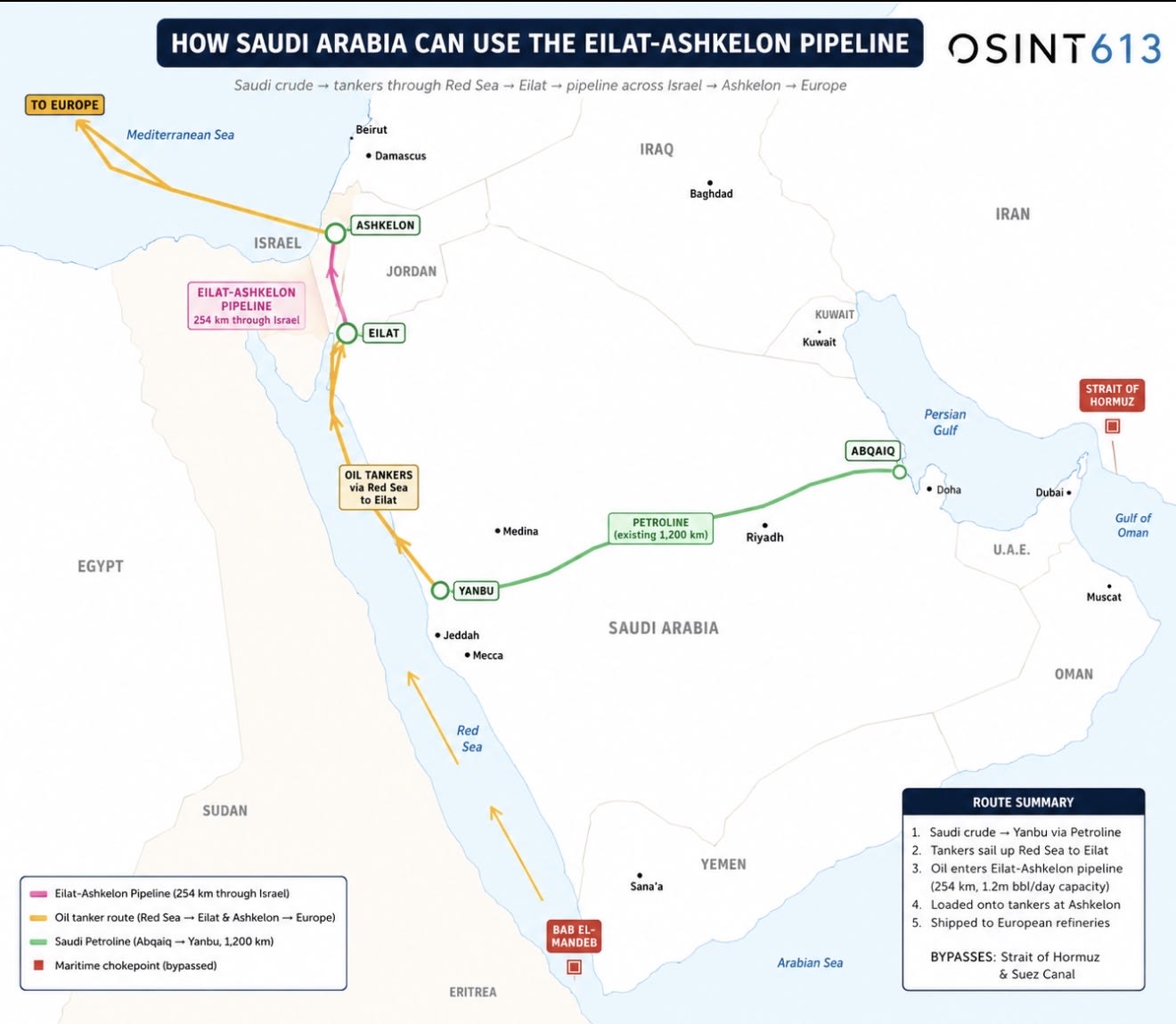
From there, tankers would sail north through the Red Sea into the Gulf of Aqaba and unload at Eilat. The crude would then move through the pipeline to Ashkelon, where it could be loaded onto tankers for Europe and other Mediterranean destinations. Transit across Israel takes only a matter of hours.
The pipeline can carry about 1.2 million barrels per day toward Ashkelon. That is well below Saudi Arabia’s total exports, but it is enough to provide a meaningful alternative during a prolonged disruption.
It would also create another export corridor alongside Egypt’s SUMED Pipeline, giving Saudi Arabia additional capacity that does not depend on Egyptian infrastructure.

The 2 routes complement one another, providing separate pathways from the Red Sea to the Mediterranean during a major shipping disruption.
For Europe bound cargoes, it would also avoid the lengthy voyage around the Cape of Good Hope.
The Real Barrier
The challenge is political.
Saudi Arabia and Israel do not have formal diplomatic relations. Using Israeli energy infrastructure would represent a major practical step toward normalization, regardless of how it was described publicly.
That has kept the pipeline out of serious discussion.
The UAE explored commercial use of the pipeline after the Abraham Accords, but Saudi Arabia has not. Any Saudi use would likely be framed as a temporary commercial arrangement rather than a political agreement, although many across the region would still view it as a significant normalization step.
Environmental concerns also remain. Eilat sits on the Gulf of Aqaba, home to one of the region’s most sensitive coral reef ecosystems. A major oil spill near the Evrona Nature Reserve in 2014 continues to shape opposition inside Israel to expanding tanker traffic through Eilat.
Could That Change?
Energy markets have a history of forcing governments to make decisions that would have seemed impossible under normal circumstances.
If the Strait of Hormuz faces prolonged disruption while Bab el-Mandeb remains under sustained attack, Saudi Arabia would have fewer options for reaching European markets.
The Eilat Ashkelon Pipeline already exists. It requires no new construction and no major infrastructure investment. The route was built decades ago to move crude from the Red Sea to the Mediterranean.
There is no public evidence that Saudi Arabia is preparing to use the pipeline or that negotiations with Israel are underway. The political barriers remain substantial.
But oil markets have a long history of changing political calculations. If both Hormuz and the Bab el-Mandeb remain under sustained pressure, Riyadh may eventually have to decide whether the political cost of using Israeli infrastructure is greater than the economic cost of leaving one of the region’s few viable alternatives unused.