
 OSINT6134 days ago
Rep. Ilhan Omar is facing federal scrutiny over allegations that could cost her American citizenship, her seat in Congress and potentially her right to remain in the United States.
Advertisement
The investigation reaches back 26 years, to the circumstances under which Omar, a Somali refugee, became an American citizen in 2000. Investigators are examining whether her family’s immigration paperwork contained false information, including questions about her birth date and her father’s naturalization.
A separate financial inquiry has raised questions about business interests belonging to her husband, whose reported valuations jumped into the millions before being revised downward.
Omar denies wrongdoing and accuses President Donald Trump’s administration of targeting her for political reasons. But search warrants, seized records and grand jury subpoenas have taken the allegations beyond the political controversy that has followed her for years.
On October 12, Homeland Security Investigations agents reportedly searched Omar’s Washington area residence under a court-authorized warrant.
Investigators reportedly seized electronic devices, her passport and documents. More than 12 grand jury subpoenas have reportedly been issued, including to family members, as federal prosecutors in Minnesota examine possible immigration fraud, false statements and conspiracy.
Homeland Security Secretary Markwayne Mullin has described the government’s case as strong and publicly discussed taking the matter before a grand jury.
The investigation concerns records dating to Omar’s arrival in the United States in 1995, after her family fled Somalia’s civil war.
At the center of the investigation is a discrepancy of ONE year.
Omar’s official birth date is October 4, 1982. She became an American citizen in 2000 through her father’s naturalization, reportedly when she was 17.
Under the citizenship law applicable at the time, qualifying children could derive citizenship through a naturalized parent before turning 18.
But older public records, including those maintained by the Minnesota Legislative Reference Library, listed her birth year as 1981.
In 2019, Omar’s congressional staff requested corrections to those records, maintaining that the earlier date was inaccurate.
If Omar was actually born in 1981, she would have turned 18 in October 1999. Depending on when her father naturalized, that could raise serious questions about her eligibility for derivative citizenship.
Investigators would need more than an incorrect public biography. They would have to establish her actual birth date and whether materially false information appeared in the immigration records.
Another allegation concerns Omar’s father, Nur Omar Mohamed, whose naturalization is central to her account of becoming an American citizen.
In 2023, former congressional candidate AJ Kern obtained responses from U.S. Citizenship and Immigration Services reporting that searches had failed to locate naturalization records for Mohamed, including under alternative names.
The New York Post reported on the documents earlier this month. The responses have fueled questions about whether Mohamed was naturalized in 2000, as Omar has maintained.
A failed records search does not establish that naturalization never occurred. Records may exist under different identifying information, and Mohamed’s original immigration file has not been publicly produced to resolve the dispute.
If Mohamed never became a U.S. citizen, Omar could not have derived citizenship through his naturalization.
Investigators are also examining whether Mohamed accurately disclosed his military service under Somalia’s former ruler, Siad Barre, when applying for immigration benefits.
Mohamed died in 2020. Prosecutors would now have to reconstruct events involving documents and family relationships dating back more than 25 years.
Federal investigators are reportedly revisiting allegations surrounding Omar’s former husband, Ahmed Nur Said Elmi.
Critics have long claimed that Elmi was Omar’s brother and that their marriage was connected to immigration benefits. Omar has repeatedly denied the allegation, which has not been publicly established.
On October 19, the New York Post reported that investigators had obtained DNA evidence potentially relevant to the alleged family relationship. The newspaper also reported that Omar’s sister, Sahra Noor, had been questioned as the investigation expanded.
The reported DNA findings have not been independently verified, and prosecutors have not publicly disclosed their results.
Any criminal case arising from the marriage allegations would require evidence of fraudulent conduct, not merely questions about family relationships.
Omar is separately facing scrutiny over financial disclosures involving her husband, Tim Mynett.
In 2023, Omar reported her husband’s ownership interests in 2 businesses at approximately $15,000 to $51,000. Her original 2024 disclosure, filed in May 2025, valued those interests at between $6 million and $30 million.
Then came another revision.
In March 2026, Omar amended the filing, reporting no net asset value for either business. Her household’s disclosed assets were subsequently estimated at approximately $18,000 to $95,000.
The businesses were Rose Lake Capital, an investment firm, and eStCru, a California winery.
House Oversight Chairman James Comer demanded financial records in February, questioning the increase in reported valuations and seeking information about the companies’ investors and finances.
Omar’s office attributed the discrepancies to accounting errors involving liabilities and ownership valuations.
D.C. U.S. Attorney Jeanine Pirro has confirmed that her office is conducting a separate investigation into Omar’s financial disclosures.
The question for investigators is whether the filings contained accounting mistakes or knowingly false information. No charges have been announced in the financial inquiry.
The government has two principal legal avenues.
The first is criminal prosecution for immigration fraud, false statements or conspiracy. But alleged misconduct dating to 2000 faces substantial statute of limitations obstacles. Criminal naturalization fraud generally carries a 10-year limitation period.
The second is a civil challenge to citizenship.
Civil denaturalization proceedings generally have no statute of limitations, but the government must meet a demanding evidentiary standard. Omar’s derivative citizenship would also raise questions about the appropriate legal procedure for challenging her status.
If federal authorities ultimately established that Omar was not legally a citizen, her position in Congress would be jeopardized. House members must have held U.S. citizenship for at least 7 years.
Deportation would require separate legal proceedings and would not automatically follow a citizenship ruling.
The investigation comes weeks before the November 3rd midterm elections.
Former President Barack Obama has condemned the administration’s actions, arguing that Omar is being targeted because of her political views. Omar has similarly accused Trump of weaponizing federal law enforcement against an outspoken critic.
Political motivation, however, would not by itself establish that the underlying allegations are false. Equally, search warrants and grand jury subpoenas do not establish guilt.
The scale of the investigation and the administration’s public statements leave little doubt that federal authorities are pursuing Omar aggressively.
The Justice Department has enormous resources at its disposal, and allegations that went unresolved for decades are now receiving renewed scrutiny.
No wrongdoing has been established. But the administration appears determined to pursue the case, with potential consequences ranging from criminal prosecution to loss of citizenship and eventual deportation.
For Omar, the question is whether federal investigators can uncover evidence strong enough to support what the administration appears intent on pursuing.
 OSINT61319 days ago
As of Monday afternoon, October 5, Saudi Arabia and Yemen’s internationally recognized government have opened their largest campaign against the Houthis since the collapse of the 2022 truce. Operation Yemen Dawn combines Saudi air power with simultaneous government advances along the western coast, around Bab el Mandeb, and across the Al Jawf and Marib fronts.
Advertisement
Main fronts of Operation Yemen Dawn as of October 5: government forces are pushing on Bab el Mandeb, and the Houthis are pressing Taiz.
The opening phase has produced a divided battlefield. Saudi backed forces appear to have regained most of Dhubab district and key positions overlooking Bab el Mandeb, while the Houthis are pressing government forces around Taiz and threatening the city’s main connection to Aden. Both sides are claiming heavy enemy losses, but most casualty figures remain unverified.
The main government objective is to remove the Houthis from Yemen’s southern Red Sea coastline before expanding operations toward Mokha and Sanaa. The immediate test is whether government forces can consolidate their gains around Dhubab, reopen threatened supply routes around Taiz and prevent the Houthis from regrouping farther north.
Yemeni President Rashad al Alimi delivers a televised address from Riyadh, Saudi Arabia, on October 4, 2026. Yemen News Agency
Presidential Leadership Council Chairman Rashad al Alimi announced Sunday that military operations had begun to retake all remaining Houthi controlled territory. Speaking from Saudi Arabia, Alimi said de escalation had failed and that operations would continue until Yemen was “liberated.” On Monday, Alimi formally named the campaign Operation Yemen Dawn. Its stated objectives are to restore government institutions, retake Sanaa and end Houthi control. The offensive was prepared by the Yemeni government and Saudi Arabia, with tens of thousands of fighters reportedly mobilized across several fronts.
The operation follows the Houthi seizure in September of roughly 150 kilometers of Red Sea coastline, including Mokha, Dhubab, Mayyun Island and positions overlooking Bab el Mandeb. Those gains gave the Houthis control of Yemen’s southern Red Sea coast and placed them directly beside one of the world’s most important shipping routes.
Royal Saudi Air Force F-15s. The coalition said 100 jets flew Monday’s opening strikes.
Coalition spokesman Maj. Gen. Turki al Malki said 100 fighter jets took part in the opening attacks Monday morning. He said the coalition was providing continuous air support for Yemeni ground forces and air cover over Bab el Mandeb while attacking Houthi positions, vehicles, reinforcements and supply routes.
Al Malki claimed 324 high value targets had been destroyed since the operation began. Saudi Arabia has not published a target list, satellite imagery or a detailed battle damage assessment. The Associated Press confirmed the coalition’s announcement but said the operational figures could not immediately be independently verified. (apnews.com) The coalition reported 97 attacks Sunday against Houthi reinforcements around the Tor al Baha front and the Taiz axis. It said aircraft, drones, artillery, missiles and snipers were used. Military sources also reported Saudi air cover accompanying government advances in Al Jawf, Marib and along the western coast.
In Marib, government forces attacked Houthi positions on the Raghwan front while Saudi aircraft reportedly struck Mount Helan, an arms depot and reinforcements northwest of the city. Fighting and air activity were also reported in Al Jawf, where government forces are attempting to pressure Houthi routes near the Saudi border.
Government forces say they recaptured Dhubab airport and cut the main Dhubab to Mokha road - Google Maps
The main coastal attack began Monday morning with forces from the Southern Armed Forces, Giants Brigades, Nation’s Shield and National Resistance Forces advancing into Dhubab district under heavy Saudi air cover. Their objective was to encircle Houthi units around Bab el Mandeb and cut the routes connecting them with Mokha and positions farther north.
Government forces say they recaptured Dhubab airport and cut the main Dhubab to Mokha road, severing a major Houthi ground line of communication. Reuters reported that government forces had taken large parts of Dhubab district and were asserting control over the area, although fighting continued near a military base close to the strait. (investing.com) Pro government sources said advancing forces also cut the Al Saqiya to Al Omari Camp route. They reported that units were moving toward Al Omari Base, Bab el Mandeb and Dhubab city after securing the airport and surrounding Houthi positions.
Yemeni military sources claimed hundreds of Houthi fighters were trapped around Dhubab and near Mayyun Island. Other reports said dozens of Houthi fighters were captured, dozens were killed and some escaped by boat. Those claims have not been independently verified, and the Houthis denied that government forces had made significant gains.
Yemen’s information minister said government forces had regained effective control of Bab el Mandeb. Control of the strait itself remains difficult to define while fighting continues nearby and the Houthis retain missile and drone launch positions farther inland and along the northern coastline. (reuters.com) H2 What Control of Bab el Mandeb Means Holding Dhubab, Al Omari Base and the coastline facing Mayyun would remove the Houthis from the closest mainland positions overlooking the narrowest section of Bab el Mandeb. It would also reopen government access to the southern Red Sea coast and create a staging area for a possible advance north toward Mokha.
The Houthis would still be capable of attacking ships with ballistic missiles, cruise missiles, drones and explosive boats launched from farther inland or farther north. Retaking the coastline would reduce Houthi control over the waterway, but it would not immediately eliminate the maritime threat.
Bab el-Mandeb, Perim (Mayyun), and the Yemen–Djibouti narrows. Credit: satellite composite.
Mayyun Island (perim Island) remains especially important because it divides Bab el Mandeb into 2 channels. Pro government sources reported Houthi fighters surrounded near the island, but there has been no independently confirmed report that government forces have landed on or retaken Mayyun.
Taiz and the Cairo citadel. The city is still held by the government, but the road south toward Aden is under pressure. Credit: Wikimedia Commons
While government forces advanced along the coast, the Houthis continued pressing around Taiz. Several Yemeni government military sources told Reuters that Houthi fighters damaged or cut parts of the main Taiz to Aden road and advanced into Al Turbah after government forces withdrew.
Those gains may have effectively surrounded government forces inside Taiz, although another government source denied that the road had been completely severed. Houthi media claimed government forces were expelled from Al Turbah, Al Shamaytin, Sama and Al Mawasit districts.
Liveuamap reported clashes reaching Al Nashma on October 4, placing fighting deeper along the southern Taiz axis. That report has not been independently corroborated. The Houthis have also occupied hilltop positions overlooking roads used to move government troops and supplies toward Taiz.
Taiz remains under government control, but its supply position is deteriorating. Saudi air power has not stopped Houthi ground movement through the surrounding highlands, where terrain and established defensive positions reduce the advantage of aircraft.
Flames and smoke at an Aramco facility south of Riyadh, Oct. 3 - Al Jazeera
Houthi military spokesman Yahya Saree said the group attacked Aramco facilities in Riyadh and Khurais with ballistic missiles and drones. He claimed the attacks caused fires and were launched in response to 50 Saudi air and missile strikes within 12 hours.
Saudi Arabia and Aramco have not confirmed what caused the reported fire. An AFP journalist saw flames and smoke rising from an Aramco facility south of Riyadh on October 3, with firefighters, ambulances and police vehicles at the site.
Sentinel 2 imagery from October 3 shows a large smoke plume rising from Riyadh’s Aramco refinery after a claimed Houthi ballistic missile strike.
The Houthis claimed Saudi Arabia conducted 106 air and missile strikes during the previous 24 hours across Sanaa, Al Jawf and Taiz. Houthi media reported about 26 attacks on Sanaa and said a strike on a sponge factory wounded 3 people. Saudi Arabia has not confirmed the Houthi strike count.
Yemeni government forces claimed Monday that they conducted 1,122 operations across Saada, Al Jawf, Taiz and the western coast, killing or wounding 1,747 Houthi fighters and destroying or disabling 364 vehicles. Another government claim said 257 attacks Saturday killed at least 700 Houthis.
Those figures remain unsupported by independent hospital records, burial data or imagery. Earlier estimates from the Taiz fighting were far lower, with Houthi sources reporting 55 fighters killed and government linked sources reporting between 26 and 34 government troops killed. Another estimate placed Houthi losses at 39.
Al Omari Base, Dhubab city - Google Maps
The coastal force is expected to push toward Al Omari Base, Dhubab city and the approaches to Mokha while Saudi aircraft continue targeting Houthi reinforcements. Government forces must secure the Dhubab to Mokha road and prevent Houthi units from reopening their supply routes.
The Houthis are trying to force the government to divide its attention between the coast and Taiz. If Saudi backed forces hold Bab el Mandeb but lose the roads around Taiz, the campaign will have traded one strategic problem for another. The next 24 to 48 hours will show whether the Dhubab advance becomes a sustained offensive north or remains an exposed coastal foothold.
 OSINT6131 month ago
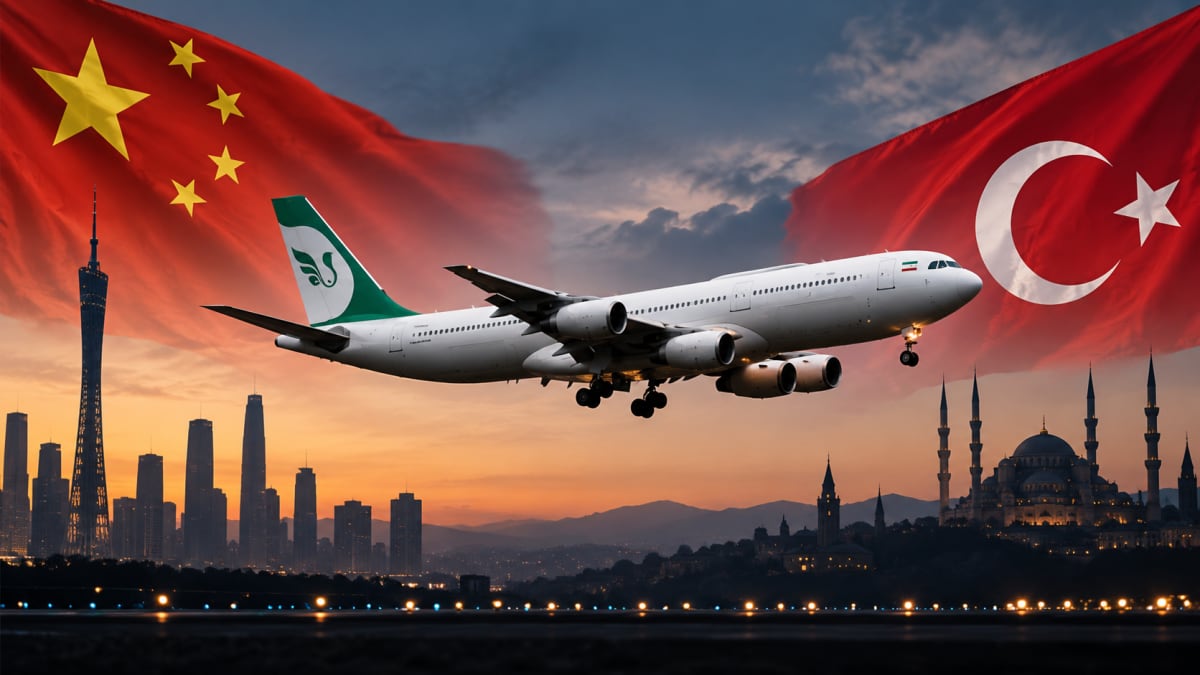
Treasury Secretary Scott Bessent said every Iranian airline would be shut down worldwide by Sept. 23. On Wednesday, a Mahan Air jet flew from Iran to China and landed in Guangzhou.
Advertisement
FlightRadar24 data showed the aircraft arriving at Guangzhou Baiyun International Airport at about 4:39 p.m. local time, after the U.S. deadline had taken effect. China had already rejected the sanctions and kept its airports open.
Today, Wednesday, a Mahan Air jet flew from Iran to China and landed in Guangzhou. - FR
Elsewhere, the pressure worked. Iraq suspended Iranian flights into Baghdad, Oman stopped Mahan service to Muscat and Georgia restricted sanctioned Iranian carriers. Turkey barred Mahan and pulled its own airlines from Iran while continuing to accept Iran Air. The first day produced a sharp contraction in Iran’s international aviation network, but not the worldwide shutdown Bessent had promised.
The Chinese flight came hours before President Xi Jinping was due to meet President Donald Trump in Washington, following preparatory talks between Bessent and Chinese Vice Premier He Lifeng.
“On September 23, all the Iranian airlines will be shut down around the world,” Bessent told CNBC on Monday.
The U.S. cannot order foreign governments to close their airports to Iranian aircraft. Instead, Treasury is threatening the companies that keep those aircraft flying. Bessent said businesses providing fuel, landing services or ticket sales could be “knocked out of the dollar system.” Treasury laid the groundwork on Sept. 8, when the Office of Foreign Assets Control sanctioned 36 targets connected to Iran’s aviation sector, including 27 Iranian airlines that had not previously been designated. It also suspended three aviation authorizations and provided a wind down period that expired at 12:01 a.m. Eastern on Wednesday.
A Mahan Air Airbus A340 - Wiki Media
Treasury says the Islamic Revolutionary Guard Corps has used ostensibly private airlines to procure and transport weapons and move personnel. Mahan Air, which has been under U.S. sanctions since 2011, has long been central to those accusations.
Several governments moved before Wednesday’s deadline.
Iraq suspended Iranian airline flights into Baghdad, Iraqi government sources told Reuters. The decision threatens one of Iran’s busiest regional travel corridors, particularly for Shia pilgrims traveling between the two countries. Iranian officials were discussing whether some passengers could instead use Najaf.
Omani aviation authorities had already stopped Mahan’s Tehran to Muscat service from Sept. 17. Georgia said it would apply the expanded U.S. sanctions against Iranian carriers. An aviation industry source in Iran told AFP that services to Azerbaijan, Georgia, Qatar, Muscat and Baghdad had been completely halted.
Turkey chose a narrower approach. Turkish authorities required Mahan to stop flying to Istanbul and Ankara, while Turkish Airlines, Pegasus and AJet halted their own Iran services. Iran Air, however, remained outside the Turkish restriction.
Flight tracking data showed Iran Air flight IR719 arriving in Istanbul on Wednesday, with the aircraft later operating the return service to Iran. Iran Air had said Tuesday that it had received no notification of a blanket ban on flights to neighboring countries.
Iran Air flight IR719 arriving in Istanbul from Iran on Wednesday - FR
China made its position public before Mahan reached Guangzhou.
Foreign Ministry spokesman Guo Jiakun said Beijing opposed what he called illegal unilateral sanctions without authorization from the U.N. Security Council. Asked again Wednesday about Iranian flights, the ministry maintained its opposition to the U.S. measures.
Mahan then landed in Guangzhou.
China presents a much harder enforcement problem than smaller regional aviation markets. The U.S. campaign depends on foreign companies deciding that access to the American financial system is worth more than servicing Iranian aircraft. Beijing has publicly rejected the sanctions themselves, leaving the pressure to fall on the Chinese companies that provide the aircraft with fuel, handling and other services.
Iran’s aviation network was already shrinking before Wednesday. Cirium data showed international capacity to and from Iran down about 49% in August compared with 2025, with foreign carriers including Flydubai and Turkish Airlines pulling out.
Iranian airlines have few easy alternatives. Decades of U.S. restrictions have left the country operating an aging fleet with limited access to Western aircraft, components and maintenance. The latest measures attack the infrastructure surrounding those aircraft abroad. A functioning jet is of little use internationally if airports will not refuel or service it.
Mahan’s Shanghai office said Wednesday it had received no cancellation notice and was continuing to sell tickets for the coming week, according to AFP. Tehran’s main airport was also showing a Shanghai departure scheduled for Wednesday.
Continued Chinese service would leave the Islamic regime with an eastern aviation corridor even as routes through several neighboring countries disappear. Turkey could provide another, narrower outlet as long as Ankara continues allowing Iran Air to operate.
Bessent has already defined the penalty for companies that service sanctioned Iranian airlines. What has not been established is whether the U.S. will apply that threat against companies operating inside China.
Mahan made it to Guangzhou on the first day of the deadline. Its next flight will show whether the companies refueling and handling the aircraft believe Bessent intends to follow through.
 OSINT6131 month ago
The last 72 hours have exposed the pressure on Saudi Arabia as the Houthis tighten their grip on the Red Sea, attack inside the kingdom and seek a separate understanding with Washington.
Advertisement
As of 10:15 PM Israel time on September 17, Saudi aircraft were striking targets across Yemen while Houthi missiles and drones continued reaching deep into the kingdom. The fighting is unfolding alongside a wider economic crisis, with Saudi Arabia’s main route for bypassing the Strait of Hormuz shut and its air defense stocks reportedly running low.
The Gulf’s defensive umbrella is a stockpile, and every interception consumes a missile that may take months or years to replace. The Houthis are testing that reality while using their control of Yemen’s Red Sea coast to threaten Saudi shipping and offer Washington a separate maritime arrangement.
Houthi fighter with RPG during a public show of force - Euronews
The Houthis took effective control of Yemen’s entire Red Sea coastline last week, including Mokha and Perim Island in the Bab el Mandeb Strait. They also seized the Greater and Lesser Hanish islands, giving the movement positions around one of the world’s most important maritime chokepoints.
The Houthis declared a blockade of Saudi Red Sea ports in late July and began targeting tankers owned or operated by Saudi companies. Commercial ships continue to transit Bab el Mandeb, but Saudi vessels remain exposed. That territorial leverage is what gives the Houthi offer of safe passage to other ships its weight.
Bab el-Mandeb labeled — Perim in the channel - Windward
Saudi aircraft have carried out strikes across Taiz, Lahj, Al Jawf, Hajjah, Marib, Saada and Al Bayda. Fresh attacks on Thursday reportedly hit Hajjah and areas around Taiz, where Houthi media said three telecommunications towers were destroyed. The same outlets reported one civilian killed in Taiz and another wounded in Abs, while also claiming three children were killed by Saudi backed Yemeni forces. Those reports have not been independently confirmed.
The Houthis claim Saudi Arabia conducted more than 450 strikes during the past week, including 54 within a single 24 hour period. Saudi backed government forces say they are inflicting heavy losses across several fronts. Rashad al Alimi, who heads Yemen’s Saudi backed Presidential Leadership Council, told the French ambassador that recent Houthi gains along the Red Sea coast were temporary.
The Houthis said they attacked King Khalid Air Base at Khamis Mushait and Aramco facilities in Yanbu using missiles and drones. Saudi Arabia has not confirmed damage at either location. Houthi military spokesman Yahya Saree described the campaign as a “siege for siege equation” and said attacks deep inside Saudi Arabia would continue until the blockade on Yemen was lifted.
Saudi authorities say more than 70 people were wounded in Houthi attacks earlier in September. Another 13 civilians were injured Tuesday in attacks around Khamis Mushait, Abha and Taif, with seven homes and two vehicles damaged. In the latest incident over Taif, falling debris from an intercepted drone killed a Yemeni resident and wounded a Saudi citizen and a Pakistani resident. Buildings and vehicles were also damaged.
Grand Mosque / Mecca from above - CNN
Saudi Arabia said another drone was intercepted south of Mecca at about 6:50 PM on September 15, before it entered the city’s restricted airspace. Wreckage reportedly fell south of the city. The coalition called it only the second attempted Houthi attack on Mecca, following a ballistic missile launch on July 27, 2017, and the first Mecca security alert in nearly a decade.
The Houthis denied targeting Mecca, while Abdul Malik al Houthi called the accusation a “heinous lie” intended to mobilize Muslim opinion against his movement. Pakistan and the Organization of Islamic Cooperation condemned the alleged attack. Iran said any attack on Mecca would be condemnable but argued that the interception of a drone did not establish its intended target.
The Houthis also claim they shot down a Saudi F15 over Marib. Footage showed fighters gathered around burned wreckage and holding what appeared to be part of a wing carrying Saudi markings. Different accounts of Saree’s statement described the weapon as either a locally produced surface to air or air to air missile.
Houthi Fighters on wreckage with a Saudi flag on a tail/wing - Houthi Media
Saudi Arabia has not acknowledged losing an aircraft.
Saudi Arabia had rerouted about 5 million barrels a day through the 745 mile East West pipeline to Yanbu after the Strait of Hormuz became unusable. Aramco Chief Executive Amin Nasser said the pipeline did more to cushion the supply shock than emergency reserve releases.
Yanbu, Saudi Arabia Aramco infrastructure after Houthi attack today Sept 17, 2026 - X
The Saudi Energy Ministry confirmed that the pipeline was shut after the September 11 attack. CNBC and NBC reported that the drones were launched from Iraq, not Yemen, and Saudi Arabia said it would not retaliate for now following a request from Iraq’s prime minister.
Saudi officials estimated repairs would take three to five weeks, while some industry estimates put the timeline at five to six weeks. Kpler analyst Matt Smith estimated that Saudi Arabia could lose about 120 million barrels if the pipeline remains closed for a month and storage at Yanbu is depleted. The International Energy Agency said Saudi crude supply had fallen to its lowest level in more than three decades. Brent settled at $105.66, WTI at $101.28, average U.S. gasoline reached $4.32 and diesel hit a record $6.23.
Saudi Arabia has reportedly sought air defense support from France, Britain, Pakistan and Egypt. The Wall Street Journal reported that U.S. forces fired between 60 and 70 Patriot interceptors and more than 12 THAAD interceptors during a single week against roughly 20 Iranian ballistic missiles aimed at American forces in Jordan. That is at least three interceptors for every incoming missile.
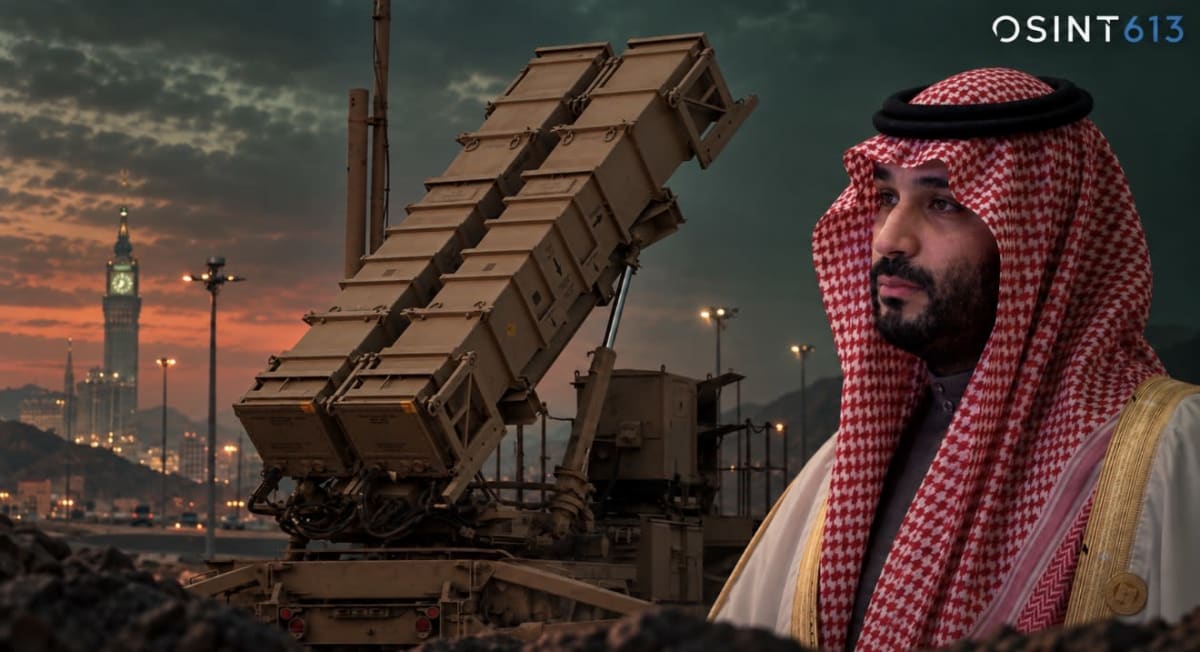
Patriot battery with the Mecca Royal Clock Tower behind it - Saudi Ministry of Defense
Washington has refused Saudi requests to join a direct campaign against the Houthis. Instead, CENTCOM established a task force for intelligence sharing and planning support, hosted senior military leaders from eight countries in Germany and sent more than 100 advisers to assist the Saudis.
Saudi Arabia’s regional defense agreement has produced contradictory messages. Turkish and Pakistani officials told the Associated Press that they had received no Saudi request for support, while a Turkish official said the alliance still needed to be institutionalized before becoming operational. Pakistan’s Defence Minister Khawaja Asif then said Thursday that the time had come to implement the Mecca agreement.
Houthi representatives, including sanctioned official Mohammad Abdulsalam, met U.S. Embassy diplomats in Muscat to preserve the May 2025 ceasefire. The U.S. ambassador did not attend. The Houthis reportedly promised not to attack American vessels while maintaining their campaign against Saudi shipping.
President Donald Trump said the Houthis had contacted his administration, wanted the U.S. to remain outside the war and were allowing most ships to pass while maintaining restrictions on Saudi vessels. Vice President JD Vance confirmed that Washington was in direct contact with the Houthis and constant contact with Saudi Arabia.
The next diplomatic test will come at the United Nations General Assembly, where Trump is expected to meet Gulf leaders. Saudi Arabia enters those talks with its Hormuz bypass damaged, its interceptor stocks under pressure and the Houthis holding the coastline overlooking Bab el Mandeb.
 OSINT6131 month ago
Yemeni Government forces withdrew from Mocha early Thursday, leaving the Houthis with a Red Sea port roughly 50 miles north of Bab al Mandeb. A day earlier, Saudi backed commanders were reporting major breakthroughs across Yemen’s northern and central desert, where Houthi units had pulled back and government forces moved into abandoned positions.
September 7th map of Yemen government forces control - OSINT613
The Houthi movement toward the coast ran through Hays, al Khawkhah, al Waziyah and Mawza while government aligned forces were reporting gains hundreds of miles inland. Reporting from Yemen quoted a former Yemeni military official describing the coastal losses as “really bad,” saying the attention being given to the government advance in the interior hid what was happening along the Red Sea.
What looked Wednesday like a Houthi retreat now looks closer to a repositioning. The Houthis surrendered open territory where Saudi airpower has an advantage and concentrated farther west. By Thursday morning, the government had more desert and the Houthis had Mocha.
Mocha sits on the approaches to Bab al Mandeb, the strait connecting the Red Sea with the Gulf of Aden and Arabian Sea. Ships traveling between Asia and Europe through the Suez Canal pass through the corridor just south of the port.
The Houthis already controlled much of Yemen’s Red Sea coastline farther north, including Hodeidah. Mocha pushes their coastal position farther south and closer to the strait. It does not put Bab al Mandeb under Houthi control, but missiles and drones operating from territory around Mocha have considerably less distance to cover to reach shipping lanes approaching the strait.
The Houthis have already used anti ship missiles, ballistic missiles, cruise missiles and drones against vessels around Yemen and the Red Sea. In late July, they declared a naval blockade targeting Saudi shipping. They now hold additional coastline much closer to the route those ships have to use.
Saudi backed Yemeni forces announced significant advances Wednesday across the northern and central fronts, including around Taiz, al Bayda and al Jawf. Al Jawf is important because routes from the governorate lead toward Sanaa, and a sustained government advance there would put pressure on Houthi defenses protecting the capital.
Fighting also continued around Marib, where Yemeni government media accused Houthi artillery of killing 3 children, including a baby. Government forces have taken territory during the current offensive, and the gains inland should not be dismissed simply because of what happened farther west.
Houthi forces push south down the Red Sea coast through Hays, al Khawkhah, Mawza and al Waziyah toward Mocha.
The problem is the territory the Houthis chose to abandon compared with the territory they took. Much of the government advance has been through exposed inland terrain. On the western front, government forces lost a port, coastline and positions overlooking the approaches to one of the busiest maritime corridors in the world.
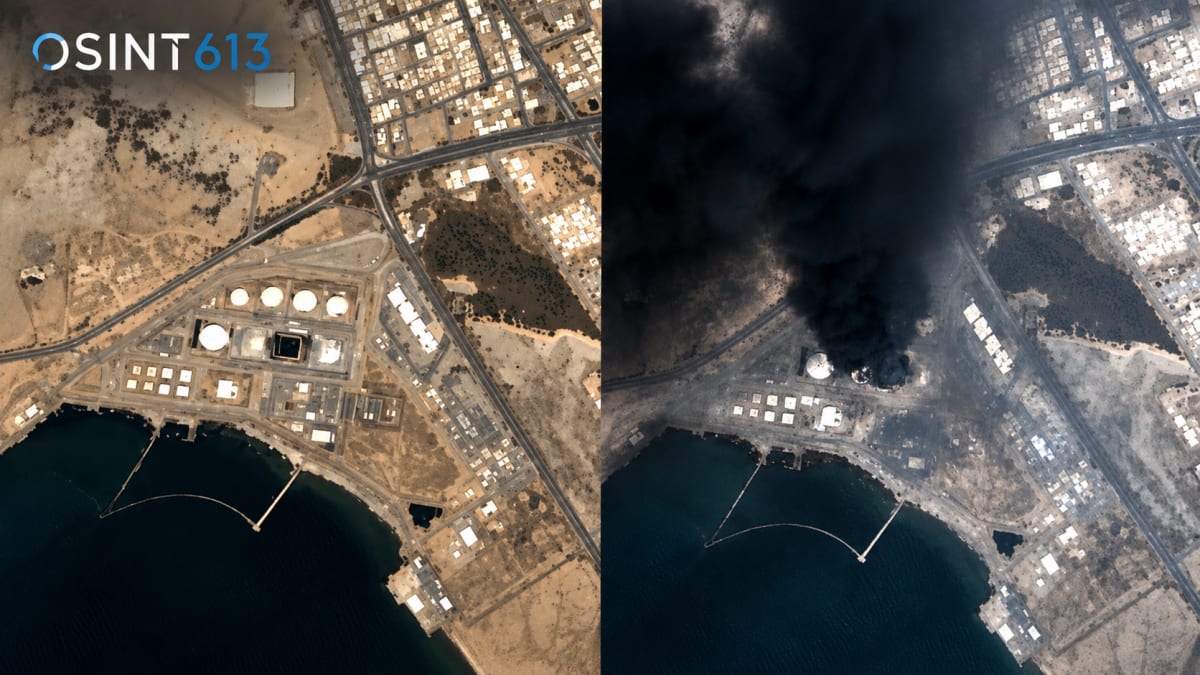
On September 7 and 8, the Houthis launched a large ballistic missile and drone barrage into southern Saudi Arabia, targeting Abha, Khamis Mushait, Jazan and Najran. The Houthis said their targets included King Khalid Air Base, Aramco infrastructure and industrial facilities around Jazan. Saudi authorities reported fires and temporary disruptions at energy facilities and said 73 civilians were wounded, including women and children.
Satellite imagery from Sep. 8 shows at least 3 oil storage tanks burning at Jazan, Saudi Arabia after a Houthi attack. - Sentinel 2
Houthi military spokesman Yahya Saree said attacks against Saudi “economic arteries” would continue until military operations inside Yemen stop and restrictions on Houthi controlled ports and airports are lifted. The Houthis said the barrage was also retaliation for Saudi and Yemeni operations inside Yemen, including a strike they claim hit a prison in al Jawf.
Saudi Arabia and its Yemeni allies responded with air operations across several governorates. The Houthis claimed 32 strikes during one overnight period and another 54 during a later 12 hour period across Taiz, Hodeidah, al Jawf, Marib, Saada and al Bayda. The strike counts come from the Houthis and have not been independently confirmed, although the Saudi backed side has confirmed extensive operations against Houthi positions.
The fighting is therefore no longer confined to who controls towns and desert roads inside Yemen. The Houthis are putting Saudi energy infrastructure and military installations back into the target set while fighting government forces across several Yemeni fronts.
The timing of the Mocha loss makes the coastline more important. The U.S. war with the Islamic regime is already putting pressure on the Strait of Hormuz, while attacks and threats against regional energy infrastructure have helped push Brent crude above $100.
Bab al-Mandeb, the “Gate of Tears,” linking the Red Sea to the Gulf of Aden. Yemen is on the right, Djibouti/Eritrea on the left. - NASA
Hormuz carries a large share of Gulf oil and LNG exports. Bab al Mandeb is the southern entrance to the Red Sea for vessels heading toward Suez. Iran sits above the first chokepoint, while the Houthis have spent years building the missile and drone capability to reach traffic around the second.
Until this week, the main Houthi position on Yemen’s Red Sea coast was centered much farther north around Hodeidah. The capture of Mocha moves that footprint south toward Bab al Mandeb at the same time the Houthis are again firing missiles and drones into Saudi Arabia.
A former Yemeni military official quoted in reporting on the fighting argued that reversing the coastal losses would require much deeper Saudi involvement and activation of the Mecca Accord, potentially bringing Turkey and Pakistan further into the fight. There is no sign at this stage that Saudi Arabia has activated such an arrangement.
There has also been no major independently confirmed Houthi attack against Israel or commercial shipping during this 72 hour period. Most of the Houthi effort has been directed at Saudi Arabia and the Yemeni battlefield, particularly the western coast.
The immediate question is where the coastal offensive stops. If Mocha is consolidated and Houthi forces continue south, the next stretch of coastline takes them toward Bab al Mandeb itself, while Saudi backed forces will have to decide how much of their inland offensive they are willing to redirect west to stop them.
 OSINT6131 month ago
We now have a wild card.
Israel assesses that Iran's economic crisis could push the regime into a Hail Mary. Iran is threatening Israel over a ridge in southern Lebanon. Israel is warning that another Iranian attack removes its restraints entirely.
Put those together and the escalation path is short.
Israel attacks Hezbollah. Hezbollah and Iran retaliate against Israel. Israel goes all out against Iran.
Three steps. Step one is a tactical operation Israel has been preparing for months.
Reuters reported Thursday that Tehran sent a message to Washington through Oman in mid August warning that a full Israeli assault on the Ali al Taher ridge would bring a large scale Iranian response. Two officials briefed on it said more than a dozen IRGC personnel are positioned there alongside Hezbollah fighters, including at least two senior officers. A third said American pressure got Israel to hold off. A White House official told Reuters the account is not accurate.
Ali al Taher Ridge where Hezbollah is trapped in tunnels beneath- Google Earth
Ali al Taher sits roughly fifteen kilometers north of the Israeli border near Nabatieh. Hezbollah spent years building command facilities, weapons stores and fighting positions beneath it. The ridge sits on the approaches to Iqlim al Tuffah, Hezbollah's logistics base for decades. Israel has it surrounded and has not gone in.
A dozen IRGC personnel are not holding that ridge against the IDF. What matters is what their deaths would authorize.
Israeli troops entering the tunnels and killing Hezbollah fighters is an operation against Hezbollah. The same operation ending with dead senior Iranian officers gives Tehran grounds to call it a direct attack on Iran. And because Iran issued the warning first, sitting on its hands afterward would expose the red line as empty.
There is a real dispute over whether those officers are there. Maariv reported Thursday, citing an Israeli military source, that the IDF assesses there are no IRGC forces inside Ali al Taher and that some Hezbollah fighters have died underground without food or water. Reuters could not verify conditions inside. Hezbollah declined to confirm an Iranian presence.
Iran may not need Israel to know. Israeli planners have to weigh the chance that clearing a bunker leaves Iranian bodies in it. Assume Tehran is bluffing and Israel finds out after the fact. Accept the claim and Iran has shielded Hezbollah's most important remaining position with a message passed through a third country.
Hezbollah has every reason to keep Iran welded to that ridge.
Losing it costs the group a position it cannot replace. A negotiated outcome costs more. The US brokered roadmap trades Israeli withdrawal for the Lebanese army dismantling Hezbollah infrastructure, and Naim Qassem has publicly rejected that framework and called for its collapse.
Hezbollah cannot reverse that by fighting Israel conventionally. It can make the fight bigger than Lebanon.
Its media office did exactly that in response to Reuters. It did not confirm Iran's warning. It said such a warning would be a natural conclusion, because Iran treats an Israeli ground advance in southern Lebanon as a major violation of the Islamabad Agreement, the June memorandum between Washington and Tehran that included the Lebanon ceasefire.
That moves an Israeli operation against Hezbollah into Iran's file with the United States. Hezbollah does not need Tehran to defend every bunker. It needs this one to involve Iranian personnel and an Iranian agreement before Israeli troops go in.
Hezbollah has already said what step two looks like. A large scale attack on Ali al Taher means a return to full war and missiles on northern Israeli communities.
None of this happens in a vacuum. Iran is being economically dismantled while it plays this hand.
Iranian rial versus the dollar Reaches all time low - Reuters
The rial is around 2.2 million to the dollar. Sanctions are tightening, maritime trade is strangled, and Iranian and American forces are exchanging strikes again, with Iran claiming attacks this week on US bases in Kuwait and the UAE.
Katz said Thursday that Israeli assessments see economic pressure and fear of internal instability pushing Iran toward desperate action. Then the second half: another Iranian attack removes Israeli restraints, including on energy and critical infrastructure.
That is step three, stated in advance, by the man who would order it.
There is also a version where Tehran is not being dragged anywhere. Israeli security officials told Israel Hayom this week they increasingly assess Iran will lead an escalation through Hezbollah, precisely because it is wary of hitting Israel directly. Under that reading Iran is not a patron getting pulled into its client's fight. It is a regime using its client to punch without signing its name.
Either way the ridge is where it starts.
The siege neutralizes Ali al Taher without testing Iran's warning. Isolate the position, kill the resupply, let conditions do the work. Reuters reported Israel has been shooting down drones attempting to deliver food and water.
Fewer casualties, and no dead IRGC officers to answer for. Israel's October election sharpens both sides of it. Destroying a flagship Hezbollah position is something to run on. Burying soldiers killed clearing tunnels weeks before a vote is not.
Hezbollah flag over the border valley - Al Jazeera
Waiting has its own cost. Hezbollah has launched explosive drones at Israeli forces near the ridge twice in the past week and Israel has answered with strikes. Whether those came from a local commander or from something coordinated with Tehran, Israel may not know when it decides how hard to hit back. Read a local decision as Iranian and Israel climbs the ladder over something settled in a bunker.
Washington is the brake, if it exists. One official told Reuters US pressure postponed the assault. The White House denies it. The US is running a blockade, fighting around Hormuz and trying to keep Israel and Iran apart. Dead Iranian officers in a Lebanese tunnel could fuse those fronts in an afternoon.
The comfortable read is that Iran is bluffing. The presence could be exaggerated or invented, a way to pressure Washington into leashing Israel and buy Hezbollah a few more weeks.
But the assumption that Iran will not act on Lebanon already failed once this year. Iran fired missiles at Israel in early June over Israeli strikes on Hezbollah outside Beirut, and that was before Tehran attached its own personnel and an explicit threat to this hill.
A Lebanese security official told Reuters an Israeli operation to take the ridge is still possible in the coming weeks.
Israel attacks Hezbollah. Hezbollah and Iran retaliate. Israel goes all out against Iran.
Every side has now said its red line out loud.Iran is being economically choked. Hezbollah is pushing to pull Iran directly into the fight. Israel is heading into the holidays and elections, while warning that another Iranian attack removes all restraints.
These could be the pieces that come right before.
 OSINT6131 month ago
Oil is still leaving the Persian Gulf. Just not Iran’s.
CENTCOM says roughly 750 million barrels of crude have moved under U.S. escort since its maritime operation began, an average of about 6.5 million barrels a day. At $90 a barrel, that is nearly $585 million worth of crude moving each day under American protection. Iran, meanwhile, has gone nearly 7 weeks without successfully moving a meaningful crude cargo through the Strait of Hormuz to China.
That has never happened before. Even during the height of maximum pressure in 2019 and 2020, Iranian crude cleared Hormuz every month. Iran was exporting roughly 2 million barrels a day as recently as March. Kpler and Vortexa put August exports at only about 220,000 to 255,000 barrels a day, much of it drawn from oil already positioned beyond the blockade. Iran still has the oil. It increasingly cannot turn it into cash.
The numbers at sea show how quickly the problem is accumulating. TankerTrackers estimates 29 tankers inside the strait are holding 36.11 million barrels of Iranian crude. Another roughly 20 million barrels remain in floating storage in Asia, where they can still be sold to China. Kpler estimates Iran may have room for another 20 million barrels in onshore storage. Once that fills, producers face a different problem: there is nowhere left to put the crude.
Tankers piling up at sea Credit: Kpler.
The cost is already enormous. Estimates put lost oil revenue at roughly $150 million a day. Broader calculations that include crude, petrochemicals and other maritime exports put the economic damage above $400 million a day. Oxford Economics estimated that a sustained blockade could eliminate 70 percent of Iran’s export revenues.
Iran is now threatening to use force if the squeeze gets tighter. Parliament Speaker Mohammad Bagher Ghalibaf said Tuesday that Iran would respond militarily if the U.S. intensifies the blockade of Iranian ports. He called the blockade “among the worst forms of military war” and said Iran “will not wait” if the U.S. moves to tighten it.
At home, the currency is showing the strain. The dollar traded Tuesday morning at roughly 211,100 toman on Tehran’s open market, equivalent to 2,111,000 rials. The central bank offered as much as $500 million in banknotes through banks between August 25 and 27. Only about $20 million was purchased, and the rial continued weakening.
Central Bank Governor Abdolnaser Hemmati is now promising as much as $2 billion to stabilize the market. “Iran has currency and it has enough,” he said Tuesday, directing the message at President Donald Trump.
But Iran cannot print the hard currency it is losing at sea. Oil exports bring in the dollars needed for imports and help support the rial. The government can borrow domestically and create more rials to cover spending, but doing so pushes more pressure into prices. The IMF expects inflation to average nearly 70 percent this year, while Iranian figures put point to point inflation considerably higher.
This is an economic collapse in slow motion. There is no single morning when everything stops. The currency buys less, imports cost more, subsidies become harder to finance and wages lose value faster than the government can raise them.
The contradiction is most visible at the pump. Iran sits on some of the largest crude reserves on earth and is simultaneously running short of gasoline.
Officials put the daily deficit at 14 million to 15 million liters. Domestic production is roughly 112 million to 121 million liters, while nationwide distribution reached 150 million liters on August 26. Tehran distributed more than 26 million liters on August 24 alone, a record for the current Iranian year. Imports that once helped cover the difference have been disrupted by the war.
Line of cars on an Iranian street waiting for fuel. - AP
Queues and temporary closures have appeared across major cities. Some stations have limited motorists to 20 liters. The government has pushed refineries harder and drawn from reserves to keep fuel flowing.
Then comes the arithmetic that makes the system so difficult to sustain. Subsidized gasoline costs 1,500 toman per liter, about $0.007 at the open market rate. A driver buying 20 liters pays 30,000 toman, roughly $0.14. The government says producing gasoline costs approximately 130,000 toman per liter, about $0.62.
Officials know the subsidy cannot continue indefinitely in its current form. President Masoud Pezeshkian has said the third tier of gasoline, currently 5,000 toman per liter, about $0.024, could rise to around 10,000 toman, about $0.047.
They also remember what happened the last time the government abruptly changed fuel prices. A gasoline increase helped ignite nationwide protests in 2019. Gholam Ali Haddad Adel, a senior establishment figure, warned on August 30 that Iranians should not wake up one Friday morning and suddenly discover gasoline has become more expensive.
Walk through an Iranian supermarket and the severity of the crisis can be easy to miss. The shelves are not empty. The customer’s wallet is.
Official food inflation is running around 128% from a year earlier. Oils and fats have risen more than 250%. Rice has roughly tripled in some markets, while meat, eggs, poultry and dairy products have all recorded steep increases.
The base minimum wage is approximately 16.6 million toman a month, about $79 at Tuesday’s open market rate. A kilogram of red meat costs roughly 2 million to 2.15 million toman, about $9.47 to $10.18. Labor representatives estimate that the basic monthly household livelihood basket has reached around 90 million toman, about $426.
The minimum wage therefore covers less than 20 percent of what labor representatives say a household needs for basic living expenses.
The same squeeze is visible in malls and bazaars. Merchants report fewer customers, installment purchases are spreading and families are replacing expensive foods with cheaper alternatives. People still walk through shopping centers and markets. They look at what is available. Increasingly, they leave without buying it.
On August 31, young jobseekers gathered outside the Lishtar refinery project in Gachsaran to protest hiring practices and demand work. Video published by HRANA appears to show police firing toward demonstrators as officers moved to disperse them. HRANA reported that at least one person was injured, although it could not independently verify the casualty report.
Another jobs protest erupted the same day in Ahvaz, where young people demonstrated over hiring at the Dabal Khazaei sugarcane operation. Rights groups reported beatings and gunfire as security forces dispersed the gathering. Protesters complained that local residents could not find work while jobs were being given to outsiders.
The government now faces two problems moving toward each other.
Outside Iran, the U.S. is demonstrating that Gulf oil can continue reaching world markets while Iranian barrels remain trapped. Ghalibaf is openly threatening military action if the blockade is tightened. Inside Iran, families are watching their wages collapse against the cost of food, drivers are queuing for gasoline and unemployed workers are confronting security forces outside industrial facilities.
IRGC fast boats near a tanker - Vox
There is no easy move left. Breaking the blockade risks a larger military confrontation. Leaving it in place means surrendering billions of dollars in export revenue. Raising gasoline prices risks another wave of unrest. Keeping prices artificially low forces the government to continue financing one of the world’s most expensive fuel subsidies while its access to hard currency shrinks.
Iran’s economic collapse is not arriving as one dramatic event. It is happening piece by piece: an oil tanker that cannot sail, a dollar that costs more rials, a gas station that limits a fill, a family that stops buying meat, a worker standing outside a refinery asking for a job.
We are headed for a collision. Even worse, Iran internally is headed toward a very dark place as ordinary Iranians struggle to afford the basic costs of life while the Islamic regime runs out of painless ways to contain the crisis.
 OSINT6131 month ago
Russia’s war in Ukraine is entering a new phase, with Ukraine inflicting increasingly serious damage on Russia’s energy infrastructure while its own ability to defend against Russia’s expanding ballistic missile campaign is being weakened by a shortage of Patriot interceptors that the U.S. and its allies cannot quickly replace.
Ukraine’s long range drone campaign against Russian oil infrastructure is producing measurable results, with Russian refineries processing about 3.6 million barrels per day in July, the lowest level since 2002 and roughly 1 third below normal seasonal levels, following strikes against facilities in Ryazan, Syzran, Volgograd, Krasnodar, Nizhnekamsk and other parts of the country.
Description: Large fire and smoke plume at an oil storage facility following a drone attack (shows the physical damage to refining capacity) Credit: Russian Ministry of Emergency Situations
The range of the campaign has also expanded considerably, with Ukrainian drones flying more than 750 miles into Russia and reaching industrial facilities in Tatarstan that Moscow had spent much of the war treating as effectively beyond Ukraine’s strike range, forcing Russia to defend an energy network spread across thousands of miles rather than concentrating air defenses around areas close to Ukraine.
The physical damage is only part of the problem because some Russian refineries rely on specialized foreign equipment that became significantly harder to replace after Western sanctions were imposed, meaning damaged components can require months to source through third countries or sanctions evasion networks while Ukraine can return to the same facility before repairs from the previous strike have been completed.
Ukraine has also expanded the campaign beyond refineries and into the infrastructure Russia uses to export crude, with Black Sea terminals and tankers increasingly coming under attack and Novorossiysk struck twice within a week, placing pressure on Russia’s ability to process oil domestically while simultaneously threatening the routes used to export crude that cannot be refined.
The effects are beginning to reach ordinary Russians through fuel shortages, rationing and higher prices in some regions, while Moscow has restricted exports of gasoline, diesel and aviation fuel in an effort to preserve domestic supplies and prevent disruption to the refining sector from becoming a broader economic problem.
For much of the war, the Kremlin has managed to keep daily life relatively insulated from the fighting for Russians living far from the Ukrainian border, but the expansion of Ukrainian strikes deep into the country is making that increasingly difficult as energy infrastructure is damaged, airports are disrupted and civilians are killed hundreds of miles from the front.
A strike on Nizhnekamsk killed 13 people, including a child, giving the Kremlin civilian casualties it can use to justify retaliation while also demonstrating that industrial centers previously considered secure are now within reach of Ukrainian weapons.
Russia cannot quickly eliminate that vulnerability by repairing individual refineries or placing air defense systems around every major industrial facility, leaving Moscow with another option it has repeatedly used during the war: increasing the cost imposed on Ukraine through larger missile attacks against cities, energy infrastructure and military targets.
Patriot missile battery on snow-covered ground with soldiers (illustrates the systems Ukraine still possesses but lacks interceptors for) Credit: U.S. Department of Defense
Ukraine’s success with long range drones does not solve its increasingly serious air defense problem because the weapons being used to damage Russian refineries cannot replace the Patriot interceptors required to defeat Russian ballistic missiles.
The Patriot shortage has become particularly severe following the U.S. and allied expenditure of interceptors during the war with Iran, with CSIS assessing that the U.S. possessed more than 2,300 Patriot interceptors before the conflict began on February 28, compared with an estimated inventory of roughly 800 now.
The scale of the expenditure became apparent during the opening phase of the conflict, when the U.S. and Gulf partners fired 943 Patriot interceptors during the first 96 hours alone, consuming in several days a stockpile that requires years of production to replace and drawing from the same limited industrial base that supplies Ukraine.
Ukraine is already seeing the consequences during Russian ballistic missile attacks, including one recent pre dawn barrage in which Russia launched 27 ballistic missiles, many toward Kyiv, killing 9 people and wounding more than 30.
President Volodymyr Zelensky said Ukrainian forces intercepted only 1 ballistic missile during the attack and attributed the failure directly to the lack of available Patriot interceptors, while another Russian barrage against the capital region killed 17 people.
Ukraine still possesses Patriot launchers, radars and trained crews, but those systems provide little protection against ballistic missiles when PAC 3 MSE interceptors are unavailable, allowing Russia to exploit an ammunition shortage without first having to destroy the batteries themselves.
H2 Russia Is Expanding Missile Production Russia is increasing missile production at the same time Western interceptor inventories are being depleted, creating an industrial imbalance that is becoming more important to the course of the war than the number of launchers either side has deployed.
Ukrainian military intelligence assessed Russia’s monthly production target for the 9M723 Iskander ballistic missile at 60, but Russian factories exceeded that target in July by producing 65 Iskanders alongside 87 Kh 101 cruise missiles.
Russia has also more than doubled planned production of the RM 48U missile used by S 400 systems, with more than 480 expected to be manufactured in 2026 compared with slightly more than 200 in 2025, while Russian forces have increasingly used the missile against ground targets on ballistic trajectories despite it originally being designed as an air defense weapon.
Ukrainian military intelligence assesses that Russia can now manufacture more than 200 cruise and ballistic missiles each month and can launch roughly 100 ballistic missiles against Ukraine every month without reducing its overall stockpile, giving Moscow the ability to maintain a sustained strike campaign rather than relying primarily on weapons accumulated before the war.
Western production is moving in the opposite direction relative to demand, with Lockheed Martin working to increase PAC 3 MSE production to 650 interceptors annually by 2027 while Russia alone plans to manufacture as many as 700 Iskander ballistic missiles this year.
Russian 9K720 Iskander-M transporter-erector-launcher with missile raised (the primary ballistic threat Ukraine is struggling to intercept) Credit: Vitaliy Ragulin
That comparison does not account for the Patriot interceptors required by the U.S. military, European allies, Gulf states and other operators facing their own missile threats, meaning Ukraine is competing for a limited supply of interceptors that must also replenish stockpiles depleted elsewhere.
The pressure is not confined to air defense, with the Kiel Institute finding that military assistance to Ukraine during the first half of 2026 remained roughly level with the previous year while financial and humanitarian support declined 41 percent.
Ukraine has therefore reached a point where its ability to strike increasingly valuable targets inside Russia is improving while its ability to absorb Russia’s retaliation depends on an interceptor supply chain that is struggling to match Russian missile production and simultaneous demand elsewhere.
The implications extend beyond Ukraine because Western intelligence agencies are increasingly examining whether Russia could use the coming years to challenge NATO directly, particularly if Moscow concludes that European military readiness and U.S. commitments have created a temporary opportunity.
The Wall Street Journal reported on August 7 that U.S. intelligence assessments had shifted from the earlier assumption that President Vladimir Putin was unlikely to confront NATO while Russia remained heavily committed in Ukraine, with current assessments considering possible Russian action against a NATO member between this fall and 2029.
Poland and the Baltic states are considered among the most exposed, although the scenario Western officials are examining is not necessarily a conventional Russian invasion involving armored formations crossing a NATO border.
Bayraktar TB2 drone being prepared on a Ukrainian airfield (representative of the long-range unmanned systems used in the energy campaign) Credit: Ukrainian Armed Forces
The probability of a major Russian attack remains low, but incidents involving Russian weapons on NATO territory have already demonstrated how easily the war can cross national borders, including a Russian drone that struck an apartment building in Romania in May and cruise missiles that came down in Poland in July.
Germany’s foreign minister has said German intelligence believes Russia is building the capability to wage war against NATO by 2029, while the Czech military’s chief of the general staff said in March that NATO military leaders could no longer rule out a direct confrontation with Russia.
The timeframe matters because the warning now being discussed is not simply that Russia could move against NATO within the next 1 or 2 years, but that a period of elevated risk extends through roughly 2029 while several major European rearmament programs are not expected to close critical capability gaps until around 2035.
That leaves several years during which Russia could expand missile production, rebuild forces damaged in Ukraine and increase ammunition stocks while European governments are still rebuilding inventories and industrial capacity depleted after years of limited defense spending and large transfers of weapons to Ukraine.
Ukraine is therefore fighting 2 different industrial contests at the same time: one in which its drones are forcing Russia to spend more money protecting and repairing an enormous energy network, and another in which Russia is manufacturing the ballistic missiles Ukraine has fewer interceptors available to stop.
The next phase of the war will depend heavily on whether Western Patriot deliveries return at meaningful volume, whether Ukraine can field domestic ballistic missile defenses that work repeatedly outside controlled testing, how quickly Russia restores damaged refining capacity and whether Moscow continues expanding missile production faster than the West can replenish the interceptors being consumed in Ukraine and elsewhere.
The battlefield advantage will increasingly belong to the side that can replace weapons and infrastructure faster than the other side can destroy them.
 OSINT6132 months ago
Israel’s Defense Minister Warns Erdogan After Strike on Syrian Airbase Israel’s defense minister directly warned Turkish President Recep Tayyip Erdogan on Thursday against testing Israel in Syria, 2 days after Israeli aircraft struck a military airbase near Aleppo that Israel says was about to receive Turkish forces.
Israeli Defense Minister Katz’s Warning to Erdogan in Turkish on X
“Erdogan is dragging Turkey into dangerous adventures in Syria,” Defense Minister Israel Katz said in a Turkish language statement directed at the Turkish president. Katz said Israel would not allow any actor to threaten its security and added that Erdogan would be better off continuing his speeches against Israel in the Turkish parliament than “attempting to test Israel’s resolve to defend itself.” The warning followed an Israeli attack early Tuesday on the Abu al-Duhur military airbase in Syria’s eastern Idlib countryside. Syrian state broadcaster Ekhbariya, citing a military source, said Israeli aircraft carried out 8 strikes against the runway and storage facilities. No casualties were reported.
Abu al-Duhur military airbase in Syria’s eastern Idlib countryside - Google Maps
The airfield is roughly 70 kilometers from the Turkish border and about 185 miles from Israel’s border with Syria, putting the target far outside the southern Syrian security zone where Israel has concentrated much of its ground activity since Bashar al-Assad fell in December 2024.
Israel remained silent for roughly 1 day before Prime Minister Benjamin Netanyahu’s office acknowledged the attack in an English language statement. It was Israel’s first acknowledged strike on Syrian government military assets since March. The explanation from Netanyahu’s office turned what initially appeared to be another Israeli attack on Syria’s recovering military infrastructure into a direct confrontation over Turkey’s expanding role in the country.
“Israel and Syria agreed to a status quo in security matters,” Netanyahu’s office said, accusing Damascus of being on the verge of breaching that understanding by allowing Turkish troops to deploy at an airbase near Aleppo. Israel said it had repeatedly warned Syria that such a deployment would threaten Israeli security and that Damascus ignored those warnings.
Netanyahu later described the message delivered to Turkey in 1 word: “Don’t.” He said Israel had identified an intention by Turkey to establish itself at the airfield and would not accept a Turkish military buildup moving farther south. “The message was conveyed but apparently they didn’t hear it, so we made sure they understood it more clearly,” Netanyahu said.
There is evidence that Turkish military personnel visited Abu al-Duhur before the attack, but no public independent confirmation that Turkish forces were preparing to deploy there. The Syrian Observatory for Human Rights said the strike followed a recent visit by a Turkish military delegation, and Syrian officials confirmed the visit to the Associated Press.
Mossad director Roman Gofman had also spoken with Syrian Foreign Minister Asaad al-Shaibani on August 14, 4 days before the attack, over Turkish deployments and Ankara’s expanding presence in northern Syria. A senior Israeli official told Fox News that highly sensitive intelligence was shared with the U.S. at the most senior levels before the strike.
Syria’s account is more complicated than a blanket denial of Turkish military activity at Abu al-Duhur. Al-Shaibani told Axios there was “no intention to establish a Turkish base there,” nor plans for a permanent Turkish military presence or deployment. He said work at Abu al-Duhur was limited to rehabilitating war damaged facilities for use by the Syrian Air Force.
According to al-Shaibani, Turkish personnel had visited the airfield days before the Israeli strike as part of training, military cooperation and an exchange of expertise between Ankara and Syria’s new government. He said the facility remained largely empty and was not yet operational, and insisted there was no security justification for the Israeli attack.
Here is the central dispute: Israel says Turkish troops were about to deploy. Turkey says there were no Turkish troops at Abu al-Duhur before or during the attack. Syria acknowledges Turkish military personnel visited the airfield, but says there was no planned Turkish base, permanent presence or deployment. Israel has not publicly released the intelligence supporting its assessment that a deployment was imminent.
Satellite view of Abu al-Duhur Airbase (Google Earth)
Abu al-Duhur had been largely out of service as a dedicated military airfield since 2013 and changed hands repeatedly during the Syrian civil war. Its rehabilitation came as the new government began reconstructing military capabilities destroyed during more than a decade of war. Israel’s Kan public broadcaster reported on August 11 that Syria was accelerating efforts to rebuild its air force, recruiting pilots, conducting flight training and holding its first fighter exercise since Assad’s fall using MiG-21s.
Turkey strongly condemned the attack. Its Foreign Ministry accused Israel of recklessly targeting Syrian infrastructure and violating the country’s sovereignty and territorial integrity, calling on the international community to take a “more resolute stance” against Israeli military operations.
The Turkish presidency called Israel’s claim that Syria was preparing to receive Turkish forces baseless and formally rejected what it described as untenable allegations about Turkey’s military position in Syria. Presidential communications director Burhanettin Duran called the attack another example of an Israeli policy of aggression threatening regional peace and said Turkey under Erdogan would continue supporting Syria’s sovereignty and territorial integrity.
Turkey’s Defense Ministry said Thursday that there were no Turkish troops at Abu al-Duhur before or during the attack. It called the Israeli operation unacceptable, warned that Israeli interventions against neighboring states must not become routine and said Turkey would continue helping Syria develop its military capabilities under a “single army” principle.
Erdogan himself has not issued a personal statement on the Abu al-Duhur strike. Ankara’s response has instead come through the Foreign Ministry, presidency, Duran and Defense Ministry. Erdogan’s most recent broader framing came in a June parliament speech in which he called Israel a concrete threat to regional peace and warned against pursuing adventures with it.
Turkey has become the principal foreign patron of President Ahmed al-Sharaa’s government, training Syrian forces and helping rebuild state institutions and infrastructure. Ankara also commands NATO’s 2nd largest military and this month signed a mutual defense framework with Pakistan and Saudi Arabia. Israel has increasingly presented that arrangement as an emerging Sunni axis, adding another layer to the confrontation as Netanyahu campaigns ahead of Israel’s October election.
U.S. envoy for Syria and ambassador to Turkey Tom Barrack confirmed Israel carried out the strike and called it “an unnecessary escalation that does not advance regional stability.” He said the attack reflected a perception, “whether accurate or misplaced,” that Turkey was preparing to increase its presence at Abu al-Duhur.
More significantly, Barrack said Turkey had not been warned. Turkish forces therefore watched Israeli aircraft heading north toward an area close to their territory without knowing the target. According to Barrack, Turkey could reasonably have prepared its own military response. “Thankfully, calm heads were able to prevent the situation from deteriorating further,” he said.
The U.S. is now working to establish a deconfliction mechanism connecting Israel, Turkey and Syria. Barrack said an information sharing channel already exists but that a more robust architecture is needed, arguing that such a mechanism is far cheaper than using kinetic action to communicate. Israel and Turkey had already established a communications line last year specifically to avoid military incidents in Syria, but the Abu al-Duhur strike bypassed it.
President Donald Trump told Axios on Wednesday that he had been briefed on the attack but declined to criticize Israel, saying he could not discuss it. Channel 12 reported that the administration has become more inclined to trust Israeli intelligence regarding the Turkish buildup, although a U.S. official said Israel should have handled the dispute without military action and expressed frustration over Netanyahu’s regional use of force.
The location of the strike makes Abu al-Duhur different from much of Israel’s recent activity in Syria. Israel has maintained 9 military posts in southern Syria since December 2024, most inside the UN patrolled buffer zone. ACLED and Telegram derived incident data show 1,722 verified and deduplicated Israeli related records in Syria between January 2025 and August 18, 2026. The Israeli campaign did not end with Assad’s fall.
Abu al-Duhur is in northwestern Syria, 70 miles to Turkey and hundreds of miles from Israel’s frontier - Google images
But Abu al-Duhur is in northwestern Syria, close to Turkey and hundreds of miles from Israel’s frontier. The strike demonstrated that Israel is prepared to enforce its definition of Syrian security threats far beyond the territory immediately adjoining the Golan.
IDF Chief of Staff Lt. Gen. Eyal Zamir reinforced that position during a visit to Israeli troops in southern Syria on August 19. Zamir said the military was monitoring changes on the Syrian front and “will not allow hostile forces to establish themselves along our borders,” adding that Israel would use its operational capabilities where and when required.
IDF Chief of Staff Lt. Gen. Eyal Zamir visit to Israeli troops in southern Syria yesterday, August 19, 2026 - IDF
The strike has also generated opposition inside Israel. Yair Golan called it a “provocative and dangerous move” and accused Netanyahu of risking confrontation with Turkey for political considerations. Former Prime Minister Ehud Barak described deliberate escalation with Ankara as reckless and stupid. Former Navy chief Eliezer Marom backed the operation, saying Turkey intended to send a delegation to prepare the airfield for Turkish activity, but acknowledged that the strike carried a genuine risk of regional escalation.
Damascus says the pressure could produce precisely the outcome Israel is trying to prevent. A Syrian source close to the government told Israeli media that the more Israel threatens Syria, the closer Damascus will move toward Turkey. Al-Shaibani has meanwhile said Syria remains open to de-escalation and that a year of U.S. mediated negotiations had made significant progress toward a security agreement before Israel backed away from commitments. Any agreement, he said, must respect Syrian sovereignty.
Abu al-Duhur therefore leaves 2 competing red lines in place. Turkey says it will continue training and rebuilding Syria’s armed forces. Israel says it will not accept Turkish military entrenchment moving south, and has now demonstrated that it is willing to strike Syrian government infrastructure to prevent it.
Katz has taken that warning directly to Erdogan. Erdogan has not yet answered him personally.
 OSINT6132 months ago
Turkey wants things from Washington. It wants sanctions relief, fighter jets, friendlier coverage in the American press, for America to stop supporting the Kurds – and its ruling party has spent the past two years building direct relationships with exactly the people positioned to hand those things over.
According to newly submitted filings with the Justice Department, the pattern goes back more than a year. You would not know any of it from reading the filings themselves, though. They're signed by Halil Mutlu, the cousin of Turkish President Recep Tayyip Erdogan, who runs the operation for the Justice and Development Party, commonly known as AKP, out of a mansion purchased in 2024 for $4.8 million, according to D.C. property records.
The operation is both immense and astonishingly vague. In a recent federal filing in the DOJ’s Foreign Agents Registration Act database, Mutlu and the party logged roughly 85 meetings and events between December 2025 and May 2026. Nearly all of them, no matter who they met, are logged as either "Discussion regarding U.S.-Turkiye relations" or "Public Event."
This same boilerplate description shows up throughout virtually every filing logging the office’s activity, whether describing meetings with sitting members of Congress from both parties, podcasters, executive branch officials, or even the co-founder of Tucker Carlson's media company.
Throughout the filings, one thing is abundantly clear: the AKP enjoys access to the highest levels of American politics, concentrated among the people positioned to decide what Turkey actually gets.
An earlier filing shows that on a single day in April 2025, Mutlu met with four sitting members of Congress, including Michael McCaul, who had chaired the House Foreign Affairs Committee until that January. He attended an event featuring the Senate Foreign Relations Committee's current chairman and met with its staff on both sides of the aisle, along with dozens of congressional staffers.
Rep. Joe Wilson, co-chair of the Congressional Caucus on U.S.-Türkiye Relations and Turkish Americans, turns up multiple times. His staffer, Stephanie Pendarvis, appears in the filings seven times over the last year.
Mutlu and AKP met with the Chinese government-linked CodePink, former Al Jazeera journalist and Zeteo founder Mehdi Hasan, and attended a banquet held by the Council on American-Islamic Relations' New York chapter. Between a CCP-linked advocacy group, a prominent progressive broadcaster, and an alleged Muslim Brotherhood front group, AKP's outreach spans nearly the entire ideological map of American media and activism – clearly by design.
A particularly notable meeting that Mutlu and AKP conducted was on March 11, 2026, with disgraced former CIA officer John Kiriakou, who pleaded guilty to leaking the identities of multiple covert CIA officers to the media, endangering their lives. Kiriakou currently hosts a show on the U.S.-sanctioned Russian state media network RT.
On March 12, 2026 – just one day after the Kiriakou meeting – AKP logged a virtual meeting with Neil Patel, co-founder of both the Daily Caller and the Tucker Carlson Network. Just several weeks later, Kiriakou appeared on Carlson’s podcast, and later announced that he was publishing a book under Carlson’s publishing house.
The timing of the Patel meeting lands after months of scrutiny over Carlson’s ties to Middle Eastern regimes. In December 2025, Carlson interviewed Qatar's prime minister on stage at Doha Forum and, addressing accusations that he had taken Qatari money, announced he was buying a house in Doha instead. In January 2026, he was in Riyadh for a real estate conference, having already sat down with Saudi billionaire Prince Alwaleed bin Talal. Within a few months, the Tucker Carlson Network had built documented relationships with three separate governments jockeying for influence over how their region is covered in Western media. In response to this exposé, Patel posted on X that “These boring and disingenuous smears don't work anymore. I meet with all sorts of people every week to try to figure out what's really going on in an increasingly complicated and dangerous world.” He did not address questions regarding what they actually spoke about.
Turkey’s ever-so-obvious goal here is to cultivate the specific people in government, in media, and in activist circles, who end up shaping what Americans hear and think about Turkey and the region in the first place.
What makes this so disturbing is the sheer scale of it. An Islamic, Muslim Brotherhood-linked dictatorship is embedding itself across the institutions that shape American policy and American media coverage, all in plain sight. Whether that access adds up to actual coordination with domestic media figures and content creators is a question Turkey has not yet been forced to answer, or even been confronted with. But better late than never.
This article was written with the help of AI
 OSINT6132 months ago
Israel is preparing to build something it has never had before: a permanent military branch dedicated to robotic warfare, including autonomous ground vehicles, drone swarms and unmanned fighter jets. The effort will be backed by one of the largest defense buildups in Israel’s history. Prime Minister Benjamin Netanyahu said in May that Israel plans to add NIS 350 billion, about $117 billion, to defense spending over the next decade, with domestic weapons production and reduced reliance on foreign suppliers at the center of the expansion.
IDF Chief of Staff Lt. Gen. Eyal Zamir is moving to formalize robotics, drones and artificial intelligence inside the military's force structure, turning systems developed and rapidly fielded during nearly three years of war into a lasting component of how Israel intends to fight.
Israel's Ministry of Defense established the Artificial Intelligence and Autonomy Administration under the Directorate of Defense Research & Development in late 2024, tasked with spearheading research, development and deployment of autonomous capabilities across all IDF branches.
Since April 2026, the IDF has been executing its most ambitious force-restructuring effort in over a decade. The five-year plan, called Hoshen, runs from 2026 through 2030 under Planning Directorate chief Maj. Gen. Hidai Zilberman, who reports to Zamir.
Zamir chose the name deliberately. Hoshen is the breastplate worn by the biblical high priest, set with twelve stones representing Israel's tribes.
Eyal Zamir ordered a new General Staff structure built around robotics, drones and AI, moving unmanned systems out of the procurement column and into something closer to a command function alongside armor and artillery. Brig. Gen. (res.) Amir Avivi described the effort during an August 11 IDSF briefing as the construction of a new robotic corps and, eventually, an “army of robots,” with air, land and sea machines tied together by increasingly capable AI.
The IDF is not starting from zero. In December 2025, Yaron Sarig, head of the Defense Ministry's AI and Autonomy program, described the recent fighting as the “first robotics war,” in which Israel deployed tens of thousands of autonomous systems, from drone swarms to ground robots.
These autonomous systems include;
• Israel Aerospace Industries ground vehicles such as the Rex MK II and RobDozer handle tunnel mapping and route clearance, operated remotely from secure sites at ranges of up to 300 kilometers, with sensors and modular payloads for reconnaissance, logistics or armed roles.
The IAI Rex MK II, an armed Unmanned Ground Vehicle ( Photo courtesy of Israel Aerospace Industries)
• Remote-piloted D9 “Panda” bulldozers, drivable from tens of kilometers away, that clear explosives with no one in the cab, while in Lebanon robots have inspected and helped dismantle Hezbollah infrastructure without exposing troops.
A remotely operated D9 “Panda” armored bulldozer. ( Photo courtesy of the IDF)
• Robotican's ROOSTER pairs a ground rover with a launchable drone, a hybrid class the IDF is expanding for tunnel reconnaissance. It can carry a payload of up to 300 grams, allowing it to integrate a precision warhead alongside other mission-specific equipment.
Rotican's ROOSTER, a caged quadcopter built for confined and subterranean spaces, shown in its armed configuration.(Photo courtesy of Robotican)
• Retired M113 carriers which are being converted into remotely driven “ghost” vehicles that absorb first contact in an assault, and the IDF is now testing multi-robot teaming, early ground swarms and Seek-and-
Strike-style aerial swarms meant to close the gap between spotting a target and hitting it.
Retired M113 carriers are being turned into robots - IDF
The longer-term objective extends far beyond remotely operating bulldozers and other equipment. It follows a clear progression: from remotely controlled machines, to systems that can navigate and execute portions of missions autonomously, and ultimately to coordinated teams of air, ground, and maritime platforms operating under the supervision of human commanders.
In this vision, AI becomes central. As Sarig noted, robotics serves as the bridge to a battlefield in which artificial intelligence is embedded both in weapon systems and in the operational capabilities available to individual soldiers.
None of this works without enormous numbers of machines. Avivi said Israeli production lines are already running around the clock. The war exposed the limits of relying on small inventories of expensive precision systems; a robotic military operating continuously across several fronts needs expendable drones, replacement vehicles, sensors and munitions in quantities far beyond what experimental units required. Alongside the hardware, the IDF is building AI infrastructure to support it. In May it established Alumot, a new unit under the C4I and Cyber Defense Directorate that combines combat personnel, technologists and AI specialists to shorten the distance between a battlefield need and a working solution.
The operating principle is simple: send the machine first. A robot can enter a booby-trapped building, inspect a tunnel or move supplies through exposed terrain before soldiers have to. Losing the platform costs money; losing the soldier is irreversible.
Casualty reduction is the loudest justification, but planners are equally candid about manpower math. Reserve call-ups cannot sustain indefinite rotations, and robotics is one of the few levers that lets the force hold its numbers without straining the reserve pool further.
How much autonomy should extend before a person signs off remains unsettled. IDF doctrine requires a “human in the loop” on lethal decisions, but rising autonomy in navigation, targeting and swarm coordination narrows what that oversight means in practice.
IDF concept videos and official statements sketch a horizon past 2032 in which manned vehicles fight alongside robotic “wingmen” that take the first risk in contact and send their own drones ahead of the formation, making human review look more like confirmation than judgment.
Electronic warfare compounds the problem: a jammed link can force a system to act alone, with no one in the loop at all, and Zilberman's teams still have to write rules for that gap before combat does.
The question is no longer whether robots will accompany Israeli soldiers into the next war. It is how far ahead of them the robots will be allowed to go.
 OSINT6132 months ago
Three Israeli soldiers were seriously wounded when a Hezbollah explosive drone struck IDF forces operating around the Ali Taher Ridge in southern Lebanon late Friday, triggering the deadliest Israeli strikes in Lebanon since agreements in June sharply reduced the fighting. Israel responded hours later with strikes in Ansar and Deir ez Zahrani that killed 11 people and wounded 19, according to Lebanon’s Health Ministry. Among the dead were 3 children and 2 women.
The exchange broke a pattern that had held, however unevenly, for nearly 2 months. Israel has continued striking Hezbollah targets while its troops control a security zone inside southern Lebanon, but Hezbollah had largely avoided openly attacking Israeli forces. This time, according to Israel, Hezbollah deliberately launched an explosive drone at troops actively operating in the Ali Taher sector.
The location is central to what is happening. Beneath Ali Taher sits one of Hezbollah’s most important remaining underground military complexes in southern Lebanon. Israeli forces have spent weeks isolating the position while Israel and Lebanon negotiate a framework intended to eventually replace the IDF with the Lebanese army.
The IDF said an officer and 2 soldiers from the Commando Brigade were seriously wounded in the drone attack. Israel responded Saturday morning with strikes against Hezbollah targets, including a building in Ansar that the military described as a central headquarters of Hezbollah’s elite Radwan Force.
Hezbollah Commander Ali Samir al Haj Hassan Eliminated
The IDF identified Ali Samir al Haj Hassan, a Radwan Force battalion commander, among those killed. Radwan is Hezbollah’s special operations formation, built in part around the capability to conduct cross border raids into Israel. The military said other Hezbollah operatives were also present at the site.
Lebanese authorities said 7 people were killed in Ansar, including women and children. Israel acknowledged that Hassan’s family was inside the compound, saying they were not targets and accusing Hezbollah of placing civilians inside a military headquarters. Senior IDF officials cited by Israel Hayom later acknowledged that the military did not know Hassan’s family was present when the strike was authorized.
Israel also struck Deir ez Zahrani, where the IDF said it killed Ali Muhammad Fakhr al Din, also known as Abu Hassan Alaa, a senior commander in Hezbollah’s Badr Unit. The military accused him of directing attacks against Israeli troops, including explosive drone operations inside the security zone.
His position ties the retaliation directly back to Ali Taher. The Badr Unit oversees Hezbollah operations north of the Litani River, and its principal underground headquarters is believed to be beneath the ridge.
The Israeli response did not end with Saturday morning’s strikes. Lebanese media reported heavy Israeli fire around Ali Taher from Saturday night into Sunday, marking a second consecutive night of intense activity around the ridge.
Al Mayadeen reported Israeli artillery, machine gun fire, airstrikes and phosphorus shells in the Ali Taher area. Lebanese media separately reported heavy explosions around the ridge. Those accounts could not be independently verified, and the IDF did not acknowledge carrying out the overnight attacks in its Sunday morning statements.
The overnight reports followed repeated attacks around Ali Taher during Saturday. Lebanon’s National News Agency reported strikes near Nabatieh al Fawqa, the teachers’ training center and the Husseini club, as well as in the valley between Ansar and Zarariyeh. It described the attacks as the deepest Israeli strikes into southern Lebanon since the ceasefire 2 months ago.
The continued fire leaves open whether Israel is maintaining pressure around the underground complex or preparing for a larger operation. The IDF has not announced an assault on the facility.
Ali Taher Ridge - Google Earth
Ali Taher is a commanding ridge in the Nabatieh area, roughly 4.5 kilometers northwest of Beaufort Castle. Beneath it is a large Hezbollah underground complex that Israeli research group Alma assesses serves as the principal headquarters of the Badr Unit. Alma says the facility was developed after the 2006 war with Iranian and likely North Korean assistance as part of Hezbollah’s wider underground network.
The complex is believed to contain command facilities, weapons storage and an extensive tunnel network. Between 30 and 40 Hezbollah members, primarily from the Badr Unit with some Radwan personnel, were reported trapped underground by mid July after Israeli forces established control over the approaches.
Israel has not stormed the facility. Israeli reporting says forces have instead attempted to isolate those inside, cutting water supply routes and disrupting attempts to resupply the position by drone. Its depth and fortification make destroying the complex from the air alone difficult without significantly expanding the operation.
Prime Minister Benjamin Netanyahu has provided few details, saying Israel is acting forcefully in Lebanon, including at Ali Taher, and is in the middle of what he described as an important operation.
For Hezbollah, losing Ali Taher would mean losing a major command position and underground network north of the Litani. Breaking the Israeli encirclement and recovering the complex would preserve the infrastructure and allow Hezbollah to portray the outcome as a military success.
The standoff is unfolding inside negotiations over who controls southern Lebanon after Israeli forces leave.
Israel and Lebanon signed a U.S. brokered framework on June 26 linking Israeli withdrawal to the verified disarmament of non state armed groups and deployment of the Lebanese Armed Forces. The process was supposed to begin with pilot zones where Hezbollah infrastructure would be dismantled before territory was transferred to Lebanese state control.
Implementation has slowed. Israel has resisted moving into additional pilot zones before verifying that Hezbollah has been removed from areas already transferred. Hezbollah rejects the framework’s central premise. It was not a party to the agreement and has ruled out disarming before Israel withdraws.
On Friday, Hezbollah leader Naim Qassem called direct negotiations with Israel a humiliating mistake and challenged Lebanese officials to identify what had been achieved through the previous 7 rounds of talks. After Saturday’s strikes, Hezbollah promised an “appropriate response.” The civilian deaths have added another complication. President Joseph Aoun condemned the strikes, while Prime Minister Nawaf Salam said they were undermining efforts to establish stability in southern Lebanon.
Israel is left with a difficult military choice. Keeping troops around Ali Taher without eliminating the underground threat exposes them to further drones and explosives. Expanding the operation risks additional civilian casualties and greater U.S. pressure as negotiations continue.
Hezbollah faces the opposite calculation. Another attack could trigger a larger Israeli operation against the ridge and the fighters underground. Waiting leaves those men isolated while Israeli forces continue controlling the approaches.
The next U.S. sponsored round of talks is expected in Rome. Whether the Hezbollah fighters beneath Ali Taher will still be alive when that round begins remains to be seen.
 OSINT6132 months ago
Mohammad Bagher Zolghadr, secretary of the Islamic regime’s Supreme National Security Council, set out six conditions this week for reopening the Strait of Hormuz. Not one of them concerns a ship.
The conditions, as Zolghadr described them, are an end to threats against Iran, a permanent halt to military action against Iran and its allies, the withdrawal of U.S. naval and air forces from the waters and airspace around the country, compensation for wartime damage, the lifting of all sanctions, and the unconditional release of frozen Iranian assets. The Strait stays closed, he said, until “America corrects its behavior.” U.S. officials have described their own starting point in almost exactly inverted terms. Vice President JD Vance has said the American priority is restoring commercial shipping, clearing the mines and returning oil and gas exports to prewar levels, and other officials have said any interim arrangement must allow vessels to transit without political approvals or permissions. Each side has now defined the other’s first concession as the thing that must happen before its own becomes available.
The six conditions contain no reference to mine clearance, traffic separation schemes, escort arrangements, insurance, or merchant vessel security. Every item addresses the political and military relationship between the two states. Set against the earlier diplomacy, in which several of these same issues were reportedly handled as reciprocal steps to be sequenced against one another, the change is in the structure rather than the content. Compensation and sanctions relief are no longer items to be traded. They are the gate.
The American position has hardened in the mirror image. Free transit without permissions is not a bargaining item that can be part-delivered; a corridor that requires approval for some flags is NOT the thing U.S. officials have said they are negotiating for. Both governments have chosen formulations that are difficult to soften without a visible reversal, which is a familiar problem in maritime disputes and rarely resolves quickly.
The Iranian line also did not come from a single office. Within hours of Zolghadr’s statement, army spokesman Brigadier General Mohammad Akraminia said the new order Iran has imposed in the Strait is irreversible, and IRGC spokesman Brigadier General Hossein Mohebi said reopening depends on Iran’s own mechanisms rather than on anything agreed with Oman. Three institutions that do not normally coordinate their public messaging said versions of the same thing on the same day, which points to an agreed government position rather than factional noise.
Foreign Minister Abbas Araghchi has been consistent that the Oman talks cover temporary routes and the legal framework for managing navigation, and that a route agreement should not be read as a reopening of the Strait. Mohebi’s statement went further, detaching the outcome from the mediation entirely. Whatever emerges from Muscat, on that account, does not decide the status of the waterway. An agreement could still be announced within days, and tankers could begin transiting under it.
Running alongside the Oman channel is legislation under review in the Iranian parliament that would bar vessels linked to the U.S., Israel and other states the regime designates as hostile from transiting until Iran is compensated for wartime damage. The draft would impose transit charges on other commercial traffic, reported at cargo-based fees of up to 7 percent, with penalties for violations and provisions for continued routing cooperation with Oman. The 7 percent figure comes from accounts of the draft rather than a published text and has not been independently confirmed. The bill has not passed and is not law.
The tracks answer different questions. Oman determines where ships sail and how they avoid mines. The parliamentary bill determines who may sail, at what cost, and under whose authority. A vessel can have a cleared lane and still lack permission to use it.
What the Oman channel can produce is a routing arrangement. What U.S. officials have said they require is transit without permissions, as the condition rather than the result. Neither arrives at the prewar Strait, where ships passed without asking anyone. The Islamic regime has said the reopening depends on its own mechanisms, and no Iranian official has described what those consist of, who operates them, or what triggers them.
The sequencing is where this closes. The regime has made an end to threats, a permanent halt to military action against Iran and its allies, the withdrawal of U.S. naval and air forces from the waters and airspace around the country, compensation for wartime damage, the lifting of all sanctions and the release of frozen assets the preconditions for reopening the Strait, which means the American forces would have to come off station first. It is difficult to see the U.S. easing its naval posture before the Strait is fully open, which is the assessment here rather than a stated American position. Each side has made the other’s first move its own price of admission, and neither has offered a smaller version of the demand.
That is not a gap that narrows on its own. It is not looking too good.
 OSINT6132 months ago
Washington is preparing to announce an interim agreement to reopen the Strait of Hormuz as early as today. Tehran spent this morning saying no reopening happens until American behavior changes.
Both governments say progress has been made. They are not describing the same agreement.
Axios, citing U.S. and regional officials, reports the United States, Iran and Oman have been negotiating a 60 day interim framework to restore commercial shipping through the Strait.
Inbound vessels entering the Persian Gulf would use a northern lane running close to Iranian territorial waters. Outbound traffic would transit a southern lane along the Omani coast in coordination with Iran. Transit fees would be waived for the 60 days while naval mines laid during the conflict are cleared. Once demining is finished, the central lane reopens under a longer term maritime arrangement that Oman and Iran keep negotiating.
Iranian leadership completed its internal review on Tuesday, which is what cleared the way for Washington to prepare an announcement.
Trump said a deal could happen tomorrow or the next day, that a lot of progress has been made, and that the Strait is going to be open very soon. He added that if Iran walks away from the agreement, they are going to get hit very hard. Treasury Secretary Scott Bessent put the odds of an agreement at today or tomorrow. Secretary of State Marco Rubio acknowledged progress and said the talks have not reached finality.
Note what the framework does and does not settle. It moves ships. It does not resolve who administers the waterway once the 60 days expire. That question is being deferred into a negotiation between Tehran and Muscat that has no deadline attached to it.
Iranian state television said Wednesday that reopening the Strait depends on a change in U.S. behavior, and that the Oman talks are unrelated to any immediate reopening.
Foreign Ministry spokesman Esmaeil Baghaei continues to insist Iran is not in direct negotiations with the United States. The discussions run through Oman. They concern safe inbound and outbound routes that respect Iranian sovereign rights and national security. Results get announced when they are concluded.
That is not the language of a government about to stand next to an American announcement. It is the language of a government preparing to describe the same document differently.
Washington will sell this as a temporary framework that restores navigation, lowers the risk of escalation and opens room for nuclear talks. Tehran will sell it as recognition of Iranian authority over the Strait. Neither has to lie to do it.
In the 5 days before the expected announcement, 3 commercial vessels were attacked in or near the Strait of Hormuz.
The worst of them was the Liberian flagged, Greek owned bulk carrier MV Minoan Pioneer, struck while transiting the U.S. designated southern lane roughly 23 nautical miles northeast of Khasab, Oman. The crew abandoned ship.
CENTCOM maintains the southern route is open. As of August 4, U.S. forces say they have redirected 45 commercial vessels, disabled 2, boarded 2 more to enforce compliance, and safely assisted more than 1,000 transits through the Strait despite repeated Iranian interference.
Those numbers are meant to show the route works. Read them the other way. It takes a redirect, a boarding and a disabling operation to keep a commercial lane functioning in what is nominally a ceasefire.
On August 4 the Indian flagged MSV Faize Noore Oliya sank after being struck off Yemen near Hodeidah. Yemen’s internationally recognized government says the vessel was hit by an explosives laden unmanned surface vessel. All 14 crew, including 13 Indian nationals, were rescued by the Yemeni Coast Guard and taken to the Port of Mokha.
India condemned the attack on a defenseless commercial vessel and called the pattern of strikes on international shipping deeply worrisome. The Indian Embassy in Riyadh is coordinating with Yemeni authorities. Yemen’s Transportation Ministry blamed the Houthis. The group has not claimed it.
On August 5, Houthi military spokesman Yahya Saree announced a new phase of the campaign and claimed several ballistic missiles hit the Saudi oil tanker Wafa in the northern Red Sea near Yanbu. The claim is unverified.
Saree called Wafa the 8th Saudi tanker targeted since the Houthis declared their blockade on Saudi shipping on July 22, claimed 29 Saudi tankers have turned back or been prevented from completing voyages, and vowed to intensify operations against Saudi linked shipping in the northern Red Sea.
Yanbu is hundreds of kilometers north of Bab el Mandeb. It is also where Saudi crude leaves the country after the East West pipeline routes it around the Gulf entirely. Rerouting north was supposed to be how Saudi exporters got out from under the blockade. The Houthis have now declared the workaround itself a target.
Riyadh is being squeezed at both ends of its export network in the same week Washington is trying to sell a Hormuz reopening as de escalation.
The framework, if announced, lowers the temperature at one chokepoint for 60 days while mines are cleared from the Strait. It does not end the maritime conflict. The Red Sea remains active, the Houthis are threatening to expand attacks on Saudi shipping, and the longer term status of Hormuz remains unresolved.
Over the next few days, there are 5 indicators worth watching. First, whether Tehran publicly endorses the same agreement Washington announces. Second, whether commercial vessels actually begin using the proposed shipping lanes. Third, whether insurers reduce war risk premiums, which would signal that the shipping industry believes the threat has eased. Fourth, whether the Houthis follow through on their threat to target Saudi oil tankers farther north in the Red Sea. Finally, whether both sides use the 60 day window to restart nuclear negotiations, or whether another attack at sea derails the process before it begins.
Diplomatic agreements can be announced in a single afternoon. Confidence in a shipping lane takes much longer to rebuild. The first indication that this framework is working will not come from Washington or Tehran. It will come from the captains who decide to sail through the Strait and the insurers willing to underwrite the voyage.
 OSINT6132 months ago
The crew of the Liberian-flagged, Greek-owned bulk carrier MV Minoan Pioneer abandoned ship early Tuesday roughly 23 nautical miles northeast of Khasab, after an apparent strike knocked out the vessel’s electrical power inside the southern shipping lane the U.S. designated for commercial traffic. One crew member is missing. The United Kingdom Maritime Trade Operations center confirmed an incident in the same area without naming the ship or assigning responsibility. No group has claimed it.
President Donald Trump had said hours earlier that the Strait of Hormuz could be “completely open” within a day. Iranian officials said they are not negotiating with the U.S., that the channel runs through Oman, and that the Strait will not return to its prewar operating structure.
Yesterday, asked whether talks with Iran had collapsed, Trump told reporters they were continuing “right now,” that they were taking place at Iran’s request, and that this was the last chance.
He described a two-phase sequence. “We’re talking about the Strait, the opening of the Strait, having it open literally by tomorrow. Completely open,” he said. “Phase two is we then will talk about the nuclear capacity.” Pressed on why he had canceled another planned strike, Trump said he wanted to give Iran every last chance before decapitation. On future transit fees, he said that if anybody is going to charge, the U.S. will charge, and that the U.S. has total control.
The Islamic regime says it will administer the traffic Foreign Ministry spokesman Esmaeil Baghaei said the discussions are with Oman, cover shipping arrangements inside the Strait, and do not constitute direct negotiations with the U.S. He said broader political dialogue is a separate matter and ruled out restoring the prewar operating structure.
Negotiating committee member Saeed Ajorlu said the Islamic regime seeks a temporary arrangement lasting one to three months under Iranian administration, with security, demining and maritime services remaining under Iranian control.
A senior Iranian official told Reuters the proposal would give the Islamic regime authority over all inbound commercial shipping, with Oman clearing outbound vessels only after notifying Iranian authorities. According to that official, the Islamic regime is unlikely to accept an alternative framework. The New York Times reported that the draft under discussion would route inbound vessels along the Iranian side of the Strait and keep outbound traffic closer to Oman, with service fees paid to the Islamic regime.
Mohsen Rezaei said the Islamic regime would not permit a second corridor through Hormuz and warned of serious casualties if the blockade is challenged militarily.
Qatari Foreign Ministry spokesman Majid Al Ansari said mediation efforts have reached a very advanced stage and that a draft framework is circulating among the parties, covering de-escalation, the reopening of Hormuz and the diplomatic process. He said no direct U.S.-Iran negotiations are currently scheduled.
Foreign Minister Abbas Araghchi said Sunday that the Oman discussions are approaching their final stages, while maintaining they are negotiations with Oman rather than with the U.S.
The risk premium has not come off Brent crude settled at $83.82 on Monday, down 4.68% on the day, after Trump canceled the planned strike. It was trading back above $84.80 on Tuesday morning. The Monday decline followed a July in which Brent gained roughly 24%, its strongest monthly move since March.
War risk insurance for Hormuz transits continues trading between 7.5% and 10% of hull value, against roughly 1% to 3% before the war. Aramco estimates approximately 2.6 billion barrels of crude have been removed from global supply during the conflict. Average U.S. gasoline prices remain near $4.09 per gallon, about 34% above February levels.
Houthi attacks continue to threaten Bab al-Mandab, leaving Saudi Arabia facing disruption at both ends of its export network.
In 4 days, 3 commercial vessels have come under attack in the Strait of Hormuz. A ship was struck northeast of Khasab on Friday. Another explosion nearby on Saturday. Early Tuesday, the crew of the MV Minoan Pioneer abandoned ship after it was struck in the U.S. designated shipping lane. Trump says it is “deal or decapitation.” Qatar says an agreement is close. Iran says it will control Hormuz. As of now, the events at sea suggest the Strait remains a war zone.
 OSINT6132 months ago
President Donald Trump announced Sunday night that talks on a deal to reopen the Strait of Hormuz would begin Monday, adding that a nuclear agreement would follow. He also said Saudi Arabia, the United Arab Emirates, Qatar and Iran had all asked him to cancel what he described as the biggest planned military attack since World War II. It was the second time he had halted a major strike package at the last minute. Oil fell more than 6 percent to around $88, while the Tehran Stock Exchange also moved higher as investors priced a diplomatic breakthrough.
By today, Monday morning, Iran’s public position was almost the opposite.
Foreign Ministry spokesman Esmaeil Baghaei spent roughly 90 minutes rejecting the central elements of Trump’s announcement. He said there are no direct negotiations with the U.S., no plans to exchange delegations “during these days,” and that the only discussions underway are with Oman over a temporary maritime route. He also stated that as long as U.S. military pressure continues, the Strait of Hormuz remains closed. An agreement with Oman, he said, is not enough to reopen it.
Iran is not publicly describing a reopening of the Strait. It is describing a controlled shipping route through a waterway it still says remains closed.
Trump included Iran among the countries that urged him to stand down.
During the same period, Iranian Foreign Minister Abbas Araghchi warned his Saudi counterpart that any U.S. or Israeli military action, including participation by regional states, would draw a decisive response and that those responsible would face the consequences.
The two public messages are difficult to reconcile. One presents Iran as part of a regional effort to prevent military action. The other warns Gulf governments against supporting one.
Baghaei described the proposal as a single shipping lane with designated entry and exit points negotiated through Oman, distinguishing it from the reopening of the Strait of Hormuz. He said Iran is not holding direct negotiations with the U.S. and has no plans to exchange delegations “during these days.” According to Baghaei, the only discussions underway concern the temporary maritime corridor, the U.S. is not participating, and an agreement with Oman alone would not reopen the Strait. He said the current restrictions will remain in place as long as what Iran describes as U.S. military aggression continues. Baghaei also said Pakistan is serving as the primary intermediary between Iran and the U.S., with Qatar assisting message exchanges, while maintaining that no negotiations with Washington are taking place.
As markets reacted to Trump’s announcement, UKMTO reported an incident approximately 20 nautical miles northeast of Khasab. Iranian forces also reportedly took warning action against the empty tanker Velos Amber as it entered the Gulf through the Omani route. The vessel completed its transit and was off the UAE coast by Monday morning.
Commercial shipping continued to encounter Iranian pressure even as markets priced a diplomatic settlement.
Israeli officials are reportedly frustrated by Trump’s second cancellation, with thousands of troops placed on alert and operational planning disrupted. Trump declined to comment on reports that American forces were being repositioned from Bahrain and Kuwait. Al Jazeera’s Tehran bureau reported no change in U.S. military posture.
Reports that Qatar and Pakistan are attempting to facilitate indirect contacts between the U.S. and Iran point to continued diplomatic activity.
Several developments would materially change the current assessment.
Iranian officials would begin acknowledging direct negotiations with the U.S. Commercial vessels would transit the Omani corridor without repeated UKMTO advisories or reported attacks. Public statements from both governments would begin describing the same diplomatic process instead of different ones.
As of today, none of those conditions exist.
From the outside, very little has changed besides oil prices. The U.S. is pushing for a diplomatic breakthrough. Iran continues to deny direct negotiations and insists the Strait of Hormuz remains closed.
Commercial vessels are still operating under the same military pressure that existed before Trump’s announcement.
 OSINT6132 months ago
The Strait of Hormuz remains heavily disrupted. Saudi Arabia’s energy infrastructure has come under repeated attack. Tankers continue to sail through one of the world’s most dangerous waterways under military escort, while governments are drawing down strategic oil reserves at the fastest pace in decades.
Under those conditions, many expected oil to be well above $100 per barrel.
Instead, Brent crude was trading around $90 on July 30, while West Texas Intermediate remained below $84. Prices are significantly higher than they were a month ago, but they remain far below the levels many predicted when the conflict escalated.
The reason is not that the disruption has been minor. It is that several emergency measures have replaced enough lost supply to prevent a full scale supply shock from reaching the market.
The most important factor has been the U.S. military operation inside the Strait of Hormuz.
According to U.S. Central Command, American forces have helped approximately 1,000 vessels carrying 500 million barrels of crude transit the Strait since early May under Operation Project Freedom. Spread across approximately 86 days, that equals an average of about 5.8 million barrels of crude per day continuing to reach global markets under U.S. protection.
Before the conflict, roughly 15 million barrels of crude and condensate passed through Hormuz every day, while total petroleum flows approached 21 million barrels daily. The volume protected by CENTCOM therefore represents almost 40% of prewar crude flows through the Strait.
That does not mean Hormuz is operating normally. Independent shipping trackers continue to report substantially lower tanker traffic than before the war, and some vessels are likely transiting with AIS transponders turned off. Even so, millions of barrels continue reaching customers instead of remaining trapped inside the Gulf, preventing an even larger disruption.
Saudi Arabia and the United Arab Emirates possess the only major export pipelines capable of bypassing Hormuz.
Saudi Arabia’s East West Pipeline carries crude from the Eastern Province to Yanbu on the Red Sea, while the UAE’s Habshan Fujairah pipeline delivers oil directly to the Gulf of Oman. Together, the International Energy Agency estimates they can reroute between 3.5 million and 5.5 million barrels per day under current conditions.
Those pipelines have become one of the world’s most valuable pieces of energy infrastructure.
Their limits are becoming increasingly apparent. Oil arriving at Yanbu must still transit the Red Sea, where Houthi attacks continue threatening commercial shipping and Saudi energy infrastructure. At the same time, producers including Iraq, Kuwait, Qatar and Bahrain remain heavily dependent on Hormuz because they lack meaningful alternative export routes.
The pipelines reduce the pressure on Hormuz, but they cannot replace it.
Another major reason prices have remained below $100 is the unprecedented release of strategic oil reserves.
The International Energy Agency approved a coordinated release of 400 million barrels after the conflict escalated, with the United States committing 172 million barrels from the Strategic Petroleum Reserve. Those emergency barrels continue entering global markets, helping refiners replace part of the missing Gulf supply without aggressively bidding up prices.
The release has bought valuable time, but it is not a permanent solution. Every barrel sold today is one that cannot be sold again tomorrow. U.S. strategic reserves have already fallen to their lowest levels in decades, leaving governments with progressively less flexibility if the conflict continues or expands.
The market has also benefited from additional production outside the Gulf.
U.S. oil production remains near record highs, while Venezuela has substantially increased exports following political changes earlier this year. Brazil and Guyana continue adding new production, contributing additional barrels at a time when every cargo matters.
Those producers cannot replace Gulf exports on their own, but together they have reduced the size of the supply gap.
Demand has also weakened.
China, the world’s largest crude importer, has sharply reduced purchases compared with prewar levels. Slower industrial activity, weaker economic growth and high energy prices have lowered the number of barrels the global economy currently requires. That reduction in demand has become one of the largest reasons oil has not experienced another dramatic spike.
Ironically, weaker economic activity is now doing almost as much to stabilize prices as additional supply.
Oil remains below $100 because several emergency measures are working at the same time. Military escorts continue moving millions of barrels through Hormuz. Saudi Arabia and the UAE are rerouting additional exports through pipelines. Strategic reserves are supplying extra crude to the market, while higher production outside the Gulf and weaker Chinese demand have eased some of the pressure.
None of those measures has solved the disruption on its own. Together, however, they have replaced enough lost supply to keep global markets relatively balanced, even as fighting continues across the region.
For now, the strategy appears to be working. Oil prices remain elevated, but they have stayed well below the levels many feared when the conflict began. Whether that continues will depend on the security of those alternative routes, the pace of strategic reserve releases, and the course of the war itself.
 OSINT6132 months ago
The debate inside Washington is no longer about whether the U.S. should strike Iran. It is about whether another air campaign changes the battlefield. According to The Wall Street Journal, President Trump is weighing 2 military options. CENTCOM commander Admiral Brad Cooper has proposed 10 to 14 days of sustained strikes designed to further degrade Iran’s remaining missile forces. General Dan Caine, Chairman of the Joint Chiefs of Staff, is looking at the same battlefield through a different lens. Every Iranian missile fired requires another Patriot or THAAD interceptor. Those inventories continue to shrink while the U.S. must also protect forces across the Middle East and maintain commitments elsewhere.
The disagreement is not really about Iran. Cooper believes spending more precision munitions now reduces the number of interceptors that will be needed later. Caine is weighing whether another campaign is worth the cost after weeks of fighting have failed to produce a decisive outcome. President Trump has publicly said the United States has more than enough munitions, while the White House has also argued that releasing updated Patriot and THAAD expenditure figures would threaten national security. Those 2 messages point to the same reality. Interceptor inventories are now part of the strategic calculation.
Wednesday night’s operation looked much closer to the limited option than the opening phase of a broader campaign. For roughly 2 hours, American aircraft struck military targets concentrated along Iran’s southern coastline. CENTCOM said the operation targeted IRGC command centers, missile facilities, drone facilities, coastal surveillance sites, coastal defense positions and maritime capabilities.
Reported strike locations included Qeshm Island, Kish Island, Abu Musa Island, Bandar Abbas, Ahvaz, Abadan, Bushehr and Kazerun. Additional reports from Khorramshahr, Bandar e Mahshahr, Farashband, Nurabad and Sirik have not been independently confirmed. Iranian reporting also pointed to strikes on an intelligence headquarters and an IRGC air defense installation near Ahvaz.
Location of U.S. strikes on Iran last night - OSINT613
Nearly every reported strike was connected to Iran’s ability to threaten shipping through the Strait of Hormuz or defend its southern coastline. There were no credible reports of attacks on Iran’s major nuclear facilities, underground missile production centers, senior political leadership or the country’s most heavily protected strategic sites. Bloomberg also reported there was no indication that bridges, power stations or other civilian infrastructure had been targeted. This was a military operation focused on degrading Iran’s coastal capabilities rather than expanding the war deeper into the country.
Prime Minister Benjamin Netanyahu struck a confident tone following his meeting with President Trump, describing it as “one of the best.” Speaking about the next phase of the conflict, Netanyahu said President Trump effectively has 3 options: reach a nuclear agreement, continue the blockade or take military action. He added that Israel supports any outcome that eliminates Iran’s nuclear program, calling that the shared objective between Jerusalem and Washington.
Netanyahu also argued the Islamic regime’s ability to use the Strait of Hormuz as leverage may not survive the war. According to him, energy infrastructure will increasingly bypass the Gulf, moving through pipelines to the Red Sea before reaching Israel and the Mediterranean. “We can unblock this choke point, and we will,” he said.
A senior Israeli diplomatic source also provided an unusually detailed assessment of Iran’s current position. According to the source, Israel knows with certainty that Mojtaba Khamenei is alive, although no one has reportedly seen him since Operation Rising Lion. The same source said Iran now possesses only about 1,500 to 1,600 ballistic missiles after repeated attacks on its production infrastructure.
The source also said Israel does not currently assess that uranium enrichment is taking place at Pickaxe Mountain and expressed confidence in Israeli intelligence regarding Iran’s remaining nuclear material. According to the assessment, eliminating 29 Iranian nuclear scientists removed a critical concentration of technical expertise from the nuclear program. The source added that if Iran attempts to rebuild its nuclear infrastructure, Israel will strike the “metastases” as well, while also expressing serious doubts that negotiations will ultimately produce a viable nuclear agreement.
Iran answered within hours.
The IRGC launched ballistic missiles toward Al Azraq Air Base in Jordan, also known as Muwaffaq Salti Air Base. Jordan’s Armed Forces said all 5 incoming missiles were intercepted with no casualties or damage. The IRGC simultaneously claimed it destroyed 3 American F 35 fighters and heavily damaged another 3, a claim unsupported by Jordan, CENTCOM or any independent reporting.
Iran’s military messaging extended beyond the missile launch. The IRGC declared that “the aggressor will be punished today” and warned that countries assisting the United States would face a harsh response if they did not change their behavior. It also insisted that the Strait of Hormuz would remain closed as long as it continued to face what it described as American threats and interference in regional naval operations, adding that outside intervention would only make the situation more complicated.
Those statements reinforce the same strategy Iran has pursued throughout the conflict. Rather than matching American airpower directly, Tehran is attempting to impose costs on the coalition while using the Strait of Hormuz as political and economic leverage.
The overnight strikes also left the central maritime problem unresolved. An LNG carrier crossed the Strait of Hormuz on Thursday with Iranian approval, one of the first notable commercial movements in weeks. Traffic through the strait nevertheless remains well below normal, while shipping through Bab el Mandeb also continues to operate below prewar levels.
That may be the most important takeaway from the operation. The strikes degraded coastal military infrastructure, but they did not fundamentally change the situation at sea. Iran is still attempting to decide which ships move, which remain anchored and under what conditions commercial traffic resumes.
A 14 day air campaign may destroy more launchers, more radars and more coastal defenses. Whether it changes Iran’s ability to influence one of the world’s most important maritime chokepoints is the question Washington is still trying to answer.
 OSINT6132 months ago
The United States and Saudi Arabia carried out their first publicly announced joint airstrikes against Iranian militia positions inside Iraq on Tuesday morning, killing at least 20 fighters from Kataib Hezbollah and Harakat al Nujaba near Basra, Al Qaim, and Mosul. The operation followed more than 30 drone attacks on U.S. forces and Saudi energy infrastructure over the previous 72 hours and came just hours after Iran fired ballistic missiles at a U.S. Central Command facility in Jordan, all of which were intercepted before impact.
Saudi Arabia putting its name on combat operations against Iran’s proxy network changes the pressure on the Islamic regime in a way that another round of American strikes alone would not. For decades, the Islamic regime built militia networks across Iraq, Syria, Lebanon, and Yemen specifically to avoid facing a broad regional coalition willing to use force openly. That buffer is thinner than it has been in years. The coalition enforcing the blockade and degrading Iran’s proxies is no longer solely American. It is expanding, and it is operating on Iraqi soil.
The airstrikes and missile exchanges dominated the news cycle. The blockade is inflicting the deeper wound.
Iran’s economy was deteriorating long before the first bomb dropped on February 28. Per capita income had fallen from roughly $8,000 in 2012 to about $5,000 by 2024. The rial halved between July 2024 and March 2025 and breached 1.45 million to the dollar on New Year’s Eve. Food inflation climbed above 70% during 2025. The government began distributing food coupons in January. Oil workers, truckers, merchants, and students protested across 17 of Iran’s 31 provinces, groups that had never aligned before in the history of the Islamic Republic.
When the war started, the Islamic regime briefly benefited. It closed the Strait of Hormuz while continuing to export its own crude, pushing oil above $90 and at times beyond $100 a barrel as competing supplies disappeared from the market. The International Energy Agency described it as the largest supply disruption in the history of global oil markets.
On April 13 the U.S. imposed the naval blockade, and the equation changed. More than 90% of Iran’s trade flows through the Strait of Hormuz. Daily crude exports fell to around 500,000 barrels. Oil revenue losses reached nearly $6 billion. The “Economic Fury” sanctions campaign added more than 1,000 designations targeting shadow banking networks, oil smuggling routes, and Hezbollah gold financing, creating the most intensive sanctions campaign ever directed at the Islamic regime.
The International Monetary Fund projects Iran’s economy will contract 6.1% in 2026 while inflation reaches 68.9%, the highest level since the 1979 revolution. The rial now trades around 1.89 million to the U.S. dollar. Capital flight reached $27 billion during 2025, roughly 7% of the country’s economy, while foreign direct investment totaled just $1.676 billion.
Automobile manufacturing has collapsed 47%. Washing machine production is down 42%. Television manufacturing dropped 36%. Petrochemical output shrank 17%. At the Iran Economy Outlook 2026 conference on July 20, economist Vahid Shaqaqi Shahri warned the country was caught between chronic inflation and hyperinflation. Iranian media also reported senior officials telling President Masoud Pezeshkian that rebuilding the economy could require more than a decade.
On July 12, retirees and citizens protested in temperatures above 50 degrees Celsius, chanting, “Warmongering is enough, our tables are empty.” Even with global oil trading near $89 a barrel, the Islamic regime cannot capitalize. Sanctions, insurance restrictions, transport limits, financial transfer blocks, and mandatory discounts to the few remaining buyers have severed the regime from a market that should be generating windfall revenue.
Iranian officials tied to the IRGC Aerospace Force have repeatedly described maritime enforcement as an existential threat to the regime. The missile strike sought to raise the cost of maintaining the naval operation. Every interception consumes expensive air defense interceptors. Every attack forces additional force protection measures. Every escalation requires more intelligence assets, naval patrols, and coordination with regional partners. The Islamic regime is betting those costs will eventually outweigh the political will to sustain the campaign.
The first publicly announced U.S. and Saudi strikes against Iranian proxies point in the opposite direction. Rather than narrowing, the coalition enforcing pressure on the Islamic regime is expanding. Saudi Arabia has now publicly accepted the political and military costs of participating in operations against Iran’s proxy network inside Iraq.
President Trump showed little sign that the campaign was nearing an end. Speaking to Fox News today after Iran’s missile attack, he said the U.S. would “beat the f**_ing sh_t out of them” and “hit them hard.” He also said the overnight strikes against Iran aligned militias in Iraq had been coordinated with Baghdad. Asked about future negotiations with Iran, Trump replied, “We’re going to let them keep talking.”
Iran’s militias have already demonstrated they are willing to strike Saudi energy infrastructure and U.S. positions across the region. Whether that pressure intensifies is no longer the central question. The more important variable is whether the coalition continues accepting the costs required to keep the blockade in place as the economic pressure on the Islamic regime continues to build.
 OSINT6132 months ago
Saudi Arabia’s oil export network is facing growing pressure. Houthi attacks have turned the Bab el-Mandeb into a far riskier shipping lane. Tankers are already taking longer routes, insurance premiums have risen, and voyages to Europe now take significantly more time and cost millions more.
The direct Yanbu to East Asia route takes 20 to 24 days. The longer alternative takes 50 to 54 days - OSINT613
Much of the attention has centered on Saudi Arabia’s East West Pipeline, which carries crude from the Eastern Province to Yanbu on the Red Sea, avoiding the Strait of Hormuz. That solves only part of the problem.
Once the oil reaches Yanbu, it still has to leave the Red Sea. If Bab el-Mandeb becomes too dangerous for regular tanker traffic, another export route is needed.
One already exists.
The Europe Asia Pipeline, better known as the Eilat Ashkelon Pipeline or Trans Israel Pipeline, runs 254 kilometers from Israel’s Red Sea port of Eilat to Ashkelon on the Mediterranean coast.
It was built in 1968 and 1969 as a joint venture between Israel and Imperial Iran under Shah Mohammad Reza Pahlavi. Its purpose was to transport Iranian crude arriving at Eilat across Israel before it was loaded onto tankers bound for Europe, bypassing the Suez Canal.
Javier Blas, a prominent Bloomberg energy columnist, highlighted that the project was important enough to appear in a President’s Daily Brief prepared for the White House. In April 1968, the CIA reported that Israel was about to begin construction of a 42 inch pipeline linking Eilat on the Gulf of Aqaba with Ashkelon on the Mediterranean, specifically to bypass the Suez Canal. The agency expected the first phase to carry about 20 million tons of oil annually, eventually expanding to between 50 million and 60 million tons a year by around 1975.
Declassified 1968 CIA President’s Daily Brief on the Eilat Ashkelon oil pipeline. - CIA
The CIA also assessed that Iran would be the pipeline’s primary supplier. It expected supertankers to unload crude at Eilat’s deep water terminal before the oil crossed Israel by pipeline and was reloaded onto smaller tankers at Ashkelon, primarily for shipment to Eastern Europe. The assessment concluded the route would likely be cheaper than transporting crude through the Suez Canal or around the Cape of Good Hope.
After the 1979 Iranian Revolution, Tehran severed ties with Israel and Israel assumed full control of the pipeline, now operated by the Europe Asia Pipeline Company.
In 2003, the system was upgraded for full bidirectional operation, allowing crude to flow in either direction depending on market demand. Today, its primary northbound route from Eilat to Ashkelon remains its highest capacity configuration.
The infrastructure remains in place and was designed for exactly this type of transit.
Saudi crude would first travel through the Kingdom’s East West Pipeline to Yanbu.
Saudi crude would move through the East West Pipeline to Yanbu, sail to Eilat, cross Israel via pipeline to Ashkelon in hours, then continue by tanker to Europe and the Mediterranean. - OSINT613
From there, tankers would sail north through the Red Sea into the Gulf of Aqaba and unload at Eilat. The crude would then move through the pipeline to Ashkelon, where it could be loaded onto tankers for Europe and other Mediterranean destinations. Transit across Israel takes only a matter of hours.
The pipeline can carry about 1.2 million barrels per day toward Ashkelon. That is well below Saudi Arabia’s total exports, but it is enough to provide a meaningful alternative during a prolonged disruption.
It would also create another export corridor alongside Egypt’s SUMED Pipeline, giving Saudi Arabia additional capacity that does not depend on Egyptian infrastructure.
Egypt SUMED Pipeline Map - Wikimedia Commons
The 2 routes complement one another, providing separate pathways from the Red Sea to the Mediterranean during a major shipping disruption.
For Europe bound cargoes, it would also avoid the lengthy voyage around the Cape of Good Hope.
The challenge is political.
Saudi Arabia and Israel do not have formal diplomatic relations. Using Israeli energy infrastructure would represent a major practical step toward normalization, regardless of how it was described publicly.
That has kept the pipeline out of serious discussion.
The UAE explored commercial use of the pipeline after the Abraham Accords, but Saudi Arabia has not. Any Saudi use would likely be framed as a temporary commercial arrangement rather than a political agreement, although many across the region would still view it as a significant normalization step.
Environmental concerns also remain. Eilat sits on the Gulf of Aqaba, home to one of the region’s most sensitive coral reef ecosystems. A major oil spill near the Evrona Nature Reserve in 2014 continues to shape opposition inside Israel to expanding tanker traffic through Eilat.
Energy markets have a history of forcing governments to make decisions that would have seemed impossible under normal circumstances.
If the Strait of Hormuz faces prolonged disruption while Bab el-Mandeb remains under sustained attack, Saudi Arabia would have fewer options for reaching European markets.
The Eilat Ashkelon Pipeline already exists. It requires no new construction and no major infrastructure investment. The route was built decades ago to move crude from the Red Sea to the Mediterranean.
There is no public evidence that Saudi Arabia is preparing to use the pipeline or that negotiations with Israel are underway. The political barriers remain substantial.
But oil markets have a long history of changing political calculations. If both Hormuz and the Bab el-Mandeb remain under sustained pressure, Riyadh may eventually have to decide whether the political cost of using Israeli infrastructure is greater than the economic cost of leaving one of the region’s few viable alternatives unused.
 OSINT6132 months ago
Saudi Arabia spent years preparing for the possibility that the Strait of Hormuz could become unusable. That contingency plan is now facing its most serious test.
On July 27, Saudi Arabia’s Ministry of Defense confirmed that drones launched by the Islamic Resistance in Iraq targeted the Abqaiq oil processing complex, the world’s largest crude stabilization facility and the starting point of the kingdom’s East West Petroline. The ministry said several drones were intercepted and that Riyadh reserves the right to respond, but fires were reported at the facility and near a pumping station linked to the pipeline. Satellite imagery later showed thermal signatures at locations that do not correspond to normal industrial flaring.
The strike came after a week of escalating attacks by Iran aligned groups across Saudi Arabia’s energy network. Houthi forces attacked oil tankers in the Red Sea, struck the Jizan refinery, attempted to hit the Yanbu export terminal with ballistic missiles, and declared a maritime blockade covering Bab al Mandeb.
No single attack has crippled Saudi oil exports. Together, however, they are exposing vulnerabilities along nearly every stage of the kingdom’s alternative export corridor, from the processing facilities in the Eastern Province to the sea lanes connecting the Red Sea with Asian markets.
Saudi East West Petroline
The East West Petroline was built for exactly this scenario.
Stretching 1,201 kilometers across Saudi Arabia, the pipeline carries crude from Abqaiq in the Eastern Province to the Red Sea port of Yanbu, allowing exports to bypass the Strait of Hormuz entirely. As tensions with Iran intensified during the 2026 conflict and commercial shipping through Hormuz became increasingly constrained, Saudi Arabia shifted the overwhelming majority of its seaborne exports onto that route.
By June, approximately 92 percent of Saudi Arabia’s seaborne crude exports were departing from Yanbu.
The adjustment kept oil moving, but it did not eliminate the kingdom’s dependence on vulnerable maritime chokepoints.
Yanbu Terminal Area
Every tanker leaving Yanbu must still transit Bab al Mandeb before entering the Gulf of Aden and continuing toward Asia. Once the Houthis declared a blockade on July 20, that narrow waterway became the next pressure point.
The Houthis quickly demonstrated they intended to enforce it.
On July 22, Houthi military spokesman Yahya Saree claimed responsibility for missile and drone attacks against the Saudi flagged tankers Encelia and Layla. Saudi authorities later confirmed that the Encelia had been struck, although all crew members escaped safely.
Commercial shipping reacted almost immediately.
AIS tracking data from Kpler, LSEG, MarineTraffic, and Windward confirmed that several Saudi crude tankers abandoned their normal southbound route through Bab al Mandeb around July 21 and 22. Among them were the Xin Long Yang, managed by COSCO and carrying Saudi crude toward China, and the Rodos. Other tankers departing Yanbu either reversed course toward the Suez Canal or remained offshore while operators assessed the security situation. Reuters and the BBC independently confirmed the rerouting.
The alternative is costly.
A typical voyage from Yanbu to East Asia through Bab al Mandeb takes roughly 20 to 24 days. Sailing north through the Suez Canal, across the Mediterranean, around Gibraltar, down the Atlantic coast of Africa, around the Cape of Good Hope, and back across the Indian Ocean extends that journey to roughly 50 to 54 days.
Yanbu to East Asia shipping routes. The direct route via Bab al Mandeb takes 20 to 24 days, while rerouting around the Cape of Good Hope extends transit to 50 to 54 days. -OSINT613
According to shipbroker Braemar, the diversion adds approximately 10,000 nautical miles. Freight costs rise by more than $5 million for a single voyage, while Suez Canal transit fees add roughly another $1 million. The longer route also reduces tanker availability because vessels remain committed for weeks beyond their normal operating cycle.
The Houthis are only part of the picture.
Long before the attacks on Jizan and Yanbu, Iran aligned militias operating from Iraq had already been targeting Saudi Arabia during the first phase of the 2026 conflict.
Between March and May, groups operating under the Islamic Resistance in Iraq launched repeated drone attacks toward Saudi Arabia and other Gulf states. Saudi assessments and regional reporting attributed many of those operations to Kataib Hezbollah, Harakat Hezbollah al Nujaba, and other factions closely aligned with Iran’s Islamic Revolutionary Guard Corps.
The targets included Yanbu, oil infrastructure across the Eastern Province, and Prince Sultan Air Base.
Saudi Arabia and Kuwait responded with limited strikes against militia positions near the Iraqi border and inside southern Iraq. Although the pace of attacks declined by late May, the capability remained.
Monday’s strike against Abqaiq demonstrated that those groups remain operational.
The Houthis have opened another front from Yemen.
On July 25, ballistic missiles struck Saudi Aramco’s refinery at Jizan on the Red Sea coast. Sentinel 2 imagery collected more than 24 hours later continued to show active fires and a smoke plume stretching roughly 70 kilometers, suggesting prolonged burning at the facility.
Aramco’s refinery at Jizan on the Red Sea coast on July 26 - Sentinel 2 imagery
The following day, Yanbu became the next objective.
Saudi air defenses intercepted 2 ballistic missiles before they reached the export terminal. One of the Patriot batteries protecting the facility is operated by Greek personnel deployed under a defense agreement with Riyadh, highlighting the international resources now committed to protecting Saudi energy infrastructure.
The interceptions prevented major damage, but they also confirmed that Yanbu had become one of the Houthis’ highest priority targets.
Viewed individually, these attacks appear disconnected. Viewed chronologically, they form a much clearer picture.
The Houthis targeted tankers after they left port. They attacked Jizan further south along the Red Sea coast. They attempted to strike Yanbu, where most Saudi crude now leaves the kingdom.
At the opposite end of the system, Iraqi militias targeted Abqaiq, where much of that crude begins its journey west.
Abqaiq oil fields, Saudi Arabia, on July 27, 2026, after the attack. Sentinel 2 satellite imagery.
Oil leaves the fields around Abqaiq. It enters the East West Petroline. It reaches Yanbu. Tankers then sail toward Bab al Mandeb before crossing the Indian Ocean.
Every major link in that chain has now been attacked, threatened, or forced to adapt within the span of 1 week.
The attacks come as the U.S. and Iran observe a fragile operational pause following 13 days of military exchanges. Washington has slowed direct operations to allow space for diplomacy, but Iran backed proxy groups continue attacks across the region.
President Donald Trump said the U.S. is engaged in “very deep talks” with Iran, warning: “I’m giving negotiations very little time. If they don’t succeed, we’ll return to very powerful military action.” He added: “Not much time. Either this moves quickly, or it won’t happen at all.”
Oil markets have reflected that uncertainty.
Brent crude climbed nearly 40 percent during July and briefly traded above $100 per barrel after concerns spread beyond the Strait of Hormuz into the Red Sea. Prices later retreated below $90 after reports of a pause in U.S. and Iranian operations before recovering toward $91 as news emerged from Abqaiq. The full market impact of Monday’s attack will depend on the eventual damage assessment, which Saudi authorities have not yet released.
Saudi Arabia still possesses the infrastructure needed to move millions of barrels of crude every day. The pipeline remains operational. Yanbu continues loading cargoes. Air defenses continue intercepting incoming missiles.
None of the attacks has shut down Saudi oil exports. That is not the point. Every interception consumes expensive air defense missiles. Every diverted tanker adds weeks to delivery schedules and millions of dollars in costs. Every strike forces Saudi Arabia to defend another piece of infrastructure. The objective is not necessarily to stop the flow of oil overnight. It is to make keeping it flowing steadily more difficult with each passing week.
 OSINT6132 months ago
A 21 year old convicted ISIS supporter carried out one of Germany’s deadliest terrorist attacks in recent years after being released on a suspended sentence despite multiple terror related convictions and an active appeal by prosecutors seeking to keep him behind bars.
On the evening of July 25, Abdul Ballout allegedly rented a white Citroën SpaceTourer and drove into crowds attending Berlin’s Christopher Street Day celebrations near Tiergarten before exiting the vehicle and attacking people with a machete. One woman was killed and 29 others were wounded, several critically. The attack unfolded only a few hundred meters from the Brandenburg Gate, where hundreds of thousands had gathered for one of Europe’s largest Pride events. Within minutes, one of Berlin’s biggest annual celebrations had become a major terrorist crime scene.
German authorities launched a citywide manhunt involving heavily armed police units, helicopters, and public warnings urging residents not to approach the suspect. About 24 hours later, officers located Ballout inside an allotment garden in Berlin’s Spandau district. According to police, he charged members of Germany’s SEK special operations unit with a bladed weapon before they opened fire. He died at the scene despite resuscitation attempts.
Investigators are continuing to determine whether Ballout acted alone. An Iranian national believed to have been inside the rented van before the attack has been arrested on related charges, although authorities have not publicly detailed his alleged role or whether he had prior knowledge of the attack.
German Chancellor Friedrich Merz described the assault as “an attack on our society,” while Interior Minister Alexander Dobrindt said the available evidence pointed to an Islamic terrorist attack. The Brandenburg Gate was illuminated in Pride colors as flowers and candles quickly covered nearby Pariser Platz.
What makes the attack particularly significant is that Ballout was already well known to German security authorities long before July 25. His radicalization was documented over several years through criminal convictions, extremist propaganda, overseas travel, and terrorism investigations.
Beginning as a juvenile, Ballout accumulated convictions for violent offenses before openly posting ISIS propaganda online. In 2025, he traveled through Turkey to Lebanon with the stated goal of reaching Syria to join ISIS. Lebanese authorities arrested him before he reached the battlefield, and a military court sentenced him to prison for incitement to sectarian conflict.
After returning to Germany in late 2025, Ballout was arrested again at Berlin Brandenburg Airport and remained in pretrial detention while prosecutors built a terrorism case against him. In May 2026, only 2 months before the attack, a Berlin juvenile court convicted him of preparing a serious act of violence endangering the state, distributing ISIS propaganda, and related offenses.
Despite those convictions, the court suspended his 22 month youth sentence. Judges pointed to his confession, time already served in detention, and what they viewed as evidence that he had distanced himself from ISIS. Prosecutors immediately challenged the ruling, arguing Ballout should remain imprisoned while the appeal proceeded. That appeal was still pending when he allegedly rented a van and carried out the attack.
Only weeks before the assault, police searched Ballout’s home during a weapons investigation. Officers recovered what authorities described as a toy gun, and the case was closed. By then, Ballout had already spent years appearing repeatedly on the radar of law enforcement, intelligence services, prosecutors, and the courts.
The case has reignited debate over Germany’s handling of convicted extremists, particularly whether individuals convicted of terrorism related offenses should receive suspended sentences while appeals remain unresolved. It has also raised renewed questions about how known radicalized individuals are monitored after their release and whether existing legal authorities are sufficient to prevent future attacks.
German investigators continue to examine Ballout’s communications, financial activity, travel history, and possible associates to determine whether anyone else played a role in planning or facilitating the attack. Regardless of those findings, one fact is already clear: the suspect was not unknown, he was not invisible, and he was not operating outside the view of German authorities. The questions now center on whether the existing system was capable of stopping him before July 25, or whether multiple opportunities were missed along the way.
 OSINT6133 months ago
Two nights have passed since the United States halted its 13 consecutive nightly strikes on Iran, creating the first operational pause since the campaign resumed. The bombing has stopped, but the broader pressure campaign has not. The naval blockade remains in force, sanctions continue, and American forces remain positioned across the region while Iran has suspended its retaliatory attacks only as long as U.S. aircraft stay out of its airspace. The pause has created the first meaningful diplomatic opening since the conflict escalated, but neither side has changed its strategic objectives. The coming days are therefore less about whether the war has ended than whether diplomacy can prevent another round of military operations.
U.S. forces boarding the Comoros-flagged M/T Charminar in the Arabian Sea July 25 - CENTCOM
The absence of airstrikes does not represent the end of the American campaign against Iran. CENTCOM confirmed that the naval blockade remains fully in force after redirecting commercial vessels attempting to reach Iran, disabling ships that repeatedly ignored warnings and conducting verification boardings to enforce compliance. Commercial shipping through the Strait of Hormuz continues under extraordinary restrictions, sanctions remain intact and American naval and air assets continue operating across the Gulf. Iran has responded by pausing its retaliatory attacks, but Iranian military officials have made clear that decision is conditional and will be reversed immediately if American strikes resume. The result is an operational pause rather than a ceasefire, with both militaries maintaining their positions while diplomats attempt to test whether the military pressure created enough leverage to reopen negotiations.
Regional mediation efforts have accelerated during the pause, but the two sides are approaching negotiations with fundamentally different objectives. According to Al Arabiya, Iran informed Pakistan that it has suspended rather than withdrawn from negotiations and remains willing to resume talks in Doha, Geneva or Islamabad. Tehran has also rejected proposals for a new navigation route through the Strait of Hormuz, insisting discussions continue under the previous memorandum of understanding.
Iranian officials want negotiations to begin with the Strait of Hormuz, followed by the release of frozen Iranian assets, while leaving the nuclear issue until the final stage. That sequence conflicts directly with Israeli priorities and only partially aligns with those of the United States.
President Trumps immediate objective is restoring freedom of navigation through one of the world’s most important shipping lanes while maintaining military pressure as leverage.
Israel continues viewing Iran’s nuclear program as the central strategic issue, creating a gap between what the Islamic regime wants to discuss first and what Jerusalem considers the primary objective of the conflict.
The Trump administration has presented the operational pause as an opportunity to determine whether military pressure has created conditions for diplomacy. President Trump has said the United States remains prepared to resume military action while simultaneously pursuing negotiations, and senior administration officials have described the current moment as Iran’s opportunity to reach an agreement before additional strikes become necessary.
Reporting by The New York Times suggested that concerns over Patriot interceptor inventories were among the issues discussed before the pause was approved. The Pentagon has not confirmed that reporting, and it should be viewed as one factor among several rather than the sole explanation for the decision.
By late April, the United States had fired more than 1,200 Patriot interceptors, according to Pentagon estimates and congressional officials. At over $4 million each, that represents at least $4.8 billion in Patriot missiles alone, excluding THAAD, SM-3 and SM-6 interceptors, with inventories believed to have fallen further since then.
THAAD Battery in CENTCOM area - CENTCOM
Sustained missile defense operations consume interceptors that require years to replace, while the United States must also preserve inventories for other potential contingencies around the world. Diplomatic considerations, force protection, regional stability and military readiness are therefore not competing explanations but overlapping realities that likely shaped the administration’s decision.
The wider conflict has continued despite the pause in American air operations. The Houthis claimed responsibility for missile and drone attacks against Saudi Aramco facilities in Jizan and Yanbu following Saudi airstrikes in Yemen.
NASA FIRMS satellite imagery showing active thermal detections at the Jizan refinery July 26
Saudi Arabia has not released a detailed damage assessment, but NASA FIRMS satellite imagery continues showing active thermal detections at the Jizan refinery, indicating persistent fire activity days after the strike.
The attacks demonstrate that even as direct U.S. military action against Iran has paused, regional pressure continues expanding. Saudi Arabia spent recent years shifting energy exports toward the Red Sea to reduce reliance on the Strait of Hormuz, yet Houthi attacks are now threatening that alternative route through Bab al Mandeb. The conflict is no longer centered on a single maritime chokepoint but increasingly affects both of the Middle East’s critical shipping corridors.
President Donald Trump greets Israeli Prime Minister Benjamin Netanyahu and his wife, Monday, July 7, 2025 - Wiki Commons
The diplomatic opening now runs directly into Prime Minister Benjamin Netanyahu’s visit to Washington, where he is expected to meet President Trump at a moment when military pressure and diplomacy are unfolding simultaneously.
Israel prepared for additional American strikes before learning late Friday that operations had been suspended, and Israeli leaders have continued emphasizing that the operational pause does not change the long term threat posed by the Islamic regime. Netanyahu warned that any Iranian attack against Israel, whether carried out directly or through proxy groups using ballistic missiles or drones, would trigger a “very, very forceful” Israeli response. In an interview with Fox News, he also said the conflict will end only when the Iranian regime falls or is weakened enough to abandon its nuclear program. That objective extends well beyond reopening commercial shipping through the Strait of Hormuz and highlights the different strategic horizons facing President Trump and Prime Minister Netanyahu.
The United States is attempting to determine whether sustained military pressure can produce a diplomatic outcome without another escalation, while Israel remains focused on ensuring Iran cannot emerge from the conflict with its long term military capabilities intact.
Whether the current pause becomes remembered as the beginning of negotiations or simply the interval before another phase of the campaign may depend less on the discussions taking place in Doha or Muscat than on what Trump and Netanyahu conclude behind closed doors in Washington.
 OSINT6133 months ago
Israel has moved its military to the highest state of readiness since the fighting resumed, but the decision on whether the region enters another major phase of the war may not be made in Jerusalem.
Prime Minister Benjamin Netanyahu is expected to convene the restricted security cabinet on Friday, followed by the full security cabinet on Sunday. Defense Minister Israel Katz has already held consultations with the IDF Chief of Staff, the commander of the Israeli Air Force, senior intelligence officials and Home Front Command.
Despite that posture, Home Front Command has not changed a single instruction for civilians, no nationwide order has been issued to open public shelters, and the municipalities that have opened shelters in recent days did so on their own initiative.
Senior Israeli officials told Ynet the military is at “maximum alert and maximum readiness.” When asked why, their answer was not Iran. “We are preparing for escalation because Trump is escalating,” one official said. “We are waiting to see what he wants and what he decides.”
According to Ynet, Western intelligence agencies assess that Iran may attempt to draw Israel directly into the conflict by launching the next strike itself.
The report does not identify the intelligence services involved or disclose the intelligence behind the assessment. It reflects an assessment of Iranian intentions rather than evidence that preparation for an attack has already been detected.
Israeli officials believe the Islamic regime sees several potential advantages.
Jerusalem has shown little interest in reopening a full-scale war. Tehran may also believe differences between Israel and the United States can be exploited politically, while continuing to seek revenge for the killing of Supreme Leader Ali Khamenei. Some assessments also suggest Iranian leaders believe the approaching U.S. elections could limit Washington’s willingness to sustain another prolonged regional conflict.
One Israeli official summarized Israel’s thinking more bluntly. “If the Iranians attack us, that is something else. It is much easier from every perspective, because then you enter the fighting.” Following Thursday’s security meeting, Katz warned that Israel is prepared for every possibility and that Iran would suffer a crushing blow if it attacks.
For nearly two weeks, Iran has directed most of its retaliation toward American forces, Gulf states and Jordan rather than Israel.
That has allowed Israel to remain outside the direct exchange of fire while the United States expanded its military campaign.
Pressure is now building elsewhere.
Houthi attacks against Saudi shipping have resumed in the Red Sea, while Reuters reported Iranian officials discussed using the Houthis to close the Bab el-Mandeb Strait. Insurance costs for ships operating in the region have surged as commercial traffic continues to decline.
A broader maritime crisis could force Washington to respond long before Israel becomes directly involved.
President Trump said Thursday he is considering what could become the largest round of strikes since the campaign began.
He told Axios he is close to making a decision while repeating that Iran will never obtain a nuclear weapon under his administration.
Two U.S. officials, however, told Axios no military order has been issued and no final decision has been made.
Trump has used similar public messaging before major military operations. In June 2025, he publicly said he would decide within two weeks before American B-2 bombers struck Iranian nuclear facilities roughly two days later.
Whether that pattern repeats remains unclear.
Watching the Military buildup
The last 24 hours offer a clear picture of where this is heading.
USAF military airbridge to the Middle East over the last 24 hours - FlightRadar
The U.S. Air Force is moving a massive amount of aircraft and military equipment toward the Middle East. Airlifters continue arriving across the region as additional equipment and personnel are positioned closer to potential operating areas.
Preparations are clearly underway if the order is given.
Israel has moved to maximum military readiness without changing civilian guidance.
The pace of U.S. military deployments and Israel’s messaging suggest another heavy round of operations is becoming increasingly likely.
Whether it happens next will be decided in Washington or Tehran, not Jerusalem.
(Thank you for your feedback on yesterday’s article, I read each one - Jay)
 OSINT6133 months ago
President Donald Trump has turned the proposed U.S. civilian nuclear agreement with Saudi Arabia into a broader geopolitical bargain, making approval contingent on 2 demands Riyadh has resisted for years: abandoning uranium enrichment and joining the Abraham Accords.
The announcement came less than 24 hours after U.S. Energy Secretary Chris Wright and Saudi Energy Minister Prince Abdulaziz bin Salman signed a civilian nuclear cooperation agreement and a bilateral safeguards arrangement. What began as a technical energy agreement is now tied directly to the future of Saudi Israeli normalization.
Saudi Arabia has repeatedly said it will not normalize relations with Israel without the establishment of a Palestinian state. Trump’s announcement leaves Crown Prince Mohammed bin Salman balancing that position against one of the kingdom’s most important strategic projects.
In a statement posted on Truth Social, Trump said the agreement would be limited to civilian nuclear power. “The Civil Nuclear Deal (There will be no enrichment of material!) being made between the United States Department of Energy and Saudi Arabia, which pertains only to non military use… will be approved, but is totally subject to Saudi Arabia joining the very respected and successful Abraham Accords.” The statement marks a sharp shift from earlier reporting surrounding the negotiations. Before the agreement was signed, officials familiar with the talks described a framework that could eventually have allowed Saudi Arabia to develop an enrichment capability following a joint U.S. Saudi feasibility study.
Trump’s statement closes that option.
Instead, the U.S. is returning to the model established with the United Arab Emirates in 2009, where Abu Dhabi accepted civilian nuclear cooperation while permanently renouncing uranium enrichment and spent fuel reprocessing.
Uranium enrichment has always been the central issue. The same centrifuges used to produce fuel for civilian reactors can also produce weapons grade uranium if a government later decides to pursue nuclear weapons. For years, U.S. and Israeli officials have argued that preventing new enrichment programs in the Middle East is one of the region’s most important nonproliferation safeguards.
Saudi Arabia has consistently argued that its nuclear program is intended to support electricity generation, desalination and the broader Vision 2030 economic program. Riyadh has also sought the right to develop parts of the nuclear fuel cycle inside the kingdom, a position that complicated negotiations with successive U.S. administrations.
Jerusalem quickly welcomed Trump’s announcement.
The Israeli Prime Minister’s Office said the joint military campaign against the Islamic regime and Israel’s dismantling of its proxy network had created an opportunity to expand regional peace. “The joint military action between the United States and Israel against the murderous regime in Tehran, alongside Israel’s dismantling of Iran’s terror axis, has created an opportunity to expand the circle of peace.” The statement added that Saudi Arabia joining the Abraham Accords would represent “a historic leap forward for peace in the Middle East” and repeated Trump’s “peace through strength” message.
Israeli governments have long viewed Saudi normalization as the most consequential expansion of the Abraham Accords. As the custodian of Islam’s two holiest sites and one of the Arab world’s leading powers, Saudi Arabia would give the agreement far greater regional weight than previous normalization deals with the UAE, Bahrain or Morocco.
Crown Prince Mohammed bin Salman said in 2018 that Saudi Arabia would pursue a nuclear weapon if the Islamic regime acquired one. That statement has shaped Israeli and U.S. security assessments ever since, particularly as Riyadh continued seeking domestic enrichment rights.
Trump’s proposal links those issues together. Before Saudi Arabia can receive American civilian nuclear technology, it would have to recognize Israel and permanently abandon uranium enrichment.
The decision now rests with MBS
Saudi Arabia has repeatedly stated that it will not normalize relations with Israel without the establishment of a Palestinian state. That position has remained unchanged throughout the Gaza war and has been reaffirmed by senior Saudi officials.
Trump’s announcement leaves Mohammed bin Salman with little room to preserve both positions.
Under Trump’s proposal, normalization comes first. Without it, there is no U.S. nuclear agreement.
Accepting those terms would require Riyadh to alter one of its central diplomatic positions or secure concessions that have so far remained out of reach. Rejecting them could delay Saudi Arabia’s civilian nuclear ambitions and one of the flagship projects tied to Vision 2030.
Congress is unlikely to be the biggest obstacle. Lawmakers from both parties have long opposed allowing Saudi enrichment, making that part of Trump’s proposal politically easier than the diplomatic conditions attached to it.
The next move now belongs to Riyadh. Whether Mohammed bin Salman changes Saudi Arabia’s position on normalization, or asks the U.S. to change its own, will determine whether this agreement becomes a cornerstone of a new regional order or another negotiation left unfinished.

