
 OSINT613
The Bombing Stopped. The Blockade Didn’t. Netanyahu Wants the Regime to Fall. Tomorrow He Lands in Washington.
Two nights have passed since the United States halted its 13 consecutive nightly strikes on Iran, creating the first operational pause since the campaign resumed. The bombing has stopped, but the broader pressure campaign has not. The naval blockade remains in force, sanctions continue, and American forces remain positioned across the region while Iran has suspended its retaliatory attacks only as long as U.S. aircraft stay out of its airspace. The pause has created the first meaningful diplomatic opening since the conflict escalated, but neither side has changed its strategic objectives. The coming days are therefore less about whether the war has ended than whether diplomacy can prevent another round of military operations.
The Bombing Has Stopped, but the Campaign Continues

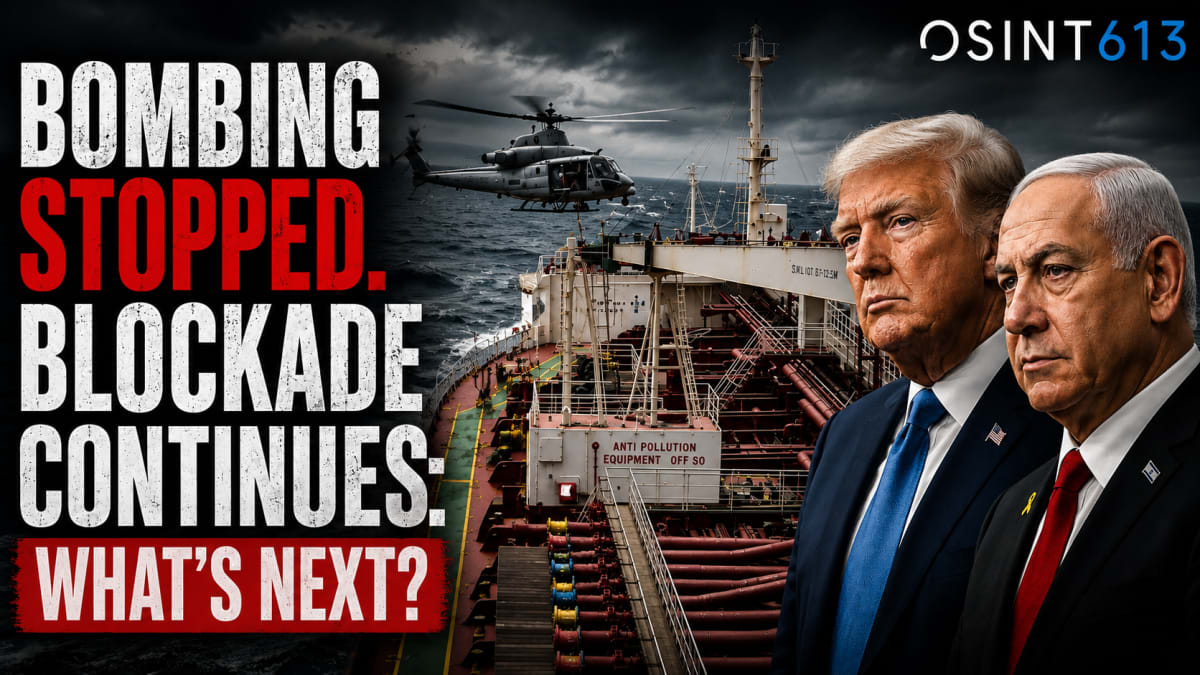
The absence of airstrikes does not represent the end of the American campaign against Iran. CENTCOM confirmed that the naval blockade remains fully in force after redirecting commercial vessels attempting to reach Iran, disabling ships that repeatedly ignored warnings and conducting verification boardings to enforce compliance. Commercial shipping through the Strait of Hormuz continues under extraordinary restrictions, sanctions remain intact and American naval and air assets continue operating across the Gulf. Iran has responded by pausing its retaliatory attacks, but Iranian military officials have made clear that decision is conditional and will be reversed immediately if American strikes resume. The result is an operational pause rather than a ceasefire, with both militaries maintaining their positions while diplomats attempt to test whether the military pressure created enough leverage to reopen negotiations.
U.S. and Iran Are Entering Talks With Different Priorities
Regional mediation efforts have accelerated during the pause, but the two sides are approaching negotiations with fundamentally different objectives. According to Al Arabiya, Iran informed Pakistan that it has suspended rather than withdrawn from negotiations and remains willing to resume talks in Doha, Geneva or Islamabad. Tehran has also rejected proposals for a new navigation route through the Strait of Hormuz, insisting discussions continue under the previous memorandum of understanding.
Iranian officials want negotiations to begin with the Strait of Hormuz, followed by the release of frozen Iranian assets, while leaving the nuclear issue until the final stage. That sequence conflicts directly with Israeli priorities and only partially aligns with those of the United States.
President Trumps immediate objective is restoring freedom of navigation through one of the world’s most important shipping lanes while maintaining military pressure as leverage.
Israel continues viewing Iran’s nuclear program as the central strategic issue, creating a gap between what the Islamic regime wants to discuss first and what Jerusalem considers the primary objective of the conflict.
The Military Pressure Has Shifted
The Trump administration has presented the operational pause as an opportunity to determine whether military pressure has created conditions for diplomacy. President Trump has said the United States remains prepared to resume military action while simultaneously pursuing negotiations, and senior administration officials have described the current moment as Iran’s opportunity to reach an agreement before additional strikes become necessary.
Reporting by The New York Times suggested that concerns over Patriot interceptor inventories were among the issues discussed before the pause was approved. The Pentagon has not confirmed that reporting, and it should be viewed as one factor among several rather than the sole explanation for the decision.
By late April, the United States had fired more than 1,200 Patriot interceptors, according to Pentagon estimates and congressional officials. At over $4 million each, that represents at least $4.8 billion in Patriot missiles alone, excluding THAAD, SM-3 and SM-6 interceptors, with inventories believed to have fallen further since then.

Sustained missile defense operations consume interceptors that require years to replace, while the United States must also preserve inventories for other potential contingencies around the world. Diplomatic considerations, force protection, regional stability and military readiness are therefore not competing explanations but overlapping realities that likely shaped the administration’s decision.
The wider conflict has continued despite the pause in American air operations. The Houthis claimed responsibility for missile and drone attacks against Saudi Aramco facilities in Jizan and Yanbu following Saudi airstrikes in Yemen.

Saudi Arabia has not released a detailed damage assessment, but NASA FIRMS satellite imagery continues showing active thermal detections at the Jizan refinery, indicating persistent fire activity days after the strike.
The attacks demonstrate that even as direct U.S. military action against Iran has paused, regional pressure continues expanding. Saudi Arabia spent recent years shifting energy exports toward the Red Sea to reduce reliance on the Strait of Hormuz, yet Houthi attacks are now threatening that alternative route through Bab al Mandeb. The conflict is no longer centered on a single maritime chokepoint but increasingly affects both of the Middle East’s critical shipping corridors.
Netanyahu’s Visit Could Decide What Happens Next

The diplomatic opening now runs directly into Prime Minister Benjamin Netanyahu’s visit to Washington, where he is expected to meet President Trump at a moment when military pressure and diplomacy are unfolding simultaneously.
Israel prepared for additional American strikes before learning late Friday that operations had been suspended, and Israeli leaders have continued emphasizing that the operational pause does not change the long term threat posed by the Islamic regime. Netanyahu warned that any Iranian attack against Israel, whether carried out directly or through proxy groups using ballistic missiles or drones, would trigger a “very, very forceful” Israeli response. In an interview with Fox News, he also said the conflict will end only when the Iranian regime falls or is weakened enough to abandon its nuclear program. That objective extends well beyond reopening commercial shipping through the Strait of Hormuz and highlights the different strategic horizons facing President Trump and Prime Minister Netanyahu.
The United States is attempting to determine whether sustained military pressure can produce a diplomatic outcome without another escalation, while Israel remains focused on ensuring Iran cannot emerge from the conflict with its long term military capabilities intact.
Whether the current pause becomes remembered as the beginning of negotiations or simply the interval before another phase of the campaign may depend less on the discussions taking place in Doha or Muscat than on what Trump and Netanyahu conclude behind closed doors in Washington.