
 Israel National News
'Not aimed at the Israeli people': British PM defends ban on Judea and Samaria
Sep 9, 2026·4 min read
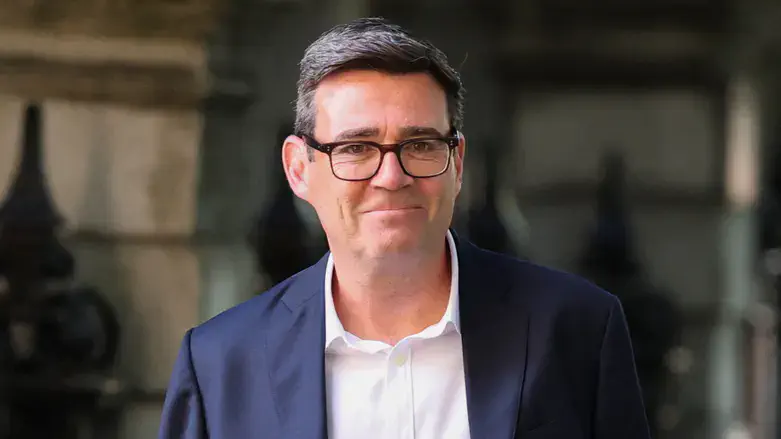
British Prime Minister Andy Burnham defended the government's decision Tuesday to impose a ban on trade in goods produced in Israeli communities in Judea and Samaria, saying Britain must be willing to take action to advance what it views as a two-state solution.
Burnham wrote in a post on social media that the measures were directed at policies of the current Israeli government rather than at Israel's population, arguing that Britain had been too hesitant in responding to developments in the region.
"Today we are announcing carefully judged, targeted steps that are not aimed at the Israeli people, but at the unacceptable policies of the current Israeli government," he wrote.
He said the government was introducing three main measures. Britain will prohibit trade in goods from what it describes as “illegal settlements", formally change its position to state that “the Israeli occupation of Palestinian territory is unlawful", and impose sanctions on individuals and companies that support, facilitate or profit from communities in Judea and Samaria.
The sanctions will also target businesses and investors involved in construction of the E1 settlement, Burnham said.
The British prime minister argued that “settlement construction" poses a threat to the prospect of a two-state solution, pointing to the approval of 104 new communities since the current Israeli government took office in December 2022. He also cited more than 1,500 incidents of violence by Israeli civilians against Palestinian Arabs reported by the UN so far this year.
Burnham specifically highlighted Israel's decision to allow tenders for construction in E1 to proceed ahead of the October elections, describing the planned development as a project that would undermine the possibility of a future Palestinian state.
"This would cut a swathe through the heart of the West Bank - snuffing out the hope of realising a two-state solution. It cannot be allowed to happen," he wrote.
The government is also announcing additional humanitarian assistance for Gaza. Burnham cited the continuing deaths and destruction in the Strip, saying more than 70,000 people have been killed, including at least 20,000 children, while millions have been displaced and Gaza's population is now confined to one third of the territory.
"The suffering of the Palestinian people is a scar on the conscience of the world," Burnham wrote, while also reiterating his condemnation of the October 7, 2023 terrorist attack and Hamas.
"I have condemned the monstrous terrorist attack on Israel on 7 October 2023 in the strongest possible terms - and continue to condemn Hamas. However, it does not justify the Israeli government’s actions in Gaza or the West Bank."
Burnham stressed that the new measures do not amount to sanctions against Israel as a whole, saying they are intended to increase pressure on the government without penalizing Israelis who oppose its policies.
"The Israeli people are not responsible for the actions of their government. And nor is the Jewish community in the UK. Blaming British Jews for the actions of Benjamin Netanyahu’s government is wrong, plain and simple. And it is antisemitism, plain and simple."
Burnham said he met representatives of Britain's Jewish community last week and pledged that his government would work to protect them and combat antisemitism.
He framed the new measures as an effort to preserve the possibility of Israelis and Palestinian Arab s living alongside one another in peace and security, arguing that this remains the desired outcome for many people in Britain.
"We are taking these steps because it is the right thing to do," wrote Burnham.
Foreign Minister Gideon Sa’ar announced in response to the British sanctions that Israel will close the British Consulate in Jerusalem and take a series of additional countermeasures.
Sa’ar said the measures were decided upon with the agreement of Prime Minister Benjamin Netanyahu and follow what he described as a series of anti-Israel decisions by Britain's Labour Government.
Under the measures, Israel will close the British Consulate in Jerusalem, remove British representatives from the International Gaza Support Center in Kiryat Gat, terminate British activities training Palestinian Authority forces in Judea and Samaria under the “British Support Team in Ramallah," and deny entry to Israel to 12 British elected representatives and other British nationals involved in antisemitic and anti-Israel activity or who deny Israel's existence.
UK Chief Rabbi Ephraim Mirvis sharply criticized the British government’s decision to impose sanctions targeting Jews living in Judea and Samaria, describing the move as “a dark day for British Jews."
“This is truly a dark day for British Jews," Mirvis said. “Today our Government has chosen to ignore the deep concerns expressed by so many of us."
The Chief Rabbi accused the government of adopting measures that lend legitimacy to anti-Israel rhetoric rather than contributing to peace.