
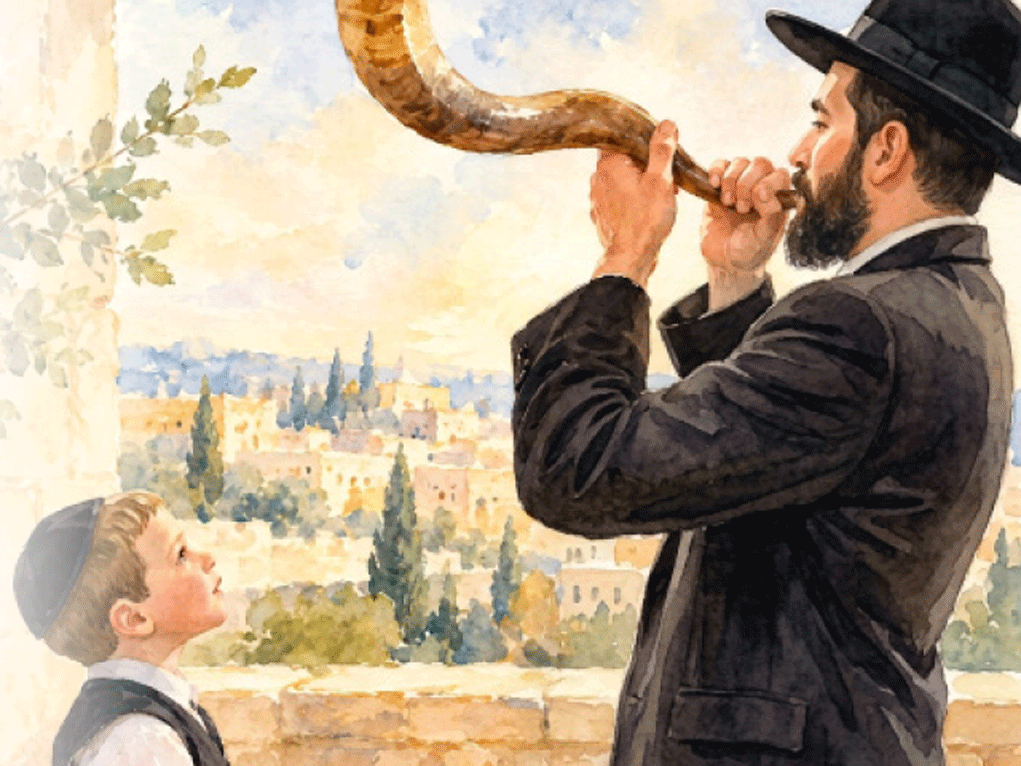

Every year, on Rosh Hashanah, right after laining, somewhere in the long stretch before the drosha and when the baal tokeia gets up, like most people, I turn to the page before tekias shofar.
On this page, printed in a small non-descript way, are Rav Sadia Gaon’s ten reasons why we blow the shofar. Nearly every machzor in the world has them. From the Yiddish Kol Bo, to ArtScroll, to the specialized ones with the peirush of a variety of Rishonim and Acharonim, they all seem to have those ten reasons, placed like instructions right before tekias shofar.
I have never seen anything remotely like this anywhere else in the siddur. We do many things over the course of a year without being handed an explanation on the facing page. We light a menorah for eight nights, we take a lulav and shake it in six directions, we eat matzah and drink four kosos and sit in a sukkah, and not one of those mitzvos has any shortage of reasons. Some simple, others Kabbalistic. But they are not placed in the machzor. You can look them up yourself. The Gemara offers them, the Gaonim offer them, the Rishonim and Acharonim offer them by the dozen. You can go for months learning up the reasons of any particular mitzvah. Yet, no siddur prints up a list for us to contemplate before performing the mitzvah. Only for tekias shofar, for some reason, are we offered a numbered list to review even before we have heard so much as a single tekiah. It’s always something that floats through my mind as I peruse the machzor before (and sometimes during) during the rov’s pre-tekios drosha.
There is a second question that is perhaps one of the most famous questions in the olam hayeshivos, and it concerns one of the most famous paragraphs the Rambam ever wrote about Elul. At the beginning of Hilchos Teshuvah (3:4), he writes, “Af al pi shetekias shofar b’Rosh Hashanah gezeiras hakosuv, remez yeish bo, k’lomar: Uru yesheinim mishinaschem v’nirdamim hakitzu mitardemaschem v’chapsu b’maaseichem v’chizru b’teshuvah v’zichru bora’achem.” Although the sounding of the shofar on Rosh Hashanah is a decree of the posuk, there is a hint contained in it, as if to say: Wake up, you sleepers, from your sleep, and you who slumber, rouse yourselves from your slumber, and search your deeds and return in teshuvah and remember your Creator.
It is quoted hundreds of times during Elul by every rov, maggid shiur, and mashpia. I’ve heard this Rambam quoted from the halls of elite-level yeshivos to the sanctuaries of the Young Israel in which I davened in my early youth. But there is a word sitting in the middle of it that most of us read straight past. K’lomar. As if to say. It sounds like a posuk, but it isn’t. The Rambam, in his poetic mastery, made it up. The Rambam is supplying the message himself, in his own words, which is quite fascinating. After all, the novi has already supplied one and put it far more beautifully than anybody has managed since. “Im yitoka shofar b’ir, v’am lo yecheradu? Can a shofar sound in a city and the people not tremble?” (Amos 3:6). There is a perfectly good remez sitting in Trei Asar, fully sourced and waiting to be quoted, yet the Rambam chose to write his own.
And then there is a third question, which I raise knowing full well that there are shiurim worth of lomdus built on top of it, and which I would like to ask while leaving all of the lomdus politely to one side. The mitzvah is not to blow the shofar. The mitzvah is to hear it, lishmoa kol shofar, which is what we say in the brocha and what the halacha means. Unlike Megillah, in which the brocha is “al mikra Megillah,” to read the Megillah, the brocha on shofar is not to blow, but lishmoa kol shofar, to hear the sound of the shofar. The baal tokeia himself, blowing 100 kolos, is not doing anything different than everyone else. He may blow, but the mitzvah is to hear.
There is one other thing that bothers me, albeit slightly. The halacha is that kol hakolos kesheirim b’shofar. All sounds are kosher for shofar. One dot on an esrog can ruin it all. One split of a lulav can render it posul. Dough lingers for 19 minutes? Chometz. But shofar? Everything goes.
Years ago, I heard a beautiful p’shat from my shver, Rav Yacov Lipschutz zt”l, to answer the question on the Rambam. Perhaps his idea is really the answer to all three questions at once.
The Rambam did not compose his own remez because he had forgotten about the posuk. He composed his own because that is the essence of tekias shofar.
Shofar has many sounds and we have many feelings. It talks to each and every individual in a different manner. To some, it may be the announcement of a king. To others, the coming of Moshiach. To a third, a call to teshuvah. Yes, every sound is kosher, because each sound can speak a different language that each of us hears through our own life experience and teshukos.
Which is precisely why the mitzvah is in the hearing. A single sound leaves a shofar, arrives at three hundred ears, and becomes three hundred different messages, no two of them alike.
Friday is September 11th. It marks twenty-five years since the attacks of 9/11, and along with everything else that has been written and said about that morning, I keep returning lately to the near misses. People in our community were late getting downtown because they had stayed behind to help their wives get the children out the door to school. Yidden from Flatbush were saved because they were still standing in a minyan that ran longer than usual. Some were already high up in the building and somehow found a stairwell and reached the street in the last minutes before the Towers came down. Twenty-five years later, they are still unable to explain to anybody, themselves included, why they turned left instead of right.
The same morning, the same attack, the same Yad Hashem moving over the same city at the same hour, and yet ask any two of those men what happened to them that day and you will not get the same answer twice, because what was said to each of them was not the same thing. One of them learned that his family is not an obstacle standing between him and his office. One of them learned something about a minyan he had almost given up. One of them heard something that he has probably never spoken out loud to a living soul. To America as a whole, the attack was collective, but to each individual, the story and lessons were different.
So go back to that page in the machzor. We asked why the machzor prints ten reasons, but, in essence, I think ten is just the start. If the machzor knew what your specific message from the shofar would be, it would have printed one big reason in bold on top. That’s the yesod of the kol. It is one kol, with a thousand different sounds. For one person, it can awake him to something completely different than the man standing right beside him in shul. The machzor is showing us the power of shofar. It is not limited to just what it sounds like on the surface. Rather, it has power to resonate differently with every single person. And that is the message conveyed by listing many different reasons. Because, specifically here, listing only one reason would defeat the purpose.
Next Sunday, the baal tokeia will rise, and the room will go quiet in the way it goes quiet only then, and he will blow one single sound, and every one of us will hear something that will speak to him or her in a special way. The shofar is talking directly to you. You know what it is saying. Make sure that you listen.
Just saying.