
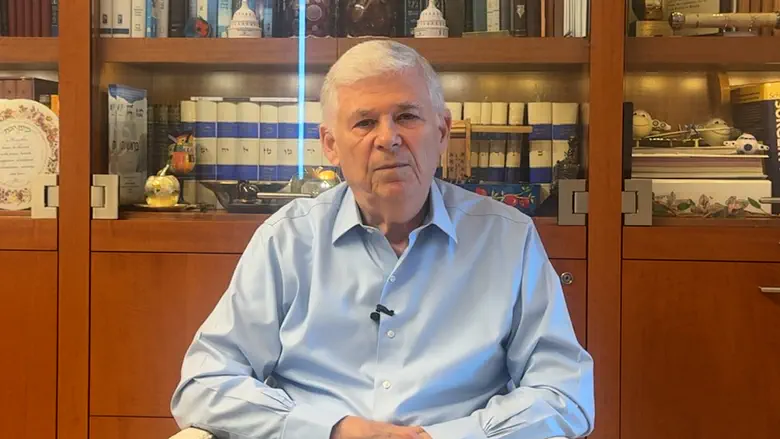

Dr. Shmuel Katz, leading pro-Israel activist and co-founder of StandWithUs, spoke with Arutz Sheva about the upcoming Israeli elections, the debate over Israelis living abroad returning to vote, the political ramifications of the October 7 massacre, and concerns over votes being wasted on small right-wing parties.
Asked whether Israelis abroad who support the government should travel to Israel to cast their ballots amid efforts by government opponents to bring their own supporters back to vote, Katz stressed that participation should be accompanied by a careful examination of the consequences of each political choice.
“Any person who wants to go and vote should go and vote, but he should vote wisely, with a big understanding of whom they are voting for," Katz said.
He argued that this applies to voters on both sides of the political spectrum, saying Israelis must look beyond campaign promises and examine what candidates are likely to do once in power.
“People must understand that all these decisions will have a fundamental effect upon their own future," he said. “Even if you are on the left, you have to be very careful who you are voting for."
Katz warned voters against taking at face value conciliatory rhetoric from Israel’s enemies, arguing that hostile actors can present themselves as moderate while pursuing very different objectives.
“The enemies of Israel will speak to you very nicely, they’ll smile at you, they’ll look very modern and accommodating. But their middle name is deception," he said.
He also drew a comparison to political divisions in the United States, criticizing left-wing economic and immigration policies and arguing that voters everywhere need to consider the long-term consequences of political platforms rather than simply their immediate promises.
Kempinski asked Katz about undecided Israelis who argue that the October 7 massacre occurred under what had been described as Israel’s most right-wing government and question whether that government should be returned to power.
Katz responded by arguing that a full investigation is necessary to establish precisely what happened in the period leading up to the massacre and why Israel’s political leadership did not receive or act upon crucial information.
“A real investigation must be done in order to find the real details," he said.
Katz criticized the conduct of the senior military leadership before and during the Hamas invasion, questioning how Israel failed to detect the preparations for such a large-scale assault and why the response took so long.
“Netanyahu did not receive the information in real time and acted upon them because he just did not have the information," Katz asserted. “So accusing Netanyahu for not acting upon information that he did not have, it’s a very difficult decision to address."
Katz also referred to conspiracy allegations that have circulated concerning the events preceding October 7, while emphasizing that he does not know whether such claims are true.
“Some of them are speaking about conspiracies and so on, which I don’t even know if it’s true or not," he said, reiterating that an investigation is necessary to determine the facts.
He argued that one of the central lessons of October 7 is that Hamas and other enemies of Israel do not distinguish between Israelis according to their political beliefs.
“This time we understand that the enemies of Israel do not care if you are on the right or if you are on the left," Katz said.
In his view, efforts to appease Israel’s enemies encouraged them to perceive the country as weak. He argued that Israel instead needs leadership capable of projecting strength while ensuring security for everyone living in the country.
“They want you to be weak. And if you are weak, you lose," he said.
Katz said he believes Israel’s right-wing parties offer the stronger path toward security and stability, while allowing Jews, Muslims and Christians to live safely in the region.
The interview also addressed the proliferation of new parties on the Israeli right and concerns that several could fail to cross the electoral threshold, resulting in tens of thousands of votes being effectively wasted.
Katz described the issue as “crucial" and called on smaller right-wing factions to unite before the election.
“The small parties must unite. If they don’t unite, they’re going to lose," he warned.
He cited Turkey as an example of the dangers of political fragmentation, arguing that divisions among opponents of Recep Tayyip Erdoğan helped him gain power.
For Israeli voters, Katz said ideological affinity should not be the only consideration when choosing a party. Voters should also consider whether their preferred party has a realistic chance of entering the Knesset.
“If you cannot vote for a party which will survive the election, you better choose a different party which will be as close to your idea as possible," he said.
“Do not vote for a party that is going to be wasting your voice. Having a voice which is going to be lost is as if you vote for the wrong party."
Katz concluded with an appeal to the leaders of smaller parties to set aside personal rivalries and unite.
“I highly recommend that all the little parties unite, take away this factor of egos and personal ideas and try to build bridges in order to create unity among the people who are going to represent us tomorrow in the Knesset," he said.
“The survival of the country depends on a solid and unified voice within the Israeli government."