
 Israel National News
Why I object to joint Jewish and Non-Jewish prayer at the Kotel
Sep 9, 2026·16 min read
Rabbi Eliezer Simcha Weisz is a member of Israel's Chief Rabbinate council.
There is something deeply encouraging about the support Israel has received from Christians around the world, particularly during these difficult years. Many non-Jewish friends have stood publicly with Israel, defended the Jewish people, spoken against antisemitism and offered genuine friendship at a time when such support has been especially meaningful.
That friendship should be welcomed with gratitude.
But precisely because we value that friendship, we must also be clear about an important distinction: friendship between religions is not the same as joining together in religious prayer.
This distinction becomes especially important when the proposed prayer is to take place at the Kotel and in its environs, the most sacred place accessible to Jews today.
I therefore strongly object to the proposed 24-hour “Global Prayer Initiative" involving Evangelical Christian groups at and around the Kotel. My objection is not directed against Christians, nor against their support for Israel. It is an objection to the idea of combining, or presenting side by side as one religious event, Jewish and Christian prayer at the Kotel and in its immediate surroundings.
There is no contradiction between welcoming Christian friendship and insisting that Jewish prayer at the Kotel remain Jewish prayer.
Gratitude Does Not Mean Religious Merger
We should be grateful to those Christians who stand with Israel. We should appreciate those who defend the Jewish people, speak against antisemitism and support the State of Israel. There are many Christians who have shown genuine friendship towards the Jewish people, and that friendship should not be taken for granted.
A Jew can stand together with a Christian against antisemitism. We can work together to defend Israel. We can cooperate on humanitarian causes and on matters of common concern. We can develop genuine friendships and mutual respect.
But prayer is different.
Prayer is not simply another form of public expression. For a Jew, tefillah is an act of avodat Hashem. The words we say, the manner in which we say them and the place in which we say them are all part of our religious life.
There must therefore be a clear boundary between standing together as human beings and standing together in prayer.
This was one of the important principles articulated by Rav Yosef Dov Soloveitchik in his famous essay Confrontation. Rav Soloveitchik supported cooperation with Christians and others in areas of common human concern, while drawing a firm distinction between such cooperation and religious or theological partnership. The Rabbinical Council of America subsequently reaffirmed these principles, distinguishing cooperation in universal areas from matters of faith, religious law, doctrine and ritual.
That distinction is not a sign of hostility.
It is a sign of respect.
We respect Christians enough to recognise that their faith is their faith and ours is ours. We do not need to pretend that our religious beliefs are the same in order to be good friends.
The Kotel Is Not Merely a Symbol
There is also a fundamental difference between holding an interfaith event somewhere in Jerusalem and holding it at the Kotel and in its environs.
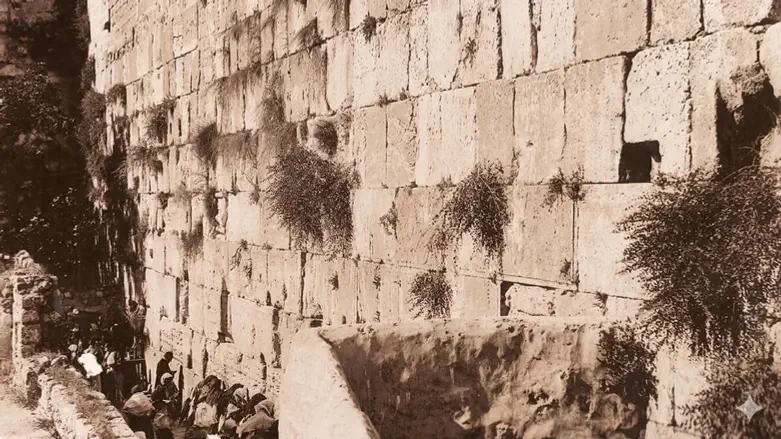
The Kotel is not simply a beautiful or historic backdrop for an international event. For generations, Jews have turned towards this place with tears, hope and longing. Jews came to the Kotel to pour out their hearts before Hashem. They came because they could not forget Yerushalayim and because they longed for the day when the Beit HaMikdash would once again stand in its place.
The Kotel represents generations of Jewish tefillah.
It is therefore not enough to say that a particular prayer gathering is intended to express friendship with Israel. The question must also be asked: What kind of religious activity is appropriate at a place whose entire character is bound up with Jewish prayer?
Israeli law itself recognises that the character of a holy place matters. The regulations governing Jewish holy places define the Kotel and its plaza broadly and prohibit, among other things, a religious ceremony that is not in accordance with the custom of the place and that harms the feelings of worshippers towards the site.
The current procedures for the Kotel likewise describe the prayer plaza as a place for prayer and state that activities there must respect the dignity of the site, worshippers and visitors.
Whatever the legal arguments surrounding a particular proposed event, one principle is clear: the character of the place matters.
A Balcony Does Not Change the Nature of the Event
It has sometimes been suggested that concerns about such an event can be answered by saying that some participants will be on balconies, rooftops or other places overlooking the Kotel plaza.
But moving the participants a short distance does not change the essential question.
The question is not simply where every individual person is standing. The question is what is being created at the Kotel and in its immediate surroundings, and what the Kotel itself is being asked to represent.
If the Kotel becomes the setting for an organised religious event in which Jewish and Evangelical Christian prayer are presented together, moving some participants or cameras to another location does not resolve the religious concern.
The Western Wall complex itself is understood broadly in the official procedures governing the site, including the upper and lower plazas and other areas under the responsibility of the Western Wall Heritage Foundation.
The concern is precisely that the Kotel and its environs should not become the setting for a new model of shared Jewish-Christian religious prayer.
What Happens to the Jewish Worshipper?
There is another question that deserves to be asked: what does this mean for the ordinary Jewish person who comes to the Kotel to daven?
A frum Jew does not come to the Kotel merely as a tourist. He comes to daven. He comes to say Tehillim. He comes to ask Hashem for help. He comes to remember those who stood there before him. He comes with his own private hopes and worries.
The Kotel should allow him to daven with the same sense of sanctity and concentration that Jews have always associated with this place.
If an organised Christian religious event is taking place at the Kotel or immediately around it, that Jew may reasonably feel that something fundamental about the character of the place has changed.
We should also consider the matter from the other side.
Christians would not regard it as a sign of friendship if Jews came into one of their sacred places and organised a Jewish religious ceremony there. They would rightly say that the place has its own religious meaning and that its character should be respected.
We should ask for the same respect for the Kotel.
Mutual respect does not require religious participation.
Sometimes the deepest form of respect is to allow each faith to worship in its own way.
Torah Does Not Ask Us to Erase Boundaries
The Torah teaches us that holiness involves distinction.
"וְהִבְדַּלְתֶּם בֵּין הַקֹּדֶשׁ וּבֵין הַחֹל, וּבֵין הַטָּמֵא וּבֵין הַטָּהוֹר."
“You shall distinguish between the holy and the ordinary, and between the impure and the pure."
Judaism has never taught that maintaining our identity means hostility towards others. We can respect other people and still know who we are. We can work together with people of other faiths and still remain firmly committed to Torah.
The Jewish people have a unique covenant, a unique Torah and a unique way of serving Hashem.
That does not mean isolation.
It means identity.
We can cooperate without merging. We can respect without participating. We can be grateful without compromising the boundaries of our faith. And we can stand together in defence of Israel without standing together in religious prayer.
What About Tehillim 122?
There is another sensitive point that should not be overlooked.
One of the Tehillim often associated with Yerushalayim begins:
"שיר המעלות לדוד, שמחתי באומרים לי, בית ה' נלך."
“A Song of Ascents of David. I rejoiced when they said to me, ‘Let us go to the House of Hashem.’"
For a Jew, these words are part of the deep longing for Yerushalayim, the Beit HaMikdash and the restoration of Jewish avodah. They carry generations of Jewish yearning.
We should certainly respect the fact that Christians may also read Tehillim and find meaning in its words. But we should be careful about presenting the joint reading of Jewish sacred texts as evidence that our religious beliefs are essentially the same.
They are not.
We can share admiration for the Bible without pretending that Judaism and Christianity understand the covenant, Torah, Mashiach and ultimate redemption in the same way.
True friendship does not require pretending that fundamental differences do not exist.
The Halakhic Principle
The halachic concern is clear. Jewish worship cannot be combined with the worship of another religion, particularly at a place as sacred to the Jewish people as the Kotel and its environs. The Torah and the teachings of our Chazal and poskim have established clear boundaries between Jewish avodat Hashem and the religious practices of other faiths. Those boundaries are not matters of politics or personal preference. They are part of the responsibility to preserve the sanctity of Jewish prayer and the distinct identity of the Jewish people.
The writings of our great poskim reflect the seriousness with which Jewish participation in non-Jewish religious worship is treated. The relevant halachic discussions include the laws of Avodah Zarah, chukot ha'akum and related questions concerning participation in religious practices. Whatever the details of particular cases, there is certainly no basis for presenting a joint Jewish-Christian prayer gathering at the Kotel and its environs as though it were simply another expression of Jewish prayer.
This is not a political issue.
It is not a question of whether we like or dislike a particular Christian group.
It is a question of what Jewish prayer is, what the Kotel represents, and where the boundaries of Jewish avodat Hashem must be maintained.
The Damage Does Not Stop at the Kotel
There is another dimension to this issue that is sometimes overlooked.
A decision made in Jerusalem can have consequences for Jews living thousands of kilometres away.
Israel is not simply another country with a Jewish population. It is the State of the Jewish people. What happens in Jerusalem is watched by Jewish communities throughout the world, and decisions made here can affect the way Jewish parents, rabbis and educators speak to the next generation.
It is tempting, especially in difficult political times, to look at a proposal such as this from an immediate political perspective.
A Christian leader supports Israel. Christian friends have stood with us. They have spoken publicly in our defence. Perhaps this is an opportunity to show appreciation.
But there is another question we must ask:
What message does this send to the Jewish community throughout the world?
A Jewish parent in Manchester, London, New York or Melbourne may spend years teaching his children that Judaism is not simply one religion among many, but a covenant, a way of life and a responsibility that has been carried by our people throughout the generations.
A rabbi may have to explain to a young person why Jewish identity matters, why Jewish marriage matters and why marrying outside the Jewish faith can have serious consequences for the continuity of Jewish life.
And then that young person may see Jewish and Christian religious leaders praying together at the holiest place in the world for Jews.
He may quite reasonably ask: If the differences between our religions are so important, why are the religious leaders in Jerusalem presenting them as though they can simply be joined together?
That is the danger.
We should be very careful not to send messages that weaken the work being done every day by Jewish parents and rabbis to preserve Jewish identity.
This does not mean that one prayer gathering will suddenly cause intermarriage. That would be an unfair and exaggerated claim. But religious boundaries do not disappear all at once. They can become weaker, one step at a time, when the distinction between different faiths is repeatedly presented as unimportant.
Today it may be a joint prayer gathering for friendship.
Tomorrow it may be another shared religious ceremony.
Over time, the distinction between friendship, cooperation and religious identification can become harder to explain.
We should not be naïve about this.
Intermarriage is already a painful challenge for many Jewish communities outside Israel. It affects not only individual couples, but also the Jewish identity of children and grandchildren and, ultimately, the continuity of entire communities.
Israel therefore cannot make every decision solely according to what appears politically useful today.
A short-term political benefit may sometimes carry a long-term communal cost.
A rabbi in England who tells a young couple that building a Jewish home is precious and unique should not have to explain an apparently contradictory message coming from Jerusalem.
A Jewish parent who is trying to preserve a strong Jewish home should not have to fight against mixed messages coming from the State of Israel itself.
And a young Jew should not be made to feel that maintaining the distinctiveness of Jewish life is somehow old-fashioned or intolerant.
This is why the issue is much bigger than one event.
It is about the message we send to the next generation.
It is about the strength of Jewish homes.
It is about the future of Jewish communities throughout the world.
And it is about whether we understand that a gesture made in Jerusalem can have consequences in every place where Jews are trying to remain Jews.
Decisions Made Years Ago - and Why They Matter Today
As a member of the Chief Rabbinate Council, I feel a particular responsibility in this matter.
I want to make clear that I am not writing here on behalf of the Council. I am expressing my own personal position.
Nevertheless, my experience on the Council has reinforced for me how important it is that decisions made by the Chief Rabbinate in the past should be respected and properly enforced.
Sometimes a decision made years ago can appear, at the time, to be dealing with a narrow or specific issue. Only later do we understand how far-sighted that decision was.
This is one of those moments.
The policies and decisions established to preserve the Jewish character and religious standards of the Kotel and its environs were not unnecessary formalities. They were intended to protect something precious. They established clear boundaries because our predecessors understood that once those boundaries become blurred, restoring them can be extremely difficult.
Today, when we see proposals for joint Jewish and non-Jewish religious prayer at or around the Kotel, we can appreciate just how wise and necessary those earlier decisions were.
This is precisely why existing decisions of the Chief Rabbinate Council should not be treated as suggestions that can be set aside whenever political circumstances change.
A policy designed to protect the sanctity and character of the Kotel must be enforced especially when circumstances arise that test the very reason for which that policy was established.
There will always be political considerations. There will always be people whose friendship we value and whose support we wish to acknowledge.
Those considerations are important.
But they cannot replace the responsibility to protect the religious character of the Kotel and its environs.
In the end, the question is very simple:
If we established these boundaries because we understood their importance, why should we abandon them precisely when they are most needed?
Sometimes the wisdom of a decision made in the past becomes clearest only when we are confronted with the situation that our predecessors were wise enough to anticipate.
We Must Not Turn the Kotel Into a Symbol of Religious Merger
There is also a question of precedent.
If an organised religious event is accepted at the Kotel and in its immediate surroundings because it is presented as an expression of friendship with Israel, it becomes more difficult to explain why similar requests from other religious groups should be treated differently.
The issue is therefore not only this particular event.
It is the principle we establish for the future.
The Kotel cannot become an international stage on which different religions conduct or combine their religious ceremonies.
That would not strengthen religious freedom.
It would weaken the very idea of a sacred Jewish place.
The Kotel is open to visitors from around the world. Jews and non-Jews are welcome to come and see it, to learn about its history and to understand what it means to the Jewish people.
But welcoming visitors is not the same as turning the Kotel into a place for joint religious worship.
There is a profound difference between saying, “You are welcome to stand here and see what this place means to us," and saying, “Let us now make this a shared religious ceremony."
We should preserve that difference.
We Can Say Yes to Friendship - and No to Joint Prayer
I welcome the friendship of Christians who stand with Israel.
I appreciate those who defend the Jewish people.
I am grateful to those who speak against antisemitism and support the State of Israel.
I hope that these friendships will continue and become stronger.
But precisely because I value genuine friendship, I believe we should also be honest about where the boundaries lie.
We do not need to pray together in order to stand together.
We do not need to merge our religious practices in order to cooperate in defending Israel.
We do not need to blur our religious identities in order to show mutual respect.
The Kotel and its environs should remain a place where a Jew can come and feel that he is standing before Hashem, connected to generations of Jewish prayer and longing, without having to encounter a joint religious ceremony of another faith.
There is nothing disrespectful about saying this.
There is nothing ungrateful about saying this.
And there is certainly nothing hostile about it.
It is simply the responsibility of a Jew to recognise that friendship between religions is strengthened, not weakened, when each religion respects the sacred boundaries of the other.
We can stand together for Israel.
We can stand together against antisemitism.
We can stand together for human dignity and for peace.
We can work together on the many challenges facing our world.
But when it comes to the Kotel and its environs, let us preserve its character as a place of Jewish prayer.
Let Jews and Christians be friends.
Let us cooperate where we can.
Let us respect one another deeply.
But let the prayer of each faith remain its own.
We can stand together without praying together.