
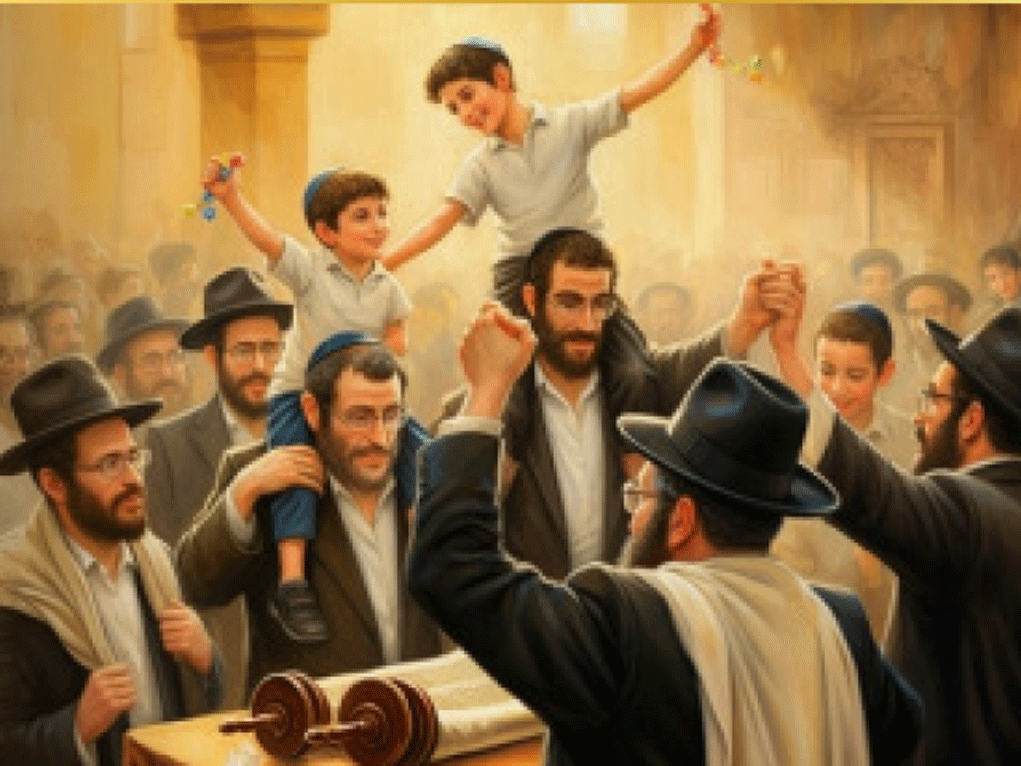

I have a question that I have been asking myself at Hakafos for the better part of fifty years. However, this time, I’ll take the leap and ask it out loud. The question might sound strange at first, which is probably why I have waited so long to ask it.
The question is this: Why is there a Yom Tov for learning Torah?
I do not mean it the way it sounds. I am not building toward an article that ends with some cute switcheroo where it turns out that Simchas Torah is really about something else entirely. I mean it for real. I assume we celebrate the learning of Torah. Not receiving the Torah. That’s Shavuos. But why one for learning Torah or for completing the cycle of krias haTorah? After all, there are so many fundamental mitzvos. We have no Yom Tov for tefillah. We have no Yom Tov for chesed (except perhaps Bike4Chai), no Yom Tov for emunah, and no one has ever proposed a night of dancing in honor of shemiras halashon (though it might well do more good than harm).
And here is what makes it stranger. We already have one. Shavuos is Zeman Matan Toraseinu, and as integral as Matan Torah is, its Yom Tov, save the concept of kulo lochem, is just like any other Yom Tov.
But bottom line, Shavuos, like every other Yom Tov, corresponds to a date and an event. Pesach has Yetzias Mitzrayim, Sukkos has the Ananei Hakavod, and Shavuos has a story of Kabbolas HaTorah powerful enough to shake the world.
Simchas Torah, by contrast, is not celebrating an event. It commemorates the fact that we reached the end of the parshiyos, which, though a major achievement, is not a historical event by any stretch. Vezos Habrocha arrives every year, on schedule, whether we learned anything that year or not. And we celebrate it as well, whether we learned anything that year or not.
Moreover, we celebrate Torah constantly. I say this as someone who has spent a good part of his life at Torah celebrations and would attend more of them if my schedule allowed. We have mega-siyumim that fill stadiums. We have Chumash parties, Mishnayos plays, conventions, Adirei HaTorah, and dinners at which grown men dance like teenagers over a masechta they completed. A community that can put ninety thousand people in a football arena over the completion of Shas, and another twenty thousand in a basketball arena to celebrate Torah lishmah, does not seem to require an annual reminder that it is fond of learning.
So what exactly are we dancing about?
Let me start with the original tefillah question, because I think it holds the key and because it puts the whole issue in a different light. Why don’t we celebrate tefillah?
The celebration of limud haTorah is very different. Nobody has a cheilek in your Shemoneh Esrei. Not your rebbi, not your chavrusa, not your father. Whatever you davened this morning between Yishtabach and Aleinu was yours alone, and it will remain yours alone. Tefillah is the one avodah that cannot be shared, subdivided, or assigned, which is precisely why it can never be made into a Yom Tov. You cannot make a public celebration out of something that no two people can hold at the same time.
Torah is different. It is the only mitzvah that the Torah itself describes as a joint partnership. Torah tzivah lonu Moshe morasha kehillas Yaakov. It is a heritage, an inheritance, and not of an individual, but of a kehillah, and the Gemara in Sukkah teaches that this is the very first posuk that a father says to a child who has learned to speak. Think about that for a moment. Before a Yiddishe kind can tell you what a mitzvah is, before he knows a single Rashi, he has been handed a deed of partnership in Torah.
Nevertheless, a joint shutfus, as some people unfortunately may know, can be where the trouble begins.
Look at what the global view actually looks like. There is a four-year-old somewhere this morning doing “kometz aleph ah.” There is a fourth-grader on his fourth perek of Mishnayos Brachos. There is a bochur in eighth grade learning Gemara without meforshim and quite pleased about it, a mesivta bochur across the street glowing over his first Rashba, and down the hall, a bais medrash bochur who has been on the same Ketzos for eleven days and considers all of them rookies. There is a yungerman in Bais Medrash Govoah moving through a sugya at a pace that would shock an outsider, and he is doing it right. There is a Yid smiling with Reb Eli, a Yid plugging with Reb Sruly. Through all of it, there is an accountant from Flatbush who has been going to the same six-thirty Daf for thirty-one years and has never once heard of either of them. There is Dirshu with its tests and Oraysa with its chazarah, a yungerman with a shteller, and a yungerman without one who, quite frankly, learns better than the man who has one, and both of them know it. We all know all of these Yidden, programs, and paths of learning, and I myself have been part of many of them.
Kinas sofrim tarbeh chochmah, says the Gemara in Bava Basra. It is the engine of the whole enterprise. But let us be honest with each other. Kinas sofrim tarbeh chochmah, and sometimes, when it is not handled properly, it can unfortunately also be marbeh more than chochmah. It can be marbeh kinah. The competition that drives a man to learn is the same competition that lets him glance across the bais medrash and subconsciously look askance at someone learning differently than him.
Which brings me to the strangest fact about this Yom Tov and the one I think explains all of it.
Shemini Atzeres (and Simchas Torah in chutz la’aretz) is designated as a personal time with Hashem. Nothing else, just us and Hashem. An eighth day, added with untold love from Hakadosh Boruch Hu—kasheh alai preidaschem, because the parting is hard for Him—and then left empty. And Klal Yisroel chose to celebrate that one day with His greatest gift, His greatest joy, the glue that holds His nation together—the Torah Hakedosha.
But it doesn’t stop there. Look at what takes place on this auspicious day. Every man gets an aliyah. Every single one, and we repeat the parsha as many times as it takes, which makes it the only day of the year when the laining is geared to the tzibbur instead of the tzibbur being geared to the laining. There is Kol Hane’arim, children called up under a tallis who cannot be counted for anything anywhere else in Yiddishkeit. And then, for the entire length of Hakafos, the Sefer Torah is closed. Nobody reads a syllable. The rosh kollel and the Alef-Bais kid are holding the identical rolled scroll, and there is no way on earth to tell from the outside which one of them knows what is written inside it.
Every shul has its own minhagim, all geared to being mechabeid the Torah and the ones who toil over it. In my shul, there is nothing I enjoy more than seeing the myriad bochurim, in yeshivos of every level, coming together to form the most energetic circles around unfamiliar men in shul, singing and shouting, “Vechayei olam nota besocheinu,” as if they have been sitting in kollel for twenty years. Fifty-one weeks a year, the Torah is open, an open sefer for anyone to come and claim their dominance in their respective cheilek. But on Simchas Torah, during Hakafos, it is closed. The sefer accepts anyone who holds it, each in his own individual mehalech.
This is also, I am convinced, why we find that so many Yidden, including distinguished roshei yeshiva, don’t hold back from taking an extra l’chaim on Simchas Torah. Purim breaks the barrier between arur Haman and boruch Mordechai. Perhaps Simchas Torah also breaks a barrier. It breaks the barrier between one man’s Rav Chaim and another man’s Mishnayos. Because for at least one day a year, we strive to recognize that every man’s learning is, in fact, his cheilek of the Torah.
Between the bochur who spent the year k’nocking over Rav Boruch Ber’s Torah and the baal habayis who does not miss the Daf for anything. Between the yungerman who sat two weeks on one Pnei Yehoshua and the young man who pays a former kollel chavrusa to learn with him after a long day at work. Between the lawyer who learns at sixty-five miles an hour on the Belt Parkway and the Yid learning in Bais Hatalmud who has not learned anywhere but the same shtender since Elul of 5741. Between the melamed who has been teaching the same alef with the same drop of honey for forty-two years, whose entire Torah seems to be contained in a single letter, and the rosh yeshiva whose Torah fills a celebrated sefer, ask yourself: Could one have reached their potential without the other?
The barrier breaks. That is what we are dancing about. Not that we have Torah. We knew that in Sivan. On Simchas Torah, we are celebrating that all of us have it, at once, in the only configuration where nobody can measure anybody.
At Har Sinai, one nation was mekabel one Torah. On Simchas Torah, one Torah is mekabel a thousand kinds of Yidden.
And somewhere in the middle of the fourth Hakafah, a bochur who spent the entire year killing himself on the lomdus, assured that a daf a day is not the real learning, will find himself clutching one end of a closed Sefer Torah with the fellow who learns that very same daf, each holding the other, both of them out of breath, neither of them able to say whose Torah it is.
It is not that they cannot tell. It is that on that night, there is nothing to tell.