

The Tur (Orach Chaim, Hilchos Rosh Hashanah 417) famously quotes from his brother, Rav Yehudah, how each of the avos hakedoshim represent one of the three major Yomim Tovim. His source for Yaakov Avinu being the connection to Sukkos is the posuk (Bereishis 33:17) which states that after he manages to divest himself from Eisav, “Yaakov journeyed to Sukkos and built himself a house and for his livestock he made sukkos; he therefore called the name of the place Sukkos.” Although many aspects of this juxtaposition are shrouded in mystery — e.g., what do animals have to do with our sukkah? — the connection between Yaakov and Sukkos is quite apparent.
However, another statement of Chazal (Bereishis Rabbah 48:10) seems to give Avrohom Avinu credit for this wonderful Yom Tov: “Hashem said to Avrohom, ‘You said [to the visiting angels], ‘Recline beneath the tree.’ By your life I will pay back your children [as it says], ‘He spread out a cloud for shelter’ (Tehillim 105:39).” This source is not as straightforward at all. First of all, what does Avrohom Avinu’s act of chesed have to with Klal Yisroel being protected in the desert by the Clouds of Glory? Secondly, it would seem from the actual story at the beginning of Parshas Vayeira that the least exertion that Avrohom did was offering them some shelter under the tree. He personally served the visitors a sumptuous meal, running through the heat of an intensely hot day while he was still in great pain from his bris milah, while pointing out a shady tree doesn’t seem to be in the same mesirus nefesh league as the rest of his hachnosas orchim. Yet, it is this deed that was the seed for Klal Yisroel’s protection and our own Yom Tov for eternity.
To make matters a bit more complicated, we should take note of the fact that the joy of our Zeman Simchoseinu seems to be rooted in Yitzchok Avinu, who is usually considered to be the fount of yirah, pachad and gevurah (see Zohar Hakadosh, Ki Sisa 44b). In the Siddur HaGra (introduction to Tefillas Shacharis), Rav Naftoli Hertz writes that “Avrohom is the source of our chesed and Yitzchok of our simcha.” So, although we understand that Yaakov Avinu is inexorably entwined in the Yom Tov of Sukkos, its joy flows from Yitzchok. This is puzzling on two accounts. First of all, why is there a dichotomy between the matrix of the Yom Tov itself and its definition in time as being Zeman Simchoseinu? Secondly, how can Yitzchok be the source of simcha when he is so often associated with the harsher emotions and middos of yirah, pachad and gevurah?
To answer this latter question, we can turn to Rav Dovid Cohen, rosh yeshiva of Yeshivas Chevron (Zeman Simchoseinu, page 183). He quotes from the rest of Rav Hertz’s essay (Imrei Shefer, ibid.), which explains that “simcha comes from hamtokas hadinim, roughly translated as “the sweetening of the bitter statutes.” To understand this further, let us turn to the foundational study of the Yomim Tovim, their order and interaction provided by my rebbi, Rav Yitzchok Hutner, in many places (Pachad Yitzchok, Rosh Hashanah 10:8; Yom Kippur 8:8; Maamorei Pachad Yitzchok, Sukkos 7, 98:15, 106). He demonstrates, based upon the commentary of the Vilna Gaon (to Shir Hashirim 1:4; Aderes Eliyohu, Ki Sisa 34:10), that Sukkos does not commemorate the beginning of the Ananei Hakavod, but their return after we sinned by making the Eigel. For this reason, Sukkos arrives after Yom Kippur, not after Pesach, when the Clouds of Glory began. Thus, the joy of Sukkos is that of having our teshuvah accepted by Hashem and being reinstated as His nation and beloved children.
Now we can understand more deeply Rav Naftoli Hertz’s words, according to Rav Dovid Cohen. Yes, Yitzchok Avinu is our guide and role model for yirah, pachad and gevurah. But that is also the essence of Sukkos. We sinned as a nation and are still paying the price for the Eigel (see Rashi, Shemos 32:34). Yet, when we were forgiven and the Ananei Hakavod returned, it is not only that we were once again protected from the elements and our enemies. As the Ramchal (Derech Hashem) defines Sukkos, we were no longer exposed physically, but, even more importantly, we were isolated from the nations and protected spiritually as well. We showed Hashem that we want to be better, so Hashem responded by the ultimate favor: I will keep you close to Me and be isolated with you under the Clouds.
We can now see that all three of the avos contributed a unique element of our own Sukkos experience. Yaakov Avinu set up the sukkah, which was originally a basic barn for his animals, as the prototype of a people who would limit their materialistic needs. The sukkah represents downsizing and reducing our gashmiyus — corporeal expectations — on behalf of increasing our spirituality or ruchniyus. Avrohom Avinu had already set this up when he indicated to posterity that even chesed doesn’t necessarily require expenditures and purchases. Sukkos begins with pointing out a shady spot under a tree. But Yitzchok, who is the embodiment of the human sacrifice, is also the one who teaches us that the ultimate joy is renouncing our sins and embracing Hashem and His Torah.
Rav Yonasan David, rosh yeshiva of Yeshivas Pachad Yitzchok in Yerushalayim (Kuntrus Sukkos 18:5, page 67) adds an important perspective to this study. He asks an interesting question. We know that the rule in kedusha is maalin bakodesh. We are always trying to rise from one level to another in our avodas Hashem. So where do we go after Yom Kippur? How is Sukkos an improvement and spiritual advance? He points out that after Dovid Hamelelech did teshuvah for his own sin, he requested a sign from Hashem that he had been forgiven. Hashem showed him this sign after he passed away, when the doors of the Bais Hamikdosh would only open upon the mention of his name (Tehillim 132:10, with Shabbos 30a).
The Vilna Gaon (ibid., Aderes Eliyohu) added that when Klal Yisroel originally received the Clouds of Gory, only the nevi’im were able to see them. However, when they returned after they were forgiven for the Eigel, all were able to perceive them. This was the sign from Hashem that we were fully forgiven. Rav Yonasan adds that this is also the source of the special joy of Sukkos of which the Rambam (Hilchos Lulav 8:12) speaks. It is the joy Rabbeinu Yonah speaks of when he highlights the great joy of the baal teshuvah when he knows that he has been accepted once again into Hashem’s good graces.
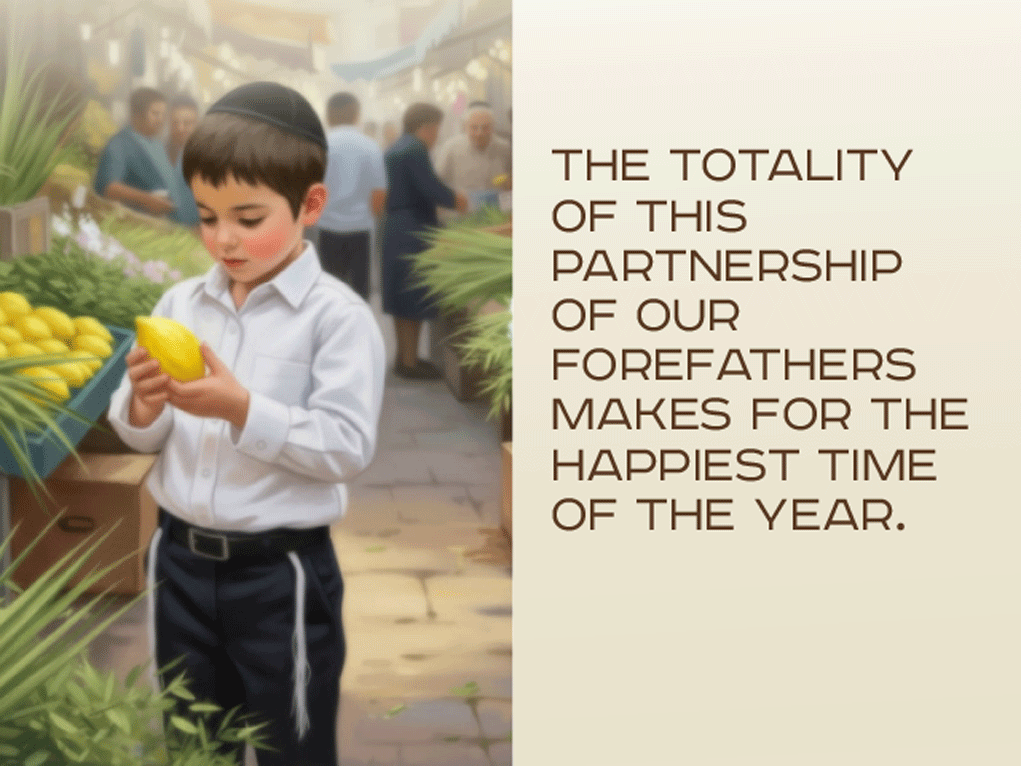
Sukkos does not come to us in a vacuum. It is the natural continuation of our teshuvah and all the efforts of our Elul and the Yomim Noraim. It took the contribution of each of the avos, in some cases going against their usual grain, as Rav Eliyohu Eliezer Dessler always points out, especially Yitzchok becoming the source of our sublime joy on Sukkos. Yaakov teaches us that we don’t need luxuries, only a simple hut, and Avrohom makes clear that even our mitzvos can be as simple and basic as pointing out a shady tree. The totality of this partnership of our forefathers makes for the happiest time of the year, but one where we have absolutely no need for the baubles of this world, only the ethereal pleasures of being in the presence of the Shechinah for a glorious week of elevation.