
 OSINT613
China and Turkey Defy the U.S. as Iranian Flights Keep Moving Despite Sanctions
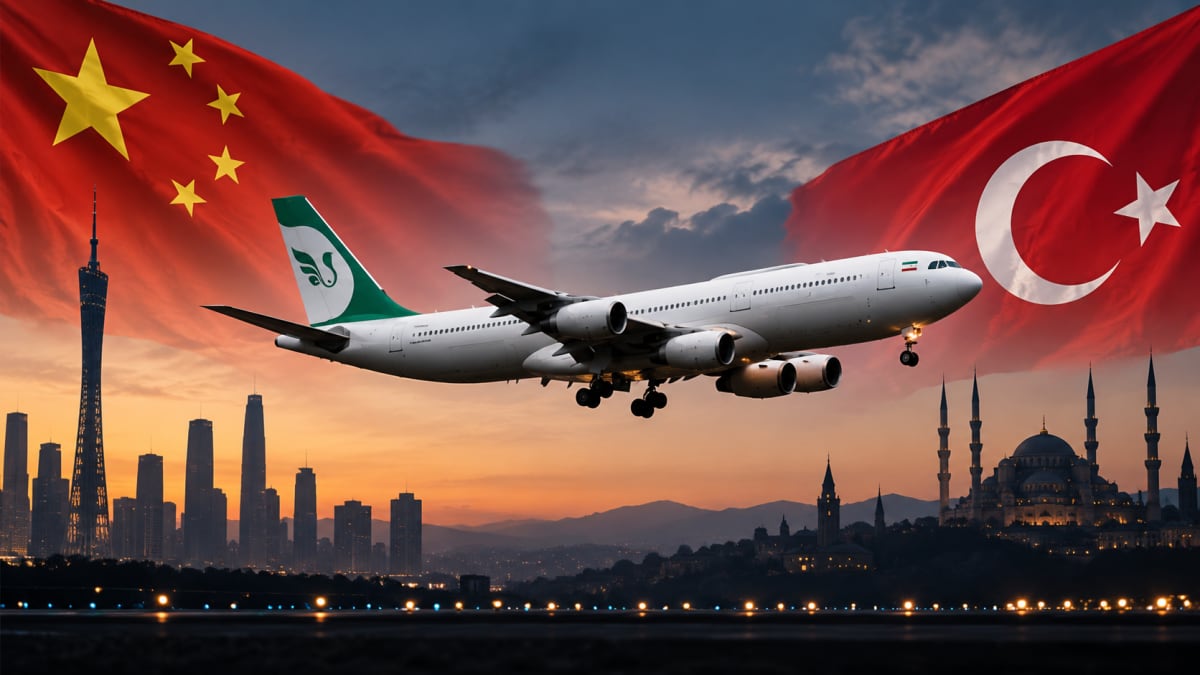
Treasury Secretary Scott Bessent said every Iranian airline would be shut down worldwide by Sept. 23. On Wednesday, a Mahan Air jet flew from Iran to China and landed in Guangzhou.
FlightRadar24 data showed the aircraft arriving at Guangzhou Baiyun International Airport at about 4:39 p.m. local time, after the U.S. deadline had taken effect. China had already rejected the sanctions and kept its airports open.

Elsewhere, the pressure worked. Iraq suspended Iranian flights into Baghdad, Oman stopped Mahan service to Muscat and Georgia restricted sanctioned Iranian carriers. Turkey barred Mahan and pulled its own airlines from Iran while continuing to accept Iran Air. The first day produced a sharp contraction in Iran’s international aviation network, but not the worldwide shutdown Bessent had promised.
The Chinese flight came hours before President Xi Jinping was due to meet President Donald Trump in Washington, following preparatory talks between Bessent and Chinese Vice Premier He Lifeng.
Bessent promised a worldwide shutdown
“On September 23, all the Iranian airlines will be shut down around the world,” Bessent told CNBC on Monday.
The U.S. cannot order foreign governments to close their airports to Iranian aircraft. Instead, Treasury is threatening the companies that keep those aircraft flying. Bessent said businesses providing fuel, landing services or ticket sales could be “knocked out of the dollar system.” Treasury laid the groundwork on Sept. 8, when the Office of Foreign Assets Control sanctioned 36 targets connected to Iran’s aviation sector, including 27 Iranian airlines that had not previously been designated. It also suspended three aviation authorizations and provided a wind down period that expired at 12:01 a.m. Eastern on Wednesday.

Treasury says the Islamic Revolutionary Guard Corps has used ostensibly private airlines to procure and transport weapons and move personnel. Mahan Air, which has been under U.S. sanctions since 2011, has long been central to those accusations.
Iran lost routes across its neighborhood
Several governments moved before Wednesday’s deadline.
Iraq suspended Iranian airline flights into Baghdad, Iraqi government sources told Reuters. The decision threatens one of Iran’s busiest regional travel corridors, particularly for Shia pilgrims traveling between the two countries. Iranian officials were discussing whether some passengers could instead use Najaf.
Omani aviation authorities had already stopped Mahan’s Tehran to Muscat service from Sept. 17. Georgia said it would apply the expanded U.S. sanctions against Iranian carriers. An aviation industry source in Iran told AFP that services to Azerbaijan, Georgia, Qatar, Muscat and Baghdad had been completely halted.
Turkey chose a narrower approach. Turkish authorities required Mahan to stop flying to Istanbul and Ankara, while Turkish Airlines, Pegasus and AJet halted their own Iran services. Iran Air, however, remained outside the Turkish restriction.
Flight tracking data showed Iran Air flight IR719 arriving in Istanbul on Wednesday, with the aircraft later operating the return service to Iran. Iran Air had said Tuesday that it had received no notification of a blanket ban on flights to neighboring countries.

China flew through the deadline
China made its position public before Mahan reached Guangzhou.
Foreign Ministry spokesman Guo Jiakun said Beijing opposed what he called illegal unilateral sanctions without authorization from the U.N. Security Council. Asked again Wednesday about Iranian flights, the ministry maintained its opposition to the U.S. measures.
Mahan then landed in Guangzhou.
China presents a much harder enforcement problem than smaller regional aviation markets. The U.S. campaign depends on foreign companies deciding that access to the American financial system is worth more than servicing Iranian aircraft. Beijing has publicly rejected the sanctions themselves, leaving the pressure to fall on the Chinese companies that provide the aircraft with fuel, handling and other services.
Iran’s aviation network was already shrinking before Wednesday. Cirium data showed international capacity to and from Iran down about 49% in August compared with 2025, with foreign carriers including Flydubai and Turkish Airlines pulling out.
Iranian airlines have few easy alternatives. Decades of U.S. restrictions have left the country operating an aging fleet with limited access to Western aircraft, components and maintenance. The latest measures attack the infrastructure surrounding those aircraft abroad. A functioning jet is of little use internationally if airports will not refuel or service it.
The next test is on the ground in China
Mahan’s Shanghai office said Wednesday it had received no cancellation notice and was continuing to sell tickets for the coming week, according to AFP. Tehran’s main airport was also showing a Shanghai departure scheduled for Wednesday.
Continued Chinese service would leave the Islamic regime with an eastern aviation corridor even as routes through several neighboring countries disappear. Turkey could provide another, narrower outlet as long as Ankara continues allowing Iran Air to operate.
Bessent has already defined the penalty for companies that service sanctioned Iranian airlines. What has not been established is whether the U.S. will apply that threat against companies operating inside China.
Mahan made it to Guangzhou on the first day of the deadline. Its next flight will show whether the companies refueling and handling the aircraft believe Bessent intends to follow through.