
 Yated Ne'eman
U.S. Bombers Evacuate British Air Base Over a Terrorist Attack Threat
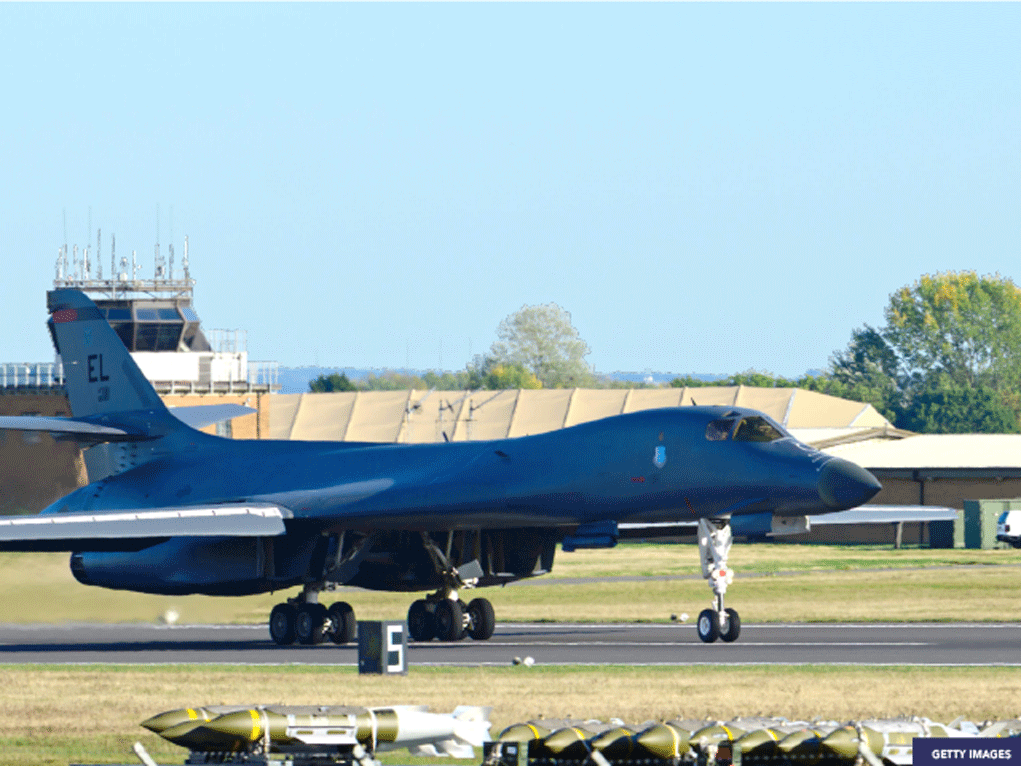
The United States removed some of its most powerful conventional bombers, which had been positioned to attack Iran from one of the most important NATO airbases in Europe. All twelve B-1B Lancer bombers stationed at RAF Fairford, in the county of Gloucestershire, about 80 miles west of London, were flown back to their home bases in the United States.
The Air Force has described RAF Fairford as its “preferred” European “bomber forward operating location.” It has been used extensively by U.S. military aircraft in previous conflicts going back to D-Day in 1944, including “Operation Iraqi Freedom” in 2003.
The planes were brought back to the U.S. following the arrest of suspected terrorists who were plotting to attack the base. The Pentagon’s European Command said the aircraft are still capable of striking Iran after taking off from their American home base.
President Trump confirmed that the planes were removed because of a specific threat to the British airbase. “Yeah, I think we can say that. They didn’t fly out by accident,” Trump said. “There were some threats, and rather than tempting the enemy… why should we leave them there? We moved them around a little bit.”
Vice President JD Vance said that the Pentagon moved the bombers “out of an abundance of caution trying to protect our guys.” The vice president then added that, “We do feel with some confidence that the Iranians are trying to do what the Iranian state has done for 49 years, which is engage in acts of terrorism against the United States and against a lot of other people as well.” He told reporters that, “We are being extremely cautious.”
British Prime Minister Burnham insisted the British base is safe, but refused to comment specifically on the military operations of “foreign nations” using the base.
British defense officials said that security has been enhanced at other RAF air bases in England being used by American F-35 and F-15E warplanes, with a special effort being made to improve their protection against drone attacks.
The series of events that triggered the withdrawal began when British police received a report of three suspicious white vans heading toward RAF Fairford. Police arrested five men in their 20s, all British citizens living in London. Police also evacuated 85 homes in the nearby village of Whellford as a precaution, and used a bomb disposal robot to search the three vehicles.
British police say they were first alerted to the possible attack by one of the five men arrested at the scene, who called Britain’s emergency phone line at 12:45 a.m., roughly an hour before a second call came in from a local citizen who saw the men heading toward the base and thought they looked suspicious.
The Suspected Terrorists Were Released For Lack Of Evidence
The five men were arrested under the British Explosives Act and on suspicion of preparing for a terrorist attack. However, no explosives were found in the vans, only containers filled with gasoline. Since no direct evidence of their guilt was found, the five were released the next day, but kept under close surveillance as British authorities looked into their backgrounds.
A sixth man, a 25-year-old dual British-Iranian citizen, was arrested in central London by British counterterrorism police a few days later, but he was also released on bail for lack of sufficient evidence to hold him.
British investigators are going through the suspects’ cellphones, dashboard cameras and other devices looking for clues and potential links to Iran, which in recent years has repeatedly mounted plots on British soil using criminal networks and other proxies.
British Prime Minister Andy Burnham said last week that, “There are strong indications that Iran played a part in what happened at RAF Fairford, but of course it remains an ongoing, complex, and serious police investigation.” He also said that British forces were “working closely” with their U.S. counterparts in trying to get to the bottom of the suspected terrorist incident.
President Trump said that the five men had been under “investigation” prior to their arrests on September 27, and that they apparently intended to cause “big damage” at the British air base. Asked whether Iran was involved in the suspected terror plot, Trump would only say that “it might be,” but offered no further details.
Trump also said the five suspects intended to do serious damage to American planes and personnel, and criticized the British government’s decision to free them on bail.
Secretary of State Marco Rubio also told Fox News last week that “what almost happened” in Britain was “a very serious situation … that clearly involves the hands of a foreign actor.”
In its initial reaction to the arrest of the five men, the Iranian embassy in London said it “categorically rejects and strongly condemns” any attempt to “link Iran to” the alleged plot to attack the RAF Fairford base. After Prime Minister Burnham suggested that Iran was responsible for the plot, Iran doubled down on its denial, with Foreign Minister Abbas Araghchi accusing the U.K. of “barking up the wrong tree.”
U.S. Warned Of A Drone Swarm Attack Against The British Air Base
However, security officials in Washington, London, Berlin and Israel said they believe the terrorist plot against the British air base was real and was originated by either the IRGC or Iran’s military headquarters in Tehran.
According to the Washington Post, one of the intelligence warnings included a threat that the American bombers at Fairford could be hit in a swarm drone attack similar to one that Ukraine launched against Russian airbases in June 2025.
In that attack, called “Operation Spiderweb,” Ukraine smuggled 117 small quadcopter armed drones into Russia. They were concealed in hidden compartments in wooden cabins being transported in cargo trucks to the vicinity of four remote military air bases located deep in Siberia and Russia’s Far North. When the drones were guided by their remote Ukrainian pilots to their targets and detonated, they destroyed 41 military aircraft comprising one-third of Russia’s long-range bomber fleet and caused an estimated $7 billion worth of damage.
Robert Tollast, a research fellow at the Royal United Services Institute, a London-based military think tank, said that other NATO bases across Europe face the same potential threat. He cited Germany’s Leipzig/Halle Airport, which serves as both a civilian field and a NATO base. Its security was breached by an explosive drone in August that German technicians managed to defuse before it could blow up. The German government blamed Russia for the attack and reacted by ordering the closure of a Russian consulate, while Russia denied that it was responsible for the drone intrusion.
Israel’s Mossad orchestrated similar attacks during its twelve-day war against Iran in June 2025. The Mossad concealed swarms of explosive-laden drones in ordinary-looking vehicles, which drove them into position to destroy Iranian missile launch sites, air defense batteries and other military targets.
Piecing Together The Picture Of A Terrorist Plot
British government officials say that their investigation of the suspected plot against RAF Fairford is ongoing, but the exact nature of the terrorist scheme and the intelligence picture of it remains murky. Reportedly, American and other Western agencies pieced it together from a variety of different intercepts and informants.
According to a Wall Street Journal report, U.S. officials had discovered an Iran-linked scheme to attack the American bombers at Fairford and kill their personnel. The report said that the British nationals had been recruited by a branch of Iran’s Islamic Revolutionary Guard Corps (IRGC) to carry out a multi-step plot that included the staging of a diversionary attack near the airbase.
Prime Minister Binyomin Netanyahu said that Israel’s intelligence services had warned Britain of a probable Iranian-sponsored terrorist attack, possibly followed by a long-range Iranian drone strike. Israel also warned Germany that the large American military bases in that country, at Ramstein and Spangdahlem, also face an elevated risk of attack from Iran.
On the other hand, some British officials have been more cautious in their comments about the plot against Fairford and have questioned just how sophisticated the planned terrorist attack on the air base was.
While Iran has previously launched attacks on British military bases in Cyprus and on the Indian Ocean island of Diego Garcia, a terrorist attack on a target in Britain’s homeland would be seen as a major Iranian escalation in the war. Such an attack would also be in line with a threat that was issued in July, in which the IRGC declared that “Any base used to launch attacks on Iranian territory is a legitimate target for our forces.”
The Strategic Advantages Of Britain’s Fairford Air Base
Fairford has long served as the primary base for American bombers in Europe. During the active U.S. air war against Iran earlier this year, about two dozen American B-1Bs and B-52 bombers were based there.
One of Fairford’s main advantages is its heavily reinforced, 10,000-foot-long runway, enabling the largest U.S. warplanes to take off from there with a full load of bombs. Fairford is also less than half the distance from targets in Iran compared to the home bases of those bombers in the continental United States. That proximity to Iran enables American bombers to fly many more missions from Fairford during the same amount of time, without the need for mid-air refueling. However, Fairford is also far enough away from Iran that it is beyond the maximum known range of Iran’s ballistic missiles.
After the April ceasefire with Iran took effect, all of the B-52s at Fairford were sent back to their home bases in the U.S., as well as some of the B-1Bs, but twelve of them remained in Fairford so that they would be immediately available to resume the bombing of Iran in case President Trump decided that such a move was necessary.
Britain’s Prime Minister Starmer Was A Reluctant U.S. Ally
In February, as the U.S. military was massing its forces near Iran, President Trump said that the U.S. might need to use the air bases in Diego Garcia and Fairford to head off a feared Iranian attack. But Britain’s Prime Minister Keir Starmer refused to allow either base to be used for a U.S. strike against Iran.
When the U.S. and Israel launched joint pre-emptive strikes on Iran on February 28, killing Supreme Leader Ayatollah Ali Khamenei and many other Iranian leaders, Starmer refused Trump’s invitation to join in. However, in an address to the English people a few hours after the joint U.S.-Israeli attack on Iran began, Starmer said, “Even in the United Kingdom, the Iranian regime poses a direct threat to dissidents and the Jewish community. Over the last year alone, they have backed more than 20 potentially lethal attacks on U.K. soil.”
Starmer relented a few days later, after Iranian drones and missiles hit targets in other Persian Gulf countries hosting U.S. forces, including civilian targets such as hotels and airports. An Iranian drone also hit the RAF base at Akrotiri in Cyprus, even though Britain refused to play any part in the U.S.-Israeli pre-emptive strikes.
In reaction to those attacks, Starmer announced that he would allow the U.S. to use the British bases in Diego Garcia and Fairford for “specific and limited defensive” operations to protect British citizens, forces and allies in the region. The British prime minister also ridiculed the suggestion that the U.S. and Israel could overthrow the Islamic regime using air power alone by declaring, “This government does not believe in regime change from the skies.”
After Iran fired two intermediate-range missiles at the British base in Diego Garcia, Starmer extended the permission for the U.S. warplanes to use British air bases to include missions intended to protect commercial shipping from Iranian attacks in the Strait of Hormuz.
Starmer’s About-Face On Iran Came Too Late For Trump
However, President Trump was not appeased by Starmer’s about-face. He publicly complained that Britain’s prime minister had waited far too long to allow the U.S. to use its bases. Trump said that the so-called “special relationship” between the U.S. and Great Britain, which dates back to the darkest days of World War II, is “not what it was” then. He suggested that Prime Minister Starmer was acting more like Neville Chamberlain, who tried to appease Adolf Hitler by surrendering Czechoslovakia in the notorious 1938 agreement at Munich, rather than Winston Churchill, who inspired the British nation with his determination to stand and fight the Nazis to the bitter end, even after the fall of France in June of 1940.
Trump also criticized Starmer for agreeing to hand British sovereignty over the island of Diego Garcia to the nearby African country of Mauritius, even though Britain received in return from Mauritius a 99-year lease permitting it to continue using the island’s military base.
Secretary of War Pete Hegseth singled out the British Royal Navy for criticism for its failure to assist the U.S. Navy in its efforts to keep the Strait of Hormuz open, even though other NATO allies, including Italy, Spain, Germany and France also refused to participate. However, Hegseth argued that Britain’s actions were particularly inexcusable because of the crucial role that the U.S. played in saving that country from defeat by the Nazis after the fall of France in 1940.
The U.S.-British “Special Relationship” Is Now In Jeopardy
Historians describe the level of cooperation between Churchill and President Franklin Delano Roosevelt, and U.S. military support for Great Britain as completely unprecedented, especially because the United States had declared its neutrality in the war before the Japanese attack on Pearl Harbor on December 7. 1941.
The “special relationship” between the U.S. and Great Britain, the phrase which Churchill coined during a wartime speech in 1944, continued into the postwar era. In Churchill’s famous speech, delivered in March 1946 in Fulton, Missouri, he observed that, “from Stettin in the Baltic to Trieste in the Adriatic, an Iron Curtain has descended across the continent [of Europe].” As a result, Churchill insisted that the “special relationship” between the U.S. and Great Britain, including the sharing of intelligence, strategic cooperation, and the joint use of military bases, had to continue in order to halt the worldwide spread of Soviet-style communism.
However, there were significant challenges during the years that followed to that “special relationship,” because the U.S. was growing stronger, while Great Britain had entered a long period of economic decline as it gradually disbanded its global colonial empire.
Earlier Crises In The U.S.-British Special Relationship
In 1956, the “special relationship” was sorely tested by the Suez Crisis, which was triggered when Egyptian President Gamal Abdul Nasser decided to nationalize the Suez Canal and, at the same time, to close the Straits of Tiran to Israeli shipping, effectively blockading the port of Eilat. Israel also feared that Nasser was preparing for an attack after Egypt received a massive shipment of modern Soviet-designed arms from Czechoslovakia. Britain allied itself with France and secretly with Israel to launch a joint attack on Egypt.
British and French forces succeeded in seizing control of Port Said at the northern end of the Suez Canal, and Israeli troops conquered the Egyptian troops guarding Gaza and the entire Sinai peninsula, including the Red Sea choke point known as Sharm el-Sheikh. President Dwight D. Eisenhower feared that the Soviet Union would use the joint attack as an excuse to intervene on Egypt’s side, and reacted by condemning the British, French, and Israeli military operations. Eisenhower also threatened to withhold crucial U.S. financial support from all three countries, and to undermine the value of the British pound, unless they agreed to a U.N. ceasefire resolution, the withdrawal of their troops occupying Egyptian territory, the reopening of the blocked Suez Canal, and its return to Egyptian control.
Eisenhower’s ultimatum stopped the British-French military effort to recapture the Suez Canal within a few days. Britain’s newly installed Labour Party prime minister, Harold Macmillan, then expressed Great Britain’s dilemma: finding a way to maintain its friendly “special relationship” with the United States, without becoming its puppet state. As Macmillan observed at that time, “Any partners are bound to have their differences now and then. … We don’t intend to part from the Americans, and we don’t intend to be satellites.”
The next crisis in the “special relationship” was triggered by the April 1982 invasion by Argentina of the British-ruled Falkland Islands, located 250 miles off the coast of Argentina in the southern Atlantic Ocean. At first, President Ronald Reagan tried to broker a negotiated settlement and refused to provide Britain with military support against Argentina, a NATO ally. However, after the Reagan administration’s diplomatic efforts failed, the U.S. imposed diplomatic sanctions on Argentina and provided Great Britain with intelligence and military support that eventually enabled the British military to retake the islands.
In 1994, President Bill Clinton decided to grant a visa to Gerry Adams, the leader of Northern Ireland’s pro-independence Sinn Féin political party, over the strong objections of British Prime Minister John Major. Adams was accused of being a member of the Irish Republican Army, which conducted a campaign of terrorist bombings in an effort to force Great Britain to give up its control over Northern Ireland and enable it to be reunited with the rest of Ireland. While Prime Minister Major responded to Adams’ visit to the U.S. by refusing to take phone calls from President Clinton for several weeks, the move ultimately drew the U.S. as a mediator into the peace talks between England and Sinn Féin. Those talks eventually resulted in a 1998 agreement which ended the decades-long conflict over Northern Ireland’s status as part of Great Britain.
Starmer Expresses Regret Over Cooperation With The U.S. In Iraq
In March, 2003, British Prime Minister Tony Blair made the unilateral decision to support President George W. Bush’s invasion of Iraq by contributing tens of thousands of British soldiers as well as intelligence support. However, the British involvement in the war in Iraq was deeply unpopular with most British voters and triggered one of the largest public protests in British history, bringing more than one million demonstrators into the streets of London.
In a speech to the British Parliament earlier this year by then-Prime Minister Starmer explaining why he rejected Trump’s invitation to join the attack on Iran, he cited Britain’s decision to join the U.S. effort to remove Saddam Hussein from power, based upon claims by Bush administration officials at the time that they had irrefutable evidence that Iraq was developing weapons of mass destruction.
“We all remember the mistakes of Iraq, and we have learned those lessons. Any U.K. actions must always have a lawful basis, and a viable, thought-through plan,” Starmer said.
Is The U.S.-British Special Relationship Still Real?
Some foreign policy experts have long disparaged the “special relationship” between the U.S. and Great Britain as a myth. It is no longer the partnership between equals that it was during World War II because Britain’s economic and military power has steadily diminished over the past 80 years.
Britain’s former national security adviser, Lord Peter Ricketts, says that the U.K. should “completely forget” the special-relationship idea. He told the BBC that because the suspected terrorists managed to convince the U.S. to remove its bombers from RAF Fairford without detonating anything, “It’s hard to conclude anything other than that this [incident] will be seen as a success by Iran.”
King Charles’ April Visit To The U.S. Was A Rescue Mission
This visit by Britain’s King Charles III to Washington, D.C., in April was widely described in the media coverage as a rescue mission for the “special relationship.” In his address to a joint session of Congress, King Charles noted that the centuries of interaction between the U.S. and the U.K. have been characterized by “reconciliation and renewal.” He acknowledged that the U.S. and the U.K. have not always seen eye to eye, and that both countries are now living through “times of great uncertainty.”
King Charles stressed that when the interests of the two nations are in alignment, they can do great things “not just for the benefit of our peoples, but of all peoples.” For example, he noted that the concept of checks and balances on government, which is a bedrock principle of the U.S. Constitution, is based on a British legal tradition that can be traced all the way back to the Magna Carta adopted in the year 1215.
He also declared that today in Great Britain, “America’s words carry weight and meaning, as they have since [it won its] independence,” and that “the actions of this great nation matter even more.”
The British monarch noted that despite their differences, “Our two countries have always found ways to come together.” He said that the NATO alliance is not a one-sided agreement, as President Trump has often complained, and recalled that the only time that the NATO alliance invoked Article 5 of its charter, declaring that an attack on any NATO member is an attack on all, was in response to the 9/11 terror attack by al Qaeda on the United States.
King Charles concluded that, “The commitment and expertise of the United States armed forces and its allies lie at the heart of NATO, pledged to each other’s defense, protecting our citizens and interests, [and] keeping North Americans and Europeans safe from our common adversaries.”
The perceived terrorist threat to the American B-1B bombers based at the Fairford Air Base highlights the fact that the U.S. war against Iran, the world’s leading state sponsor of international terrorism, has important national security ramifications for other countries around the world, including Great Britain, which is more than 3,000 miles from Iran.
A Brief History Of The B-1b Bomber
The B-1B Lancer entered service with the U.S. Air Force in 1986 as a strategic bomber capable of penetrating enemy airspace carrying both nuclear and conventional weapons.
The original B-1 was intended to serve as a supersonic replacement for the 1950s-era B-52 bomber. However, the B-1 program was canceled in 1977 by President Jimmy Carter because of the development of much cheaper cruise missiles which could be launched as standoff weapons by the B-52, as well as initial plans for the development of a radical new type of radar-evading stealth bomber.
However, because of long delays in the development of the B-2 stealth bomber, President Ronald Reagan announced in 1981 that he was ordering 100 modified B-1B bombers as an interim solution to keep the U.S. strategic nuclear bomber threat viable until the B-2 could be deployed. The redesigned B-1B was capable of carrying a much larger bomb load than the original B-1. The B-1B also incorporated new “stealth” radar-evading design elements, improving its ability to penetrate hostile airspace undetected.
As part of the START I (Strategic Arms Reduction Treaty) agreement with the Soviet Union, which was signed in 1991, the U.S. modified all of its B-1B bombers so that they would no longer be capable of using nuclear weapons.
However, the B-1B remains capable of carrying a payload of up to 75,000 pounds of conventional weapons, including a mix of JDAM precision-guided bombs, JASSM cruise missiles, as well as a large variety of other non-nuclear weapons.
The B-1B is capable of flying more than 7,400 miles without refueling, with a top speed around Mach 1.2. It can also approach well-defended targets undetected by flying at low altitudes at high subsonic speed. Because of its variable swept wings, a fully loaded B-1B can take off from much shorter runways than the B-52 needs, making it much easier to deploy than the B-52 at the air bases of U.S. allies around the world.
Since entering service forty years ago, the U.S. Air Force has used the B-1B very effectively as a conventional bomber against targets in Iraq, Afghanistan, Libya, Syria, Venezuela and, now, Iran. Of the 100 B-1B warplanes that were ordered by the Reagan administration more than 40 years ago, 45 of the planes remain in active service with the Air Force today.
U.S. And Britain Still Searching For Answers To The Terror Threat
Meanwhile, the U.S. and Britain are still trying to find more evidence to determine whether the suspects arrested at RAF Fairford were recruited and directed by Iran. They are also re-evaluating the seriousness of the terrorist threat to U.S. warplanes stationed at British air bases, and whether it is possible to strengthen the defenses of those bases sufficiently to protect them against Iranian-directed drone attacks.