

On Erev Sukkos, like the rest of us in the Northeast, I was busy halachically ensuring that my s’chach would remain kosher in advance of the storm. Amid klerring about zip ties, and jute, and finding old beams to place on top of the bamboo, I suddenly remembered something. I had spent hours picking out a beautiful esrog, and then more time picking out hadassim, a lulav and aravos. But with all of that, and with all my attention now on securing my sukkah, I realized that I had forgotten to buy a koishekel. I had tied down everything except the lulav. So, mere hours before Yom Tov, I ran out and found a local shuk, here in the Five Towns, that was in its last minutes before closing. They had a variety of koisheklach, from the simple Litvishe ones to the grandiose, rebbe-style ones. Despite the late hour, I could not bargain. (And unlike lulavim and esrogim, a koishekel lasts forever!)
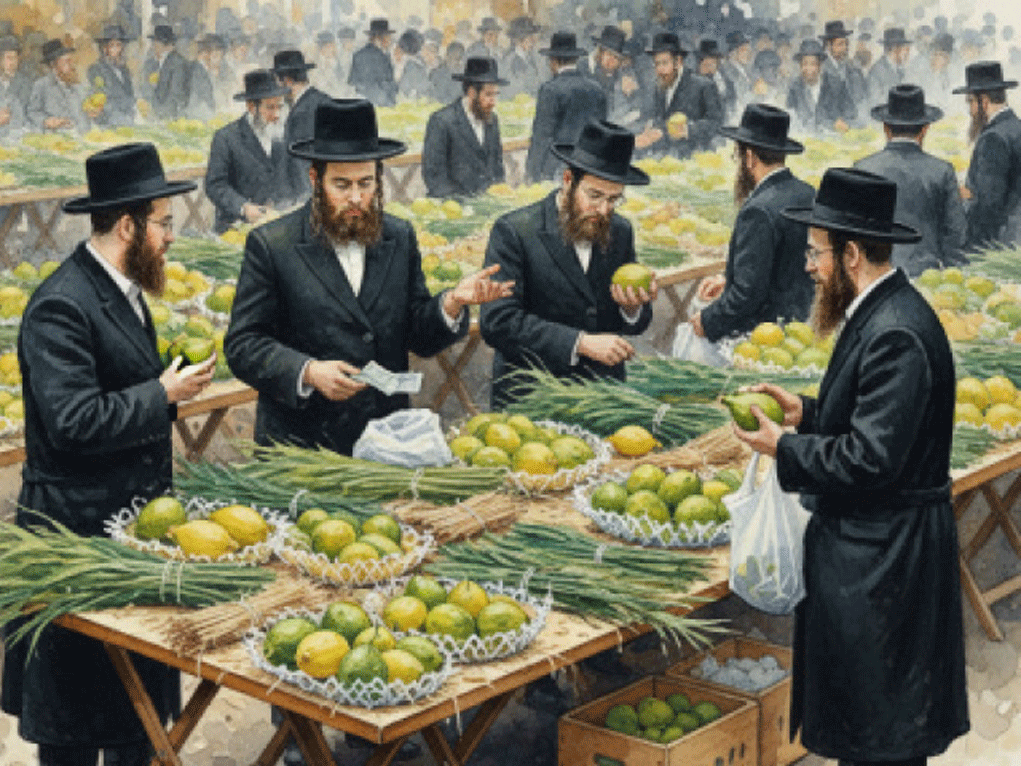
As I was paying, something caught my eye. It was something that we have all been looking at for the past few weeks, but this time it hit me differently. Very differently. I looked down and saw tables with esrogim. I felt really bad for them. The place was closing in 20 minutes and there they were. These esrogim had been planted, nurtured, watched, picked, carefully packaged and shipped. They were then vetted and selected by mochrim, put out on tables, shown by private appointment, and scrutinized by hundreds of Yidden, young and old, rich and poor. But now, hours before Yom Tov, their destiny looked all but sealed. They would not be used for the mitzvah de’Oraysa of “ulekachtem lochem.”
The fortunate ones would be carted off to become esrog jelly, and the rest would be carted off to the garbage. I found it terribly sad, and I am aware of how that sounds. Fruit does not think. But Chazal made certain to tell us about mountains that quarreled over who would host Matan Torah, or about how the moon came before the Ribono Shel Olam with a complaint, so I allowed myself, standing there with my koishekel (the rebbishe one, for those curious; I am an Ostrov-Kalushiner ainikel after all!), to wonder what the esrogim were thinking.
They all started out the same, some of them on the very same tree, and every bit of that care was for one posuk. Ulekachtem lochem. The mitzvah of an esrog is lekicha. They were born to be taken. Their entire purpose in this world is to be taken, and these were the ones that nobody took.
The seforim hakedoshim, building on the Arizal, describe the briah as a ladder of levels. Beginning with the domeim, there is the tzomeiach, chai and medaber, and each level waits to be lifted by the one above it. An animal that is shechted properly and eaten by a Yid who makes a brocha, and who then uses that strength to learn and to daven, is brought up to a place it could never have reached in the pasture, while the neveilah and the treifah are left where they were. If that is true of a steak, I would imagine that it is certainly true for an esrog, held together with the daled minim in the hand of a Yid, with a brocha and a Shehecheyanu and the naanuim of Hallel, for a mitzvah de’Oraysa.
The Gemara in Bava Metzia (85a) tells of a calf that was being led to shechitah. It went and hid its head in the folds of Rebbi’s garment and cried. Rebbi said to it, “Zil, lekach notzarta — Go, because for this you were created.” It was true, of course, and according to the mekubalim, it was more than true, because the calf was crying on the way to the greatest aliyah it would ever have. And still, they said in Shomayim that because he did not have rachmonus, yissurim should come upon him, and they did, for thirteen years.
The Gemara does not say that Rebbi was wrong. But being right was not what the moment asked of him. So, I am not going to stand in front of a table of unsold esrogim and explain to them why their fate had to end up this way. Rather, I want to point out two things that I noticed on the way home.
The first, perhaps, is that there is no hiddur with only one esrog. The posuk tells us “pri eitz hadar — a beautiful fruit.” We have all seen the man who spends forty minutes at the stand turning esrogim over one at a time. I sometimes have been that man, and I certainly have been the person waiting on line behind that man. But he never chooses one esrog without comparing it to the one he will not use. He can only choose because there is something to choose from. Suppose a single esrog was put on the table. Somehow, no matter how beautiful it is, you would feel like you walked out with a kosher esrog and nothing more. The one that goes home in the silver box is mehudar because its beauty was superior to the dozens that remained behind. Those were not taken to be used for the mitzvah, yet their presence, somehow, enhanced the beauty of the mitzvah.
The second point belongs to the Bnei Yissoschor. He writes (Maamorei Chodesh Shevat) that we have a kabbolah from his rabbeim to daven on Tu B’Shevat for a beautiful, kosher esrog, and he is medayeik that the Mishnah calls the day “Rosh Hashanah la’illan,” one tree, the tree from which a Yid will need a fruit when Sukkos comes. And what is on the table in many homes on Tu B’Shevat when that tefillah is said? Esrog jelly. The esrog that nobody wanted sometime during Tishrei is right there during Shevat, with a brocha said over it, while a Yid davens for the esrog that he will take next year. It did not become a mitzvah. It became part of a tefillah for next year’s esrog. The jelly and its brocha became the hope for the future. It certainly was not a piece of refuse.
But even after most of the leftover esrogim are taken to be used for esrog jelly, there are still a handful that remain behind. And for them, we need another nechomah. The same Gemara in Bava Metzia continues and teaches us that the yissurim that Rebbi received for his lack of sympathy for the calf left him the same way they came — through a maaseh. His maidservant was sweeping the house and was about to sweep out some young weasels, and he told her to leave them be, because the Torah teaches us about the Ribono Shel Olam, “verachamov al kol maasov.”
Kol maasov. All of them. Every one of us knows somebody who was grown with the same care and was every bit as ready, and who, for reasons that no one will ever explain to him, was not the one who got picked.
It is the girl whose résumé has been examined like an esrog in the shuk, or the bochur who has been told for years how special he is among everyone, yet both are still waiting for the phone to ring. It is the talmid, or the talmidah, who sits in the same seat every day and has yet to be noticed by a rebbi or a morah. It is the child to whom nothing comes easily, who puts in twice the hours of the boy next to him and has never once heard his name called out for it. It is the man who is out looking for a job, or even the man who has one and can work for 10 hours a day to support his family yet still cannot pay his bills at the end of the month. It is the choshuve yungerman who learned with hasmodah for years, who can say a shiur with such clarity, yet although he has put his name in for every shteller opening, he’s still waiting for one of them to call back.
They did everything that was asked of them and nobody asked for them.
They do not need a p’shat from us. They certainly do not need to hear, “Lekach notzarta.”
I do not know the cheshbon of the esrog that was left on the table, and I am not going to pretend that I do. But Chazal tell us (Shabbos 77b) that of everything Hakadosh Boruch Hu created in His world, He did not create even one thing levatolah, and Ben Azzai teaches (Avos 4:3), “She’ein lecha adam she’ein lo sha’ah, v’ein lecha dovor she’ein lo makom — There is no man who does not have his moment, and nothing that does not have its place.” If there is nothing without its makom, then that esrog had its makom too, even if its place was on a table in the Five Towns twenty minutes before closing. And if that is true of a mere physical entity, it is certainly true of an adam. The only difference is that the esrog’s place was on a table where I could see it, and a person’s makom is often somewhere that none of us are looking. The girl who is still waiting, the yungerman without a shteller and the father who works ten hours a day and still comes up short are not waiting for their tachlis to begin. The fellow who just can’t close the deal. They are in the middle of it. Nobody chose them yet, but Somebody put them there, and His rachamim is on kol maasov, the ones who have been recognized and selected already and the ones who still eagerly wait to be.
I walked out of that shuk feeling bad for the esrogim that had been left on the table. But as Ben Azzai taught us, nothing that is left on the table has been left behind. Somehow. Somewhere. Sometime.
Just Saying.