
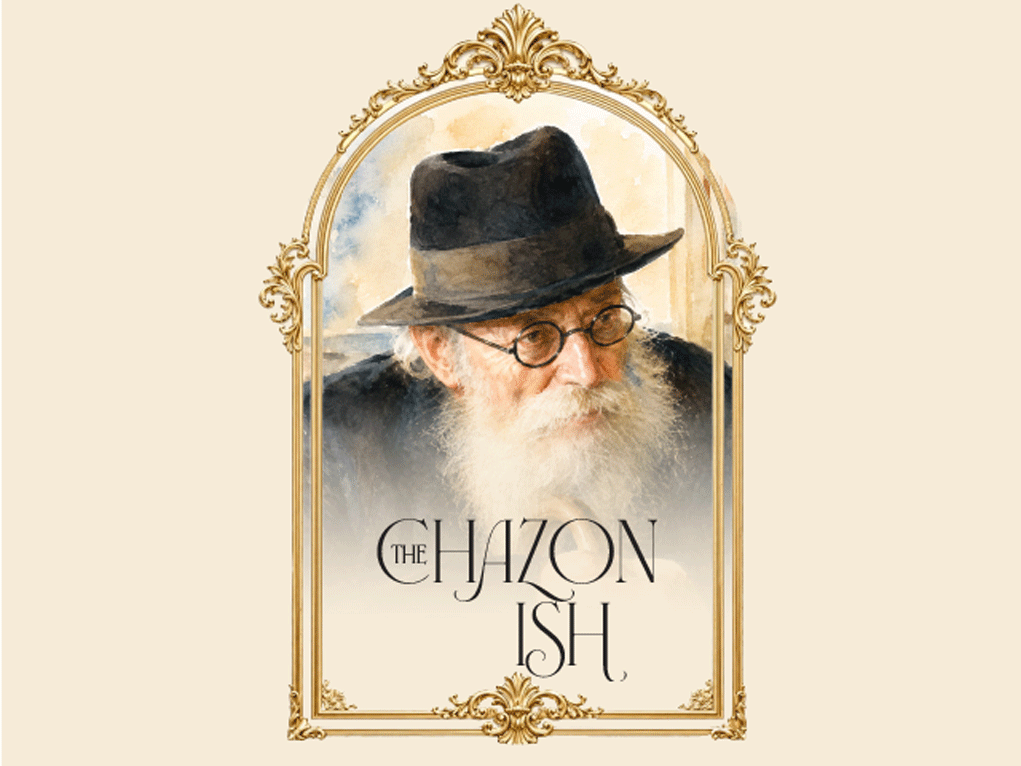

Discovering the Extraordinary Shiur Komah of the Chazon Ish Through His Chiddushim, Psakim, Hora’os and Hanhagos
As the 73rd yahrtzeit of the Chazon Ish approaches, the Yated is privileged to present an essay by Rav Michoel Sorotzkin, whose Torah writings have earned the appreciation of discerning bnei Torah.
Much has been written about the extraordinary gadlus of the Chazon Ish, but conventional accounts of his life can convey only part of his greatness. His chiddushei Torah, the subtlety of his sevaros and the depth of his halachic reasoning offer another way to understand the towering personality behind them.
Rav Sorotzkin brings his exceptional koach ha’iyun to this undertaking. Drawing on the Chazon Ish’s vast Torah legacy, he examines carefully selected sugyos and yesodos that reveal the qualities underlying his brilliance: ameilus baTorah, yiras Shomayim, an uncompromising pursuit of emes and an extraordinary sense of responsibility.
To identify, among thousands of intricate chiddushim, the principles that illuminate the character of a gadol requires both breadth of knowledge and depth of understanding. These qualities have long distinguished Rav Sorotzkin’s contributions to the Torah public.
We are deeply grateful to Rav Sorotzkin for sharing his scholarship with our readers once again. His essay invites serious bnei aliyah to appreciate the greatness of the gedolei hadoros through their Torah itself.
His Torah Bears Witness to His Greatness
As the fifteenth of Marcheshvan approaches, marking the 73rd yahrtzeit of Rav Avrohom Yeshayahu Karelitz, the Chazon Ish, we consider an aspect of his greatness that receives less attention in accounts of his life. His gadlus baTorah, extraordinary hasmodah, exalted kedusha and influence on the Torah world are well known. But what does his Torah reveal about the man who produced it? What can we learn from the way he developed a sevara, arrived at a hachra’ah and issued a hora’ah about the character of his intellect and the stature of his nefesh?
To approach these questions, we turn to the Chazon Ish’s writings. By examining the yesodos of selected chiddushim and psokim, we can see how his derech halimud and practical hora’ah expressed the qualities that shaped his life. A single sevara may reveal more about his approach than a lengthy biographical account; a halachic ruling may show the depth of his yiras hora’ah, his responsibility toward another Yid and his devotion to emes. Our purpose is to understand the man through his Torah.
This approach is especially fitting for the Chazon Ish, whose Torah and personality were so closely intertwined. The precision with which he established the geder hadin in his writings also governed decisions affecting the lives of others. His ability to distinguish between similar halachic concepts helped him discern the difference between genuine rachmonus and sentiment that was inconsistent with mishpat haTorah. His concern for almanos, yesomim and brokenhearted individuals grew from the same foundation as his gadlus baTorah. In his life, iyun and ma’aseh, din and chesed, were inseparable.
The comprehensive character of his gadlus recalls the extraordinary Torah greatness of the Vilna Gaon. The point is not to compare the stature of these two luminaries of Klal Yisroel, but to recognize a particular form of Torah attainment embracing all the chelkei haTorah while penetrating to the essential yesodos of every sugya. The Chazon Ish, in Kovetz Igros, cheilek alef, iggeres 32, describes the greatness of the Vilna Gaon in terms of yegiah, bekius, tevunah and chassidus. Gadlus baTorah, in this conception, is measured neither by the accumulation of knowledge alone nor by brilliance of reasoning considered independently, but by the completeness with which every faculty of a person becomes devoted to Torah. Whoever examines the writings of the Chazon Ish, extending across vast portions of Shas and Shulchan Aruch, encounters an extraordinary manifestation of such comprehensive greatness.
The Derech Halimud: Establishing the Emes of the Sugya
A fundamental principle of the Chazon Ish’s derech halimud was his insistence that the obligation of iyun is not discharged merely through familiarity with the accepted maskonah. A sugya must be examined from its sources until its essential gedorim and limitations have been established. In his Igros, he explains that even where the hachra’os of the Rishonim stand before the learner with an authority which he has no standing to dispute, he remains obligated to employ his own understanding in examining the sugya. The process of clarification itself constitutes an indispensable part of limud haTorah. This does not grant license to advance arbitrary chiddushim against the Rishonim. It demands that the learner exert his full abilities to understand their words and the manner in which their conclusions emerge from the Gemara.
Submission to the authority of the Rishonim might appear to leave little room for independent iyun. The Chazon Ish understood the relationship differently. Precisely because he revered the Rishonim, he was careful not to attribute to them explanations that could not withstand scrutiny of the sugya. The learner must distinguish between seeking to defend his own opinion and seeking the emes. An ingenious chiluk has value only if it accounts for the entire sugya. The worth of a chiddush lies in the clarity and necessity of its reasoning.
This helps explain the distinctive style of the Chazon Ish. He often begins without spelling out the kushya that prompted his discussion and proceeds directly to a concise chiluk. Its significance becomes apparent only after the learner has struggled with the relevant sugyos and considered other explanations. To understand his maskonah, one must return to the Gemara and Rishonim, examine the alternatives and discover why he found it necessary to define the din as he did.
Rav Yitzchok Hutner observed that the Chazon Ish’s derech halimud could not be imitated except through extraordinary yegiah and prolonged immersion in the depths of halacha. The Chazon Ish did not merely possess a collection of methods that could be reproduced by studying the form of his chiddushim. His derech was rooted in ameilus, which would not permit the learner to abandon a sugya while an essential detail remained unresolved. A learner may imitate a chiluk without acquiring the disciplined thought that produced it. Genuine attainment requires that uncompromising demand for clarity that governed the Chazon Ish throughout his learning.
The Yesod of Muktzah Machmas Chisaron Kis
A striking illustration appears in Chazon Ish, Hilchos Shabbos, siman 43, se’if koton 17, concerning muktzah machmas chisaron kis. The Gemara in Shabbos 123b teaches that certain implements, including a large saw and a particular agricultural instrument, may not be moved on Shabbos because their owners are makpid that they should not be employed for other purposes. The fundamental chakirah is whether the owner’s hakpodah is what confers upon the utensil the status of muktzah or whether it removes the basis upon which moving it might otherwise have been permissible.
The Chazon Ish examines the matter through the distinction between a kli shemelachto l’issur and a kli shemelachto l’heter. A kli shemelachto l’issur may not ordinarily be moved for the performance of its designated melocha on Shabbos. Its permissible movement is restricted to letzorech gufo or letzorech mekomo. Where the owner is makpid that it not be employed for any other purpose, the possibility of permissible use letzorech gufo has effectively been removed. A kli shemelachto l’heter, however, remains designated for a function permissible on Shabbos, and the owner’s unwillingness to employ it for other purposes does not necessarily render it muktzah machmas chisaron kis. The Chazon Ish further examines the separate consideration of kevius makom, whose effect must be determined according to its own particular geder.
The crucial question is the sibbas ha’issur. The owner’s hakpodah is not treated as an independent prohibition that applies equally to every valuable object. Its effect depends on the grounds that would otherwise permit the object to be moved. Once that relationship is understood, the distinctions follow from the definition of the din itself.
Ameilus BaTorah and the Measure of Genuine Attainment
The Chazon Ish’s extraordinary yegiah is illustrated by an account of his prolonged study of a single Mishnah in Maseches Mikvaos. According to one version, he returned to its difficulties over a period of three months. The importance of the account lies in what it reveals about his understanding of learning. One person may complete a masechta in a relatively short time and grasp its principal sugyos. Another may spend weeks on a single Mishnah because it contains yesodos that bear on an entire area of halacha. For the Chazon Ish, progress depended on how thoroughly a matter had been clarified rather than on the number of dapim covered.
The Chazon Ish’s yegiah went beyond hasmodah in its ordinary sense. Hasmodah denotes the ability to devote one’s time consistently to learning. His yegiah included an unwillingness to leave a difficulty merely because a plausible explanation had been found. Where another learner might accept an interpretation and proceed, he continued until the explanation established all relevant details satisfactorily. This illuminates his extraordinary mastery of the entire Torah. His vast bekius served his iyun. At times, a din in one masechta illuminates an apparently unrelated halacha. At other times, the distinction between seemingly similar dinim establishes the proper geder of each. The scope of his knowledge enabled him to examine every sugya in light of its relevant parallels without obscuring its particular halachic character.
Shiurei Torah: The Metzius and the Geder Hadin
His iyun also had far-reaching practical consequences in his examination of shiurei Torah. The subject appears to concern the numerical relationship among the amah, tefach, etzba, beitzah and the measurements of length and volume mentioned by Chazal. In truth, it involves fundamental questions regarding the transmission of halachic measurements and their proper determination where different methods of calculation appear inconsistent. The Noda B’Yehudah had already examined the difficulty concerning measurements derived from the etzba and beitzah. The Chazon Ish, in his Kuntres Hashiurim, investigated the matter through a comprehensive examination of the sugyos and the poskim.
The Chazon Ish’s adoption of larger shiurim should not be understood simply as a preference for chumra. He sought to determine which measurement the din actually required. A larger shiur may be a chumra in one context and a kula in another, so its consequences cannot determine the maskonah. The evidence must establish the shiur, after which the posek must determine how to apply it using available measurements. Even a question that appears to involve practical calculation demands a full examination of its halachic yesodos.
Electricity On Shabbos and the Geder of Boneh
One of the Chazon Ish’s most widely discussed chiddushim appears in Orach Chaim, siman 50, se’if koton tes, concerning the closing of an electrical circuit on Shabbos. The essential chakirah is whether completing such a circuit constitutes ordinary use of an existing apparatus or whether bringing the system into its operative state involves tikkun mana or boneh. Externally, no conventional structure is erected, since the wires and apparatus already exist. Nevertheless, until the circuit is completed, the system does not possess the capacity to perform its intended function. There is therefore room to consider whether establishing its operative condition falls within the halachic concept of tikkun or banyan.
The Chazon Ish developed the position that completing the electrical circuit involves tikkun mana and discussed its severity under the melocha of boneh, particularly where the system forms part of a structure attached to the ground. Rav Shlomo Zalman Auerbach addressed the foundations of this sevara, particularly the distinction between an enduring act of construction and the temporary activation of a system intended to be opened and closed during ordinary use. Their discussion concerns not merely the practical question of electricity on Shabbos, but the definition of the halachic act. Does the operative completion of an existing system constitute boneh or does it remain an act of ordinary use? This cannot be determined merely by describing the physical operation of electricity, but requires examination of the gedarim of the melachos. The Chazon Ish thus approached a phenomenon unknown in the time of Chazal by returning to the accepted principles of hilchos Shabbos and examining whether the new metzius fell within their scope.
Shvi’is and the Search for Permissible Cultivation
The Chazon Ish’s responsibility as a posek was particularly evident in hilchos Shvi’is and the mitzvos hateluyos ba’aretz. Following his arrival in Eretz Yisroel, many questions in Seder Zera’im that had long been studied primarily as matters of Torah learning became practical issues affecting the parnossah of farmers and the yishuv. The Chazon Ish examined the melachos of Shvi’is, kedushas Shvi’is, otzar bais din, and the halachos of agricultural cultivation, establishing guidance for those determined to observe Shvi’is in accordance with halacha. Although he rejected reliance upon the heter mechirah, he also sought legitimate ways for farmers to sustain themselves. His concern was to establish what the Torah prohibited and permitted, and to discover legitimate means by which those working the land could maintain their parnossah while fulfilling the mitzvah.
Particularly instructive was his interest in giddulei mayim during Shmittah. The question whether cultivation in water without ordinary soil constitutes the prohibited melocha of zeriah involves several considerations, including the status of an atzitz she’eino nakuv, the din of zeriah b’bayis and the definition of the medium in which the plants grow. Each depends upon its own halachic foundation. The Chazon Ish examined the circumstances under which a heter might be established, with particular attention to separation from the ground and the conditions governing the place of cultivation. In accordance with his guidance, experiments with giddulei mayim were undertaken at Kibbutz Chofetz Chaim, seeking a means of growing produce during Shvi’is without violating the issurim of working the land.
His work on Shvi’is illustrates the responsibility he felt toward those who depended on the land for their parnossah. He insisted on uncompromising observance while actively searching for permissible methods of cultivation. Neither economic hardship nor a desire for stringency could replace a careful determination of the din. Accurate knowledge of agricultural conditions was essential, since a mistaken understanding of the metzius could lead to an incorrect halachic conclusion.
Hilchos Treifos and the Changing Metzius
Another yesod appears in the Chazon Ish’s discussion of hilchos treifos and developments in medical knowledge. Chazal established particular categories of treifos, and the question arises how these relate to subsequent advances in treating conditions formerly regarded as fatal. Are the halachic definitions dependent at every moment upon the medical possibilities then available, or were certain classifications established as enduring gedarim? In Chazon Ish, Even Ha’ezer, Hilchos Ishus, siman 27, he addresses the distinction between established gedarim of treifos and other halachos whose application depends upon the actual medical condition of the person concerned.
The question is whether a change in medical metzius changes the geder hadin. Some halachic classifications were established for all generations and do not necessarily change with advances in treatment. Other halachos depend on a person’s present medical condition and prospects for recovery, making current medical knowledge directly relevant. The Chazon Ish examined the character of each din before determining which facts governed its application.
The Choleh and the Responsibility of Hora’ah
In this connection, a remarkable incident is related concerning a man who was afflicted with a grave pulmonary illness. Having examined his condition, the physicians advised him to travel abroad for an operation under the care of a renowned specialist, maintaining that his prospects for recovery in Eretz Yisroel were exceedingly remote. The patient presented his predicament before the Chazon Ish, who, according to the account, instructed him to remain in Eretz Yisroel and undergo the procedure there.
The explanation attributed to the Chazon Ish reflects the central place of halachic categories in his thinking. The patient’s lung condition was said to involve a defect about which the Mechaber and the Rama differ in hilchos treifos. According to the Rama, it renders an animal a treifah; according to the Bais Yosef, it does not.
The Chazon Ish is said to have observed that the Bais Yosef is the mara d’asra of Eretz Yisroel, where his rulings possess particular halachic authority. Consequently, in Eretz Yisroel, where the psak of the Mechaber governs, this condition is not deemed a treifah. In chutz la’aretz, however, where the ruling of the Rama is followed by Ashkenazic communities, the very same condition is regarded as a treifah. It would therefore be preferable, he advised, for the patient to remain in Eretz Yisroel, where the halachic determination was in his favor. The patient accepted his counsel, underwent the operation in Eretz Yisroel, and, bechasdei Shomayim, recovered.
As transmitted, the account shows how naturally the Chazon Ish approached even a medical predicament through the categories of Torah. His study of halacha shaped the way he considered the circumstances of daily life, far beyond the walls of the bais medrash.
It is important to emphasize that the halachic definition of a treifah in an animal does not necessarily correspond to the medical prognosis of a human being suffering from a comparable condition. The account also does not establish that halachic reasoning displaces the findings of competent physicians in matters of pikuach nefesh. On the contrary, the considered judgment of medical experts occupies an indispensable place in the halachic determination of circumstances involving danger to life. Nevertheless, the incident conveys something of the singular depth of the Chazon Ish’s emunas chachomim and his unwavering conviction that the ultimate framework of judgment must remain firmly rooted in the wisdom of Torah.
His mastery of halacha did not relieve him of the obligation to establish the facts accurately. Each situation required careful investigation, an assessment of the reliability of the information available and a practical conclusion grounded in the relevant halachic principles.
This combination of clarity and responsibility characterized the Chazon Ish as a posek. Questions affecting human life demanded especially careful judgment and the yiras hora’ah appropriate to decisions of such consequence.
Mussar and Halacha Are Not Separate Domains
A particularly revealing source for understanding the Chazon Ish’s personality is Emunah Ubitachon, particularly the third perek, in which he examines the relationship between mussar and halacha. A person may possess a naturally compassionate disposition and considerable generosity without his conduct necessarily conforming to the emes of Torah. At times, rachmonus may be directed toward someone not entitled to it under the circumstances, while a person may regard himself as the victim of injustice when he is actually infringing upon another’s rights. Middos cannot attain their proper form unless they are governed by mishpat haTorah. It is halacha, rather than natural sentiment alone, that determines the conduct required.
To explain this principle, the Chazon Ish cites the Gemara in Bava Basra 21b concerning melamdei tinokos seeking to establish themselves in a town where other melamdim are already teaching. The established melamdim cannot prevent the newcomers through the claim of pasakta lechiyusi, because of the takanah concerning Torah learning. The Chazon Ish describes the earlier melamdim, whose parnossah may suffer through the arrival of competitors. They may sincerely consider themselves injured parties and regard the newcomers as wrongfully depriving them of their livelihood. Yet, according to halacha, they have no right to prevent the newcomers from teaching.
The choice of this sugya is revealing. Both sides may sincerely believe that they are in the right, yet the established melamdim have no halachic claim to prevent the newcomers from teaching. Their sense of injury cannot determine the proper course of action. The Chazon Ish showed that halacha gives mussar its direction, even when natural sympathy points elsewhere. His precision in din sharpened his understanding of what one person owes another.
“It Is Even More Difficult to Forbid”
An account concerning a difficult question of agunah illustrates this responsibility. A serious case was brought before the Chazon Ish, and after examining the sugyos and relevant poskim, he reached the maskonah that the woman could be permitted to remarry. A relative who had participated in the discussion remained troubled and presented further arguments concerning the severity of the issur of aishes ish. The Chazon Ish is reported to have replied that while it was difficult to permit, it was even more difficult to forbid.
The suffering of an agunah cannot justify a heter that lacks sound halachic foundations. Once a heter has been established, however, a posek cannot turn what is permitted into an issur merely because he fears the responsibility of ruling leniently. Refusing to permit is itself a halachic decision, with consequences for the person affected. A chumra is not automatically an expression of yiras hora’ah, just as a kula is not necessarily a sign of insufficient caution. The question is what the sugya requires. The Chazon Ish accepted the responsibility to determine the din without allowing either fear or sympathy to distort it.
The Chazon Ish’s Extraordinary Consolation to Rav Yaakov Galinsky
The Chazon Ish’s concern for people in distress emerges powerfully from an account related by Rav Yaakov Galinsky. After surviving Siberia and reaching Eretz Yisroel, Rav Yaakov found himself among the remnants of a devastated generation. Many survivors had lost their families, possessions and almost everything connected to their former lives. His own suffering had left him close to despair. When he came to the Chazon Ish and described his anguish, the Chazon Ish responded with a ma’aseh involving a psak of Rav Yitzchok Elchonon Spector.
There was once a Yid who earned his parnossah by traveling to commercial fairs, purchasing merchandise and selling it at a profit. Eventually, he fell ill and was unable to undertake the journey. He entrusted his money to his wife and sent her to purchase merchandise on his behalf. Upon arriving at the fair, she fainted, and when she recovered, she discovered that the money had disappeared. She raised an alarm, and someone reported seeing a particular individual pick up the money from the ground. Confronted, the man admitted taking it but maintained that he was under no obligation to return it. Since the money had been lost in a town whose inhabitants were predominantly non-Jews, he argued, the owner would naturally have despaired of recovering it. Consequently, the finder had acquired the money through yi’ush.
The matter came before Rav Yitzchok Elchonon. The woman provided clear simanim, identifying the two separate bundles and the particular amount contained in each. Rav Yitzchok Elchonon instructed the finder to return the money. When the man protested that according to the din of yi’ush it belonged to him, Rav Yitzchok Elchonon directed him to comply with the psak and explained its foundation. Even accepting that money lost in a town inhabited predominantly by non-Jews is subject to immediate yi’ush, that principle could not establish the finder’s ownership here. The money did not belong to the woman, but to her husband, who entrusted it to her for his business. The husband had no knowledge of the loss, and no yi’ush had occurred on his part. The woman might have despaired of recovering it, but her yi’ush could not divest her husband of ownership, since she possessed no authority to effect yi’ush concerning property belonging to another.
The decisive question was not merely whether the circumstances ordinarily produced yi’ush, but whether the person experiencing yi’ush was the baal hamamon whose ownership could be affected. Having completed the account, the Chazon Ish turned to Rav Yaakov Galinsky and asked: “Who gave you permission to despair?” Your life, strength, gashmiyus and ruchniyus are not possessions over which you enjoy absolute ownership. They are entrusted to you by the Ribbono Shel Olam. Just as a person cannot effect yi’ush concerning money that does not belong to him, neither may he surrender to despair over the life and abilities Hashem has placed in his keeping. As Chazal teach in Brachos 10a, “Afilu cherev chadah munachas al tzavaro shel adam al yimna atzmo min harachamim.”
The Chazon Ish offered Rav Yaakov no promise that his circumstances would improve. Instead, he challenged the very premise that a person may surrender to despair. The halachic rule governing yi’ush of an aveidah and its application to avodas Hashem are distinct: In hilchos aveidah, yi’ush has a defined legal effect on ownership. Here, the Chazon Ish drew on that distinction as a moshol. Just as a person cannot relinquish property belonging to someone else, he cannot treat the life and abilities entrusted to him by Hashem as his to abandon.
This was a distinctive expression of the Chazon Ish’s chesed toward the impoverished, the bereaved and those who felt unable to continue. Alongside his sympathy, he sought to restore their awareness of life’s purpose and their ability to meet its obligations. He brought comfort through the Torah in which he was immersed.
Middas Habitachon and Its Proper Geder
The Chazon Ish applies similar precision in the second perek of Emunah Ubitachon, where he establishes the proper definition of middas habitachon. It is sometimes assumed that bitachon requires a person to be certain that whatever occurs will conclude as he desires, and that apprehension concerning an unfavorable outcome indicates deficient bitachon. The Chazon Ish explains that this is not its proper geder. Unless a person has received specific knowledge concerning the future, he cannot be obligated to regard a particular outcome as certain. Rather, the foundation of bitachon is the recognition that there is no mikreh in the world and that everything occurs under the Hashgocha of Hakadosh Boruch Hu.
This establishes a fundamental chiluk between bitachon and the expectation of a favorable result. The latter concerns the outcome a person desires, whereas bitachon concerns his relationship to the Hashgocha through which that outcome is determined. A person may possess genuine bitachon while remaining uncertain of what awaits him, for his bitachon rests not upon knowledge of the future but upon awareness of the One Who governs it. This is iyun in Chovos Halevavos in the fullest sense. The Chazon Ish distinguishes two closely related concepts according to their essential gedarim and determines what each requires. The same intellectual discipline governing his discussions in hilchos Shabbos and taharos is employed in defining the obligations of emunah and bitachon.
The same understanding of bitachon gives added meaning to his words to Rav Yaakov Galinsky. No one is promised the outcome he desires and the future may remain uncertain. But a person who recognizes Hashem’s Hashgocha must continue the avodah entrusted to him. His life and abilities remain a pikadon to be used in Hashem’s service.
The Brisker Rov and the Chazon Ish: A World That Was and a World That Is No More
The Brisker Rov’s esteem for the Chazon Ish provides another measure of his stature. The Griz, whose own sevaros and hachra’os were subjected to exacting scrutiny, recognized the Chazon Ish as an exceptional authority in hora’ah. His presence, in the Brisker Rov’s view, was a source of strength for Klal Yisroel, and his daas Torah carried unusual weight.
It is related that a particularly grave shailah, involving matters of dinei nefashos, was once brought before the Brisker Rov. Having heard the particulars, he instructed the questioner to travel to Bnei Brak and present the matter to the Chazon Ish. After the Chazon Ish had carefully examined the circumstances and rendered his hachra’ah, the questioner returned to Yerushalayim and conveyed his ruling to the Brisker Rov. The Griz replied that he himself had been of precisely the same opinion, but he had nevertheless refrained from issuing a practical psak until the matter had been brought before the Chazon Ish. The episode shows the esteem in which the Griz held the Chazon Ish. It was not any deficiency in his own birur hahalacha that occasioned his restraint, but rather his recognition of the exceptional authority of the Chazon Ish in matters touching upon the lives of Yidden.
Yet, an even more extraordinary expression of this recognition is attributed to the Brisker Rov upon the histalkus of the Chazon Ish. He is reported to have declared: “We are now living in an entirely different world. Until now, ours was a world in which the Chazon Ish was present. From now onward, it is a world without the Chazon Ish.”
The Brisker Rov’s words conveyed more than grief over the loss of a great gaon. He believed that the Chazon Ish’s presence had given the dor a particular measure of assurance and guidance. With his histalkus, that source of strength was gone.
Rav Chatzkel Levenstein mrelated that after the petirah of the Chazon Ish, the Brisker Rov changed his customary hanhogah and began answering the public’s shailos more extensively. His conduct reflected the responsibility he felt in the absence of the Chazon Ish.
For the Brisker Rov, the loss of the Chazon Ish meant that the Torah world had lost an irreplaceable source of guidance in Torah and hora’ah.
The Status of Bnei Yeshiva and the Meaning of Toraso Umnaso
The Chazon Ish’s approach to bnei yeshiva remains particularly relevant as the question of their status continues to occupy Klal Yisroel in Eretz Yisroel. Central to that discussion is the meaning of Toraso umnaso and its role in preserving Torah for future generations. In Shabbos 11a, Chazal describe the exceptional status of Rav Shimon bar Yochai and his companions, whose Torasan umnoson was such that they did not interrupt their learning even for tefillah. The Shulchan Aruch (Orach Chaim, siman 106, se’if 2) distinguishes between those who attain that madreigah and other lomdei Torah. Enrollment in a yeshiva does not automatically confer the identical halachic status in every respect. Nevertheless, the concept expresses an essential ideal: for one whose Toraso is umnaso, learning is the defining avodah of his life.
The Chazon Ish, who devoted his own existence to ameilus baTorah, appreciated the necessity of enabling bnei Torah to immerse themselves in learning without outside occupations interrupting their formative years. This was not merely a matter of securing favorable circumstances for the individual learner. It concerned the perpetuation of Torah and the possibility of producing talmidei chachomim capable of transmitting its mesorah to succeeding generations. His approach must therefore be understood as an expression of his conception of the Torah world rather than as an isolated communal arrangement. Already during 5708 and 5709, the question of military service for yeshiva students was raised with roshei yeshiva and communal representatives. The arrangements then discussed were particularly concerned with those genuinely devoted to limud haTorah as their principal occupation, while distinguishing them from those who did not fulfill the conditions of Toraso umnaso.
Two halachic considerations require separate examination. The first concerns the standing of limud haTorah and preservation of bnei yeshiva devoted to its acquisition. The second concerns obligations arising from the needs of the tzibbur, including pikuach nefashos, each to be determined according to its own gedarim. Hatzolas nefashos is among the gravest obligations of the Torah, and Toraso umanuso cannot serve as an indiscriminate exemption from an obligation of rescue where the din requires participation. Conversely, the cultivation of bnei Torah cannot be treated as a private undertaking measured solely by its immediate practical consequences. The existence of a Torah world capable of producing gedolei Torah is itself a fundamental concern of Klal Yisroel.
The issue extends beyond the hours a person spends learning. Exceptional gadlus baTorah generally requires years of sustained ameilus and uninterrupted iyun. Although few bnei yeshiva will reach the stature of the Chazon Ish, the yeshiva provides the conditions in which a young learner can grow into a talmid chochom, a moreh hora’ah or a bearer of the mesorah. The value of his dedication must therefore be considered in light of both his present learning and the Torah he may yet acquire and transmit.
A Gadol Hador Without the Authority of Office
Although the Chazon Ish never held a formal rabbinic position and was not a rosh yeshiva in the conventional sense, he became one of the principal authorities in hora’ah and communal leadership for Klal Yisroel. His standing arose from the recognition that his hora’os were founded upon extraordinary iyun and judgment devoted exclusively to emes. One account concerns the dispute between the Novardok yeshivos and the Vaad Hayeshivos in Vilna over their allocations from the Vaad’s funds. The question was whether the numerous Novardok branches should be regarded as independent yeshivos for allocation or as one network receiving a collective share. According to the account, Rav Chaim Ozer Grodzensky entrusted the determination to the Chazon Ish, who heard the arguments and established the share to which the Novardok yeshivos were entitled.
The account also reflects the Chazon Ish’s middas ha’emes. His authority rested on the confidence that he could judge without being swayed by relationships, prestige or position. In his Igros, he observes that chachomim may take greater pleasure in a penetrating kushya than in ready agreement, since the purpose of iyun is to reach the emes of Torah. That commitment gave particular force to his decisions on matters affecting the tzibbur.
Sensitivity Through Dikduk Hadin
An account describes the Chazon Ish’s conduct when an elderly and weakened individual was present for tekias shofar and did not wish to eat before the tekios. The Chazon Ish instructed that the pesukim customarily recited beforehand be shortened so that the elderly man would not have to wait. Despite his extraordinary attention to every detail of halacha, he distinguished between the essential chiyuv and an additional practice. He saw no justification for imposing discomfort upon a weakened person where the practice could be shortened without compromising the mitzvah. Dikduk hadin and consideration for another were not competing demands. Proper dikduk itself required the distinction,
There is likewise the account of an epidemic in Stoibetz, when members of the chevrah kadisha feared attending to the burial of those who had died because of infection. The Chazon Ish became actively involved in ensuring that the niftarim would receive proper kevurah. The circumstances also involved concern for danger to the community if the deceased were not dealt with appropriately. The incident illustrates the seriousness with which he approached obligations affecting the living and the dignity of the departed, while the requirements of pikuach nefashos retained their independent force. The dinim of tumah v’taharah and kavod hameis that he examined in the bais medrash were also practical obligations demanding action when circumstances required.
The Character of Gedolei Torah
In Kovetz Igros, cheilek 2, iggeres 133, the Chazon Ish writes of the importance of knowing the gedolei Torah in their true character and appreciating the hearts and middos of the chachmei hador. Understanding a gadol therefore requires attention to the qualities that shaped his Torah. Along with his chiddushim, he leaves succeeding generations a derech hamachshovah, a relationship to emes and a model of the middos that accompanied his attainment.
The subjects examined here—from muktzah, electricity and shiurei Torah to Shvi’is, mussar, emunah and the obligations owed to another Yid—reflect a consistent approach. The Chazon Ish sought the precise geder hadin and followed the evidence of the sugya wherever it led. That devotion to emes shaped his conduct as surely as it shaped his learning.
His greatness extended beyond the brilliance of individual chiddushim and psakim. Through a lifetime of ameilus baTorah, Torah became the foundation of his thought, judgment and conduct. Seventy-three years after his petirah, his writings continue to engage lomdim, his hora’os remain central to difficult sugyos, and his yesodos are examined in botei medrash throughout the Torah world.
He left succeeding generations more than a treasury of Torah. His life showed what a person can become when his entire being is devoted to its acquisition.
The words of the posuk are especially fitting: “V’es yirei Hashem yechabed.” And likewise, the words of Chazal: “Ein kavod ela Torah.” His standing did not come from public office. It was the Torah he acquired through lifelong ameilus that established his place among the gedolei hadoros, and its light continues to illuminate the botei medrash of Klal Yisroel ad hayom hazeh.