
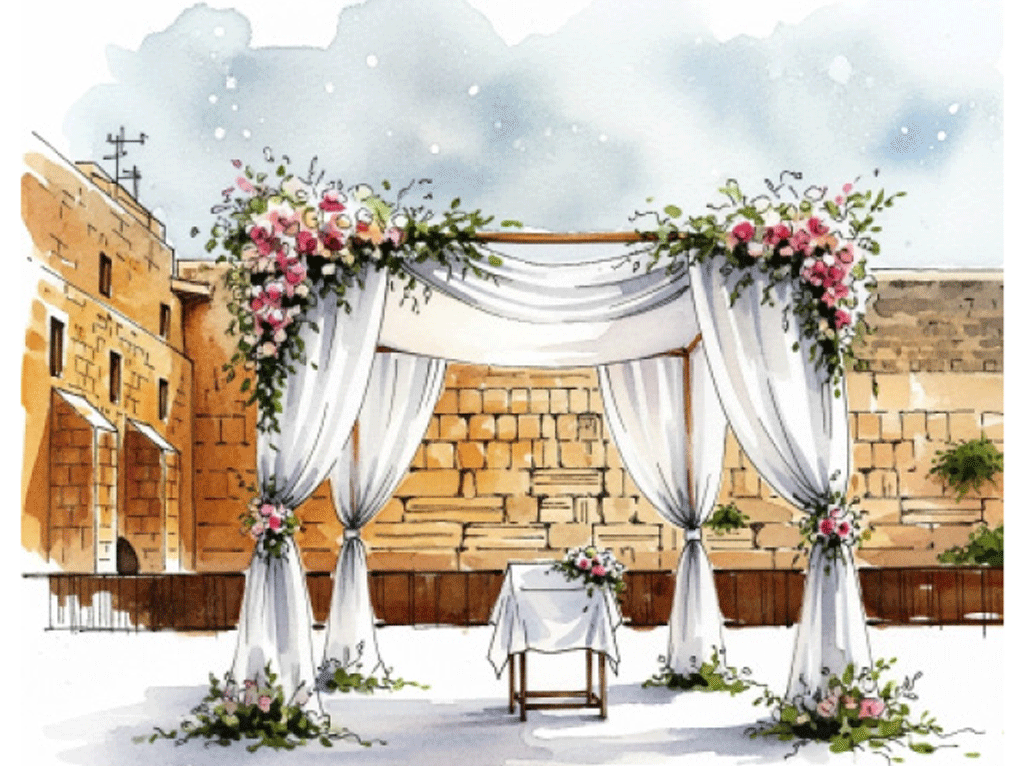

I hope our dear readers will forgive me a personal moment in these pages. My rebbetzin and I have, boruch Hashem, just come from the chasunah of our granddaughter, Faigy, daughter of our children, Rav Shmuel and Esther Feitman, who married Yisroel Aryeh Levi, son of Rav Yehoshua and Chaya Bracha Levi in Lakewood. Faigy is named after my mother a”h, a survivor of Churban Europa, who was not zoche to see grandchildren during her lifetime, as was my father z”l, who suffered in the same way. My gratitude to Hashem is all the greater because of this great brocha to which my rebbetzin and I were zoche.
I mentioned this fact to someone who has already married off numerous grandchildren and was somewhat unimpressed with our milestone. This leads me to share a few thoughts and feelings upon the incredible gift of our noshim tzidkaniyos, our righteous wives, daughters and granddaughters in Klal Yisroel. I hope and am mispallel that this may inspire some people who take these gifts somewhat complacently when they are actually so amazing and miraculous.
I will begin with this week’s sedra, Parshas Lecha Lecha, which seems to be the source for this divine blessing. At the very beginning of the parsha, the Torah relates that Avrohom Avinu asked his wife, Sarah Imeinu, for a favor: “It occurred, as [Avrom] was about to enter Egypt, he said to his wife Sarai, ‘See now that you are a woman of beautiful appearance… When the Egyptians will see you, they will say, ‘This is his wife;’ then they will kill me, but you they will let live. Please say that ‘you are my sister, that it may go well with me for your sake,’ and that I may live because of you” (Bereishis 12:11-13). Rashi explains that Avrohom was seeking gifts from the Egyptians. Rav Yonasan David, rosh yeshiva of Yeshivas Pachad Yitzchok in Yerushalayim, asks a powerful question (Sefer Me’iras Einyaim, page 24). First, Avrohom asked for gifts and only later asked that they not murder him. It would certainly seem that, first of all, he should ask that his life be spared and only then request presents.
Rav Yonasan derives from this sequencing some basic conclusions about Avrohom Avinu and the crucial role of women in our lives. He explains that, in truth, Avrohom, then still known as Avrom, did not worry about losing his life at all. He already had a promise at the beginning of the sedra from Hashem that “I will make of you a great nation” and much more. His emunah and bitachon were complete, and so he did not fear death. However, what he did want was that his salvation and hatzolah should come through Sorai, his wife. He did not simply request that “things go well,” but that it should happen “for your sake.” For this reason, he first mentioned the gifts and then life itself, because he already had a divine assurance of life and was actually requesting the seemingly lesser matanos. He added the part about life itself because he wanted his very existence to come from his wife as well.
Rav Yonasan goes on to explain the far-reaching intentions and hopes of Avrohom Avinu for his future progeny and nation. He wanted all of this to come about through the partnership of avos and imahos, particular himself and Sarah. This is what the posuk means when it says, “Look to Avrohom your forefather and to Sarah who bore you, for I have called them One” (Yeshayahu 51:2) Although the general translation of this posuk is “when he was yet one alone,” the posuk also declares that Avrohom and Sarah are one. The Maharal (Chiddushei Aggados to Bava Basra 58a) has already established this, saying that “in the building of the edifice of Knesses Yisroel, Avrohom and Sarah are one.” He even goes on to say that “Avrohom and Sarah are more unified that any other couple in the history of the world.”
Rav Yonasan finds the matrix of this eternal relationship between the avos and imahos even earlier in the Torah: “On the day that Hashem made man…He created them male and female. He blessed them and called their name Man on the day that they were created” (Bereishis 5:2). This statement is the source of the Gemara (Yevamos 63a) that “one who has no wife is not a man.” The Rama (Orach Chaim 6) teaches that when we recite in Asher Yotzar that Hashem does wonders (umafli laasos), it refers to the unification of two near-opposites, body and soul. This differentiates man from all the other creatures in the world. That bond was meant to last forever, but through Adam’s sin, body and soul are destined to part upon death. Man represents the primarily spiritual element and woman the primarily physical element, but together they form a unit wherein the soul elevates the body in both (see Maharal, Tiferes Yisroel 3, and Nesivos Olam, Nesiv HaTorah 15).
As Rav Yonasan concludes, when Avrohom Avinu was beginning his avodah as the father of Klal Yisroel, he wanted to include Sarah Imeinu from the very nascence. The joining of the zochor and the nekeivah mirrors the unifying of body and soul. The Ramban (beginning of Hilchos Ishus) makes clear that after Mattan Torah, marriage took on a new reality. From that moment, marriage in Klal Yisroel brought about kedusha, holiness, because it allowed and mandated the sanctification of both body and soul, spirituality with corporality. This, in turn, begins to restore to mankind the lost grandeur of Adam Harishon, as represented by Avrohom and Sarah and later the other avos and imahos. For this reason, they are all interred in the Me’oras Hamachpeilah, meaning Cave of the Pairs, where both their bodies and souls are present forever in the state of perfection and unity for which they were destined (see Maharal to Bava Basra 58a).
With this approach of Rav Yonasan David, we can now begin to understand the depth of Chazal’s statement (Bava Metziah 59a) that “a person should always be careful about the honor of his wife, because the blessing of the home comes about only because of her.” The Gemara derives this promise from the posuk quoted at the beginning of this essay. Avrohom wanted his blessings to come from Sarah. We now understand that to mean that through marriage, both husband and wife fulfill their eternal task of restoring the lost glory of both Adam and Chava. It is now only in the purview of Klal Yisroel, not the rest of the world, to effectuate this restoration, since we join in kiddushin, holiness, not just a partnership or physical phenomenon. Kiddushin is the way that we restore the full holiness to Hashem’s world, the way that He had originally planned. For that reason, each husband should cherish his wife for helping him to fulfill this cosmic mitzvah.
It is for this reason, amongst others, that I was so moved to hear at sheva brachos of the hopes and aspirations of my granddaughter and her husband to bring the Shechinah into their new home. When this is carried over to a third generation, with one’s children raising their own children to understand this purpose in marriage, it truly justifies all the efforts that generations have poured into their children, grandchildren and, G-d willing, great-grandchildren. At a time like this, I think of my parents who never saw their second generation and their parents who were murdered before they could even see one new generation. Yes, this is a nekamah against Hitler ym”sh, but it is also an even sweeter moment in time to know that traditions, teachings and mesirus nefesh have not been in vain. It is a brocha that I wish upon all our friends and brethren. But we must each try to remember that after the original creation, nothing comes from nothing. We must all continue to daven daily and almost constantly for all our offspring, so that we can restore the glory and together bring Moshiach Tzidkeinu bemeheirah beyomeinu. Amein.