
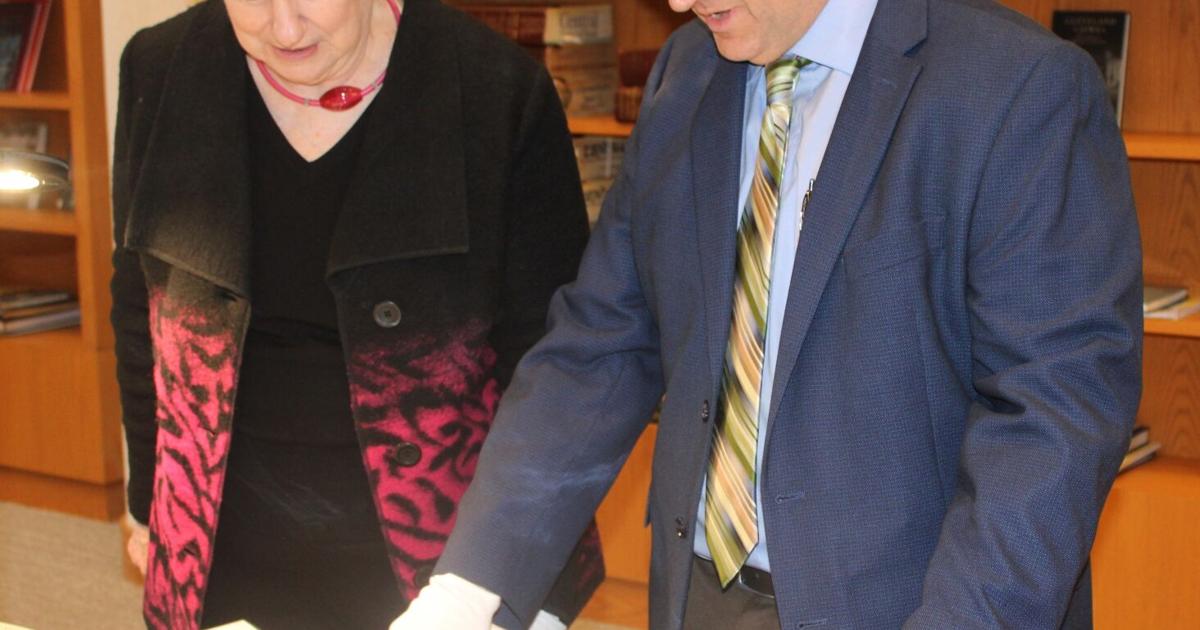

Attendance at the White Glove Brunch celebrating the 50th anniversary of Cleveland Jewish Archives at the Western Reserve Historical Society on Oct. 18 exceeded initial expectations, according to event co-chair Amy Kaplan of Lyndhurst.
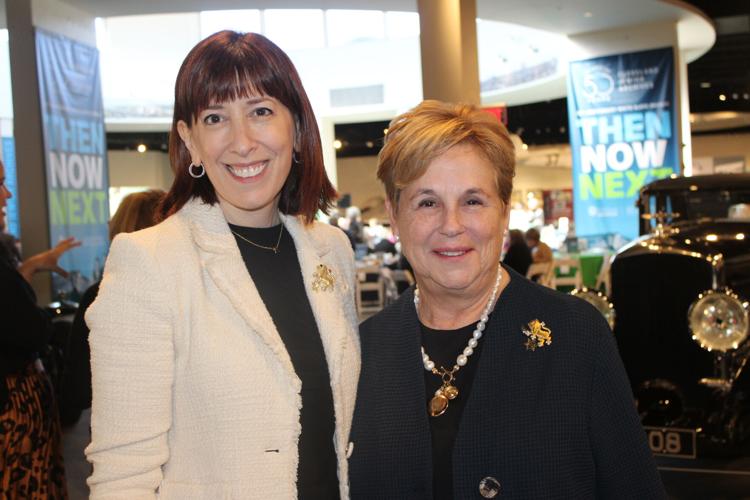
Jewish Federation of Cleveland President Erika B. Rudin-Luria talks with White Glove Brunch co-chair Amy Kaplan of Lyndhurst.
PHOTOS: Cleveland Jewish Archives celebrates 50 years
Jewish Federation of Cleveland President Erika B. Rudin-Luria talks with White Glove Brunch co-chair Amy Kaplan of Lyndhurst.
“When we started planning, we had no idea how it would turn out,” she said as guests filled the Crawford Auto Aviation Museum gallery for food and drink. “But people responded. We were hoping for 100, and we have 250. It’s thrilling.”
While all came to support the anniversary of the Cleveland Jewish Archives, some came away with the realization that they have a new repository for their family histories.
That was the mission of the morning, themed “Then. Now. Next” to celebrate and raise awareness of 50 years of Cleveland Jewish Archives and encourage contributions to the $4.2 million five-year initiative, “Securing the Future of Jewish Cleveland’s Past,” to complete the collection’s digitization.
Sean Martin, Western Reserve Historical Society curator for Jewish History, welcomed brunch guests with a brief history of Cleveland’s Jewish Archives, which dates to the 1950s after a local group chose to take a decentralized approach and break away from the American Jewish Historical Society’s national archives effort.
The move was welcomed by the Western Reserve Historical Society because it viewed Cleveland’s Jewish community as “under-represented” in its collection, according to Martin.
The Jewish Federation of Cleveland partnered with the Western Reserve Historical Society in 1976 to establish the Cleveland Jewish Archives and is its primary funder.
A half-century later, as new technologies have emerged, additional funding is needed to complete the digitization of the massive collection of materials, both print and non-print documents such as photographs, film and audio recordings.
“’Materials’ is a vague word, but the stories of laughter and sorrow are accurate,” Martin said. “’Materials’ teaches others.’”
Federation President Erika B. Rudin-Luria in her remarks to attendees said that the $4.2 million campaign has been jump-started by a $2 million gift from the Jack, Joseph and Morton Mandel Foundation of Cleveland.
“Their support is always transformative,” Ann Freimuth, event co-chair and Cleveland Jewish Archives advisory committee member, said. “It validates to those who know nothing about the Cleveland Jewish Archives that it’s something worth considering.”
Cindy Bruml, event co-chair and member of the Jewish Archives advisory committee and Western Reserve Historical Society board, told attendees that the $4.2 million campaign will “spread the word and heighten awareness of these treasures.”
“The archives are not just a repository,” she said. “They are a recognition that the past matters, teaching us today and into the future. They must be accessible to scholars and teachers if they are to help guide us into the future. Digitizing is important to give access. It is essential in today’s world.”
Kaplan said that digitizing involves far more than scanning materials. Archives must be made “searchable” to scholars and teachers and the process is time-consuming.
In addition to digitizing the Cleveland Jewish Archives, the funds will enable Martin – whom Freimuth called ““the heart-and-soul scholar of the Jewish Archives of Cleveland” -- to write a third volume of Cleveland’s Jewish history, picking up where current volumes end in the mid-1990s.
“So much has changed that the people need to understand,” Kaplan said.
Following the program, guests were invited to the museum’s first-floor library, where they were given white gloves and encouraged to peruse the collection of Jewish archives material that Martin had curated specifically for this one-time event, including paintings, photographs, speeches, audio recordings, and high school yearbooks with pictures of Jewish fraternity Beta Alpha Tau members.
“People loved seeing everything,” Martin said.
Some attendees accepted rides on the historic Euclid Beach carousel, housed in the museum due in part to generous donations from Cleveland’s Jewish community.
Miriam Rosenblum, who grew up on Cleveland’s west side and attended Beth Israel-The West Temple in Cleveland, flew back from her home in Boston to attend the White Glove Brunch.
She told the CJN that she came to see the collection because her father, Lou Rosenblum, was among the first to raise awareness of the plight of Soviet Jews in what became known as the American Jewry movement, founding in 1963 the nationally recognized Cleveland Council on Soviet Anti-Semitism.
Jack Bialosky of Chagrin Falls told the CJN that he was not certain when his family arrived in Cleveland from the Bialystock region northeast of Warsaw, but it was likely during the second wave of Jewish immigrants in the 1860s, not the first wave of the late 1830s. His family founded the Cleveland architectural firm Bialosky.
“My dad designed synagogues,” he said. “And a lot of his papers are still in the office.”
He and his wife, Ronni, said that it would be an honor to have them in the Cleveland Jewish Archives.
The event was the first of two sponsored by the Federation celebrating Cleveland Jewish Archives’ 50th anniversary. The second, “Archives Alive,” on May 16, 2027, will feature breakout sessions on aspects of past life, culture, religious leaders and institutions in Cleveland’s Jewish community, including the local rock-and-roll movement.
“History is more than a record of what happened,” Rudin-Luria said. “It tells us who we are and where we came from. Cleveland’s Jewish Archives help us meet the present with perspective and the future with purpose. We must make the collection accessible to tell Cleveland Jewish community’s evolving story.”