
 Israel National News
Is Tom Barrack fit to represent America in the Middle East?
Oct 24, 2026·7 min read
Stephen M. Flatow is an attorney and the father of Alisa Flatow, who was murdered in an Iranian-sponsored Palestinian terrorist attack in 1995. He is author of A Father’s Story: My Fight for Justice Against Iranian Terror (now available in an expanded paperback edition on Amazon.com) and is the chair of the Religious Zionists of America-Mizrachi. An oleh chadash, he divides his time between Jerusalem and New Jersey.
Tom Barrack has a problem with history.
And at some point Americans-and particularly those who care about the American-Israel relationship-are entitled to ask whether that problem makes him unfit for the enormous diplomatic responsibilities President Donald Trump has given him.
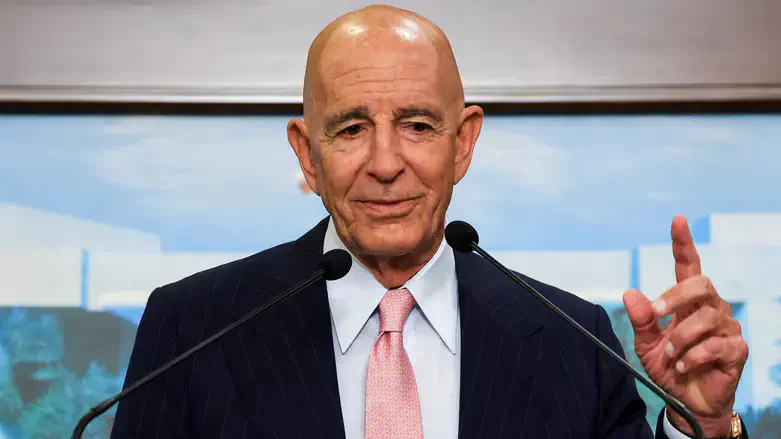
Barrack is America's ambassador to Turkey and special presidential envoy for Syria and Iraq. He is therefore one of the most important American officials dealing with Israel's increasingly dangerous neighborhood.
Yet once again, he is making statements about Jews, Zionism and Israel that range from historically indefensible to diplomatically astonishing.
Speaking at the Global Security Forum in Doha, Barrack declared that when he was growing up, “there was no antisemitism in the U.S. It just didn't exist."
He then extended the thought to the Middle East, where there was supposedly “very little antisemitism."
And then came the history lesson:
“The Jews existed side by side forever. Zionism in '48 became another issue."
Where does one begin?
Perhaps in Culver City, California.
That is where Barrack grew up.
Not Beirut. Not Damascus. Not Baghdad. Culver City.
He was born in Los Angeles, the grandson of Lebanese Christian immigrants. His father operated a grocery store. Barrack attended Loyola High School and the University of Southern California before his professional career eventually brought him into extensive contact with Saudi Arabia and other parts of the Arab world.
Barrack has repeatedly invoked his upbringing as evidence for his understanding of Jewish-Arab relations. He has described himself as a Lebanese Catholic raised in a heavily Jewish environment where everybody did business with Jews.
Fine.
But childhood recollections are not history.
Indeed, Culver City's own historical reckoning makes Barrack's sweeping claim about American antisemitism particularly strange. The city has acknowledged a past of discriminatory housing practices and deed restrictions barring racial minorities and people of non-Christian faiths from property ownership. Historical accounts of Culver City specifically include Jews among those subjected to exclusion.
Perhaps young Tom Barrack never personally encountered antisemitism.
Good for him.
That does not mean it “didn't exist."
Father Charles Coughlin existed. University quotas existed. Restricted hotels and clubs existed. Employment discrimination existed. Housing restrictions existed. American Jews did not imagine any of them.
An American ambassador should know the difference between autobiography and history.
But Barrack's rewriting of Middle Eastern Jewish history is more disturbing still.
Jews did indeed live throughout the Arab and Muslim world for centuries. Sometimes relations with their Muslim neighbors were peaceful and productive. Jewish civilization flourished at various times in Muslim lands.
But Barrack's idyllic picture of Jews happily living “side by side forever" until Zionism somehow intruded in 1948 is historical nonsense.
Was there no antisemitism when Damascus Jews were subjected to a notorious blood libel in 1840?
Was there no Jew-hatred when the ancient Jewish community of Hebron was attacked in 1929 and Jews were slaughtered-nineteen years before the creation of Israel?
Was there no antisemitism during the Farhud in Baghdad in 1941, when Jews were murdered, women assaulted and Jewish homes and businesses looted-seven years before Israeli independence?
Apparently all of that disappears in Barrack's version of Middle Eastern history.
And Zionism did not suddenly appear in 1948.
The First Aliyah began in the nineteenth century. Theodore Herzl convened the First Zionist Congress in 1897. The Balfour Declaration came in 1917. The Arab riots of 1920 and 1921, the Hebron massacre of 1929 and the Arab revolt of 1936-1939 all occurred because the Arab-Jewish conflict over Jewish national restoration was already well underway.
So what exactly does Barrack mean when he says, “Zionism in '48 became another issue"?
The implication is difficult to miss: Jews and Arabs lived peacefully together until Zionism-and ultimately Israel-spoiled everything.
That is not history. It is a political narrative.
And it is a narrative Israel's enemies have been promoting for generations: Judaism is acceptable; Jews are acceptable; what caused the trouble was Zionism and Jewish sovereignty.
One might expect to hear that formulation from anti-Zionist activists on an American campus.
It is alarming to hear something resembling it from a senior American diplomat responsible for some of the most sensitive relationships in the Middle East.
Unfortunately, Barrack's latest remarks cannot be viewed in isolation.
Earlier this year, he declared that “the world is not antisemitic" and again invoked his Lebanese Catholic upbringing to minimize the problem.
He has called Israel and Hezbollah “equally untrustworthy."
Think about that for a moment.
Israel-a democratic American ally whose soldiers defend their country under civilian authority-and Hezbollah, an Iranian-sponsored terrorist organization responsible for decades of murder, kidnapping and destabilization, are apparently equally deserving of suspicion.
Barrack has questioned Israel's democratic character, saying that Israel can “claim" to be a democracy while suggesting that benevolent monarchies have worked better in the Middle East.
He described Israel as occupying the Golan Heights even though the administration he represents recognizes Israeli sovereignty there. He later had to clarify his remarks.
He suggested that an Israeli military operation in Syria might have been intended to “bait" Turkey into confrontation ahead of an Israeli election.
Now he tells us that Iran is “not an evil regime," while carefully distinguishing its religious government from the Revolutionary Guards.
There is a pattern here.
Again and again, Barrack minimizes the ideological hostility of Israel's enemies while subjecting Israel's motives, history and actions to extraordinary skepticism.
Turkey receives understanding.
The Syrian government receives encouragement.
Iran receives semantic refinement.
Hezbollah receives moral equivalence.
Israel receives lectures.
That is precisely backwards.
This does not mean an American diplomat must defend everything an Israeli government does. Friendship does not require silence, and diplomacy certainly does not require agreement.
But an envoy entrusted with America's interests in the Middle East ought to possess three elementary qualifications.
He should understand the history of the region.
He should accurately represent American policy.
And he should be able to distinguish America's democratic ally from the terrorist organizations and authoritarian regimes seeking to weaken or destroy it.
Barrack's repeated statements raise legitimate questions about all three.
Perhaps his comments are simply careless. If so, carelessness on this scale is itself alarming in a man carrying such a large diplomatic portfolio.
Perhaps he genuinely believes this romanticized version of Middle Eastern history. That would be more troubling.
And if he understands the history perfectly but nevertheless chooses to present it this way, that would be worse still.
I cannot know which explanation is correct.
But President Trump should want to know.
Because Tom Barrack is no longer a private businessman reminiscing about his Lebanese heritage or his years doing deals with Arab princes.
He speaks for the United States.
When an American envoy rewrites the history of antisemitism, dates the Zionist problem to 1948, equates Israel with Hezbollah and repeatedly seems more anxious to explain Israel's adversaries than to understand Israel's security concerns, Americans have every right to ask a simple question:
Is Tom Barrack the right man to represent the United States in the Middle East?
.
...