
 Yated Ne'eman
Could Trump’s All-In Midterm Campaign Surprise Pollsters Again?
A broad consensus of pollsters is confidently predicting that the Democrats will easily win control of the House of Representatives in next week’s midterm election, and probably the Senate as well.
But President Trump is determined to do everything he can to prove them wrong. Since the start of October, he has been crisscrossing the country, making personal appearances at dozens of campaign events. His strategy is to motivate the voters who elected him president in 2024 to create an unexpected surge for Republican candidates running for seats in the House and Senate, thereby proving the polls to be wrong once again.
During a flight last week on Air Force One to attend a GOP campaign rally at the airport in Sioux City, Iowa, Trump was asked by Washington Examiner chief political reporter Byron York about those dire poll predictions.
Trump replied, “[I know] people say that, [but] I just don’t see it. There’s such enthusiasm. . . You saw that last night,” he added, referring to a wildly enthusiastic Republican campaign rally in South Carolina. He then mentioned the reversal in the polls following his visit to Alaska to support the GOP incumbent senator, Dan Sullivan. Trump said, “I took him from losing to being ahead,” against his Democrat opponent, former Congresswoman Mary Peltola. To win re-election, Sullivan will also have to overcome a dirty trick by Alaska Democrats, who put a different person who is also named Dan Sullivan on the state’s complicated ranked voting ballot, in a blatant effort to confuse Alaska’s voters.
Trump also told York that he has not yet given up hope that the GOP will surprise almost everyone by maintaining its slim majority in the House. He cited the GOP electoral advantage from the redistricting of congressional districts in several states, based upon a recent, landmark decision by the conservative majority on the U.S. Supreme Court. Trump expects that the redrawn district lines will result in flipping 5 to 10 seats from Democrat to Republican in next week’s election, which might be enough to keep the Republican House majority intact if enough of the other House races turn out to be more competitive than the national polls are now predicting.
Trump Applying The Lessons From His First Term Midterm Loss
Trump seems to be determined to improve upon the outcome of the 2018 midterm election during his first term as president, when he was much less involved in personally campaigning for Republican candidates in House and Senate races across the country.
Because his name was not on the 2018 ballots, many of the low-propensity working-class voters who elected him president in 2016 stayed home, while Democrat voters who hated him turned out in force. As a result, in the 2018 midterms, Republicans suffered a net loss of 40 seats in the House, with 30 GOP incumbents losing their bids for re-election, which enabled Democrats to seize majority control of the lower legislative chamber. However, in the Senate, Republicans defied the odds and electoral history in 2018 by expanding their majority control in the Senate with a net gain of 2 seats. But in that same election, the GOP did lose the governorships they had held in 7 states, including Illinois, Kansas, Maine, Michigan, Nevada, New Mexico, and Wisconsin.
Unlike the 2018 midterms, in the current election cycle, Trump has been urging his enthusiastic supporters attending the GOP campaign rallies he has led across the country to act as if his name does appear on their ballots, by showing up at the polls on Election Day, November 3, or during early voting, to cast their votes on behalf of the Republican candidates whom he has endorsed.
“I might be wrong,” Trump admitted after reporter York told him that he thought the GOP would lose control of the House in the midterms, but “the country’s never done better. People feel good,” the president declared. “The [cost of] gasoline’s a little high, but it’s coming down. You know, gasoline is lower than it was with Biden and Obama,” Trump has tried to remind his voters, “and I got rid of the [Iranian] nuclear threat.”
Republican Candidates Will Pay For The Promise Trump Didn’t Deliver
But during their conversation on Air Force One last week, York suggested that even some of Trump’s supporters would wince at his claim that the American economy has “never done better.” York argued that in 2024 Trump was “elected [president] to do one big thing — bring down inflation — and inflation every year was 3% when Trump took office in January 2025, and it is 3.7% today.” York notes that inflation is “nowhere near where it was — 9.1% — in the worst of the Joe Biden years, but Trump promised it would go down, and it hasn’t,” which is the main reason behind the GOP’s current midterm problems.
On the other hand, Trump has been able to remind his supporters at the GOP rallies across the country about his administration’s many other significant economic achievements. Look at the stock market, and look at your 401(k) retirement accounts. They’re both up, he told the crowd at the Sioux City event. Trump then added, “Income for hardworking Americans has soared to the highest level ever recorded. . .
“The poverty rate has just reached its best [lowest] level in American history.” Trump also boasted about his success in promoting American exports and attracting new investment in the manufacturing sector of the American economy, including the September 30 announcement of the planned construction of a huge new $15 billion steel plant that will add 1,750 permanent high-paying jobs to Iowa’s economy.
While on stage during the Sioux City rally, Trump polled the audience to discover which of the tax breaks he got Congress to pass last year was their favorite. While his elimination of tax on tips was popular, and doing away with tax on overtime pay was more popular, the largely elderly crowd’s clear favorite was the elimination of the income tax on Social Security retirement benefits.
Trump Still Promising Price Relief At The Pump After The Iran War
After citing his solid economic accomplishments, Trump told the enthusiastic crowd that he had made his case, declaring playfully that he had earned their votes. He also predicted once again that inflation will come down and the current $ 4-a-gallon gas prices at the pump will plunge after the war with Iran ends, which Trump expects will happen soon after the midterm election.
Reporter York’s somewhat skeptical comment was, “That will be great if it happens, although until then prices will remain a real problem. Still, the good indicators in the economy [Trump boasts about] are real.”
Trump Doesn’t Believe His Low Job Approval Rating Is Real
York asked Trump during their flight on Air Force One to Iowa why, despite Trump’s undeniable economic accomplishments and his success in closing the border with Mexico to the massive number of illegal immigrant crossings during the Biden years, his presidential job approval number is so low, 38.8% approval vs. 60.4% disapproval, according to the widely respected RealClearPolitics average of polls.
Trump responded by challenging the accuracy of that 38% approval rating, calling it “fake.” To bolster that claim, Trump referred to the recent disclosure that the Wedgewood polling operation fabricated the data it used to publish 15 polls between June and October that deliberately inflated the popularity of the more progressive candidates in Michigan, Wisconsin, and Mississippi Democrat primaries. The fake polls were accepted as authentic by the New York Times (but not RealClearPolitics), and impacted the outcomes of those primary races by altering the behavior of Democrat campaign donors and misleading campaign strategies.
When York asked Trump what he thought his true job approval rating was, he said 60%, and then declared that if he could run for office again, “I don’t believe I could be beaten by anybody.” Trump then showed York a September video clip of CNN’s in-house polling expert, Harry Enten, who recalled that, “In the 2024 election versus Kamala Harris, [Trump] got 99% of the MAGA GOP vote.” Trump’s comment on that clip was to express surprise that he hadn’t gotten 100% of the votes from his 2024 MAGA supporters.
Why Trump Still Believes In His Own Popularity
York’s takeaway from his conversation with Trump was that the adulation that he experiences at his rallies from “large, enthusiastic crowds,” and “the persuasive fact that he has twice been elected president of the United States — add that all together and it accounts for Trump’s belief in his own popularity and ability to influence elections, even those in which he is not running.”
York then asked Trump whether his admitted desire to “always cater to my [MAGA] base” means that he does not make enough of an effort to win the support of independent voters.
When the president dodged answering that question, York concluded that “Trump’s belief that economic indicators are strong for coming growth. . . his skepticism of polls. . . and. . . his confidence in his sky-high, rock-solid approval ratings among his MAGA base. . . add up to Trump’s belief that Republicans can win not just the Senate, which many observers see as too close to call right now, but the House, too, which those observers believe is lost to the GOP.”
Nevertheless, York does not believe that Trump’s optimistic attitude about the likely outcome of the midterm election for the Republicans is the result of ignorance or naivete.
Why Trump Can’t Afford To Admit That The Gop Is Losing
York writes, “Trump knows the polls, of course. He is a close and discriminating reader of news stories. And he has certainly heard advisers, consultants, and others describe the adverse conditions Republicans face in races across the country. But what should he do? Tell his party that they’re going to lose? Trump knows how many Republicans look to him for leadership. If he appears to lose hope, they will, too. So he keeps at it as he nears the end of an extraordinary 32-day cross-country campaign tour. And,” York adds, “[Trump] has a [strong] case to make,” when he argues that his economic policies are benefiting working-class American voters, aside from the inflation problem due to the war in Iran.
For example, during his campaign stops in Georgia and Michigan last week, Trump announced that the Big Three U.S. carmakers (General Motors, Ford, and Stellantis) and Audi, the luxury German auto company, are making major investments in factories, creating many new jobs in those states, in order to avoid the tariffs which Trump has imposed on imported vehicles.
Trump Says He Needs Netanyahu To Win To Help Him Finish The Iran War
Meanwhile, in a message to Israeli voters in this week’s Knesset election, Trump doubled down on his recent endorsement of Prime Minister Binyomin Netanyahu. In a Truth Social post, Trump said that he needed Netanyahu’s help to “finish the job that we [the U.S. and Israel] started” to eliminate the nuclear and missile threats from Iran and its terrorist proxies.
Trump wrote, “As everyone is aware, including the enemy, Bibi and I have had a great relationship in winning together.
“I did the Venezuelan attack [in January], one of the most successful military operations in history, but before that [in June 2025], we did Operation Midnight Hammer, stopping the world’s number one state sponsor of terror from obtaining a nuclear weapon.
“Then we did Operation Epic Fury,” in February, and as a result, Trump declared, “Iran now has no navy, no air force, and both their military and economy are in shambles, including the fact that Iran’s inflation is at 300%. The [U.S.] naval blockade has precluded them from getting oil [out of the Strait of Hormuz], and two levels of [Iran’s] leadership, both military and otherwise, are gone.”
Trump then urged Israeli voters to remember “when you go to the polls. . . that Bibi has been an outstanding warrior prime minister! Israel was called [by Iranian leaders] the Little Satan, with the United States being called the Big Satan, by some very evil people.
“There can no longer be the chant heard around the world of ‘Death to America, death to Israel,’ and there won’t be,” Trump promised, with the only question being whether he would accomplish that by making a deal with Iran, or by finishing the job he started with a renewed military attack.
Trump Receives Praise From Former Foe Desantis And Rfk Jr.
Fox News Channel host Jesse Watters aired a video clip of the reunion last week between Trump and his early rival for the GOP’s 2024 presidential nomination, Florida Governor Ron DeSantis, who warmly welcomed the president upon his return from the midterm campaign trail to the Sunshine State he now calls home.
Watters also showed his large nationwide television audience a video clip of Trump’s controversial Secretary of the Department of Health and Human Services, Robert F. Kennedy Jr., praising the president for supporting his Make America Healthy Again (MAHA) initiative. RFK Jr. declared, “A lot of my liberal friends said to me, ‘Oh, you better not shake a hand with that guy [Trump] because he’s going to double-cross you. He’s going to lie to you. He’s going to use you to help him win an election, and then he’s going to discard you.’
“And I want to tell you this,” Kennedy continued. “Every commitment, every promise that Donald Trump has made to me, he has kept ‘in spades.’”
In a separate video clip, RFK Jr. also praised Trump for “rebuilding the infrastructure [and] reopening the markets for hard [hit American] commercial fishermen.”
Watters then told his television audience that Republican candidates across the country, “from Iowa down to Florida,” are benefiting from the momentum shift that Trump has been generating with his campaign rallies. Watters displayed a video clip of the GOP’s gubernatorial candidate in Florida, Congressman Byron Donalds, who is leading in the latest statewide polls, declaring, “We are going to tell the Democrats once and for all that they can have the crazy [liberal policies] in California; they can keep the idiocy in Illinois, [Mayor Zoran] Mamdani stays in New York, but it’s not coming to Florida!”
Close Senate Races Being Watched In Texas And Maine
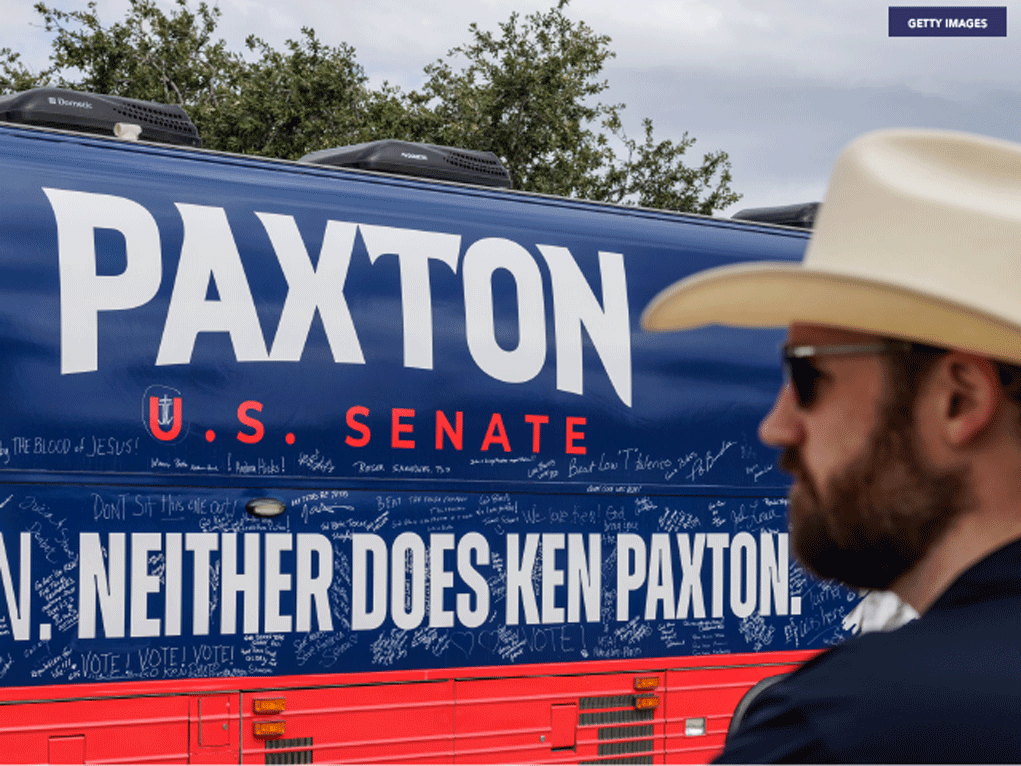
Watters also rebroadcast a clip from Katy Tur, one of the liberal hosts at the leftist cable news channel MS Now (formerly known as MSNBC). She expressed skepticism about polls reporting that progressive Texas Democrat senatorial candidate James Talarico holds a narrow lead over Texas attorney general Ken Paxton, because Tur said she has seen firsthand just how deeply Texas voters have been ingrained to vote for Republican candidates.
In a second video clip, Watters showed Talarico telling a liberal podcast host that he disagrees with a recent statement by progressive Congresswoman Alexandria Ocasio-Cortez (AOC), in which she called some of her previous, widely unpopular “woke” positions on social policy issues “crazy.”
Talarico said, “I don’t regret standing up for my constituents. I would do it again. I think what I’ve regretted is kind of how I phrased certain things because it obscured the point I was trying to make.”
Watters also cited the results of one of the latest polls on the close senatorial race in Maine. In recent election cycles, Maine has been a reliably Democrat-voting blue state, with the glaring exception of its support for moderate Republican Senator Susan Collins. She has been re-elected to office for five terms, defying polls that have repeatedly erroneously predicted her defeat, and she is now in the process of doing it again.
Watters noted, “Maine hasn’t voted for a Republican presidential candidate since 1988. Yet, they still can’t knock off Susan [Collins], who’s been there 30 years, and has built up so much clout [due to her seniority in the Senate] that Maine always gets what it needs [from the federal government].”
Michigan Democrat El-Sayed’s Unbelievable Terrorism Denials
Bret Baier, the chief political anchorman for the Fox News Channel, conducted an illuminating broadcast interview last week with Michigan’s controversial Democrat senatorial candidate, Abdul El-Sayed, who made a determined effort to evade answering Baier’s questions about El-Sayed’s newly surfaced old family ties to the Muslim Brotherhood, which has been labeled by several Middle East nations as a radical Islamic terrorist organization. In 1987, the Muslim Brotherhood’s original Egyptian branch gave birth to Hamas in Gaza while it was under Israeli occupation.
In his telling exchange with reporter Baier, El-Sayed angrily declared that, “I have never been a member of the Muslim Brotherhood [and] I never will be a member of the Muslim Brotherhood.” El-Sayed also berated Baier for questioning his allegiance to the U.S. Constitution, and declared, “I am interested [only] in serving the United States.”
El-Sayed’s critics have also cited the fact that his father-in-law, Jukaku Tayeb, is a former president of the Michigan chapter of the Council on American-Islamic Relations (CAIR), the American Muslim community’s leading apologist for Islamic terrorist groups, including Hamas and the Muslim Brotherhood. CAIR has also been outspoken in lobbying against U.S. support for Israel.
During a landmark federal trial (2007-2009) of the Texas-based Holy Land Foundation for its support for international Islamic terrorist organizations, the U.S. Justice Department named CAIR as an unindicted co-conspirator. In addition, the state governments of both Texas and Florida have designated CAIR as a foreign terrorist organization, citing its historical ties to Hamas and its efforts to promote the adoption of Islamic Sharia law as a substitute for civil law in the United States.
During a flight on Air Force One Sunday to campaign against El-Sayed at an event in Michigan, Trump declared, “Heading to Michigan to fight a jihadist member of the Muslim Brotherhood — A man who should never be allowed inside the Halls of our great and beautiful Capitol Building, in Washington, D.C.”
Trump also noted that, “Abdulrahman Mohamed El-Sayed wants our country to go to Sharia law. If it ever does, he should be the first [one] that’s tried!”
Obama Called Upon To Save Democrats In Michigan And Ohio
Fox News reporter Watters also highlighted El-Sayed’s increasingly desperate struggle to cultivate the support of Michigan’s Black voters, with whom, according to the polls, he has been doing poorly. Those efforts included an appearance over the weekend at one of El-Sayed’s campaign rallies in Detroit by former President Barack Obama.
The fact that almost a decade after leaving office, Obama remains, by far, the most effective spokesman for the Democrat party reveals the comparative weaknesses of the Democrats who have been anointed by the party’s establishment since then to replace him as their national leader, including Hillary Clinton, Joe Biden and Kamala Harris.
Violating the unwritten rule of political etiquette that ex-presidents should never publicly criticize their successors in office, Obama told the audiences at the Democrat campaign event in Detroit, and another held earlier that day in Ohio, regarding President Trump, “We have never seen a president excel in straight-up grifting on your dime like this.”
Obama also told his audience in Detroit, “The current president chose to make a series of bad decisions, the most important of which was that he decided to start an unnecessary war nobody had asked for and nobody voted for.” In addition, with respect to Trump’s nationwide campaign to arrest and deport criminal illegal aliens living in this country, Obama said, “I do not recall anybody campaigning on sending masked agents running through our streets.”
In a targeted effort to generate more support for El-Sayed from Michigan’s Black voters, Obama attempted to link the harsh criticism of El-Sayed for his associations with the Muslim Brotherhood and for campaigning with notorious antisemite Hasan Piker, to the challenges Obama himself faced as the first Black major party candidate for president in 2008.
“We have seen this movie before. I starred in it,” Obama said. “This stuff didn’t work on me. Not in Michigan. It’s not going to work on Abdul.”
Obama Says El-Sayed Is Being Attacked For Being An Agent Of Change
Obama also told the Detroit audience that, like himself, he viewed El-Sayed as the leader of a movement to change a deeply flawed American political status quo. “I can also tell you this from experience,” Obama said. “Whenever a movement builds to challenge that broken system, the people who benefit from the status quo will say and do anything to stop that train from coming,” Obama said. “They will use lies, and they will use fear.”
In response to polls showing El-Sayed’s Republican opponent, former Congressman Mike Rogers, gaining ground, winning public support from several prominent Michigan Jewish Democrats, and receiving large campaign contributions from pro-Israel donors nationwide, Senator Bernie Sanders and AOC each announced separate $1 million emergency contributions to El-Sayed’s embattled campaign.
In an interview with NBC News, El-Sayed was reminded that when he was a public health official for the city of Detroit, he was highly critical of the Affordable Care Act, better known as Obamacare, for failing to make more progress in reforming the American health care system. El-Sayed responded with an implicit apology. He admitted that he was younger and angrier when he made those critical comments, and that he now believes that with Obamacare, the former president “did his best with the circumstances he had.”
In his Ohio appearance, Obama rallied his followers behind Democrats Sherrod Brown running for the Senate and gubernatorial candidate Amy Acton. Both of them are in tight races in a former battleground state which has become much more supportive of Republican candidates in recent election cycles.
Obama ridiculed Trump’s imposition of tariffs on imports from America’s trading partners, especially on Canada. He mocked Trump’s attempts to remake the decor in the White House according to his own tastes, and to build a large new ballroom on White House grounds for hosting state dinners, even though the need for such a facility has long been clear. He also criticized Trump for filling his current administration with what Obama called “unserious people,” such as War Secretary Pete Hegseth, who has been attempting to de-politicize the atmosphere in the Pentagon that Trump inherited from the Biden administration, in an effort to restore sagging troop morale and boost America’s military readiness.
Several Pollsters Now Hedging Their Bets On A Democrat Blue Wave
Meanwhile, several prominent mainstream media pollsters, including former New York Times chief pollster Nate Silver, RealClearPolitics polling expert Sean Trende, and CNN’s Harry Enten, are now hedging their bets on the size of the “blue wave” of Democrat victories that they have been predicting in next week’s midterm election,
Politico has also published a warning from GOP pollster Patrick Ruffini of Echelon Insights, who identified systemic flaws in current polling methodology that have artificially inflated the number of “battleground” states that are currently in play. Ruffini suggests, and both Silver and Trende seem to agree, that current polling suffers from a “non-response bias” by Republican voters who are reluctant, for a variety of reasons, to answer pollsters’ questions truthfully.
As a result, Ruffini claims that the opinions of Democrat voters are influencing current polling results at twice the rate of the Republicans who are more reluctant to express their true feelings. Ruffini is therefore skeptical that Democrat Senate candidates from deep-red voting Midwestern states, including Iowa, Ohio, and Kansas, are doing as well, and are as competitive against their GOP opponents as the recent polling in those states indicates.
In his own analysis, Nate Silver agrees with the observation that, “certain Republican-leaning voters are less likely to respond to polls. GOP voters have lower social trust. They’re also less likely to have college degrees, and “noncollege” voters are considerably less likely to respond to surveys.
Similarly, Sean Trende of RealClearPolitics claims that an AI analysis of recent state-by-state election results has confirmed his suspicion that, “Put most simply, polls tend to understate Republicans in red states and Democrats in blue states.
“In 2018,” Trende cites as an example, “the polls underestimated Republican performances in Florida, Indiana, North Dakota, and Missouri, while underestimating Democrats in Arizona and Nevada.”
In The Senate Midterms Republicans Have A Home Field Advantage
Political analyst Henry Olsen, who writes the Washington Post’s “Margin of Victory” newsletter, similarly notes that in the current midterm election campaign, most of the most closely contested races for Senate seats are in normally Republican-voting states. He therefore concludes that Democrats who go into Election Day holding leads of two points or less against their Republican opponents, or with the support of less than 48% of the total number of voters in those “red” states, are vulnerable to surprise upsets. That is because the majority of undecided voters are likely to choose at the last moment to return to their past pattern or strong family tradition of voting for the Republican candidate by default.
Olsen cites as an example of this theory in action the surprising results of the 2016 presidential election. Throughout that entire general election campaign, Hillary Clinton held a lead varying from 1.9 to 6 percentage points over Donald Trump, but her share of support among polled voters as a whole never exceeded 45.7%. As Olsen explains it, while Mrs. Clinton was consistently leading Trump, she never actually “made the sale” for a majority of voters. According to Olsen, that meant that those “voters who didn’t care for Trump but tended to lean Republican on policy would decide who prevailed” in the end. They are the ones who gave Trump his dramatic “come-from-behind” 2016 victory.
For the same reason, Olsen also believes that the Republican Senate incumbent in Kansas, Roger Marshall, has a clear advantage over Democrat Adam Hamilton, even though their polling numbers are so close that they are in a statistical dead heat. That is because most of the undecided voters in “ruby-red” Kansas today normally vote for Republican candidates.
Lessons In How To Handicap This Year’s Midterm Polls
Using that rule of thumb for evaluating state polling results going into next week’s midterm Election Day, Olsen suggests that former Democrat senator Sherrod Brown is in a weaker position than his current 2.4% polling lead over Republican Jon Husted would suggest, because his support averages 47.1 percent compared to Husted at 44.7%. Doing the math, it appears that about 8% of Ohio voters remain undecided in this race. That means that Republican Husted would need to win the votes of those deciding their choice at the last minute by a not unreasonable 5-3 ratio in that strongly Republican voting-state, in order to overtake Democrat Brown and win the election.
Olsen’s conclusion is that, in the midterm contest to win control of the U.S. Senate, in which most of the battleground states normally vote Republican, “to truly be considered favorites, Democrat [candidates] need to be leading by two or more points on election eve and be at or above 48 percent support. Fall short of either mark, and the [actual outcome of the] race could easily flip the other way [due to] just a small polling error or a late return by right-leaning [undecided] voters to past patterns.”
Watters also told his Fox News audience last week, citing the report in Politico, “internal polling from both parties say that Republicans are fighting hard,” which suggests that “this so-called [blue] wave [may be] turning into a little bit of a trickle.”
Watters also noted that failed 2028 Democrat presidential candidate Kamala Harris has resurfaced after a long and well-deserved hiatus from the public spotlight, following her spectacularly inept 2024 campaign. Apparently hoping to make another presidential run in 2028, Harris has returned to campaign on behalf of progressive candidates, mostly in deep blue states and voting districts where her participation is still welcome, even though her widely ridiculed “word salad” pronouncements remain as vague and indecipherable as ever. For example, at a campaign event for U.S. Senate candidate Scott Colom in Columbus, Mississippi, last week, Harris declared, “Never let someone else’s limited ability to see your capacity be a limitation on your ambition.”
Trump Out-Hustling His Democrat Opponents
Watters observes that in the “mad dash to the finish line,” which is next Tuesday’s midterm election, those Democrats, including Sanders, AOC, Obama and Harris, are “out in full force” competing with one another for the leadership of their party. Meanwhile, their efforts are being matched by President Trump, who is “showing a ton of hustle, [while] trying to build a red wall and defy history” by enabling the Republicans to retain control of the Senate, and possibly even the House.
As a result, Watters cautions us with regard to expectations for the outcome of next week’s midterm, “Don’t count the Republicans out!”
Cincinnati-based Washington Post political commentator Gary Abernathy, writing for USA Today, makes a similar argument regarding the race in Ohio between John Husted, who was appointed by Ohio’s GOP Governor Mike DeWine to fill Vice President JD Vance’s Senate seat for the final two years of his elected term in office, and former Democrat Ohio Senator Sherrod Brown.
Abernathy concedes that during his previous 18 years in the Senate, Brown was a liberal who was not known for holding extreme leftist or socialist views. However, in today’s Democrat Party, which is well along in the process of being taken over by the Democrat Socialists of America, one has to assume that Brown would go along with the wishes of 70% of today’s Democrat voters who told an ABC News/Washington Post/Ipsos poll that they currently hold a favorable view of democratic socialism, as defined by the recently published national platform of the DSA.
All Democrats Now Committed To The Extreme Dsa Socialist Agenda
According to Abernathy, the DSA demands that all of its approved Democrat candidates commit themselves to its left-wing goals, which call for “eventually abolishing the police and prisons, ending all military and economic aid to Israel, legalizing migration and granting voting rights to all permanent residents. It would abolish the Electoral College and the Senate, and even replace the president and Supreme Court with an executive and judiciary chosen by Congress.”
It is clear that many of those avowed socialist and socialist-aligned Democrat candidates will be elected in next week’s midterm election, and that they will wield “outsized influence” in the next Congress, especially if the Democrats gain majority control. As a result, Abernathy predicts that Brown, if elected senator, will be unlikely to stand in their way, and will agree to cast party-line votes in favor of all of DSA’s extreme socialist-inspired policies.
Abernathy suggests that even though the current average of statewide Ohio polls shows Brown leading Husted, his Republican opponent, by 2.4 percentage points, that finding likely underestimates the actual GOP vote, as indicated by the results in Ohio’s most recent midterm Senate race in 2022. Nearly every poll that year showed the race between Vance and the Democrat candidate, Tim Ryan, to be a virtual dead heat as late as mid-October, but by Election Day Vance won the Ohio Senate seat by the relatively comfortable margin of more than 6 points.
Abernathy also believes that the polls have overestimated the potency of the so-called “affordability issue” that Democrats are counting upon to power the “blue wave” they are expecting to ride to victory in next week’s election. Looking beyond inflation, most other economic indicators are clearly signaling strong growth.
Democrats Promoting An “Affordability Panic”
He writes that in order “to succumb to the affordability panic, Americans must ignore that median household income last year hit a record high and the official poverty rate fell to a record low. We must forget that cumulative inflation was 21.4% over Biden’s four years, compared with 5.4% in Trump’s first 20 months. And we must overlook that the One Big Beautiful Bill Act cut taxes for every income group, with new deductions for tips, overtime, and seniors.”
Abernathy also admits that, despite the election of Mayor Zohran Mamdani to run New York City, and other socialist candidates gaining footholds in other deep blue cities and states, he simply “can’t fathom” the acceptance of socialism by the American people who, “for decades. . . spent blood and treasure to contain socialism’s first cousin, communism, around the world. How tragic it would be.” Abernathy laments, “if those forces were unleashed on American soil, with the deliberate aid of citizens at the ballot box.”
He therefore concludes that, “in these elections, the typical issues must take a back seat as voters stand shoulder to shoulder for a higher cause — reaffirming America as an unyielding bulwark against socialism. Beyond all the chaos and chatter, that’s the monumental question these midterms will decide.”
Trump Is Being Energized By His Political Last Hurrah
On Monday, the Wall Street Journal published a front-page article written by its reporters who attended every one of Trump’s seven midterm rallies held the previous week across seven states, starting in Kansas on Monday and ending in Michigan on Sunday, with stops along the way in North Carolina, South Carolina, Iowa, Florida and Georgia.
At the end of that week, Trump had been speaking to crowds of supporters for 11 hours, and his voice was noticeably hoarse. But despite the grueling schedule, the 80-year-old president never faltered because, his White House aides say, he feeds off the energy of the crowds attending his campaign events.
The article notes that “crowds are generally smaller than they were when he was on the ballot, but the president is reveling in the attention, touting his agenda, stirring the pot and [frequently] veering off script [as has long been Trump’s habit]. . .
“At the arenas, gyms and airport hangars where he has been holding court, the Trump show is unabashedly back — perhaps for a final time as his decade-long dominance in [national] politics begins to sunset.”
The article also observes that, “the rallies are something of a security blanket for Trump, according to advisers, freeing him from the pressures of the job, critical news coverage and the low [job] approval ratings.”
Can Trump Pull Off Yet Another Political Surprise?
The strategy behind putting Trump at the center of the Republicans’ national midterm campaign is simple. He is clearly the party’s single best motivator for reluctant, low-propensity previous Trump voters, who are the key to Republican hopes for upsetting the widespread predictions of a Democrat midterm election sweep.
Even though his supporters already know Trump’s campaign talking points, they want to be there at his personal appearance events because he regularly “punctuates his rally speeches with a steady drip of sometimes bizarre, occasionally candid and often comedic comments.” His supporters told the Wall Street Journal reporters that they love these “improvisational moments,” and that, unlike other politicians, “Trump is fearless.” He will say exactly what he thinks, and “he doesn’t care what people think about him” when he does.
To his tens of millions of loyal supporters around the country, Trump is much more than their favorite politician. For them, he has become a living legend.