
The Hamas-supporting state of Qatar has found itself at the center of a firestorm over allegations that it illegally funded Israeli Arab parties in last week’s Israeli election—thrusting the Islamist country under the international spotlight.
The uproar captures the striking contrast between Qatar’s carefully groomed image as an objective mediator in Washington –even as it bankrolls Muslim terrorist groups—and the charges of election bribery now under investigation in Israel.
As is well known, the two Arab parties, Ra’am and the Joint List, won 19 Knesset seats, a shocking election result many attribute to secret Qatari efforts to boost Arab voter turnout.
Israeli detectives arrested four members of Ra’am—an Arab political party in the Knesset–on suspicion of election bribery, Middle East Forum reported. Detectives found tens of thousands of shekels in their homes with ballots and envelopes bearing the inscription, “Gifts from the Islamic movement.”
Did those “gifts” come from Qatar, Turkey or other countries as alleged? Qatari spokesmen have repeatedly denied using cash to influence opinion. Yet evidence accumulating from last week’s election suggests these claims are false, the article states.
Election observers and polling station officials in numerous Israeli Arab communities reported seeing voters carrying fuel vouchers and gift cards, allegedly distributed to them as they went to vote. The reports noted that some voters acknowledged receiving the cards in exchange for voting for Ra’am.
The Shin Bet and other national security agencies have launched sweeping investigations to determine whether election bribery or fraud occurred, who was responsible, and the extent of any wrongdoing.
Qatar and the Muslim Brotherhood
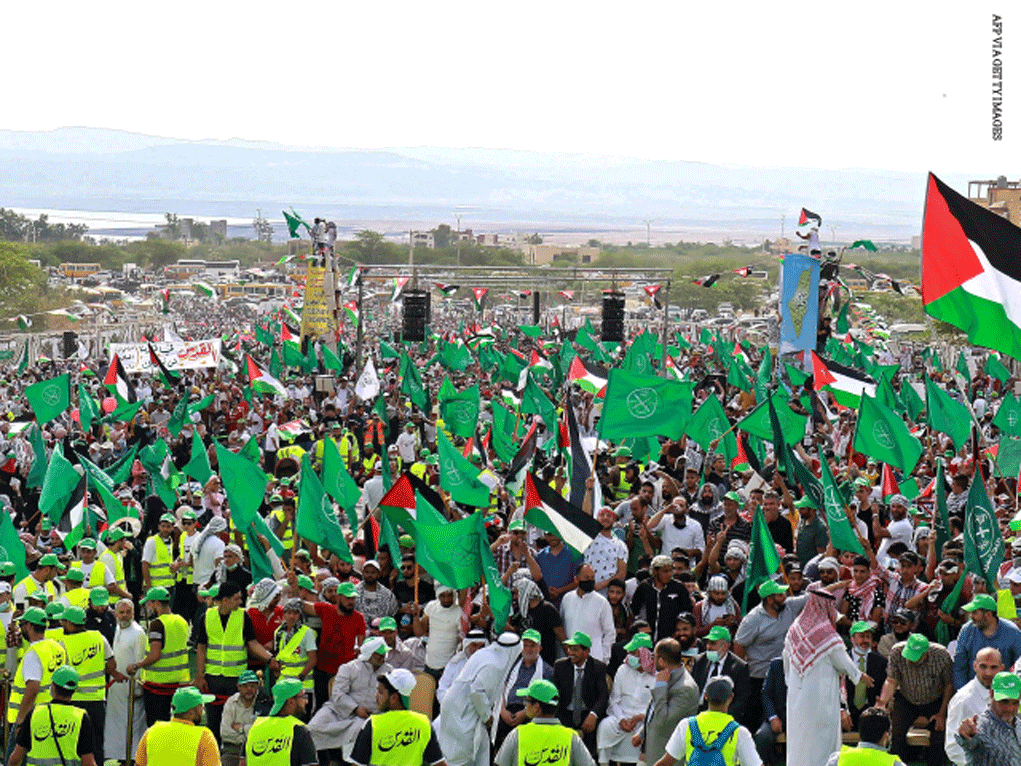
The Ra’am party represents an Islamist movement linked to the Muslim Brotherhood, an extremist Islamist movement with a global reach. It was founded nearly a century ago in Egypt, and has morphed over the decades into a mammoth network of Muslim charities, advocacy groups, and terrorist-supporting agendas. Having grown into one of the Gulf’s wealthiest states, Qatar has emerged as the Muslim Brotherhood’s principal patron and financial backer.
The Brotherhood’s long-term goal is to impose Islamist religious and political authority throughout the world, governed by Sharia law. Under this world order, citizens of all countries would be stripped of civil liberties, and anyone “disrespecting” Islam would be sentenced to Sharia penalties, including the amputation of limbs and execution.
With its public relations ploy of avoiding violent confrontation while covertly supporting Islamic terrorist goals, the organization for decades succeeded in keeping its terrorist ties and activities shrouded in obscurity.
Terrorism experts in the U.S. and Europe, however, have gradually uncovered the creeping global network of hundreds of Brotherhood chapters, branches and offshoots.
Most recently, Human Health and Service (HHS) secretary Robert F. Kennedy Junior ripped aside the movement’s veneer, accusing it of promoting fanaticism, suppressing independent thought and promoting hostility toward Western democratic values.
In a lengthy online post, RFK trampled political correctness, writing truths that drew furious backlash from mainstream media.
He accused the Muslim Brotherhood and its allies of spreading anti-Semitism across the world, and said that Jews being killed and driven from Middle Eastern countries “is the real genocide.”
The HHS secretary slammed the Brotherhood for creating an “international propaganda machine” targeting Jews and Israel, with roots in its historical relationship with Nazi Germany.
Kennedy claimed that Nazi propaganda chief Joseph Goebbels and other German propagandists had helped establish the Brotherhood’s communications operations during the 1930s and subsequent decades.
“The massive influx of money from Iran and the Gulf States starting in the 1990s turned this propaganda operation into an amplifier of unmatched power that makes Goebbels look like a piker [little-leaguer]” he wrote. [See Sidebar]
Tehran’s Loyal Ally
Qatar has remained a staunch ally of Iran throughout the Iran-U.S. war, and even during periods of intense regional confrontation, as is the case today. Its relationship with Tehran is built on shared hard-core Islamist doctrine as well as on mutual ownership of an enormous natural gas field.
This allegiance to Iran has sparked clashes with Saudi Arabia and the United Arab Emirates (UAE), which view it as posing a serious threat to their governments’ stability. The conflicts culminated in 2017 with Saudi Arabia, UAE, Bahrain and Egypt imposing a diplomatic blockade of Qatar.
The Saudis and Emiratis were reportedly contemplating an outright invasion of the tiny Gulf country.
Qatar’s rulers found themselves completely outmatched in a vital source of power: influence in America. Saudi Arabia and the UAE each spent nearly four times what the Qataris had invested on lobbying and public relations firms in the year before the blockade began.
This equation abruptly changed as Qatar reassessed its powerlessness. A new report by the Foundation for Defense of Democracies (FDD), which examines Qatar’s contemporary influence in the United States, details how radically the numbers have changed since then.
The wealthy Gulf nation began investing heavily in lobbying, public relations firms, and think tanks to counter the Saudi anti–Qatar campaign. Qatar has also allocated staggering amounts of money to U.S. defense, real estate, energy, education, and politics, recently pledging $500 billion in U.S. investments over the coming decade.
In the last five years, it has provided $6.25 billion to American universities alone.
Qatar has also quickly become one of the chief importers of U.S. military hardware. According to the State Department, Qatar has over $26 billion in active government-to-government cases with the U.S., making it the U.S.’ second-largest foreign military sales partner in the world.
In short, the country’s enormous financial resources have enabled it to pour billions into influencing U.S. politicians, shaping American university curricula, and manipulating media coverage.
A Billion Dollar Air Base
Qatar’s lobbying efforts also helped preserve the U.S. military presence at Al Udeid, the magnificent air base that Qatar built in 2000 specifically to accommodate American forces— and for which Doha foots the entire maintenance bill, the FDD report said.
Since 2013, Al Udeid has been the launch point for countless U.S. strikes in Iraq, Afghanistan, and beyond. It has become central to projecting American power in the Persian Gulf, an asset that became even more vital after Biden’s disastrous Afghanistan withdrawal.
Costing more than $1 billion, Al Udeid was part of Qatar’s plan to lure the U.S. away from the air base in Saudi Arabia, where it had been for more than a decade. The facility can house thousands of American troops and also serves as a regional base for Britain’s Royal Air Force.
Qatar’s scheme to ingratiate itself with Washington was enormously successful.
“You’ve been a great ally, and you’ve helped us with a magnificent military installation and military airport, the likes of which people haven’t seen in a long while,” President Trump told the Emir of Qatar at a dinner at the Treasury Department in 2019.
Awkward Financial Entanglements
In Nov. 2025, President Trump announced his intention to outlaw the Muslim Brotherhood, singling out the Lebanese, Egyptian and Jordanian branches as foreign terrorist organizations (FTOs) with much blood on their hands, and imposing financial sanctions on them.
Yet with his administration and numerous members of Congress financially entangled with Qatar, implementing a broader plan against the Muslim Brotherhood that would include its branches in Turkey and Qatar has proven slow and difficult.
Three cabinet-level members in the Trump administration — former Attorney General Pam Bondi, FBI Director Kash Patel, and EPA Administrator Lee Zeldin — have all previously held consultancy or lobbying positions on Qatar’s behalf.
President Trump’s chief of staff, Susie Wiles, led lobbying firm Mercury Public Affairs when it represented Qatar’s embassy in Washington, attested the Free Press.
“And then there is Steve Witkoff, president Trump’s longtime friend and his special envoy to the Middle East. Witkoff also happens to be a beneficiary of Qatar’s largesse,” the article noted. “In 2023, Qatar’s sovereign wealth fund bought out his faltering investment in New York’s Park Lane Hotel for $623 million.”
“Qatar’s influence operation in America is a clearly bipartisan affair that didn’t end with Trump’s first presidency,” explains a Quincy Institute analyst. “Throughout the Biden administration, Qatar could count on more than a dozen high-level Democratic operatives in its lobbying stable.”
Image Laundering While Bankrolling Terrorist Groups
Awash in fantastic wealth and the soft power it garners, Qatar today postures as Washington’s favored “peace broker” even as it bankrolls movements bent on the West’s destruction.
With massive investments in Western education and politics, the tiny Gulf state—of barely 300,000 citizens— has acquired an outsized ability to shape American and international opinion while promoting Islamist ideology across Western society.
Qatar’s image laundering operation kicked in immediately following the October 7 Hamas attacks. Facing damaging press coverage, the Qatari regime scrambled to burnish its image as a loyal American ally—masking the reality that it was sheltering Hamas leaders and emboldening them to keep the hostages in captivity.
Millions from Qatar poured into America’s newsrooms around this time. Federal records, reviewed by the Free Press, show that Doha invested about $570,000 in “digital advertising aimed at positive messaging” of Qatar.
$170,000 went to The New York Times; $110,000 to The Wall Street Journal’s parent company, $60,000 to Google and Meta, and more than $70,000 to NJI Media, a Virginia-based ad agency hired to influence public perception of Qatar.
A clip of former Qatari Prime Minister Hamad bin Jassim Al-Thani resurfaced in November 2025 in which he boasts that Doha “had journalists on our payroll in many countries.”
Another incident illustrates the extravagant amounts of money Qatar is willing to toss around to launder its image.
Almost 90% of Qatar’s population are foreign workers, some of whom are kept in slave-like conditions. The regime drew scathing criticism for exploiting migrant workers involved in building soccer stadiums for the 2022 World Cup hosted by the Gulf country.
Human-rights groups and European media equated the mistreatment of migrant workers with slave labor, alleging that thousands had died building the stadium. The ensuing scandal, dubbed “Qatargate” by the Washington Post, deeply embarrassed the Qatari regime.
Doha poured millions into U.S. newsrooms around this time to clean up its muddied name. In one example, the Al Thani family gave $50 million to the conservative news site Newsmax. The paper’s news anchors and writers were instructed to soften their coverage of Qatar, reports Block and Solomon in “How Qatar Bought America.”
The Fangs Behind the Mask
“Qatar’s rulers may drape themselves in the costume of “mediators” and “moderates,” but the mask has slipped, writes a Jerusalem Post op-ed. “They are ideological fanatics whose loyalty lies with the Brotherhood, whose alliances include Iran, and whose money fuels Hamas. They are not partners—they are patrons of terror and destabilization.”
“Qatar’s billions are not harmless investments. They are weapons,” the author, Jose Lev Alvarez, writes. These shrewd politicians already bought silence from academics, politicians, and cultural elites.”
Qatar’s support for the Muslim Brotherhood is perhaps the clearest expression of the ideological agenda behind its influence-buying operations, linking its vast financial reach to the advancement of the Muslim Brotherhood agenda seeking the downfall of Western societies.
The Muslim Brotherhood’s “playbook” outlines specific steps in the overall plan to replace Western civilization with Islamic rule under Sharia, Middle East analyst Gilad Briggs explains in an article in Arutz Sheva.
These strategies differ markedly from the overt brutality of Islamist groups such as ISIS and Al-Qaeda, which prompted fierce Western military counterattacks.
In striking contrast, the Brotherhood has waged a secret campaign of slow and steady subversion in Western countries, operating through front organizations that lay the groundwork for spreading their toxic ideology.
A central pillar of this strategy described in an internal Muslim Brotherhood document known as “The Project” is referred to as “Tamkeen,” writes Briggs. This is a policy of entrenching the Brotherhood within Western institutions, even pretending to unite with hard Leftists whose libertarian lifestyle and values actually repulse radical Islamists.
The 2001 raid on a Muslim Brotherhood headquarters in Italy uncovered “The Project” and its detailed blueprint for infiltrating Western institutions. The document outlined covert operations, alliances with political rivals, efforts to influence media consumption, and the use of doublethink as elements of a broader plan to conquer the West, the article detailed.
“It should have sent lasting shock waves through the global intelligence community,” the author writes. But Western governments greeted these and other revelations of Brotherhood schemes to attain Islamic world power with inertia.
By contrast, seven nations with substantial Muslim populations—Egypt, Saudi Arabia, UAE, Bahrain, Jordan, Syria, and Russia—have outlawed the Muslim Brotherhood, branding it as a terrorist organization. Kenya and Argentina have also banned the Brotherhood, fearing its destructive impact on their societies.
Yet Western leaders seem unable to muster the political will to follow suit. They remain “paralyzed by the fear of diplomatic repercussions from Middle East countries,” the article notes. They are also afraid of triggering eruptions of Muslim hostility on their own soil, as is happening in France and other European countries.
‘Surrendering to that fear,” the writer argues, “invites a slow and gradualist suicide.
***
RFK’s Blistering Wake-Up Call
HHS Secretary Robert F. Kennedy published an extraordinary online post last week, praising Israel as a beacon of democracy and innovation and excoriating the Muslim Brotherhood and Hamas for championing martyrdom and indoctrinating children into a death cult.
He argued that Israel “had transformed desert and swamp land into a prosperous country and built a democratic society in which Jews and Arabs can vote, practice their faith and participate in the country’s institutions.”
Kennedy highlighted Israel’s achievements in agriculture, economics and technology, describing the Jewish state as “a robust and heroic outpost for freedom and Western values.”
He then contrasted those achievements with a list of violent practices associated with Islamist extremism, including suicide bombings, hijackings, beheadings, attacks on religious minorities and the bombing of buses and crowded restaurants.
“In 1928, six years after the Ottoman Empire collapsed, the Muslim Brotherhood began to spread its dark strain of violent fundamentalism from Egypt to Palestine and across the Muslim world,” RFK wrote.
“If you want to understand the Muslim Brotherhood’s vision for society, look no further than Gaza. Hamas, which rules Gaza, is the Palestine branch of the Muslim Brotherhood.
“Instead of building a nation, Hamas has transformed Gaza into a death cult wallowing in victimhood, nursing grievances, addicted to violence, resentments, and yearning for a seventh-century miasma.”
He then posed the question: “Why then does the world hate Jews and embrace Islamists?”
“The answer, of course,” Kennedy wrote, “is a sophisticated mass propaganda campaign that ignores evidence and inverts reality to make Israel a global villain.”
“Anyone wondering what America’s future looks like if the Muslim Brotherhood gets its way has only to look at France,” he observed, “where Islamist mobs of the red–green alliance, following the Muslim Brotherhood playbook, chant communist phrases, wave Palestinian flags, and vent their destructive hostility toward the West.”
Taking Down Abdul El-Sayed
In the same lengthy post, Kennedy renewed his criticism of Abdul El-Sayed, accusing the Democratic candidate for Senate in Michigan of ties to the Muslim Brotherhood.
“Abdul El-Sayed mocks his critics as Islamophobic or anti-Arab racists when they inquire about his continued loyalties to the Muslim Brotherhood. But El-Sayed and his family have long and deep entanglements with the terrorist organization,” the HHS secretary noted.
“The Project for the Investigation of Terrorism documents El-Sayed’s two decades of intensive affiliations with the Muslim Brotherhood,” Kennedy continued. “That same organization recorded dozens of instances in recent years where Abdul El-Sayed has either directly lied about his relationship or refused to disavow the Muslim Brotherhood.”
“Why can’t El-Sayed give us a full-throated condemnation of this terror group, and disavow its poisonous ideology without ambiguity?” Kennedy asked. “Why can’t he acknowledge that the Muslim Brotherhood is a despicable terror organization, and that Islamism and sharia law are anathema to American values?
“Americans shouldn’t have to worry whether a U.S. Senate candidate has loyalty to an ideology that openly hates our country and has vowed to destroy it.”
***
The Hostage-Broker Charade
Qatar has not only provided both the Brotherhood and Hamas—its Palestinian branch—with political backing and lavish financial support. The Gulf state is also a refuge for the Taliban’s exiled political leadership and the financier of Palestinian terrorism,” attests the Free Press.
“It is also the chief propagandist of Islamism through its media powerhouse, Al Jazeera, which reaches 430 million people in more than 150 countries.”
The fabulously wealthy nation continued supplying Hamas terrorists with a luxurious haven even after the October 7 atrocities. On the very day of the massacre, Doha’s Foreign Ministry released a statement saying it “holds Israel solely responsible” for the “escalating violence,” with no acknowledgement then, or ever, of any atrocities on the part of Hamas.
These facts make Qatar’s role as mediator in the recent hostage negotiations particularly loathsome. While the captives languished in Hamas’s dungeons, enduring starvation and torture, Qatar was simultaneously providing sanctuary and support to the very Hamas leadership responsible for their horrific ordeal—all the while posing as tireless peacemakers.
The spectacle of Qatar preening as the liberator of the hostages while maintaining close ties with their sadistic captors is grotesque. The fox was guarding the henhouse. How repugnant. But it served Qatar’s interests perfectly.
Playing the role of go-between with Hamas is precisely what allowed Qatar to whitewash its collusion with terrorists and also help its terrorist friends survive to fight another day.