
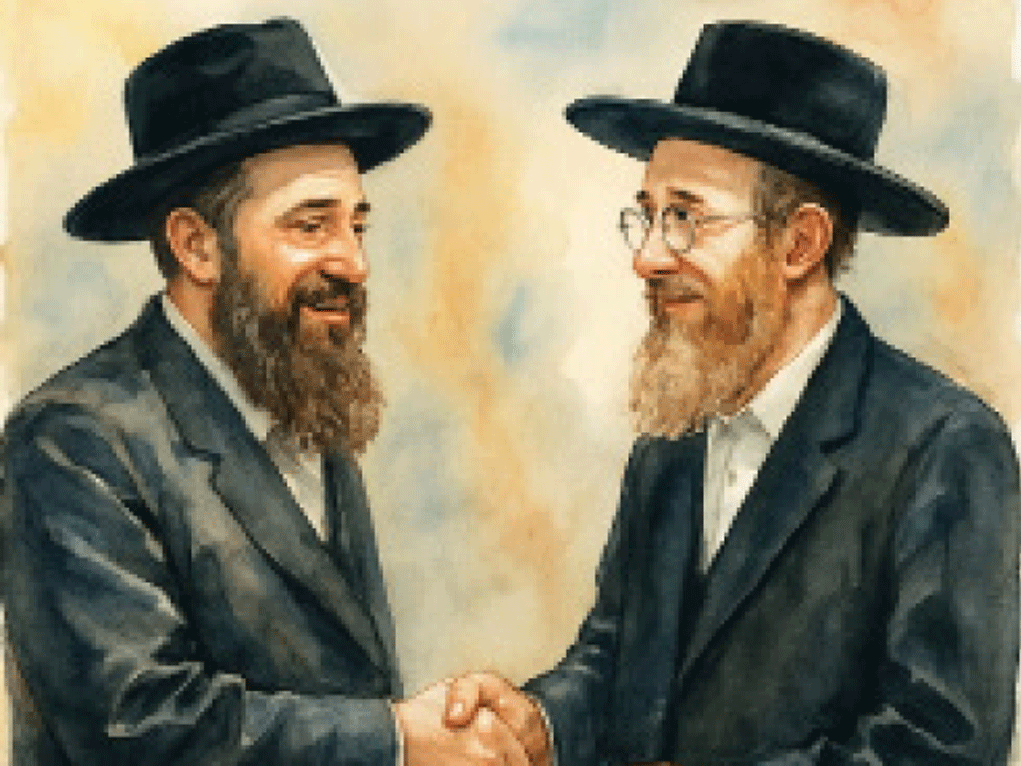

I must confess. I am still an out-of-towner. Although both my rebbetzin and I grew up in New York, we lived in Cleveland for almost twenty years and most of our children were born there. We still say gut Shabbos to people we don’t know, despite the occasional quizzical looks. I remember that when we first moved back to New York, my rebbetzin called out a pleasant gut Shabbos to someone on our way home from shul. The fellow took a few steps backward, responding, “Do I know you?” If it shook us up at first, we got used to the idea that one doesn’t speak to strangers, even amcha Yisroel. But why? Rabbeinu Yonah (commentary to Avos 4:1) advises that any honor we give to others will only cause reciprocity, so why not do it?
Chazal (Medrash Hagadol) to this week’s sedra point out that when Rivkah Imeinu said to Eliezer, “Please drink, my master,” she was just fulfilling the basic derech eretz we each owe to our fellow human being, let alone our fellow Jew. The Medrash reveals that Rivkah did it with simcha as well. Chazal (Pirkei Avos 4:20) state unequivocally that one should greet everyone first, not waiting to respond.
Yet, for some reason, this is often not the case. For the best of reasons — family simchos — we have been spending quite a lot of time away from home with unfamiliar faces. My rebbetzin and children greet everyone, sometimes getting a return brocha, sometimes…nothing. Now, we all know that New Yorkers are tough. We are a tough nation — and am keshei oref — and we have been shaken and hurt enough to constantly be on guard. But a yarmulka or a shaitel are giveaways, and frankly we aren’t speaking of gentiles. The Gemara (Brachos 19b) teaches that sometimes, kavod habriyos even overrides a negative commandment. The Rambam (Hilchos Sanhedrin 24:10) even extends this with a kal vechomer. If we owe this to every human being, a tzelem Elokim, all the more so one of our brethren.
Another kal vachomer is even more dramatic. Chazal (Mechilta end of Parshas Yisro) say, “If we have to give honor to the mizbei’ach, which has no feelings at all, all the more to a person walking up its ramp. I know that this newspaper reaches many cities and even countries, but I am speaking mainly to my fellow New Yorkers and centers of Torah Yidden. We can be hardy and more than a bit crustaceous, but maybe we have forgotten how to simply be friendly, kind and affable, at least to our very own. I certainly don’t want to stereotype or cast aspersions. But when we speak of getting back to basics, let’s start by saying “hello.”
It is interesting that aveilim (mourners) are not permitted to greet people. Some poskim indicate that this is a form of joy that is forbidden to them. We should extrapolate from that how much of an obligation we have to greet our own, even when we don’t know them. The great Chassidic rebbe, the Noam Elimelech, wrote (Siddur Nehora) that “we should take to heart the positive traits of our fellows and not their foibles.” This should be easier when we don’t even know these people, so we shouldn’t have any preconceived notions about their deficiencies. As some people say, “I’m sorry. I don’t know you well enough to hate you.”
When my rebbetzin and I visited Rav Elazar Menachem Man Shach in his modest apartment, the rosh yeshiva initially spoke directly to me. However, after a moment or two, he turned to my rebbetzin, asking gently, “Can you hear me?” Soon he was climbing a ladder to get candies for our children. This was the friendliness and modesty of the gadol hador toward everyone.
The Chazon Ish, when he was already quite frail and could barely move, stood up when a father brought in his Down Syndrome son. He explained with a smile that he rose because the young man had achieved so much of his potential that he was a true gadol, worthy of honor.
When I had the zechus to speak with Rav Yehudah Zev Segal, the beloved rosh yeshiva of Manchester, England, he began to weep when I mentioned the name of a sick child. Such was his love for a Yid he would never meet or even see.
The Rebbe of Vorka, Rav Yitzchok Kalish, would often say that each Yid is like a holy sefer. We may not lean upon him, push him or demean him. However, he concluded, “concerning himself, he should have no airs and think of himself as something mundane, which has no expectations whatsoever” (Chassidim Mesaprim 2:364). Rav Yisroel Salanter practiced this ideal in his own dealings with everyone. In fact, he taught a lesson to a very frum man who was walking to shul on Erev Yom Kippur, lost in thought about teshuvah. Rav Yisroel asked the man for the time, but he didn’t answer because of his holy reverie. However, Rav Yisroel explained to him that no matter what lofty thoughts he was thinking, there is no excuse for not greeting a fellow man and answering his question if he was able (Ohr Yisroel 59:2).
Speaking of Rav Yisroel, it is appropriate to end the way that he conducted his last moments on this earth. Rav Yisroel noticed that the bochur who was taking care of him was getting nervous about the fact that he would apparently soon be left alone with a corpse. Rav Yisroel spent his last words and strength assuaging the bochur’s concern. He patiently explained that there is nothing to fear from being with a meis for a short time. The chevra kadisha would soon come to take over and the Malach Hamovess was not interested in anyone else in the room (Shaarei Tzion 5693, page 65). To appreciate this act of spiritual heroism, one must imagine that Rav Yisroel would have wanted to concentrate upon his own thoughts of teshuvah, prepare for what he would say to the Heavenly Tribunal or just get his last thoughts together. But to him, characteristically, the needs of another totally took precedence over his own needs of the moment.
None of this is meant, chas veshalom, as criticism of any one community, let alone individuals. Furthermore, there are definitely advantages to living in a thriving Torah atmosphere versus out of town, where not everyone is on the same page religiously. But, with all that, there is something to be said for old-fashioned and unadulterated friendliness, in the spirit of Chazal, the gedolei mussar and our rabbeim and rebbetzins. Sometimes, we sadly can’t see the forest for the trees and lose track of the basics. Having had the incredible zechus of meeting and even knowing some of the gedolim of the past few generations, I can’t recall a single one who was ever unfriendly to a fellow Yid. On the contrary, these giants had no airs about them and were always friendly to everyone. I even remember being present when someone called a friend or his child by their first time when there was a rosh yeshiva there with the same name. On each occasion, to the mortal chagrin of the speaker, the gadol answered as if it was entirely normal for someone decades younger to address them by their first name. To any and all tzaddikim, the opportunity to speak directly to a child or young adult was precious to each of them.
I can only utter a personal wish that each member of Klal Yisroel would feel the need and mandate to greet every other with a short acknowledgment that they count and have been noticed. This can certainly help for the moment, but sometimes it can have positive consequences for generations and eternity. Please, let’s all just say “hello.”