
Israeli news site with a religious-Zionist perspective covering Israel and the Jewish world.
Israeli news site with a religious-Zionist perspective covering Israel and the Jewish world.

 Israel National News59 minutes ago
Cross-border financial planning can become stressful when important tasks are delayed.
U.S. brokerage accounts, IRA accounts, beneficiary designations, estate documents, and account transfers often take longer than expected, especially for Americans living in Israel.
What feels like a routine financial task can quickly become a last-minute scramble when paperwork, firm response times, holidays, and professional coordination all collide.
The best time to deal with financial decisions is before pressure builds. Starting early gives you time to review your options, ask questions, gather documents, and make more thoughtful choices. For cross-border investors, acting during calm periods can make the difference between a manageable process and a stressful deadline.
Key takeaways and action points:
 Israel National News1 hour ago
Soccer (illustration)iStock
An official with the Egyptian Football Association has suggested that the national team’s elimination from the 2026 World Cup was influenced by refereeing bias connected to head coach Hossam Hassan’s political activism regarding Gaza, according to a Thursday report by Israel's Channel 12 News.
Following a dramatic 3-2 defeat against Argentina, where Egypt blew a 2-0 lead, EFA board member Mustafa Abu Zahra argued that even if controversial officiating decisions were carried out in response to Hassan’s outspoken support for Gaza, the squad’s political message made the outcome worthwhile.
“Palestine is the concern of every Egyptian. If what we went through in the match was because of Hossam Hassan’s support for the Palestinian cause, then we have gained by supporting the cause and sending a message to our brothers that we stand with them," he said.
Hassan notably waved a Palestine Liberation Organization (PLO) flag on the pitch after his team's World Cup Round of 32 victory over Australia, saying he was dedicating the win to both the Egyptian and Palestinian people.
Video circulating on social media showed Hassan carrying the flag around the stadium as some fans chanted, "Free, free Palestine!" The footage quickly went viral.
After the defeat to Argentina, Hassan was documented confronting a fan waving an Israeli flag in the stands in Atlanta.
After the final whistle, Hassan was heading down to the dressing rooms when he spotted the fan with the Israeli flag in the stands. He attempted to lunge at him but was restrained by stadium security forces on the scene.
Hassan and his brother, who serves as his assistant, then confronted a photographer at the venue before eventually retreating to the dressing room.
Outrage over the Argentina match reached political circles in the United States as well. New York City Mayor Zohran Mamdani voiced support for the team's grievances, alleging that Egypt was "robbed" as a result of missed fouls and a disallowed goal overturned following a Video Assistant Referee (VAR) review.
 Israel National News1 hour ago
Josh ShapiroReuters
A Delaware County man was placed in police custody Wednesday after allegedly leveling antisemitic slurs and threats of violence against Pennsylvania Governor Josh Shapiro during a visit to a state lawmaker's office, authorities confirmed, according to NBC 10 Philadelphia.
The incident began on Tuesday, July 7, when the 65-year-old suspect visited the district office of State Representative Leanne Kruger to request assistance with unresolved tax issues.
According to law enforcement, while a legislative staff member was actively trying to help the man navigate his tax concerns, he began using antisemitic slurs to describe Governor Shapiro. During the outburst, police say he also communicated an explicit threat to commit arson against the governor’s official mansion.
The Pennsylvania State Police Political Violence Threat Unit launched an immediate investigation and interviewed the suspect at his residence on Wednesday. During the encounter, the suspect gave investigators conflicting details regarding the interaction at the district office.
According to the official police report, the 65-year-old acknowledged using the antisemitic epithet during the conversation. However, he claimed his remarks regarding the governor's mansion were actually meant to be sympathetic, explaining that he and his relatives were survivors of a prior arson attack.
The suspect was taken into custody and faces multiple criminal counts, including terroristic threats with intention to terrorize another, ethnic intimidation, harassment, disorderly conduct through obscene language or gestures, and threatening unlawful harm to influence, according to NBC 10.
A judge set Franklin’s bail at $100,000. He is currently being held at the Delaware County Prison pending further legal proceedings.
Shapiro’s home in Harrisburg, Pennsylvania, was set on fire in April of 2025. The incident occurred just hours after the Shapiro family hosted a Passover dinner at the state-owned residence. Governor Shapiro, his wife Lori, their four children, two dogs, and another visiting family were forced to evacuate the home, which sustained significant damage. Fortunately, no injuries were reported.
The suspect in the case confessed to harboring intense animosity toward Governor Shapiro. He told investigators he would have attacked the governor with a hammer if given the opportunity and acknowledged he was aware people might have been inside the home at the time of the arson.
The suspect in the 2025 arson was charged with attempted homicide, aggravated arson, and terrorism.
 Israel National News2 hours ago
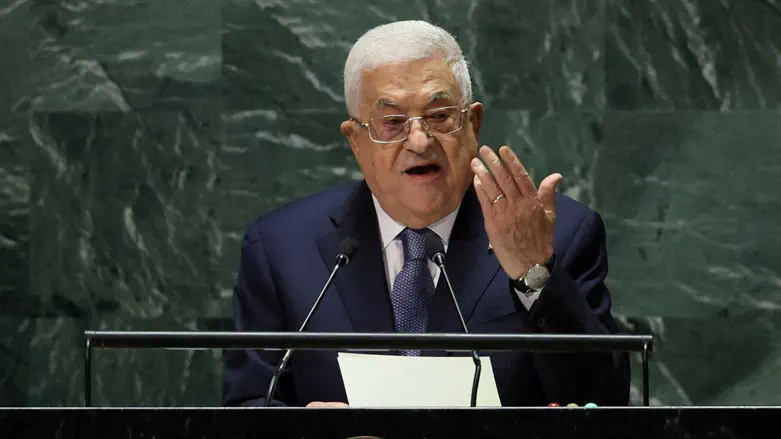
Mahmoud AbbasBrendan McDermid/Reuters
Palestinian Authority (PA) chairman Mahmoud Abbas signed a decree on Thursday slating a legislative election for November 28, setting the stage for what would mark the first parliamentary vote in the PA-controlled territories since 2006, DW reported.
"The presidential decree calls on the Palestinian people in Jerusalem, the West Bank and the Gaza Strip to participate in free and direct legislative elections to elect members of the Palestinian Legislative Council on the date specified," the Palestinian Authority's official Wafa news agency reported.
Abbas, 90, originally secured the PA chairmanship in 2005 under a four-year mandate that technically expired in 2009. The following year, the rival Hamas terror group defeated Abbas’ Fatah movement in elections, touching off a bitter internal conflict that left the legislature dissolved and electoral processes completely frozen for nearly two decades.
General elections in the PA were scheduled for 2021, but Abbas officially announced that they would be postponed, likely due to fears that he would once again lose to Hamas.
Foreign donor nations providing financial subsidies to the Ramallah-based PA have persistently demanded that legitimate elections be held as a prerequisite for continued funding. Last month, Abbas separately announced plans to hold an election for PA chairman in 2027.
 Israel National News2 hours ago
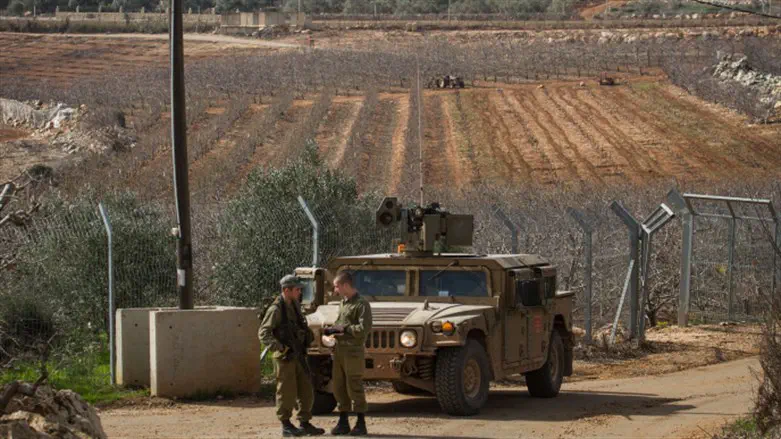
Lebanon borderFlash 90
The initial "pilot zone" in Lebanon designed to transfer territory currently held by Israeli forces back to Lebanese authority will officially begin "in a matter of days," a US official announced Thursday, according to CNN.
The rollout marks the operational phase of a US-brokered effort to restore Lebanese state control following weeks of intense diplomacy.
“Further pilot zones are being mapped out and planned," the official said. “CENTCOM is coordinating with both countries to move forward."
To support the transfer of authority, Washington intends to mobilize broader diplomatic and financial assistance to help Beirut manage the transition across southern Lebanon.
The official said the US “will soon begin outreach to international partners to help the Lebanese Government effectively restore sovereignty in these zones and across their country more broadly."
The initiative builds upon a 14-point framework negotiated during US-mediated discussions between Israeli and Lebanese officials in Washington in late June. Upcoming diplomatic engagements will focus on technical execution rather than high-level political bargaining.
Planned talks in Rome next week will be “a closed discussion that will enable the governments to hand off to technical teams, which will work on all issues outlined in the Framework," the official said.
It remains to be seen whether the framework agreement will be implemented, as significant friction remains between Beirut and Jerusalem over the scope and timing of any military pullout.
According to a diplomatic source familiar with the negotiations, Lebanese President Joseph Aoun has conditioned his country’s ongoing participation in bilateral talks on Israel commencing a military withdrawal from southern Lebanon.
The agreement has also been criticized by the Hezbollah terrorist organization which has refused to disarm, as stipulated in the agreement, and declared that "Without Hezbollah, nothing will pass."
Hezbollah Secretary-General Naim Qassem strongly condemned the framework agreement, describing it as a "humiliating and disgraceful" deal that, he claimed, amounts to a surrender of Lebanon's sovereignty.
Aoun recently defended the framework agreement, asserting that it is the sole pragmatic path to avoid armed combat.
 Israel National News3 hours ago
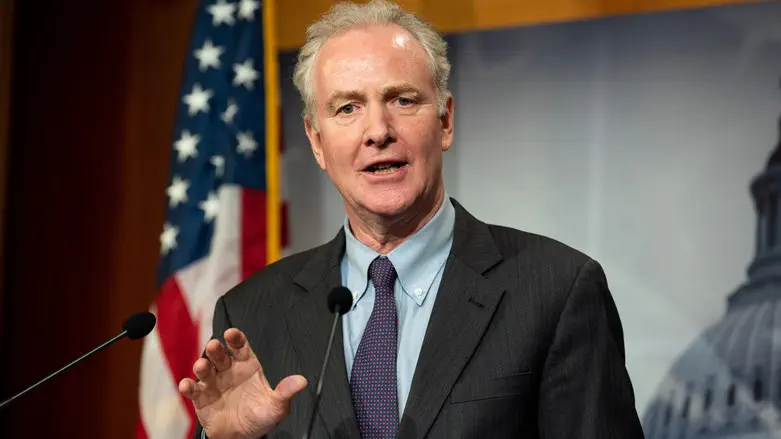
Chris Van HollenReuters
A group of progressive US senators is pushing fellow Democrats to delay advancing major defense spending legislation, seeking to force a floor debate on pending provisions designed to expand military and intelligence cooperation with Israel, Reuters reported on Thursday.
The initiative - spearheaded by Democratic Senator Chris Van Hollen of Maryland - urges colleagues to withhold procedural votes on the National Defense Authorization Act (NDAA) until lawmakers can address proposed measures aimed at deepening security ties between Washington and Prime Minister Benjamin Netanyahu’s government.
The maneuver underscores a deepening rift within the Democratic party over traditional US policy toward Israel. As November's midterm elections draw closer, a growing number of Democratic lawmakers are openly challenging long-standing, bipartisan support for the alliance.
"As Senate Democrats, we should not be providing votes compelling him (President Donald Trump) to deepen the U.S. relationship with Netanyahu's extremist government," the lawmakers stated in a "Dear Colleague" letter obtained by Reuters.
The effort received backing from Democratic Senators Jeff Merkley of Oregon, Ed Markey and Elizabeth Warren of Massachusetts, and Peter Welch of Vermont. Senator Bernie Sanders of Vermont, an independent who caucuses with Senate Democrats and has been one of the most vocal critics of Israel, also signed the letter.
Van Hollen has also emerged as one of the Capitol's most prominent critics of US policy toward Israel, frequently pushing to enforce the Leahy Law to restrict arms transfers over human rights concerns and accusing the Netanyahu government of restricting humanitarian aid to Gaza.
Congress is currently hammering out the final details of this year's NDAA, which sets policy and authorizes funding for much of President Donald Trump's proposed $1.5 trillion military budget. Versions of the legislation passed by committees in both the House and Senate contain provisions to expand US-Israel defense cooperation, as is the case every year.
The letter also noted that draft versions of the fiscal 2027 Intelligence Authorization Act - a measure routinely attached to the broader defense authorization package - include provisions to tighten bilateral intelligence sharing with Israel.
 Israel National News3 hours ago
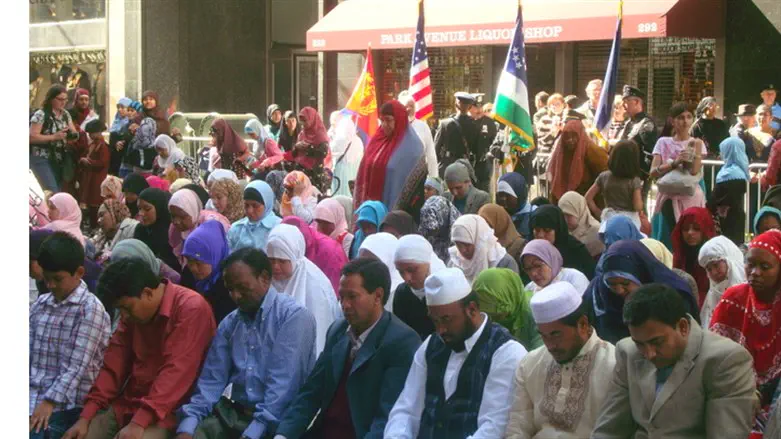
Muslims Pray on NY StreetsNew York Residents
Melanie Phillips, a British journalist, broadcaster and author, writes a weekly column for JNS. Currently a columnist for The Times of London, her new book, Fighting the Hate: A Handbook for Jews Under Siege, has just been published by Wicked Son. Her previous book, The Builder’s Stone: How Jews and Christians Built the West and Why Only They Can Save It, was published in 2025. Access her work at: melaniephillips.substack.com.
(JNS) More and more information is surfacing to reveal that the Islamic holy war against the West isn’t just being waged on the battleground of the Middle East.
Even more significantly, it’s also being waged through a trillion-dollar influence campaign to colonize and subvert the Western mind, organized by extremists from the Islamic world.
These have tunneled into the West through a vast civic infrastructure whose real purpose and sources of funding have been as well concealed, and in their own way are just as deadly as the subterranean genocide factories in Gaza and Lebanon.
To those with eyes to see, it was obvious from the start that the hate marches springing into existence after Oct. 7, 2023-even while the Hamas-led atrocities were still going on-weren’t spontaneous protests against Israel.
They were instead a globally coordinated campaign to turn gullible Westerners into the unwitting army of Islamic jihad through support for the Palestinian Arab cause.
An important new report by NGO Monitor shows that this post-Oct. 7 protest infrastructure in Britain has used the signature liberal causes of humanitarianism and human rights to launder the Islamic jihad against the West.
The report found that, through a series of concentric circles, just six groups have been involved in more than 80% of the major protests.
In the innermost circle sit the states hostile to the West: Iran, China, Russia and Qatar; terrorist organizations, such as Hamas, Hezbollah and Al-Qaeda; and extremist religious-political movements like the Muslim Brotherhood.
Lapping around them are charities, campaign groups, protest movements and advocacy organizations that provide legitimacy for these hostile forces, amplify their propaganda and transmit extremism to society.
Out of 40 organizations mapped in the report, at least 11 have links to extremist groups or officials who have cooperated with Hamas, Hezbollah, Iran’s Islamic Revolutionary Guards Corps (IRGC), the Popular Front for the Liberation of Palestine and the Muslim Brotherhood.
U.S.-based progressive foundations and far-left activist groups, such as the Open Society Foundation, Action Network, Cultures of Resistance and the Rockefeller Brothers Fund, are providing significant funding and support, facilitating donations and strengthening the British protests.
Some of these groups have helped inspire violence in the United States. Last month, U.S. prosecutors indicted eight current and former students at the University of Michigan for conspiring to threaten university leaders, law enforcement, businesses and the Jewish Federation.
The indictment stated that one of the internet websites used by the defendants to spread their demands belonged to Palestine Action, the U.K. group that continues to attract passionate support from otherwise respectable, middle-class Brits, despite having been proscribed by the government as a terrorist outfit.
Well-meaning, if ignorant, people continue to support such organizations on the naive assumption that they help the oppressed.
The Islamist program to subvert the Western mind has relentlessly focused for years on universities and schools. The Institute for the Study of Global Antisemitism and Policy has just published another vitally important report, “Institutional Capture," which documents how anti-West, Islamist Qatar has reshaped American education in a devastating program of cultural infiltration.
Over the past 16 years, according to the report, Qatar Foundation International (QFI), the U.S. member of the Doha-based Qatar Foundation for Education, Science and Community Development, has conducted a systematic campaign to embed itself within American educational institutions.
Deploying at least $65.3 million across 220 documented initiatives between 2009 and 2025, it has been a “manipulator of thought" in social studies, science, technology, engineering, arts and mathematics, as well as in youth engagement, professional development and social activism initiatives.
Through corporate restructuring and strategic partnerships, it has leveraged the reputation of host organizations to embed the Qatari viewpoint on the Middle East in educational materials served up to students in both universities and K-12 schools.
At national conferences for social studies educators, it has stacked the proceedings with presenters trained by QFI to present Qatari talking points.
The result has been an educational echo chamber that “casts doubt on Israel’s very existence, rejects curriculum that teaches students about the efforts to normalize relations between Israel and Arab states, and normalizes and relativizes terrorism."
This is the template for the Muslim Brotherhood’s long-term strategy for civilizational jihad against Western society, turning educational institutions into a weapon of war by shaping, producing and normalizing ideological positions that fit the agenda of conquering the West for Islam.
It’s scant wonder, therefore, that the West has fallen victim to a psychotic madness about Israel’s fictitious perfidies-a malevolent narrative of demonization that is in turn a Trojan horse for suicidal anti-Western loathing and contempt among the elites. Millions of people are being manipulated on a staggering scale.
America is beginning to grapple with this. In March, the House Committee on Education and the Workforce released nearly 900 pages of documents detailing two major American university partnerships in Qatar.
As the Jewish Institute for National Security of America observed in its own analysis of these documents last month, they showed that Qatar has “used complex funding contracts with American universities to acquire access to intellectual property, governance deliberation, academic credentialing and institutional reputation, which it has used to help support Islamist movements hostile to the United States and its allies."
The release of those documents galvanized the introduction last month of legislation to ban federal funding to colleges that operate branch campuses in adversarial countries, or accept research funding for sensitive fields like artificial intelligence, biotech and quantum computing.
That’s a welcome development, but acute concerns still remain.
This process of jihadi infiltration has been going on for decades. Successive British governments and U.S. administrations have refused to acknowledge the civilizational threat that it poses.
In large measure, this is because the West can’t understand Islamic religious fanaticism. It assumes that everyone in the world is, like itself, governed by self-interest. So it simply can’t get its collective head around the fact that Islamists are apocalyptic and messianic, and believe they have a divine command to conquer Israel, America and the West for Islam.
U.S. President Donald Trump seems to make the same mistake. True, none of us can know what’s in his mind. Maybe he really does understand the Islamists’ mindset and is playing a long game to reel them in.
But maybe he believes that the Iranian regime and other Islamists are driven by the same self-interest as in his own world, and that therefore he can end all such conflict through his supposedly unmatched "art of the deal".
Such concerns are exacerbated by the extremely troubling financial links between members of Trump’s circle and Qatar. Rather than treating it as the enemy of the civilization that it is, Trump has used Qatar as a trusted interlocutor in talks with Hamas, the Taliban and Iran.
His apparently unshakeable belief in the universality of venal self-interest presumably explains his disbelief that the Iranian regime won’t accept that its devastating military losses mean it’s lost the war.
It explains his view that Gaza’s Islamist lions would obviously be turned into lambs by the prospect of the Strip’s transformation into a property developer’s Riviera paradise.
And it may explain his support for Turkey’s menacing Islamist president, Recep Tayyip Erdoğan. According to Trump, Erdoğan almost entered the war in support of Iran and against America, but the U.S. president talked him out of it. Now, Trump reportedly intends to reward him for this by selling him F-35 warplanes.
Taking his words at their face value (which may always be a mistake), this suggests that narcissistic fantasies prevent this American president from understanding what being an Islamist means.
So as Trump continues to give us all political whiplash by his on-off-on Iran war, and as the West allows its mouth to be stuffed with Qatari gold, the Islamists fight on-as they’ve done ever since the seventh century-playing the longest civilizational war game in the world.
 Israel National News3 hours ago
Mike Huckabee and Yarden BibasAyal Margolin/Flash 90
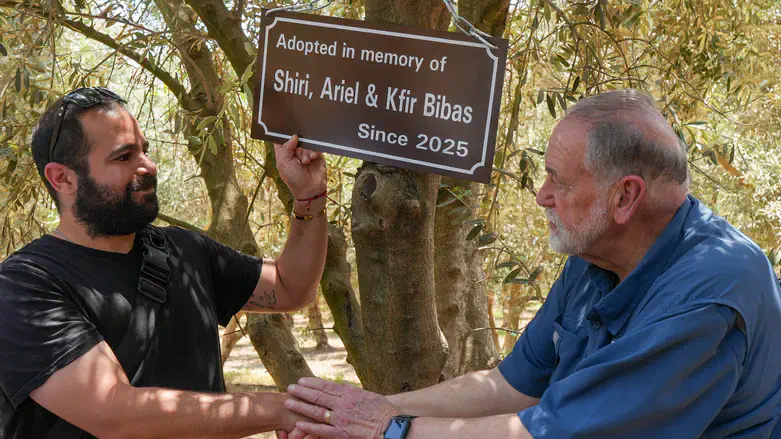
US Ambassador to Israel Mike Huckabee participated on Thursday in a memorial event at Moshav HaYogev, located in northern Israel west of Afula, in memory of Shiri, Ariel, and Kfir Bibas, as part of the "My Tree in Israel" initiative. A memorial tree was dedicated to the family members during the ceremony.
The event was also attended by Yarden Bibas and his sister, Ofri. Ambassador Huckabee expressed his deepest condolences to Yarden for the tragedy that befell his family, saying that the entire world had prayed for their safety. He added that the atrocities of October 7 and everything the State of Israel endured must never be forgotten.
The kidnapping of the Bibas family - mother Shiri, four-year-old Ariel, and nine-month-old infant Kfir - from their home in Kibbutz Nir Oz became one of the most heartbreaking images of the October 7 Hamas attacks. The haunting footage of a terrified Shiri clutching her two young, red-headed boys in a blanket as terrorists dragged them into Gaza shocked the global conscience. As the youngest hostage taken during the attack, baby Kfir, along with his brother Ariel, quickly emerged as international symbols of the innocent civilians targeted in the massacre and the agonizing plight of the hostages.
Another poignant moment occurred during Thursday’s ceremony, when Avi Harush, father of fallen soldier Reef Harush, showed the ambassador and his wife the tree planted in memory of his son - a commando soldier who fell in battle in the Gaza Strip in April 2024. Harush shared photos, spoke about his visits to the site, and said he feels his son is "at peace."
During the visit, Huckabee toured an olive oil press at the moshav, where he was shown the production process. He noted that he buys many bottles of Israeli olive oil each year to give as personal holiday gifts to friends.
While on the tour, Huckabee updated the plaque on the olive tree he had previously adopted, changing his title from "Governor Huckabee" to "Ambassador Huckabee," and adopted an additional tree in honor of his daughter, Arkansas Governor Sarah Huckabee Sanders.
The "My Tree in Israel" initiative connects supporters of Israel worldwide with local farmers through the adoption of olive trees, grapevines, or shares in whiskey casks, with the goal of strengthening Israel's agricultural sector and local economy.
 Israel National News4 hours ago
TehranReuters
The United States is continuing technical-level nuclear negotiations with Iranian representatives in pursuit of a diplomatic resolution, a US official confirmed on Thursday, even as President Donald Trump authorized a new series of military strikes against targets in Iran this week.
“The United States is still committed to finding a resolution, and technical talks continue. Iran can never possess a nuclear weapon," the official said, as quoted by CNN.
The administration official emphasized that the existing diplomatic framework remains contingent on Iranian compliance, noting that recent maritime disruptions in the Middle East have severely strained the agreement.
The memorandum of understanding, the official added, is “performance-based," and Iran’s actions, including the Strait of Hormuz not being fully reopen and strikes on ships during the NATO Summit, “constitute failed performance at an unacceptable level."
“Iran’s attacks on these innocent vessels are acts of terrorism," the official added.
The US Army struck over 90 targets in Iran early Thursday morning, marking the second consecutive night in which the US struck Iran. The strikes followed Iranian attacks on ships in the Strait of Hormuz.
Trump told reporters, as the strikes were ongoing, that the Iranians had called him and are desperate to make a deal with the US.
“Iran called a while ago. They want to make a deal so badly," said the President, who added, “I just don't know if they are worthy. I don't know if they are going to honor the deal. That's the problem."
 Israel National News7 hours ago
Donald TrumpOfficial White House Photo by Molly Riley)
In an exclusive report by The Wall Street Journal, published on Thursday, individuals familiar with the matter revealed that Israeli intelligence has passed fresh information to US officials detailing an updated Iranian plot targeting President Donald Trump.
If substantiated, the intelligence signals a dramatic escalation in the ongoing conflict between Washington and Tehran.
Tehran has repeatedly pledged retribution against Trump following the first-term US drone strike that killed Qassem Soleimani, the high-ranking general who led the Quds Force of the Islamic Revolutionary Guard Corps.
When approached for comment, the Israeli Embassy in Washington declined to elaborate, while Iran’s Mission to the United Nations did not immediately respond. A senior US official confirmed to Channel 12 News that Israel recently transferred new and detailed intelligence to the United States indicating that elements within the Tehran regime actively discussed a plan to assassinate Trump.
Two US officials later told Channel 12 News that the intelligence transferred by Israel to the United States does not point to an organized, specific, or detailed plot to assassinate Trump.
According to the US officials, the Israeli intelligence actually centered on a single piece of information involving purely general discussion on the topic among elements within the Iranian regime.
For its part, the White House directed The Wall Street Journal to statements made by the president earlier in the week.
The remarks in question were made to journalists in Ankara, Turkey, when President Trump explicitly addressed the looming threats against him.
“They want to take out the US leader - me," he said. “I’m on every list. I saw this morning, I’m on every single one of their lists. And so far, I guess I’ve been a little bit lucky, but that maybe doesn’t last very long."
Meanwhile, hostility from Tehran remains public and pronounced. During the funeral for slain Iranian Supreme Leader Ali Khamenei, crowds chanted calls for Trump’s death while displaying a banner reading, “We Will Kill Trump."
 Israel National News7 hours ago
Minister Bezalel SmotrichYonatan Sindel/Flash 90
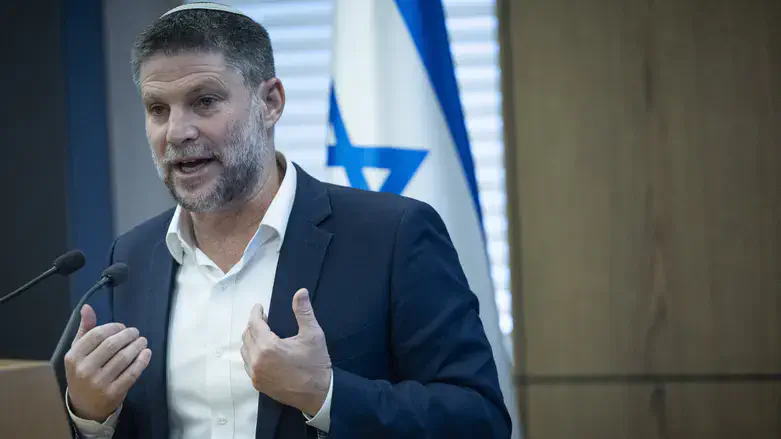
Finance Minister Bezalel Smotrich revealed Thursday evening details from a conversation he held with US Special Envoy to the Middle East, Steve Witkoff, shortly after his appointment to the role.
Smotrich said that the meeting took place alongside then-Strategic Affairs Minister Ron Dermer, a day after Witkoff visited the Gaza border area and viewed footage documenting the atrocities of the October 7 attack.
Smotrich recounted that Witkoff was visibly shaken by the footage and told him: "Bezalel, I will not let two million Nazis live next to your children along the border fence."
Addressing Israel's security policy in the Gaza Strip and Lebanon, Smotrich added, "There is only one thing that hurts the enemy - land. Anyone who messes with us will lose land forever," while calling for the establishment of a long-term security buffer zone along the Lebanese border.
Watch the Hebrew video:
סמוטריץ׳ חושף את הדברים שאמר ויטקוףללא קרדיט
 Israel National News8 hours ago
Netanyahu and TrumpAmos Ben Gershom/GPO
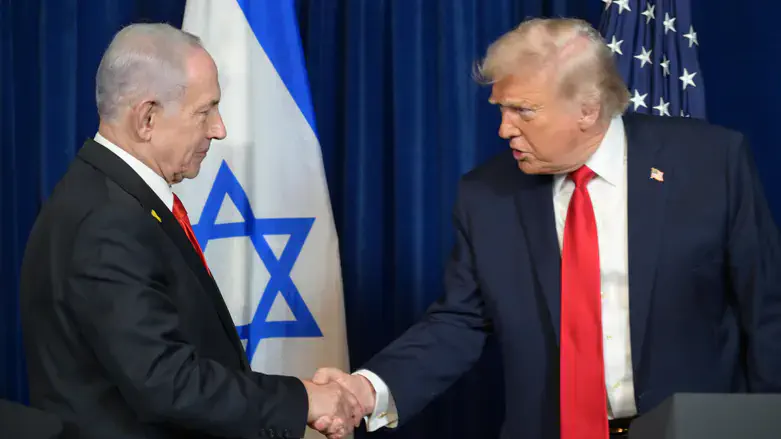
As part of the continuous contact between Prime Minister Benjamin Netanyahu and US President Donald Trump, an additional conversation took place this evening between the two on Thursday evening.
According to the Prime Minister’s Office, during the conversation, the continued coordination between the countries in various sectors was established.
President Trump updated the Prime Minister on American moves in the Gulf.
The Prime Minister, on his part, raised the severity of the statements made by Turkish President Recep Tayyip Erdogan and his people against the existence of the State of Israel.
Netanyahu also highlighted the need for security zones along Israel's borders, according to the statement.
The Prime Minister earlier on Thursday evening spoke at the graduation ceremony of Air Force Flight Course 192, addressing regional security threats, the campaign against Iran, and the importance of preserving Israel’s air superiority.
"The war is not over. Alongside the old challenges, new challenges are emerging. Alliances rise and alliances fall - we are closely monitoring these developments and are prepared for every scenario. We must always be stronger than our enemies," he stressed.
In an apparent reference to the possibility of a US sale of F-35 fighter jets to Turkey, Netanyahu added, "Preserving Israel’s air superiority is a cornerstone of national security and a key element in maintaining stability in the Middle East."
 Israel National News9 hours ago
Ayelet ShakedTomer Neuberg/Flash90
A new poll conducted by Menachem Lazar's polling institute indicates that former minister Ayelet Shaked is the preferred candidate among undecided religious Zionist voters to lead a new party.
According to the poll, which was conducted for the religious Zionist Hamavdil advertising agency, Shaked has the support of 24% of the respondents, ahead of Yuli Edelstein, who received 12%, and Gilad Erdan with %9.
Last week, it was revealed on Arutz Sheva that the President of the Otniel Yeshiva, Rabbi Benny Kalmanson, and other Zionist rabbis have been working recently to examine the possibility of forming a new right-wing party. As part of the process, the rabbis have reached out to several right-wing figures to check the feasibility of the move and their willingness to participate in it.
Among the figures who were apparently approached were MK Yuli Edelstein, former Ambassador Gilad Erdan, and former Minister Ayelet Shaked. Speaking with Arutz Sheva-Israel National News, Rabbi Kalmanson, whose son Elchanan fell during the battles of October 7th, noted that he reached out to figures from the heart of the religious Zionist community, Hesder yeshiva deans and settlement leaders from across the country.
According to Rabbi Kalmanson, there is dissatisfaction with the actions of the party called "Religious Zionists." "Other rabbis and I are not happy with what is being done in the party that took the name 'Religious Zionists.' We are certainly examining other partnerships on the right and the hard right, with different approaches to military service and dependence on the haredi public, and various roles in the rabbinical world. We are certainly looking into the matter."
 Israel National News10 hours ago
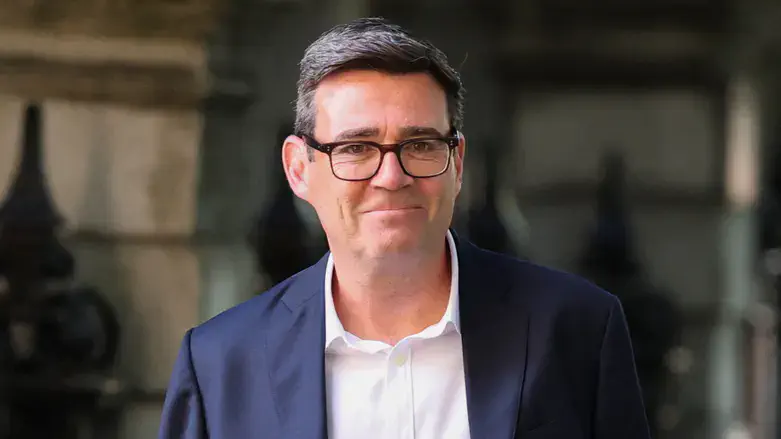
Andy BurnhamReuters
British MP Andy Burnham, who is expected to succeed Keir Starmer as prime minister, laid out his anti-Israel platform on Thursday, apologizing for Labour's initial response to Israel's military campaign in Gaza and promising a stronger approach toward the Jewish state if he becomes prime minister.
In an interview with The Guardian, Burnham said Labour's early handling of the issue fell short. "I know many people feel that at the start of Israel's military action in Gaza, my party didn't get it right, and I am sorry about that," he said. "The response has too often not been good enough. We need to do better."
Burnham said a future government under his leadership would seek to increase pressure on the Israeli government, including by considering additional sanctions against individuals and entities and examining a ban on trade in goods originating from what he described as illegal settlements.
"We've got to do more to put pressure on the Israeli government," Burnham said. While noting that the UK had already taken "some important steps," he added, "the UK was too slow to call for a ceasefire in the war launched following the Hamas-led October 7th Massacre. And we must now do more to strengthen our approach."
Burnham declined to describe the situation in Gaza as genocide, saying such a determination should be left to international courts.
"I have been absolutely appalled by what I've seen and read about the destruction of Gaza," he said. "There's increasing evidence that war crimes appear to have been committed. There must be accountability for the depth of the suffering the people of Gaza have experienced. Ultimately, however, it must be for the international courts to determine, rather than politicians."
The interview also addressed concerns among Jewish communities. Burnham said he remained committed to combating antisemitism and reiterated his condemnation of the Hamas attacks of October 7th.
"There is no contradiction between a zero-tolerance approach to antisemitism and holding the Netanyahu government to account," he said. "I will always take a fair and balanced approach and stand up for what is right."
Burnham also criticized what he described as an increase in settler violence in Judea and Samaria and eastern Jerusalem, as well as continued settlement expansion. He said further measures should be considered, including "looking at further sanctions" and "looking at measures to ban trade in goods with illegal settlements."
He also said the humanitarian situation in Gaza remained "a scar on our collective conscience," citing continued civilian casualties, limited humanitarian aid, and the continued expansion of Israeli military control.
 Israel National News10 hours ago
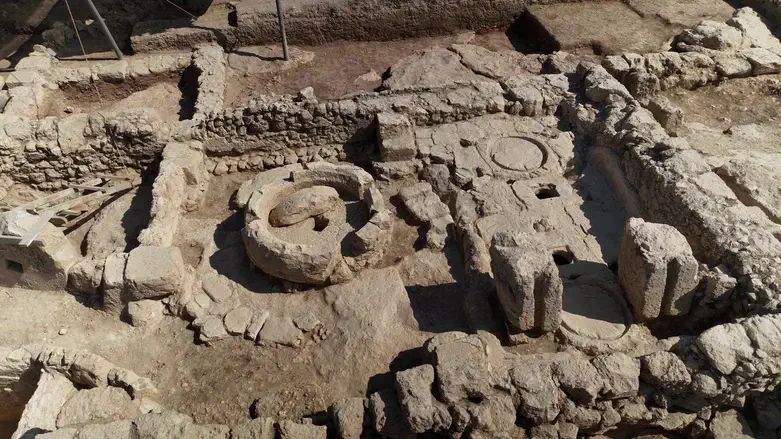
AntiquitiesEmil Aladjem, Israel Antiquities Authority
A new legal opinion by the Kohelet Forum, written by attorney Avraham Shalev and commissioned by the Shomrim Al Hanetzach [Guardians of Eternity] organization, states that, contrary to the position of the Civil Administration and the National Guard’s legal advice over the years, Israel has an obligation to act against the destruction of heritage sites in Areas A and B.
The opinion was written against the backdrop of the intention to build a mosque on the territory of the archaeological site of Brechot Shlomo [Solomon's Pools], which, according to the organization, would have meant the irreversible destruction of antiquities, a move that was prevented following the intervention of the political echelon.
The organization claims that for years Israeli enforcement against damage to heritage sites in Areas A and B was avoided due to the position of the Civil Administration and the National Security Council (NSC)'s legal advice. They claim that the new opinion presents a legal foundation according to which Israel is obligated to act to protect heritage sites in these areas as well.
This morning (Thursday), a discussion was held in the Foreign Affairs and Security Committee's subcommittee on Judea and Samaria on the subject of violations of the Oslo Accords by the Palestinian Authority and the Israeli response. During the discussion, it is reported that representatives of the Civil Administration and the National Defense Ministry refrained from clearly answering who is the Israeli entity responsible for enforcing the Oslo Accords in Areas A and B.
According to the opinion, the actions and omissions of the Palestinian Authority constitute a violation of the articles in the Oslo Accords that oblige it to protect archaeological sites and prevent damage to them. It was further determined that in light of this violation, Israel is not limited by the agreements in this context, and it is entitled to exercise its powers in Areas A and B to prevent the destruction of heritage sites, when this is a specific suspension of the arrangements for the purpose of preventing damage and not a sweeping withdrawal from the agreements.
Shomrim Al Hanetzach stated that the opinion provides the political echelon and the cabinet with a legal foundation for immediate Israeli intervention. The organization said, "Solomon Pools and the Hasmonean Palaces also deserve a yellow line. "The time has come for Israel to occupy the area and operate with complete freedom of action. The heritage sites cannot wait. We call on the Israeli government to show governance and act immediately, so that we don't wake up in the morning and discover one day that 3,000 years of history have been destroyed because of legal advice that ties the hands of the executive and political echelons."
 Israel National News11 hours ago
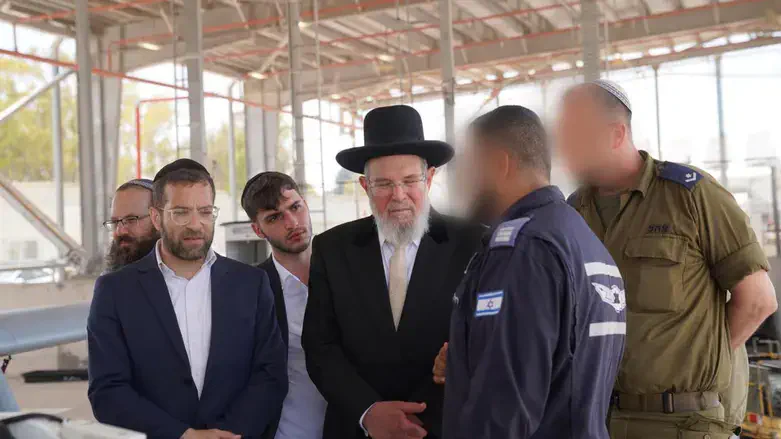
Rabbi Kalman BerIDF Spokesperson
Israeli Chief Rabbi Kalman Ber sent a halakhic letter to the head of the Shvut Israel Yeshiva, Rabbi Yehoshua Ben Meir, in which he addressed the issue of halakhic dispensations to desecrate Shabbat to boost morale during wartime.
In his letter, the Chief Rabbi rules that there is no place for such a blanket permit since fundamental instructions on matters of Shabbat and war should be accepted by Torah scholars and halakhic arbiters.
At the beginning of the letter, the Chief Rabbi noted that he usually avoids ruling on halakhic questions regarding the military since "the Military Rabbinate, which is on the ground and is closely familiar with the operational reality, is the appropriate body to show the way in such cases."
This being said, in this case, according to Rabbi Ber, there is "a general halakhic provision that comprehensively permits Shabbat desecration to boost morale, and it could be used as a precedent for other cases," therefore, he sees a need to address it.
Rabbi Ber stated that he agrees with Rabbi Ben Meir's halakhic stance, and writes that "The aforementioned exemption poses a significant halakhic and factual challenge and is not based on halakhic sources and on an accurate examination of reality. Therefore, there is no place to allow Shabbat desecration to boost morale."He further warned that expanding permits of this kind could “open the door to broadening the scope of permissible Sabbath desecration beyond the limits established by the Sages and the leading halakhic authorities throughout the generations."
The Chief Rabbi went on to say that, based on his own military service, there is no doubt that leave contributes to soldiers' recovery and morale. However, he argued that this alone does not constitute pikuach nefesh (a life-saving necessity) that would halakhically justify violating the Sabbath. He added that such a directive could also affect the public's perception of the sanctity of the Sabbath if civilians see observant soldiers traveling home on Shabbat.
The rabbi further emphasized that when issuing a broad and unprecedented halakhic ruling with far-reaching public implications, “it would have been appropriate to first submit it for the consideration and ruling of the foremost Torah scholars and leading halakhic authorities, and only afterward publish it as a general directive." He said that, going forward, any fundamental directive of this nature should be brought before senior Torah scholars for a ruling before being made public.
At the same time, Rabbi Kalman Ber stressed that his remarks should not be viewed as criticism of the IDF's unit rabbis, battalion rabbis, or the heads of the Halakha Department in the Israeli Military Rabbinate. He said their role is to implement halakhic rulings in accordance with operational realities, whereas determining overarching halakhic policy “is entrusted solely to the foremost Torah scholars and leading halakhic arbiters, whose rulings are authoritative."
 Israel National News11 hours ago
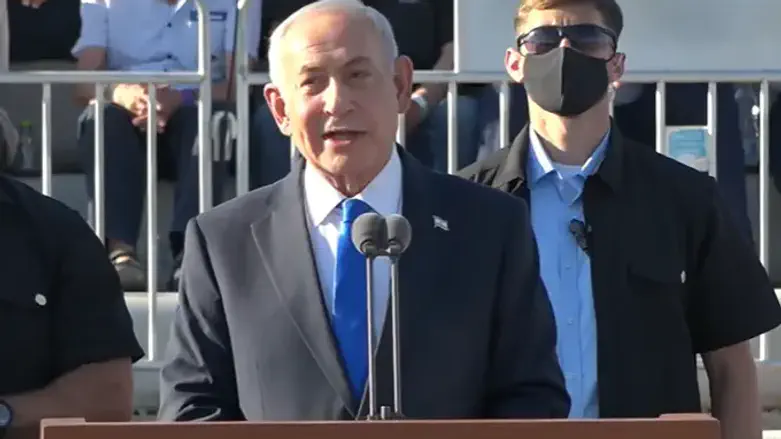
Prime Minister Benjamin Netanyahu spoke Thursday evening at the graduation ceremony of Air Force Flight Course 192, addressing regional security threats, the campaign against Iran, and the importance of preserving Israel’s air superiority.
"The skies of the Middle East have witnessed unprecedented activity over the past year - particularly the two successful operations we launched against Iran," Netanyahu said. "Had we not acted, Iran would have armed itself with nuclear weapons. The Iranian terror regime suffered a severe blow, and our policy is clear: with or without an agreement, Iran will not possess nuclear weapons."
Turning to recent regional developments, Netanyahu said, "The war is not over. Alongside the old challenges, new challenges are emerging. Alliances rise and alliances fall - we are closely monitoring these developments and are prepared for every scenario. We must always be stronger than our enemies."
In an apparent reference to the possibility of a US sale of F-35 fighter jets to Turkey, Netanyahu stressed: "Preserving Israel’s air superiority is a cornerstone of national security and a key element in maintaining stability in the Middle East."
Netanyahu’s comments were viewed as a reference to recent regional developments, particularly Turkey’s growing influence and reports that the United States may approve the sale of F-35 aircraft to Ankara. Against this backdrop, the prime minister emphasized the need to preserve Israel’s air superiority, stating that Israel must remain "stronger than its enemies."
Defense Minister Israel Katz also addressed the possibility of renewed fighting with Iran, continued IDF operations on multiple fronts, and the missions awaiting the graduates of the course.
Opening his remarks, Katz recalled his speech at last year’s Air Force graduation ceremony. "Exactly one year ago, at the conclusion of Flight Course 190, I said that this ceremony sends a direct message to the dictator Khamenei and the group of Iranian ayatollahs - that Israel’s long arm will reach you in Tehran, Tabriz, Isfahan, and anywhere from which you try to threaten and harm Israel."
He continued: "About four months ago, we returned to operate in Iranian airspace, eliminated many senior regime officials, and in the historic opening strike of Operation 'Roaring Lion,' eliminated Khamenei the father and severely wounded Khamenei the son."
Katz delivered another warning to Iran, saying: "Today as well, I want to begin my remarks with a message to the Iranian regime and all those who seek our harm: The State of Israel is stronger, more determined, and more powerful than ever."
The defense minister stressed that Israel is prepared for the possibility of renewed fighting. "The IDF is ready and prepared to resume the campaign, achieve renewed air superiority, and carry out a blue-and-white strike in Iran to eliminate threats - even for a third time. If we need to return, we will return, and with even greater force."
Katz added: "The IDF is currently deployed in security zones in Gaza, Lebanon, and Syria and will not withdraw from them. It is our right and duty to protect the residents of the Galilee and the citizens of Israel from jihadist enemies seeking to destroy the State of Israel."
Addressing the commemoration of fallen soldiers, Katz said: "All our achievements on the battlefield, in the diplomatic arena, and in the struggle for Israel’s security and future were made possible by the courage, bravery, and sacrifice of IDF soldiers and security personnel, and by the fallen throughout the generations who gave their lives for the revival of the Jewish people in their homeland and for the defense of the State of Israel."
He added: "Thousands of years from now, our people will remember the warriors of Israel who fell defending the homeland - their courage, their spirit, and the price they paid to ensure the existence, security, and future of the State of Israel."
Katz concluded his remarks by addressing the new graduates: "Graduates of Course 192, I have a feeling you will have no difficulty accumulating flight hours in the coming years."
 Israel National News12 hours ago
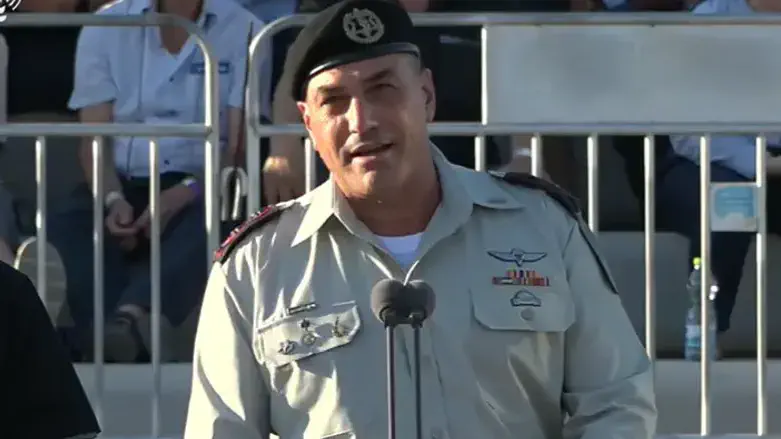
IDF Chief of Staff Eyal ZamirIDF Spokesperson
IDF Chief of Staff Eyal Zamir delivered an address on Thursday at the graduation of the 192nd Israeli Air Force Pilots Course. In the address, he summed up the IAF's activities during the war, mentioning the various operations, the lessons learned from the October 7th Massacre, and the IDF's preparations for the future.
Zamir opened his remarks, stating that "a clear line of initiative, creativity, professionalism, and heroic courage connects the chapters of exemplary operations of the IDF and the Air Force over the years."
He mentioned the Entebbe hostage rescue operation, the Second Lebanon War, and Operations Rising Lion and Roaring Lion, saying they "are a demonstration of Israel's unique offensive and defensive technological might, a testament to the Israel Air Force's unique ability to reinvent itself against every threat, to turn the impossible into a sophisticated operational plan, and to execute it with remarkable precision at the moment of truth."
The Chief of Staff emphasized that the military obtained its achievements thanks to broad inter-branch collaboration. "Everyone works together for a joint goal." According to Zamir, "It is difficult to describe in words the multi-arena missions conducted by IAF pilots in the skies of the Middle East in the past two and a half years. We struck every arena."
Later in his address, he detailed the IAF's achievements: "We achieved air superiority that allowed us to fly over any area to our choosing. In a surprise attack, we eliminated the leaders of the ayatollah regime, the nuclear officials, the weapons industry, the surface-to-air missile batteries, and the surface-to-surface launchers. We turned the third perimeter into a first perimeter and caused the enemy in Gaza, Beirut, Sanaa, and Tehran to feel the same sense of persecution."
According to Zamir, "At the same time, the IAF also led the aerial defense effort with unprecedented success rates that allowed us to continue to fight. We distanced the existential threats a short time before they became tangible."
He added that "in a unique collaboration between the IDF and the US Military, our ally, the biggest superpower in the world, we flew wing-to-wing... a historic joint combat procedure which led to unprecedented capabilities that proved the IAF's purpose: to be Israel's strategic and multi-arena wing."
Addressing the course graduates, Zamir said, "Dear graduates, today you inherit this proud legacy-to dare, to innovate, to surprise, and to achieve victory."
At the same time, he stressed, "We never forget our point of departure. The failure of October 7 will forever be remembered as a national disaster and a systemic failure. We looked directly at the root causes of the shortcomings throughout the IDF, and we did the same within the Air Force. Without compromise, and with the required humility, we worked to uncover the truth, internalize the lessons, and implement them. As a result, we remain constantly prepared and alert in accordance with the evolving security assessment."
The IDF Chief of Staff noted that "in recent weeks, hundreds of Air Force aircraft have been on immediate takeoff alert," adding, "Even at this moment, we are closely monitoring developments in Iran and Lebanon and are prepared for immediate action. Against anyone who attempts to harm us, we will respond with overwhelming force."
He also addressed the growing integration between the Air Force and ground forces. "A major change that has taken place within the Air Force over the past two and a half years is the deep partnership with the ground forces. Fighter jets and attack helicopters carried out thousands of strikes during the ground campaigns in Gaza and Lebanon, providing closer support than ever before to maneuvering forces. 'Sa'ar' helicopters transported troops to the front lines and evacuated wounded soldiers directly from the battlefield."
Zamir also paid tribute to those killed and wounded in the war. "'Even a fist was once an open hand and fingers,' wrote the poet Yehuda Amichai, and we remember that well. We remember the fallen, our finest sons and daughters, who gave their lives in fierce battles. We embrace the bereaved families and stand alongside those wounded in body and spirit, who bear the scars of war. Their memory and heroism are the compass that obligates us to continue, to fight, and to prevail."
Turning to the future of the Air Force, he said, "Graduates of Pilots Course 192, our Air Force is in the midst of a dramatic force-building process, a broad expansion that is being accelerated even under fire. New squadrons are being established, we are acquiring new transport and attack helicopters, and our aerial refueling and intelligence capabilities are being enhanced to ensure Israel's absolute air superiority for generations to come. These aircraft and these capabilities are now waiting for you. I have complete confidence in the skills you have acquired to join the ranks of our aircrews and take to the skies at any hour in defense of the homeland."
Concluding his remarks, he addressed senior IDF commanders and the graduates, quoting from this week's Torah portion: "'He shall not break his word; he shall do according to all that proceeds from his mouth.' There is a connection between a military leader and the words that come from his mouth. Words create obligation, and the command to us is clear: Speak with genuine and pure intent, say little, do much. Let our actions speak for themselves."
He ended with a message to the graduates: "New air warriors, fly with determination, fight with courage, and always remember the justice of our cause, the depth of your responsibility, and the people on the ground for whom you serve as a shield of protection. Soar high, 'knights of the skies, brave and noble,' and always return home safely. Today we salute you with pride and great expectations for what lies ahead."
 Israel National News12 hours ago
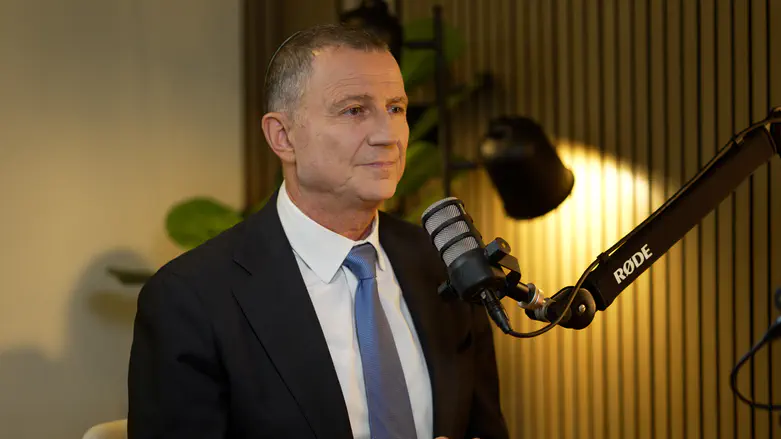
MK Yuli (Yoel) Edelstein spoke to Arutz Sheva-Israel National News about the new political party he is working to establish, aimed at representing hundreds of thousands of right-wing voters who, he says, feel politically homeless.
“We are right now in the midst of an attempt to organize a political party that would answer the real need of, I would estimate, hundreds of thousands of potential voters who are, on the one hand, holding what is defined in this country as right-wing views - the Land of Israel is important to them. A free economy is important to them. Judicial reform is important to them. But they are not prepared to vote for the present coalition because of the draft exemption legislation and because of the oversized influence of different coalition partners, especially haredi bodies," says MK Edelstein.
MK Edelstein refutes the claim that he is against the world of Torah. “I think, actually, it wouldn't be an exaggeration to say that I'm trying to save the world of Torah. Because whoever lives in Israel sees what's going on, and in the end, if the situation continues like that - meaning that no haredim will be drafted into the army, while at the same time they receive serious economic support from the state, and every reasonable person understands that it is not the case that every young haredi man is studying 10 or 15 hours a day in the yeshiva - eventually there will be a government that would, I would say, start a very marginal policy toward the haredi community, and as a result could ruin the world of Torah and could ruin the yeshiva world."
“That’s why I’m trying all the time to come up with practical solutions for the issue, and never at any stage have I suggested that we immediately draft everyone or close yeshivas or something like that," says MK Edelstein. “There are tens of thousands of haredi youth, as we speak, at this very moment, who are not in the world of the yeshiva in practical terms, and they could and should be drafted, and many of them even want to be drafted."
He continued to claim that “sometimes it’s about the leadership. But in many places that I would go to, even at weddings or when paying condolence calls, I was very tense. I thought that when I would come into a hall like that, in an audience like that, I would feel the hostility, I would feel the tension.
“And the first time, the second time, and the third time, the exact opposite happened. People would approach me and say, ‘We want you to succeed.’"
“So I know it’s not an opinion poll, but empirically it’s a good test that there is what they call the ‘asuna,’ the leadership of the haredi community, and at the same time many people are just waiting for a change in the situation in order to become more integrated into society."
On his friends’ opinions in the Likud, as well as Prime Minister Netanyahu, MK Edelstein says, “It’s all about politics. I think it’s all about politics, but I really can’t speak for them because it’s very difficult and very painful for me to try to understand what happens to people. I remember them standing together with me on different podiums and stages and talking about the same values and talking about the same issues. But now, when there’s a demand to vote for massive draft exemptions, they vote, and when there’s a demand not to support sovereignty in Judea and Samaria, they run out of the hall. This is something that, as I’ve said, is very painful, not just difficult to explain."
On his new party, MK Edelstein says that “the left wing says that we are proxies of Netanyahu and that he invited us to be his coalition partners after the elections. But we are not hiding the truth. We speak the truth. The truth is that what the country badly needs is a broad Zionist government. A broad Zionist government can be formed only with the participation of Likud and Religious Zionism.
“But at the same time," he continued, “it can’t be overdependent on haredi factions or marginal factions. I think that only a broad government can take real care of the issues that are so important to the Right."
MK Edelstein says that he does not oppose a government led by Netanyahu, but “the party that I will be part of, or that I will lead, whatever happens, will not be, as they say in the Knesset, the 61st finger of any coalition, because any narrow government - never mind who is heading it and never mind how talented the person who is heading it is - every narrow government will be a big trouble for the State of Israel. It won’t last long and it won’t be able to take care of issues."
He adds that after October 7 there was a feeling, and even dialogue, that the haredim would understand and that they would be with us, but it did not happen. This was very disappointing on a personal level. Though objectively speaking, I understand that the government was too slow, occupied with other issues, and the army was too slow because there was this spirit probably for a week, two weeks, three weeks, but then nothing happened.
“After October 7, as a former chair of the Foreign Affairs and Defense Committee, I immediately started checking what we should be doing in order for October 7 not to happen in Judea and Samaria. We were in real danger. The young men were all taken for reserve duty. In many communities, only women and children were staying there. So it turned out that in many haredi towns and communities in Judea and Samaria, it was impossible to form any kind of local self-defense force because, excluding a few, no one knew how to operate an M16 rifle. This was a real challenge and a real problem."
“This is part of our motivation to make sure that haredi youth, especially in Judea and Samaria but not only there, get military training, serve in the army, and will be able to defend themselves and their families."
“It’s not about total equality, but it’s about sharing the burden and about the possibility of giving people who are serving for 400, 500, 600 days in miluim at least the opportunity to see their families and their children once in a while. It’s about sharing the burden."
MK Edelstein, who served as Minister of Diaspora Affairs, commented on the role of the Jewish Diaspora and its relationship with Israel, saying, “It goes both ways. On the one hand, after October 7, we received incredible support from the Jewish Diaspora all around the world. Unfortunately, among Jews around the world are those who have totally lost their way, or their mind, or whatever you call it, and are part of all these Jews for Palestine movements and this unexplainable self-hating approach. Some would say also the support for Mamdani, among other things.
“But they need us. They need to feel the connection to the State of Israel. Sometimes we are too busy with things inside, and we just expect that they will help us and express solidarity with us, and that we don’t have to do anything. But that’s not the way. I’m sure that we will be able to strengthen the connection there."
 Israel National News13 hours ago
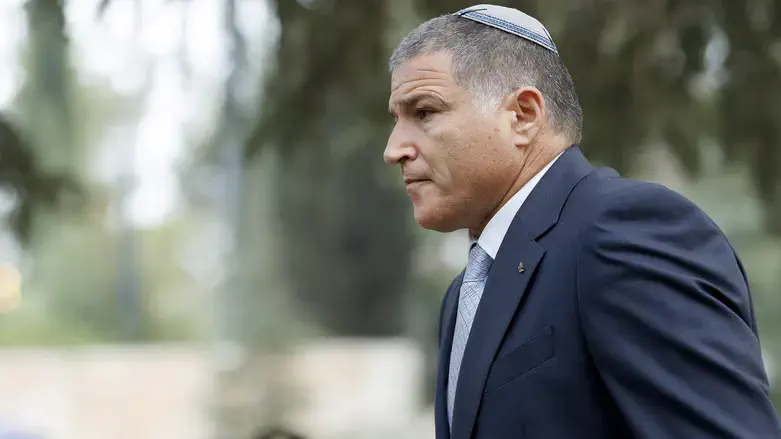
David ZiniMoshe Shai/FLASH90
Shin Bet chief David Zini approached Attorney General Gali Baharav-Miara in order to receive approval to open an investigation into Channel 12 News over allegations that it leaked information regarding the timing of the launch of Operation Roaring Lion.
According to a report on Ynet, the request came after heavy pressure was applied on Zini by cabinet ministers and Prime Minister Benjamin Netanyahu, following a prolonged period in which he pushed back against their demands.
Throughout the process, Zini argued: "There are 4,500 people involved who were privy to the secret. There is no lead. Investigating journalists requires the approval of the attorney general."
A source who attended the cabinet discussion in question described the intense exchanges that took place there as a "cross-examination." The sharp verbal confrontation between ministers and the Shin Bet chief took place while Prime Minister Benjamin Netanyahu had left the meeting room.
Among other statements, the Shin Bet chief explained his view to the ministers: "The incident happened a long time ago; they asked to investigate several months later. More than 4,500 people were privy to the secret. There are those who can leak information and those who receive it. Usually, it happens through third parties. You can conduct communications checks on thousands of people; there are people [who would need to be questioned] with special status."
He added: "This is not the removal of an immediate threat or the saving of lives. You all want it to be treated that way, so that approval would be required in order to investigate, and the proof is that you have not changed this [requirement]. There is no lead in any case. When there are thousands of people who could be the source of the leak, it is always someone who passes information to someone else. We have investigated serious cases after that happened, and even there we had limitations. You, as the legislative authority, should change the law."
Government ministers expressed clear dissatisfaction upon hearing these explanations. In response, Zini concluded his remarks with a direct appeal to them, saying: "I make sure to respect you, but respect yourselves."
 Israel National News13 hours ago
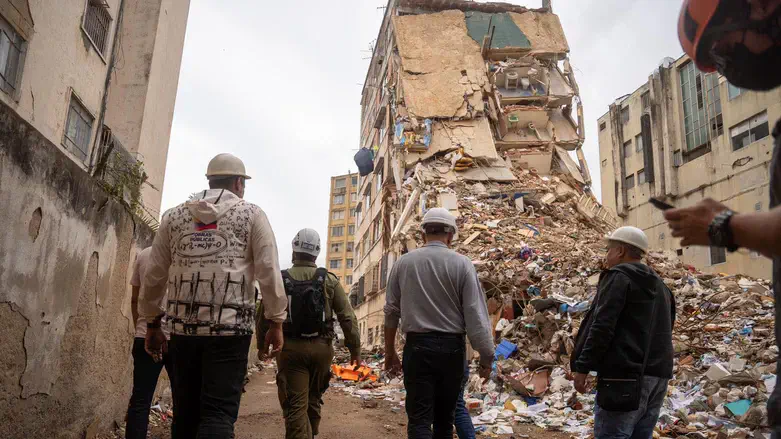
Israeli delegation in VenezuelaIDF Spokesperson
Prime Minister Benjamin Netanyahu spoke on Thursday with the commander of the Israeli aid delegation to Venezuela, Home Front Command Commanding Officer Brigadier General Elad Edri, and Israel's designated Ambassador to Mexico, Yoed Magen.
The delegation has been operating in the country for the past ten days following the devastating earthquake to assist local authorities with structural assessments and classification of damaged buildings and restoration processes.
As part of its activities, the delegation, together with the local Ministry of Infrastructure, formulated a national reconstruction plan that was presented to the acting President of Venezuela, Delcy Rodríguez, and approved by her.
Netanyahu said in the conversation: "Thank you, BG Edri, and hello too to our Ambassador Designate, Yoed Magen. You are doing something unique; you are restoring both ruins and ties. You are showing the residents of Venezuela, as well as the Venezuelan government, the true face of the State of Israel."
He added, "The rescue and aid delegation assisted countless countries around the world, but what you are doing now is going to a country that cut ties nearly 20 years ago, and you're proving how good it is to be tied to Israel. We didn't ask who or what. We said, 'What needs to be done to help?' And you went with your good delegation, and you are representing us brilliantly."
Netanyahu noted that "unfortunately, we have gained a lot of experience in dealing with ruins because of our enemy's missile barrages, and I think you are number one in the world. But as far as we are concerned, what we are doing now on the diplomatic front, with the human connection between the nations, is no less important, and I salute you for this. Do your best, and we will welcome you with open arms when you return home. Thank you. Bravo."
BG Edri responded, "We got here last Wednesday following the request of the Venezuelan government to help in the effort to rebuild the country after the earthquake. We have been here for ten days already. Our mission began as a technical screening mission, meant to examine structures. Very quickly, in coordination with the local Infrastucutre Ministry and under the leadership of the Ambassador with me here, Yoed Magen, the Ambassador Designate to Mexico, we began building a national plan that aims to take all the components that need to be carried out to allow the destroyed buildings to be removed, to demolish them, to remove the large amount of waste that has accumulated, and to begin to return this place to some kind of routine."
Edri added, “We are very proud to represent Israel here. There are more than 30 members of the Israeli Foreign Ministry, the Home Front Command, and other IDF bodies. We are working around the clock together with the local government and the Venezuelan government's Ministry of Infrastructure.
"We have also connected with the local Jewish community, which is a very Zionist and very warm community. The reception we have received here has been overwhelmingly welcoming. Both government officials and the Venezuelan people have shown great warmth toward the delegation. We feel safe moving around here and carrying out our mission. There is no one prouder than Ambassador Yoed and me to stand here on behalf of the State of Israel, wearing the country's symbols on our clothing and carrying out this important mission. Thank you for the opportunity, and we are very pleased to speak with you."
 Israel National News14 hours ago
 Israel National News14 hours ago
Islamic State terroristsAbed Rahim Khatib, Flash90
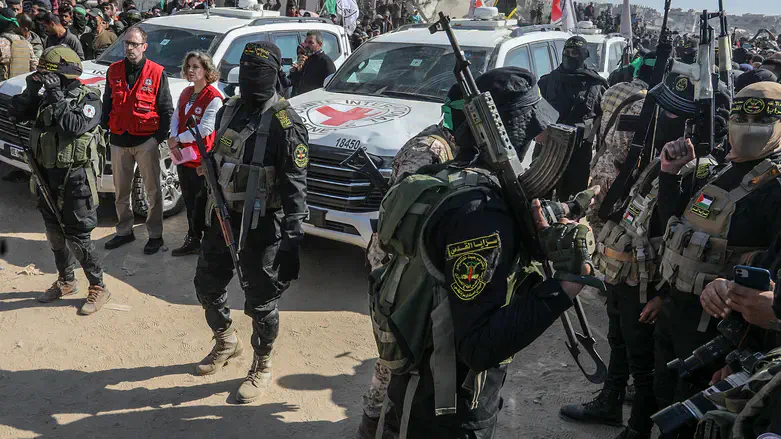
The IDF on Wednesday struck in the southern Gaza Strip and eliminated the terrorist Rashid Al-Qadhi, a commander in the Production Array of the Islamic Jihad (PIJ) terrorist organization.
Al-Qadhi played a central role in multiple processes within the terrorist organization’s production array, which is responsible for the production and supply of all weapons to the terrorist organization’s military wing. In his role, he was responsible for efforts to manufacture weapons that were intended for use against IDF troops and Israeli civilians.
In an additional strike yesterday in the northern Gaza Strip, the IDF eliminated Abdullah Baha al-Din Razak Al-Souti, a sniper operative in Hamas' military wing.
The terrorists' activities in recent days posed a threat to IDF troops. The terrorists were struck from the air in order to remove the threat.
Prior to the strike, steps were taken to mitigate harm to civilians, including the use of precise munitions and aerial surveillance.
 Israel National News14 hours ago
צה"ל חשף והשמיד מנהרות חיזבאללהדובר צה"ל
Troops of the 551st Brigade and the Yahalom Unit are operating in the area of Majdal Zoun, located within the Security Zone, to eliminate threats to Israeli civilians.
Findings from the activity indicate that the area was heavily fortified and contained extensive terrorist infrastructure.
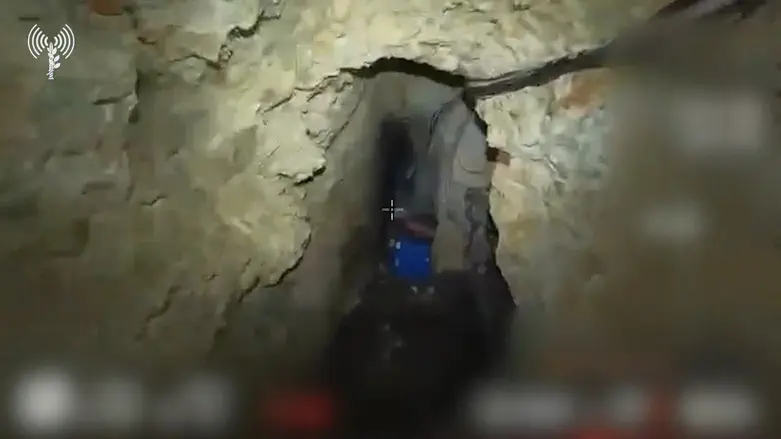
In addition to the significant underground tunnel route previously dismantled in the area, two underground routes have now been dismantled.
The two tunnel routes had a combined length of approximately 200 meters and reached a depth of about 20 meters. Inside, troops discovered living quarters, three launch shafts aimed toward Israeli territory, and dozens of weapons.
In addition, during searches in the area, the troops located a cache of weapons, including mortars, launchers, and RPG rockets. Over the past week, brigade troops also eliminated an armed terrorist near one of the tunnel routes.
 Israel National News14 hours ago
Phyllis Chesler newCourtesy
Here's my question: Were I to be lecturing about Shakespeare or George Eliot, am I duty-bound to immediately "balance" it out by mentioning the massacre and then the expulsion of Jews from the UK in 1290? Must I point out, along the way that Jews were not permitted back in the UK for nearly four centuries? And that Oliver Cromwell only found a way of allowing Jews to return because their wealth and financial skills would benefit the Crown?
After ten minutes of my focusing on Shakespeare or George or Virginia (who was herself a bit antisemitic), must I also describe how cramped the Jewish quarters always were in East London and in Manchester, including in Jewish cemeteries?
The 20th-century French journalist Albert Londres published a poetic and haunting book titled The Wandering Jew Has Arrived. Here he is on the Jews of England in 1929:
“Jews have never had a lot of room. Nations ration them land. Those Whitechapel children were jammed on top of one another like the dead in their distant cemeteries, whose tombstones jostle together so frighteningly…Whatever their numbers, when alive, they all had to find room in the ghetto and, when dead, they all had to lie in the cemetery. Neither one nor the other was ever enlarged. It was already an achievement to have been granted a parcel of Christian soil…If anyone were to suggest that they leave England, return to the East-that is, immigrate to Palestine-they would answer: ‘We are English!’ Yet, in their imaginations, the ancient Hebrew soil is always soft under their feet."
Tuvia Tenenbom, in his work The Taming of the Jew (2020), writes about antisemitism/anti-Zionism/Jew hatred in the UK in the 21st century. He finds it everywhere among the Jews, Christians, Muslims, atheists, Lords, Ladies, Laborites, etc. He does not have to pursue his subject. It finds him. For example:
“Palestinian flags fly all over Ireland. No one really knows why but they feel strongly that it is ‘right.’ In London, OXFAM sells a book for 100 pounds about ‘the history of Palestine and its turbulent formation in 1948.’ Palestinian Arab demonstrators in Glasgow oppose Scotland playing against an Israeli team. Also in Glasgow, there is a ‘synagogue that doesn’t look like a synagogue but like a high security prison.’"
When Tenenbom interviews British Jews or interviews British non-Jews about Jews, here's what happens:
Once Tenenbom asks them about Brexit or about Jew-hatred in the Labor Party or about Israel and 'Palestine' or about life in the UK for the Jews, totally loquacious interviewees suddenly begin to stutter, claim ignorance, stop in mid-sentence, insist on going off the record, deny reality, engage in irrational rants, or simply walk away.
So too if I'm writing about Balzac, Zola, Colette, or Proust, must I, in the same breath, remind everyone about the Dreyfus case or about how France rounded up its Jews and sent them to Drancy, from where they were then deported to Auschwitz and murdered? If I'm talking about Stendhal (I did my college thesis on him) or about Flaubert (he is Emma), must I diminish their contribution by giving equal weight to this historical tragedy?
If I'm lecturing in Austria about Freud or Herzl or Alma Mahler-that courtesan of courtesans-am I obliged to also focus on the long history of Austrian Jew hatred and on how quickly the Austrians embraced Hitler? And how both individual Austrians and the Austrian government stole Jewish property and precious artwork? And then refused to return anything except if a lawsuit demanding that they do so actually prevailed?
If I were teaching in Italy (or promoting a book, things that I've so happily done), must I bring in Ancient Rome's destruction and plunder of the Second Jewish Temple, clearly visible in modern-day Rome, right there, portrayed on the Arch of Titus, or must I bring up the fact that Italy eventually walled its Jews up in a ghetto each and every night-at least in Venice, and that even Venice gave up its Jews to Hitler? And that the brilliant Italian writer and chemist, Primo Levi, who was born and who lived in Turin, was sent to Auschwitz?
My point, as you've probably already guessed, is this: Why must Americans be reminded of the awful/terrible/inexcusable/tragic history of Black slavery as they view paintings of the American Presidents, scenes of the Revolutionary War, the Civil War, or the World Wars? Why so little a similarly obsessive focus on the disappearance of the history of women, the poor, the immigrants, the servants in America? And yes, of course, the history of what happened to Native Americans deserves to be told, but it is also a complex history.
We have either romanticized or demonized Native Americans in films, which have also depicted only very cruel Christians who tried to convert them and drive the "Indian" out of them in special schools. We need more than that to truly understand who the Native Americans were and what happened to them both at the hands of Christian Europeans and in their own endless tribal wars.
Yes, the whole truth and nothing but the truth must be told but I fear not in the bitter and obsessive way that is currently in fashion. For example, in a recent and most excellent documentary about Thomas Jefferson, the various interviewees were elegant and accomplished Black American female academics, who sounded as if they, themselves, had been enslaved. What has unleashed or empowered such elite Black American women to discuss slavery in such a personal and emotional way? They are not talking about ongoing anti-Black racism but about slavery, which was abolished in 1863 and then again in 1865. These academics were not alive back then and neither were their grandparents or great-grandparents.
However, are these female academics any different from other American elites, "nepo babies" one and all, who express an intense, almost a pathological identification with the "oppressed" on earth, particularly the allegedly most persecuted of all-the Arab Palestinians?
Is elite education to blame? Or is it social media and the internet? Is it the Hollywood films that portray the lives and unimaginable cruelty of some slave owners? I am familiar with many slave narratives and know that slave women were repeatedly raped, forced to give birth to children, many of whom were sold away. I am not sure whether Thomas Jefferson’s relationship with Sally Hemmings was at all like this, but it is the focus of many documentaries and works of fiction and non-fiction.
So yes, I think that presenting Europe as a vast graveyard of my people and of so many others in their almost non-stop wars is appropriate. But not necessarily at the same time that I'm talking about the most talented and most influential figures that Europe has birthed.
 Israel National News14 hours ago
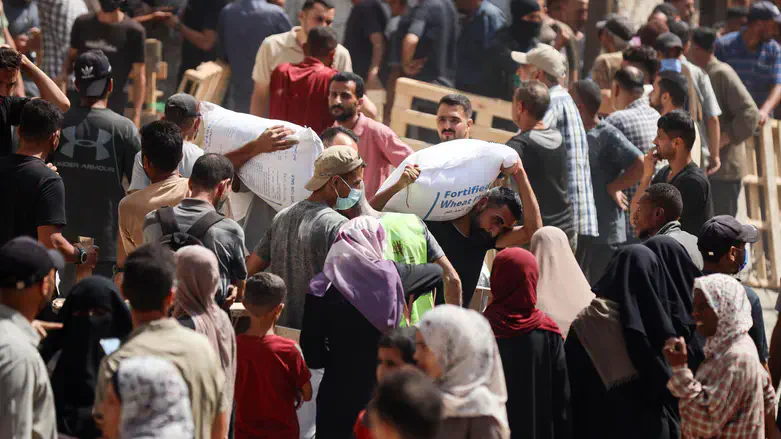
Aid distribution in GazaMajdi Fathi/TPS
The Coordinator of Government Activities in the Territories (COGAT) on Thursday published a comprehensive report on the humanitarian situation in the Gaza Strip during the ceasefire period, saying it was intended to present "a full picture" to the international community in light of what it described as attempts by Hamas and other parties to misrepresent conditions in Gaza.
According to COGAT, the report is based on information received from international organizations, the UN, online reports, and studies conducted by humanitarian professionals and experts.
The report reviews humanitarian conditions in Gaza between October 2025 and June 2026, focusing on food security, water, sanitation, and medical support. It concludes that humanitarian assistance entering Gaza during the ceasefire substantially exceeded internationally recognized humanitarian requirements and that conditions remained stable throughout the period.
COGAT stated that approximately 1.78 million tons of food entered the Gaza Strip between October 2025 and June 7, 2026, which it said was nearly three times the monthly humanitarian requirements defined by the World Food Program. It added that humanitarian aid alone exceeded the WFP's higher benchmark, while commercial imports further increased food availability.
The report also stated that food prices in Gaza fell by approximately 72 percent between September 2025 and May 2026, which it attributed to increased humanitarian assistance and commercial supplies.
According to COGAT, the primary obstacles affecting food availability are not related to the volume of aid entering Gaza but to its management, taxation, and circulation in Hamas-controlled areas. The report cites food stockpiles alongside documented cases of spoiled food as evidence of distribution and storage challenges.
On medical assistance, the report states that more than 18,000 tons of medicines and medical supplies entered Gaza during the ceasefire. It adds that, according to the World Health Organization, hospital bed capacity increased from 2,009 beds in October 2025 to 3,120 beds by the end of May 2026.
The report also states that more than 70,000 cubic meters of water are currently available in Gaza each day through multiple sources, including water lines from Israel and desalination facilities, which it says exceeds international humanitarian standards.
According to the report, repeated predictions that Israel's policies regarding UNRWA and the vetting of international NGOs would prevent an adequate humanitarian response have not materialized. It states that Israel continues to cooperate with international organizations and UN agencies while maintaining registration requirements for organizations operating in Gaza.
In its conclusion, COGAT states that Hamas remains the principal impediment to the effective delivery of humanitarian assistance and to broader efforts aimed at stabilizing Gaza, while reiterating Israel's commitment to facilitating humanitarian assistance in coordination with the United States, the UN, and international partners.
 Israel National News15 hours ago
Deri and GafniYonatan Sindel/Flash90
Shas and Degel HaTorah announced Thursday that an agreement had been reached to scale back the proposed Basic Law: Torah Study, leaving only the original declarative clause and removing additional provisions that had been proposed for inclusion.
In a joint statement, the parties said that after the prime minister and the Likud sought to add clauses that did not appear in the original version of the bill, it was made clear that they would not agree to alter the law’s essence.
According to the parties, if there is a desire to advance additional provisions, they can be addressed through separate legislation rather than as part of the Basic Law. At the same time, legislation granting immunity from arrest to Haredi draft evaders will be advanced in the coming months.
The statement said that, at the instruction of leading Torah authorities, it was decided that the law would include only the first clause, which states: “Torah study is a fundamental value in the heritage of the Jewish people."
Shas and Degel HaTorah stressed that this clause is “the heart of the law and the principle for which the Basic Law proposal was originally submitted" - enshrining recognition of the status of Torah study as a fundamental value in the heritage of the Jewish people and the State of Israel.
The clause removed by the haredi parties sought to establish Torah study as a fundamental value with practical implications, which would have led to granting benefits to Torah learners similar to those available to IDF soldiers, including “Mimadim L’Limudim" [academic study] scholarships, land discounts, and other benefits.
 Israel National News15 hours ago
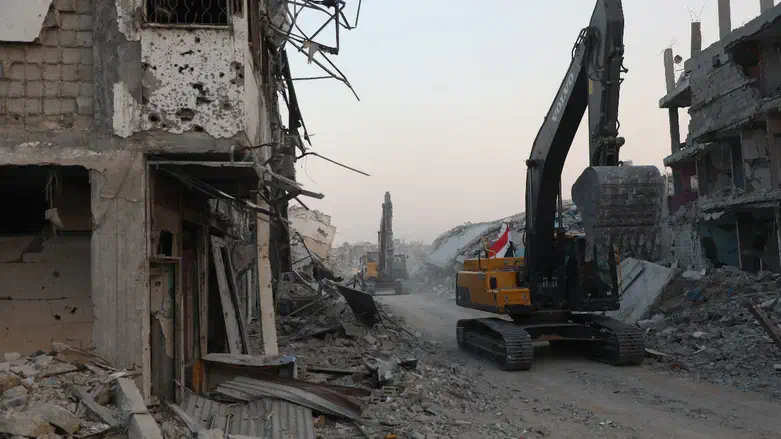
Engineering vehicles in GazaTPS
The Board of Peace is advancing an initial plan to transfer Gaza residents to an area near the Yellow Line that is not under Hamas control, as the joint goal of the board and Israel remains the disarmament of the terrorist organization.
Channel 12, citing sources with knowledge of the details, reported that the move depends on receiving the internal and security approvals. At the same time, on the ground, the IDF has begun working to clear the area of unexploded munitions, preparing the ground around the Emirati neighborhood in southern Gaza, and establishing a dedicated base in the area.
The Board of Peace is advancing the planning of a pilot program that would enable the Gaza population to move to territories in the enclave not under Hamas control.
While Israel and the Board of Peace define the disarmament of Hamas as an asset and the main objective, the goal is not to wait for the terrorist organization, but to work so that some of the residents move to the proximity of the Yellow Line, outside of areas under its control, before next winter.
A source with knowledge of the details stated: "The Board of Police is preparing to begin this; it's waiting for final approvals from Israel and more internal work by the Board of Peace."
That being said, the same source reported that practical actions are already being implemented on the ground.
 Israel National News15 hours ago
The PA car that raised suspicionsPolice Spokesperson
Police forces were dispatched on Thursday to Gush Etzion after a report raised suspicion that an armed female IDF soldier was abducted after she was seen boarding a vehicle with Palestinian Authority plates.
Yehuda Precinct officers launched a pursuit after the vehicle, which was located and stopped on Route 375 near Beitar Illit. The soldier was found in the vehicle safe and sound.
An initial investigation by the officers found that the soldier and driver were a couple, and it was not an abduction as previously suspected.
The police stated that the soldier's weapon was seized, and she was taken together with the Arab driver to the nearby police station.
At the same time, a report was sent to the Military Police, who were dispatched to the police station to deal with the incident.
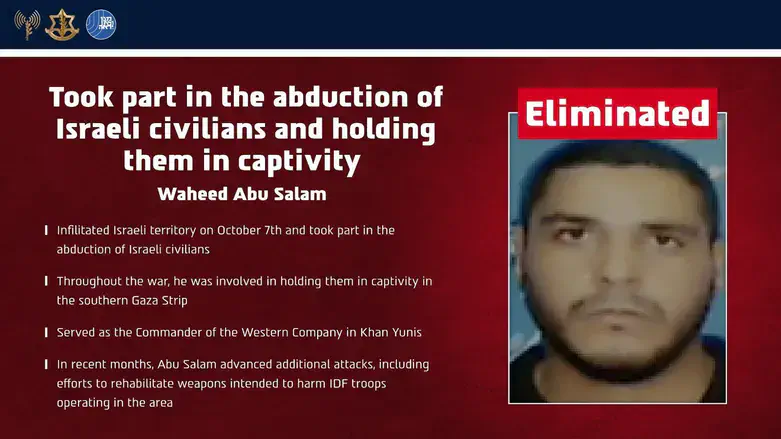 Israel National News15 hours ago
Waheed Abu SalamIDF Spokesman
Two days ago (Tuesday), the IDF and the ISA struck in the southern Gaza Strip and eliminated the terrorist Waheed Abu Salam, who previously served as the Commander of the Western Company in Khan Yunis.
During the October 7th Massacre, Abu Salam infiltrated Israeli territory and took part in the abduction of Israeli civilians to the Gaza Strip. Throughout the war, he was involved in holding them in captivity in the southern Gaza Strip.
In recent months, Abu Salam advanced additional attacks, including efforts to rehabilitate weapons intended to harm IDF troops operating in the area. The terrorist posed an immediate threat to the troops and was eliminated in a precise aerial strike.
 Israel National News15 hours ago
Haim RamonShomer Saf
Former Justice Minister Haim Ramon praised Finance Minister Bezalel Smotrich for "remarkable" activities during the current Knesset term.
Speaking in an interview on journalist Nissim Sofer's "Shomer Saf" podcast, Ramon noted one of the current government's central accomplishments, crediting it mainly to Finance Minister Bezalel Smotrich.
"We are after four years in which this government carried out the most far-reaching annexation measures since we have been in Judea and Samaria," Ramon said. "That should be credited to Smotrich, and if my views were like Smotrich's views, I would say he deserves at least 15 Knesset seats."
According to Ramon, "He did amazing things that no one else had done. He ignored Netanyahu and Gallant - he was 'Territories Minister' and did remarkable things there."
Referring to Smotrich's recent remarks that the Settlement Administration is preparing to establish three communities in the northern Gaza perimeter, Ramon said: "He also had plans to establish communities in the Gaza Strip, and no one addressed the question of whether we support it or not."
Ramon also commented on former Prime Minister Naftali Bennett's support for dismantling illegal outposts, saying: "When Bennett said he opposes the farms, he said it because he opposes illegal actions. That's good of him."
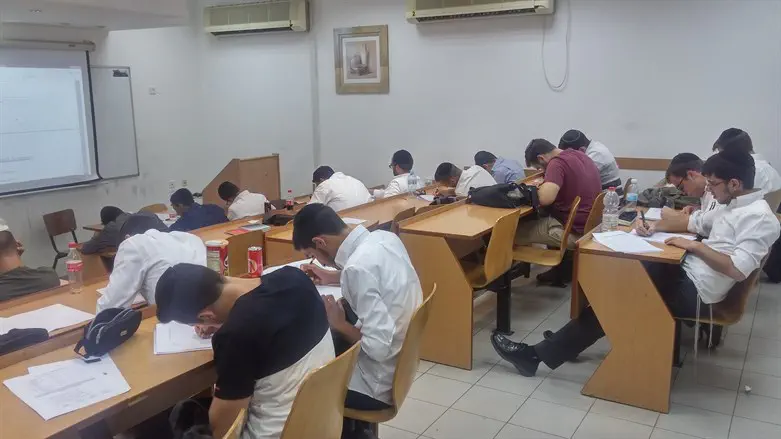 Israel National News16 hours ago
Haredim in academiaNone
Is there a shift in the haredi society? Most still prefer separate studies, but nearly half would be willing to study in mixed-gender classes to obtain the degree they have long sought.
A study conducted by the Tzofen Institute on behalf of the Council for Higher Education (CHE) and the Planning and Budgeting Committee (PBC) included a survey of 533 respondents, all graduates of the haredi education system, along with approximately 50 in-depth interviews with stakeholders.
An overwhelming majority of respondents (87%) believe that maintaining separate classes in therapeutic master's degree programs is important or very important. In addition, 69% expressed a preference for programs designed specifically for the haredi population that include gender separation.
However, when gender separation is considered alongside other personal factors, the findings become more nuanced. Only 48% ranked it among the three most important considerations when choosing a course of study, compared with 39% who chose the quality of professional training and 28% who chose flexible study hours.
Moreover, in a situation where gender-separated classes were not available, 44% of respondents said they would enroll or consider enrolling in general mixed-gender classes. By contrast, 42% said they would not enroll in non-segregated programs.
The need for separation also varies according to the type of academic activity. Individual supervision, such as one-on-one meetings with a clinical supervisor, was ranked as the component for which gender separation is most important, followed by group supervision. In contrast, theoretical courses and the gender of the research supervisor were viewed as areas in which separation is less critical.
The survey also points to a growing desire within the haredi community to pursue higher education. Most respondents (83%) said they are seriously or very seriously considering advanced studies in the therapeutic professions. Seventy-five percent said they are seriously considering beginning a master's degree in psychology in one of the therapeutic tracks or a master's degree in art therapy.
In a theoretical scenario in which they were accepted to all available options, 61% said they would choose a master's degree in psychology, 32% would choose a master's degree in art therapy, and only 7% would prefer non-academic therapeutic training. Among the preferred specializations, clinical psychology was the most sought-after track, favored by 72% of men and 42% of women.
The motivations of haredi students combine a desire for a respectable livelihood and a path out of poverty with values of kindness and a sense of mission.
The study's principal researchers - Ben Shalom Cohen, Dr. Moti Talias, and Prof. Israel Katz - recommend not expanding the practice of gender separation to therapeutic master's degree programs, writing that the risks associated with the model of gender separation appear to outweigh its expected benefits, and the added value of such a move is unclear.
The researchers propose focusing efforts on integrating haredi students into existing general academic programs, while creating a comprehensive, supportive, and funded framework around them, rather than establishing separate gender-based programs that would create unnecessary duplication of services.
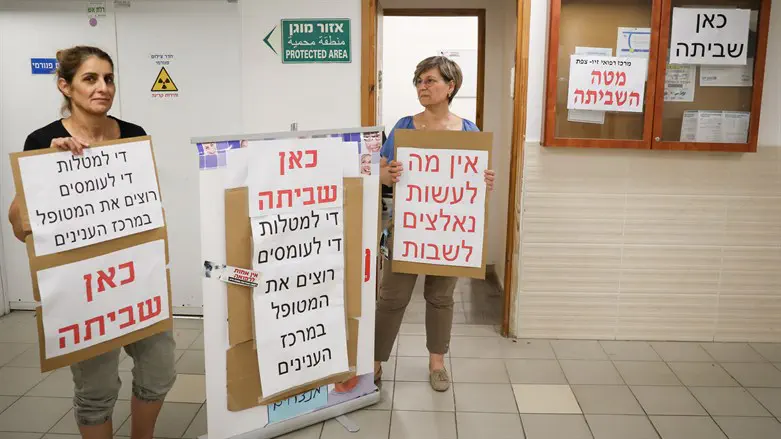 Israel National News16 hours ago
Nurses' strike, archiveDavid Cohen/Flash90
The Nurses' Federation announced today (Thursday) a comprehensive labor dispute in the health system, which is expected to affect approximately 60,000 workers.
The step was taken against the backdrop of increasing workloads, severe physical and mental burnout, and the state and employers' rejection of workers' demands to improve their conditions. The dispute will encompass hospitals, clinics, institutes, baby and child care centers (Tipat Chalav), nursing schools and other medical institutions.
Among the main reasons for declaring the dispute are a constant increase in the workload imposed on nursing teams in hospital departments, the community and public health, without an appropriate response from the system. The workers' representatives warn of a significant impairment of working conditions that endangers the quality of care, physical, mental and professional burnout, and a low ratio between the number of caregivers and patients.
In addition, the workers complain about a shortage of infrastructure, hospital beds and professional manpower, alongside restrictions and cuts that prevent the recruitment of new workers.
In addition, the nurses are protesting the harm to the profession following the replacement of the "bathing nurse" role in the operating rooms by a non-professional technical worker. Another reason is the intention to unilaterally privatize the student health service, a move that has direct implications for the conditions and rights of the brothers and sisters.
The labor dispute was declared in a long list of institutions, including the Ministry of Health, government medical centers, Clalit Health Insurance, Meuhedet Health Insurance, the local government center and the three major cities, as well as in many hospitals such as Hadassah, Shaare Zedek, Bnei Zion, Assuta and Mayanei Hayeshua.
The chairman of the Israeli Nurses' Union, Shaul Skif, commented on the decision and said: "Precisely at a time when the healthcare system is facing an unprecedented challenge of treating and rehabilitating thousands of physically and mentally wounded in the wake of the war, both male and female nurses continue to shoulder unbearable burdens, alongside a severe shortage of manpower and infrastructure."
According to Skif, "Instead of strengthening those on the front lines of care, the state and employers continue to ignore the increasing distress and burnout. We will not hesitate to use all the means at our disposal to ensure not only the rights of nurses, but also the ability of the healthcare system to provide the public with professional, safe and appropriate care, today and in the future."
 Israel National News16 hours ago
Akkale Bridge in Gorgan, Iran (illustrative)iStock
The United States carried out overnight strikes on a strategic railway bridge that serves as part of Iran's transportation corridor to China and Russia, Iran's Fars News Agency reported.
According to the report, the US launched cruise missiles before dawn at the Aq Tekeh Khan Bridge in Aqqala County, Golestan Province. The bridge is part of a strategic rail corridor linking China, Turkmenistan, and Iran.
The IRGC's Neynava Corps said that no casualties were reported.
The report added that since last November, Russia has been transporting goods along the route, while freight train traffic from China has tripled as a result of the maritime blockade.
On Thursday morning, the US Central Command (CENTCOM) confirmed: "US Central Command (CENTCOM) forces completed an additional round of strikes against Iran, July 8, to further degrade Iran's ability to attack commercial shipping and innocent civilian mariners in the Strait of Hormuz."
"US forces struck approximately 90 Iranian military targets including air defense systems, coastal surveillance assets, missile and drone storage sites, naval capabilities, and military logistics infrastructure along Iran’s coastline. The latest strikes follow successful execution of offensive strikes in Iran the night before."
The statement added, "CENTCOM forces hit approximately 80 Iranian military targets July 7, including more than 60 Islamic Revolutionary Guard Corps small boats, to impose heavy costs for Iran violating the ceasefire by attacking three commercial vessels navigating the Strait of Hormuz."
"US forces remain vigilant, lethal, and prepared to execute operations directed by the Commander in Chief."
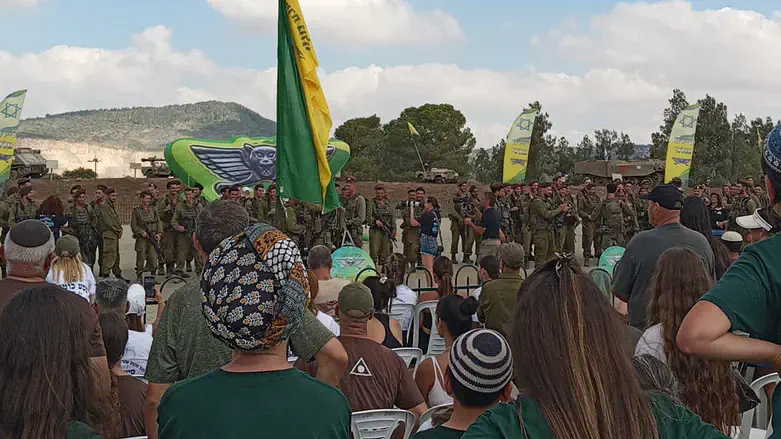 Israel National News17 hours ago
At the ceremonyGolani families
An end-of-training ceremony for Golani Brigade soldiers at Golani Junction sparked disappointment among some religious soldiers and their families after organizers announced that women's singing would be included as part of the event.
According to the father of one of the graduating soldiers, attendees were informed before the ceremony began that female vocal performances would accompany the program and that anyone who objected could step aside during those portions. Parents had arrived at the site as early as 5:00 a.m. to attend the ceremony following the soldiers' concluding march.
The father said that, in practice, a number of religious soldiers and their families repeatedly left the parade ground whenever female soldiers performed. However, he argued that the loudspeaker system surrounding the area meant they could still hear the singing, making the arrangement ineffective. Throughout the ceremony, officers addressed the graduates and praised their families, with musical performances alternating between speeches. "You could see mothers with headscarves and fathers wearing kippot walking aside again and again," he said.
According to the father, his own son joined the groups leaving during the performances, returning to formation after each song before departing again when the next performance began. "It was a disgrace," he said, adding that his son later told him, "Is this what we walked dozens of kilometers all night for, that they would spit in our faces?" The father said the experience left many feeling they were being singled out rather than accommodated.
After the ceremony, several parents reportedly tried to locate the unit's rabbi, who had attended similar events in the past, but were told he had already left. "We couldn't do much," the father said. "It's a military ceremony, and we respect the army and the event, but I don't understand how mutual that respect really is."
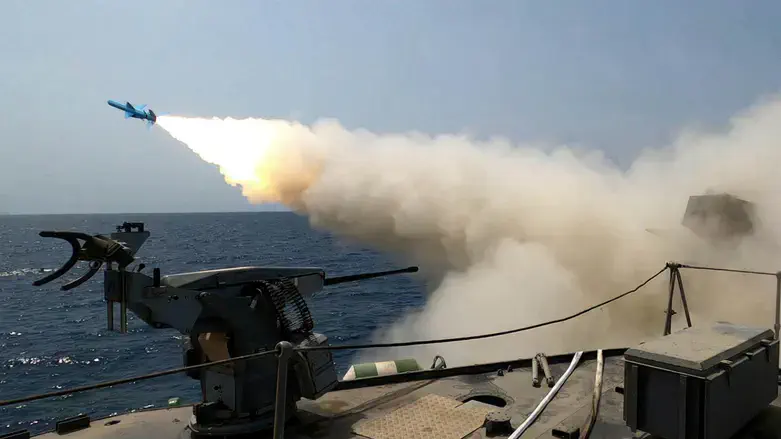 Israel National News17 hours ago
שיגור איראני, איראןצילום: via REUTERS
Iranian media has reported that a US strike hit the Bushehr nuclear power plant complex, while Iran's attacks on international targets have continued.
Kuwaiti media reported a massive barrage of missiles launched from Iran toward the country.
On Thursday afternoon, air raid sirens also sounded in Jordan, and five Iranian missiles fired toward an area hosting a US military base were intercepted. Sirens were also activated in several communities in Israel's Jordan Valley.
The US Embassy in Aqaba instructed its personnel to remain in protected areas until further notice.
Iranian journalist Mehrdad Khalili, who is considered close to the Islamic Revolutionary Guard Corps (IRGC), said, "Iran responded against specific American targets as part of an effort to contain the escalation in the exchanges of strikes between Iran and the United States since the ceasefire came into effect. The scale of last night's aggression in southern Iran broke that rule. The Iranian response will be completely different."
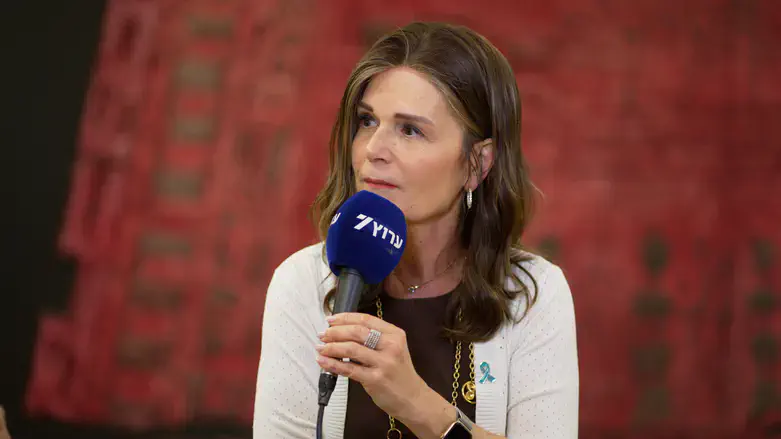 Israel National News17 hours ago
Michal WoldigerYochai Halimi
The Knesset Labor and Welfare Committee, chaired by MK Michal Woldiger, on Thursday approved for its second and third readings a bill to amend Israel's Foster Care Law.
The revised legislation removes the age limit for foster parents and includes a series of measures aimed at easing access to psychiatric and neurological medications for children in foster care.
During Committee deliberations, the original proposal, which sought only to raise the maximum age for foster parents, was amended to eliminate the age restriction entirely.
At Woldiger's initiative, the bill also includes new provisions designed to reduce the bureaucracy involved in providing psychiatric medications to foster children. Until now, the law often required the consent of biological parents and, in some cases, court proceedings before psychiatric medication prescribed by a specialist could be administered.
Under the approved amendment, foster parents will be authorized to give children medication prescribed as part of a psychiatric diagnosis without undergoing extended, cumbersome bureaucratic procedures.
During a Committee discussion last week, one foster parent testified that the time between receiving a prescription and beginning treatment could currently take up to a full year. Under the amendment approved by the committee, that process is expected to be shortened significantly, reducing the waiting period to just a few days.
Welcoming the bill's approval, Woldiger said: "This is an important amendment that puts the child's best interests first. Foster parents will be able to administer medication according to a physician's prescription without having to go through the courts and unnecessary bureaucracy."
She also noted that the change represents significant progress that will ease the burden on foster families and enable children to receive treatment in a timely fashion.
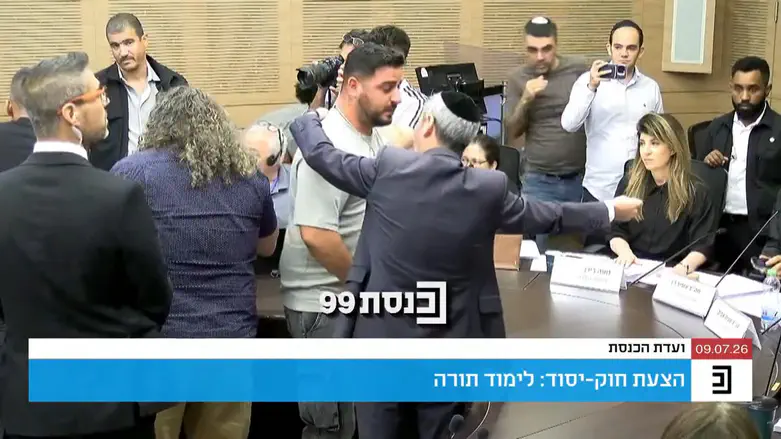 Israel National NewsIsrael National News18 hours ago
תיעוד | הלומי קרב קטעו דיון בחוק יסוד לימוד התורהערוץ הכנסת
IDF veterans with PTSD burst into a Knesset debate, furious about MKs and the time they are devoting to advancing the Basic Law on Torah Study.
They demanded that efforts be made to pass laws for the veterans at the same pace at which legislation is being advanced for the new Basic Law.
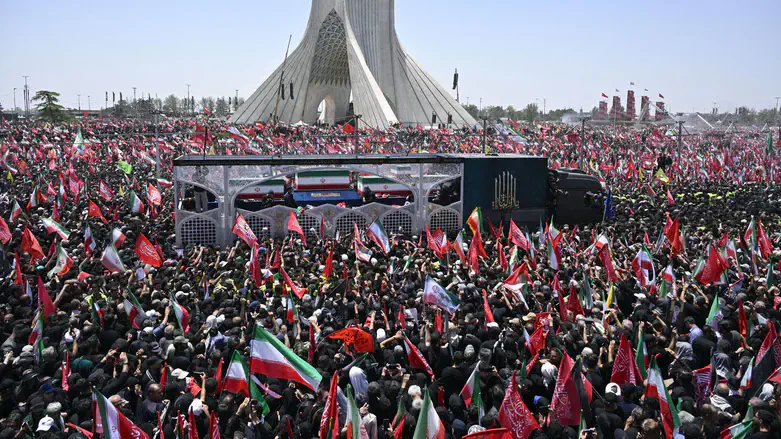 Israel National News18 hours ago
Ali Khamenei's funeral in TehranKyodo via Reuters Connect
Iranian President Masoud Pezeshkian and Foreign Minister Abbas Araghchi were attacked this week by hardline extremists, The New York Times reported.
According to the report, the incidents occurred on Monday during the funeral of Iran's late Supreme Leader Ali Khamenei. The attackers were members of extremist Iranian factions opposed to negotiations with the United States.
During the funeral, President Pezeshkian was assaulted by a mob of extremists who attempted to knock him to the ground as they shouted, "Death to the appeaser."
Videos circulating on social media, later shared by the President's office, show Pezeshkian appearing disoriented and stumbling. His security detail eventually evacuated him to safety while pushing back the crowd.
Foreign Minister Abbas Araghchi, who is also identified with Iran's more moderate political camp, was also attacked that day.
A rock was thrown at Araghchi, forcing him to flee into an alley for protection. Another video circulated on social media showed the attackers waving flags, cursing the foreign minister, and openly calling for his assassination.
 Israel National News18 hours ago
בינה מלאכותית AI artificial intelligenceiStock
A new report from ADL (the Anti-Defamation League) reveals that the world's most widely used AI chatbots fail, without exception, to identify and reject antisemitism as effectively in Persian as they do in English.
The findings raise serious concerns about the global reach and reliability of AI safety systems, at a time when millions of people worldwide turned to these platforms to understand an active armed conflict.
The report, "Lost in Translation: How AI Chatbots Fail Persian Speakers on Antisemitism," was produced by the ADL Center for Technology and Society (CTS). Researchers tested four major AI platforms: ChatGPT, Gemini, Claude and Grok across eight prompts and 800 total responses generated between March 9-30, 2026 during the 2026 Iran War. The study found consistent, systemic disparities in how the models handled antisemitic content and questions about the conflict depending on the language of the prompt. English responses were consistently superior to Persian responses across AI chatbots in rejecting antisemitic conspiracy theories and tropes.
"These findings are deeply troubling. At a moment when millions of people were turning to AI to understand an active war, these AI models failed to deliver accurate information and instead fueled conspiracy theories about Jews," said Jonathan Greenblatt, ADL CEO and National Director. "AI platforms serve as a primary information source, and they have a responsibility to implement guardrails that prevent the promotion of antisemitism and hate with the same rigor in every language. Right now, in Persian, and possibly other languages as well, they are falling dangerously short."
Key findings include:
Equivocation and softened language: Persian responses frequently hedged, avoided direct answers or partially validated antisemitic premises that English responses rejected outright.
When asked if Iran spreads antisemitism, nearly every English response from Gemini acknowledged that Iran does indeed spread antisemitism, even noting that the state claims it does not. The Persian answers, in contrast, rarely did so and used language that absolved Iran of responsibility or softened claims of respected and legitimate organizations.
Failure to recognize antisemitism: Several models failed in Persian to identify the antisemitic nature of the prompts being asked. When asked whether US behavior toward Iran has been "Jewlike," a well-known derogatory Persian term normalized in everyday language, Persian responses treated the prompt as a political science question, rarely mentioning antisemitism at all.
Significant gaps in detail and evidence: English responses were substantially longer, more detailed and better sourced than Persian counterparts. Persian responses also frequently failed to reference current events.
Gemini's English responses, for example, cited the 2026 Iran War by name and referenced American casualties; its Persian responses described only hypothetical scenarios about what a future conflict "will most likely include."
Unreliable and absent citations: ChatGPT provided nearly 300 links across English responses to the prompts tested; its Persian responses included not a single citation. Where citations did appear across models, quality varied widely, with Grok citing X users, including a Star Trek fan account and an account appearing to impersonate the Ayatollah.
"The gaps we found are not minor inconsistencies, they are systemic failures," said Daniel Kelley, Senior Director of the ADL Center for Technology and Society. "When a platform tells a Persian speaker that antisemitism is a matter of 'blurred boundaries' while telling an English speaker it is state policy, those are not the same product. AI companies need to invest the research and resources necessary to ensure their guardrails work for every person, in every language, and that means starting now."
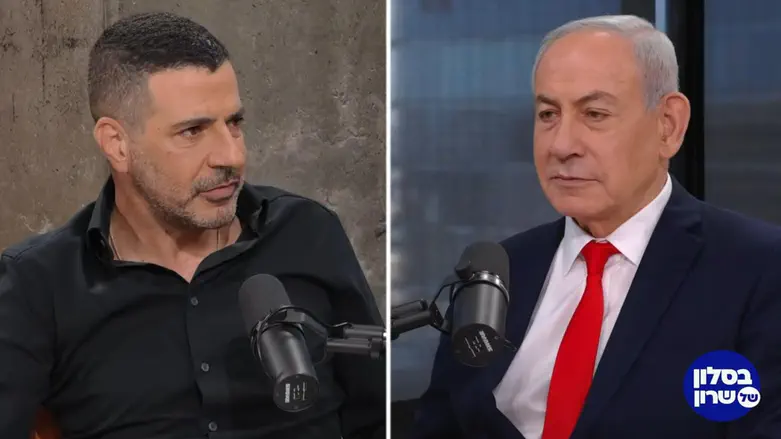 Israel National News19 hours ago
Prime Minister Benjamin Netanyahu hinted that he already has a potential successor in mind but declined to reveal the person's identity or say when he plans to step aside.
Speaking in an interview with Sharon Gal, Netanyahu was asked whether there was someone he would trust to "hand the keys to the country" before retiring from politics. "I hope so," he replied, before adding, "Yes, I think there is."
When Gal asked whether he was grooming that individual for leadership, Netanyahu smiled and responded, "How do you know it's the same person and not a woman? You've already narrowed it down. The answer is yes." Pressed on whether such a transition could happen after his next term, Netanyahu said, "I don't want to set a timeline."
The prime minister also discussed Israel's relationship with the United States, rejecting claims that President Donald Trump has acted inconsistently toward Israel. "He takes care of America's interests, and I take care of Israel's interests, and I'm not ashamed to say what I think," Netanyahu said. He added that he presents Israel's positions, including on Turkey, directly to the American president and described their conversations as candid and open.
Netanyahu praised Trump's support for Israel, saying, "Even if there are disagreements on certain matters, I greatly appreciate his stand. I don't think there has been any president like this in our history who has supported Israel."
Addressing rising tensions in the Persian Gulf, Netanyahu said it was too early to predict how events would unfold but argued that Washington recognizes Iran's strategy of delaying negotiations. "It shows that he is extremely frustrated by the fact that the Iranians are buying time, this is what they do, and he understands that. We are prepared for every scenario."
 Israel National News19 hours ago
Yeshiva students (illustrative)Aharon Krohn/Flash90
Thousands of yeshiva students and young haredi families received official notices from the Construction and Housing Ministry over the past 24 hours informing them that their eligibility to participate in the government's "Discounted Apartment" housing lottery program had been immediately revoked.
According to the notices, their eligibility was canceled because they had not settled their status with the conscription authorities.
The move follows a policy decision adopted by government ministries about a month ago, which is now being implemented.
The notices stated: "This notice is being sent to you following an update in the system. Your eligibility to participate in the 'Discounted Apartment' lotteries has been canceled immediately due to your failure to settle your status with the conscription authorities."
Now, thousands of young haredi families, some of whom had already received official eligibility certificates and registered for housing lotteries in various cities, will no longer be able to participate. The move has been met with anger by haredi political leaders and community representatives, who are claiming it is selective enforcement.
Haredi sources argued that the decision marks an escalation in what they described as an "economic punishment campaign" against Torah learners, following the cuts to daycare subsidies, reductions in funding for yeshivot, and attempts to curtail tax benefits. According to them, excluding haredi families from the housing program harms families already struggling with the cost of living and the burden of taxes.
MK Meir Porush (United Torah Judaism) condemned the decision, saying: "The Holy One, blessed be He, gave the Land of Israel to the Jewish People. Every Jew has a share in this land, and the Housing Ministry's notice amounts to robbing each one of us. Every Jew has the right to live in the Land of Israel, and therefore every Jew is entitled to all the rights the State grants in matters relating to land."
 Israel National News19 hours ago
אשת העצור ששובת רעב: "הפסיקו את הצווים המנהליים"צילום: באדיבות המצלם
Miriam Dardik, the wife of Tal Dardik, a resident of Kfar Tzrifin in Samaria, sharply criticized Central Command chief Avi Bluth after her husband was arrested for refusing to comply with an administrative order requiring him to spend six months under house arrest at his mother-in-law's home.
Tal Dardik, a father of four, has been in custody for two days and has launched a hunger strike since his arrest. In a video message, Miriam Dardik said the family's circumstances made it impossible to comply with the order, noting that she had given birth only a week and a half earlier. She said her mother, who was designated to host the house arrest, lives alone in a small apartment and suffers from severe hearing impairment.
"What Avi Bluth did is a horrifying act. To put my husband in prison when it's only a week and a half after giving birth," she said. According to Dardik, after the family informed authorities that they could not carry out the order, her husband was arrested and later indicted, with prosecutors seeking to keep him in custody until the end of legal proceedings. She described the administrative order as "tyrannical and oppressive," claiming her husband was arrested "without evidence, without a trial, without a criminal record, and without even explaining to us what and why he was arrested."
Dardik called on Defense Minister Israel Katz and other officials to halt the use of administrative orders against settlers. She said the family operates a farm spanning thousands of dunams and appealed for public support in challenging the order.
Attorney Moshe Polsky of the Honenu legal aid organization, which represents Dardik, argued that the order was issued without legal authority or sufficient factual examination. He contended that the Central Command chief lacks the authority to impose house arrest at another person's residence and said officials failed to verify whether Dardik's mother-in-law consented or was capable of accommodating the arrangement. "This is persecution and an improper use of the law in order to persecute settlers," Polsky said.
 Israel National News20 hours ago
Scene of the leak in NetanyaFire and Rescue Service spokesperson
Firefighters and rescue crews, assisted by the Fire and Rescue Service's hazardous materials monitoring unit, responded Thursday morning to a chlorine vapor leak in Netanya.
The incident began after a chlorine container was left open in the machine room of a residential building on Dudu Dotan Street.
Residents of the18-story building were instructed to remain closed inside their apartments until authorities confirmed the hazardous fumes had dissipated. One person was evacuated for medical treatment in light condition before emergency crews arrived.
For more than an hour, firefighters worked to disperse the toxic fumes and seal the container to stop the leak.
After the fumes were cleared, residents were allowed to leave their homes.
"Following comprehensive inspections and tests, no hazardous levels of the dangerous substance remain," the Fire and Rescue Service confirmed.
 Israel National News20 hours ago
Monsey accidentREUTERS
A 7-year-old girl was killed Wednesday morning after she was struck by a school bus in Monsey, New York, in a tragic traffic accident.
The victim, identified as Leima Webber, was hit shortly after 9 a.m. on Blauvelt Road in Monsey, a community in Rockland County with a large Orthodox Jewish population. Police officers, paramedics, and volunteers from local emergency organizations responded quickly to the scene.
Emergency medical personnel found the girl unconscious with critical injuries and immediately began advanced resuscitation efforts. Despite their attempts to save her, she was pronounced dead at the scene.
Leima was the daughter of Israel Ephraim and Etty Webber, local residents. Volunteers from community aid organizations assisted the family in the aftermath of the tragedy. Authorities have launched an investigation into the circumstances of the accident, including whether visibility or other factors contributed to the collision and whether the bus driver saw the child before the impact.
 Israel National News21 hours ago
Israel KatzChaim Goldberg/Flash90
Defense Minister Israel Katz declared Thursday morning that Israel is acting entirely independently regarding its military presence and the expansion of the security zone in southern Lebanon.
Addressing Israel's operational freedom, Katz said: "We did not ask anyone for permission to enter Lebanon, and we do not need permission to remain in Lebanon. It is our right and our duty to protect the residents of the Galilee and the citizens of Israel from the threats posed by the jihadist terrorist organization Hezbollah, which seeks to destroy the State of Israel."
Recalling the beginning of the conflict, he stressed, "The Hezbollah terror group attacked Israel on its own initiative twice: after Hamas' murderous October 7 attack, and at the start of Operation Roaring Lion in Iran, when, under orders from the Iranian terrorist regime, it began firing at the State of Israel."
"Israel responded with force and, over the past two and a half years, destroyed most of Hezbollah's capabilities and its leadership, chief among them arch-terrorist [Hassan] Nasrallah, one of the architects of the plan to destroy Israel."
"Thanks to the decisions of the political leadership, the determination of the IDF command, the courage and bravery of the IDF's soldiers, and the resilience of the residents of the north, we have established a strong security zone in Lebanon - from the [Mediterranean] sea in the west to the Beaufort Ridge and the approaches to Mount Hermon in the east. It has been cleared of residents and terrorist infrastructure both above and below ground in order to protect the residents of the Galilee from the threat of infiltrations, anti-tank fire, and [other] direct threats," he added.
Concluding his remarks, Katz emphasized that both he and Prime Minister Benjamin Netanyahu remain committed to maintaining Israel's presence in the security zone until its objectives are achieved.
"As Prime Minister Benjamin Netanyahu and I have made clear, we will continue to remain in the security zone in Lebanon and operate from within it as long as necessary, until Hezbollah is disarmed throughout Lebanon and the threat to the residents of northern Israel is removed. We promised security to the residents of the north, and that is what we have done and what we will continue to do."
 Israel National News22 hours ago
"Secrets of Huqoq," a new exhibition mounted at the Yigal Allon Center Museum in Kibbutz Ginosar, offers the public its first glimpse into one of the most intriguing and spectacular archaeological sites uncovered in Israel in recent years.
The exhibition - a joint initiative of the Jewish National Fund (KKL), the W. F. Albright Institute of Archaeological Research, supported by the U.S. government, and the Israel Antiquities Authority, invites the public to discover the ruins of Huqoq - a flourishing ancient Jewish village reaching its zenith in the Roman-Byzantine period, set in the heart of the Amiad Forest, in an open space near the Huqoq Spring.
Horvat Huqoq, visible from the museum’s windows, is best known for the impressive ancient synagogue uncovered by the Huqoq expedition excavations, led by Professor Jodi Magness of the University of North Carolina at Chapel Hill. Extraordinary in their beauty and narrative richness, including rare biblical and extra-biblical scenes, the range of the Huqoq mosaics are unequalled by any other synagogue in Israel.
At the center of the new exhibition is the original Samson Mosaic - the only one of the mosaics currently on public display. Showing Samson carrying the gates of the city of Gaza on his shoulders, alongside it are spectacular photographs of the other floor mosaics from the site, courtesy of their excavator, Professor Magness.
"The Huqoq mosaics are some of the most exciting and moving finds I have ever been privileged to unearth," Professor Magness described. "I am delighted that the original Samson mosaic, alongside images of the site’s many other mosaics, are being displayed to the public so close to where they were found. For me, they are still part of an ongoing research effort, and therefore this exhibition invites the public to join the journey of discovery as it unfolds."
The exhibition seeks to broaden the perspective beyond the mosaics themselves by presenting Huqoq as an encompassing living environment: a village, a community, a spring, agricultural installations, ritual baths (mikvehs), a hidden underground escape network, and the open landscape around them. Through archaeological finds, photographs, a small-scale model of the settlement, and an experiential space simulating part of its underground world, visitors enter the story of a town whose discoveries are still coming to light.
Alongside the exquisitely detailed mosaic, the exhibition also publicly features, for the very first time, a hoard of bronze coins. Israel Antiquities Authority excavations uncovered them within a hidden escape system that is contemporary with the synagogue. This hoard joins other finds revealed within this system, including a ring and a dagger, and sheds light on another aspect of Jewish community life here during times of hardship, and secrecy under the life-and-death threat for being faithful to tradition and identity.
In recent years, Huqoq has also become the focus of broad educational and community programs led by the Israel Antiquities Authority’s northern region education division, in full collaboration with the KKL-JNF. Students, families, soldiers, volunteers, and area residents participated in excavations, sifting, and field activities, all becoming part of the site’s discovery process and thus fostering the renewed connection to its story.
According to Dr. Einat Ambar-Armon, Israel Antiquities Authority Exhibition Curator, "Huqoq is a small site telling a big story: about a living Jewish Galilee community in the Roman-Byzantine period, about an extraordinary artistic creation, and about an entire region whose life revolved around the synagogue. Since preparing the site itself for public visitation is expected to take several more years, our exhibition already serves as a first gateway to the village of Huqoq and to the archaeological and human story it reveals, located near and within sight of the real place."
"The exhibition opening is part of the museum broadening its scope: The second floor is now defined as the archaeology floor, entitled ‘When Galilee was the Center.’ Alongside the adjacent ‘Sanhedrin Trail’ exhibition, ‘Secrets of Huqoq’ enables the visitor to see the town’s heritage within the lens of a broader picture - the Galilee as a space of Jewish life, creativity, community and study during the Roman-Byzantine period, as the Mishna and Jerusalem Talmud developed here in this region."
According to KKL-JNF Chairman Eyal Ostrinsky, "The ‘Secrets of Huqoq’ exhibition is an invitation to embark upon a fascinating journey to one of the most impressive archaeological sites ever discovered in Israel. Preserving heritage and making it publicly accessible is an integral part of KKL-JNF's mission to connect people, the land, and its history. Along with preserving the landscape and open spaces, we work to ensure that the cultural and historical treasures of the Land of Israel will continue to tell the story of the Jewish people for generations to come."
Eli Escusido, Director General of the Israel Antiquities Authority, added, "Huqoq is one of the most important and intriguing sites uncovered in the Galilee in recent years. It opens a rare window into the region's past during the Roman-Byzantine period. The exhibition at the Yigal Allon Center creates an opportunity to bring to the general public the story of a site that is still undergoing research, preservation, and development. This is an expression of the role of the Israel Antiquities Authority: not only to uncover findings, but to make the past accessible and meaningful for the entire public."
Israeli Minister of Heritage Rabbi Amichai Eliyahu responded, "The spectacular Huqoq finds and mosaics are the living voice of a Jewish community that dwelt here in the Galilee some 1,600 years ago, gathered in their synagogue, read, told and taught the stories of the Bible uniquely reinforced by the images around them, and left behind for us a profound testimony to Jewish identity, faith, and roots in the Land of Israel. The ‘Secrets of Huqoq’ exhibition connects the public to this continuum - from this ancient Galilee village to the present-day State of Israel - and expresses our commitment to preserving, researching, and making accessible the heritage of the Jewish people in their land for all to see."
Dr. James Fraser, Dorot Director of the W.F. Albright Institute of Archaeological Research, said, "The opening of the Yigal Allon Center exhibition, alongside the start of conservation and documentation work at the Huqoq site itself, and, the development of a new website dedicated to the site's findings, mark an important stage in a multifaceted process to reveal the rich Huqoq story to the public. We are proud to be key partners in this rewarding enterprise, made possible in part thanks to the support of the United States Embassy in Israel and the United States Department of State. This vital assistance expresses international cooperation in the research, preservation, and accessibility of cultural heritage - at a symbolic time when the United States is celebrating 250 years of its own independence."
According to Dani Zamir, Yigal Allon Center CEO, and Oshrat Siso, Museum Director, "‘Secrets of Huqoq’ connects heritage, a museum experience and the Galilee landscape, and plays a part in a broader process of renewing our museum and deepening its place as a gateway to the Galilee story. The fact that the site itself is visible from the museum windows transforms the visit here into an invitation to see Huqoq not only as a find from the past, but as part of the living story of the Galilee."
Mosaic of Samson carrying the gates of GazaEinat Ambar-Armon, Israel Antiquities Authority
Secrets of Huqoq exhibition at the Yigal Allon CenterEinat Ambar-Armon, Israel Antiquities Authority
Prof. Yinon Shivtiel beside a coin hoard, an iron knife, and a bronze ring discovered in the hiding complex at Huqoq, during excavations by the Israel Antiquities Authority and Safed Academic College.
 Israel National News22 hours ago
AntisemitismiStock
With new survey findings showing most Jewish Americans experienced antisemitism in the past year, former Attorney General of the Commonwealth of Virginia Jason Miyares issued a powerful call to action on Tuesday, urging elected officials nationwide to confront the escalating crisis.
Speaking at a special briefing organized by the Combat Antisemitism Movement (CAM), Miyares, a member of CAM’s US Advisory Board, detailed the model he advanced in Virginia, including the establishment of dedicated antisemitism task forces, and encouraged peers to implement it in their states.
In partnership with then-Governor Glenn Youngkin, Miyares created the first antisemitism working group inside a state attorney general’s office. The Virginia model promotes the International Holocaust Remembrance Alliance (IHRA) Working Definition of Antisemitism, and also features law enforcement training programs, coordination mechanisms with education authorities, curriculum initiatives for students, and legal steps to counter the influence of foreign funding.
"You can’t be neutral or silent," said Miyares. "This one of the defining moments of our time. Every civilization that has ever embraced antisemitism falters and fails - it is a sign of a rot. And if you don’t stamp it out, it would affect your entire society."
Tuesday’s briefing, led by CAM CEO Sacha Roytman Dratwa, followed CAM’s recent release of a study revealing that 57% of Jewish Americans, including 205,000 children, experienced antisemitism directly in the last year.
The survey polled a representative sample of 1,060 Jewish Americans spanning religious, cultural, and political backgrounds. Other findings included that 58% of respondents felt less safe than they did a year ago, and 38%, or roughly 2.3 million Jewish Americans, now hid their Jewish identity publicly due to antisemitism fears.
"Nobody is asking for religious protection, we’re asking to be protected when we’re targeted on the basis of our shared history and heritage rooted in the Land of Israel," CAM President of US Affairs Alyza D. Lewin said at the briefing. "When Jews are targeted by people who are hostile to the very notion that we are a people indigenous to Judea, that has to be understood as antisemitism."
Lewin also warned about the growing use of AI-generated content to spread antisemitic tropes online, including fabricated "rabbi" accounts pushing antisemitic messaging, and called on social media platforms to require disclosure of AI-generated actors.
Roytman Dratwa continued, "This survey confirms what our community has felt for years, antisemitism in America is a national emergency, measured in the millions. When a former state attorney general lays out a concrete blueprint and tells his colleagues across the country we are in a time demanding they act, that is precisely the kind of leadership this moment requires."
 Israel National News23 hours ago
Plane (illustrative)iStock
A dramatic incident unfolded in the skies over Argentina when Leandro Andrés Bertazzo, a 42-year-old flight instructor, was conducting a training flight in a Cessna 150 with his 22-year-old student, Rosario, CNN affiliate TN reported.
Without warning, he removed his headset, unbuckled his seatbelt, told the stunned student, "You know what you have to do, carry on," then opened the aircraft door and jumped to his death.
Despite her young age and limited experience, Rosario regained her composure and safely landed the aircraft on the runway.
Eduardo Álvarez, director of the flight school where Bertazzo worked, told TN that there had been no warning signs that the instructor intended to take his own life, and that earlier the same day, Bertazzo had completed another training flight with a different student without incident.
"He made this tragic decision on board an aircraft with another person by his side," Álvarez told TN. "It’s impossible to think about it or understand it, but the human mind is so complex."
He added that Bertazzo was "a beautiful person with a great smile." Noting the difficulty in opening a plane door mid-flight, he stressed, "We are surprised that this has happened."
The plane was not damaged.
Police have opened an investigation to determine what led the flight instructor to jump from the aircraft mid-flight, leaving the young student alone in a life-threatening situation.
 Israel National News23 hours ago
Arrest, illustrationIsrael Police
An indictment filed this week accuses an IDF reservist of unlawfully removing his military-issued weapon from base and transferring it to another individual, allegedly for use in criminal activity.
According to the indictment, the case involves two residents of Rahat who were arrested after police discovered them in possession of an M-16 and a large quantity of ammunition. Investigators allege that the weapon had been entrusted to 21-year-old reservist Karinaoui Ma'asari as part of his military service but was only authorized for use within his military base.
Prosecutors say Ma'asari took the rifle off base in violation of military orders and drove to Neighborhood 17 in Rahat, where he met 20-year-old Fahad Alkarinaoui and a third individual who has not been identified. The three allegedly sat together in a vehicle with the loaded rifle, which contained a magazine holding 29 rounds. Police also found seven additional loaded magazines and two ammunition boxes containing roughly 170 more rounds.
According to the indictment, Ma'asari remained in the driver's seat while Fahad and the third suspect exited the vehicle wearing face coverings. Fahad allegedly carried the rifle in a ready-to-fire condition.
Police officers from the Rahat station, who were conducting a planned patrol in the area, spotted the suspicious activity and ordered the suspects to stop. Prosecutors say Fahad and the unidentified suspect fled on foot. During the chase, Fahad allegedly threw away the rifle before stumbling and being apprehended by officers, who recovered the weapon nearby.
Ma'asari was arrested inside the vehicle, while the third suspect escaped and remains at large. The allegations against the defendants have not yet been proven in court.
 Israel National News23 hours ago
During today’s Security Council discussion following the UN Secretary-General’s report on Conflict-Related Sexual Violence, Israel's Ambassador to the United Nations Danny Danon strongly condemned the conduct of Pramilla Patten, the Secretary-General’s Special Representative on Sexual Violence in Conflict, who compiled the report that led to Israel's inclusion in the UN blacklist.
During the debate, Patten defended the decision, saying the list is not intended to be political, but rather a preventive tool.
Still, she accused Israel, claiming that sexual violence continues in detention facilities, at checkpoints, and during military operations, with victims being pressured not to file complaints.
In his remarks, Ambassador Danon demanded the full release of all communication between Patten and the Secretary-General to expose the Secretary-General's role in the decision. He noted that Patten admitted she had not personally verified the allegations against Israel and that verification was not part of her office’s responsibilities.
Danon also pointed out that the report cites 13 alleged incidents attributed to Israel in 2025, while other conflicts documented in the report contain thousands of cases.
"Ms. Patten, I have a challenge for you before this Council. If you have nothing to hide - show us," he said. "Prove that this decision was not fast-tracked. Prove that there was no political pressure. In the interest of transparency, release your communications with the Secretary-General."
"Any credible institution should not be scared of transparency. Show this Council how the decision was really made. You could have defended the independence of your mandate. You tried to stain Israel. But the stain is not on Israel. It is on this report. It is on this process. Ms. Patten, the stain is on you."
 Israel National News23 hours ago
Raising the Torah in Beit ElFlash 90
The Torah relates in our Parasha, that:(38:8-156):
’Hashem spoke to Moshe, saying;’Speak to Bnei Israel and say to them: When you cross the River Jordan to the Land of Canaan, you shall designate cities for yourselves, cities of refuge they shall be for you, and a killer shall flee there - one who takes a life unintentionally.
‘The cities shall be for you a refuge from the avenger, so that the killer should not die until he stands before the assembly for judgment.’
(35:28)’He shall dwell in it until the death of the Kohen Gadol whom one who had been anointed with the sacred oil.’
We further read:
(35:28)'The one who has bern adjudged to find refuge in one of the cities of refuge,’must dwell in his city of refuge until the death of the Kohen Gadol, and after the death of the Kohen Gadol, the murderer shall return to his possession.’
Abarbanel asks the obvious question that arises, on these psukim:’Why did the Torah tie the stay of the murderer in the city of refuge, to the death of the Kohen Gadol, and what is the relevance of the words:’The Kohen Gadol who has been anointed with the sacred oil?’
Rashi comments:’Because he’ - the Kohen Gadol - ‘comes to cause the Shechina to dwell on israel, and to lengthen their days, whilst the murderer comes to chase away the Shechina from Israel, and to shorten life, it is not appropriate that they should be before the Kohen Gadol.
‘Another thing: Since it was for the Kohen Gadol to pray for the people, that there should not arise this obstruction to Israel, in his lifetime.’
Abarbanel advances a different answer to our query: ’The Torah chose the death of the Kohen Gadol as the time for the return of the murderer from his exile in the city of refuge, because - the Kohen Gadol being such a prominent person in Israel - that event would have a major sobering impact and cause all the people to be fearful, reflecting that the life span of man is like that of a passing shadow’ and this will lead all - including any avenger - to remove any thoughts of revenge from his mind.
‘He will thereupon forget his private sorrow at what was done to the one who was close to him who was killed.
‘It was for this reason that the Torah said: Till the death of the Kohen Gadol, he being the great one, whose death would cause all thoughts of vengeance, to be forgotten.
‘Our Sages (Makot 11.) said: Because his death atoned for Israel, as he should have prayed for mercy for his generation - and he didn’t’.
‘As to the words: ’Who was anointed with the sacred oil’, could be said to allude to Hakadosh-Baruch-Hu, Who anointed him with the sacred oil, and elevated him, to be the most honored in the nation - so who would be concerned at the death of a close friend, as against the national tragedy which befell the entire nation?’.
Haktav veHakabalah advances another reason, for this being the release from the city of refuge:’Since inadvertent killings will inevitably occur - and the perpetrators be obliged to go into exile in the cities of refuge - undoubtedly the circumstances would vary in each case, as each would depend upon the intention and according to the specific case, to go into exile - and by our standards of judging, one would be obligated to be exiled tor ine year, another for two, and the third one, ten years, according to the specifics of the event.
‘Our Sages say - as to inadvertent killing - that it occurs when two are in a hostel, one meriting death and the other meriting exile - one kills the other in a manner that the one who merits death, is killed, and the other - exile; as we are told:’Hashem, before whom all is revealed, does justice’ - and knows how many years of exile the one merits, and He also knows how many years of life the Kohen Gadol has remaining.
‘Therefore, He ensures that the number of years the inadvertent killer will have to remain in exile in the city of refuge - till the ordained death of the Kohen Gadol - is the number of years that he merited exile.
‘Had there been the one fixed period of exile to all inadvertent killers, clearly justice would not be done - as it varies from case to case - and this is clearly correct.’
Rav Avigdor Nebenzahl precedes his exposition on our subject, by bringing the parsha of Noach, where - despite the decree having been issued Above - that ‘the end of all flesh had come’ - the flood was called: מי נח: ‘the waters of Noach’, Hashem faulting him as bearing responsibility for not having prayed for mercy, this despite the decree having been made.’
Ask the Rav: ’Could his prayer, in these circumstances, had any effect ? ‘And he answers that: we can offer an answer, from our parsha, and the role played by the Kohen Gadol - Rashi blaming him, that by reason of his prayers - or lack of prayer - the inadvertent killing occurred in his lifetime.
‘More surprising - to us - is the halakha that, if the Kohen Gadol during whose reign, the inadvertent killing occurred, dies before a verdict has been rendered as to that killing, that Kohen Gadol dies, and another Kohen Gadol is anointed - in that case, the inadvertent killer - if adjudged to exile - remains there till the death of the second Kohen Gadol, even though he was not in office at the time of the killing.
‘The reason for attributing blame to him, is - again - that the adverse judgment was, in some way, due to his failure to pray that the killer be exonerated by the Beit Din!
‘To understand this wondrous matter, let us note a special halakha: in capital cases, the defendant is exonerated if all the judges rule that he was guilty- Why? Because if not one of them found in favor of the accused, they must not have performed their duty fully, evidenced by the failure of any one judge, to find reason to acquit!
‘What relevance can this have to our situation - that some measure of blame attaches to the Kohen Gads, for the exile to the city of refuge, of our inadvertent killer?
‘The answer is to contemplate the role of the Kohen Gadol: it is to elevate the spiritual level of the world, by his service of Hashem - and, within his people, as the most sanctified and elevated of all.
‘Had he performed his role as required, the world would be elevated to a level where the inadvertent killer would not be found liable to exile, by the Beit Din - as at that elevated level, assuredly there would be found a side of merit to acquit - and to spare him, exile.
‘However, in our own imperfect world, the judges adjudged - and this too is a true judgement - that the verdict was: exile.
‘Since the Kohen Gadol did not succeed to raise the level of the world - he bears an element of blame, which was the reason that - as our Sages relate - his mother, to appease the residents of the city of refuge, presents them with gifts so that they not pray for his death - which would allow their sons to return home.’
Rav Moshe Sternbuch adds:’The case of the second Kohen Gadol’ - which we elucidated in the preceding exposition - ‘involves a novel element: That though the exile to the city of refuge is an atonement for his inadvertent act, nevertheless the Kohen Hagadol - the tzadik o the generation - is required to pray for mercy, that the killer be acquitted - meaning: that Hashem, beyond the strict letter of the law, accept his repentance from his bad ways, without him suffering the pangs of exile - and the Kohen Gadol is called to account, for his failure to pray for this.’
Rav David Hofstedter brings our Rashi, and wonders: ’Why is the Kohen Gadol ascribed blame - for not praying -only for this transgression, and not also for other transgressions by Bnei Israel, such as idolatry and not keeping the Shabbat?
‘Further, what of the case of the second Kohen Gadol anointed, who is ascribed blame for inadvertent killings committed before his assuming the role, on the death of his predecessor.
‘The answer may be, that in truth, the Kohen Gadol is held accountable for not praying for inadvertent killings which occurred during his reign - not only because of his standing at the head of the people - but because they negate the essence of the Kehuna.
‘Our Sages extol peace as being one of the foundations of Aaron and his tribe - this being true of every Kohen, which is evidenced by every Kohen having the zechut of ‘the Priestly Blessing’, which concludes:’and place on you, shalom’.
‘As this is the essence of Kehuna, inadvertent killing is a negation of this attribute - more so, in the case of a Kohen Gadol.
‘Any killing - even inadvertent - testifies to a breach of the comity and amity which should bind everyone in Israel - as had the killer the required feeling of good-will towards every Jew, he would have taken greater care not to kill.
‘Had the Kohen Gadol performed his role in perfection - one of whose pillars is peace - blessings from Above would have been showered on the nation,’and it would not have come to there being killing - even inadvertently - by one of the people.
‘This being the case, the responsibility of the anointed Kohen Gadol - even though the killing occurred before his anointment - to the unity and peace, obligated him to pray for peace among the people and - had he done so - he would have been assisted from Abovee, that no individual amongst the people would be adjudged to go into exile, as the Beit Din would assuredly find a point of merit, justifying the acquittal of the person judged.’
Rav Yosef Salant asks on the Gemara which Rashi brought- that the Kohen Gadol bears blame for not praying for mercy for the inadvertent killer:‘Why should he seek mercy for the one who has been adjudged as being required to go into exile in a city of refuge? If this is a true judgment, should he pray that the Beit Din err in their judgment?’
The Rav answers:’I found a sage who answered as follows:The halacha is that if all the members of the Beth Din find him guilty, he ia acquitted’, for the reason we have previously brought - ‘and therefore, the Kohen Gadol should have prayed that all would adjudge him guilty, as he would then be absolved from exile.
‘A beautiful answer, but the basic question remains: If, by the Torah, he is truly liable to exile, the exile is his atonement - so why are we seeking to blame the Kohen Gadol for not praying properly, if, had he done so, the killer would have found atonement, by his exile in a city of refuge?! Now he is left without atonement!
‘More surprising, the halakha of the second Kohen Gadol - where the killing occurred before he entered office, but the Beit Din handed down its judgment of exile, after he assumed the role - why should he bear blame, for not praying for mercy?
‘To answer this, let us note our Sages teaching: the parsha of the קרבנות: the offerings, is juxtaposed to the parsha of the priestly garments, to teach that, just as the korbanot atone, so too, do the priestly garments, each of them for a different transgression, including the robe, which atones for inadvertent killing.
‘This wondrous chessed surely depends on the intention of the Kohen Gadol, when he dons the garment - to atone for inadvertent killing, he had to have the intention, that mercy be shown to inadvertent killers - and pray that this be the case.
‘Had the Kohen Gadol properly performed his role, when donning the priestly robe, and prayed for mercy for inadvertent killers, this would have - just like the korbanot - brought atonement to all inadvertent killers, amongst the people.
‘He would also have in mind - and in his prayers - that the Beit Din when deciding a case of inadvertent killing which occurred before his assuming the role, would find grounds to acquit - and Hashem would heed his prayers, so that the judges would find grounds to absolve him from exile.
‘This would not be a perversion of justice - nor deprive the killer of atonement - as he is truly deemed to have atonerd - and he is clean in the eyes of Heaven, which is why he was also acquitted in the earthly tribunal.
‘If - on the other hand - he is found guilty by the Beit Din - and sent to exile in a city of refuge - it is a sign that the priestly garments have not worked in the desired manner - as they should have absolved him and brought him atonement - and for this, the Kohen Gadol bears blame, for not seeking mercy properly when donning the priestly garments, as had he done so whole-heartedly and prayed for mercy, when donning the garments, that the garments atone for inadvertent killing in the nation, there would have been atonement for the transgression - and the Beit Din would have acquitted the accused.’
A parting gem, brought by Rav Eliyahu Shlezinger, from the mussar master Rav Chaim Zaitchik, as to why the Kohen Gadol anointed with the sacred oil, after the inadvertent killing, but before the judgment of the Beit Din, bears blame for not praying for mercy, for the inadvertent killer.
‘The reason is, that at the time of the great joy and pride at having been elevated to his high new office - and specifically at that special time - the one newly anointed, is called to account, for not having in mind the predicament of the needy individual - the inadvertent killer - and to feel and share in his predicament, by praying for him.
‘Imagine the picture today: One is elevated to high office, would he have in mind - on his special day - the predicament of a lowly individual - more so, one awaiting judgment, for inadvertent killing?
‘The Torah comes to demand of us - especially at this time of our personal good fortune - to have in mind - and in our prayers - every individual who is in need.’
לכבוד הולדת הנין הראשון לנו, ביום שבת קודש
ולרפואת חיילי צהל וכן נועם עליזה בת זהבה רבקה ונחום אלימלך רפאל בן זהבה רבקה, בתוך שאר חולי עמנו.
 Israel National News23 hours ago
JusticeiStock
L. Charm Tenenbaum, [email protected] is an Alumnus of John Jay College of Criminal Justice, author of Please Don't Feed The President: A First Lady's Plea For Her Nation's Help.
If the National Bar Association and satellite Character and Fitness Committees were fully invested in ascertaining by investigation whether graduating Law student applicants for the Bar participated in and/or supported pro-Palestine Arab activism while on campus, surely, the organization would not squander their fiduciary duty to the Law, the Courts, the Clients. They would deny the privilege to those who promoted the hate and harassment of their Jewish classmates with the same fervor Gazans vote consistently for Hamas.
It is without question that there has been a dereliction of duty in this regard, granting entrance to practice law to those fully vested in hate. By extension, however, concerns mount as to violating the Civil Rights of their Jewish classmates.
Taking protests against The State of Israel to the American street instead of a genuine concern first and foremost re America is reprehensible. Interests here at home should have been concerning enough to the committees' investigators. Where is the committees' outrage that these wannabe lawyers protested on the side of murderers, hostage takers and sexual deviants violating human beings? The next stage was Israel becoming a thorn in the side of the global media and 'officials' living in a wanton world that has turned away from values and innocence.
During WWII, Dresden was reduced to rubble, due to a real genocide happening across Europe. While the aftermath of the October 7, 2023 massacre into Israel produced rubble around the rebellious, certainly there was no genocide on Israel's part. In fact, from the Gaza Envelope to Gaza proper, food and supplies were ushered in for Gazans, even though many had willingly taken part in ransacking the kibbutzim. To the outside world, it was as if Israel created its own havoc and grief.
The Students For Justice In Palestine groups held sway on the American campus, erecting tent modules, caused damage to statuary and buildings in the name of a cause only pro-terror imbeciles embrace. American soil coast to coast was soiled as indifferent administrators and instructors allowed these alien nation encampments within their gated communities devolving any semblance of sanity as a syllabus for humanity the way it once was.
When graduation day came, rabidly bitter convocations of hate went beyond the degree they hoped to receive. The speeches given were supposed to demean Jewish Pro-Israel life, yet the orators were clearly a diabolical mess. Nerdeen Kiswani (CUNY Law 2022) chose to disparage Israel and Zionism. Fatima Mousa Mohammed (CUNY Law 2023) demonized Israel and the NYPD. Melat Kivos, an Ethiopian grad of Notre Dame Law and a member of the Democratic Socialists of America, became a newbie attorney at Sidley Austin. She posted to Medium "criticizing law firms including her employer for opposing pro-Palestine protests where she continued about highlighting the chilling future lawyers employment prospects for critics of the Israeli governments actions and its legitimacy. When asked by her employer to remove the post, she refused and was fired."
She went to Notre Dame Law, which steadfastly adheres to a Judeo-Christian foundation. She chose to post against Israel, rather than write about her responsibilities at the law firm.
Melat and the others showcased above are prime examples of how the Bar Association's Character and Fitness Committees ignore what must not be ignored. You will note, I've chosen to concentrate on law grads, rather than undergrads, as the former hope to embark on a profession of advocacy for a clientele supposedly composed of 'a beautiful mosaic' requiring 'a learned hand'.
Since the brouhaha, thirteen Federal judges have made it plain they would not hire law clerks from Yale, Stanford and Columbia due to the indifference from the administrators during this appeasement to hate. The Federal government also took action against immigration judges seen as "sympathetic to the pro-Palestine activists blocking deportation of international students from Tufts and Columbia. Rep. Elise Stefanik took note of a retired pro BDS law professor at Columbia, Katherine Franke who is to have said: All Israeli students who served in the IDF are dangerous and should not be on campus. Those students are dangerous"
Excuse me, but the Pro- Hamas students are not dangerous?
While job offers have been rescinded, the question of why these activists pass muster from the committees investigating character and fitness, remains an open question.
Not only do I take issue with the American Bar Association, the National Lawyers Guild's behavior shows neither organ is interested in seeing a Court of Law and The Client as important enough to eliminate provacateurs that go far beyond Free Speech from a license to practice.
The National Lawyers Guild has a Palestine subcommittee, is pro BDS, and opposes the international Holocaust remembrance alliance definition of Anti-Semitism. Its history includes defending El Sayyid Nosair, the man who assassinated Meir Kahane. They defended the Blind Sheik Omar Abdel-Rahman of Gama'a al-islamiyah who was behind the 1993 bombing of the WTC.
The Guild has been accused of being a communist front for decades. They've opposed the Patriot Act, they were the biggest funding source for the domestic terrorist group the Weather Underground. They approved Japanese-American internment during WWII, yet would never make a case for Pro- Palestine activists' internment based on the activists' allegiance to Hamas. In fact, on Oct 8, 2023, the day after the massacre upon Israel, the Guild "reiterated the rightfulness of the Palestinian struggle-including armed struggle."
If a Court of Law is public domain, isn't 'discovery' from the Character and Fitness Committee investigations and Final Report regarding an applicant for admission to the Bar, a public matter? Concerns about who is fit and has the character to make these determinations and, who passed muster, should both be first and foremost on the minds of jurists, employers and the public.
As for those employers who rescinded job offers to those whose activism goes far and beyond the values of humanity and the safe space, have any firms felt 'hoodwinked' and contacted the Committee for answers?
.
 Israel National News1 day ago
Rabbi Lazer GurkowCourtesy
I know I speak for all of us when I say that summers were longer when we were younger. These days, it seems the snow starts falling again before it has even finished melting. I know moving to Canada extended my winter, but not by that much. This shift is in the mind. Time is relative: the older we get, the faster it moves. Today, I want to suggest a method to slow it down.
I’m not talking about a genetic resequencing to slow down aging. I’m talking about a mental technique that works for millions: slowing down enough to be mindful of each moment.
The Journeys
The Torah lists all forty-two journeys our ancestors made across the desert (Numbers 33:1-49). If you ask me, the only important journeys were leaving Egypt, arriving at Sinai, and reaching Israel. If you really want to get detailed, fine-include the locations where major events occurred. But every single journey? Why? What for?
If you asked about my day, I’d give you the highlights: I closed a deal, caught up with a friend, or booked a vacation. If I gave you an exhaustive report of every moment, your eyes would glaze over in seconds. I’m sure I can come up with forty-two things that happened today, but they aren't important enough to share. So, why does G-d share them all?
The Journey of Life
The Baal Shem Tov taught that these forty-two journeys are reflected in our own lives (Degel Machaneh Ephraim, Numbers 33:1). The meaning of each moment is highly personal, but here are possible examples: graduation is our Sinai moment. Marriage is our splitting of the sea. Retirement might be our liberation. The Torah lists the journeys of our ancestors because they are the blueprints for our own.
These forty-two journeys repeat themselves daily at the micro level. Speeding by a police car without getting caught? That’s your exodus. Studying Torah is your Sinai. When a table opens up at your favorite restaurant, that’s your manna moment. When you thought you’d get fired but got a raise instead, the sea just split. A drink at the water fountain is when Moses strikes your rock. Forty-two journeys, all in a day.
The Torah lists them all not because each is profound, but because they are all yours.
Making Each Moment Count
Our days are split into “journey moments" and “destination moments." Journey moments are preparation. To meet a friend, you have to get dressed, grab the keys, drive, and run errands. To eat dinner, you have to shop, cook, and set the table.
The preparation is the journey; the goal is the destination. If someone asks how your day was, you share the destinations. Sharing the journeys would bore them. Those moments are secondary; they merely set the stage for what matters. Right?
Wrong. This is precisely the mistake the Torah aims to correct by listing every journey. While it might be inappropriate to list every errand in casual conversation, it is perfectly acceptable in a “teaching moment." This is G-d teaching us a lesson: the journey moments of our day are not insignificant. On the surface, they appear subsidiary to the destination, but from G-d’s perspective, each moment carries its own weight, its own significance, and its own permanence.
Every Stop Has a Purpose
That’s easy to say, but what does it actually mean? How is the drive just as important as the appointment?
The answer is in the text. When the Torah lists the journeys, it specifies that they were all at G-d’s behest (Numbers 33:2). The timing, distance, and location were meticulously planned. On some occasions, G-d instructed them to stay an evening or a day; on others, a week, a month, or a year (Numbers 9:17-21).
A short stop on the way to a destination is not G-d’s style. Humans might stop at a store on the way to an appointment; G-d doesn’t. If He has us stop somewhere, it is always its own destination, never just part of the journey. If He stopped us somewhere for an evening, it wasn’t just a rest stop. He had a task for us to complete in that destination, and one evening was all the time we needed to complete it.
Suppose I ran into the store to pick up some salt. It took forty seconds. On the way, I saw a little boy and flashed him a smile. That may have been the entire purpose of my visit. It had nothing to do with salt-don’t you get it? G-d planned this. He had my son drop the salt the night before, just so I would be short on salt today. I remembered that on my way to the appointment, which brought me to the store precisely when that boy, desperate for a smile, was standing there.
If I believe a task’s purpose is the one I perceive, most of my life is just trivial “journey time." But if I believe G-d brought me here, every moment is a destination.
G-d’s Timeless Moments
This is the secret formula for making your summer stretch. You know why my summer flashes by? Because the moment school ends, I’m packing kids for camp. When they’re out of the house, I’m planning for school. Before school even begins, the High Holidays are on my mind. I rush through the journey to reach the next destination. If I immersed myself in each task, my days would be fuller. My summer would be longer.
G-d transcends the limitations of time: For G-d, each moment is timeless. If G-d planned my moments, they, too, become timeless. They aren't fleeting events that disappear before I notice them; they are permanent fixtures. The Talmud observes: “Since G-d told them to travel and G-d told them to make camp, they were permanently fixed in each phase for the duration" (Eruvin 52b).
G-d also transcends the limitations of space. I may have been in that store for forty seconds, but my gift to that child will remain. The child, I, and the connection we formed will be permanently present in that location. This marks that time and space as a timeless, fixed dwelling for us both.
Stop rushing to the end of the chapter, and you might find that the book never ends. It is never about the moments of your life; it is always about the life in your moments. Accumulate enough of those, and your summer will last forever.
 Israel National News1 day ago
Global Sumud FlotillaRobert Bonet via Reuters Connect
Moshe Phillips is national chairman of Americans For A Safe Israel (AFSI: www.AFSI.org), a leading pro-Israel advocacy and education organization.
The spotlight on the funeral events for Iran's late leader Ali Khamenei in Tehran has exposed some of the most rabid anti-American and anti-Israel extremists for what they truly are.
Among the Americans in Tehran were Jackson Hinkle, who reportedly led "Down With The USA" chants and Calla Walsh, known as a co-founder of Palestine Action USA (now known as Unity of Fields). On social media Hinkle has shown support for the so-called Gaza Flotilla provocateurs.
Lisi Proenca is another prominent anti-Israel radical who was in Tehran and she is also a Gaza Flotilla veteran. While in Iran at the funeral, Proenca declared: “free people of the world" must support Iran to be a “border against Zionism" and said the Ayatollah was "martyred."
The last time Proenca made the news was in April when she defended a fellow Brazilian who was accused of sexual misconduct while on the Flotilla. Proenca was on the same ship as Thiago Avila, a prominent flotilla ship organizer, who she called a “good friend and comrade" despite the accusations.
The moral bankruptcy of the flotilla radicals really requires deep examination.
A close look at the boats used in the past by these anti-Israel extremists aboard Gaza Flotilla boats reveals as much about their true motivation as attending the funeral of a brutal terrorist backer-something that both journalists and Israel's supporters have missed, and should not have.
One would have expected that the banners on the ships would feature messages like "Stop The Blockade," "Feed Gaza," or even "Stop The Genocide," but the boats I saw in the photos had no such messages at all. That’s because the anti-Zionist radicals on the boats do not really care about the residents of Gaza more than the Hamas terrorists do, and they know that in reality, there’s no genocide or starvation.
The signs on the boats that I saw in photos read:
"Free Gaza"
In response, it must be noted that before October 7, no Israeli soldiers were in Gaza when Hamas launched their terrorist invasion. The withdrawal of Israeli soldiers from Gaza concluded on September 12, 2005. Gaza was already free.
"Free Palestine"
One is left wondering what these signs mean, but the meaning should be clear. Mahmoud Abbas has been the chairman of the Palestine Liberation Organization (PLO) since 2004, and to this day the PLO still features a map of "Palestine" that leaves zero room for a State of Israel of any size-"from the river to the sea."
"Leve Palestina"
This last message-"Leve Palestina"-may be the most telling to understand the true motives of these haters. It almost certainly refers to a 1979 song that has this hate in its very first line: "Long live Palestine and crush Zionism. Long live, long live Palestine." The song infamously glorifies violence and terrorism, stating, "And we have thrown stones at soldiers and police; and we have fired missiles."
In an August 2024 unabashed tribute piece about the song Al Jazeera reported that the song "has gained new life since ... October 7" and YouTube videos with it have had millions of views.
In the first line of its October 1, 2025 coverage of the flotilla, The New York Times reported, "Activists on a flotilla of vessels carrying humanitarian aid," and later that "Their mission is to deliver food during the humanitarian crisis there." It should be plain that the fanatics' only goals were to provoke Israel and ensure that the media continued to portray Israel as the only bad actor. The New York Times and others acted as accessories to the flotilla criminals and never analyzed the signs the ships carried or to what extent there were any real aid supplies.
The official website for the flotilla spells it out: "Our efforts build on decades of Palestinian resistance". Despite claims of nonviolence on the part of the Israel-bashing Sumud flotilla fanatics, "Palestinian resistance" has meant one thing since the 1964 founding of the PLO (when Gaza was occupied by Egypt and Judea and Samaria was occupied by Jordan), and that one thing is violence.
Are there any leaders advocating for nonviolence among Palestinian Arabs? If so, where are they? Such figures rarely make headlines and they are very rare.
Israel's supporters must do more to educate the public about the extremists who are using social media to tell lies about the world's only Jewish State and exhibit support for Hamas, Hezbollah, and Iran. This is absolutely crucial.
 Israel National News1 day ago
Parashat Matot, the first of this week's double Torah portions of Matot-Masei, (beginning in Numbers 30), opens with the subject of oaths and vows.
Man’s ability to speak is a true reflection of the Divine image in which he is created, and his words have the power to create - as well as to destroy. If he uses his words wisely, he can truly emulate God and bring blessing to the world.
This week's Jerusalem Lights podcast finds our hosts in deep reflection on man's unique power of speech, and his great responsibility to use it wisely.
Jim Long and Rabbi Chaim Richman share powerful Torah insights on these last two portions of the Book of N
 Israel National News1 day ago
Ohad HemoArutz Sheva
Ohad Hemo, Channel 12 News' Arab affairs correspondent, revealed on the Western Wall Heritage Foundation's podcast that he narrowly survived a terrorist bombing on the No. 18 bus in Jerusalem during the 1980s.
"I was on the No. 18 bus with my mother when I was about eight years old," Hemo told host Racheli Haddad. "Everyone knows about the 1996 Yahya Ayyash bus bombings, but there was already an attack on the No. 18 near Mount Herzl back in the '80s."
"My mother and I boarded the bus, and about 50 to 100 meters before the blast, we got off because it was too crowded and another bus had arrived," he recalled. "We got off, boarded the next bus, and seconds later, there was an explosion. The Pollak sisters of blessed memory were killed in that attack."
The deadly attack occurred on December 6, 1983, claiming the lives of six Israeli Jews - four killed instantly and two who succumbed to their injuries in the following days - and injuring 44 others. The terrorist had planted the explosive device in the rear of the bus before it departed, and was not on board when the bomb detonated.
Watch the Hebrew video:
 Israel National News1 day ago
UNESCO headquarters in ParisiStock
A new investigation published Wednesday by Geneva-based NGO UN Watch accuses the United Nations Educational, Scientific and Cultural Organization (UNESCO) of repeatedly labeling slain Hamas and Islamic Jihad terrorists as journalists, maintaining those designations even after the groups publicly acknowledged their operational roles.
According to the findings, cited in a JNS report, UNESCO “has neither corrected nor withdrawn the statements in question" despite subsequent public admissions by Hamas and Islamic Jihad confirming that several individuals honored by the UN body were active members of their military wings.
Among the documentation highlighted in the report is the case of Mohammed Manhal Abu Armana, whom UNESCO publicly memorialized as “a journalist for the news agency Palestine Now."
UN Watch noted that Hamas later released a video depicting Abu Armana acting as a platoon commander, brandishing weapons, launching a rocket-propelled grenade, and stating, “By Allah, we will not betray this blood."
The investigation also references Anas al-Sharif, whom UNESCO categorized as an Al Jazeera reporter. UN Watch pointed out that Israeli military authorities had released documentation prior to UNESCO’s official statement identifying al-Sharif as the head of a localized Hamas cell responsible for directing rocket strikes.
“UNESCO action to defend press freedom around the globe has tremendous potential," UN Watch noted in its assessment.
“This golden opportunity is squandered, however, when the authority of the United Nations is used to make factual assertions that have not been adequately verified."
In light of the findings, UN Watch submitted a formal request calling on UNESCO Director-General Khaled El-Enany to conduct a comprehensive audit of all casualty notices concerning media workers issued since October 7, 2023. The organization urged UNESCO to > “correct or retract" any factual inaccuracies, open an independent probe into the agency’s internal verification protocols, and publicly hold the responsible officials accountable.
Israel has had a contentious relationship with UNESCO, which has approved several anti-Israel resolutions in recent years.
In November of 2023, UNESCO passed a resolution on the Gaza war which was critical of Israel but failed to condemn Hamas, resulting in criticism from the Israeli Foreign Ministry.
In 2018, UNESCO approved a resolution declaring that the Cave of the Patriarchs in Hebron and Rachel’s Tomb in Bethlehem are "an integral part of the Occupied Palestinian territory."
Previous resolutions referred to the Jewish state as "the occupying power" in Jerusalem. Another declared the Old City of Hebron as a “Palestinian World Heritage site".
In 2016, UNESCO passed resolutions declaring that Israel has no rights to Jerusalem, and describing the Temple Mount and Old City of Jerusalem as Muslim holy sites.
The Trump administration withdrew from UNESCO in 2017, citing its anti-Israel bias. Israel withdrew from UNESCO in 2019. The Biden administration reversed Trump’s decision and rejoined UNESCO in July of 2023.
 Israel National News1 day ago
Arkia airplaneTomer Neuberg/Flash 90
Direct air connectivity between Israel and Morocco is set to return this summer, with Israeli carrier Arkia revealing plans on Wednesday to restart scheduled service following a three-year pause triggered by the Oct. 7, 2023, Hamas attack on Israel.
Beginning Aug. 24, the airline will run twice-weekly non-stop flights connecting Israel to Marrakech, with one-way ticket prices starting at $329, according to a JNS report.
Israel’s national airline, El Al, has not yet announced a return to its North American or North African routes servicing Morocco.
Tourism executives inside Israel welcomed the announcement, pointing to strong interest among local travelers.
“The resumption of direct flights to Marrakech is fantastic news for the Israeli public, and we are already seeing tremendous demand for the destination," Yoni Waxman, deputy chairman of Israel’s Ophir Tours, told JNS.
“The fact that Arkia has announced the resumption of flights to Morocco with the Israeli security apparatus supporting the decision is quite promising," Mark Feldman, CEO of Jerusalem’s Ziontours, told JNS. “Sadly, if the Iran war heats up, Arkia may postpone that resumption as Israelis are concerned that attacks on Israel will resume."
Morocco restored diplomatic ties with Israel as part of the Abraham Accords, a US-brokered initiative during President Donald Trump’s first term in office, that has led to increased cooperation between the two countries.
Since the outbreak of hostilities between Israel and Hamas in October 2023, there have been recurring mass protests in Morocco urging the government to withdraw from the normalization agreement.
A protest in December of 2023 saw thousands staging a march in Rabat, demanding an end to Morocco's ties with Israel.
Around one million Israeli citizens trace their ancestry to Morocco. In 2022, approximately 200,000 Israelis traveled to the North African country, with many undertaking heritage visits to explore their family roots.
 Israel National News1 day ago
The hate crimes unit of the Service de police de la Ville de Montréal (SPVM) has launched an investigation into a series of coordinated, targeted incidents against Hasidic Jewish residents in the Outremont and Mile-End areas on Friday evening, according to CityNews Montreal.
Details provided by the Council of Hasidic Jews of Quebec (CJHQ) indicate that multiple worshipers returning from synagogue following Shabbat services faced aggressive harassment from occupants of a vehicle cruising through the local streets.
“Victims were yelled at, subjected to antisemitic slurs, spat at, and had objects thrown at them," the organization said in a statement posted on Facebook.
The CJHQ revealed that several victims had their traditional fur hats - known as shtreimels - snatched or struck off their heads during the altercations. Among those targeted was a mobility-impaired individual using a wheelchair.
Security camera footage released by the organization captures a motor vehicle stopping along a curb before an occupant steps out, approaches a pedestrian from behind on the sidewalk, attempts to tear the man's shtreimel away while taunting him, and flees back to the waiting vehicle as it speeds off.
Strongly condemning the assault, the CJHQ emphasized, “This was not a prank or a random act of mischief."
The series of attacks has drawn sharp condemnation across the political spectrum and from civic rights organizations. Outremont Mayor Caroline Braun characterized the actions as unacceptable, reflecting on recent local trends.
“For several months now, I have observed a disturbing rise in antisemitism in Montreal and Outremont," Braun wrote on Facebook. “We have seen the emergence of hateful graffiti, acts of intimidation, violence, and hate speech that have no place in our city. This must stop."
In response to the hostility, United Against Hate Canada issued an urgent plea for local authorities to bolster the SPVM’s specialized hate crimes division and requested direct oversight collaboration from the Public Security Commission.
“There needs to be rapid arrests for this latest manifestation of hate and the heaviest instruments in the Criminal Code need to be used against those arrested," said Marvin Rotrand, director general of United Against Hate Canada, as quoted by CityNews.
Rotrand's organization further called on Montreal Mayor Soraya Martinez Ferrada to institute a dedicated municipal task force aimed at countering antisemitism.
Meanwhile, the Centre for Israel and Jewish Affairs (CIJA) characterized the events as “a horrific act of Jew hatred in Montreal… A month after the prime minister’s address, Canada’s antisemitism crisis continues as attacks targeting visibly Jewish Canadians spread across the country. Here’s what happens when antisemitism is normalized: A gratuitous, cowardly, and hateful attack against Hasidic Jews was carried out on Friday evening."
The incidents came amid a sharp increase in acts of antisemitism in Canada in general and in Montreal in particular.
One synagogue in the city, Congregation Beth Tikvah, was firebombed twice within a year.
In November of 2024, a man described as Arab entered a Jewish-owned business in Montreal and threatened to kill the business's owners as he went on an expletive-laden tirade against Jews and Israel.
That incident took place days after violent rioting broke out in Montreal during a pro-Palestinian Arab demonstration, in which demonstrators set fire to an effigy of Prime Minister Benjamin Netanyahu and then threw firecrackers at the police, smashed the windows of stores, and set fire to several vehicles.
In July of 2024, a Jewish cemetery in the city was vandalized, with the vandals arranging stones over the graves into the shape of a swastika.
This past November, the words “Kill all Jews" along with “Allahu Akbar" were found scrawled on the wall of a bathroom on the Concordia University campus.
In March, a kosher restaurant and a neighboring business in Montreal were vandalized.
 Israel National News1 day ago
Hendel and TropperFlash 90
A poll published Wednesday evening on Channel 13 News reveals that for the first time in the election campaign, Gadi Eisenkot's "Yashar" party has outpaced Likud by one seat.
According to the data, if elections were held today, Yashar would win 23 seats, while Likud would take 22.
The joint faction of Naftali Bennett and Yair Lapid drops to 15 seats, Yisrael Beytenu receives 10, The Democrats 10, Shas 8, Otzma Yehudit 8, United Torah Judaism 8, Hadash-Ta'al 6, the Religious Zionist party 5, and Ra'am 5.
The governing coalition bloc secures 51 seats, the anti-Netanyahu opposition bloc reaches 58, and the Arab parties account for 11 seats.
According to the poll, the political union between Yoaz Hendel and Chili Tropper fails to prove its viability, remaining below the 3.25% electoral threshold at 2.2% - just ahead of Benny Gantz's party, which trails at 2.1%.
When asked who is best suited for prime minister, Eisenkot widened his lead over Netanyahu, with 46% favoring Eisenkot compared to 36% for Netanyahu and 18% undecided.
 Israel National News1 day ago
Embattled Maine Democratic Senate nominee Graham Platner announced Wednesday in a video statement that he is ending his campaign, allowing state Democrats to select a replacement candidate to challenge six-term Republican Sen. Susan Collins in a marquee November midterm contest.
Platner's departure comes after a 41-year-old Maine resident publicly alleged in reports by CNN and Politico that Platner sexually assaulted her nearly five years ago. Platner has repeatedly denied the claim.
“We believe that for the movement to continue it can’t be me - and for that reason we are suspending campaign operations," Platner said in a video posted on X, adding that he intends to file paperwork to withdraw.
“This is incredibly difficult because I know that some will think that it’s an admission of guilt and it most certainly is not. We’re not doing it because of the allegations, we’re doing it because of the structures that are being taken away from us by those in power," Platner added.
Platner faced a state-mandated July 13 deadline to withdraw from the general election ballot. Following his official departure, the Maine Democratic Party has a two-week window to select a replacement nominee.
Support for Platner among key Democratic figures disintegrated rapidly earlier in the week after the allegations went public.
In a video statement published Monday, Platner characterized the allegations as “troubling, serious and false" while acknowledging the severe political impact of the story.
Following the initial reports, a wave of high-profile supporters - including independent Sen. Bernie Sanders of Vermont - withdrew their backing and urged Platner to leave the race.
The exit follows months of intense public scrutiny surrounding the political newcomer. Platner’s platform was marked by a polarizing, hardline anti-Israel stance; he frequently blasted American foreign aid to Israel, referred to military operations in Gaza as genocide, and faced intense backlash from Jewish Democratic groups after characterizing campaign contributions channeled through the pro-Israel lobby AIPAC in ways critics labeled antisemitic.
More recently, he accused Prime Minister Benjamin Netanyahu of war crimes.
Beyond his virulent anti-Israel platform, Platner has come under fire following the revelation that he spent nearly two decades with a Nazi Totenkopf symbol tattooed on his chest.
Platner addressed the fascist imagery last October, admitting to having the tattoo for roughly 20 years. He rejected any personal alignment with Nazi ideology, asserting that he received the body art while "inebriated" as a young adult and without understanding its historical context. At the time, he did not explain why the symbol remained on his body for so long.
He subsequently altered the marking, stating that he ultimately decided to overlay the Nazi symbol with an entirely new design. Platner defended the decision by claiming that while his initial goal was total surgical removal, he opted for a cover-up design due to a scarcity of advanced tattoo removal Platner, an oyster farmer and Marine Corps veteran, became the presumptive nominee in April after two-term Democratic Gov. Janet Mills dropped out of the primary race. However, lingering concerns over his viability led independent groups to continue polling other potential Democrats against Collins.
Potential contenders to take over the Democratic nomination include three former primary candidates for governor: Nirav Shah, former director of the Maine Center for Disease Control and Prevention; Secretary of State Shenna Bellows; and former state Sen. Troy Jackson, a logger backed by Sanders. Dan Kleban, a brewery owner who previously bowed out of the Senate race to back Mills, formally launched his candidacy on Wednesday.
 Israel National News1 day ago
Prime Minister Benjamin NetanyahuCourtesy of Sharon Gal's podcast
Relations between Jerusalem and Washington alongside regional security tensions took center stage in an interview given by Prime Minister Benjamin Netanyahu to journalist Sharon Gal.
Netanyahu dismissed claims regarding the nature of US President Donald Trump’s actions, clarifying that the president is not acting contrary to his statements. "He looks after America's interests, and I look after Israel's interests - and I am not ashamed to speak my mind," the prime minister said.
Netanyahu elaborated on diplomatic matters raised during joint discussions, noting that when he holds specific positions regarding Turkey and the conduct of President Recep Tayyip Erdogan, he presents them directly. He added that this also applies to the broader security situation across the northern border, noting in reference to the security zone in southern Lebanon: "We must protect the region."
The prime minister stressed the dialogue between him and the US president is conducted with complete openness. Emphasizing his deep appreciation for American policy, Netanyahu stated, "Even if there are disagreements on certain matters, I greatly appreciate his support. I do not think there has ever been a president so supportive of Israel in our history."
Regarding recent events and rising tensions in the Persian Gulf region, Netanyahu explained that at this stage, it is still too early to determine which direction developments on the ground will lead.
However, he noted that the US administration's responses reflect the reality regarding Tehran: "It shows he has immense frustration over the fact that the Iranians are playing for time - that is what they are doing - and he understands that."
Referring to the country's level of readiness for the outcomes of the regional conflict, the prime minister concluded, "We are prepared for any scenario."
Watch the Hebrew video:
 Israel National News1 day ago
US President Donald Trump said on Wednesday night that the Iranians had called him and are desperate to make a deal with the US.
Trump made the comments in a conversation with reporters aboard Air Force One as he was returning to Washington from Turkey.
“Iran called a while ago. They want to make a deal so badly," said the President, who added, “I just don't know if they are worthy. I don't know if they are going to honor the deal. That's the problem."
The conversation with the press took place after the US army launched strikes in Iran for the second time in as many nights.
Commenting on those strikes, Trump said, “We just hit them very hard. We hit them 20 to 1. Every time they hit us, we are going to hit them 20."
Asked whether he is aware of any credible threats by Iran, the President replied, “I hear threats all the time. I am number one on their list."
US Central Command (CENTCOM) announced earlier on Wednesday that its forces have begun launching strikes against Iranian targets.
The confirmation came after explosions were heard in Iran. The explosions were reported in Bandar Abbas, in Chabahar and on Kharg Island, among other places.
“At the direction of the Commander in Chief, US Central Command forces have started conducting additional strikes against Iran to further degrade their ability to threaten freedom of navigation in the Strait of Hormuz," said CENTCOM.
“The United States is holding Iran accountable for recent unjustified aggression against commercial shipping and civilian crews freely navigating a vital international waterway," it added.
Trump commented on the strikes in Iran in a post on his Truth Social platform.
"This is in retribution for yesterday’s bombing of ships by Iran. If it happens again, it will get much worse!" he wrote.
Meanwhile, a US official told CNN that the ceasefire with Iran “has at least temporarily ceased".
The official added that the situation with Iran continues to be very dynamic and there could be more strikes beyond what was announced. The US military is in a wait-and-see mode, the official stated, adding that the targets of the latest strikes were missiles and drones, that could be used against US assets, like aircraft carriers.
Wednesday’s strikes came one night after CENTCOM struck over 80 targets in Iran hit with precision munitions “as an immediate response to Iran's latest attacks on commercial vessels transiting the Strait of Hormuz."
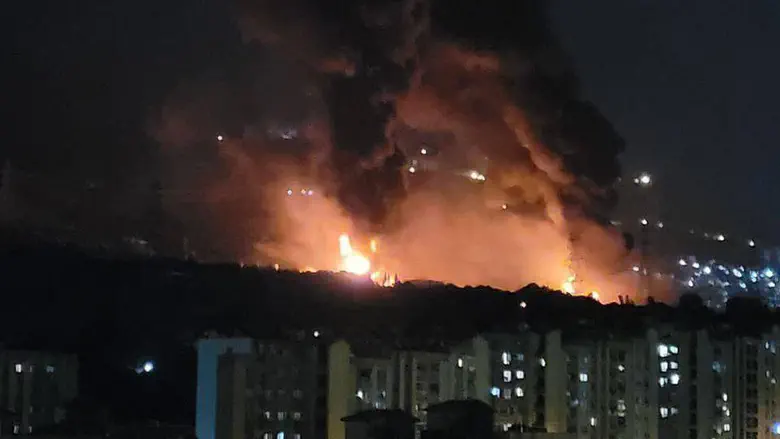 Israel National News1 day ago
US Central Command (CENTCOM) on Wednesday evening announced that its forces have begun launching strikes against Iranian targets.
The confirmation came after explosions were heard in Iran. The explosions were reported in Bandar Abbas, in Chabahar and on Kharg Island, among other places.
“At the direction of the Commander in Chief, US Central Command forces have started conducting additional strikes against Iran to further degrade their ability to threaten freedom of navigation in the Strait of Hormuz," said CENTCOM.
“The United States is holding Iran accountable for recent unjustified aggression against commercial shipping and civilian crews freely navigating a vital international waterway," it added.
Later in the night, it was also reported that a railway bridge in northwestern Iran was attacked, causing damage to transportation infrastructure in the area.
A senior US official confirmed to Channel 12 News that the US military conducted precision strikes using cruise missiles against two railway bridges in northern Iran. This marks the first time the US military has targeted infrastructure on Iranian soil since the ceasefire took effect on April 8.
An Israeli official told Al-Arabiya that the US had notified Israel it would carry out powerful strikes in Iran.
Following the US strikes, an Iranian military source told the Nournews agency, "We will soon launch a massive attack against US military bases in the region."
Mohsen Rezaee, an advisor to Iran's Supreme Leader, issued a direct threat toward the United States and its regional allies following the US strikes in Iran.
In a brief post on social media, Rezaee wrote, "The aggressive enemy and its partners will be severely punished."
US President Donald Trump commented on the strikes in Iran in a post on his Truth Social platform.
"This is in retribution for yesterday’s bombing of ships by Iran. If it happens again, it will get much worse!" he wrote.
Meanwhile, a US official told CNN that the ceasefire with Iran “has at least temporarily ceased".
The official added that the situation with Iran continues to be very dynamic and there could be more strikes beyond what was announced. The US military is in a wait-and-see mode, the official stated, adding that the targets of the latest strikes were missiles and drones, that could be used against US assets, like aircraft carriers.
The US strikes came hours after Trump lashed out at Iran, describing its leadership as “scum", and said that it was likely the US would launch strikes against it once again.
Wednesday’s strikes came one night after CENTCOM struck over 80 targets in Iran hit with precision munitions “as an immediate response to Iran's latest attacks on commercial vessels transiting the Strait of Hormuz."
 Israel National News1 day ago
Violent clashes broke out on Wednesday evening between dozens of haredi rioters who turned up at Military Prison 10 at the Beit Lid base to protest the arrests of draft dodgers and soldiers guarding the base.
The demonstrators, men and women, arrived at the base by bus. Immediately after arriving, they began to confront police and infiltrate the prison.
So far, the soldiers have managed to remove the male protesters, but the women remain inside the base.
 Israel National News1 day ago
Rainbow flagISTOCK
LGBT members of Israel's Democrats Party are challenging the party on its commitment to promoting its policy towards the Arab sector as well.
Omer Nachmani, who was Yair Golan's spokesperson, reported that he was approached by numerous members of the LGBT community who are concerned by the fact that a leading candidate in the Democrats with a realistic chance for election has, for the past week, refused to be photographed with a rainbow flag.
"If this candidate were a religious Jew, and not a Muslim, she would have been kicked out of the party," Nachmani wrote in a post on Facebook. He added, "I will not agree to any compromise on my human and civil rights, the same way I would not agree to any compromise on the human and civil rights of the Arab sector. The Democrats is my home, and in my home there will be no homophobia, not even implicitly.
To illustrate his position on the issue, Nahmani attached a graphic image of Soumya Bashir, a Muslim activist running for the Democrats ticket, wearing a rainbow hijab.
During Pride Month, Yair Golan, leader of The Democrats, published several Hebrew-language videos highlighting the party’s support for LGBTQ rights and the LGBTQ community. However, the same videos were not published on the party’s Arabic-language Facebook page.
 Israel National NewsIsrael National News1 day ago
The “Road Officers" projectPolice Spokesperson
As part of the ongoing battle against road accidents, the Israel Police Traffic Division launched the “Road Officers" project on Wednesday.
As part of the initiative, dash cameras and an advanced documentation system will be installed in approximately 100 patrol vehicles, aimed at expanding enforcement against life-threatening traffic violations and strengthening deterrence on Israel’s roads.
The launch ceremony was attended by Israel Police Commissioner Insp.-Gen. Danny Levy and Traffic Division Chief Maj.-Gen. Haim Shmueli. Levy described the launch as “a celebration for law enforcement officers" and “a day of reckoning for those who, until today, were able to drive on the shoulder and cut into traffic."
“People drive as if we are a third-world country, and there aren't families that only want to return home," Levy said.
The police commissioner said the project has initially been launched with 100 cameras, including one installed in his own vehicle at his request. He added that the Traffic Division is moving toward a digital enforcement model in which “speed and deterrence are the name of the game," calling the initiative a significant investment in modern enforcement tools.
In the first stage, cameras were installed in 100 patrol vehicles, with plans to expand the program to hundreds of additional vehicles, including those outside the Traffic Division. The system enables officers to document violations while on the road and transfer the footage to a national review center. After the vehicle’s license plate is identified, a ticket will be issued to the owner if investigators determine that a traffic violation occurred.
Police officials said the key innovation is the ability to turn regular patrol vehicles into active enforcement tools, even without an officer stopping the driver at the scene. While the initiative is expected to increase deterrence and improve road safety, officials acknowledged that it may also lead to a rise in the number of appeals filed against traffic tickets.
“This is not just another project. It is an organizational and national effort that expands the Israel Police’s enforcement and deterrence capabilities in order to restore safety and confidence on the roads," Shmueli said.
“From now on, every officer will be able, at any given moment while driving, to carry out precise and effective enforcement against drivers who commit life-threatening violations," he added.
The police also noted that last month, the Knesset Economics Committee approved the Transportation Ministry’s request to revise the traffic points system. The changes include harsher penalties for offenses such as using a mobile phone while driving, running red lights, driving on the shoulder, and failing to yield to pedestrians. At the same time, point penalties will be reduced for certain offenses, and the period required to erase points for less serious violations will be shortened.
 Israel National News1 day ago
Yaakov's sister being notifiedIDF Spokesperson
A 15-year investigation has officially determined the burial place of Private Yaakov Zrihan, who fell while partaking in a convoy as part of Operation Harel during Israel's War of Independence.
According to the investigation's findings, Zrihan was buried in a mass grave in the Harel Brigade's cemetery in Kibbutz Kiryat Anavim, along with other IDF soldiers who fell during the operation.
The IDF stated that "Private Yaakov Zrihan fell in a supply convoy to the besieged Jerusalem during Operation Harel in 1948, and his place of burial was unknown. After an intense investigation led by the IDF Casualties Department's Missing Persons Branch, which took 15 years, his place of burial was located.
Pvt. Yaakov ZrihanIDF Spokesperson
Yaakov made aliyah from Casablanca, Morocco, in December 1947 through the Habonim movement on the Haportzim illegal immigration ship. Upon his arrival, he was assigned to the "Hasna" training at Kibbutz Ramat Hakovesh, which was intended to move to Kibbutz Bror Chayil. Later, on April 12th, 1948, he enlisted in the Transportation Service and was assigned as an operational driver in the "Etzioni" brigade. During Operation Harel, he participated in a convoy to Jerusalem on April 20th, 1948, which consisted of approximately 300 vehicles, including armored ones. During the trip, he was killed in a battle that broke out in the Shaar Haguy area, together with 13 other convoy members. On April 22nd, he was buried in the Kiryat Anavim Cemetery.
The latest discovery was made possible after many years of extensive efforts to determine Zrihan's fate. In 2024, a special investigative team was established and carried out a wide range of activities, including locating and analyzing historical documents, interviewing witnesses, conducting complex soil analyses, and performing archaeological surveys in the area. Cross-referencing the findings ultimately led investigators to determine the location of his burial in the Harel Brigade military cemetery.
Members of the family, including Zrihan's sisters, were officially informed Tuesday evening that the investigation had concluded and that the mystery surrounding his burial place had been solved. The update was delivered by the Head of the IDF Personnel Directorate's Casualties Division, Brig.-Gen. Edna Eliya.
In the coming weeks, 78 years after his death, a state military ceremony will be held at the military cemetery in Kibbutz Kiryat Anavim, where a memorial marker bearing his name will be added to his grave.
Brig.-Gen. Edna Eliya commented on the completion of the investigation, saying, "Following a comprehensive investigation, today we were able to bring an emotional sense of closure. We informed the family of Yaakov Zrihan, of blessed memory, of the investigation's findings and the location of their loved one, who fell in battle 78 years ago. It is a privilege for us to continue acting out of a deep moral commitment to bring comfort and to accompany bereaved families."
Yvonne Cohen, Zrihan's sister, described her feelings after receiving the news: "For me, finding my brother's burial place means everything. I will call my sons so that, for the first time, they will be able to recite Kaddish at his grave."
 Israel National News1 day ago
Speaking at the NATO summit President Donald Trump declared that NATO is stronger and more unified than ever following the alliance's summit in Turkey, crediting his leadership for dramatically increasing allied defense spending while touting American military strength and defending recent U.S. military action against Iran.
Speaking after the summit, Trump praised Turkish President Recep Tayyip Erdoğan for hosting what he called "a tremendously successful NATO summit," describing him as "a great leader" and "a friend of mine for a long time."
"I want to thank President Erdoğan, who's really a great man. He's a great leader. He's a friend of mine for a long time," Trump said. "He's done a fantastic job in Turkey."
Trump also praised NATO Secretary General Mark Rutte, calling him "an extraordinary person" who has successfully united the alliance.
"There was tremendous love in that room," Trump said of the closed-door meeting with NATO leaders. "The press couldn't see the speaking... every one of them spoke... They have a lot of good in their heart, not evil. They're doing a great job for their country."
Trump argued that his administration has fundamentally transformed NATO by pushing allies to dramatically increase military spending.
He noted that NATO members agreed last year to raise defense spending from the long-standing 2% target to 5% of GDP, saying nearly all members are now moving toward that goal.
"Everybody said it was impossible, and now they're all thanking me," Trump said.
According to Trump, allied defense spending increased by nearly $150 billion in 2025 alone, with much of that money being spent on American-made military equipment.
"We make the best equipment in the world," he said. "The Patriots and the Tomahawks and everything we have is considered to be the best."
Trump said the United States remains "by far the largest contributor to NATO" while investing a record $1 trillion this year in its own armed forces, adding that he intends to request $1.5 trillion in future defense spending.
He also highlighted new defense agreements announced during the summit, including billions of dollars in investments involving Lockheed Martin, Northrop Grumman and Anduril Industries.
"We're pushing very hard to have the defense companies build more plants," Trump said, predicting waiting times for key weapons systems could eventually shrink from years to just weeks.
Trump said his meetings with NATO leaders, Ukrainian President Volodymyr Zelensky, Syrian President Ahmed al-Sharaa and President Erdoğan demonstrated renewed international respect for the United States.
"It was clear that America is back, and we're stronger and bigger and better than ever before," he said.
"We're respected again like maybe never before."
Trump repeatedly returned to what he described as the "unity" inside NATO.
"If there's one word that comes out of today, it's unification," he said. "I've never seen anything like it."
A major focus of Trump's remarks was Iran, as he defended recent U.S. military operations and insisted they had permanently crippled Tehran's military capabilities.
"I was there for one reason-that Iran cannot have a nuclear weapon," Trump said. "We denuclearized Iran."
"They will never have a nuclear weapon."
Trump claimed Iran's military infrastructure had been devastated.
"They have no military left. Their air force is gone. Their ships are gone. One hundred fifty-nine ships are at the bottom of the sea. Their radar is gone. Everything's gone."
He argued that Iranian nuclear facilities buried beneath mountains had effectively been destroyed.
"That stuff is so far down under a granite mountain that collapsed on top of it. It'll take months to get it out."
Trump warned that any attempt to restore the sites would be met with force.
"We're watching that. If anybody goes there, they get blown up."
Asked whether fighting could resume, Trump suggested any future confrontation would be brief.
"I don't think it's going to start again," he said. "Anything that happens is going to happen very fast."
He added that the United States had responded forcefully after recent Iranian attacks on shipping.
"They hit a couple of ships and so we hit them much harder. When they hit, we hit ten times harder."
Trump also said Iran's economic situation had deteriorated dramatically.
"They have 350% inflation," he claimed. "They want to make a deal, but they don't know how to make a deal."
At another point, Trump referred to Iran's leadership as "scum," saying they remained determined to target him personally.
"I'm number one on the kill list for Iran," he said. "But I'm doing what's right for the country."
Trump predicted that oil prices would continue falling despite renewed regional tensions.
"We have an oil glut right now," he said. "Oil is coming down."
He argued that securing the Strait of Hormuz would ensure continued energy supplies.
"Anything that happens is going to happen very fast and will only make it safer, including for oil."
Trump also devoted much of his remarks to domestic economic achievements, arguing that tariffs had sparked an unprecedented manufacturing boom.
He claimed the United States now has over $19 trillion in new investment commitments and the highest employment levels in its history.
"There has never been anything like what's happened with this country," Trump said.
He pointed to announcements by major companies including Toyota, Eli Lilly, Merck and semiconductor manufacturers, saying tariffs had encouraged companies to build factories inside the United States.
"If you build your product here, you pay no tariff."
Trump said he had an "excellent" meeting with Erdoğan and indicated he is open to allowing Turkey back into the F-35 fighter jet program.
"My inclination is to say, look, he's done everything. He's helped us in so many different ways."
Trump praised Turkey as "the second most powerful country in NATO" and said bilateral relations had significantly improved since his return to office.
"It's one of our best relationships."
He also credited Erdoğan for staying out of the recent regional conflict despite having the ability to become involved.
"He stayed out of that war at my request," Trump said. "He's been a very good ally."
Trump praised Syrian President Ahmed al-Sharaa, saying Syria had undergone a remarkable turnaround.
"He's doing an unbelievable job in unifying Syria," Trump said.
"Syria was a mess... and now it's just come together. He's done a fantastic job."
While Ukraine was not the main focus of Trump's remarks, he confirmed he met with President Volodymyr Zelensky during the summit.
Trump maintained that the alliance is now stronger than ever and said NATO leaders expressed overwhelming support for continued cooperation with the United States.
"There was tremendous unity in that room," he concluded. "The love for our country-it was incredible."
 Israel National News1 day ago
Prime Minister Netanyahu and President TrumpREUTERS/Jonathan Ernst
Initial findings from the July 2026 Israeli Society Index by the Jewish People Policy Institute (JPPI) indicate a sharp decline in Israeli public confidence in US President Donald Trump, alongside broad opposition to the recently signed US-Iran nuclear agreement and strong support for the agreement with Lebanon.
The survey found that, for the first time since JPPI began tracking the issue, fewer than one in ten Israelis expresses "a great deal of trust" in President Trump to do the right thing for US-Israel relations. Just 7% said they have a great deal of trust in the president, while 41% said they have some trust and 45% said they have no trust at all.
The figures mark a significant decline from previous surveys. In January 2025, following Trump's return to the White House, 32% expressed a great deal of trust in him, while 21% said they had no trust. During Operation Lion's Roar in March 2026, the share expressing high trust rose to 34%. The decline continued over recent months, falling to 19% in April, 12% in June, and 7% in July, following the signing of the Iran nuclear agreement and the president's public statements.
Among right-wing Israelis, 8% expressed a great deal of trust in Trump and 56% said they had some trust, while the share expressing high trust has dropped from 29% a year ago, shortly after Operation Rising Lion, to 8% today. The proportion expressing no trust has more than doubled.
Among centrists, 58% said they have no trust in Trump, rising to 74% among the center-left. In both groups, no respondents expressed a great deal of trust in the president. Among those who voted for Likud in the 2022 election, 15% expressed high trust, while distrust reached 58% among National Unity voters and 77% among Meretz voters.
Among Jewish Israelis alone, 5% expressed a great deal of trust in Trump, while 46% said they have no trust in him whatsoever.
Despite the decline in confidence in the president, 74% of Israelis said they still regard the United States as a true friend of Israel.
The poll also found broad agreement on how Israel should manage its relationship with Washington. Sixty-six percent of Israelis, including 77% of Jewish Israelis, said Israel should seek to coordinate with the US administration whenever possible but ultimately act according to what it believes is in its own best interests when disagreements arise. Only small minorities said Israel should always defer to Washington or disregard US positions altogether.
The survey found broad opposition to the agreement signed between the United States and Iran.
While 55% of Israelis expressed concern in June as the agreement was taking shape, 68% now believe it is bad for Israel following its signing, including 56% who described it as "very bad for Israel," up from 34% one month earlier. Fourteen percent said they believe the agreement is good for Israel.
Among Jewish Israelis, 68% described the agreement as "very bad for Israel," while no Jewish respondents selected the option that it is "very good for Israel."
Opposition extended across the Jewish political spectrum, with 72% of Likud voters, 89% of Religious Zionism voters, 91% of Labor voters and 81% of Meretz voters viewing the agreement negatively. Among Arab Israelis, 57% said they believe the agreement is good for Israel.
By contrast, the agreement with Lebanon received broad public support. Sixty-three percent of Israelis said the agreement is good for Israel, while 18% disagreed.
Support was nearly identical among Jewish and Arab Israelis, at 63% and 64% respectively. It also crossed political lines, with 68% of right-wing respondents and 62% of left-wing respondents supporting the agreement.
The survey found that Israelis remain divided over the future of Gaza.
Forty-three percent favored attempting to weaken Hamas through economic and diplomatic means, while 35% supported returning to military operations until Israel's stated objectives are achieved. Fourteen percent said the current situation should be maintained.
Among Jewish Israelis, 50% favored economic and diplomatic pressure while 41% supported renewed military operations to eliminate Hamas rule. Among Arab Israelis, 51% supported maintaining the current situation and preserving the ceasefire.
Political divisions were also reflected in responses on Gaza. Sixty-eight percent of respondents on the right favored renewing military operations, while 70% of centrists and 92% of left-wing respondents supported economic and diplomatic pressure.
A similar poll by the Israel Democracy Institute published earlier this week found that the share of Israelis who believe Israel's security is a central consideration of President Trump's fell from 44% in May to 28% in June. The survey, conducted among 603 Jewish respondents and 151 Arab respondents between June 28 and July 1, also found that among Jewish respondents, the belief that Israel can fully rely on Trump declined by 38 percentage points between March and June 2026. Just over one-third of Israelis said they believe Israel's strategic security situation is better today than it was before the war with Iran.
A separate survey by the Associated Press-NORC Center for Public Affairs Research, conducted between June 11 and June 17 among 3,040 respondents, including 1,022 Jewish adults, found continued declines in support for Israel among US adults. Forty percent said the US is "too supportive" of Israelis, while 39% said the US is "not supportive enough" of Palestinian Arabs. Among Democrats, 58% said the US is "too supportive" of Israelis, up from 45% in January 2024, while 21% of Republicans shared that view. The survey also found that one-third of American Jewish adults believe Israel has committed genocide in Gaza, while 49% said it has not. Among US adults overall, about one-third said they believe Israel has committed genocide, including roughly half of Democrats. The poll further found that 38% of US adults hold an unfavorable view of Prime Minister Benjamin Netanyahu, compared to 28% who view New York City Mayor Zohran Mamdani unfavorably. Among Jewish adults, about six in ten viewed Netanyahu unfavorably, while 39% viewed Mamdani negatively and 44% viewed him positively.
 Israel National News1 day ago
The Prime Minister's son formally known as YairAvshalom Sassoni/Flash90
Yair Netanyahu, the son of the Prime Minister, has changed his name and is now registered with the Israeli authorities under the name "Yonatan Han," the Haaretz newspaper reported on Wednesday.
The change was discovered through tax authority records, which include the new name with his identification number.
Whereas in December 2024, his tax withholding certificates were still issued under the name Yair Netanyahu, this year, the same identifying details appeared instead.
Netanyahu's second son, Avner, also chose to use a pseudonym in the past. When he purchased an apartment near London, England, in 2022, he was registered in the British Land Registry under the name "Avi Avner Segal."
Yair's new name is not out of the blue, but rather based on his family history. The name "Han" is the original last name of his maternal grandfather, Shmuel Ben Artzi. Yonatan is the name of his paternal uncle, who fell during the operation to rescue hostages from Entebbe Airport in 1976.
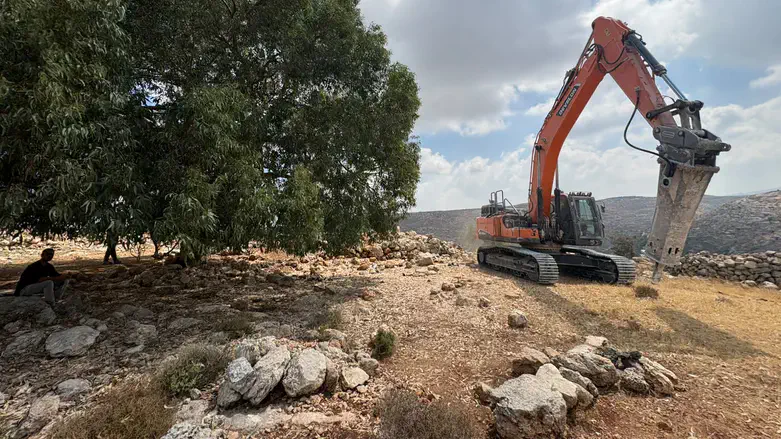 Israel National NewsIsrael National News1 day ago
Constructing the town of NatofBinyamin Regional Council
The Binyamin Regional Council is advancing plans to establish a new community, Natof, in western Binyamin, following the Diplomatic-Security Cabinet's decision to approve and regulate new communities in Judea and Samaria.
According to the plan, the community will be built near the towns of Nili and Na'ale, a short drive from central Israel. The Council noted that this will be the first time since the 1980s that a new community is being advanced in Binyamin for a founding group of secular families.
The initiative is being promoted in cooperation with the Ministry of Settlements and National Missions, the Settlement Division of the World Zionist Organization, the Binyamin Development Company, and the Amana company. Alongside the planning process, the Council is working to assemble the group of founding families who will take part in establishing the new community.
Binyamin Regional Council head and Yesha Council chairman Israel Ganz said, "Binyamin is a complete Israeli mosaic, made up of religious, secular, and haredi [people]. We are proud of the strong and thriving secular communities in Binyamin, and now we are proud to lay the foundations for Natof and continue that story."
He added, "Settlement is a national mission that belongs to every part of Israeli society. We invite families who want to be part of the founding group of pioneers in Natof to join us and help build the next generation of communities in western Binyamin."
"We grew up on the legacy of the founders of Nili, Na'ale, and Kfar Ha'oranim. Now it is time to grow the next generation of communities in western Binyamin and continue the Zionist endeavor in the area."
Settlements and National Missions Minister Orit Strock said, "Through settlement, we are reclaiming parts of the Land of Israel that were abandoned, planting deep roots in a land that has always been ours, and creating a better political and security reality - a protective wall of communities - both within the Binyamin Region and on the other side of the Seam Line."
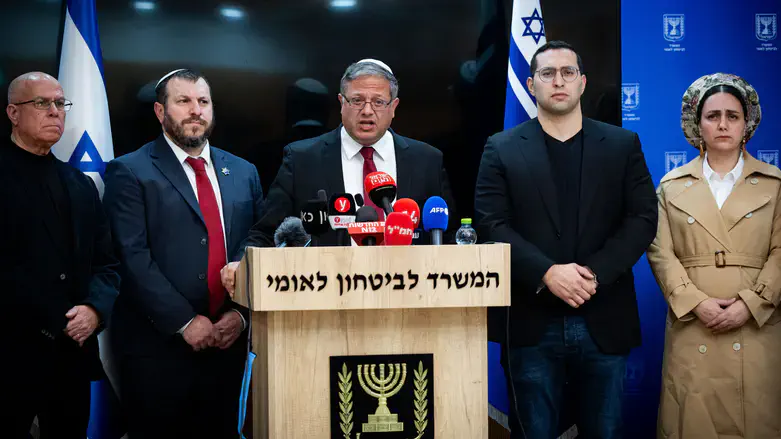 Israel National News1 day ago
Otzma YehuditYonatan Sindel/Flash90
The leadership of the Nachala Movement, headed by co-chairs Daniella Weiss and Zvi Elimelech Sharbaf, held a special working meeting with members of the Otzma Yehudit faction in the Knesset.
Also participating in the meeting were representatives of the "Gaza Vanguard" settlement nucleus and representatives of the Nahal-Sderot settlement nucleus. During the meeting, the movement's leaders presented the activities of the settlement groups since the October 7th massacre, as well as practical plans to establish the communities of Nisanit, Elei Sinai, and Dugit in the northern perimeter of the Gaza Strip before the upcoming elections.
Among the prominent participants was Itzik Pitousi, a bereaved father and chairman of the Forum of Heroism. His son, Yishai, of blessed memory, was killed while fighting to defend Kibbutz Nahal Oz during the Simchat Torah massacre. Pitousi told faction members that he is an integral part of the settlement groups and spoke of the aspiration to establish a new community in the northern perimeter area in memory of his son, to be called "Garin Yishai."
Representatives of the movement stressed to the faction members that, following the Defense Minister's recent remarks, the clear objective is to work toward the reestablishment of Nisanit, Dugit, and Elei Sinai before the next election campaign, as a first step toward renewed Jewish settlement in the region.
National Security Minister Itamar Ben-Gvir said during the meeting, "The Nachala Movement teaches us determination and dedication. Otzma Yehudit supports this 100 percent, and we will work to advance it in the Security Cabinet. We will not be like grasshoppers, and the people of Israel are with us. G-d willing, this year, even before the elections, Nisanit and Dugit will return to us. We will not be satisfied with restoring only what existed in Gush Katif. Strengthening the communities and encouraging emigration are two very important goals. 'You shall drive out the inhabitants of the land'-that is what we know, and with G-d's help we will work to achieve it."
Daniella Weiss added, "I remember very well how Rabbi Menachem Felix of Elon Moreh blew the shofar when the political upheaval of 1977 brought the Right to power. There is no doubt that today, as well, the path for the Right to win the elections is through settlement. This is the clear move that will raise the morale of the entire nation and lead to victory."
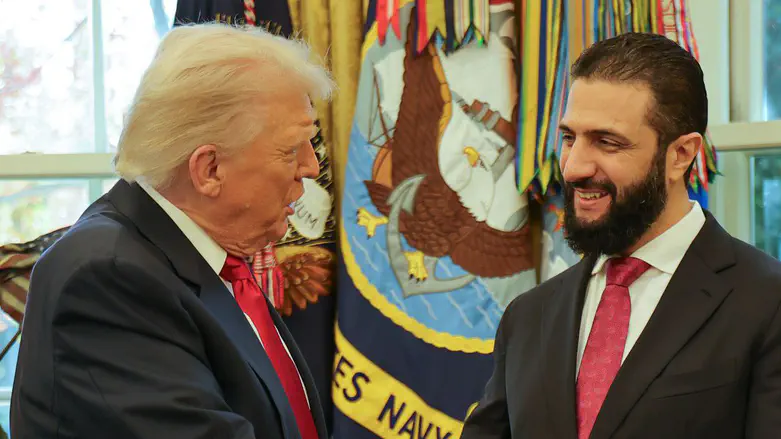 Israel National News1 day ago
President Donald Trump met on Wednesday with Syrian President Ahmed al-Sharaa on the sidelines of a NATO Summit, and stated that Syria has undergone a dramatic transformation following his decision to lift sanctions on the country.
The two also discussed the future of Syria, Israel’s security concerns, relations between Israel and Lebanon, and Trump's close cooperation with Prime Minister Benjamin Netanyahu.
Trump praised the decision to remove sanctions from Syria and said the move, combined with regional support, would help the Syrian people move forward.
“The historic decision that President Trump has taken by lifting the sanctions of Syria, as well as the help of friendly countries and loving countries in the region, Turkey and other countries in our neighborhood - the entire Syrian people thanks President Trump," al-Sharaa said.
Trump thanked him and responded that he believed Syria was heading in a positive direction.
During the exchange with reporters, Trump was asked whether he intended to remove Syria from the US list of state sponsors of terrorism.
“I think I will. Yeah, I think I will," Trump said. “Why wouldn't he? He's done a great job."
Trump indicated that the issue had been under consideration and suggested that removing Syria from the list would be a logical next step following what he described as positive developments.
The discussion also focused on Syria’s possible role in regional security, including the issue of Hezbollah in Lebanon. Asked whether he still wanted Syria to help address Hezbollah’s activities in Lebanon, Trump said Syria could potentially play a role.
“They could help. We'll find out," Trump said. “I think we're making a lot of progress."
Trump added that Syrian leadership could contribute positively, saying: “They would do a very good job."
Trump was also questioned about concerns raised by Prime Minister Benjamin Netanyahu regarding Turkish President Recep Tayyip Erdogan’s regional ambitions, particularly regarding Syria.
Netanyahu has warned about Erdogan’s influence and what he described as Turkey’s imperial ambitions in neighboring countries.
Trump defended his relationship with the Turkish leader, saying that Turkey had not taken action against Israel and emphasizing Ankara’s importance as a US ally.
“He hasn't been involved with Israel at all and he's left it alone," Trump said. “I wouldn't say he's a friend because he's not a friend of Netanyahu, of Bibi. They don't get along, I think. But for me, he's been great."
“Turkey's been fantastic and a fantastic ally," Trump continued. “They're also a NATO country."
Trump said his administration had delivered unprecedented support for Israel, pointing to several major policy decisions.
“No president's done as much for Israel as I have. Nobody even close," Trump said.
He highlighted US recognition of Jerusalem as Israel’s capital and the recognition of Israeli sovereignty over the Golan Heights.
“If you look at all the things with Jerusalem, all the different things that we've done, the Golan Heights - things nobody has ever done anything for Israel like me," he said.
Asked whether he believed Netanyahu should be reelected in Israel’s upcoming election, Trump praised the prime minister’s leadership during wartime while saying he was not involved in Israeli politics.
“I can tell you this. He's been a great wartime president - we worked with a prime minister," Trump said. “So, we work with each other very closely and we went through a very big thing. We did a big thing together."
“In my opinion, he's been a great wartime prime minister," Trump added.
Trump said he believed Netanyahu should be popular because of his leadership but noted that Israeli politics were a separate matter.
“I don't know anything about his politics. I'm not sure. I would think he should be popular because he did a very good job," Trump said.
Trump also credited his own administration with supporting Israel during major security challenges.
“If you had a weak prime minister, you wouldn't have - and if you had a different president, I guarantee there wouldn't be an Israel," Trump said. “Israel wouldn't exist today if you didn't have me as president."
Trump was asked whether he believed Israel should withdraw its forces from southern Lebanon.
“Well, I talked to Bibi about that. Yeah, I think they're going to," Trump said.
“I think they want to. I don't think it's a question of me. I think it's - they want to," he added.
Trump said Israel’s concerns about security were understandable but expressed optimism about growing cooperation between Israel and Lebanon.
“They're getting along with Lebanon," Trump said. “They're signing deals with Lebanon, first time ever."
A US official accompanying Trump said that an agreement between Israel and Lebanon included the goal of an eventual Israeli withdrawal while recognizing Israel’s need to protect its security interests.
“Obviously, Israel's concerned about their security, but the president did a great job bringing those two countries together for the first time," the official said.
“It's a big thing. First time in many years."
Trump said he believed the arrangement would succeed.
“So, we have a deal with Israel and Lebanon and yeah, they'll leave and I think it's going to work out very well," he said.
Trump said Syria’s rapid changes were the reason for his visit and described the developments as among the fastest transformations he had witnessed.
“We're here for this because Syria has turned around as fast as I've ever seen," Trump said.
He added that he believed his own administration had similarly changed the United States quickly.
“Well, actually, I turned the United States around very fast too," Trump said.
During the lengthy exchange, Trump also discussed US energy production and economic policy, saying record oil production had strengthened the country’s position during international conflicts.
“When we decided to do this, it's called the denuclearization," Trump said. “We have to do it. They're never going to have a nuclear weapon."
Trump said he expected oil prices to continue declining due to increased production.
“We thought oil would go much higher. And it didn't go very high. And now it's coming way down," he said. “You're going to see oil drop very low."
A US official accompanying Trump said American energy production had reached historic levels.
“Under President Trump in his first term, now in his second term, the US is an energy superpower," the official said.
The official added that strong domestic production had helped the United States withstand international challenges.
Trump also said lower energy prices would eventually reduce costs throughout the economy.
“When oil goes, so goes everything else," Trump said.
He added that temporary increases could occur following military actions but said he expected prices to continue falling.
“It’s down from, let's say, $135 down to $69," Trump said. “It's dropping and everything else drops."
Trump ended the discussion by returning to Syria’s transformation and comparing it to changes he said he had implemented in the US.
“Syria has turned around as fast as I've ever seen," Trump said.
He praised the Syrian leadership and said the country’s progress represented a major regional development.
“Actually, I turned the US around very fast too," Trump said.
 Israel National News1 day ago
Rivka Ben Mosheצילום: Banner Media
Two years ago, this family lost a fourteen-year-old daughter. This year, doctors told her mother she has cancer. Rivka Ben Moshe is a single mom raising nine children, and every month she is forced to choose between the treatment that keeps her alive and the food on her children's table. The doctors have now said the treatment cannot wait.
To help Rivka start treatment today, click here now
The Ben Moshe children have already survived the worst thing a family can. Two years ago, they lost their sister. She was fourteen. Now they are watching their mother grow weaker, and they are terrified of losing her too. Adina, one of the daughters, wrote, "My mother has been there for us through the hardest times, and now, we are watching her grow weaker and weaker".
The money runs out the same way every month. Rivka's treatments cost more than the family can carry, so the choice becomes medicine or groceries, and lately the rent has slipped behind on top of it. If they cannot catch up, they could lose their home while their mother is fighting for her life.
The reason this cannot wait is medical. In the family's own words, the doctors told them the treatments must begin now, before the money is even in hand. "We already lost a sister. Don't let us lose our mother, too", the children wrote.
So far, $12,413 has come in toward a $100,000 goal. That leaves $87,587 still to raise, and the treatment clock is already running. The fundraisers have asked donors to give generously, $360 or more, where they can, because the situation is that urgent.
Add your gift now, while there is still time to help
The children asked for one thing: that their mother not have to face this alone. A gift today tells nine children that when it mattered, people did not look away.
Give now and help save Rivka's life. Click here
*Every donation is tax-deductible.*
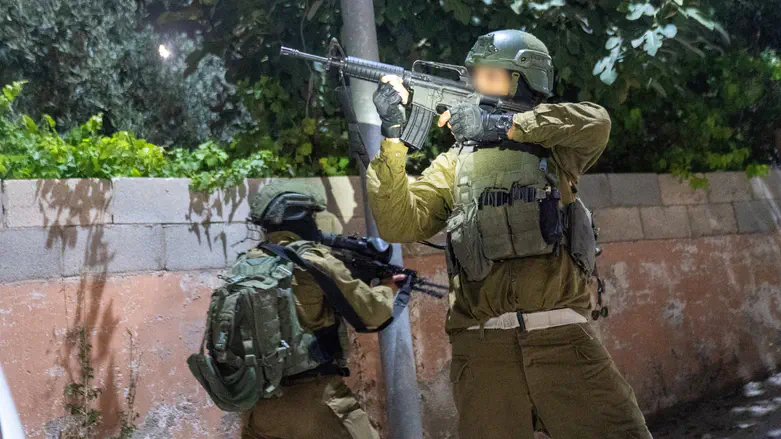 Israel National News1 day ago
IDF raids buildings in JeninIDF Spokesperson
Overnight (Wednesday), IDF soldiers completed dozens of counterterrorism activities across Judea and Samaria.
During the operation, the forces apprehended 20 wanted individuals, including suspects who were planning to carry out a terror attack, an arms dealer, a suspect involved in smuggling illegal entrants, and suspects affiliated with the Hamas terrorist organization.
The soldiers completed an airborne operation overnight in the Menashe Brigade area. During the operation, the soldiers searched more than 50 structures in the Jenin area.
After gunfire in Hebron overnight, IDF soldiers apprehended five suspects and questioned additional suspects in the Judea Brigade area.
In the area of Tulkarm, IDF soldiers and Israel Border Police officers apprehended four Hamas-affiliated suspects, as well as an additional wanted suspect on suspicion of incitement to terrorism in the area of Funduq.
 Israel National News1 day ago
הזירה בשכונת א-טורצילום: דוברות כבאות והצלה
Magen David Adom (MDA), Fire and Rescue Services, and police forces were called to the A-Tur neighborhood in Jerusalem following reports of an incident at a beauty salon. According to MDA reports, 12 women were injured - seven in moderate condition and another five in light condition. The victims were evacuated to Hadassah Ein Kerem, Hadassah Mount Scopus, and Shaare Zedek hospitals.
According to initial information, there is suspicion that the incident involved carbon monoxide poisoning caused by inhalation of a hazardous substance.
The incident took place on Sheikh Inbar Street, and some of the victims were unconscious when emergency crews arrived at the scene.
At this stage, authorities are investigating whether the source of the incident was a generator that was operating in the basement level of the beauty salon and allegedly caused the spread of the hazardous substance. The circumstances of the incident remain under investigation.
The Fire and Rescue Service said that firefighters from the Egoz station operated at the scene following reports of the evacuation of the women. They added that the initial assessment indicates suspected poisoning, though the circumstances have not yet been determined.
Police said that officers from the Shalem Station are securing the scene, assisting emergency and rescue teams, and working to keep traffic routes clear to allow the evacuation of the injured.
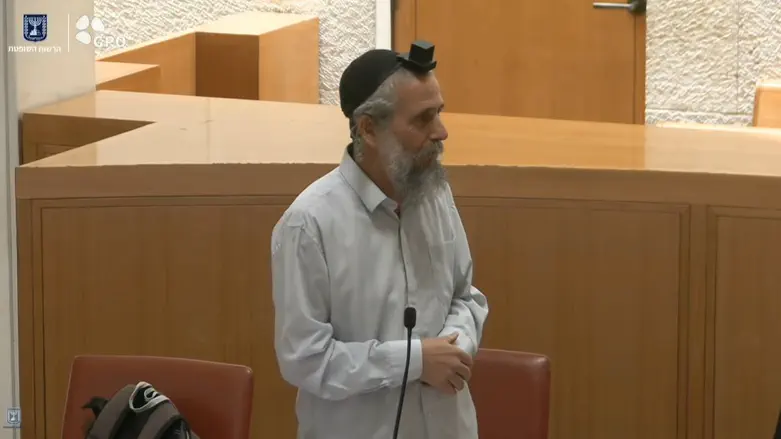 Israel National News1 day ago
מיכאל פואה עם התפילין בדיוןמתוך השידור
The chairman of the “Choosing Family" organization, Michael Fuah appeared before the Supreme Court on Wednesday wearing tefillin during a hearing on the organization’s petition regarding posthumous sperm extraction.
Justice Noam Solberg commented on Fuah’s unusual appearance, noting that petitioners appearing before the court wearing tefillin was “not a routine occurrence." Fuah explained that two months ago he accepted upon himself to wear tefillin throughout the day.
Solberg said the practice was interesting, noting that wearing tefillin all day requires maintaining an atmosphere of holiness. Fuah responded that only frivolous or inappropriate activities constitute a distraction from the mitzvah.
Chief Justice Yitzhak Amit remarked that the practice was “very unusual" and said he was glad Fuah viewed the Supreme Court as a holy place.
 Israel National News1 day ago
Ran ErezAvshalom Sassoni/Flash90
Teachers Union chairman Ran Erez on Wednesday escalated his dispute with the Education Ministry, sharply criticizing Education Minister Yoav Kisch.
Speaking at a press conference, Erez warned that unless the Ministry changes its conduct during the summer break, the Teachers Union will not allow the upcoming school year to begin.
According to Erez, the dispute over salary deductions imposed on teachers after classes were canceled due to the security situation is only one symptom of what he described as a much deeper failure in the management of the education system.
"No matter which party you vote for, if you care about the future of the country, our immediate future is in danger," he said.
According to Erez, while the Education Ministry canceled classes that day, teachers continued working from home, holding lessons and activities with their students. Despite this, he said, the Mnistry decided to deduct their pay.
"They are punishing teachers because of a decision made by the Education Minister," he claimed.
Erez also leveled personal criticism at Kisch, claiming that since he took office there has been no genuine cooperation between the Ministry and the Teachers Union.
"The moment I saw his interview, I understood that teachers do not interest him," Erez said. "Since I took office, there has never been an education minister who did not consult with us on decisions. He is focused on politics and headlines."
He also accused the Ministry of harming special education and managing education reforms inconsistently. According to Erez, thousands of teaching hours have been cut, reforms have been repeatedly canceled and replaced, while severe shortages of teachers in subjects such as physics, mathematics, and English continue to worsen.
Erez also addressed the integration of special education students into secondary schools, warning that without the necessary resources those students could suffer. In addition, Erez noted that violence in the education system is increasing, both against teachers and among students. According to him, this is due to a lack of boundaries and enforcement.
Concluding his remarks, Erez warned that unless the crisis is resolved in the coming months, the Teachers Union will prevent the start of the next school year.
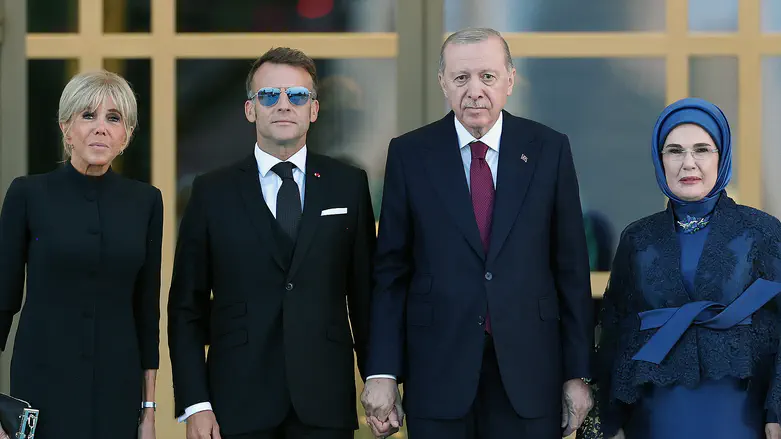 Israel National News1 day ago
A rather uncomfortable moment highlighted the clash of cultures between NATO Nations when French President Emmanuel and First Lady Bridget Macron were greeted by Turkish President Recep Tayyip Erdoğan and his wife Emine during the official reception at the NATO Summit in Ankara,
As they exchanged pleasantries, French President Emmanuel Macron attempted to kiss the hand of Turkish First Lady Emine Erdoğan.
In footage from the incident, the observant Muslim Erdoğan is seen pulling her hand away as the French President attempted to make the gesture.
After that, President Recep Tayyip Erdoğan is seen shaking Macron's hand for several seconds, which attracted attention on social media.
 Israel National News1 day ago
US President Donald Trump said on Wednesday during a meeting with Ukrainian President Volodymyr Zelenskyy at the NATO Summit in Ankara, Turkey, that US forces were likely to strike Iran again tonight.
"They are behaving very badly, as they have for 47 years," Trump said about the regime, noting that the US "hit them hard" after they launched drones and a missile at ships.
"We'll probably hit them again tonight. I'll give them a little warning; we're going to hit them hard tonight," he added and stressed his dissatisfaction with the regime.
According to the President, "It's not even a war; it's the denuclearization of Iran. It's not about regime change. Even though I think it's regime change when you knock out the first group, the second group, I think that's the ultimate regime change, but that's not what it's about. It's about not wanting them to have nuclear weapons."
The President continued his criticism of Iran: "They'll agree on everything, and then have a news conference and say we never even talked about it. They're cuckoo; there's something wrong with these people."
Trump clarified that, as far as he is concerned, the fact that the ceasefire is over does not mean the US is returning to a full-scale war.
He added, "They violate the agreement every day. They lie, they cheat, they kill people. They've been killing people for 47 years. They knocked out the USS Cole. We lost some 200 people."
He also said that the US may take over Kharg Island, Iran's main oil hub.
According to Trump, the Iranians "deserve" the strikes. "They asked for a time-out to go to the funeral of Khamenei, and I said to give it to them. And they start shooting missiles."
He concluded: "They're dishonourable people, and they can't keep a deal, so we'll see. Now, as to whether or not Steve Witkoff, Jared, JD, and everyone working with them will talk? I guess they can talk, but I'm not seeing it with them. My whole life is deals, I don't see it with them. There may be a big attack tonight, and it will knock out a lot of stuff."
 Israel National News1 day ago
פשיטת המסתערבים על האירועדוברות המשטרה
Undercover officers [mista'arvim] from the Border Police's Tactical Brigade and detectives from the Umm al-Fahm Police Station raided a celebration in the city this week following reports of gunfire at the event. Several suspects were arrested during the operation, and officers seized two handguns, magazines and ammunition.
According to police, upon arriving at the venue, officers spotted muzzle flashes from within the celebration and identified a suspect holding a handgun. The forces quickly surrounded the area and entered the compound.
During the operation, a Glock handgun, along with a magazine and ammunition, was thrown toward one of the police teams. The weapon was recovered by officers.
A subsequent search of the area led to the discovery of another suspect who had attempted to hide near the venue. A Beretta handgun was found in his possession.
At the conclusion of the operation, police had seized both handguns, magazines and ammunition. All of the suspects, including the event organizers, who are suspected of involvement in the shooting and the possession of the weapons, were transferred to the Umm al-Fahm Police Station for further investigation.
The Police reported, "The Israel Police will continue to act decisively and with zero tolerance against the phenomenon of gunfire at celebratory events, with the goal of protecting public safety and preventing the possession and use of illegal weapons."
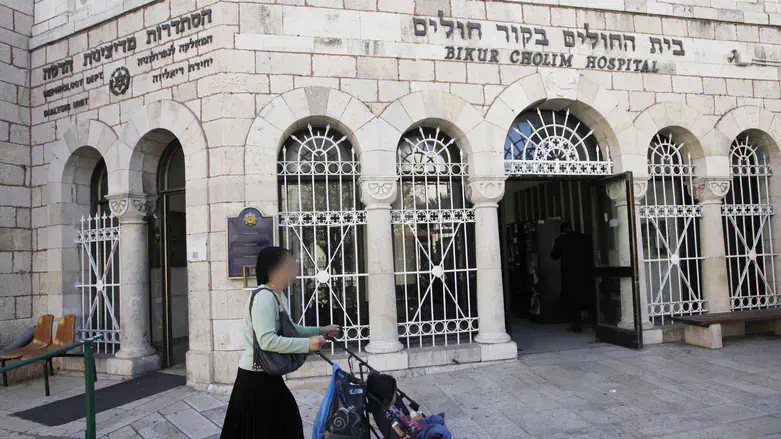 Israel National News1 day ago
Bikur Holim HospitalMiriam Alster/FLASH90
A public dispute has erupted at the Jerusalem Municipality after Deputy Mayor Yitzhak Meir Brim (Agudat Yisrael) accused City Council member Yossi Havilio of unfairly targeting the haredi community in a strongly worded letter.
The exchange follows Havilio's campaign against the municipality's decision to allocate the historic Bikur Cholim hospital building to a haredi educational institution. Havilio argued that the move undermines proper governance, the rule of law, and the protection of public assets, while warning it would alter the character of downtown Jerusalem.
Brim dismissed those claims, saying criticism of municipal decisions is legitimate only if it is applied consistently. He argued that Havilio has focused on the Bikur Cholim allocation while ignoring what Brim described as similar planning concerns surrounding the former Shaarei Tzedek hospital building, which is currently occupied by the Public Space association.
In his letter, Brim questioned whether the rule of law is being applied equally across the city or only when haredi institutions are involved. He claimed Havilio's approach raises concerns about selective enforcement and discriminatory treatment of the haredi sector. Brim concluded by urging the council member to apply the same legal standards to all cases, saying that only consistent enforcement can credibly be presented as a defense of the rule of law.
 Israel National News1 day ago
Itamar Ben Gvir at the meetingYonatan Sindel/Flash90
A heated confrontation erupted Wednesday morning during a meeting of the Knesset Interior Committee, chaired by MK Yitzhak Kroizer, as lawmakers discussed enforcement against illegal construction in the Negev.
During the session, National Security Minister Itamar Ben Gvir clashed with Rula Daoud, an activist from the Standing Together movement, who interrupted him as he presented the government's enforcement policy.
Daoud attacked Ben Gvir, saying, "You're the one who lives in a settlement."
Ben Gvir responded: "Is your house legal? Show me the permit right now. If it's illegal, we'll demolish your house."
The meeting focused on state enforcement efforts against illegal construction in the Negev and was marked by several heated exchanges among participants.
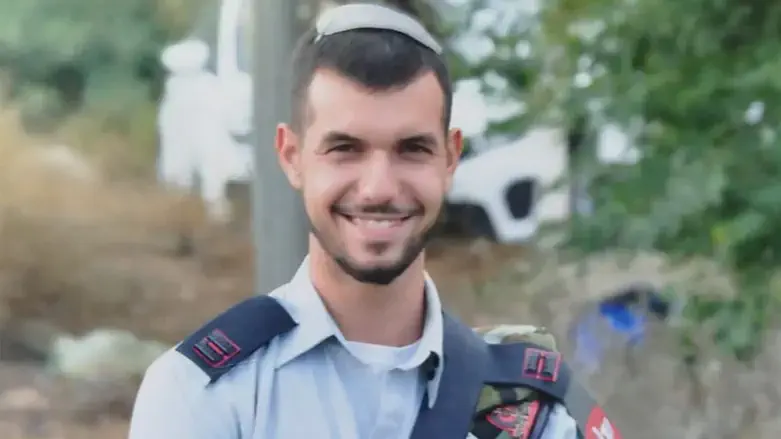 Israel National News1 day ago
Malachi MoundaniCourtesy of the family
An IDF reserve officer who was critically wounded in combat in southern Lebanon underwent a rare life-saving operation after doctors discovered a piece of shrapnel lodged just millimeters from his aorta.
Maj. Malachi Moundani, 26, a reserve unit commander from the community of Neve in the Eshkol region, was seriously injured during an encounter with terrorists last Thursday. He was evacuated to Rambam Medical Center with multiple penetrating wounds in life-threatening condition.
After stabilizing him, doctors found that a fragment had come to rest dangerously close to the aorta, the body's main artery. Medical teams faced a difficult choice: operating carried significant risks due to his extensive injuries, but leaving the fragment in place could have proven fatal if it shifted and tore the artery.
Following consultations between trauma, vascular, and cardiac surgery specialists, doctors decided to proceed with surgery. Dr. Tzvi Adler and Dr. Kamel Morshad successfully removed the fragment without complications.
"The fragment was sitting right next to the aorta, in contact with it," said Prof. Gil Bolotin, head of Rambam's cardiac surgery department. "Any movement could have punctured the aorta and led to a catastrophic outcome."
Bolotin noted that the case was exceptionally rare and scarcely documented in medical literature, prompting extensive deliberations over whether surgery was the safest option. "We chose to operate," he said. "The procedure went smoothly, and fortunately the patient stabilized afterward and was transferred for continued treatment at the medical center."
The fragment that settled close to the aortaPhoto: Rambam
 Israel National News1 day ago
Cigarettes hidden inside pineapplesLand Crossings Authority, Israeli Ministry of Defense
On Wednesday, an unusual smuggling attempt involving thousands of cigarettes concealed inside hundreds of pineapples was thwarted at the Lachish Crossing.
The smuggling attempt was detected by the security inspection personnel of the Land Crossings Authority at the Israeli Ministry of Defense, who transferred the findings to representatives of COGAT's Judea Liaison and Coordination Administration.
The shipment had been purchased by an Israeli company authorized to operate under the private sector humanitarian aid mechanism and was intended to reach the Kerem Shalom Crossing as part of the humanitarian aid entering the Gaza Strip. The truck and its entire cargo were confiscated and transferred to the Customs Directorate and the other competent authorities for further investigation.
In response to the incident, the Coordinator of Government Activities in the Territories (COGAT), Major General Yoram Halevy, ordered the immediate suspension until further notice of the company's authorization to deliver humanitarian aid into the Gaza Strip.
"COGAT, in cooperation with the Land Crossings Authority at the Ministry of Defense, the Customs Directorate and all relevant security authorities, will continue to act decisively and with zero tolerance against any attempt to smuggle goods or exploit the humanitarian aid mechanism," an official statement stressed.
 Israel National News1 day ago
Iran of oldAI generated
One must not think and speak of Iran as a nation state or Iranian culture as restricted only to the political boundaries of contemporary Iranian, Tajik, Kurdish, Afghan and Caucasian lands.
Culturally and historically, Iran - Aryana Kshatra in the Avestan and 'Old Persian' (also known as the Aryan language)-or, as the later Sassanian Persians referred to it, in their Middle Persian (Pahlavi) language as "Eranshahr" (the Aryan realm)-is more a global civilization than a geographically restricted political entity.
The word 'Aryan' in this sense does not refer to a race. It refers to a culture, and means quite literally; 'the realm of the Nobles'.
Like other significant civilizations of the ancient and classical world, such as Greece and Rome, Iranian/Persian influence stretches across large parts of the globe-both geographically and temporally and is baked into every other civilization on earth, especially into Western Civilization--which would simply not be conceivable without it.
The Indo-Iranian Nexus
From the primordial proto-Indo-Europeans, ancestors of all of today's Indo-European languages onward, Aryanem Vaeja has encompassed vast geographic regions, leaving a unique signature while being influenced by the diverse cultures and regions it encountered. The prehistoric migrations of the equestrian, chariot-wielding Irano-Aryan/Indo-Aryan peoples from their Eurasian homeland north of the Black and Caspian Seas southward into the Iranian Plateau and Northern India gave birth to the twin civilizations of Vedic India and Zoroastrian Iran-and to the Sanskrit, Avestan, Aryan (also known as Old Persian) and Gathic languages.
The Medes: Architects of a Hybrid Empire
The ethno-linguistically Iranian (Aryan) tribes (i.e. Medes, Cimmerians, Scythians, and Persians et al )settled into the Iranian Plateau (to which they gave its name), as well as regions that had for millennia been the home of the great Mesopotamian empires, from the Sumerians to the Babylonians and Assyrians. When the Iranian Medes-part ancestors of today's Kurds and first cousins of the Persians-overan these great and ancient civilizations, including the venerable Elamites, they created the first hybrid Mesopotamian/Indo-European empire that Western Asia had seen.
The Achaemenid Empire: A Multicultural Cosmopolis
Under the Achaemenid (Hakhamaneshis) dynasty-formed by the union under Cyrus the Great of Iranian Persians and Medes with the indigenous Elamites-the world's first proper, cosmopolitan, tolerant, multicultural, multi-lingual, multi-ethnic, multi-religious, proto-federalist political entity came into being. This empire, known in the West as the first 'Persian Empire,' governed dozens of nations from Ionian Greece, Thrace, and Macedon in the northwest to the Indus Valley in the Southeast, and from Egypt and Abyssinia in the southwest to Scythia and Central Asia in the Northeast.
Centered in the ancient and cosmopolitan Mesopotamian city of Babylon, the Empire contained, by some estimates, nearly 40% of the world's population under the Pax Persica (Persian Peace) for 230 years.
Cyrus the Biblical Messiah: A Liberator of Peoples
Cyrus the Great is particularly notable for his liberation of many subjugated peoples, including the Hebrews, from the 'Babylonian Captivity.' For this, he is referred to in the Bible as a "Messiah." Later Iranian Shahanshahs (Kings of Kings) rebuilt the Second Temple of the Hebrew people. Theologically, the ancient religion of Judea and the Hebrews included some of the Zoroastrian concepts, such as an afterlife, individual conscience (as opposed to collective guilt) and responsibility, ethical and cosmological dualism, paradise (Paradaija), hell, "Day of Judgment" eschatology, and others.
These ideas can be found in the Hebrews' Babylonian Talmud and became part of the DNA of all Abrahamic religions, including Christianity and Islam.
Zoroastrianism's Influence on Greek Philosophy
Zoroastrian thought influenced pre-Socratic Greece, transforming the primarily cyclical Homeric worldview of degenerating, fatalistic cycles into an ethical framework. The amoral Homeric ethos, previously lacking a sense of personal conscience, was profoundly impacted by Zoroastrianism. The first generation of Greek philosophy and science emerged during a time when large parts of the Greek world, including Ionia and Caria were Iranian colonies.
Greek thinkers such as Pythagoras, Heraclitus, Plato, Aeschylus, Herodotus, and Xenophon were greatly influenced by Iranian culture. And the revolutionary Zoroastrian concept of Mazdayasna-the love of wisdom-was directly translated by the Greeks as "Philo-sophia."
Eranshahr's Game of Thrones
Chivalric Iran in the Age of the Parthian and Sassanian Royal and Noble Houses
In later centuries, the world was again divided between two superpowers: the feudal Parthian and Sassanian Empires of Iran on one side, and Rome-Byzantium on the other. The feudal, chivalric Iranian realm of Eranshahr (i.e. the Aryan domain), protected by its heroic Seven Noble Houses, defensive great walls, heavily fortified castles, and armored mounted Asvaran (knights), successfully rivaled and held off Rome and Byzantium for 800 years-the longest rivalry between empires in human history.
Iran's role in the spread of Perso-Roman Mithraism, Dualistic Manichaeism, proto-Communist Mazdakism and the Birth of Christianity
During this era, Parthian Iran's pagan Mithraism and Sassanian Persia's Manichaeism profoundly influenced the religious and philosophical consciousness of both Republican and Imperial Rome, helping shape what we now know as the Catholic Church.
Saint Peter's Basilica itself is built on the site of an earlier Perso-Roman Mithraic temple.
The date of Christmas (winter solstice) is thought by some to be derived from the Mithraic holiday Sol Invictus, still celebrated in Iran today as the night of Yalda/Chelleh. Many Christian rituals and traditions seem to be partially or entirely Mithraic in origin. Even Saint Augustine, a Father of the Catholic Church, was a devotee of the Persian philosopher and prophet Mani for much of his adult life.
And it was also during this era that the antinomian, proto-communist movement of the revolutionary figure, Mazdak briefly took over the apparatus of the Sasanian Imperial state abolished private property and practiced 'free love'.
Iranic Europe
The Influence of the Sarmatians and Alans
Medieval European culture, from castles and knights in armor to Gothic architecture, chivalry, and the Troubadour movement, was significantly influenced by the mythology, folklore, and history of the northern Iranic tribes known as the Sarmatians (Sarmats) and their subgroup the Alans (i.e. Aryans/Iranians) and Roxalans (i.e. shining Alans)who settled much of Central and Western Europe during the great Barbarian Migrations that took place during the decline and fall of the Western Roman Empire.
Iranic Sarmatians and Alans were present and participated alongside their Germanic Goth cousins during the sack and fall of Rome itself!
The Persian national epic Shahnameh (Chronicle of Kings) and the Caucasian Nart Saga share elements with the Arthurian legends of the Grail, central to Western European identity. Today, the descendants iof these Iranic Sarmatians and Alans are baked into most European populations, But in one region of the Caucasus they still remain as a distinct known as the Ossetians. They refer to themselves as the "Ironi" and proudly maintain their Iranic heritage, identity, and language.
Iranian Influence on 'Islamic' Civilization
The now-global literature of the Thousand and One Nights (incorrectly labeled the "Arabian Nights") was primarily a collection of pre-Islamic Indian, Mesopotamian, Greek, Jewish, and Iranian stories gathered during Persia's pre-Islamic Sassanian dynasty.
The unmistakable silhouette of Islamic architecture, from the Persianate Taj Mahal in India to the Alhambra in Spain, is predominantly Persian/Iranian. Islamic architecture is an evolution and continuation of the earlier developments made by the Byzantines in the West and the pre-Islamic Parthian and Sassanian dynasties of Iran, in the East These had mastered the monumental dome, arch, and vault to an unprecedented level before the birth of Islam. And that tradition continued to evolve after Islam, often by Iranian and Greco-Roman architects.
Iranian Transformation of Islamic Theology
Persian influence also transformed the theology of Islam itself. From Salman the Parsi to the Mazdakite-influenced Sufism and the Ismaili Shiite movements of Hassan al-Sabah and the libertine sect of the Hashishin (assassins), subjugated Iranians reshaped Sunni Islam into a humane, esoteric, philosophical, mystical religion of love.
This transformation culminated in the humanism of Persian poets, philosophers, mystics, and freethinkers such as Farabi, Saadi, Attar, Jami, Rumi, and Hafez and Iran's national epic poet Ferdowsi whose monumental Shahnameh (Chronicle of Kings) retold the mythological and historical story of the Iranian (Aryan) peoples from 'creation' down to the Islamic invasions.
Iran's Scientific Golden Age
The so-called "Islamic" Golden Age, which created the 'scientific method,' Algebra, Trigonometry, Optics, and Chemistry, and contributed so much to Medicine, Astronomy, Geography, and Philosophy, was largely driven by Persian/Iranian scientists and thinkers. Many of these individuals were either secret Zoroastrians (derisively labeled as "Magusis" by their Muslim Arab rulers) or full-on freethinkers and libertines.
Influence on the European Renaissance
When this brilliant Golden Age was extinguished in Iran and the Abbasid East by the savage onslaught and holocaust of Genghis Khan and his Mongol hordes, its discoveries and knowledge flowed through Byzantium, the Crusaders, and Muslim Moorish Spain and Sicily to Europe. This knowledge catalyzed the Italian and European Renaissance in the 15th century. Iranian philosophers and scientists such as Abu Ali Sina (Avicenna) and Zakaria Razi (Rhazes) were used as essential texts in European universities like Montpellier for over 500 years.
Lingua Persica:
The Late Persianate Cultural Sphere, from India and Central ASia to the European Caucasus and Balkans
From the 12th to the 19th centuries, Persian culture, literature, language, architecture, painting, music, manners, cuisine, and aesthetics were dominant not only in the Safavid Persian Empire but also in the Indian sub-continent, the tri-continental Ottoman Empire, and Timurid, Turkic, and Mongol Central Asia, as well as the Caucasus. The literary, courtly, and administrative language of Mughal India in the East, the Seljuk and Ottoman Empires in the West, and the Turko-Mongol Khanates of Central Asia was Persian.
Persian literature, mythology, and folklore became the Lingua Persica-the cultural language-from Delhi to Istanbul and from Baghdad through Esfahan to Samarkand, Bukhara and Merv.
The Parsis of India
This is not to omit the earlier Parsi (i.e. Persian) Zoroastrian community that has lived as refugees in India since they emigrated from Iran following the Arab invasion of Sassanian Persia. These Parsi and Irani communities have played an enormously instrumental role in both the economy of India and in securing India's independence from Britain.
The Brilliant Shadow of Eranshahr Through the Ages
From the primordial, shamanistic, pagan Indo-European religions of Zurvan (the equivalent of the Greek Chronos) and Mithra (Mehr); to the Zoroastrian revolution of Mazdayasna (Philo-Sophie); to the esoteric Gnostic, Nestorian Christian, and Islamic Sufi traditions; to the exoteric, syncretic, universalizing religions of Manichaeism, the proto-socialist and antinomian Mazdakite movement, to the East-Iranin Scythian invention of Mahayana Buddhism, and the syncretic universalizing modern Bahai faith born in 19th century Iran-the various branches of the Iranian, Iranic, Persian, and Persianate cultural galaxy are an ever-present-if often invisible, forgotten, or suppressed-"empire of the mind" (to borrow a phrase from Michael Axworthy), as well as of the heart and spirit.
There is an inexhaustible, historical but also still (miraculously) living, breathing, evolving legacy and heritage-of and from Aryana, not a nation state, not a race, but a multi-ethnic, multi-continental cultural and civilizational 'realm of the Nobles.'
...
 Israel National News1 day ago
Eliminating Hamas terrorists in Gaza (illustrative)IDF spokesperson
The IDF on Tuesday struck in the southern Gaza Strip, eliminating terrorist Mohammed Emad Alrahman Abu Taima, a Nukhba cell commander in Hamas’ military wing.
During the October 7th massacre, Taima infiltrated Kibbutz Nirim.
Throughout the war, Taima commanded a Nukhba cell that carried out ambushes against IDF troops. In recent months, alongside advancing additional attacks, he was involved in maintaining the operational readiness of the terrorists and attempted to recruit new terrorists to Hamas.
"The terrorist posed an immediate threat to IDF troops operating in the area and was eliminated in a precise airstrike," the IDF stated following the strike.
"Prior to the strike, steps were taken to mitigate harm to civilians, including the use of precise munitions and aerial surveillance.
"IDF troops under the Southern Command remain deployed in the area in accordance with the ceasefire agreement and will continue to operate to remove any immediate threat."
 Israel National News1 day ago
ניפוץ דלת הכניסה להארץמצלמת אבטחה
In the early hours of Wednesday morning, masked suspect threw two bricks at the entrance to the Haaretz newspaper's offices in Tel Aviv, shattering the glass door before fleeing the scene.
According to security footage, the first brick thrown at the entrance failed to break the door. The suspect then hurled a second brick, which shattered the glass, and fled immediately afterward.
No formal police complaint has yet been filed, but police contacted Haaretz and have begun examining the circumstances surrounding the incident.
The attack comes just days after unknown individuals smashed the entrance door of the building housing Channel 12 News in Tel Aviv.
In that case, it was unclear whether the vandalism targeted the news agency or another business operating in the building, and the motive remains unknown.
The incident at Channel 12 occurred about a month after threatening graffiti was sprayed near the company's offices. Following that attack, Channel 12 said it was "shocked, but not surprised by the violence," and called on police to swiftly identify those responsible.
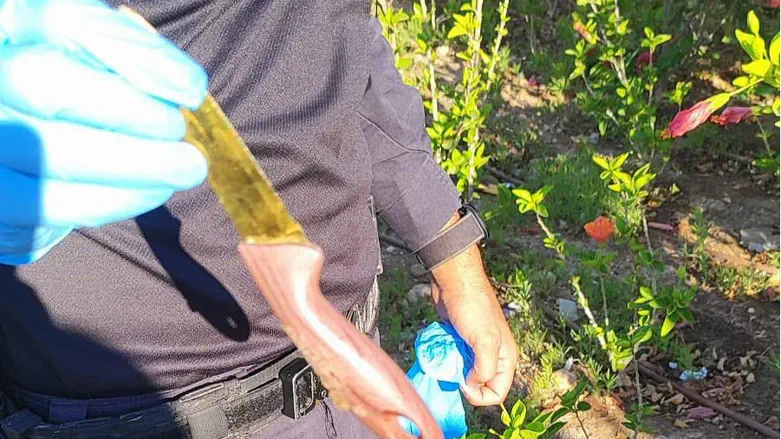 Israel National News1 day ago
המצלמות חשפו את הסכיןדוברות המשטרה
A 45-year-old Palestinian woman from Ein Sultan, near Jericho, was arrested Wednesday morning after allegedly attempting to conceal a knife during security screening at the entrance to an industrial area near Modi'in Illit.
At approximately 6:00 a.m., security personnel reported the discovery of a knife near the checkpoint. A review of surveillance footage allegedly showed the suspect throwing the knife into nearby bushes while undergoing security checks. Following the discovery, police launched a search for the suspect.
The woman, who works at a business in the industrial area, was located and arrested a short time later. She was taken to the Ma'ale Adumim police station in the Judea and Samaria District for further questioning.
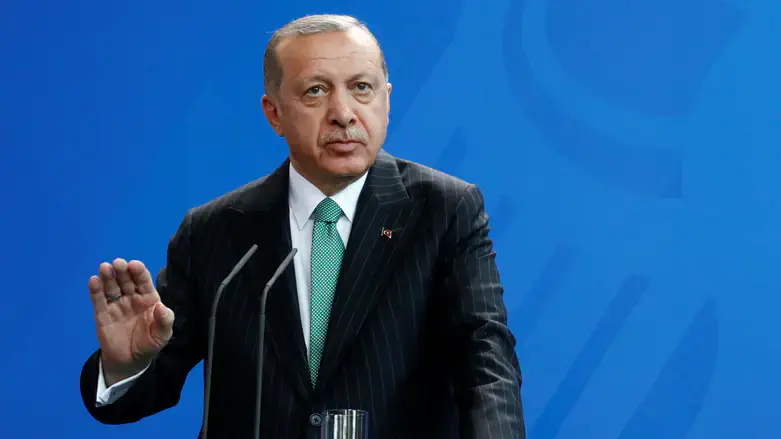 Israel National News1 day ago
Recep Tayyip ErdoganReuters
Former Ichilov Hospital spokesman Avi Shoshan claimed during a Channel 14 panel discussion that Israel once helped save the life of Turkish President Recep Tayyip Erdoğan by sending an Israeli physician to treat him.
Commenting on Erdoğan's appearance during the NATO summit, Shoshan said, "Do you know who looks unwell? Erdoğan. And do you know why I think about that? Because Israel saved him."
According to Shoshan, a senior physician from Tel Aviv's Ichilov Hospital, whose name he declined to reveal, was sent to treat Erdoğan after he developed cancer.
"An Ichilov doctor - I won't reveal his name - saved Erdoğan," he stressed. "A doctor from Israel. Israel saved him."
Shoshan also stressed that this doctor acted as "a physician representing the State of Israel, at the request of the Mossad and with the approval of Prime Minister Benjamin Netanyahu, flew [there] and saved his life."
"I remember every media outlet chasing me to confirm the story. At the time I didn't confirm it, but Israel saved him," Shoshan said.
Criticizing the Turkish president, he slammed: "This man, who today threatens the Jews, is alive and breathing thanks to a Jew, thanks to an Israeli, thanks to Benjamin Netanyahu, and thanks to [former Mossad chief] David Barnea."
Several years ago, Israeli media reported that Erdoğan had received medical advice for a period from Israeli physician Prof. Itzhak Shapira, deputy director of Ichilov Hospital in Tel Aviv, who was also responsible for the hospital's medical tourism program.
 Israel National News1 day ago
Rabbi Tuvia Blau with the Lubavitcher RebbeJEM
The Chabad-Lubavitch community is mourning the passing of Rabbi Tuvia Blau, one of the movement's senior rabbis in Israel, who died at the age of 90.
Rabbi Blau served as the rabbi of the Chabad-Lubavitch community in Jerusalem's Neve Yaakov neighborhood and was among the founders of the city's Torat Emet and Beit Chana educational institutions.
For decades, Rabbi Blau was active in Jewish education, the dissemination of Chabad hasidic teachings, and public service. He was also known as an author and editor of the Lubavitcher Rebbe's talks, and wrote numerous books and articles on Jewish law, philosophy, and hasidic teachings.
Born in Jerusalem on the 16th day of the Jewish month of Iyar in the year 1936 to the Blau family, he became affiliated with the Chabad-Lubavitch community in his youth. He later helped establish Chabad evening yeshivot in Jerusalem, held various positions in Tze'irei Agudat Chabad, and devoted many years to educational and communal work.
Over the years, he published numerous books and booklets, including "Klalei Rashi," "Ner Lemeshichi," "On Customs and Their Sources," and the "Leket U'Prat" series. He also headed several Torah institutes and worked on translating volumes of Likkutei Sichot into Hebrew.
Rabbi Blau's passing comes about three weeks after the death of his wife, Rebbetzin Chana Frumet Blau.
His funeral will take place Wednesday at 2:00 p.m., departing from Shamgar Funeral Home in Jerusalem to the Chabad section of the Mount of Olives cemetery, where he will be laid to rest beside his wife.
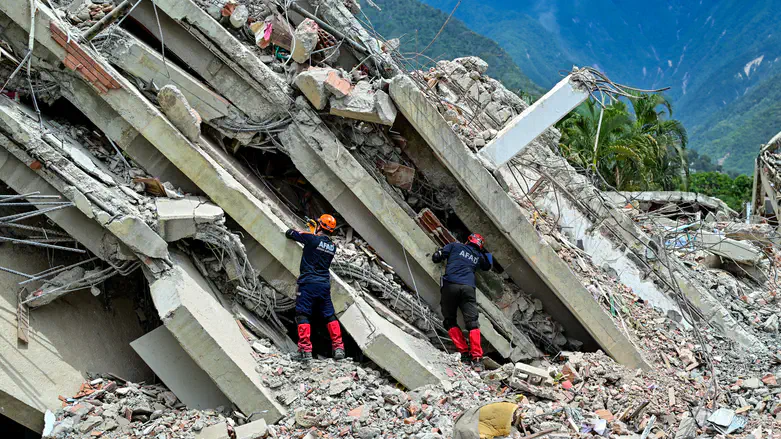 Israel National News1 day ago
Venezuela earthquakeAnadolu via Reuters Connect
Venezuela is facing a devastating emergency. The earthquakes have left the country in complete disarray, with homes destroyed, basic services interrupted, and families desperately searching for food, water, medicine, shelter, and medical care.
Click Here To Help Hatzalah Venezuela
Within the Jewish community alone, at least 85 families are homeless right now. Many are sleeping wherever they can. Some are elderly. Some need regular medication. Some have children. Many have no reliable access to clean water, and in today’s Venezuela, clean water has become a commodity worth more than gold.
In the middle of this crisis, Hatzalah Venezuela is doing what Hatzalah is known for around the world: responding immediately when lives are on the line.
The Hatzalah name carries recognition, trust, and urgency. It means trained volunteers. It means medical readiness. It means someone answers the call when every second matters. In Venezuela, that name now represents one of the only direct lifelines available to a community in crisis.
Hatzalah Venezuela is uniquely positioned to help because they are not arriving from the outside trying to understand the situation. They are already there. They know the community. They know the roads. They know the families. They know which areas are blocked, which neighborhoods need help first, and how to get supplies into the hands of people who cannot reach help themselves.
Their volunteers are distributing clean water, critical pharmaceutical medications, prescription medications, food, and emergency supplies. They are providing medical response, transportation, welfare checks, and emergency support. They have access to distribution centers, emergency equipment, and all-terrain vehicles that can reach areas ordinary vehicles cannot.
In many cases, Hatzalah Venezuela is moving faster than overwhelmed systems and reaching places where government services and outside agencies cannot provide immediate help.
This is not an abstract emergency. These are families with no home tonight. Patients without medication. Elderly community members without water. Children without stability. A community that urgently needs direct support.
Your donation will help Hatzalah Venezuela continue delivering life-saving and life-sustaining assistance on the ground, directly to the people who need it most.
100% of funds raised will go directly to relief efforts in Venezuela. No proceeds will benefit any local not-for-profit organizations in the United States.
Now is the time to act.
Click Here To Help Hatzalah Venezuela
הצלהצילום: ללא
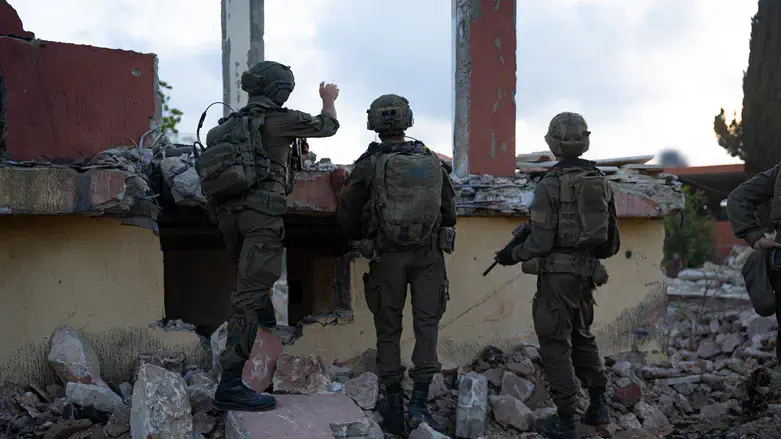 Israel National News1 day ago
Soldiers in LebanonIDF
Soldiers from the 679th Brigade, operating under the 91st Division in the security zone in southern Lebanon, are challenging the IDF's account of an operation in Bint Jbeil, disputing the claim that a dog handler from the Oketz working dog unit killed a Hezbollah terrorist during the incident.
In an official statement released by the IDF, the military said that troops were conducting searches inside a building where, a week earlier, a reserve soldier had been seriously wounded in an encounter. According to the statement, a military working dog named Mars was sent into the building to search for threats.
The IDF said the Hezbollah terrorist opened fire, killing Mars, before being shot and killed by the Oketz handler accompanying the force.
However, shortly after the statement was published, Arutz Sheva - Israel National News reported, citing soldiers involved in the operation, that troops from the 679th Brigade, not the Oketz handler, were responsible for killing the terrorist. Additional soldiers who were present during the incident have since echoed that account, contradicting the official version.
According to the soldiers, the Oketz handler deployed Mars to search the building before other forces entered. After the terrorist shot and killed the dog, the handler returned fire, but the soldiers say those shots did not kill the terrorist.
They claim that troops from the 8112nd Battalion subsequently took control of the scene, surrounded the terrorist, and repeatedly called on him to surrender. According to their account, the terrorist was ultimately shot and killed by a battalion soldier only after he moved toward a nearby weapon.
Responding to the conflicting accounts, the IDF said it is reviewing all aspects of the incident, including the circumstances surrounding the terrorist's death.
"Following the announcement distributed earlier, the IDF is examining all details of the incident, including the manner in which the terrorist was eliminated," the military said in a statement. "The matter will be investigated and lessons will be learned. After the debriefing, the IDF will present the findings transparently. If an error was made, it was a well-intentioned human error."
 Israel National News1 day ago
Donald Trump in a meeting with NATO Secretaryvia REUTERS
US President Donald Trump on Wednesday spoke about the exchange of strikes between the US and Iran, declaring an end to the ceasefire agreement.
At the NATO summit, Trump was asked whether the memorandum of understanding between the US and Iran had ended. He responded, "To me, I think it's over. I don't want to deal with them anymore."
He added, "They're led by sick people... I'll speak to our negotiators. They want to negotiate - they're good people... but they have to come back to me. As far as I'm concerned, it's just a waste of time dealing with them."
"These are evil sick people," he continued. "They're cancer, and you know what you have to do - you have to cut out cancer early."
Regarding the recent US strikes in Iran, Trump spoke during the summit to Fox News, saying, "We attacked very powerfully last night. The very dangerous people from Iran, they're sick, there's something wrong with them. We said go and do your funeral stuff and instead of that they started shooting rockets at ships yesterday and so we hit them very hard last night, very hard."
"And I would say 20 to 1, 20 times tougher and I told them every time you hit, we hit and of course they're dirty players so they go after everyone, probably including me. I've been number one on their list for years and they're a bunch of scum, if you want to know the truth, they're scum. And so we don't like them, I don't like them and they're evil people and it's the denuclearization of Iran and we're going to denuke it. We're not going to let them because they're crazy and they can't have a nuclear weapon and they go around killing people, they've killed thousands and thousands of our soldiers, they've killed hundreds of thousands of innocent people.
"They've killed thousands and thousands of people, even the USS Cole was theirs, you remember that disaster," he added. "So I don't like them at all and frankly I think we waste a lot of time with them and I think we should just do our business."
"Can you imagine, they start shooting bombs, actually missiles and ships yesterday, Saudi Arabia, Kuwait, a couple of others and I don't think they know what the hell they're doing but they're bad people, very bad people. I think they're incompetent, by the way, because if they were competent they would have made a deal a long time ago, like how about 47 years ago."
Regarding Israeli Prime Minister Benjamin Netanyahu, Trump said that although he "loves" Netanyahu, the Israeli leader "said bad things about Turkey" on Tuesday. Turkey's President Recep Tayyip Erodgan, Trump added, is "great."
 Israel National News1 day ago
TzfatDavid Cohen/Flash90
Dozens of rabbis and community leaders in Tzfat have signed a public letter calling for the immediate cancellation of public transportation services operating during Shabbat, arguing that the buses violate the city's longstanding status quo and threaten its Jewish character.
In the letter, the rabbis expressed alarm over the launch of public bus services during Shabbat, writing, "We have heard a report that has shaken the city, that here in Tzfat Shabbat has been publicly desecrated through the operation of public buses." They said the development demands a united public response.
The rabbis urged residents to join the effort to preserve the sanctity of Shabbat, stating, "It is our duty to stand together at this hour as one person, for the sanctity of the city and the sanctity of Shabbat, so that outsiders do not break through."
The rabbis called on government officials, local authorities, and those responsible for operating the transportation services to halt the initiative and restore the previous arrangement. "We appeal to everyone who has the power to prevent these actions to stand in the breach and act to preserve Shabbat in its entirety, as has been the custom in our city since ancient times," they wrote.
The appeal follows demonstrations held in Tzfat last Shabbat against the operation of public transportation during the holy day. Several protesters were arrested during the demonstrations.
The protests have centered on three regional bus routes operated by Netiv Express: Route 361 to Haifa, Route 511 to Kiryat Shmona, and Route 367 to Nahariya. The routes begin departing from Tzfat at approximately 6:00 p.m., around two and a half hours before Shabbat concludes.
 Israel National News1 day ago
Freed hostage Rom Braslavski shared a personal video reflecting on his life since returning from captivity and the sense of mission that now guides him.
"Captivity was both the greatest curse and the greatest blessing G-d gave me," he said. "Many people ask me how I survived it. The truth is, I don't have an answer myself. I don't know how I survived. From a logical perspective, if we go by logic, I should be dead."
"The fact that I was released obligates me to speak for those who didn't come back to us - for those who were murdered and massacred on October 7, or in captivity or the soldiers who went out to fight and sacrificed their lives."
"It shaped me. It shaped my character," he said, adding, "Now that I'm free, I'm dealing with very severe post-traumatic stress. It's incredibly difficult to return to life after such a massive upheaval in life."
"My question is this: Am I going to return to life, or am I going to remain a prisoner in Gaza? Will I get up and strengthen myself again and again and refuse to let them win? Or will I lock myself in my room and refuse to let the sun in? Because if I do that, they have won and not me.
"They win and I do not if I sink into depression and sadness. That's not something I'm willing to accept. Every day I choose again: to open the shutters, get up early, and let the sunlight into my life. I let the sun illuminate my dark face. It's dark inside, but bright outside, and my light on the outside slowly penetrates my soul."
Braslavski shared, "The PTSD and the severe trauma I went through - the bodies I saw, all the blood I saw, all the people who died that I carry on my shoulders, all my friends who were murdered - it's a good enough reason not to get up."
"But I choose, time and again, to rise from the blow I've been dealt, to give thanks to G-d: 'I give thanks before You... for mercifully restoring my soul within me; great is Your faithfulness,' because G-d had mercy on me and saved me from that house of bondage."
 Israel National News1 day ago
Palestinian workers, illustrationJorge Novominsky/Flash90
More than 200 Gaza residents who remained in Israel and Judea and Samaria since the outbreak of the war have surrendered to Israeli security forces in recent days in an effort to return to the Gaza Strip, according to a report by Galei Tzahal.
The report said the individuals had entered Israel before the October 7th massacre with work permits or for medical treatment and remained outside Gaza after the war began. This week alone, a group of 46 Gazans surrendered at a crossing in Samaria before being transferred back to the Gaza Strip.
Defense officials believe the growing number of voluntary surrenders is linked to the loss of financial and logistical support previously provided by Palestinians in Judea and Samaria. During much of the war, many Gazans who remained outside the Strip were able to find housing, employment, and economic assistance, but officials say that support has largely ended in recent weeks.
According to defense estimates, anywhere from several hundred to several thousand Gazans who entered Israel before the war are still believed to be in Israel or Judea and Samaria. Officials noted that while efforts were made early in the war to locate and return them to Gaza, those operations were later suspended.
 Israel National News1 day ago
Mansour AbbasChaim Goldberg/Flash90
MK Mansour Abbas, chairman of the United Arab List (Ra'am), the Knesset party which represents the southern branch of the Islamic Movement, accused the Israeli government of responsibility for the wave of murders in the Arab sector.
According to Abbas, the government's "racist and fascist" policies and its failure to fulfill its duty to provide security for Arab citizens have led to the murders.
Murder in Arab society has been rampant for decades, and police are afraid to enter Arab communities due to the danger involved. In addition, though some Arabs have called for police intervention, Arab society largely fears Israeli police and does not want government intervention.
Abbas expressed confidence that Arab and Jewish voters would succeed in toppling what he described as the "fascist and racist" right-wing government in the next Knesset elections, predicting that Ra'am would win at least seven seats.
Abbas also expressed hope that such results would enable Ra'am to join other parties in forming a new governing coalition to replace the current government, and give the party influence, and ability to participate in decision-making and shaping policy.
According to him, Ra'am's priorities include improving personal security for Arab citizens, securing recognition for illegal Bedouin villages in the Negev, and combating what he claimed to be racism, fascism, and discrimination against Israel's Arab population.
