JBizNews31 minutes ago
Hundreds of thousands of children’s finger light toys have been recalled by a California-based company because of a risk they could be swallowed, cause chemical burns and death, according to the U.S. Consumer Product Safety Commission.
Cade California Electronic this week recalled 179,739 units of the light-up toys sold on Amazon between March 2015 and July 2026 for $5 to $16.
The toys violate the mandatory safety standard for toys “because the toys contain button cell batteries that can be easily accessed by children. If button cell or coin batteries are swallowed, the ingested batteries can cause serious injuries, including internal chemical burns, and death,” the CPSC said in a release.
The finger lights contain three button cell batteries and come in 50 pieces in a box in white, blue, red and green.
“California Cade Electronic” and “Finger Flashlights” are printed on the front of the package.
Parents should immediately take the toys away from children and return them to the company for a full refund.
There haven’t yet been any reports of injuries.
The recall notice added that cell batteries are hazardous and should be thrown out or recycled using local battery recycling guidelines.
 JBizNews7 hours ago
The backstory to how this movie got to a theater near you could be a movie. And it might be someday, but Hollywood won’t make it.
Hollywood isn’t making a lot of movies these days. Production has moved away, to Texas, to Georgia, to Canada. California has the natural environment that created Hollywood in the first place, but the business environment that has driven much of Hollywood away and is strangling what’s left of it. It’s so bad that President Donald Trump recently stepped in to try to save the industry that’s been weaponized against him.
Hollywood has mostly forgotten that its primary purpose is to entertain.
Warner Bros. had a movie it spent $70 million to create, finished in 2022. It brought some big names together – James Gunn as writer and producer, stars John Cena and Will Forte, and even bigger names in Bugs Bunny, Wile E. Coyote, and all the other classics from Looney Tunes. Warner didn’t just launch production on this film, it went through the entire process, and had a finished work that was ready for theaters. It was called “Coyote vs. Acme,” pitting the hapless Wile E. Coyote against the megacorp from which he’d bought so much failed gear from over the decades.
But thanks to perverse tax incentives and a difficult climate for major movie releases, Warner decided to do the unthinkable: It was going to delete this finished movie. Not just shelve it. Destroy it.
Will Forte, who plays Coyote’s attorney in the film, appeared on Jay Mohr’s podcast, called it “A very frustrating story.”
“So we make this movie. The script is really fun. And then, we went through the process of making this movie, and we made an even better movie than this great script.”
Because half the film is animated with composited cartoon characters, anvils and other tropes, post-production was a long process. But it got through all that, Forte says, and they were called to a screening.
“After all the animation, they’re finally ready to show it to the cast. They called us up on a Tuesday night. Said, ‘OK we’re gonna show it to you next Tuesday. It’s testing really well, we’re very excited about it.’ The next day I get a call that Warner Bros. is going to shelve it. Just wants to take a tax loss.”
The cast still got to see the movie. Forte said he assumed that if Warner was shelving it, “It must be not as good as these guys said. But they saw it, and it’s “great.”
“Which made it even more frustrating… It was nuts.”
As an artist, seeing a corporation shelve your work would tend to be frustrating. But it might be understandable if the work is terrible. The corporation may even be saving you from embarrassment. But “Coyote vs. Acme” was testing well with audiences, and it landed well with the people who made it.
The big names involved, and then more big names, and then a grassroots campaign, all gathered force to try to shame Warner into releasing the movie. A guy wearing a Wile E. Coyote costume showed up at Warner picketing the studio.
And it worked. Sort of. Warner shopped the movie around, but was reportedly asking for more money than it spent from any buyers. Eventually a little 12-person outfit called Ketchup Entertainment bought the film for $50 million.
Ketchup spent roughly 25 cents marketing the movie. There was no build-up of reviews, no big trailers dropping on YouTube powered by ad dollars. Really, very little marketing. I happened to see a video about it one day while trolling YouTube. And it looked fun, like “Who Framed Roger Rabbit?” or “Space Jam” kind of fun.
“Coyote vs. Acme” landed in theaters worldwide in late August. It’s competing with a Spider-Man tentpole and some other summer films, but it’s holding its own, hitting second and third on its first two weekends and getting strong reviews across the board. As of this writing it has blown past $50 million. Ketchup wins by getting its name out there and may even make some money, and with the $100 million war chest it announced in May, it’s not done.
But is “Coyote vs. Acme” any good?
In some ways it’s irrelevant if the movie is actually good. It’s a piece of art that should be seen by the audience it was made for. Bad movies, and books, and TV shows, get released every day. The art, and the hours of blood, sweat and tears the humans put into making it, matters.
I saw it over the long weekend. And it’s good. Very good. The jokes land, the cartoon combination with live action works, the sometimes surprising use of classic Looney Tunes characters all fit, the cartoon tropes and send-ups work, and John Cena delivers a deliciously villainous performance as Acme’s shark lawyer.
Getting back to what was once Hollywood’s reason to exist, “Coyote vs. Acme” entertains. And then some.
FOX Business reached out to Ketchup Entertainment, John Cena and Bugs Bunny prior to publication.
 JBizNews13 hours ago
About 2.3 million sour candy bottles are facing a recall over a choking hazard that could lead to serious injury or death, according to federal regulators.
The recall was initiated for Ricky Joy Sour Crush Rolling Liquid Candy Bottles because the rolling ball on the bottles can detach and become a choking hazard, the Consumer Product Safety Commission announced on Thursday.
“The rolling ball on the recalled candy bottles can detach, posing a risk of serious injury or death from choking hazard,” the commission warned.
The plastic candy bottles were sold individually and in packs of three or 12 in blue raspberry, strawberry, green apple and watermelon flavors.
The recalled candy bottles were sold at H-E-B, Forman Mill and other candy stores nationwide, as well as online at Walmart, CandyFunHouse.com, RickyJoy.com and other online retailers from January 2023 through May 2026.
They were sold for about $3 per bottle and between $13 and $32 for a pack.
The bottles contain 1.85 fluid ounces of sour liquid candy to be applied through the bottle’s rollerball top.
The Ricky Joy logo, “EXTREME SOUR,” “SOUR CRUSH” and the flavor name are printed on the front of the bottle along with the image of a green monster with its tongue sticking out.
No injuries have been reported thus far in connection with the recall effort.
Consumers are urged to stop using the candy bottles immediately, take them away from children and contact The Ricky Joy Company for a refund.
 JBizNews19 hours ago
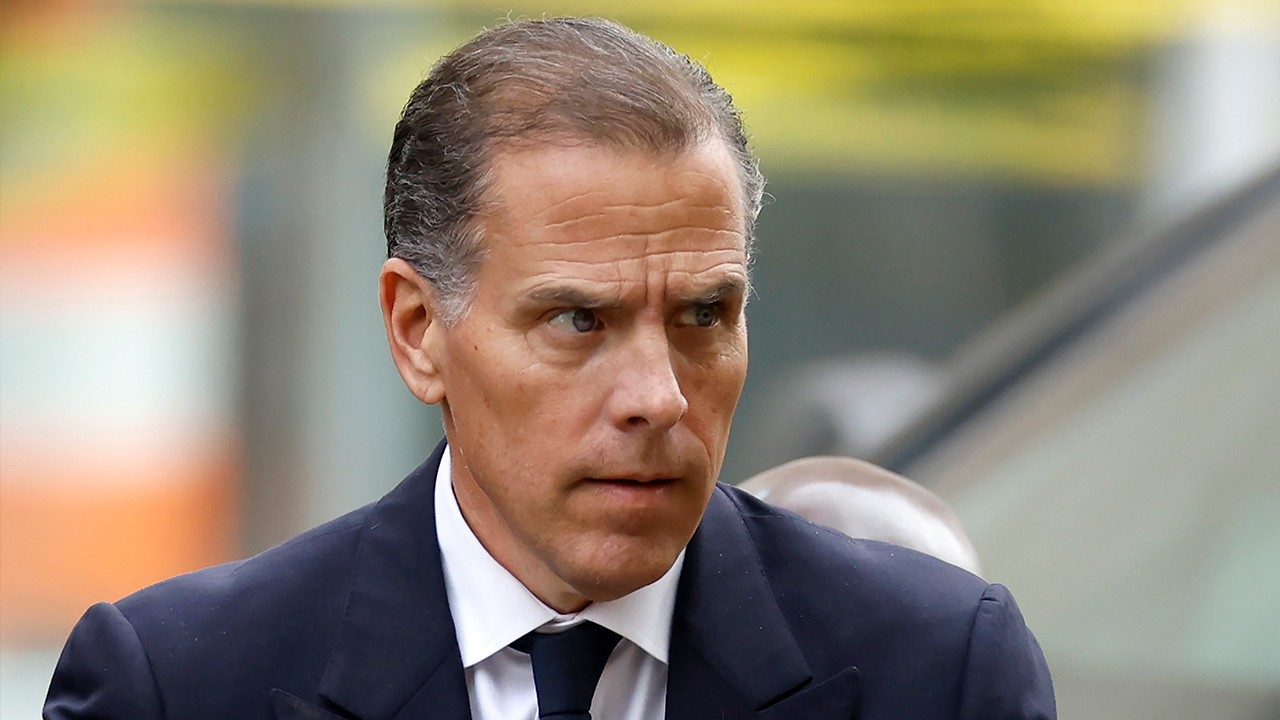
Former first son Hunter Biden lashed out online after his $LAPTOP meme coin collapsed, blaming a “f–k up” that left four out of five investors with losses, while one mystery trader came away with nearly $1 million.
Biden chose the name $LAPTOP in a nod to the laptop controversy that became the subject of political controversy surrounding him and his father, former President Joe Biden. The hard drive from the laptop dropped off at a Delaware repair shop in 2019 contained thousands of emails documenting Hunter Biden’s international business dealings, as well as intimate photographs and videos revealing his cocaine and alcohol addiction, prompting scrutiny by Republican lawmakers into the father and son.
Hunter Biden has said the symbol used to target him is now a symbol of “resilience, redemption and recovery.”
Biden claimed the issue began shortly after trading started on Wednesday because the project’s market maker supplied significantly less liquidity than needed to handle the initial demand.
“There was a f–k up. The f–k-up occurred in the first 30 seconds of launching the coin, in which the market maker, for some unknown goddamn reason, only put in $5,000 of liquidity. And the demand was through the roof,” Biden said on Friday in a video posted on X.
The project’s thin liquidity pool helped drive the token’s quoted price from $2.39 to an eye-popping $316 before it crashed.
Biden said his coin’s value was briefly “larger than the market cap of f–kin’ goddamn BlackRock,” adding that the price chart “looked like Mount Everest.”
BlackRock’s market cap is upwards of $175 billion.
The mystery trader turned a roughly $250,000 bet into $1.18 million within just minutes, earning about $930,000 before transaction costs, according to a blockchain analysis by Datavault AI.
But other traders were less fortunate, as about 80% of traders who bought $LAPTOP on launch day lost money, according to blockchain analytics firm Bubblemaps, which estimated that more than 15,000 wallets ended up in the red.
A buyer who invested roughly $200,000 when $LAPTOP was near its brief peak was left holding tokens worth about $2,000 after the collapse, according to Datavault AI.
“This is my f–king token,” he said in the video. “I’ve been working on this thing for six months straight.”
“I was intimately involved in every single discussion, every single step of the way in creating the tokenomics, in creating the way in which the coin would be presented,” he continued. “At the end of the day, it’s my responsibility, and there was a f–k-up.”
Biden said the situation had stabilized, but acknowledged that investors had already been hurt.
“They got it under control, but not before the damage was done,” he said.
Biden said he plans to stick with the project and repair the damage, although he did not elaborate on whether this means compensating investors.
“I am in this to the end 100%, and I promise you that we’re gonna make it right,” he said.
He said the project was working to increase liquidity and trading volume.
“This isn’t some bulls–t f–king celebrity token where I get on Twitter and say, ‘Oh, I didn’t know about this, and, you know, I’m really sorry,'” Biden said.
“Biden also said he and his partners had “not made a single dollar” from the project, previously disclosing that they were in a six-month lockup period that prevented them from selling their token holdings.
 JBizNewsJBizNews20 hours ago
J.P. Morgan this week named Nelle Miller and William Sinclair as the new co-CEOs of its U.S. Private Bank, a specialized wealth management division that serves important clients.
The Private Bank is one of the largest providers of wealth management services with more than $2.4 trillion in total client assets and 57 offices nationwide, according to its website.
Miller also serves on the Asset & Wealth Management Operating Committee and the Global Private Bank Operating Committee and chairs the Advisory Council for the New York City Market Leadership Team.
She previously led the largest region in the U.S. Private Bank, the New York business, along with the Family Office Investments and Advice, overseeing the company’s Global Investment Opportunities, outsourced chief investment officer and Morgan Private Advisory organizations nationally, “serving the firm’s largest families and most complex clients.”
Miller was a founding member of the Global Investment Opportunities team.
“I have spent my career alongside clients through market cycles and the most meaningful moments in their families’ lives, and Will and I are fortunate to lead a team that knows our clients just as deeply,” Miller said in a statement, according to outlet Pulse 2.0.
“The decisions families face today are more interconnected than ever, spanning private markets, liquidity and multigenerational planning. This is an extraordinary opportunity to build on everything that makes this business special.”
She joined J.P. Morgan in 2002 on the Institutional Equities Desk, where she covered New York-based hedge funds and mutual funds as a research salesperson.
“Nelle continues to personally advise some of New York’s most prominent families,” her biography on the J.P. Morgan website says. “As a leader of the Private Bank, she is a dedicated mentor to many young women across the firm and takes an active role in their career.”
Sinclair, who joined J.P. Morgan in 2007, is also global co-head of the Family Office Practice as well as a member of the U.S. and Global Private Bank operating committees.
“William leads with a client-first mindset and oversees more than 5,500 professionals in 57 offices across the United States. Together, they serve individuals, families, family offices, and institutions across a broad range of wealth management needs,” his biography says.
Sinclair worked for 10 years as a senior private banker working with business leaders, hedge fund managers and J.P. Morgan executives on their personal financial needs.
He also previously led the Financial Institutions Group and the U.S. Family Office Practice.
“Nelle and I are honored to take on this responsibility together and bring the global scale of the Private Bank to families and markets across the U.S.,” Sinclair said in a statement, Pulse 2.0 reported.
“We have a fantastic franchise with exceptional people and an unparalleled breadth of capabilities. Our focus will be on delivering the full power of J.P. Morgan to our clients and continuing to attract and develop the best talent in the industry.”
Their appointments follow David Frame being named in July 2025 as global CEO of J.P. Morgan Private Bank.
FOX Business has reached out to J.P. Morgan for comment.

 Matzav
Related stories

 Belaaz1 day ago
 Matzav1 day ago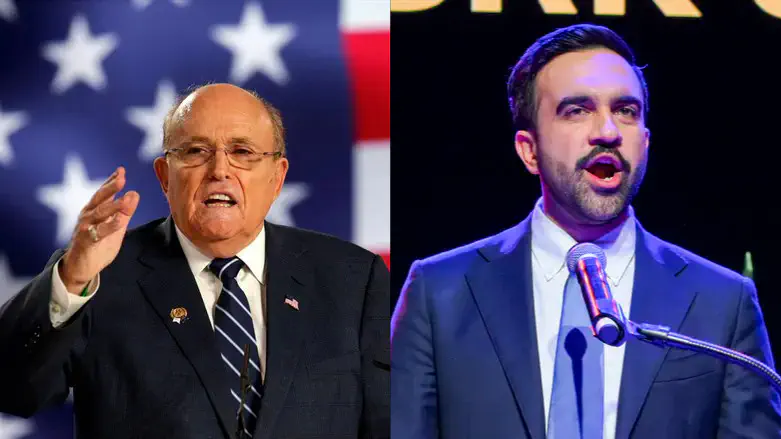
 Israel National News1 day ago
 Vos Iz Neias1 day agoMatzav23 hours ago
New York City Mayor Zohran Mamdani and Rep. Alexandria Ocasio-Cortez drew sharp criticism Friday after cameras showed the two smiling and laughing together during the solemn reading of victims’ names at the Ground Zero ceremony marking the 25th anniversary of the September 11 terrorist attacks. The brief exchange occurred during a ceremony in which relatives spent hours reading the names of the 2,977 people killed on September 11, as well as the six victims of the 1993 World Trade Center bombing.
A live broadcast of the ceremony captured Mamdani and Ocasio-Cortez appearing cheerful during their interaction, while other portions of the coverage showed grieving relatives and attendees overcome with emotion as the names of those murdered in the attacks were read from the podium.
The images quickly circulated online, prompting criticism from political figures and commentators who questioned the appropriateness of the exchange during such a solemn event.
“Why …. are these two laughing?!?” Meghan McCain, former “The View” host and daughter of late GOP Sen. John McCain, wrote on X.
“How … do you laugh while the names of those murdered on 9/11 are being read aloud? Why would you do so?” wondered Texas GOP Sen. Ted Cruz.
Brooklyn Republican Councilwoman Inna Vernikov also condemned the scene, tying it to the controversy that had preceded Mamdani’s attendance at the ceremony.
“After thousands of families of victims of terror beg Mamdani not to show up, he stands there and laughs while families weep. This is NYC’s Mayor,” scolded Brooklyn Republican Councilwoman Inna Vernikov.
According to an unnamed source cited by the New York Post, the exchange occurred after Gov. Kathy Hochul, New York Attorney General Letitia James and Sen. Chuck Schumer had departed during the ceremony, leaving Mamdani standing without many of the other prominent officials who had been nearby.
“Nobody wanted to be by him,” the source said. “It was awkward.”
Members of the mayor’s administration and Ocasio-Cortez subsequently took seats around Mamdani, according to the account, and it was during that period that the exchange between the mayor and the congresswoman was captured on camera.
The same source, however, offered a more favorable assessment of Mamdani’s conduct during the ceremony overall, saying the mayor remained respectful for the rest of the event, stayed longer than many other elected officials and remained through the conclusion, speaking afterward with relatives of 9/11 victims.
“He doesn’t help his case,” the insider quipped. “This guy doesn’t distance himself from people who say America deserved to be attacked. And where the f—k was his wife? She misses America 250, now this.”
Mamdani’s wife, Rama Duwaji, has generally maintained a low profile during her husband’s mayoralty, describing herself as a private person, although she has appeared at some major public events, including the Knicks’ ticker-tape parade and New York Fashion Week.
Mamdani’s attendance at Friday’s commemoration had itself become the subject of controversy before the ceremony. Some relatives of 9/11 victims and Republican political figures had urged him not to attend. Mamdani rejected those calls and said he wanted the anniversary to remain focused on the victims, their families and first responders. The mayor has called the September 11 attacks a “horrific act of terror.”
There was also pushback against the interpretation of the video. Michael Ragusa, who served as head of security for Mayor Rudy Giuliani, said he was standing near Mamdani and Ocasio-Cortez and maintained that the widely circulated footage did not provide the full context of what happened.
“The camera just caught her greeting him hello. Multiple other politicians were laughing and joking behind me. Republicans and Democrats,” he wrote on X.
“And for the record I am a life long republican who has been very critical of these two,” he added.
Earlier in the ceremony, Mamdani was seen exchanging an awkward handshake with Giuliani, who was mayor of New York City at the time of the September 11 attacks and had publicly argued before Friday’s commemoration that Mamdani should not attend.
One source cited by the Post claimed that Giuliani nevertheless gave Mamdani a warmer reception than some of the other elected officials at the ceremony.
“None of the elected wanted to be near him,” they said.
The previous evening, Mamdani participated in the final portion of a Manhattan interfaith memorial walk commemorating 9/11. The walk included stops at Jewish, Christian and Muslim houses of worship, although the mayor joined at its final stop, the Islamic Center of New York City. There, Mamdani delivered remarks remembering those killed in the attacks and praising first responders and religious leaders who assisted New Yorkers in the aftermath.
Mamdani had also faced criticism during his mayoral campaign over comments he made while discussing the experiences of Muslims in New York following the September 11 attacks.
“I want to speak to the memory of my aunt, who stopped taking the subway after Sept. 11 because she did not feel safe in her hjiab,” then-candidate Mamdani intoned.
Related stories
Belaaz1 day agoMatzav1 day agoIsrael National News1 day agoVos Iz Neias1 day ago Matzav
Related stories
 Belaaz1 day ago
 Matzav1 day ago
 Cleveland Jewish News1 day agoCleveland Jewish News1 day agoMatzav23 hours ago
[Video below.] President Donald Trump singled out Shimmy Biegeleisen z”l, the 42-year-old Brooklyn father of five who was killed in the World Trade Center on September 11, 2001, as he paid tribute Friday to individual victims of the terror attacks during a solemn 25th-anniversary commemoration at the Pentagon. Trump recalled that Biegeleisen was on the 97th floor of the South Tower and surrounded by photographs of his five children when the building came down. Records and memorial sources identify Biegeleisen as a vice president at Fiduciary Trust International who was killed at the World Trade Center.
Trump delivered the remarks at a ceremony honoring the 184 people killed when American Airlines Flight 77 was deliberately crashed into the Pentagon on September 11, 2001.
Opening on a somber note, Trump commemorated all 2,977 victims who were killed in the coordinated attacks in New York, Virginia and Pennsylvania, reflecting on the magnitude of the loss a quarter-century later.
The President recalled several of the children who were aboard American Airlines Flight 77, among them three 11-year-old students traveling on a school trip. He also remembered sisters Zoe Falkenberg, 8, and Dana Falkenberg, 3, who were traveling with their parents. Trump then recounted the fate of a group of Pentagon colleagues who had gathered for a sergeant major’s dinner party the weekend before the attack: “Every person at that sergeant major’s party was murdered by terrorists who flew Flight 77 straight into this legendary building.”
“Today we renew the sacred oath that we first swore in their names a quarter of a century ago. We will never, ever forget,” the president said. “That’s why we fight today. We don’t have a choice. There can only be victory. We fight hard, we fight to win. We will always remember the victims and the families of September 11th, 2001.”
WATCH:
Trump proceeded to recount the stories of individual victims whose lives ended that morning. Among them was Patrick Danahy, 35, who was working on the 90th floor of the South Tower. After the North Tower was hit, Danahy telephoned his pregnant wife, Mary, told her he was safe and urged her not to watch television. She later watched as the second plane struck the South Tower and the building collapsed with her husband still inside. Their youngest daughter was born exactly one month later, on October 11.
Trump then turned to the story of Shimmy Biegeleisen, who was 42 and working on the 97th floor of the South Tower. The Brooklyn resident and father of five was killed when the tower collapsed. Trump described Biegeleisen as being surrounded by photographs of his five children in his final moments.
“Free people must never avert their eyes from such hideous cruelty. We cannot forget that moment of immense and horrible evil that took place in this world, bent on the destruction of all that is good,” Trump stated.
“But this morning, we also remember how America responded to that wickedness,” he continued. “On days like 9-11, we learn what a country is truly made of. We’re learning right now what we’re made of and we have to be strong and we have to be smart. And Americans are made of a goodness spirit that can transcend any earthly force.”
The President also revisited the heroism aboard United Airlines Flight 93, whose passengers and crew fought back after realizing the plane had been hijacked as part of the wider attack. Trump recalled a flight attendant boiling water to use against the hijackers and spoke about Todd Beamer, the 31-year-old New Jersey passenger who asked a telephone operator in Illinois to join him in The Lord’s Prayer before uttering his now-famous final words — “Let’s roll” — as passengers moved to retake the cockpit. Their actions prevented the plane from reaching its intended target, and it crashed into a field near Shanksville, Pennsylvania.
“In those harrowing days after the attacks, we saw the authentic spirit of our nation. We were all New Yorkers that day, every one of us,” President Trump said.
Trump also highlighted the massive American flag that became a symbol of the Pentagon’s resilience in the immediate aftermath of the attack. On September 12, 2001, General James Jackson ordered the largest flag in the military’s collection to be displayed beside the damaged portion of the Pentagon. During Friday’s ceremony, Trump asked those assembled to stand in recognition of the flag and the three firefighters who originally raised it: Joseph Morabito, Scott Morgan and Carl Sahlberg.
“In the generation since 9-11 American sons and daughters have traveled to the darkest corners of the earth and done battle with a shadowy enemy so that our children might once again know carefree days in cloudless skies,” said Trump. “For 25 years, our best and bravest have kept America safe, and today we salute every member of the United States military who served in the war on terror.”
“A generation after 9-11, we also know that the final response to those atrocities and the ultimate victory over the perpetrators will not be found on a foreign battlefield,” Trump remarked while also recognizing current American service members involved in efforts to prevent Iran from obtaining a nuclear capability.
The President additionally paid tribute to FDNY Captain Timothy Stackpole, a father of five who had endured years of grueling rehabilitation after suffering severe burns over 40% of his body in a five-alarm fire in 1998. Stackpole had returned to full duty and was promoted to captain shortly before September 11. Although he was off duty on the morning of the attacks, he rushed to the World Trade Center to help and was killed when the South Tower collapsed.
“As scripture tells us, the light shines in the darkness and the darkness has not overcome it,” said the commander-in-chief. “September 11th reminded us of the terrible power of hate. The 25 years since have shown us the even greater power of the American spirit to endure and prevail and to win.”
{Matzav.com}
Related stories
Belaaz1 day agoMatzav1 day agoCleveland Jewish News1 day agoCleveland Jewish News1 day ago Belaaz
Related stories
Belaaz23 hours agoSaudi Arabia has suspended operations on its strategically important East-West oil pipeline after it came under attack Thursday, putting another major route for Gulf crude exports at risk and adding to the upward pressure already gripping oil markets.
The Saudi Press Agency cited a source within the energy ministry who said pipeline operations had been stopped as a “precautionary measure” following attacks in the Riyadh and Madinah regions that resulted in a “number of injuries”.
The ministry did not provide a timetable for restarting the pipeline, saying additional information would be released as developments occur.
Saudi Arabia’s foreign ministry said drones launched from Iraq struck the pipeline. The kingdom said it would not retaliate “at this stage”, following a request from Iraq’s prime minister.
Iran-supported armed groups in Iraq have previously launched drone and missile attacks against Saudi Arabia during the conflict involving the US, Israel and Iran.
The pipeline strike occurred as Iran-backed Houthi forces intensified missile and drone attacks against Saudi Arabia, including strikes aimed at energy infrastructure in the southern part of the kingdom. Saudi Arabia has long ranked as the world’s largest crude oil exporter.
Stretching roughly 1,200km, the East-West pipeline transports crude from Saudi Arabia’s major oil-producing fields in the east to Yanbu, a Red Sea port. Its strategic importance has increased because it provides an alternative export route that can reduce Saudi Arabia’s dependence on shipping through the Strait of Hormuz amid Iranian restrictions on tanker traffic.
“Emergency and specialised technical teams responded immediately following the attacks, taking the necessary measures to secure the pipeline and assess its safety,” the ministry said.
Brent crude, the international oil benchmark, finished Friday at $104.56 a barrel, marking a gain of more than 8 per cent for the week. Oil prices surged after news of the pipeline attack emerged Thursday, followed by the circulation of satellite imagery.
US diesel prices reached a record $6 per gallon earlier in the week, increasing pressure on the Trump administration as the country approaches midterm elections that will determine control of Congress.
Oil markets have faced heightened volatility as Houthi forces have continued attacks against Saudi Arabia while expanding their position in Yemen. Their growing control around the Bab al-Mandeb Strait has increased concerns about threats to commercial shipping through the strategic passage between the Red Sea and Gulf of Aden.
“The Houthi blitzkrieg near Bab al-Mandeb is threatening to close the main oil relief valve for the seven-month war,” said Helima Croft, an analyst at RBC Capital Markets.
“The real question is whether the US will step in to try to avert the worst-case outcome for this critical waterway or if Washington will remain reticent about wading into this metastasising second front,” she added.
A Saudi official would not comment on whether Washington had chosen against providing additional assistance in the campaign against the Houthis. The official said the kingdom was “working closely with its partners, including the US, to ensure freedom of navigation in the Arabian Gulf and Red Sea”.
The East-West pipeline was also targeted in April, although Saudi Aramco, the state-owned oil company, was able to restore operations relatively quickly.
Following the outbreak of the conflict with Iran, Saudi Arabia substantially increased the amount of crude transported through the pipeline. That helped the kingdom’s exports recover to almost 8mn barrels per day in June, according to International Energy Agency estimates.
Pipeline utilization has subsequently been limited, however, as Houthi forces began targeting Saudi tankers operating in the Red Sea. Yanbu shipped only about 2.5mn barrels per day in August, the IEA reported, the weakest monthly level recorded since 2013.
Although tanker traffic through the Strait of Hormuz appears to be recovering, volumes remain substantially below the approximately 20mn barrels per day of oil and fuel that moved through the strategic chokepoint before the war.
TankerTrackers.com analysts estimated that combined oil exports from Iraq, Kuwait, Saudi Arabia, Qatar, the United Arab Emirates and Oman were averaging more than 10mn barrels per day. Iranian exports, they said, had fallen to zero.

 The Lakewood Scoop23 hours ago
A Red Bank man has been sentenced to 20 years in New Jersey State Prison for a horrific Lakewood crash that killed a 42-year-old woman and an 11-year-old girl.
Raul Luna-Perez, 43, was sentenced Friday by Judge Guy P. Ryan to 10 years in prison on each of two counts of Aggravated Manslaughter. The sentences will run consecutively, resulting in a total 20-year prison sentence.
Under the No Early Release Act, Luna-Perez will be required to serve at least 85 percent of his sentence before becoming eligible for parole.
Judge Ryan also sentenced Luna-Perez to 18 months in prison on an Assault by Auto charge stemming from the same incident. That sentence will run concurrently with the other sentences.
The sentencing stems from a devastating crash that occurred at approximately 11:20 p.m. on July 26, 2025, at the intersection of Cross Street and Hearthstone Drive in Lakewood.
Investigators determined that Luna-Perez was driving a Dodge Durango eastbound on Cross Street when he crossed into the oncoming lane and collided head-on with a Nissan Sentra.
The driver of the Nissan, Maria Pleitez, 42, of Lakewood, was pronounced deceased at the scene.
An 11-year-old girl who was seated in the front passenger seat was transported to Monmouth Medical Center Southern Campus, where she later succumbed to her injuries. A second 11-year-old girl who was seated in the rear of the vehicle was transported to Jersey Shore University Medical Center for treatment and was subsequently released.
The passenger in Luna-Perez’s Dodge Durango was also hospitalized with minor injuries and later released.
First responders detected signs that Luna-Perez was impaired following the crash. A subsequent court-authorized blood draw revealed that his blood alcohol concentration was at least .19, more than twice New Jersey’s legal limit of .08.
Investigators also found cocaine metabolites in his blood, and toxicology results determined that he was under the influence of both substances at the time of the crash.
Further investigation revealed that Luna-Perez was accelerating at approximately 60 miles per hour and crossed over the double yellow line while passing four other vehicles before crashing into the Nissan.
Luna-Perez was initially charged with Vehicular Homicide and Assault by Auto. Following the blood test results and continued investigation, the charges were upgraded to two counts of Aggravated Manslaughter and two counts of Strict Liability Vehicular Homicide.
He was taken into custody at an ICE detention facility in Elizabeth on August 7, 2025, and has remained detained in the Ocean County Jail since that time.
Luna-Perez pleaded guilty to the charges before Judge Ryan on June 15, 2026.
 Matzav1 day ago
After nearly four decades at the center of chareidi political life in Israel, MK Moshe Rafael Gafni is concluding his lengthy tenure in the Knesset, closing a remarkable chapter that took him from a young communal activist in the southern development town of Ofakim to one of the most powerful and influential chareidi lawmakers in the country.
Throughout the corridors of the Knesset in Givat Ram, governments have risen and fallen, ministers have come and gone, and Israel’s political landscape has repeatedly been transformed. Yet for close to 40 years, Gafni remained a remarkably constant presence. He never held the title of government minister, never commanded an army and never led a secular political party, but the practical influence he accumulated at some of the most important intersections of Israeli public life established him as one of the country’s most seasoned and respected parliamentarians.
Gafni’s personal story became intertwined with the modern history of the chareidi community in Israel. It began in the country’s south, continued through the dramatic night when he was summoned to the home of Rav Elazar Menachem Man Shach zt”l, and eventually brought him to the coveted chairmanship of the Knesset Finance Committee, the position through which he would leave an enduring imprint on Israel’s economic and political system.
Moshe Gafni was born in the early summer of 5712 in Tel Aviv to his parents, Eliyahu and Chava Bracha, Polish Holocaust survivors who were affiliated with Ger.
He received his early education at the Yesodei HaTorah Talmud Torah before continuing his Torah development in two of the most prominent Lithuanian yeshivos in Israel, Slabodka Yeshiva in Bnei Brak and Grodno Yeshiva in Ashdod. Under the Toraso umnaso arrangement, he deferred military service and became firmly rooted in the Lithuanian yeshiva world.
Following his marriage to his wife, Chana, in 5733, Gafni moved to Ofakim in the western Negev. The move was part of a broader initiative by the Lithuanian Torah leadership to strengthen communities in Israel’s outlying areas by establishing thriving Torah centers there.
In Ofakim, Gafni quickly became a central figure in the local community. He headed the Zichron Eliyahu kollel and eventually entered municipal politics as a member of the Ofakim City Council.
Long before he entered the Knesset, Ofakim provided Gafni with his first real education in politics and public service.
Recalling those years, Gafni once described the intensive grassroots work that characterized his approach: “לא היה בית שאני ואשתי לא היינו בו” — “There was not a home that my wife and I had not been in.”
Rather than limiting himself to matters directly affecting religious institutions and Torah education, Gafni became deeply involved in the everyday difficulties facing residents of the development town. He dealt with welfare issues, helped struggling families and confronted the often-unyielding bureaucracy of municipal and national government agencies.
Thus, Gafni did not arrive at the Finance Committee years later as a detached technocrat. His political education had been acquired on the ground, dealing directly with ordinary citizens and the hardships of families living on Israel’s socioeconomic periphery. That experience would later shape the way he approached the national budget and social policy, often extending his involvement well beyond matters affecting the chareidi community alone.
His years in Ofakim also gave him practical experience in public administration, bridging social divides and navigating government ministries and bureaucracies. At the same time, his writing for the Yated Ne’eman newspaper helped develop the sharp public style for which he would later become known.
The Historic Split: The Night That Changed Chareidi Politics
The year 5749 marked a watershed in chareidi politics. Long-simmering tensions between the chassidic wing of Agudas Yisrael, led largely by Ger, and the Lithuanian Torah community reached a breaking point. Many in the Lithuanian community believed they were underrepresented and increasingly marginalized, circumstances that had already contributed to the establishment of Yated Ne’eman and the Shearis Yisrael kashrus organization.
Ahead of elections for Israel’s 12th Knesset, Rav Shach, the Ponovezh Rosh Yeshiva, made the historic decision to break with Agudas Yisrael and establish an independent political party, Degel HaTorah.
Rav Shach sought young, energetic individuals to build the new movement. Late one night, Gafni was summoned to Rav Shach’s home and instructed to run for the Knesset. Rav Shach gave him one succinct directive that Gafni would carry with him throughout his political career: “תשמור על החוק” — “Observe the law.”
Running under the eitz ballot symbol, the fledgling Degel HaTorah stunned Israel’s political establishment by winning 34,279 votes and securing two Knesset seats. Gafni entered the Israeli legislature for the first time.
Upon joining the 12th Knesset in 1988, Gafni began developing a distinctly different model of political power. Instead of pursuing a ministerial portfolio, he concentrated on accumulating influence within the Knesset itself, particularly through its committees. He served on bodies including the Knesset Committee and the Labor and Welfare Committee, laying the foundations for the parliamentary power he would later wield.
Inside the Movement: The Rotation Years and Degel HaTorah Leadership
During the 13th and 14th Knessets, after Degel HaTorah and Agudas Yisrael joined together under the United Torah Judaism banner, Gafni had to contend with carefully negotiated rotation agreements between the factions. The delicate balance between the two components of UTJ meant that he moved in and out of the Knesset at different points.
Those years outside the Knesset, however, became another important stage in his development as a public figure. Moving between parliamentary and extra-parliamentary activity gave him an intimate understanding of both the political system and the communal infrastructure behind it.
Recognizing his organizational and administrative abilities, Rav Shach entrusted Gafni with another major responsibility, appointing him secretary-general of Degel HaTorah. Gafni was no longer merely an elected official working in the Knesset chamber; he was responsible for operating the machinery of the young political movement itself.
He helped build the party apparatus, developed relationships with mayors and municipal officials, local askanim, community administrators and roshei yeshiva throughout the country, and managed the movement’s ongoing activities in accordance with the direction of the Gedolei Torah.
That period became crucial to understanding Gafni’s later effectiveness on the national stage. He knew the political machinery from the inside, understood the intricacies of local government and maintained direct relationships with communities on the ground. The combination ultimately made him a particularly skilled parliamentary operator capable of navigating virtually every major decision-making center.
A Shaliach, Not a Minister
One of the defining principles of Gafni’s political career was rooted in Rav Shach’s position regarding participation in an Israeli government.
Under the principle of collective ministerial responsibility established in Israel’s Basic Law: The Government, ministers share responsibility for the actions of the government as a whole. From the Lithuanian chareidi perspective articulated by Rav Shach, this created serious concerns regarding responsibility for public chillul Shabbos, consequential security decisions and government spending contrary to Torah values.
Rav Shach therefore instructed Degel HaTorah representatives not to serve as ministers in Israeli governments.
Gafni adhered to that position throughout his career. Even as representatives of other chareidi factions eventually accepted ministerial posts, and despite offers of senior portfolios including the Housing Ministry, Gafni refused to become a minister.
The sole exception to his general avoidance of executive government office came between 1990 and 1992, when he served as deputy religious affairs minister in Yitzchak Shamir’s government. The deputy-minister position gave him executive authority without making him a full member of the government carrying collective ministerial responsibility.
Rise to the Center of Parliamentary Power
Another important milestone came during the 15th Knesset, when Gafni was appointed chairman of the Knesset Interior and Environment Committee.
The committee dealt with some of the most complicated issues facing the country, including local authorities, planning and construction, municipal government, public administration and environmental matters. Gafni’s earlier years on the Ofakim City Council gave him firsthand familiarity with many of the issues now reaching his committee on the national level.
A major turning point came in January 2009 with the passing of MK Rabbi Avrohom Ravitz z”l, Gafni’s longtime political partner and a leading figure in Degel HaTorah.
Following Ravitz’s passing, Gafni became chairman of Degel HaTorah, placing him at the forefront of the Lithuanian chareidi community’s political representation while remaining completely subordinate to the direction of its roshei yeshiva and Gedolei Torah.
From there, Gafni eventually reached what would become his most important center of parliamentary influence: the chairmanship of the Knesset Finance Committee.
Across several terms totaling more than a decade — approximately 13 years during the 18th, 20th, 23rd and 25th Knessets — Gafni transformed the Finance Committee chairmanship into an extraordinary center of political influence. From that position, he repeatedly confronted and negotiated with Finance Ministry officials while directing resources toward preserving the Torah world and advancing social policies benefiting Israel’s periphery and economically vulnerable populations.
Political Moderation and Loyalty to the Right-Wing Bloc
Gafni’s political worldview has long contained an unusual combination. On diplomatic and security matters, he has described himself as a faithful student of Rav Shach, rejecting messianic approaches to territorial issues and supporting diplomatic flexibility when necessary for pikuach nefesh. Gafni has even said in the past that his diplomatic positions were relatively close to those of the political left.
At the same time, his political alliances remained firmly with the right-wing bloc led by Binyamin Netanyahu. The traditionalist camp was viewed as a more natural partner for the chareidi parties because of its greater respect for the religious status quo, in contrast to the secular left associated with influential sectors of Israel’s academic and judicial establishments.
The End of an Era
Gafni’s final years in the Knesset unfolded against the backdrop of the bitter battle over the draft law, an issue that has deeply divided Israeli society and posed an existential challenge to the yeshiva world.
High Court rulings, the freezing of government funding and sanctions directed at yeshiva students eventually led to a dramatic development in July 2025. At the instruction of the leaders of the Lithuanian chareidi community, Rav Dov Landau and Rav Moshe Hillel Hirsch, Degel HaTorah withdrew from the governing coalition, bringing Gafni’s latest tenure as chairman of the Finance Committee to an end.
Gafni and his longtime colleague Uri Maklev subsequently moved away from the front line of parliamentary leadership, with MK Yaakov Asher expected to assume the leading role in representing Degel HaTorah in the Knesset.
Yet Gafni’s departure from the Knesset after nearly 40 years of public service did not mark the end of his involvement in Degel HaTorah.
Despite his retirement from parliamentary life, Rav Dov Landau asked Gafni to continue leading Degel HaTorah’s national movement, reflecting the appreciation within the party’s Torah leadership for his decades of devotion to the Torah world.
Moshe Gafni thus closes one of the longest and most consequential chapters in modern chareidi political history. From a young avreich and communal activist in Ofakim to the chairman sitting at the center of Israel’s national budget process, his political career was defined by a combination of social activism, parliamentary maneuvering and, above all, his conception of himself as a shaliach carrying out the directives of the Gedolei Torah.
{Matzav.com}
 JBizNews1 day ago
Evergreen Fresh Sprouts LLC on Thursday announced it’s recalling over 200 cases of broccoli sprouts over concerns they may be contaminated with salmonella, according to the Food and Drug Administration (FDA).
Evergreen said it’s recalling 215 cases of broccoli sprouts, each of which includes six four-ounce bags per case, because of the risk of salmonella contamination.
Salmonella is a foodborne illness that can cause serious and sometimes fatal infections in young children, frail or elderly people and those who have weakened immune systems.
The recalled broccoli sprouts were delivered to three distributors in the state of Washington from Aug. 24 to Sept. 2, with the product possibly distributed and sold in retail stores to consumers in Idaho, Montana and Washington.
The broccoli sprouts were packaged in clear plastic four-ounce zip lock bags, with the UPC code 8 38796 00105 1 and use by dates of 9/7/26, 9/9/26, 9/11/26, 9/14/26 and 9/16/26.
Consumers who purchased the affected broccoli sprouts are urged to immediately discard the product. Businesses are urged by the Centers for Disease Control and Prevention (CDC) not sell or serve recalled broccoli sprouts and to wash and sanitize items and surfaces that may have come in contact with recalled broccoli sprouts.
The CDC has recorded a total of 22 cases in Idaho, Washington, Montana and Utah.
Evergreen said that it was notified the broccoli sprouts have been related to a multistate salmonella outbreak, which included 22 cases as of Sept. 9.
It initiated the recall when broccoli sprouts with a use by date of 9/16/26 tested positive for salmonella in an analysis conducted by a third-party lab. The company stopped producing and distributing broccoli sprouts on Sept. 4 and is undertaking a root cause investigation, Evergreen said.
Symptoms of salmonella typically include diarrhea, fever and stomach cramps. Some people — particularly young children, adults age 65 and older and people with weakened immune systems — may experience more severe illnesses requiring medical treatment or hospitalization, according to the CDC.
People who may have been exposed to salmonella should contact a healthcare provider if they have any of the following symptoms:
 Matzav
Related stories
 Israel National News1 day agoCleveland Jewish News3 days ago
 Vos Iz Neias4 days ago
 Matzav4 days agoMatzav1 day ago
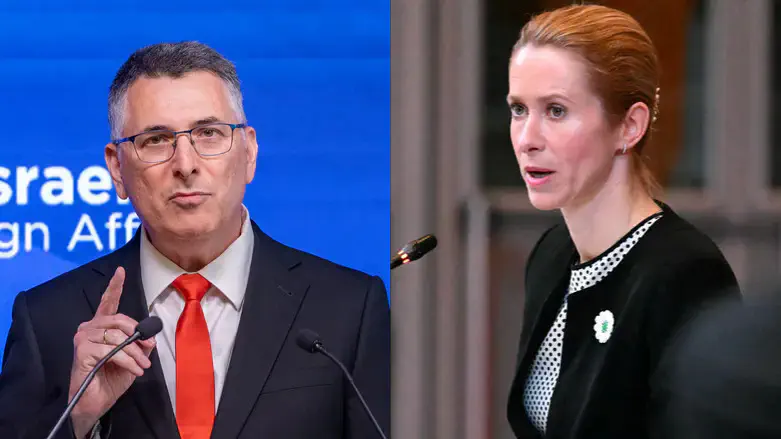
Foreign Minister Gideon Sa’ar sharply rebuked European Union foreign policy chief Kaja Kallas on Friday after she compared Jewish communities in Judea and Samaria to Russian-controlled Crimea while advocating for an EU-wide prohibition on trade in goods originating from those communities.
Speaking to The Irish Times, Kallas called on European governments to take what she characterized as a “principled stance” by backing a bloc-wide ban on commerce involving products from “Israeli settlements in Occupied Palestinian Territories.” Kallas said there was widespread agreement among EU countries that Jewish communities in Judea and Samaria violate international law.
To bolster her argument, Kallas invoked the European Union’s actions following Russia’s 2014 annexation of Crimea. “The question is what do we do about this? If we take the example when Crimea was occupied, then it was very clear, it’s illegal, we don’t recognize this, which means that we stop the trade with any products that come from Crimea,” she told the newspaper.
“We should have the same principled stance – you know this is illegal, everybody agrees – so we should stop trading with Occupied [Palestinian] Territories.”
Sa’ar responded forcefully on social media, rejecting both the historical and legal premise behind Kallas’ analogy.
“The comparison drawn by Kaja Kallas has no factual or legal basis whatsoever and is completely unacceptable.”
Sa’ar argued that the Jewish connection to Judea and Samaria stretches back through thousands of years of recorded history and rejected the contention that the territories could be equated with land seized from an existing sovereign state.
“The Jewish people’s connection and right to Judea and Samaria and the Land of Israel are more extensively documented than those of any other people in human history. Contrary to the comparisons drawn by Ms. Kallas, Judea and Samaria have never belonged to a Palestinian state, which never existed. Even the Palestinians themselves signed on a negotiated solution for the disputed territories.”
Sa’ar also questioned why the EU’s top foreign policy official would draw such a comparison between Israel and Russia, pointing to Israel’s democratic system and its security relationship with Europe.
“And finally – what does the high representative for foreign affairs and security policy is trying to do? Comparing the only democracy in the Middle East, that contributes in so many ways to Europe’s defence and security, to Russia? Did she stop to think about what she was actually saying?” concluded Sa’ar.
The clash followed additional European moves targeting Israeli communities in Judea and Samaria. Days earlier, British Foreign Secretary Ed Miliband announced that Britain would bar imports of goods produced in those communities. France and Canada joined the announcement, saying they too would “bring forward national measures to ban trade in settlement goods.”
Israel subsequently unveiled a series of retaliatory steps through Sa’ar. Among them, Israel said it would shutter the British Consulate in Yerushalayim, remove British personnel from the International Gaza Support Center in Kiryat Gat, and terminate British involvement in training Palestinian Authority forces in Judea and Samaria through the “British Support Team in Ramallah.”
In addition, Israel announced that 12 British elected officials and other British citizens would be denied entry to the country. Israeli officials said the individuals were being barred because of antisemitic or anti-Israel activity, or because they had denied Israel’s right to exist.
{Matzav.com}
Related stories
Israel National News1 day agoCleveland Jewish News3 days agoVos Iz Neias4 days agoMatzav4 days ago Vos Iz Neias1 day ago
WASHINGTON D.C (VINnews) — President Trump and First Lady Melania Trump issued a formal Rosh Hashanah message Friday wishing the Jewish community a sweet new year as the High Holy Days get underway.
The two-day observance of Rosh Hashanah, the Jewish New Year, begins at sundown Friday, Sept. 11, and continues through nightfall Sunday. It marks the start of a period of prayer, reflection and repentance that leads to Yom Kippur.
From @WhiteHouse, a Presidential Message on Rosh Hashanah:
“Melania and I send our warmest greetings to the entire Jewish community on Rosh Hashanah—the Jewish New Year and the first of the High Holy Days.
The Jewish community around the world marks the anniversary of when the…
— RJC (@RJC) September 11, 2026
In the White House statement, the president and first lady offered “warmest greetings to the entire Jewish community.” They noted that the holiday commemorates the creation of Adam and Eve and opens “a solemn season of prayer, repentance, and spiritual renewal.”
The administration used the message to restate its priorities, saying it remains committed to “ushering in a historic renewal of faith across our country, eliminating the scourge of anti-Semitism, and defending the sacred right of religious liberty for every single American.”
The greeting closed with the traditional blessing: “May you be inscribed in the Book of Life. Wishing you a Happy, Healthy, and Sweet New Year!”
The Republican Jewish Coalition shared the statement Friday and thanked the president. The message arrives days after Trump hosted Hasidic rabbis at the White House in what officials described as a rare gathering of its kind.
Friday also marks the 25th anniversary of the Sept. 11, 2001, terrorist attacks.
Rosh Hashanah customs include sounding the shofar, eating apples dipped in honey as a symbol of a sweet year, and reciting prayers for inscription in the Book of Life.
 JBizNews
Related stories
JBizNews1 day agoFord announced on Thursday that it’s planning to expand its manufacturing presence in Kentucky with a $1 billion investment in a new state-of-the-art paint shop at its Kentucky Truck Plant.
The investment will allow for the construction of a new paint shop, which will replace its existing paint shop and further the modernization of the Kentucky Truck Plant in Louisville.
The upgraded technology in the paint shop will provide cleaner and more efficient paint quality, boosting efficiency and environmental sustainability in production processes, Ford said.
Ford’s Kentucky Truck Plant is the automaker’s largest and highest revenue manufacturing plant, with a vehicle rolling off the assembly line every 45 seconds, the company noted. It produces vehicles including the F-Series Super Duty pickups, the Ford Expedition and Lincoln Navigator SUVs.
“For more than a century, Ford and Kentucky have grown together, and we’re investing to ensure that relationship remains strong for generations to come,” said Ford CEO Jim Farley.
“These investments demonstrate our confidence in Kentucky’s workforce, our commitment to American manufacturing, and our belief that the future of mobility and energy will be right here in the United States,” he added.
Ford said in its announcement that groundbreaking on the project is expected by late this year. The company is also planning to host a Kentucky Truck Plant Family Open House on Sept. 13 for employees and their families to spotlight the work that goes on at the facility.
Ford’s nearby Louisville Assembly Plant is also in the midst of a significant update, with Ford installing its new Universal EV Production System at the facility. That investment will support production of the recently unveiled Ford Fathom, a midsize electric pickup truck that’s planned to launch in 2027, and transform the facility into one of Ford’s most advanced and flexible manufacturing plants.
Ford’s presence in Kentucky dates back to 1913, when the first Model T rolled off the assembly line in Louisville. The Bluegrass State is also home to over 6,000 Ford retirees.
The automaker previously announced a $2 billion investment in Ford Energy, which will enable the conversion of a former battery manufacturing site in Glendale, Kentucky, into a large-scale producer of battery energy storage systems.
The company noted a 2020 study by the Boston Consulting Group found that Ford contributes $11.7 billion annually to Kentucky’s economic output, with nearly 120,000 people in the state employed by Ford, its suppliers and dealers.
A 2023 report by University of Louisville Professor Thomas Lambert found that Ford’s total economic impact in Kentucky tops $33 billion across its network of vendors and suppliers.
 Matzav1 day ago
A rare and lengthy meeting took place between the Toldos Aharon Rebbe and Beit Shemesh Mayor Shmuel Greenberg, during which the Rebbe personally asked the mayor to assist with the continued expansion of the chassidus’ mosdos in Ramat Beit Shemesh Daled, including plans to establish an additional yeshiva for the growing community.
Toldos Aharon has long maintained a substantial presence in Beit Shemesh, and in recent years the kehillah has expanded significantly into Ramat Daled. The Rebbe is said to view Beit Shemesh, and particularly its rapidly developing neighborhoods, as an important center for the future growth of the chareidi community.
Three active Toldos Aharon batei medrash have already been established in Ramat Daled, along with a mikvah, representing a combined investment of approximately NIS 2 million. The facilities have become central gathering points for local Toldos Aharon families as the community continues to expand.
The Rebbe arrived in Beit Shemesh in the middle of Elul for approximately a week of rest. During his stay, he received chassidim each evening, offering his birchas hashanah ahead of Rosh Hashanah.
Among those who came to receive a blessing was Mayor Shmuel Greenberg, who was granted an unusually lengthy private audience at the Rebbe’s residence.
During their meeting, the Rebbe and Greenberg discussed the needs of the developing Toldos Aharon community in Beit Shemesh and the challenges accompanying its rapid growth.
Community leaders and askanim told the Rebbe that although Toldos Aharon does not participate in municipal elections, Greenberg has nevertheless worked with the kehillah and assisted its needs wherever possible.
The Rebbe warmly thanked the mayor for his efforts and blessed him that he should merit serving as a faithful and effective shaliach on behalf of the future of the chareidi community in the neighborhood.
In keeping with the custom during the days preceding Rosh Hashanah, the Rebbe then presented Greenberg with an apple and honey and wished him a shana tovah u’mesukah.
Following the exchange of blessings, the Rebbe and Greenberg continued their discussion privately.
During that closed-door conversation, the Rebbe personally raised the need to further expand and strengthen Toldos Aharon’s network of mosdos in Ramat Daled. A particular priority discussed was advancing plans for an additional yeshiva to serve the community’s growing number of families and bnei yeshiva.
The unusual meeting was seen within Toldos Aharon as another indication of the increasingly significant place Beit Shemesh occupies in the chassidus’ future plans, as its leadership looks toward further strengthening and expanding the Toldos Aharon presence in the city.
 Matzav1 day ago
Britain’s top domestic intelligence official issued a stark warning on the 25th anniversary of the September 11 attacks, saying the next major security catastrophe could already be developing beyond the areas intelligence agencies are currently watching.
Ken McCallum, director general of Britain’s MI5 intelligence service, said that while security agencies must continue learning from previous terrorist attacks, concentrating too heavily on yesterday’s threats could leave countries dangerously exposed to an entirely different type of attack in the future.
McCallum made the warning in an opinion piece published Friday to coincide with the 25th anniversary of the September 11, 2001, terrorist attacks, when al-Qaida terrorists hijacked passenger aircraft and attacked the World Trade Center and Pentagon. His remarks were also reported by Reuters.
“We know that the next strategic shock will, by definition, not resemble the last one. That is perhaps the most important lesson of all,” McCallum wrote in the commentary for the Independent newspaper.
The MI5 chief cautioned that intelligence agencies cannot simply prepare to prevent another attack modeled on what happened on 9/11. The next catastrophic threat, he suggested, may emerge through entirely different methods, actors or targets.
“We must of course always learn from the last attack – but must beware of preparing brilliantly to fight yesterday’s enemy, using yesterday’s methods, against yesterday’s target … The uncomfortable truth is that the next strategic shock may already be taking shape somewhere we are not yet looking.”
McCallum stressed that the terrorist threat has not disappeared. Although al-Qaida is substantially weaker than it was at the time of the September 11 attacks, he said the organization remains dangerous, while it and other terrorist groups continue to harbor ambitions of carrying out attacks capable of inflicting mass casualties.
He pointed in particular to a recently thwarted Islamist terrorist plot targeting the Jewish community in Manchester, England. According to McCallum, the plan called for gun attacks intended to murder hundreds of Jews — an example, he said, of the continuing desire among extremists to carry out large-scale atrocities.
But terrorism is no longer the only danger occupying MI5.
McCallum said British intelligence is increasingly confronting threats backed by hostile states. Those operations can take forms ranging from sabotage carried out through criminal proxies to cyberattacks targeting critical infrastructure, including power stations.
That changing landscape, he argued, means governments cannot prepare for the next major crisis on their own.
The world’s infrastructure also looks markedly different from what existed in 2001. Many systems and essential services that were once largely controlled by governments are now operated by private companies. McCallum said protecting those systems will therefore require cooperation between government agencies, private businesses and academia.
The time to establish those relationships, he warned, is before an attack occurs — not while a crisis is already unfolding.
“We cannot wait for the next shock to discover who owns the vulnerability, who has the authority to act, or who was supposed to pick up the phone,” he wrote.
McCallum framed that preparation as part of the responsibility owed to the nearly 3,000 people murdered on September 11, arguing that marking the anniversary cannot be limited to looking backward and remembering those who were killed.
Instead, he said, the lesson of 9/11 must include preparing for threats that may look nothing like the attack that changed the world 25 years ago.
“We owe the victims of 9/11 – and those who will otherwise become the victims of tomorrow’s attack – something more than remembrance. We owe them preparation, resilience and the courage to adapt before the next shock arrives.”
 Matzav1 day ago
[Video below.] A deeply emotional scene unfolded after midnight at the Har Nof home of Rav Moshe Shternbuch, as the senior posek broke down in uncontrollable tears following Selichos, crying out over the difficult situation facing Klal Yisroel and pleading with the Ribono Shel Olam for mercy as the Yemei Hadin approach.
The extraordinary scene took place in Rav Shternbuch’s home in Yerushalayim while much of the city was asleep. After completing Selichos after chatzos, Rav Shternbuch remained immersed in intense emotion, tears streaming from his eyes as he began speaking to those gathered around him.
His words, delivered amid repeated sobbing, left those present shaken. Several of Rav Shternbuch’s close attendants themselves began to cry, later remarking that the raw emotion and unusual manner in which he spoke were unlike what they were accustomed to seeing from him.
Rav Shternbuch began with a piercing call to teshuvah.
“Come, let us return to Hashem, because the time is difficult and the troubles of our hearts have multiplied, and we do not know what will be…”
Then his voice broke.
“Father, Father, Father! Come back to us! How much longer will we have to suffer? You told us that we are Your children, and a father does not abandon his children. Please, do not abandon us! It is true that we sinned before You with brazenness and defiance, and we did not listen to the voice of the holy Creator, but You are our Father…”
Rav Shternbuch continued through his tears, pleading that the relationship between Hashem and His children should itself serve as the source of forgiveness.
“HaKadosh Baruch Hu will help us and He will forgive us, because it is the way of a father to forgive his son, and You will forgive us because we are Your children, for that is what You promised us: ‘You are children to Hashem your G-d.’”
He then uttered a brief sentence that encapsulated the anguish evident throughout his remarks:
“The situation is bitter, bitter, bitter!”
Rav Shternbuch went on to speak with profound pain about the gezeiros and spiritual challenges confronting the Torah community. His words were deliberately guarded, and he indicated that there were matters about which he could not speak openly.
“They are killing us and fighting against us. Oy.”
Then, addressing those gathered around him, Rav Shternbuch issued a stark warning.
“Rabbosai! The situation is not good! I am not permitted to speak, and I will not speak, chas v’shalom, but the situation is bitter, bitter, bitter, bitter! Oy, they want to completely uproot us from HaKadosh Baruch Hu, and they want us to become a nation like all the nations, a people like all the other peoples. And about this HaKadosh Baruch Hu said, ‘That which enters your minds shall not be!’ It will not happen!”
With his voice filled with anguish, Rav Shternbuch continued:
“And they disgrace HaKadosh Baruch Hu and do not listen to His voice. And what will be the end? They are killing us and fighting against us… Oy, HaKadosh Baruch Hu should help and have mercy! This is a time of tzaros, and HaKadosh Baruch Hu should help us get through it.”
WATCH:
{Matzav.com}
 Vos Iz Neias1 day ago
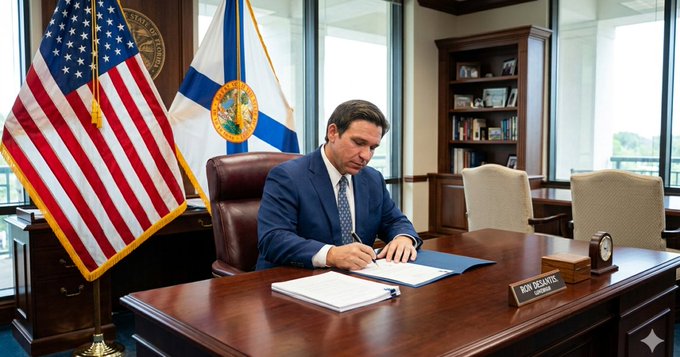
TALLAHASSEE, Fla. (VINnew) — On the 25th anniversary of the Sept. 11 terrorist attacks, Gov. Ron DeSantis and the Florida Cabinet approved an emergency rule Friday establishing how the state can designate organizations as domestic or foreign terrorist organizations.
The rule puts into effect a process created by legislation signed into law earlier this year. Under the law, Florida’s chief of domestic security — currently Florida Department of Law Enforcement Commissioner Mark Glass — can designate an organization that meets specified criteria as a terrorist organization. The governor and Cabinet then have the authority to approve or reject the designation by majority vote.
For a domestic designation, the organization must be based in or operate in Florida or the United States, engage in terrorist activity and pose an ongoing threat to the security of Florida or the United States. A foreign organization must already be designated as a foreign terrorist organization by the U.S. secretary of state and pose an ongoing threat.
DeSantis opened Friday’s brief meeting by honoring those who died while rescuing others during the Sept. 11, 2001, attacks in New York, Washington and Pennsylvania.
“We have enemies in this world,” DeSantis said, noting that those who carried out the attacks had a clear political and ideological agenda and that the threat had not been extinguished.
“We’ve obviously been keen on this issue for a long time,” DeSantis said of the new designation process. He said the framework would allow Florida to take action against hostile actors and terrorist groups.
This morning we approved Florida’s terrorist-organization designation rule during our Florida Cabinet meeting.
We now have the process to name these groups, cut off taxpayer support, and hold those who bankroll them accountable.
— Attorney General James Uthmeier (@AGJamesUthmeier) September 11, 2026
Glass told the governor and Cabinet that he believed there were “imminent dangers to public health, safety, and welfare” from increasing risks posed by foreign and domestic terrorist groups.
The emergency rule was announced Thursday and approved during a teleconference meeting that lasted just over two minutes. Attorney General James Uthmeier, Chief Financial Officer Blaise Ingoglia and Agriculture Commissioner Wilton Simpson did not comment during the meeting.
The new process stems from House Bill 1471, which was approved by the Legislature and signed by DeSantis in April. The law also establishes criminal penalties involving material support, membership and military-type training connected to designated terrorist organizations.
 Matzav1 day ago
The return of the final 20 living hostages on Hoshana Rabbah. The arrests of bnei yeshiva and the massive “Million-Man Rally.” War with Iran, missile strikes and extraordinary miracles in Bnei Brak and Arad. Heartbreaking tragedies that left the Torah world reeling. The dramatic ruling in the decades-long Ponevezh Yeshiva dispute and a shocking murder inside Kollel Chazon Ish. And, as the year drew to a close, an extraordinary scene at the White House: the two Satmar Rebbes standing side by side.
As 5786 draws to a close, it is difficult to remember a year containing so many events that seemed, at the moment they occurred, almost impossible to absorb. It was a year of gezeiros and arrests, war and loss, tefillah and chizuk, heartbreak and remarkable yeshuos — twelve months that left an indelible mark on the chareidi community in Eretz Yisroel and throughout the world.
Here is a look back at a year that will not soon be forgotten.
An extraordinary wave of emotion swept through Klal Yisroel on Hoshana Rabbah, as the final 20 living hostages held by Hamas in Gaza were finally returned to Israel.
For two long years, since the outbreak of the Simchas Torah War, Jews around the world had waited, worried, cried and davened for their return. Their plight had become part of the daily consciousness of Jews everywhere, with countless tefillos offered on their behalf.
Then, on the sacred day of Hoshana Rabbah, as the final peteklach are sealed, the news that so many had desperately awaited finally arrived. The complicated operation was completed, and the remaining living captives emerged from the nightmare of Hamas captivity.
Across the Jewish world, the response was one of overwhelming gratitude to Hashem. In yeshivos, shuls and Chassidic batei medrash, spontaneous singing broke out as Jews expressed their thanks for the tremendous chasdei Hashem and celebrated the fulfillment of the great mitzvah of pidyon shvuyim.
The closing days of Tishrei brought an entirely different kind of upheaval, as a wave of arrests involving bnei yeshiva sent shockwaves through the Torah world.
Ariel Rosenzweig, a bochur learning at Yeshivas Neveh Eretz in Be’er Yaakov who had only recently lost his father, was arrested while still sitting shivah.
Then came the arrest of Ariel Shamai, a bochur at Yeshivas Ateres Shlomo, who was taken into custody by military police at his home in Ramat Gan.
Shamai’s arrest galvanized the yeshiva world. His rosh yeshiva, Rav Shalom Ber Sorotzkin, had just landed in the United States when he learned what had happened. He immediately boarded a flight back to Eretz Yisroel.
A massive gathering was subsequently organized outside Prison 10, led by Rav Moshe Hillel Hirsch. In an extraordinary scene, Rav Moshe Hillel delivered a shiur klali there to mark the opening of the winter zman.
Thousands of children from Ateres Shlomo institutions around the country also traveled to the prison area. Rav Sorotzkin addressed them about the battle to secure his talmid’s release and responded to criticism of comparisons that had been made between the campaign for the arrested bochur and the struggle to free the hostages from Gaza.
The arrests ultimately led to one of the largest chareidi demonstrations in recent memory.
At the beginning of Cheshvan, plans were finalized for what became known as the “Million-Man Rally” at the entrance to Yerushalayim, called in response to the arrests and the ongoing battle over the drafting of bnei yeshiva.
Hundreds of thousands poured into the area on Thursday, with many beginning their journeys during the previous night. Knowing that transportation into Yerushalayim would be extraordinarily difficult, participants arrived hours ahead of time.
The yeshiva world was careful not to allow the demonstration to come at the expense of seder. Bnei yeshiva left early in the morning and dispersed among nearby batei medrash, where they learned Seder Alef before proceeding to the rally.
Gedolei Yisroel representing numerous communities and chugim participated from specially prepared balconies overlooking major intersections. The enormous gathering joined in tefillah over the draft gezeirah, amid a declaration that the chareidi community would not accept a reality in which lomdei Torah were taken from the batei medrash and imprisoned.
Later in Cheshvan came a major development in one of the longest and most bitter disputes in the yeshiva world.
After decades of conflict at Ponevezh Yeshiva, Judge David Cheshin, who had spent four years serving as arbitrator between the opposing sides, issued his final ruling.
The decision ordered the faction commonly known as the “Mechablim” to vacate the yeshiva’s campus in Av 5786.
An appeal followed, and Judge Shavach subsequently issued another ruling in Elul, setting Tishrei as the time for the yeshiva operated by that faction to leave the campus.
Kislev saw tens of thousands gather for the annual night of chizuk led by Rav Tzvi Meir Zilberberg.
The enormous gathering stretched deep into the night. Until approximately 4 a.m. on Motzoei Shabbos, participants continued streaming forward to undertake personal kabbalos aimed at strengthening themselves in ruchniyus and protecting the sanctity of the Jewish home.
The gathering has developed into an annual event whose influence is felt across broad segments of the chareidi community.
At its center was Rav Tzvi Meir’s approximately two-hour address, delivered in Yiddish. Thousands of special headsets provided simultaneous Hebrew and English translation.
Among the subjects Rav Tzvi Meir addressed was the need for vigilance regarding technology. He also spoke forcefully about the spiritual dangers posed by artificial intelligence, describing it as one of the significant challenges confronting the generation.
Teves brought a tragedy that shook the yeshiva world.
At the conclusion of a demonstration in Yerushalayim against the draft law, 14-year-old Chaim Yosef Eisental, a beloved bochur at Yeshivas Ohel Torah in Ramot Daled, was fatally struck by a bus.
The inscription subsequently placed on his matzeivah described a young masmid taken in the prime of his youth while returning from a gathering of tefillah held for the preservation of Torah in Eretz Yisroel.
It also recorded the extraordinary wave of chizuk that followed his petirah, as people accepted upon themselves greater diligence in Torah learning, work on their middos, and teshuvah in his memory.
On Thursday night, 19 Teves, painful news emerged from Hadassah Ein Kerem Hospital in Yerushalayim: Rav Uri Lupolianski zt”l, the renowned founder of Yad Sarah and former mayor of Yerushalayim, had passed away following years of illness. He was 77.
Rav Uri enjoyed an especially close relationship with Rav Yosef Shalom Elyashiv zt”l, who held him in exceptionally high regard and viewed him as a trusted representative in matters affecting the broader community.
Those familiar with their relationship knew that Rav Uri’s public activities were conducted under Rav Elyashiv’s guidance. Rav Elyashiv publicly expressed his esteem for his devoted shaliach on numerous occasions.
Despite his enormous accomplishments, Rav Uri remained strikingly unassuming. Shem Shomayim was constantly on his lips. He walked without airs, spoke with humility and treated everyone he encountered with warmth. The smile and pleasant countenance for which he was known remained part of him under virtually every circumstance.
At the beginning of Shevat, tragedy struck a daycare center on Rechov HaMem-Gimmel in Yerushalayim’s Romema neighborhood, where toddlers Leah Tziporah Goloventzitz a”h and Aharon Katz z”l lost their lives.
In the immediate aftermath, intense media attention focused on the daycare and accusations were directed at its operators. Parents of children attending the facility later strongly disputed the allegations and said much of what had been circulated was false.
In a letter, parents said their children were feeling the effects of the daycare’s closure and that they hoped operations would resume. They expressed their desire to continue sending their children there, describing the care as loving, devoted and responsible.
The parents also condemned rumors that had circulated following the tragedy, saying they unfairly maligned the daycare workers. They concluded their letter with an expression of grief and a tefillah that such terrible news no longer be heard among Klal Yisroel.
Barely a day after the daycare tragedy — and only weeks after Yosef Eisental’s death — another young bochur was killed.
Naftali Tzvi Kramer z”l, 17, a talmid of the Satmar yeshiva in Komemiyus, was fatally struck after returning from a demonstration against proposed autopsies of the two children who had died in the Yerushalayim daycare tragedy.
Police initially presented the incident as an ordinary traffic accident unrelated to the demonstrations in the area.
Video footage subsequently released, however, raised troubling questions about the bus driver’s conduct. Audio from inside the bus captured girls recognizing the approaching danger before the impact and screaming in alarm over the manner in which the vehicle was being driven.
Shevat also saw the remarkable rise in prominence of the Krechnif Kfar Ata Rebbe, who became known among some of his American followers as the “Tzinor HaShefa.”
The Rebbe had been quietly elevated following the shivah for his father, the Krechnif-Sighet Rebbe zt”l. But it was an enormous Tu B’Shevat tish in Yerushalayim that suddenly brought him widespread attention.
Dozens — and soon hundreds — were drawn to him. Young and old, baalei batim and bnei Torah, yeshiva bochurim and working men, Jews from strikingly different backgrounds found themselves crowding around the same relatively young Rebbe.
They sang together with intense deveikus and danced with extraordinary enthusiasm. A Rebbe who had previously been known largely within a more limited circle suddenly became a phenomenon attracting Jews far beyond the traditional boundaries of his own chassidus.
On Shabbos Zachor, the joint Israeli-American offensive against Iran began, in an operation dubbed “Roar of the Lion.”
Israel sustained severe missile strikes in the fighting, with one of the earliest devastating impacts occurring in Beit Shemesh.
Nine people were killed when an Iranian missile directly struck several buildings. Another 28 people were injured, including children; two were seriously wounded, two moderately, and the remainder sustained lighter injuries. At least some of those hurt had been inside a shelter.
Amid the devastation came a striking image.
Shrapnel from the Iranian missile penetrated a Sefer Torah inside the shelter — precisely at Parshas Zachor, the very parshah that Jews around the world had read that Shabbos.
For those who discovered it, the symbolism was impossible to miss: Parshas Zachor, with its command to remember Amalek, had been read on the very Shabbos that war erupted against modern-day Persia — Iran — evoking unmistakable associations with the story of the Megillah.
The war with Iran continued into Pesach, and Bnei Brak experienced numerous missile impacts. Homes were badly damaged, yet numerous families emerged unharmed in what residents described as extraordinary miracles.
In the aftermath, signs of gratitude to Hashem appeared on damaged and destroyed homes, as families publicly expressed thanks for having survived.
An especially remarkable story unfolded in Arad on Erev Yom Tov within the Gerrer community.
Three-year-old Yedidya Rotlevy was blown from the fourth floor of his home by the force of a missile explosion. He plunged downward with a collapsing wall and became trapped beneath debris — yet survived.
When his family was finally reunited with him at the hospital, the little boy innocently described what had happened:
“לא קיבלתי שום מכה, ורק הגיעו אנשים פתאום ולקחו אותי באמבולנס”.
“I didn’t get hurt at all. Suddenly some people came and took me in an ambulance.”
His father, Rav Tzvi Meir Rotlevy, described the terrifying moments after their fourth-floor apartment sustained a direct hit. Racing into the destroyed children’s room, he discovered that two of his children had miraculously survived.
Then he saw that Yedidya’s bed was empty.
The little boy had fallen into the abyss together with the wall.
Trapped inside the devastated apartment and not knowing where his son was, Rav Rotlevy said an extraordinary thought took hold of him.
“מה שעבר לי בראש זה שאת העיר ערד הקים הרבי ה’לב שמחה’ מגור”, סיפר האב. “אמרתי לעצמי: הילד נמצא עכשיו בידיים שלו. איפה בדיוק? אני לא יודע. אבל בידיים שלו הוא נמצא”.
“What went through my mind was that the city of Arad was established by the Gerrer Rebbe, the Lev Simcha,” the father recalled. “I told myself: The child is now in his hands. Where exactly? I don’t know. But he is in his hands.”
As Nissan bein hazmanim came to an end and Iyar began, an unspeakable tragedy befell the Spiegel family of Yerushalayim’s Ramat Shlomo neighborhood.
The double catastrophe left the Torah world stunned and brought tears into thousands of Jewish homes.
On Erev Shabbos, at the Sanz beach in Netanya, two brothers — Yissachar Dov “Dubi” Spiegel z”l, 21, and Avraham Yeshaya Spiegel z”l, 17 — were swept into the sea.
They were the sons of Rav Shlomo Spiegel, a rosh yeshiva in Yerushalayim’s Beis Yisroel neighborhood.
The older brother, Yissachar Dov, was pulled from the water in critical condition. Doctors fought for his life for several days as tens of thousands of Jews around the world poured out their hearts in tefillah.
But the terrible decree had been sealed, and Yissachar Dov’s neshamah returned to its Creator.
Even as the family sat shivah, there was still no closure. Search teams continued desperately combing the sea for his younger brother, Avraham Yeshaya.
Days of agonizing uncertainty and tefillah followed.
Then came the devastating news: Avraham Yeshaya’s body had been found in the water.
The grieving family rose from one shivah to accompany a second son and brother to his levayah, before beginning another period of shivah.
The tragedy left an open wound throughout the chareidi community. Jews everywhere followed the family’s ordeal with tears, while marveling at the extraordinary strength with which the family accepted the crushing news.
On Erev Shavuos, an act of horrifying violence took place inside Kollel Chazon Ish in Bnei Brak.
Rav Yishai Por zt”l, one of the distinguished avreichim of the kollel, was stabbed to death. He was 52.
The accused killer, Guy Achtlinger, had reportedly repeatedly antagonized Rav Yishai.
Rav Yishai, who possessed a profound reverence for the words of the earlier Torah giants, had prepared a handwritten notice that he intended to post in the beis medrash protesting what he regarded as the degradation of the teachings of the kadmonim. He never had the opportunity to hang it.
Friends remembered Rav Yishai as a person of extraordinary yishuv hadaas. Nothing about him was hurried or impulsive.
Even his modest meals were eaten privately in a quiet corner of the stairwell, slowly and with meticulous cleanliness. Those who knew him said that his presence was always pleasant, his surroundings orderly, and his conduct measured and refined.
Thousands of Vizhnitzer Chassidim from Eretz Yisroel and abroad gathered in Kiryas Vizhnitz in Bnei Brak for an emotional and historic Shavuos in the presence of the Vizhnitzer Rebbe.
The Yom Tov carried an added dimension of simchah with a historic hachnosas Sefer Torah. The Rebbe, who continues to require a refuah sheleimah, had begun writing the Sefer Torah while undergoing medical treatment in Los Angeles.
The hachnosas Sefer Torah began approximately three hours before Yom Tov with a special gathering for the children of the chassidus outside the main beis medrash.
The Rebbe then emerged from his home on Rechov Toras Chaim carrying the Sefer Torah. Lining both sides of the street were dozens of grandchildren and great-grandchildren of the Yeshuos Moshe and the Rebbe, including family members who had traveled especially from Skver in the United States, holding flaming torches as the procession moved forward.
Another tragedy during this period became seared into the collective memory of the chareidi community.
Mrs. Ayala Davidson a”h, just 33 years old and the daughter of Rav Aharon Seler, was critically injured in a devastating car accident on Erev Shabbos Parshas Bamidbar while traveling to a postpartum recovery center. Her infant son was killed in the crash.
Resuscitation efforts initially succeeded, and Mrs. Davidson was rushed to the hospital for surgeries and intensive treatment.
For a week, doctors fought to save her.
Near Shavuos, the battle ended, and she returned her neshamah to her Creator.
The tragedy left behind five young yesomim and a grieving husband who had himself been seriously injured in the crash. With chasdei Shomayim, he subsequently emerged from immediate danger and continued his recovery.
Shock and grief swept through the Torah world in Tammuz following the murder of the renowned mekubal, Rav Amos Kamos Chaim Guetta zt”l, rosh yeshiva of Yeshivas Rabbi Yitzchak Chai Taieb in Netanya and rav of the city’s Libyan Jewish community.
Rav Guetta, 75, was stabbed to death inside his yeshiva.
His levayah continued for hours as masses accompanied him to kevurah. In the weeks that followed, his kever in Netanya became a destination for those wishing to daven there.
His matzeivah describes a towering figure devoted to Hashem, Torah and his fellow Jews, who dedicated himself with mesirus nefesh to bringing Jewish hearts closer to their Father in Heaven.
Tammuz also brought an unprecedented sight in the battle over the arrest of bnei yeshiva.
For the first time, thousands of Gerrer Chassidim traveled from across Eretz Yisroel to the gates of Prison 10 at Beit Lid following the arrest of Yechiel Kutainer, a Gerrer bochur detained at an IDF recruitment office.
The demonstration was organized with little advance notice and was led by the Gerrer Rebbe, who made the special trip from Yerushalayim to the prison.
At roughly the same period came the massive “vehicle protest,” which blocked major arteries across Israel.
Within half an hour of its start, the scale of the demonstration was evident. Traffic was severely affected, the Israeli media devoted extensive coverage to it, workers began leaving their offices early, and workplaces emptied as commuters attempted to avoid becoming stranded.
For those participating, the intended message was unmistakable: the arrests and imprisonment of lomdei Torah would not pass quietly.
In Av, leading Gedolei Yisroel and cheder administrators convened for an emergency gathering to confront an increasingly serious problem: the shortage of qualified melamdim.
The gathering brought together Rav Dov Landau, Rav Moshe Hillel Hirsch, Rav Dan Segal, Rav Shraga Steinman, Rav Chaim Feinstein, Rav Binyamin Finkel and Rav Shimon Galai, along with prominent community rabbonim from around Eretz Yisroel.
At the center of the discussion was how to strengthen the sacred work of melamdei tinokos shel beis rabban and encourage qualified individuals to enter the field.
The Gedolim called upon community rabbonim to identify and encourage men blessed by Hashem with the necessary abilities to undertake the holy responsibility of educating the next generation — and to view becoming a melamed as a lechatchilah, not as a fallback career.
A person capable of succeeding in the sacred work of teaching Jewish children, they stressed, is a marbitz Torah in the fullest sense, whose importance to Klal Yisroel is immeasurable.
At the same time, parents and the broader community were urged to show greater appreciation and respect for the melamdim whose daily toil and devotion are building the future generations of Klal Yisroel.
After a year dominated in no small measure by the battle over the draft and the arrests of bnei yeshiva, the Torah world entered Elul with remarkable momentum.
Elul 5786 was an unusually short zman, but one filled with tremendous spiritual intensity. Despite the uncertainty, arrests and continuing gezeiros, the yeshivos opened their doors to extraordinary growth and expansion.
Even as bochurim lived with the possibility of arrest hanging over them, the response inside the yeshiva world was to retreat more deeply into the daled amos of Torah and halachah.
The sounds of learning filling the batei medrash provided their own answer to a turbulent year.
And then, in the closing days of 5786, came an image that few in the Chassidic world could have imagined seeing.
The two brothers who lead the rival Satmar communities — the Satmar Rebbe, Rav Aharon Teitelbaum, and his brother, the Satmar Rebbe, Rav Zalman Leib Teitelbaum — stood side by side at the White House.
For decades, the division between the two Satmar camps — commonly referred to as the “Aharonim” and “Zalonim” — has been one of the most deeply entrenched splits in the Chassidic world.
Yet there they were in Washington, together, following a handshake and an historic conversation during a visit hosted by President Donald Trump.
At the very end of the year, before the cameras in the seat of American power, a wall that had long seemed virtually impossible to breach suddenly showed a crack.
The symbolism of the moment was difficult to overstate: the trappings of the White House surrounding two of the most prominent leaders of Satmar, brothers whose respective communities have spent decades apart, now presenting an image of unity and brotherhood.
Nor was the encounter merely accidental. It had been arranged in advance, and Rav Zalman Leib approached his older brother and extended his hand.
It was a remarkable image with which to close a remarkable year.
After twelve months of war and miracles, arrests and mass gatherings, terrible tragedies and extraordinary yeshuos, 5786 leaves behind memories that will remain with the chareidi community for many years to come.
May the coming year bring only besuros tovos, yeshuos and nechamos. May it be a year of geulah and salvation, and may we merit in 5787 to report only happy news, b’ezras Hashem.
A kesivah vachasimah tovah.
A gut yohr.
{Matzav.com}
 JBizNews1 day ago
A nationwide healthcare uniform retailer is shutting all of its brick-and-mortar retail stores, the company said.
A message on the Scrubs & Beyond website reads: “All Retail Stores Closing.” No other explanation was given.
The company sells nurse scrubs and uniforms from top brands, including its own Beyond Scrubs line.
It has more than 100 stores across 30 states, the website states.
Many of the stores are holding going-out-of-business sales with discounts ranging from 20% to 40% off all merchandise.
FOX Business has reached out to Scrubs & Beyond’s parent company, Kindthread, for comment.
The Scottsdale, Arizona-based Kindthread acquired and relaunched the Scrubs & Beyond brand and stores in 2022, the Post Bulletin newspaper reported.
Scrubs & Beyond has been in business for more than 20 years. In that time, the company became the largest retailer of healthcare apparel and accessories in the country, the website states.
It is unclear how many employees will be impacted by the closings.
 JBizNews1 day ago
Billionaire businessman John Catsimatidis is warning that foreign adversaries will do “anything” to weaken President Donald Trump, while also voicing disappointment with Canadian Prime Minister Mark Carney.
Catsimatidis joined FOX Business’ Cheryl Casone on “Mornings with FOX Business” to discuss national security concerns on the 25th anniversary of the September 11 attacks, geopolitical tensions and what he sees as efforts to undermine President Trump.
“The evil empire, whether it’s Russia, North Korea, China, Iran, the evil empire will do anything to make sure that they cripple Trump in the November 3rd election,” Catsimatidis said.
The Red Apple Group chairman and CEO singled out Canada, saying he was disappointed in Carney despite describing the prime minister as someone he likes and considers smart.
“I think he [Carney] feels the same way, that they’re gonna be able to take a bigger advantage of the United States if Trump was crippled,” Catsimatidis said.
Catsimatidis framed his concerns around Trump’s approach to business and international negotiations, arguing that the president’s dealmaking makes him a target for countries seeking an advantage over the United States.
“He’s not only a president, he is a businessman,” Catsimatidis said.
Catsimatidis also reflected on the September 11 attacks, saying he lost four personal friends and a cousin that day. He warned that younger Americans have no personal memory of the attacks and argued that the country must remain vigilant.
“I believe that our country is under attack and that if we don’t keep our eyes open, there’ll be another 9/11. New York is the target, Washington is the target, and we have to be extra careful,” he said.
Catsimatidis closed with another warning about threats facing the country.
“November 3, help save America, because we’re under attack in so many directions,” Catsimatidis warned.
 The Lakewood Scoop1 day ago
The Posek spoke after Slichos this week.
 Matzav
Related stories
Matzav1 day ago[Video below.] Vice President JD Vance turned an unexpected disruption during his primetime address at the Republican midterm convention in Dallas into one of the night’s most talked-about moments, firing back at a protester waving Mexican and Palestinian flags and drawing a thunderous response from the crowd as speculation about Vance’s political future continued to build.
The interruption came Thursday night as Vance addressed Republicans gathered at the American Airlines Center. The protester unfurled what appeared to be Mexican and Palestinian flags and was subsequently removed by security as attendees booed and began chanting “USA!”
After the disruption, Vance explained to television viewers what had happened inside the arena.
“What the people at home missed is that we just had a protester interrupting us and waving the Mexican flag.”
“Well, my friend, if you love Mexico so much, get your a– over there. I’ll buy you the plane ticket,” the VP said, to which the crowd erupted into applause.
The unscripted exchange immediately drew attention from conservative commentators online, with many praising Vance’s ability to respond to the interruption on the spot.
“JD Vance just MIC DROPPED a leftist heckler who interrupted him waving a Mexican flag…this place is DEAFENING,” conservative commentator Eric Daugherty wrote on X, adding, “TOTAL PANDEMONIUM.”
Conservative commentator Benny Johnson described Vance’s comeback as an “epic response,” while Trump supporter and activist Scott Pressler said the vice president responded “without missing a beat,” describing the exchange as “an iconic moment.”
Another conservative commentary account, Overton, compared Vance’s handling of the episode to President Donald Trump’s confrontational political style.
“This was masterful. A Trump-level move from JD Vance,” wrote Overton, a conservative commentary and news account. “Vice President Vance perfectly handled a protestor waving a Mexican flag at the RNC in Dallas. Then he fired back with a savage one-liner that sent the American Airlines Center into absolute bedlam.”
As the confrontation ended, convention attendees broke into a loud chant of “USA!” — a response also reported by other news organizations covering the speech.
Ryan Fournier, a co-founder of Students for Trump, was among those who celebrated the exchange online.
“JD Vance just absolute [sic] WIPED THE FLOOR with a leftist heckler who interrupted his rally waving a Mexican flag.”
“The crowd went completely WILD. Unbelievable energy,” wrote Fournier.
The reaction came during a convention that placed Vance in a prominent role alongside President Trump and gave the vice president an opportunity to present his message to a national Republican audience. Reuters reported that attendees at one point chanted “48,” a reference to supporters who would like to see Vance become the 48th president. Trump, while praising Vance during the convention, did not make an endorsement for the 2028 presidential race.
Andrew Kolvet, a spokesman for Turning Point USA, also portrayed the confrontation as a defining moment of the convention.
“JD Vance just notched the most iconic moment of the RNC when he told a protester waving a Mexican flag exactly what all red blooded Americans were thinking,” wrote Turning Point USA spokesman Andrew Kolvet.
Conservative commentator Brilyn Hollyhand went further, explicitly connecting the incident to the next presidential election.
“Yea JD for President after this.”
Vance, meanwhile, quickly incorporated the interruption into his broader argument, telling the audience that he would have to depart from his prepared address because of what had just occurred.
“Ladies and gentlemen, I had a whole speech written. But I think I’ve got to change it because we just discovered the symbol of the far left — an idiot waving … a Mexican flag at a protest when he should be waving the flag of the United States of America.”
The vice president then used the protester and the foreign flag as a transition into a broader message about American identity and the country’s standard of living.
“Now, we all know, of course, that as much as that person might wave around a foreign flag, he’d much rather live in Dallas, or in Cincinnati, or in any one of our great cities than Mexico,” President Donald Trump’s No. 2 continued. “But while we wave the American flag and fight for the American dream, we have to remind ourselves tonight that the good life that is the foundation of this country’s promise is not guaranteed.”
The remarks returned Vance to one of the central themes of his address: his argument that Americans have inherited economic, cultural and political benefits that each generation has an obligation to preserve.
“Every generation of Americans has had to fight for these things when it’s our turn,” he went on.
Vance then turned his attention to the November midterm elections, sharply attacking Democrats and portraying the election as a contest over cultural and political values.
“And this fall, the Democrats are running candidates who will tell your children what they’re allowed to say, how they’re allowed to live, and importantly, who they ought to hate, because that’s what the Democrat Party is about in 2026,” Vance continued. “It’s not about you, it’s about foreign fraudsters, and it’s about who they hate. And we got to send their a–es back in November.”
The speech was one of the marquee addresses of the Republican convention’s second and final night. Vance also paid tribute to slain conservative activist Charlie Kirk and urged Republicans to remain united heading into the midterms.
The vice president’s prominence at the gathering also fueled discussion about the Republican Party’s potential field for 2028, when President Trump will be constitutionally barred from seeking another term. Vance has been widely discussed as a possible candidate, although the next presidential contest remains more than two years away and no Republican nominee has been determined.
For the moment, however, it was the spontaneous confrontation rather than the 2028 speculation that produced one of Vance’s biggest reactions of the convention — transforming a brief protest from the stands into an applause line that reverberated through the American Airlines Center.
 The Lakewood Scoop1 day ago
Note: We will not be updating any of our forums from sundown this evening until after sundown on Sunday in observance of Rosh Hashana.
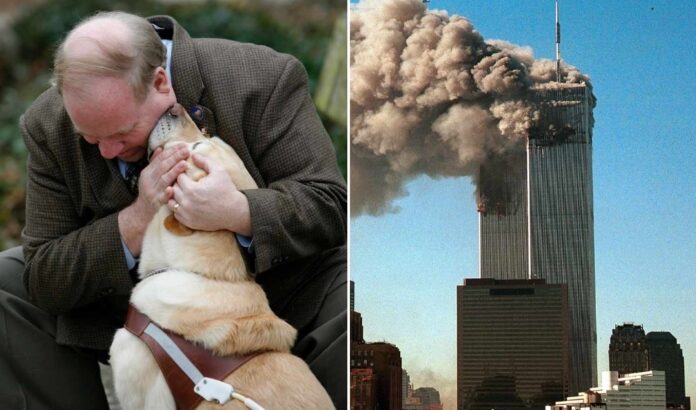 Vos Iz Neias1 day ago
NEW YORK (VINnews) — Twenty-five years after the Sept. 11, 2001, attacks, Michael Hingson still credits his yellow Labrador retriever, Roselle, with guiding him and others to safety from the 78th floor of the World Trade Center’s north tower.
Hingson, blind since birth, worked as a regional sales manager for a data-storage company. Roselle, his fifth guide dog, had been paired with him in 1999 and routinely accompanied him to the office.
That morning Hingson was preparing a conference room when American Airlines Flight 11 struck the building several floors above. The tower swayed. A loud boom rattled the office.
Roselle emerged from under the desk, calm and wagging her tail. Hingson took her leash, told her to heel, and they headed for the stairwell with colleague David Frank.
The descent covered more than 1,400 steps through smoke and the smell of burning jet fuel. Crowds filled the stairs. Firefighters passed going up. Hingson kept praising the dog to keep her focused and to project calm.
Near the 50th floor, Frank voiced despair. Hingson replied that if he and Roselle could keep going, so could everyone else. Other evacuees later told him they followed the confident voice and the dog.
They reached the lobby as the south tower was hit. Outside, falling debris and the roar of collapse filled the air. Roselle suddenly stopped at the top of stairs leading into the Fulton Street subway station. The pair took shelter underground. Police later escorted them out.
That night at home in New Jersey, Roselle picked up a toy and played with Hingson’s retired guide dog.
The story drew worldwide attention. Hingson became a speaker and co-author of the book “Thunder Dog.” Roselle received the American Kennel Club’s Award for Canine Excellence in 2002. She died in June 2011 at age 14.
Hingson has said the dog’s composure that day showed how fear can be managed rather than allowed to paralyze. He continues to speak about trust, training and remaining focused under pressure.
Roselle’s work that morning illustrated the training and partnership that define successful guide-dog teams.
 Vos Iz Neias1 day ago
by HaGaon Rav Shmuel Auerbach zt”l Darchei Shmuel Siman 17
Translated and Presented by Rabbi Yair Hoffman
The Mishnah (Rosh Hashanah 27a) states: “A shofar that cracked and was glued together is pasul (invalid). If one glued together pieces of shofars, it is pasul. If it was perforated and the hole was plugged: if [the plug] interferes with the blowing, it is pasul; if not, it is kosher.” The Gemara (27b) adds a Beraisa: “If it cracked lengthwise, it is pasul. If it cracked crosswise: if enough remains for a blast, it is kosher; if not, it is pasul.” It also teaches: “If one placed a shofar inside a shofar — if he heard the sound of the inner one, he has fulfilled his obligation; if he heard the sound of the outer one, he has not.”
Two foundational principles run through the whole discussion. First, the Torah says “shofar” in the singular — “one shofar, and not two or three shofars.” Second, the Gemara rules that “all sounds are kosher in a shofar” — a thin sound, a thick sound, or a dry sound all count as the sound of a shofar. The Rishonim (early authorities) disagree about how these two principles apply to a shofar that has cracked, been glued, or been plugged, and the author carefully sorts out their positions and then examines how the Shulchan Aruch and the Mishnah Berurah ruled.
The Mishnah (27a) reads: “A shofar that cracked [and was glued] is pasul … [glued] pieces of shofars … is pasul.” Rashi, in his comment on the word pasul, gives the reason: it is like two shofars. On the surface, this reason fits the second case — glued pieces of shofars — much better than the first. That is indeed how the Ramban reads Rashi, both in his commentary and in his Derashah for Rosh Hashanah, when he explains what Rashi meant (see below, Section 3), and the Pri Chadash (586) reads Rashi the same way.
Tosafos and the other Rishonim, however, understood Rashi’s comment as referring to the cracked shofar. And this seems to be correct. After all, Rashi has to explain why a cracked shofar is pasul, and the simplest reading is that his comment covers both cases — the cracked shofar and the glued pieces alike. Tosafos’ own careful wording supports this: they write that glued pieces of shofars are “likewise” not disqualified because of “two [shofars],” and the point of that remark is to reject the reasoning that would follow from Rashi, namely that the disqualification is because of “two shofars.”
In Tosafos HaRosh, the Rashba, the Ran, and others, Rashi is taken to mean that the “cracked” shofar split completely into two pieces. This is puzzling. A shofar split into two pieces is not “cracked” (nisdak); it is “divided into two” (nechlak lishnayim). [ This is the lashon of the Mishnah in Keilim (chapter 4, mishnah 1, and chapter 16): “which was divided into two.”]
Furthermore, if Rashi had meant that, he should have written “cracked and divided into two parts” — and he did not. Tosafos and those who follow their approach were pushed into this reading of Rashi because without it a cracked shofar is not “two shofars.” Yet when Tosafos themselves come to explain why a cracked shofar is pasul, they say it is because the Torah requires “one shofar, and not 2 or 3.” They reject Rashi with the words: “This does not seem right, for if so, it should apply all the more to pieces of shofars, which really are two shofars.” That argument only works if Rashi’s “cracked” shofar is not actually split into pieces. So it is clear that Tosafos understood Rashi’s case as a shofar that did not come apart into pieces.
The same emerges from the Chiddushei HaRamban. He explains that, according to Rashi, the cracked shofar is pasul because even if one can blow it, the sound is nothing but a hollow echo (havarah); and in his Derashah he explains that it is simply not a shofar. The Ramban is speaking of the shofar even before it was glued, as he states explicitly there that the discussion applies to a cracked shofar on its own. It is therefore clear that this is not a shofar broken into pieces; it is a shofar that can still be blown. This fits best with a shofar cracked along its entire length on one side. And even if it is cracked on both sides, the shofar must still be holding its shape — meaning it did not crack all the way to the end — so that it can still be blown. [See also the Ramban’s language on 27b, s.v. nisdak l’rochbo. This will be explained below in Section 5.]
The Ritva likewise writes that perhaps even Rashi meant a crack on one side only. [The Ritva explains Rashi’s reasoning this way: just as gluing two shofars together does not help, so too gluing a crack does not help to make it a vessel and a shofar. Tosafos and the other Rishonim, however, did not see fit to make that comparison in Rashi.]
This is even clearer from Rashi on 27b. On the words “cracked [lengthwise],” he writes “entirely.” On “crosswise,” he writes that it means across its whole circumference. And on “if there remained [enough for a blast],” he writes: “from the place of the crack [downward] … it is considered as though the whole [lower part] was removed.” This must be describing a shofar that is still whole up to the place of the crack; it is “considered as though removed,” but in fact the entire shofar is still present. In the same way, “cracked along its whole length” can simply mean a crack running its full length. In any event, it certainly does not mean a shofar split into two pieces — contrary to how Tosafos and the Rishonim understood Rashi.
One could try to defend the reading of Tosafos and the Rishonim in the following way. The cracked shofar of the Beraisa — which was not glued — is pasul even if it cracked on one side only, and perhaps even with a mere crack. The cracked shofar of our Mishnah, where even gluing does not help, is a shofar that cracked and split in two. This is in fact the position of Rabbeinu Yerucham in explaining Rashi: a shofar cracked into two pieces is pasul even when glued, while a shofar cracked on one side is repaired by gluing. It is also the position of the “some explain” (that is, Rabbeinu Yehonasan) and of the Rosh’s ruling: “cracked lengthwise” means even partially, and as long as it did not crack entirely, gluing repairs it.
However, Rashi’s plain wording strongly implies that the Mishnah and the Beraisa are speaking of the very same kind of crack. This is also indicated in Tosafos and the Rosh (s.v. nisdak l’orko), in the Ramban, and in the Rashba; and the Ran and the Rosh explain Rashi’s view this way even more clearly. It is also precise in Rashi on 27b: a crosswise crack must run around the whole circumference, but a lengthwise crack need not run around the whole circumference — even one side is enough. [One could slightly force Rashi on 27b, s.v. nisdak kulo (“cracked entirely”), to mean “on both sides,” but the reading given here appears very clear.]
It may even be that a shofar cracked in this way never actually separated and was never glued. It may also be that the crack does not go all the way through the wall of the shofar but only nearly so. [The Pnei Yehoshua explains Rashi’s reasoning — that the cracked shofar is disqualified because of the glue — as meaning that the shofar did not separate completely; and he reads Rashi’s “crosswise” as not necessarily the whole circumference but most of it. Rashi’s wording does not read that way. See further below in the discussion of the Mishnah Berurah.]
And even if one takes the position that a crack running fully through the wall is no less pasul, it must still be that the shofar holds itself in its shape, even though the crack goes through the wall, as explained above.
Tosafos on our Mishnah cite the explanation of Rabbeinu Yitzchak: a “cracked shofar” is one that can produce only a small, weak sound. Although all sounds are kosher in a shofar, here the sound is an inferior one that does not resemble a blast at all. The Ramban, following his own understanding of Rashi in the case of the cracked shofar, likewise explains that even if one can blow it, the result is only an echo. [Meaning: it is not a full shofar sound, and it is regarded as a mere echo.]
In his Derashah, the Ramban retracted this, on the basis of the Yerushalmi that all sounds are kosher; he explained instead that the cracked shofar is pasul because it is not a shofar. [The Yerushalmi says so even of a shofar whose sound changed because of a hole.]
It is obvious that, even according to Rabbeinu Yitzchak, a poor sound fails to count as a shofar sound only in a case like a cracked shofar, where the sound is extremely poor because of the damage. In an ordinary shofar there is no such thing as a defect in the type of sound; every sound counts as the sound of the shofar.
The Rosh in his Pesakim cites Rashi’s explanation of the cracked shofar and objects: if so, this is simply the case of glued pieces of shofars! He first explains that “cracked” means cracked on one side, as Tosafos do. At the end of his discussion, though, he concludes that there was never any difficulty: gluing pieces together along the length of the shofar is different, because the sound passes from piece to piece, and so it is fitting to disqualify it as “two shofars”; but here, where the whole length of the shofar is one piece, it is not comparable to pieces of shofars. The implication is that our Mishnah teaches us that even such a shofar is considered like two shofars, as Rashi explains.
The Rosh is only reconciling Rashi’s wording; he is not ruling this way for practical halachah, as the Korban Nesanel there and the Drishah (586) explain. According to the Rosh’s own view, a shofar cracked even on one side is pasul.
Author’s note: It is puzzling that the Rosh, in his Pesakim, would explain something that is not for practical halachah. Also, his phrase “from the outset there was no difficulty” implies that there was no need for him to add further explanation.
It seems more likely that the Rosh in his Pesakim holds — in keeping with the practical halachah of our Mishnah — that the disqualification of glued pieces of shofars is indeed because of “not two [shofars],” unlike Tosafos.
Author’s note: Though Tosafos too, at the end of their comment, write that even the cracked shofar is disqualified because of “two or three shofars.”
On this reading, the Rosh at first followed Tosafos, but ultimately he does not; rather, the Mishnah’s two cases — the cracked shofar and the pieces — are two distinct laws. The Rosh further explains that a shofar cracked lengthwise, even from both sides, cannot be derived from the case of pieces of shofars, and is a separate teaching. According to Rashi, the Mishnah teaches something new: even a cracked shofar counts as two shofars. According to the Rosh, a shofar cracked even on one side is pasul because it is not considered a shofar at all. It is even possible to say that according to the Rosh himself, in truth, a shofar cracked on both sides is not considered two shofars, following the Rosh’s reasoning, but is pasul because it no longer has the name “shofar.” This fits the Rosh’s wording better — “from the outset there was no difficulty.” With pieces of shofars, where the joining is stronger and there is less of a deficiency in the name “shofar,” the disqualification is only because of “not two,” as the Rosh explains. And Tosafos, who hold that the disqualification of pieces is not because of “not two,” add that a piece of a shofar does not carry the name “shofar.” That is Tosafos’ reasoning. In Rashi’s reasoning, pieces of shofars are included in “two shofars,” and a shofar cracked into two pieces is likewise “two shofars” — and the Mishnah teaches that even this counts as two shofars. It is possible that this is also the Rosh’s view: a shofar cracked into two pieces and glued is like two shofars. But it seems more likely that the Rosh’s view is as set out in Section 6, with Hashem’s help.
The Rosh’s core reasoning — distinguishing between pieces of shofars and a cracked shofar whose whole length is a single piece — is not entirely clear. Seemingly, just as with pieces of shofars the gluing does not help and the sound passes from piece to piece, so that it is like “two,” the same should be true here, and all the more so according to Rashi’s cracked shofar that split into two pieces: since the gluing does not help, the sound is passing through two separate pieces of shofar. One might explain the Rosh as follows: only with pieces of shofars, where each piece is a full circumference of shofar, is it considered two shofars; not so with a cracked shofar, where there is not even half a full circumference. But this is not at all evident in the Rosh’s wording. His wording is only that the whole length of the shofar is one piece — and that requires much study, since the gluing does not succeed in making it one shofar, and the sound emerges from the start through two separate parts.
The explanation of the Rosh appears to be this. Since it is not literally two shofars, it resembles the Gemara’s case of a shofar placed inside a shofar, where Tosafos and the Rosh explain that the disqualification is because of “one shofar and not two.” A shofar that split and was glued resembles the Gemara’s case (26a) of a cow’s horn, which is built of layer upon layer and therefore appears like two shofars. [One could say that in the case of the cow’s horn the layering is from its natural formation, while here it merely appears so. See Tosafos in Sotah.]
In such a case, the Rosh’s reasoning is that only pieces of shofars, where the sound passes from piece to piece, are “two” — not a shofar whose whole length is one continuous piece.
It seems that Rashi can be explained as follows. The Tosafos Yeshanim already understood Rashi’s “cracked” as a shofar that did not split in two, but simply cracked on one side, and that its disqualification is because of “one shofar.” So too the Ramban: Rashi’s cracked shofar is not one that split into two pieces, and it is even cracked on one side only, in keeping with the plain wording of Rashi, as explained. [The Ramban explains, according to Rashi, that the cracked shofar is pasul because it no longer carries the name “shofar,” and he makes no mention at all of Rashi’s “two shofars.”]
On this approach, the disqualification is indeed that it is “like two shofars” — and this is what Rashi means in his comment on the word pasul — namely, that wherever the shofar is held together by glue, there is no single solid piece of shofar, and this too falls under “one shofar and not two.” This is very precise in Rashi’s comment on the Mishnah, where he mentions no disqualification other than “two shofars,” and that reason applies to the whole Mishnah, both to the cracked shofar and to the pieces, as explained above. One can also explain why, according to Rashi, the Mishnah needed to state the disqualification of pieces separately and did not leave it to be derived from the cracked shofar: one might have thought that since the gluing there is strong, it is like a new face of shofar, and it does not matter how it came to be — unlike a cow’s horn, whose layering is from its very formation.
The Ramban in his Derashah, as above, writes that a shofar cracked entirely along its length (following Rashi) is nothing but fragments of a shofar, for a vessel that broke leaves the category of “vessel,” both regarding tumah and regarding every other matter. Presumably he does not mean that all the halachic rules of a broken vessel becoming tahor apply here. Rather, the essential point is that it has left the category of “vessel” entirely, and a cracked shofar has left the category of “shofar” completely. [A shofar does not receive tumah, because it is not made to hold anything, as stated explicitly in the Tosefta (Keilim, Bava Metzia 6:1) and in the Rambam (Hilchos Keilim 5:2). As for the ruling that certain horns are tamei, the Kesef Mishneh (5:3) explains, following the Bartenura and the Mishneh LaMelech, that this is because people store coins inside them. The Mikdash David left unresolved the difficulty from the Gemara in Shabbos, which permits moving a shofar because one can draw water with it; the Rambam did not cite this law about moving a shofar, and this is not the place to elaborate. The Magen Avraham (308:4) rules that a shofar may be moved only for use of its body or its place; his source is the Hagahos Ashri; see also the Or Zarua (siman 86). As for what the Mikdash David raised from the Gemara in Shabbos — whether a use must resemble the object’s principal use — see the Rambam (Hilchos Keilim 8:6), where the plain reading is that it must resemble its principal use; and according to the view that this is not required, the case is a shofar that is not designated at all for such use. See there.]
Tosafos and the other Rishonim disagreed with Rashi and held that “cracked” means cracked even on one side. According to Rashi, Tosafos, the Ramban, the Rashba, and the Rivevan, a lengthwise crack disqualifies only when the shofar cracked entirely; if part of it remains attached, there is no disqualification of “cracked.” A question arises according to those who explained that the crack is on one side only (and, as noted above, one can say the same of Rashi): what is the law if it cracked on both sides? Perhaps in such a case even a crack running most of the length is pasul, since it comes from both sides. But the silence of the Rishonim implies that they drew no distinction between a crack on one side and a crack on two sides, and that in every case only a crack running the full length is pasul.
The Mishnah Berurah (586:35) writes that the disqualification of a cracked shofar applies only when the crack goes all the way through the wall; his source is in the poskim cited there. The implication of Tosafos and the other Rishonim also leans this way, since they departed from Rashi’s case of a shofar cracked on both sides into two pieces and spoke of a shofar cracked on one side only — implying that on that side it cracked and separated like a break. In the plain reading, the Mishnah Berurah’s intention is that the shofar split and separated; if the crack goes all the way through, it is no less pasul. But it was explained above from Rashi on 27b, regarding a crosswise crack, that the shofar is not truly split apart. The Ramban’s wording is likewise “as though [the lower part] was removed,” and the Rambam’s is “as if it were entirely cut off” — implying that it did not truly divide and separate. It is hard to say that this holds only when the shofar did not crack entirely. So too the Rosh’s wording: “we consider the part from the crack downward as though it was removed”; and even though he wrote that the case is one where most of the width cracked, it is hard to say that this was meant to exclude a crack across the entire width. If so, a cracked shofar is not necessarily one whose crack goes fully through the wall.
It may be that, as a general matter, a crack that goes through the wall also causes separation, and the Mishnah Berurah simply spoke in general terms. Even according to the Mishnah Berurah, there is room to consider a crack that runs through most of the thickness, very nearly all of it, and lacks only a bit from going fully through; it is even possible that in such a case gluing helps. May Hashem enlighten our eyes in His Torah.
The view attributed to Rashi by the Rishonim — that “cracked” means split into two pieces — was rejected by the Rishonim themselves for halachah. According to Tosafos, the Ramban, and Rashi himself, “cracked” does not mean split into two pieces, and in the plain reading it means cracked even on one side. According to Rashi, the law of the cracked shofar, whether on one side or on both, applies only when it cracked entirely. So too the Ramban in his Derashah. In his Chiddushim on 27b, regarding a crosswise crack, the Ramban cites Rashi that the crack must run around the whole circumference, and he writes that presumably “the majority is like the whole,” as we find everywhere. One must ask why the Ramban did not say the same of a lengthwise crack. He then proves the point from the case of a shofar perforated over most of its area and plugged with its own kind, which is kosher — unlike one perforated entirely, which is pasul — and he explains that in that case the two ends remain whole. It follows that a shofar cracked lengthwise over most of its length is kosher only when both ends are whole. From the Ramban’s earlier words, however, this does not seem to be so, and the matter requires study.
The Ramban further explains that a crosswise crack over most of the width is pasul because the shofar is treated “as though [the lower part] was removed.” At first glance, this is not merely the general rule that “the majority is like the whole”; rather, the majority crack causes the shofar to be treated as if that part were removed, and through this the rule takes hold more firmly — a majority treated as removed is like the whole. One can explain: with a crosswise crack there is a real consequence, in that the part below is truly “as though removed” through a complete break, and from this the law extends to a majority crack, which likewise counts as a break. But with a lengthwise crack, the very foundation of the law is that a shofar cracked entirely has no shofar-form; that is not so where a minority remains attached, for then it is not entirely cracked. [Compare the law of a limb mostly detached, in Yevamos and elsewhere; this is not the place to elaborate.]
The Biur HaGra cites the Rokeach, who compares this to the treifah of a severed windpipe: a lengthwise split does not render the animal a treifah by majority, while a crosswise severing does. The Rokeach holds that a shofar cracked lengthwise is kosher, provided one does not glue it with something not of its kind; and a shofar cracked crosswise is treated as if cut, so that a handbreadth and a bit must remain.
The view of Rabbeinu Yehonasan HaKohen, cited in the Ramban’s Derashah and in the Ran, and the view of the Raavad in his Derashah, cited in the Ran, is that a lengthwise crack of even the smallest size is pasul, because the shofar will eventually split apart. According to the Raavad and Rabbeinu Yehonasan, this falls under the Mishnah’s law that a shofar cracked and glued is pasul, as stated in the Raavad and the Ran. [The Ramban does not state explicitly, in Rabbeinu Yehonasan’s view, that gluing does not help; but in the plain reading, according to the Ramban as well, Rabbeinu Yehonasan’s view is that this is the Mishnah’s law of a glued shofar being pasul.]
Even a shofar with the smallest crack, if glued, still stands to split apart and is treated as though it cracked entirely. Only if one bound it tightly with a thread or a cord is it kosher, since this holds it so that it will not split, as stated explicitly in the Raavad and the Ran, and so too in the Ran in the view of Rabbeinu Yehonasan. And the Raavad adds that this is on condition that a shofar’s minimum measure remains.
The Rosh follows the “some explain” that he cites: the Mishnah’s law — that a cracked shofar is pasul even if glued — applies to a shofar that cracked entirely, from end to end. If it did not crack entirely, then once it is glued it is kosher. The Beraisa’s law of a lengthwise crack, where the shofar was not glued, disqualifies even the smallest crack; but whatever did not crack from end to end may be glued and is then kosher. [A later authority took pains to prove for the Rosh’s view that a shofar not entirely cracked may be repaired by gluing; but this is stated explicitly in the Rosh, who cites it from the “some explain” and rules that this is the primary view, and the Kesef Mishneh also took the Rosh’s view as primary.]
We also learn from the Beraisa that a crack disqualifies even without gluing; it is not the glue that causes the disqualification, as is clear from the Rosh’s first explanation and from the Ramban. This is to exclude the reasoning of the Rokeach concerning a crosswise crack. Regarding a crosswise crack, the Rosh (siman 6) states that a crack across most of the width disqualifies the whole shofar, and it is kosher only if the measure for a blast remains above the crack, since we treat the part from the crack downward as though it were removed. It seems that according to the Rosh and the “some explain,” binding with a thread or cord accomplishes nothing; only glue helps, since glue restores the body of the shofar, whereas tightening it from the outside leaves it still without the name “shofar.” [See further below in the discussion of the Shaar Ephraim.] The Ritva cites “some who are stringent” that even the smallest lengthwise crack is pasul. The implication is that gluing certainly does not help, and in the plain reading even binding with a thread and cord does not help. The Ritva himself disagrees with this.
The Maggid Mishneh (Hilchos Shofar 1:5) cites “many of the commentators,” and adopts their view as primary, that a lengthwise crack is pasul when it runs the whole length or most of it. He anchored this in the Rambam’s wording there, “if it cracked lengthwise it is pasul.” Note that the Rambam does not mention the Mishnah’s point that it is pasul even if glued. It seems he used the Beraisa’s general wording, which includes the disqualification in every case; and, as noted, the disqualification does not stem from the glue. In any event, the Mishnah’s law is that even a glued shofar is pasul. The commentators and the Maggid Mishneh are to be understood the same way: a shofar cracked over most of its length is likewise pasul, and neither a thread nor gluing helps, just as they do not help for a shofar cracked entirely. This is also how the Mishnah Berurah (586:43) explains the Maggid Mishneh’s view.
We thus find the following positions among the Rishonim:
The words of our masters, the authors of the Shulchan Aruch (586:8), require much study. The Shulchan Aruch brings two views. The first: “Some say that even if it cracked the smallest amount it is pasul, unless one bound it tightly with a thread or a cord.” It is puzzling that Maran did not cite, as is his practice, the view of the Rosh — that gluing helps and a thread is not needed. Indeed, in the plain reading, according to the Rosh a thread and cord do not help at all; that requirement is only the view of the Raavad, and of the Ran in the reasoning of Rabbeinu Yehonasan, who require specifically a thread and cord. Likewise, what the Rama adds — that the measure for a blast must remain above the place of binding — is only the view of the Raavad, not the view of the Rosh; and even the Ran did not mention this in Rabbeinu Yehonasan’s view. The Mishnah Berurah (586:41) and the Shaar HaTziyun (75) ruled that this requirement of a remaining measure is not needed.
The Shulchan Aruch then brings the second view: “And some say it is pasul only if it cracked over most of its length, and if one glued it, it is kosher.” This is very puzzling. The view of the Rishonim that a crack over most of the length is pasul means that such a crack is like a crack over the whole length, as is clear in the Maggid Mishneh and the Ritva — meaning that even gluing does not help, just as it does not help for a shofar cracked entirely. Nowhere in the Rishonim is there any mention of gluing being needed for a shofar cracked entirely. Nor is this the view of the Rosh, who holds that even the smallest crack is pasul and requires gluing; only the commentators cited by the Maggid Mishneh, and the Ritva, hold that a majority crack is like a whole crack — and if so, gluing does not help. Rabbeinu Yerucham’s view appears to be like the Rosh’s: even the smallest crack requires gluing, and gluing helps whenever the shofar did not crack entirely. The Beis Yosef indicates that Maran meant the commentators cited by the Maggid Mishneh — and that is very puzzling, as explained.
The Mishnah Berurah (586:44) writes, regarding a shofar cracked over most of its length, that it is kosher if glued, and that it is specifically with glue that we validate it, because it then becomes as if whole; but if one tightened it with a thread or cord, this does not help, since it cracked over most of its length. The Shaar HaTziyun (80) writes that this follows the Pri Megadim, the Mateh Ephraim, and the Chayei Adam. The thrust of these words is that even those who say a thread and cord are required nevertheless agree that a majority crack is not helped except by gluing.
In truth, the Biur Halachah there (s.v. “and some say only if most”) notes that the Rokeach requires a crack over the entire length, and concludes that there is no need to be concerned. In this humble opinion, there is room to consider — in light of what has been explained above, in our poverty of understanding — that this is also the view of the Or Zarua and the Ramban, at least where the shofar cracked over only most of its length and both ends are intact, as above, and of the Rashba as well. [The Rambam’s view cannot be determined, as the Beis Yosef explains.] Therefore, in a case of great pressure, where no other shofar can be obtained, perhaps one can say that a person who recites the blessing over such a shofar has not lost. This requires study.
The Biur Halachah there (s.v. “and some say only if most”) observes that the Mechaber did not mention at all the view of those who hold that only a shofar cracked entirely is pasul — namely Rashi, Tosafos, the Mordechai, the Semak, and the Rokeach — and writes that in a case of great need, where a shofar cannot be obtained even through a non-Jew, one may rely on the view of those who require a crack over the whole length, so long as a small part of the shofar remains attached; that is, even without gluing. He adds that if the two ends of the shofar remain intact and it is glued, one may rely on this even without such great need. As explained above, the Or Zarua, the Ramban, and the Rashba should be counted among those who hold that only a crack over the whole length disqualifies, which strengthens the Biur Halachah’s conclusion.
On Rashi’s phrase in our Mishnah, “he glued it with glue,” the Ramban explains that through glue the shofar is held together by something not of its own kind; and it is explained there that the shofar itself can be fused together when it is heated in fire. The Rosh writes that it is not feasible to fuse it by heating. He explains that “not of its own kind” applies chiefly where one plugged a hole with a different substance; but if one joined the crack with glue, the shofar has returned to what it was, and the glue is not noticeable between the edges of the crack. The Korban Nesanel there (note 20), cited in the Biur Halachah (586:8) — see also the Mishnah Berurah — explains that this is because a hole involves a missing piece, and the plug is noticeable.
The foundation of the Rosh’s view appears to be this: with a hole, the body of the shofar is filled in and completed by something not of its kind, whereas with a crack the shofar’s own body returns to what it was. The Rosh adds that the glue is not noticeable in a crack. It seems the point is that since gluing is necessary in order to join the crack, if the glue were noticeable it would change the form of the shofar. The Ramban’s reasoning, by contrast, appears to be that even with a crack, gluing counts as adding something not of its kind; and since the gluing is necessary in order for it to carry the name “shofar,” then even though the glue is not noticeable, the shofar is considered to have been repaired and completed by something not of its kind. It does not help unless the glue can be entirely removed, or unless the shofar was fused by fire, as the Ramban states there.
The Biur Halachah there, citing the Pri Megadim (Eshel Avraham 14), leans somewhat toward the view that even a hole involving a missing piece, if it is small — the Biur Halachah means very small — and one can put glue there, counts as being of its own kind; the Biur Halachah explains that this is because it is not noticeable. Now, the phrase “put glue there” would seem in the plain reading to apply also to gluing a crack rather than filling a hole; but presumably the main intent is to fill the hole, even with something not of its kind, in a way that is not noticeable. [It is hard to learn from this that there is some special advantage to glue merely because the repair is made in an unnoticeable way; there is no source for such a distinction.]
According to what was explained, the essential point depends on whether the hole is a significant lack that needs to be filled. If it is, then filling it with something not of its kind does not help, even if the filling is not very noticeable. If the hole is so tiny that it does not count as a lack at all, then seemingly it would be kosher even without any filling or plugging whatsoever. But if even a very small hole counts as a hole, then, since the hole detracts from the shofar, any filling counts as the shofar having been completed by another substance; and it is not so sound to say that after the glue is put in, the status of “hole” is nullified on its own.
The Shulchan Aruch (586:8) rules: “If one glued it, it is kosher, even with glue; and there is one who says that it is kosher only when it was fused together by itself, through fire.” The Biur Halachah (s.v. “when it was fused by itself”) is puzzled by the Mechaber’s language, which implies that he holds all agree that fusing by itself is effective, whereas the Rosh holds that it is specifically glue that works, and if one heats the shofar in fire it cannot be joined well. See what he writes there. Maran’s words are indeed puzzling. The Rosh’s disagreement is over the factual reality — that the shofar does not fuse through fire alone. [The Mishnah Berurah’s phrasing, “if one heats it in fire it cannot be joined well,” is not the Rosh’s wording.]
And certainly, if the shofar did not fuse, there is nothing to discuss at all. The Shulchan Aruch’s ruling refers to a case where one fused it and it was actually joined through the fire. [The Ritva writes that this is done in the way that skilled craftsmen do it.] In such a case, a shofar fused by itself is better than one glued with glue, since glue counts as a different substance according to the Ramban’s reasoning.
The Mishnah states: “If it was perforated and plugged — if [the plug] interferes with the blowing, it is pasul.” Rashi does not comment on this phrase, and his silence supports the plain reading that it is the plug that interferes with the blowing. In his comment on the Gemara (s.v. “with its own kind, kosher”), Rashi writes: “if it does not interfere with the blowing.” This certainly refers to a plug of the shofar’s own kind — it is kosher only if it does not interfere, as will be explained.
Tosafos (s.v. “perforated and plugged”) write: if we explain the Mishnah as speaking of after the plugging — meaning that the plug was not smoothed and it obstructs the sound — it is difficult, since all sounds are kosher. They mean that the plug was not smoothed, and a bump from the plug remains protruding inside the hollow of the shofar, and this obstructs the spread of the sound, so that the shofar’s sound does not come out in its fullness. Their question is: what does it matter that the sound is not complete, if it is still the sound of a shofar, and all shofar sounds are kosher?
In their conclusion, Tosafos return to this reading — that “interferes with the blowing” means after the plugging — and yet they do not address at all their earlier question that all sounds are kosher. It follows that, in their final view, the problem is not that the plug’s obstruction leaves the sound incomplete, for that does not detract, since all sounds are kosher. Rather, the problem is that through the obstruction of the protruding plug, there is a change in the sound; and consequently the plug is itself shaping the sound of the shofar, so that it becomes a shofar together with another thing — like a shofar that was plated with gold. Tosafos had already mentioned earlier that if, through the plugging, the sound returned to what it was, the plug is nullified to the shofar. But the place of a plug that protrudes into the shofar is a thing that itself obstructs and alters the sound.
Since Tosafos in their conclusion did not explain at all that the obstruction consists of a change in sound, it seems that even in their conclusion the obstruction is what they described at the outset – that the plug was not smoothed — and the point is that such a plug is considered as shaping the sound of the shofar, as explained. This is what they mean by concluding that if it interferes after the plugging it is certainly pasul: in such a case the plugging did not repair the shofar. It is not because of a change in the sound, which comes about through the plug; rather, it is the very substance of the plug. Even if it is not noticeable on the shofar, and the change is such that the sound is still a shofar sound with only a slight alteration, since the plug is what governs it, any change is like gold plating on the mouthpiece, which is invisible from outside. Perhaps this is even worse, and it is forbidden according to all.
The Rosh (siman 10) cites “some explain” that the Mishnah means: if the hole interfered with the blowing before it was plugged, and once plugged the sound returned to what it was — it is pasul, because this plug assists the sound, like a shofar plated with gold. According to this, if the plug interferes with the blowing after the plugging, the shofar would be kosher. See there. The idea is that a minute change is not considered “assisting the sound,” for there would be no end to the matter. [Presumably even a person who grips the shofar tightly in his hands while blowing affects the sound slightly, and the like.]
With gold plating there is a noticeable change in the sound; and likewise where one plugged the hole and the sound returned to what it was, the plug is a noticeable cause. But where a plug leaves a slight change compared to the sound before the plugging, that is different.
The Rosh’s conclusion is that “if it interferes with the blowing” means after the plugging: since the plug interferes with the blowing, it is like a shofar and another thing. See there. The Rosh’s wording does not spell out what the interference is. Maran in the Beis Yosef, cited in the Korban Nesanel, explains it as follows: even though the plug still interferes, nevertheless this is not like the sound of a plugged hole; the sound is not what it was at first, before the hole, when the shofar’s sound was complete, and it is also not the sound as affected by the hole; it emerges that the plug is itself conditioning the shofar’s sound. This explanation reads into the Rosh’s wording — that the plug interferes with the blowing — a meaning that the Rosh himself did not spell out. It does not seem at all that the Rosh means, as Tosafos do, that the plug’s protrusion itself obstructs the sound and causes a change in it. Rather, the Rosh’s words in his Pesakim are that the plug interferes with the blowing — meaning, in the plain reading, that the body of the plug interferes; as the Rosh explains, interference with the sound before the plugging is of no concern, since the sound returns to what it was, which means that the plug is nullified to the shofar. Only where the plug itself interferes does it govern the form of the sound, and then it is like a shofar and another thing, as explained.
The Rambam (Hilchos Shofar 1:5) writes: “If one plugged it with its own kind … and the plugged holes did not interfere with the blowing, it is kosher.” The Rosh in his Pesakim and in his novellae explains that “interferes with the blowing” means after it was plugged, and concludes that this is also the Rambam’s view; and the Kesef Mishneh cites the Ran, who takes this as primary. This is unlike Rabbeinu Manoach and the Hagahos Maimoniyos, who understood the Rambam’s words as referring to interference before the plugging. See there.
It appears, however, that in the Rambam’s words there is a different approach, and it nearly amounts to a separate law. The Ramban, in the Milchamos and in his Derashah, explains that the disqualification of a plug that interferes with the blowing is because the plug is not fitted well and interferes with the sound; it stands to fall out, and consequently the entire plug is like another thing assisting the sound. The Rashba and the Ran explained as the Ramban did, but did not mention that it stands to fall out. On their view, since the plug is not fitted well, it does not repair the shofar, and it is worse than if one had not plugged at all: although the hole was mended by the plug, the body of the shofar itself was not completed, and with respect to the sound, the plug causes obstruction and assistance to the sound. The Rambam’s language — “the plugged holes did not interfere with the blowing” — likewise speaks of the state of the shofar after the plugging: the holes themselves, in their plugged state, must not interfere. This fits the reading of the Rosh and the Ran, and it is in keeping with the Ramban’s reasoning that a poorly fitted plug is itself a foreign element in the shofar.
The view of Rashi, the Rif (as the Baal HaMaor and the Ramban explained his words), the Rambam, the Ramban, the Rashba, the Ran, and the Ritva is that a plug of the shofar’s own kind is kosher only if it does not interfere with the blowing. The view of Tosafos, the Baal HaMaor, the Raavad, and the Rosh is that a plug of its own kind is kosher even if it interferes with the blowing, and they proved their view from the Yerushalmi, which states explicitly that even a plug that interferes with the blowing is kosher.
It appears that, according to the Rambam, a shofar that was perforated and not plugged is kosher; this also appears to be the view of Rashi and the Rif, and they hold this way in our Talmud, unlike the Yerushalmi. So too the Ritva (27b, on the Mishnah, s.v. “and plugged it”). If so, there is no proof from the Yerushalmi. The Yerushalmi follows its own approach: a perforated shofar is kosher because all sounds are kosher, and accordingly it is clear that a plug of its own kind is kosher even if there is still interference stemming from the hole, since it is no worse than before the plugging. But for us, who hold that a perforated shofar is pasul, as long as the sound is still obstructed because of the hole, the shofar has not yet been made kosher; and there is no proof at all from the Yerushalmi. The other Rishonim held that the halachah follows the Yerushalmi that a perforated shofar is kosher, and therefore even if interference from the hole remains, it is kosher. The Ramban and the other Rishonim who rule according to the Yerushalmi in this matter, and the Ritva, hold that the interference is a problem for another reason, as explained above.
Tosafos and the Rosh established that the interference must arise from the plug itself, not from the hole, because the sound of a shofar that was plugged is, in any event, altered — and yet the Mishnah teaches that a plug of its own kind that does not interfere is kosher. From this we see that the change in sound brought about by the plugging is not a problem, and only the plug’s own interference matters. The Raavad in both the Hasagos and Derashah explains it the same way: the concern is with the plug, not with the sound before the plugging. The Ritva’s language, that the plug must be fitted so that it doesn’t interfere, is in line with this.
The Gemara does not mention the disqualification of “not two or three shofars” except in the case of a cow’s horn (26a), in explaining the reason of the Rabbis who disqualify it: since it is built of layer upon layer, it looks like two or three shofars. [This does not mean that it is disqualified merely because it looks that way; it is disqualified by Torah law, as the Gemara there states — “the Merciful One said ‘one shofar'” — and so too Tosafos there.]
The Rif and Rambam do not mention this reason of “looks like two or three shofars” in the case of a cow’s horn; they give only the Mishnah’s reason, that it is called a “horn” and not a “shofar.” [The Rambam does not mention this concept of “one shofar and not two” at all. In his Commentary on the Mishnah, likewise, he did not mention it in the psul of the cracked shofar, of glued pieces of shofars, or of a shofar inside a shofar.] According to the Rambam, then, the disqualification of glued pieces of shofars and of a cracked-and-glued shofar rests on the shofar’s not being whole and one in its own body, rather than on the derivation of “one shofar.” The other Rishonim, by contrast, used the principle of “one shofar and not two” to explain several of the Mishnah’s cases, and so the cases of the Mishnah and the case of the cow’s horn are understood as sharing a single principle.
The Gemara (27b) states: “If one placed a shofar inside a shofar … if he heard the sound of the outer one, he has not fulfilled his obligation.” Rashi explains that the wall of the inner shofar interrupts the blast. That is, in this case the sound emerges from the outer shofar and not from the inner one. Ordinarily, the sound emerges from the shofar in the normal way, and only the shofar’s own shape and decoration make the sound thin or poor; but when one places a shofar inside a shofar, which interrupts the sound, the shofar’s sound does not emerge in its fullness. In the plain reading, since the shofar sound is the sound of the outer shofar, and the inner shofar interrupts the blast, there is no complete, proper blast here. Rashi explains according to the plain sense of the Gemara, that the sound emerges from the outer shofar alone — unlike the Rosh and Ran, who hold that the sound emerges from both shofars. On Rashi’s reading, the case is not one of “2 or 3 shofars,” since the inner one merely obstructs, and one can say this is why he placed the disqualification in the interruption of the blast.
Tosafos explain the case of hearing the sound of both the inner and the outer shofar as one in which the sound emerges through the hollow of both, and in such a case it is two shofars. The Rosh and Ran follow this approach: where the sound passes through both, the shofar is disqualified because of “one shofar and not two.” Where sound emerges from the inner shofar alone, the outer one is nullified to it and does not count, and he has fulfilled his obligation.
The Ramban in his Derashah, regarding a shofar inside a shofar where one heard the sound of both, explains that these are “two sounds from a single person, which cannot be heard” — see there. It is self-evident to the Ramban that in such a case there is no problem of “two shofars,” since each shofar sound stands on its own and there is no deficiency in there being two. So too the Ritva in his Chiddushim. This is unlike the Rosh and the Ran, to whom it is self-evident that such a case is pasul because of two shofars.
Rabbeinu, in a further discussion, wondered at the Ran on grounds of logic: in such a case, two shofars should not detract, since each shofar sound is kosher on its own; and he raised a similar wonder against Tosafos. The comparison is to reading two megillos at once, or to two gittin — see there; this is not the place to elaborate. It appears that even if we were to say that two gittin can both take effect, that is because each get is stated fully on its own and is already complete. But here one hears a combined sound made up of two shofars together. [The Ritva there writes that if the outer shofar protrudes beyond the inner one at its end, it is certainly two shofars and is pasul.]
The Ramban’s words there require further study. He writes that we do not follow the shofars, which are two, but the sounds. If so, according to the Ramban, every sound of a shofar is judged on its own, and it is the mingling of two sounds that a person cannot properly hear that is the problem – not how manyshofars. On this approach, even one who heard the sound of both shofars has not fulfilled his obligation, but for a reason that has nothing to do with “one shofar and not two.” This is a fundamental difference between the Ramban’s approach and that of the Rosh and the Ran, and it also bears on the entire discussion above about whether a cracked or glued shofar is disqualified as “two shofars,” or because it has lost the name “shofar” altogether.
The translator can be reached at [email protected]
 Matzav
Related stories
Matzav1 day agoA massive Rosh Hashanah seudah expected to draw some 2,000 Israelis at the Chabad House in Phuket, Thailand, has been canceled at the request of Israeli security officials amid concerns that pro-Palestinian demonstrators could target the gathering and create a dangerous confrontation.
The Friday night seudah had been scheduled as one of the major Rosh Hashanah gatherings for the large number of Israeli travelers currently in Phuket. Chabad Houses throughout Thailand regularly serve as a home away from home for thousands of Israeli tourists, providing tefillos, Shabbos and Yom Tov seudos, kosher food, and other Jewish services.
According to the Chabad House, the decision to call off the event was made following a request from Israeli security officials.
The security concerns reportedly centered on the possibility that pro-Palestinian activists could gather near the Chabad House and attempt to provoke a confrontation with the Israelis attending the Rosh Hashanah seudah.
In a message distributed to those who had been planning to participate, organizers warned people not merely that the seudah had been canceled, but that they should stay away from the vicinity altogether.
“Dear guests, due to a request from Israeli security officials, we deeply regret that we must cancel the event,” organizers told those planning to attend. “Please do not approach the area. The protesters may become violent, and it could be dangerous. If you know of other travelers who were planning to attend, please pass this message along.”
The cancellation affects the large Friday evening event, but does not mean that the Chabad House is canceling its broader Rosh Hashanah schedule.
Chabad officials said that the other planned Rosh Hashanah tefillos and Yom Tov seudos, beginning on Shabbos and continuing thereafter, are presently expected to proceed according to schedule.
The unusual cancellation comes as Chabad Houses around the world continue to operate under heightened security concerns, particularly at locations frequented by large numbers of Israelis and during Shabbos and Yom Tov, when sizable groups of Jews may be gathered together in one location.
For the approximately 2,000 Israelis who had expected to spend Friday night together at Chabad of Phuket, however, the security warning means that the large communal Rosh Hashanah seudah will not take place — with organizers explicitly urging travelers to remain away from the area because of fears that the anticipated protest could turn violent.
 Vos Iz Neias1 day ago
JERUSALEM (VINnews) — Rachel Rabin-Yaakov, the younger sister of slain Prime Minister Yitzhak Rabin and a founding member of Kibbutz Manara on Israel’s northern border, died Friday. She was 101.
Born in Tel Aviv in 1925 to Nehemiah and Rosa Rabin, she was three years younger than her brother Yitzhak. Their mother, known as “Red Rosa,” was a Labor movement activist, Haganah member and Tel Aviv city councilwoman.
At 17, Rabin-Yaakov joined a pioneering group that established Kibbutz Manara in 1943 on a rocky hilltop near the Lebanese border. She taught the kibbutz’s first class of children and later helped found and lead the Emek HaHula regional school. She remained a leading educator and public figure in the Upper Galilee kibbutz movement for decades.
During Israel’s 1948 War of Independence she took up arms to defend the community she had helped build. She lived at Manara for 80 years until she was evacuated with other residents after Hezbollah attacks following the Oct. 7, 2023, Hamas assault. She did not return because of her health.
President Isaac Herzog called her life “a model of educational and public service.” He said she was among the pioneers who “clung to the rocky soil on an isolated mountain and founded Kibbutz Manara” and that she herself fought to protect it. Herzog noted he had spoken with her on her 101st birthday and that she continued to mourn her brother’s 1995 assassination.
Funeral services are scheduled for Monday at the cemetery on Kibbutz Manara.
Her husband, Rafi Yaakov, died in 2012. She is survived by children, grandchildren and great-grandchildren.
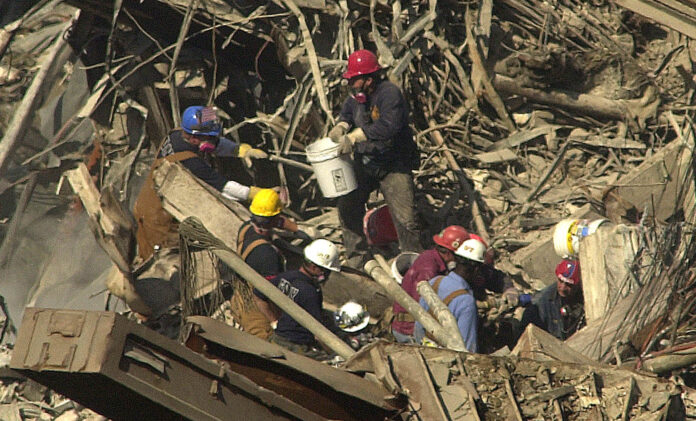 Vos Iz Neias1 day ago
NEW YORK (AP) — I stood amid the rubble of the World Trade Center, passing buckets of debris down a line of volunteers and first responders. It was hours after the Sept. 11, 2001, attacks. A little white object poking out of the gray ash caught my attention.
Scuffed and dirty, it was unmistakably a golf ball. And in that moment, it represented an incomprehensible loss that would take years, if ever, to process.
A person whose name I do not remember, most likely never knew, told me to not throw it out. We understood the significance of finding something personal in the acres of pulverized concrete and twisted steel. I set it near a mound of shredded metal thought to be pieces of the planes that were flown into the two towers.
People worked tirelessly through those first chaotic hours, frantically digging through what became known as “the pile” for any signs of life. We stood side by side with fellow New Yorkers, digging, doing whatever we felt would help, occasionally stopping as shouts for silence pierced the whir of activity. Early optimism quickly gave way to despair.
So little was recognizable that it was a gut punch when you came across something that suggested an individual had worked here: a torn photo, a paper weight, a shoe. Each artifact that surfaced told a never-discoverable story about someone gone. Each object, no matter now anodyne, had become a piece of American history.
For me, an avid golfer at the time, the golf ball hit especially hard. I imagined it with other balls in a jar on a desk, each with a different corporate logo stamped on it. This ball represented a moment I liked to believe brought someone a modicum of joy — a closed deal, inclusion in a fun scramble, maybe that one shot that kept the person thinking that breaking 90 was possible.
For duffers, golf is a mostly frustrating game. Yet it’s also about aspiration, friendship and camaraderie. Those were things that, in those days, were sorely needed. And that’s why finding a ball in the smoldering rubble still resonates 25 years later.
___
Howie Rumberg was the first Associated Press reporter on the scene at the World Trade Center after the Sept. 11, 2001, attacks. Part of a recurring series, “American Objects,” marking the 250th anniversary of the United States. For more American objects, click here.

 JBizNews
Related stories
 JBizNews1 month ago
 JBizNews1 month ago
 JBizNews2 months ago
 JBizNews3 months agoJBizNews1 day ago
The federal government’s annual budget deficit reached $2 trillion after the first 11 months of fiscal year 2026, the nonpartisan Congressional Budget Office (CBO) reported.
The CBO’s monthly budget update for August noted that the 11-month deficit total was $6 billion lower than the same period last year, though it explained that the difference was caused by shifts in the timing of certain payments around Labor Day in 2025 and that the current deficit would’ve been $82 billion more than last year’s shortfall if not for those shifts.
Federal spending has risen by $147 billion, or 2%, compared with last year, though CBO noted that figure would be an increase of $235 billion, or 4%, after accounting for those timing adjustments. Tax receipts are up $154 billion compared with the same period last year.
The increase in spending was driven mainly by mandatory spending programs – including Social Security, Medicare and Medicaid – as well as interest expenses incurred from servicing the national debt.
Spending on Social Security benefits rose by $78 billion, or 5%, from last year due to increases in average benefit amounts and the number of beneficiaries. Medicare spending rose $73 billion, or 8%, due to increased enrollment – while Medicaid outlays increased $47 billion, or 8%, due to higher costs per enrollee.
Interest expenses on the national debt increased by $111 billion, or 12%, because of the larger national debt relative to a year ago and because of higher long-term interest rates. Declines in short-term interest rates partially mitigated the overall rise in interest payments.
Other notable spending increases occurred within the Department of Veterans Affairs, which saw a rise of $41 billion, or 14%, due to more people receiving veterans’ benefits and higher spending per person; while the Department of Defense’s spending rose by $41 billion, or 5%, from a year ago due to higher spending on military personnel and research and development.
Spending by the Department of Education decreased by $79 billion, or 56%, though this was largely due to a reduction of $53 billion being recorded in the estimated costs of outstanding student loans in June 2026 after a $24 billion increase was recorded in July 2025.
CBO reported that tax receipts have risen 3% in FY2026, up $154 billion from a year ago. Individual income tax receipts rose $189 billion, or 8%, while payroll taxes increased $50 billion, or 3%, in the first 11 months of the fiscal year. Customs duties, including tariffs, were up $1 billion, or 1%, in that period.
Those tax revenue gains were partially offset by a decline of $96 billion, or 25%, in corporate income taxes due to 2025 tax reforms under the One Big Beautiful Bill Act.
Maya MacGuineas, president of the nonpartisan Committee for a Responsible Federal Budget, said in a statement that the federal government’s borrowing this year has surpassed what was borrowed in the entirety of last year, and may rise further in September, the final month of FY2026.
“Such extraordinarily high deficits are just one piece of our fiscal situation that is falling apart. The gross national debt recently hit the sobering milestone of $40 trillion; we’re now spending more on yearly interest costs than on our national defense; debt held by the public exceeds the size of our entire economy; and trust funds for programs that tens of millions of Americans rely on face insolvency in less than a decade,” MacGuineas said.
“It is clear that we have delayed the hard choices for far too long,” she added. “If lawmakers want to fix our laundry list of issues, they should come together and agree to a plan to target reducing deficits to 3% of GDP – half their current level – and get to work on shoring up our trust funds,” MacGuineas said. “If not, we risk leaving future generations with damage that can’t be undone.”
Related stories
JBizNews1 month agoJBizNews1 month agoJBizNews2 months agoJBizNews3 months ago JBizNews1 day ago
Texas is emerging as the newest battleground in the fight for corporate America.
As the Texas Stock Exchange lands commitments for its first major corporate listings, New York Stock Exchange President Lynn Martin is pointing to the Lone Star State’s “pro-business environment” as a major reason companies continue to flock there.
Martin joined FOX Business’ Cheryl Casone on “Mornings with FOX Business” to discuss the growing competition in Texas and the strength of U.S. capital markets.
The NYSE recently opened its NYSE Texas headquarters in Dallas, expanding its presence in a state where Martin said the exchange already has roughly 130 listed companies.
“We have about 130 listed companies with us, we’re extraordinarily excited about the opportunity in Texas as well as… The general pro-business environment that has really been created and fostered by Governor Abbott,” Martin said.
The expansion comes as the newly launched Texas Stock Exchange begins landing major corporate listing commitments, adding another player to a market long dominated by established exchanges. The development puts Texas at the center of a growing competition for public companies and capital.
Martin’s comments also come amid renewed momentum in U.S. capital markets, with more companies looking to tap public markets for funding.
“There’s a sense of optimism, there’s a sense of optimism that our markets are open. Our markets are incredibly strong, resilient, deep liquid, and there are more and more companies that are looking to tap the best form of capital, which is the form of capital that is available uniquely in our U.S. capital markets,” Martin said.
For the NYSE, the push into Texas positions the exchange to capitalize on the state’s growing corporate footprint while competing directly in an increasingly crowded market.
 JBizNews1 day ago
I think I speak for a lot of women when I say that when you’re eight months pregnant, all you want to do is sleep.
And when you work the hours that I was working on the morning of Sept. 11, 2001, you dream about sleep.
At the time, I was an anchor at CNBC working a split shift. I would get up at 3 a.m. ET, anchor the 5 a.m. to 7 a.m. premarket show, go home at 7:30 a.m., try to sleep for a few hours, then return to the studio in Ft. Lee, New Jersey, to anchor the 4 p.m. market wrap-up broadcast. Insane hours, I know.
But about a year earlier, when I was only helming the early morning gig, I jumped at the offer to reach a broader audience in the afternoon. The catch was that I could only have the 4 p.m. if I continued to work the pre-dawn show as well.
Just getting used to the crazy sleep schedule was hard enough, but when I got pregnant with my first child, it quickly became way more difficult. But I gamely plowed ahead. On Sept. 11, 2001, I was a month and a few weeks from giving birth.
After finishing the morning show on that sparkling September day, I headed home, lumbered into my apartment in Edgewater, New Jersey, right on the Hudson River, just a town away from the studio, closed the blackout curtains and was just drifting off when my then-husband, a senior producer at MSNBC, called me. “Turn on Channel 4,” he said. He sounded anxious.
I flipped on the TV and saw smoke pouring out of the North Tower of the World Trade Center. It looked like some idiot had flown a small plane right into the side of the building. “What the hell happened?” I asked. With a more urgent tone he said, “I don’t know, but I’ve gotta go,” and hung up.
I stared at the screen. The shot was from a live, unmanned camera affixed atop another downtown building. The towers bisected a crystal blue sky. Zero clouds. What happened?
Being a business news journalist, I knew a lot of my show guests worked in that tower. I was mentally ticking off who worked on which floor when suddenly a second plane, clearly a large passenger jet, plowed into the South Tower. Instinctively, my right hand flew to my belly and my left hand covered my mouth. I grabbed the phone and woke up my father on the West Coast. “Dad, turn on the news. NOW.”
My father, a surgeon and fully aware his daughter was eight months pregnant, took one look at the TV and immediately adopted his reassuring “doctor” voice. “Liz, I’m sure there’s an explanation for this. Whatever it is, I need you to be really calm, OK?”
“I am calm, Dad. But I’ve got to get back to the studio.” The newswoman in me was kicking in. I hung up and jumped back into my clothes, into the car and sped back to the office.
When I walked in, people looked shocked. Glancing surreptitiously at my stomach, my manager said, “Liz, if you want to go home, we understand. We’ll get someone else to do the show.” I was perplexed. We’re in the news business. The thought of not doing my job at a time like this literally never occurred to me. I thanked him and said, “No, I’m here. Have we figured out which Wall Street firms are on which floors?”
But I already knew the answer. Cantor Fitzgerald occupied the top floors of the North Tower. Huge staff. Fund giant Fred Alger Management was right below them on the 93rd floor. My chest tightened. My dear friend David Alger was their CEO. I silently begged. Please, PLEASE, David, tell me you’re not there.
Sandler O’Neill Partners was on the 104th floor of the South Tower. Co-founder Herman Sandler was a Wall Street legend. He’d be fine, right? Marsh & McLennan. Keefe, Bruyette & Woods. Euro Brokers. I knew people in both towers.
Whatever hope we had that friends had survived disappeared when both towers collapsed, enveloping lower Manhattan in that awful, sickening gray ash.
But I kept thinking, “Surely David Alger had led his troops down the stairwell before the collapse. That’s David.”
I envisioned him gripping a bullhorn, marching north on Broadway. He was larger than life with the best smile ever. I’d seen him just two weeks earlier when he had been a guest on the network.
I ran into him after that interview. “Liz!” he boomed, flashing that high-wattage smile. He looked down at my belly, put his hand gently on it, looked directly in my eyes and said, “You’re going to be the best mom.” David was the proud father of two daughters, so he knew from whence he spoke.
I would never see David again. He died on 9/11 along with 2,977 others in the towers, at the Pentagon and in Shanksville, Pennsylvania – all victims of the coordinated attack by the Al Qaeda terrorist group. I attended David’s funeral. His daughters were drenched in grief.
A month and two weeks later, still mourning him, Herman Sandler, and so many others, including the 658 innocent souls who worked at Cantor Fitzgerald, I felt contractions. My obstetrician’s office told me to come in. My doctor’s practice was in the city. They quietly ushered me past a pregnant woman staring blankly in the corner of the waiting room. I later learned her husband had been killed in the World Trade Center attacks. Twenty-five years later, I can still remember thinking, “How can I be happy right now? What kind of world am I bringing this child into?” Any joy felt inappropriate.
That night I gave birth to a healthy baby girl. Of course, I felt happiness, but it was tinged by an unseen gray veil of sadness. Trust me, all of us who were there on 9/11 felt the same way. I took comfort in knowing that all the letters in David’s last name – A, L, G, E and R are woven within the name we chose for our newborn: Gabrielle.
The darkness in the rotted hearts of those who stole lives and futures on 9/11 will never be understood, nor does that kind of evil deserve the effort. What does deserve effort is carrying on, reaching for the stars and living a good life while holding tight the memories of the 2,977 who didn’t get to continue theirs.
 JBizNews1 day ago
Former Federal Reserve Chair Jerome Powell has reportedly sold a waterfront Maryland estate for $7.2 million.
The six-bedroom, eight-bathroom home on Gibson Island changed hands in an off-market sale on Aug. 4, less than three months after Powell concluded his eight-year term as chair of the Federal Reserve, Realtor.com reported, citing public property records.
The 7,155-square-foot home sits on a two-acre waterfront lot overlooking the Magothy River, the outlet reported.
The home was not publicly listed on a multiple listing service, with the Baltimore Business Journal first reporting the sale.
Built in 2004, the shingle-style mansion features water views from nearly every main room, along with a waterfront swimming pool, stone terraces, a private pier with a boat lift and landscaped grounds, according to Realtor.com.
Powell purchased the property for $3.86 million in 2006.
The former Fed chair and his wife, Elissa Leonard, continue to own another home on Gibson Island that they purchased for about $3 million, Realtor.com reported.
The couple’s primary residence is in Chevy Chase, Maryland.
Powell concluded his tenure as Fed chairman in May, with Kevin Warsh succeeding him.
During his time leading the central bank, Powell frequently clashed with President Donald Trump over interest rate policy.
FOX Business reached out to Powell and Gibson Island Real Estate for more information.
 Matzav
Related stories
Matzav1 day agoIsraeli Prime Minister Bibi Netanyahu marked the 25th anniversary of the September 11 terror attacks on Friday by drawing a direct parallel between the atrocities committed in the United States on 9/11 and the Hamas massacre in Israel on October 7, declaring that America and Israel stand together against the same forces of terrorism and evil.
In a message commemorating the nearly 3,000 people murdered on September 11, 2001, Netanyahu recalled the innocent victims who left their homes that morning never imagining that they would not return.
“25 years ago, thousands of innocent people went to work in the World Trade Center in New York. They never came home,” Netanyahu said.
The Prime Minister said that the pain of such a devastating loss does not fade with the passage of time and emphasized that Israelis share in America’s remembrance of those murdered.
“For those who know such loss, it never leaves you. America remembers them. Israel remembers them.”
Netanyahu also honored the extraordinary heroism displayed by first responders and ordinary Americans as the attacks unfolded, including those who entered the burning towers and those who fought the hijackers aboard the planes.
“We remember the firefighters who ran up the stairs while everyone else was running down. We remember the police officers, the first responders, the passengers who bravely fought back on the hijacked planes, and we remember the evil that murdered them.”
Netanyahu then connected the attacks of September 11 to the October 7, 2023 massacre, when Hamas terrorists invaded southern Israel, murdering approximately 1,200 people and abducting more than 250 others into Gaza. Israeli law now formally refers to the events as the October 7, 2023 massacre.
“On September 11th, America was hit by pure evil. On October 7th, Israel was hit by it again,” the Prime Minister stated.
Netanyahu argued that acts of terrorism directed deliberately against innocent civilians cannot be excused or rationalized by pointing to political grievances or broader circumstances.
“There is no context for burning families alive. There is no grievance that justifies murdering innocents deliberately.”
“There is no ‘yes, but’ when it comes to terrorism,” he added.
The Prime Minister also pointed to the slogan “Death to America, death to Israel,” saying that the hostility directed toward both countries comes from the same ideological source.
“They hate both of us for the same reason, because America and Israel stand for freedom, for democracy, for civilization. For life.”
Netanyahu has repeatedly framed the October 7 massacre as an attack extending beyond Israel itself, portraying Israel’s fight against Hamas and the broader Iranian-backed terror axis as part of a larger confrontation between democratic societies and radical Islamist terrorism. In an address to President Donald Trump at the Knesset last year, Netanyahu similarly recalled the October 7 atrocities, including the murder of American citizens and the abduction of Americans into Gaza.
In Friday’s message, Netanyahu also singled out President Donald Trump, praising the President’s approach to confronting terrorism.
“Under President Trump’s leadership, America has shown once again that it stands up to terror.”
Netanyahu concluded by returning to the victims and heroes of September 11, saying that remembrance must include both those who were murdered and those who willingly placed themselves in danger to save others.
“So today, we remember. We remember those who were taken. We honor those who ran towards the flames.”
The Prime Minister ended with a joint message on behalf of Israel and the United States, declaring that neither country would allow terrorism to force it into submission.
“And America and Israel say together, we will never bow to terrorism. We will never surrender to evil. And together, we will defeat it.”
 Vos Iz Neias
Related stories
Vos Iz Neias1 day agoLONDON (AP) — U.K. lawmakers on Friday voted down legislation to allow terminally ill adults in England and Wales to choose to end their lives.
The Terminally Ill Adults (End of Life) Bill was opposed by 286 members of parliament, while 270 voted for it.
The vote brings an end to a two-year debate in Parliament about assisted dying.
On two previous occasions in 2024 and 2025, the elected House of Commons had backed the bill, but it didn’t become law because it was effectively filibustered by unelected lawmakers in the revising House of Lords chamber.
The bill had proposed allowing adults in England and Wales, with fewer than six months to live, to apply for an assisted death subject to the approval of two doctors and an expert panel.
The government took a neutral stance, saying it was a matter of conscience.
The new U.K. leader, Prime Minister Andy Burnham, didn’t vote because he said he didn’t want to “unduly influence the debate.”
Opponents branded the bill unsafe and unworkable, citing concerns around potential coercion of vulnerable people and a lack of safeguards for those with disabilities.
Lawmaker and cancer surgeon Dr. Zubir Ahmed also noted uncertainty around a doctor’s prognosis.
“I have to be honest with you,” he said. “When I am asked to prognosticate as to whether someone has six months to live or not, I am as often wrong as I am right.”
Proponents of “ assisted dying ” — sometimes referred to as “assisted suicide” — had hoped it would mark the biggest change to social policy in the U.K. since abortion was partially legalized in 1967. The intention was to put an end to the practice of those near the end of their lives going to other countries, such as Switzerland, for an assisted death.
Assisted suicide — where patients take a lethal drink prescribed by a doctor — is legal in countries including Australia, Belgium, Canada, Luxembourg, the Netherlands, New Zealand, Portugal, Spain, Switzerland and parts of the U.S., with regulations on qualifying criteria varying by jurisdiction.
In July, French lawmakers backed a similar bill to allow adults with incurable illnesses to receive lethal medication. However, it hasn’t become law, because there will be a review to determine if it complies with the French Constitution.
 The Lakewood Scoop1 day ago
 Matzav1 day ago
A public unveiling of a $100,000 statue honoring slain conservative activist Charlie Kirk descended into angry confrontations in Times Square on Thursday, as supporters and opponents of Kirk screamed at one another, shoved and scuffled amid a heavy police presence on the first anniversary of his assassination.
The 6-foot-5 sculpture was created by Italian-born New York artist Sergio Furnari, who said he intended the memorial to Kirk to promote free speech and dialogue rather than deepen political divisions. Instead, the unveiling quickly became another demonstration of the intense polarization that continues to surround Kirk and his legacy one year after he was murdered.
Video from the scene showed heated confrontations developing around the sculpture as Kirk supporters — including men draped in American flags — exchanged insults with protesters who had gathered to oppose the memorial.
The confrontations at times became physical. Footage showed people pushing and shoving, objects being thrown and individuals ending up on the pavement as police officers attempted to maintain order. At least one physical altercation was captured on video.
Opponents of the memorial shouted obscenities at the statue and made obscene gestures toward Furnari during the unveiling.
At another point, several young men stood in front of the sculpture with their hands raised while arguments continued around them. One Kirk supporter wearing an American-flag vest could be heard telling others to “calm down.”
Another man carrying a large American flag shouted about “Islamists” as protesters confronted him.
Police temporarily stopped traffic through part of Midtown Manhattan while the event was underway, as large numbers of spectators and protesters crowded into the Times Square area.
The statue itself depicts Kirk holding a microphone and wearing a T-shirt emblazoned with the word “FREEDOM,” an apparent reference to the campus debates and political activism for which he became nationally known.
Furnari said before Thursday’s unveiling that he considered the work broader than simply a tribute to Kirk.
“It’s a monument definitely to Charlie, but it’s even a monument to freedom of speech,” he told Fox News.
Furnari began working on the sculpture shortly after Kirk was shot and killed on September 10, 2025, while appearing at an outdoor event at Utah Valley University in Orem, Utah.
Kirk, 31, was answering questions before a large crowd when he was fatally shot. Prosecutors have charged Tyler Robinson with aggravated murder, alleging that Kirk was targeted because of his political views. Robinson has pleaded not guilty, and a Utah judge recently ruled that prosecutors may continue seeking the death penalty.
Furnari said the reaction to Kirk’s murder — and particularly what he regarded as a lack of sympathy toward Kirk’s widow, Erika, and his parents — motivated him to create the Times Square memorial.
‘I [saw] how Erika [Kirk] got treated, including the parents of Charlie, and that’s what I think became my catalyzer,’ he said.
Furnari emphasized that his decision to create the statue did not stem from agreement with everything Kirk had said or advocated.
‘If you’re a parent, no matter if you were Democrat or Republican, you should have a little bit of empathy.’
The sculptor said he had not considered himself a major Kirk supporter before the assassination and that his response was driven primarily by the killing and its aftermath.
‘It’s not like I agree with him. There’s a lot of stuff I didn’t agree with,’ Furnari said.
‘But still, freedom of expression and, in my case, freedom of creation — there are no boundaries, no borders. That’s where we kind of stand together.’
Furnari estimated that the project cost him ‘probably more than $100,000’ when the materials and extensive time devoted to creating it were taken into account.
He initially financed the sculpture with his own savings and subsequently launched an online fundraiser in an effort to recover some of the expense. Furnari has said donors to the project will have their names engraved on the statue’s platform.
As the project progressed, Furnari said, his determination to display the sculpture publicly increased because of the continuing mockery of Kirk following his assassination.
‘I became more passionate about it — just because of the way everybody was making fun of him,’ he said.
‘I feel like they killed him once, and they kill him each time, over and over again.’
Thursday’s confrontation in Times Square was just one of numerous events across the country marking one year since Kirk’s death.
At Utah Valley University, where Kirk was killed, classes were canceled Thursday as the school marked the anniversary. Turning Point USA organized a large memorial there, while a student group opposed to the organization planned a protest outside.
Kirk was also honored Thursday evening at the Republican midterm convention in Dallas. A memorial video was played for convention attendees, and Vice President JD Vance spoke extensively about Kirk during his keynote address, recalling their friendship and Kirk’s role in conservative politics.
Vance also addressed Kirk’s two young children, telling them that history would remember their father as both a significant political figure and a good man. Kirk’s widow, Erika, has assumed leadership of Turning Point USA since her husband’s death.
Turning Point USA itself has expanded considerably during the year since Kirk was killed. Reuters reported Thursday that the organization now has a presence at more than 3,500 high schools and 1,500 colleges, further entrenching the organization Kirk co-founded as a major force in conservative youth activism.
Other commemorations were organized around the United States and overseas, including gatherings in Kirk’s hometown of Arlington Heights, Illinois, at Turning Point USA’s headquarters in Phoenix and as far away as Australia and Britain.
But the Times Square scene demonstrated the other side of Kirk’s posthumous legacy. His supporters continue to regard him as an influential advocate for conservative ideas and open political debate, while critics remain strongly opposed to his political positions and rhetoric.
{Matzav.com}

 Yeshiva World News1 day ago
Prime Minister Benjamin Netanyahu issued a Rosh Hashanah greeting to President Donald Trump, his family and the American people, highlighting what he described as historic progress achieved by Israel and the United States over the past year.
“I want to wish President Donald J. Trump, his family, and the American people a Shana Tova—a happy and healthy New Year.
Over the past year, the United States and Israel have achieved historic progress together. Iran and its evil axis are weaker than ever, while the U.S.-Israel alliance is stronger than ever.
I congratulate President Trump on his blockade of Iran’s evil regime and on the economic pressure brought to bear against the world’s greatest source of instability.
The people of Israel stand with the people of the United States and with President Trump in confronting the forces of terror. In the year ahead, we will continue to make the world safer for all.”
(YWN World Headquarters – NYC)
 JBizNews1 day ago
At 9:15 a.m. Eastern Time today, oil was priced at $105.82 per barrel with Brent serving as the benchmark (we’ll explain different benchmarks later in this article). That’s an increase of 62 cents compared with yesterday morning and around $39.25 higher than the price one year ago.
Oil price per barrel
% Change
Price of oil yesterday
$105.20
+0.58%
Price of oil 1 month ago
$90.64
+16.74%
Price of oil 1 year ago
$66.59
+58.91%
It’s impossible to forecast oil prices with detailed precision. Many different elements affect the market, but ultimately it boils down to supply and demand. When worries about economic recession, war, and other large-scale disruptions increase, oil’s path can shift fast.
Gas prices at the pump don’t only track crude oil. They also include what it takes to refine and move that fuel, the taxes layered on top, and the extra markup your local station adds to stay in business.
Since crude oil generally makes up a majority of the per-gallon cost, changes in its price have an outsized impact. When oil surges, gas prices typically rise in tandem. But when oil retreats, gas prices often lag on the way down, a trend sometimes described as “rockets and feathers.”
In case of emergency, the U.S. has a store of crude oil known as the Strategic Petroleum Reserve. Its primary purpose is energy security in case of disaster (think sanctions, severe storm damage, even war). But it can also go a long way toward softening crippling price hikes during supply shocks.
It’s not a long-term answer and is more meant to provide temporary relief, assisting consumers and keeping critical parts of the economy running, like key industries, emergency services, public transportation, etc.
Both oil and natural gas are key sources of the energy we use every day. Because of this, a big change in oil prices can affect natural gas. For example, if oil prices increase, some industries may swap natural gas for some segments of their operations where possible, which increases demand for natural gas.
To gauge oil’s performance, we often turn to two benchmarks:
Between these two, Brent better represents global oil performance because it prices much of the world’s traded crude. And, it’s often the best way to track historical oil performance. In fact, even the U.S. Energy Information Administration now uses Brent as its primary reference in its Annual Energy Outlook.
Looking at the Brent benchmark across several decades, oil has been anything but steady. It’s seen spikes due to factors such as wars and supply cuts, and it’s also seen crashes from global recessions and an oversupply (called a “glut”). For example:
All to say, oil’s historical performance has been anything but smooth. Again, it’s hugely affected by wars, recessions, OPEC whims, evolving energy initiatives and policies, and much more.
Looking to stay up-to-date regarding the latest energy developments? Check out our recent coverage:
How is the current price of oil per barrel actually determined?
The current price of oil per barrel depends largely on supply and demand, including news about potential future supply and demand (geopolitics, decisions made by OPEC+, etc.). In the U.S., prices also move based on how friendly an administration is to drilling, as it can affect future supply. For example, 2025 saw the Trump administration move to reopen more than 1.5 million acres in the Coastal Plain of the Arctic National Wildlife Refuge for oil and gas leasing, reversing the Biden administration’s policy of limiting oil drilling in the Arctic.
How often does the price of oil change during the day?
The price of oil updates constantly when the “futures” markets are open. A futures market is effectively an auction where people agree to buy or sell oil in the future. As long as people and companies are trading contracts, the oil price is changing.
How does U.S. shale oil production affect the current price of oil?
In short, shale is rock that contains oil and natural gas. Think of shale as energy yet to be tapped. The more shale the U.S. accesses, the more energy we’ll have—and the more easily oil prices can keep from spiking as much thanks to a greater supply.
How does the current price of oil impact inflation and the broader economy?
When oil is expensive, it tends to make everyday items cost more. This can be related to energy (your heating, gas utilities, etc.), but it’s also due to the logistics involved with making those items accessible to you. Shipping, for example, can affect the price of things at the grocery store, as it’s more expensive to get those products from warehouses and farms onto the shelf.
This story was originally featured on Fortune.com
 Matzav1 day ago
George W. Bush warned that a quarter-century after the September 11 terror attacks, Americans risk forgetting one of the central lessons he drew from that day: threats developing overseas can ultimately endanger the United States at home.
Speaking publicly about 9/11 ahead of the 25th anniversary, the 43rd president argued against an isolationist approach to foreign affairs and said America cannot assume that events beyond its borders have no consequences for its own national security. Bush made the remarks during a special program at his presidential library in Dallas alongside Condoleezza Rice, who was his national security adviser on September 11, 2001, and later served as secretary of state.
“Our nation occasionally goes through isolationist periods, where the attitude is, ‘Well, we’ve got too many problems at home. Therefore, who cares about what happens overseas?'” Bush said. “Which really means to me they just don’t pay attention to the lessons of 9/11, because what happens overseas matters to our national security at home.”
Bush said the United States should also support people seeking freedom from oppressive governments, although he stressed that such support does not necessarily require American military intervention.
“We don’t have to send troops,” Bush said. “We ought to at least stand with them and stand beside them because this is what we went through 250 years ago. And again, it’s a belief that everybody wants to be free and we saw that in Afghanistan.”
Afghanistan became the first major battlefield of the American response to September 11. Bush launched the war there following the attacks, targeting Al-Qaeda and the Taliban government that had harbored it. The United States subsequently supported the establishment of a new Afghan government, but the conflict continued for two decades. American forces withdrew in 2021, and the Taliban rapidly returned to power.
Bush rejected the contention that Afghans who experienced the intervening years of greater freedom did not understand what they had gained — and subsequently lost.
“Of course they know the difference,” Bush said. “Young girls going to school for the first time in their lives know the difference. Women becoming doctors and professors know the difference between a free society and a tyrannical society. And sadly, these women who begin to realize their full potential no longer have a chance to realize their full potential.”
Much of Wednesday’s conversation focused not on subsequent wars or foreign policy, but on the extraordinary hours of September 11 itself and the decisions Bush and his senior advisers were forced to make as the attacks unfolded.
Bush recalled being at Emma E. Booker Elementary School in Sarasota, Florida, when his chief of staff, Andy Card, approached him and quietly informed him that a second aircraft had struck the World Trade Center and that America was under attack.
In that instant, Bush said, his presidency fundamentally changed.
“I became a wartime president,” Bush said. “This was a war, and that the job of the president and the country and his team is to rally the nation and to do what’s necessary to protect our people.”
Bush had been less than eight months into his presidency when Al-Qaeda terrorists hijacked four commercial airliners on the morning of September 11, 2001. Two were flown into the Twin Towers in Lower Manhattan, another struck the Pentagon, and United Airlines Flight 93 crashed near Shanksville, Pennsylvania, after passengers and crew members fought back against the hijackers.
Bush and Rice recalled the enormous uncertainty inside the government that morning, when authorities had no way of knowing how many aircraft had been hijacked or where another attack might occur.
Suddenly, Rice recalled, virtually every commercial airplane in the sky had to be viewed as a potential weapon.
With authorities ordering aircraft across the country to land, Transportation Secretary Norman Mineta was attempting to keep track of the unprecedented operation using a legal pad.
Amid the confusion, senior officials briefly feared that the U.S. military itself might have shot down Flight 93. It was subsequently determined that the aircraft crashed after passengers attempted to overpower the terrorists.
“There was this horrible moment where the vice president kept trying to get confirmation as to what had happened, and for about 10 minutes, we thought we’d shot down a civilian aircraft,” Rice said. “And that always to me represented just how hard the decisions that you had to take under a lot of pressure.”
The uncertainty did not end when the attacks were over. Rice has recalled that the threat information confronting the administration exploded almost immediately, as officials scrambled to determine whether additional terrorist operations were underway.
Bush said that while he understood immediately that the country had suffered an enormous trauma, he did not fully grasp the magnitude of the devastation in New York until he saw Ground Zero himself.
He “had a sense there was a lot of trauma,” Bush recalled, but didn’t realize “how bad it was ’till I went there.”
Three days after the attacks, on September 14, Bush traveled to the wreckage of the World Trade Center, where firefighters, police officers and rescue workers were still searching through the ruins.
It was there that Bush delivered one of the defining moments of his presidency, standing atop the rubble beside retired FDNY firefighter Bob Beckwith and addressing rescue workers through a bullhorn.
Looking back 25 years later, Bush said his concern was not only preventing another attack but ensuring that fear and anger did not fundamentally change the character of the country.
“I didn’t want us to lose our soul,” Bush said. “I wanted, as we defended our freedoms, I wanted people to remember how precious they are.”
That concern, Bush said, was also behind his decision to visit the Islamic Center of Washington just days after the attacks.
He recalled making the visit “because I was deeply concerned about stories of women of color being harassed at shopping centers, particularly in Michigan.”
Bush said he viewed the fight against terrorism as an ideological struggle and believed abandoning religious freedom in response to the attacks would itself constitute a defeat.
“It became clear to me that this is an ideological struggle, which is what I viewed it as, and we forego one of the most important parts of our ideology, which is the freedom to worship the way you want to worship,” he said. “All of a sudden, the enemy has won a victory, and so that was part of my thinking.”
Bush and Rice also described the dramatic change in mindset inside the administration from September 11 to what they called a “Sept. 12” mentality.
The priority was no longer simply responding to what had happened, they said, but identifying threats and stopping another catastrophic attack before it could occur. Bush said “we needed to go on the offense.”
Rice said it can be difficult, 25 years later, for Americans who did not experience that period to appreciate the enormous pressure surrounding virtually every national-security decision.
“People now don’t understand the heaviness of the days after 9/11 in trying to protect the country,” Rice said.
That passage of time itself has become part of Bush’s concern. A substantial portion of the American population was either not yet born or too young to remember September 11, and Bush said Wednesday that preserving the memory of the sacrifice, courage and national response that followed the attacks is increasingly important.
Twenty-five years later, Bush said, the events of September 11 still carry lessons about national security, freedom and America’s relationship with the rest of the world — lessons he fears the country is increasingly inclined to overlook.
 Vos Iz Neias1 day ago
(AP) – When children forget their lunch, can’t solve a math problem or don’t know how to get somewhere, the instinct for parents can be to step in immediately. But sometimes, the problem is an opportunity.
Developmental experts and educators say children need chances to struggle with everyday problems because figuring them out is a skill that has to be practiced.
The challenge for parents is knowing when to help and when to step back. There is a difference between helping children through difficult situations and removing the problem before they have a chance to try. At a time when an answer or AI-generated help can be seconds away, giving children room to figure things out for themselves can be hard to do.
What independence looks like depends on a child’s age, abilities, and circumstances, but experts say it means learning to plan, make decisions, solve problems, recover from mistakes and figure out what to do next. Here’s how experts say parents can give children more opportunities to practice those skills.
Pause before stepping in
Children have unprecedented access to information, while technology has given parents more ways to monitor their kids’ lives. They can track their children’s locations, see grades in real time, and email teachers immediately. That means parents can intervene before their children have had a chance to realize there is a problem, let alone figure out a solution.
There is a downside to that convenience, said Dr. Dana Suskind, a professor of surgery and pediatrics at the University of Chicago and author of the book “Human Raised.”
“I think the most important thing we can give children is not the answer, but the experience of figuring it out,” Suskind said. When parents swoop in, she said, children are deprived of opportunities to practice skills like pausing before acting, remembering what worked previously, and trying new solutions.
If children rarely have to struggle, it can lead to severe anxiety when they have to figure out something on their own, said Dr. Stephanie Carlson, director of the Institute of Child Development at the University of Minnesota.
When there is a real danger, parents should step in, but when stakes are lower, they can slow down and talk through the problem. That could mean asking children open-ended questions: What do you think? What could happen? How could you solve this? What else could you try?
Allow children to experience boredom
Allowing children to be bored, frustrated, impatient or nervous can support their learning and better prepare them for adulthood, experts say.
Boredom can facilitate creativity and play while helping children build confidence and resilience, said Kiryn Hoffman, CEO of the National Children’s Museum in Washington, D.C.
In “10 Rules for Raising Kids in a High-Tech World,” psychologist Dr. Jean Twenge writes that children and teens have fewer opportunities than previous generations to spend time with friends, get around on their own and make decisions outside the watchful gaze of adults. By their senior year of high school, fewer teens have a driver’s license, go on dates or work paid jobs than in previous generations, she writes.
Give children a little more to handle
Parents don’t have to manufacture situations for children to navigate. Routine tasks naturally provide children with opportunities to practice agency, experts say.
Nicole Knoth, a mother of two teen girls in Flagstaff, Arizona, started giving her daughters small decisions to make when they were young. At age 5, for example, she would give them $5 at a store and have them calculate what they could afford, including tax and discounts. Now, as teens, they are grocery shopping and her oldest is managing her own credit card.
Jemia Cunningham-Elder, a mother of four daughters in Chicago, learned there isn’t a set age for when children should be expected to do something on their own. She looks at what each child can handle, then gives them a little more freedom and watches what happens.
If they manage it, they get more independence. If they struggle, she considers whether it was a useful learning experience or a sign they weren’t ready yet.
That approach also recognizes something important: independence doesn’t mean doing everything alone.
Children who realize they don’t know how to solve a math problem and ask the teacher for help are practicing independence, too. So are children who forget their assignments and figure out how to find the information rather than having parents call their teachers.
Know when to step in
The same approach doesn’t apply to every situation. Parents have to weigh safety, maturity and circumstances.
Caroline Chirichella, a 37-year-old mother who lives in the Campania region of southern Italy, had been trying to give her 8-year-old daughter, Lucia, more freedom. But she hesitated to let her spend time outside with friends on her own because of concerns about traffic in the street.
There are other situations where the stakes are lower.
Chirichella said she and her husband eventually stopped calling other parents or teachers when Lucia forgot to write down an assignment. She told her daughter: “Your homework is your responsibility.”

 Boropark24
Related stories

 RocklandDaily1 day ago
 Williamsburg 3651 day ago
 Daily Monroe1 day ago
 Boropark242 months agoBoropark241 day ago
By Y.M. Lowy
Today will be warm with a high of 82° and a low of 67°. Some clouds will pass through, but sunshine will break through for much of the day.
Shabbos will be a bit cooler with a high of 78° and a low of 72°. Expect some sunshine early, giving way to increasing clouds.
Sunday will be humid with a high of 80° and a low of 69°. Occasional rain and a thunderstorm are possible in the morning, followed by periods of clouds and sunshine in the afternoon.
Related stories
RocklandDaily1 day agoWilliamsburg 3651 day agoDaily Monroe1 day agoBoropark242 months ago The Lakewood Scoop1 day ago
Leading Gedolei Yisrael are calling upon Klal Yisrael to partner with Vaad Harabanim in supporting widows, orphans and struggling families throughout Eretz Yisrael. They are asking each person to contribute $600, or $50 a month for 12 months. May this tremendous zechus bring donors and their families health, parnassah, nachas and great yeshuos.
SPECIAL GIFTS: $360+ — Beautiful silver knife, a well-known segulah for abundant parnassah | $600+ — Special Shtar Chaim signed by the Gedolim + the silver knife
SHTAR CHAIM SIGNED BY:
Rav Moshe Hillel Hirsch shlita
Rav Dov Landau shlita
Rav Elimelech Biderman shlita
Rav Dovid Cohen shlita
Rav Reuven Elbaz shlita
The Rachmastrivka Rebbe shlita
Related stories
 Matzav1 day ago
President Donald Trump turned the closing night of the Republican midterm convention in Dallas into an unusual mass voting pledge Thursday, instructing thousands of supporters to raise their right hands and swear that they would cast ballots in the Nov. 3 elections.
The moment came as Trump made voter turnout a central focus of his closing appearance at the American Airlines Center, repeatedly urging his supporters to treat the midterms as though his own name were on the ballot. Republicans are seeking to retain control of Congress, and Trump has made mobilizing voters who typically turn out for him in presidential elections a major theme of the convention.
Trump told the audience that the stakes of the election extended to his administration’s agenda, warning that Democratic control of Congress could threaten policies enacted since he returned to the White House.
“So on election day, November 3, you’ve got to do me a favor. You’ve got to get out and vote and you’ve got to pretend I’m on the ballot because in a way I am on the ballot, because if they get in, they are going to take away all of the things that we’ve got, and we can’t let that happen.”
Trump has repeatedly employed the “pretend I’m on the ballot” message during the 2026 campaign, reflecting Republican concerns about reproducing the coalition and turnout that helped elect him in 2024 when he himself is not running.
The President then turned to election laws, repeating his longstanding calls for voter identification and proof-of-citizenship requirements while accusing Democrats of opposing such measures because they “want to cheat.”
“In many cases, look, they don’t want to give you voter I.D. Why? Because they want to cheat,” he said.
“They don’t want to give you proof of citizenship. Why? They say well it’s very complicated process. They have more lines. We want voter I.D. We want proof of citizenship. We want honesty in our elections. We want honesty in our country.”
Democrats dispute Trump’s characterization of their position and his allegations of widespread election cheating. Disagreements over proof-of-citizenship and identification requirements have become a significant partisan issue, with supporters arguing that such rules strengthen election integrity and opponents warning that some proposals could unnecessarily prevent eligible citizens from voting.
Trump then shifted into a more theatrical mode, asking the entire audience to raise their right hands and repeat a pledge after him.
“Please raise your right hand,” the President instructed.
What followed mixed a serious turnout appeal with jokes and improvisation as Trump had the crowd repeat his words.
“TRUMP: So please raise your right hand. I pledge —
“CROWD: I pledge.
“TRUMP: To the greatest president in the history of the United States —
“CROWD: To the great president in the history of the United States.
“TRUMP: That loves us so much he can’t even breathe.
“CROWD: That loves us so much he can’t even breathe.”
Trump continued by having attendees pledge to bring relatives and friends with them to vote, while joking about cheating and voting without being registered.
“TRUMP: That I will go out with my family, my friends, I’ll do it any way, I don’t care if I’m registered or not, I’m going to try to cheat like hell like they do. There has never been bigger cheaters, they don’t care, I am going to go out and I’m going to get my friends and family and we are going to vote on November 3, or we are going to vote before that. Right?”
The remark about voting while unregistered was made in the context of Trump’s joking pledge; under election law, a person must satisfy the applicable registration requirements in order to cast a valid ballot.
Before finishing the pledge, Trump turned his attention to some of his longtime supporters near the front of the arena.
“Okay. Ready? Ready? Here’s — okay. Are you ready?
“Look, Front Row Joes, are you ready? The — look at them. The great ladies of north Carolina. It’s about number 300, I don’t know how the hell they do it. They are beautiful.
“Okay. Are you ready? Ready? To finish the pledge. So we swear”
The audience responded: “We swear.”
Trump then delivered the central portion of the pledge.
“That on November 3, we’re going to go out and vote and, you know what?
“If you want, you can vote Democrat, but I don’t think there is one person in this room that’s gonna vote democrat. I don’t think so. So I don’t want to waste the words vote Republican, just go out. If you vote you’re voting Republican. OK. So help me God.”
The crowd repeated: “So help me God.”
Trump appeared pleased with the volume of the response.
“Whoah. Now I know. I’d say just about everybody was screaming —”
He then added another joke aimed at making sure his supporters actually followed through in November.
“You know what happens if you don’t vote right? You go to hell, you know that. You go to hell. And I don’t want that to happen to you so please go and vote!”
The audience subsequently broke into chants of “Vote! Vote!”
The mass pledge capped two days in which Trump repeatedly sought to place himself personally at the center of the Republican turnout effort. On opening night, he similarly told supporters to act as though he were running again, saying, “I’m asking you to pretend that I’m on the ballot.”
Republicans have organized their midterm strategy around retaining their congressional majorities, while Democrats are seeking to gain control of Congress and have campaigned against the Trump administration’s record and policies.
Trump’s closing remarks followed Vice President JD Vance’s keynote address and concluded the Republican Party’s unusual two-day midterm convention, an event designed to energize the party ahead of Election Day.
The President had promised that his second-night appearance would be considerably shorter than his lengthy opening-night address. His remarks nevertheless featured an extended series of appeals for turnout, including the crowd-wide pledge.
And as the convention reached its conclusion, Trump left his supporters with the message he had emphasized throughout the gathering: whatever else Republican voters do between now and November, he wants them at the polls.
 Yeshiva World News
Related stories
 Yeshiva World News1 day ago
 Israel National News2 days ago
 Yeshiva World News2 days ago
 Yeshiva World News2 days agoYeshiva World News1 day ago
More than 60,000 Yidden from around the world have arrived in Uman, Ukraine, for Rosh Hashanah, marking what organizers say is one of the largest gatherings in the city in years.
Tens of thousands participated on Erev Rosh Hashanah in the massive Tikkun HaKlali near the Tzion of Reb Nachman of Breslov, filling the surrounding streets as the gathering reached numbers not seen since before the COVID pandemic.
Behind the scenes, Ichud Breslov established an extensive command-and-control operation to monitor the enormous crowds. Dozens of closed-circuit cameras cover the area surrounding the Tzion, with live feeds displayed inside a central command center. Emergency and security officials are stationed there to monitor crowd density and respond immediately should an emergency arise.
Ichud Breslov chairman HaRav Nosson Ben Nun remained inside the command center during the Tikkun HaKlali together with senior emergency officials, including Oz Avizov, director of ZAKA’s resilience division.
Following the event, HaRav Ben Nun said organizers were pleased with the massive Tikkun HaKlali gathering, which was the largest since before the COVID pandemic, and were now turning their attention to Rosh Hashanah itself, when tens of thousands will remain in Uman.
He said that more than 60,000 people from around the world had arrived in Uman this year.
The extraordinary turnout comes despite the continuing war in Ukraine and the complicated journey required for travelers reaching Uman through neighboring European countries.
(YWN World Headquarters – NYC)
Related stories
Yeshiva World News1 day agoIsrael National News2 days agoYeshiva World News2 days agoYeshiva World News2 days ago Matzav1 day ago
WATCH LIVE: Thousands are gathering to remember the lives lost on Sept. 11, 2001. Watch the reading of the victims’ names as the nation marks 25 years since the attacks.
 Vos Iz Neias1 day ago
(AP) – The sprawling snack-food factory in upstate New York appeared to be closed when a small army of immigration officers arrived after 9 a.m. Following a brief discussion of whether to force their way inside, a manager opened the front door.
Over the next several hours, body cameras were running as federal authorities from several agencies made 57 arrests, debated which files to seize and when to release employees who were U.S. citizens. They also searched for anyone in hiding.
The footage from September 2025 shows the raid at the Nutrition Bar Confectioners plant in Cato, New York, a town of 2,500 people east of Syracuse, and offers a rare glimpse inside a workplace immigration sweep. The Associated Press analyzed the video, which was part of a lawsuit filed Thursday that accuses authorities of overstepping their search warrants.
The officers ordered a manager to announce their presence over loudspeakers while they entered the building and caught employees on the production line, in the warehouse and a few in the bathroom. Officers covered all exits while others swept the interior, including homing in on locked doors.
Male officers encountered a locked bathroom and began shouting instructions in broken Spanish at female employees through the door, demanding that they come out. After about 10 seconds, officers broke through the door.
One woman was outside of a stall and another in the stall. A male officer peered through a locked stall door, and his body cam video revealed a woman sitting on the toilet.
“Miss, pull up your pants. Come out of the bathroom,” he told her.
“You have to wait. I can’t come out like this, naked!” she replied.
Investigators interviewed the general manager and said they were looking into hiring practices and potential fraudulent documents. Inside and outside the building, officers checked every office, storage room and hallway for anyone who was hiding.
Employees were lined up and separated into groups of U.S. citizens and potential noncitizens. Officers asked for their immigration status, requested documents and posed questions about their entry into the U.S. Some employees were pregnant.
Some were parents and expressed concern for their children at home. Others said they would not answer questions without first speaking to their attorneys, and officers told them they would be arrested.
One employee refused to answer questions. “Will you let me talk to my attorney?” she asked the officer. He raised his voice and continued asking about her immigration status.
U.S. citizens were asked for personal information, including their phone numbers and addresses before they were allowed to leave.
A Border Patrol agent who spoke to another official wearing a camera used disparaging language about children from other countries when recounting his experience working at a South Texas immigrant detention center. He said President Joe Biden’s administration allowed millions of people to enter the United States from countries where children are treated “differently” than they are by American parents.
“In other countries, kids are more of a commodity or it’s more of like, I’m going to put it in those terms. It’s more like an animal, right? It’s not prized the way that we do it,” he said.
“There’s countries like Brazil and other places where they’re literal street rats at a very young age who commit crimes, and then they come here. I don’t know if you have kids, but they’ll eat our kids for breakfast.”
Homeland Security did not immediately respond Thursday to a request for comment on the video footage or the lawsuit.
Not all officers wore body cameras, but those who did often indicated to other officers that they were recording before they initiated a conversation.
ICE’s Homeland Security Investigations unit is responsible for workplace raids, which have been relatively few and low-key compared to ICE’s removal unit, which arrests people in the street, at homes and in public and also manages detention centers. The Trump administration’s largest workplace raid was last year at a Hyundai electric vehicle plant in Georgia. It resulted in nearly 500 arrests and fueled diplomatic tension with South Korea.
The lawsuit against Homeland Security claims federal officers exceeded the authority of their warrants and violated workers’ constitutional rights against unlawful search and seizure.
“There were no arrest warrants,” said Perry Grossman, a supervising attorney at the New York Civil Liberties Union, which filed the lawsuit with the Worker Justice Center of New York.
“There was no suspicion that individual workers had committed crimes. And they seized easily 100 people for nonconsensual questioning. They arrested 57. Out of those 57 people, criminal charges were brought against only five. And the most serious charge was unlawful reentry.”
Grossman said one employee got her charges dismissed after contending in a lawsuit that her Fourth Amendment rights were violated. He said he was not aware of any charges or indictments against the employers.
Officers detained about 60 people and deported some employees, including two plaintiffs who are part of Thursday’s lawsuit. One plaintiff has since been allowed to reenter the country. Attorneys for the second deported plaintiff are seeking his return.
Law enforcement agencies have come under criticism for not using body cameras and for refusing to release footage when they do. ICE, in particular, has been scrutinized after a $75 billion infusion from Congress and an expanding street presence that has led to three fatal shootings this year.
ICE’s own rules on releasing video are unclear. Its policy calls for expedited release of footage after a serious injury or death in custody when doing so is determined to be in the “ best interests of the agency.”
The Trump administration has repeatedly promised to equip ICE field agents with body cameras, as required by Congress. Homeland Security Secretary Markwayne Mullin said last week that the agency was “on track” to do so by the end of September.
 Yeshiva World News1 day ago
As we approach Rosh Hashona, Bobbie’s Place offers an unbeatable deal. With just one click, you get the zechus of tzedakah and chesed as we enter the Yemei Hadin. You get the merit of bringing joy to a mother whose financial struggles precludes her from buying Yom Tov clothing for her children. And you bring simchas Tom Tov to the more than 12,000 children and teens who receive their Yom Tov clothing from Bobbie’s Place.
Bobbie’s Place is the store without a cash register that provides beautiful new clothing to thousands of families in our neighborhoods. And they do it in such a dignified way. Every child who visits Bobbie’s Place leaves not only with beautiful new clothing but also a beautiful experience. They have confidence, dignity and self-esteem.
Your donation is used to purchase clothing for children who need them. Bobbie’s Place has no paid staff, no mortgage or rent and no marketing or pr budget. Every dollar contributed provides $3 worth of clothing to a family that needs assistance.
$3 in assistance for every dollar donated. Three zechusim for each contribution.
DONATE NOW to grab this deal before Rosh Hashanah.
See the video below to see what the Roshei Yeshiva say about Bobbie’s Place
 The Lakewood Scoop1 day ago
A Toms River man was killed in a crash on the Garden State Parkway in Tinton Falls Thursday afternoon, State Police tell TLS.
Officials identified the victim as Mark Edgell, 57, of Toms River.
According to Police, Edgell was traveling southbound in a Nissan SUV near milepost 103.1 when the vehicle struck a guardrail, ran off the roadway to the left and then struck a tree. No other vehicles were involved in the crash.
Edgell sustained fatal injuries in the crash.
The crash remains under investigation.
 The Lakewood Scoop
Related stories
The Lakewood Scoop1 day agoAs the United States marks the 25th anniversary of the 9/11 attacks, the deadliest attack ever on American soil, Lakewood Township lowered its flag to half-staff to honor the 2,977 innocent men and women who lost their lives that fateful day.
In addition to honoring the devastating number of civilians who perished on 9/11, Township officials highlighted the heroism and sacrifice of the emergency services personnel who lost their lives while saving countless others.
In total, 343 NYC firefighters, 60 NYPD and Port Authority police officers, and eight EMS personnel, among other law enforcement officers, paid the ultimate price that day. Countless other personnel suffered long-term health damage and premature death as a result of their work at Ground Zero.
“It seems so long ago that America suffered this historic attack, and at this crucial anniversary, it is imperative that we, as Americans, educate those who were not alive when this happened as to what occurred that day,” says Lakewood Police Department Chief Gregory Meyer.
“We need to keep the memory of the heroic police officers and other first responders, among thousands of innocent civilians, alive and continue to recognize their sacrifices!”
“A quarter of a century has passed, but our promise to ‘Never Forget’ has not faded,” says Lakewood Fire Department Chief Jonathan Yahr.
“The sacrifice of our fallen brothers and sisters reminds us daily of the profound responsibility we accept when we wear this uniform. Here in Lakewood, we remain steadfast in our commitment to protect our community and to uphold the values of selflessness, brotherhood and dedication that defined the heroes of 9/11.”
“The magnitude of September 11 has forever changed our nation, our communities and the families who continue to carry the pain of losing loved ones,” says Lakewood EMS Chief Crystal Van de Zilver.
“As I reflect on September 11th, I am reminded of the countless heroic actions from our fellow first responders who selflessly ran toward danger without hesitation, demonstrating extraordinary courage in the face of unimaginable devastation. May we continue to share their stories and honor their service.”
“On September 11th, America saw thousands of innocent lives lost and countless family members and friends left with shattered hearts for life,” says Township Committeeman and Emergency Services Liaison Meir Lichtenstein, who serves as a longtime volunteer EMT.
“At this solemn juncture, we pay special tribute to the over 400 men and women who did what emergency services personnel do every day: put the lives of others ahead of their own and paid the ultimate price as a result. No doubt, their legacy of service and sacrifice is remembered and will inspire American heroes for generations to come.”
 JBizNews1 day ago
Stablecoins have made it exceptionally easy to move money across borders instantaneously. The problem that remains for users, especially those in emerging markets, is getting those funds to their preferred local payment methods. Texas-based global payments infrastructure company Latitude aims to change this by giving businesses the infrastructure to use stablecoins to send local currency through familiar methods, such as bank accounts and mobile wallets.
Cofounded by industry veterans Cyril Mathew, Brian Wrightson, and Vivek Morzaria—their collective resumés include stops at well-known names like Stripe, Uber, Coinbase and Meta—Latitude announced Wednesday that it raised $35 million in a Series A round. Oak HC/FT, a venture and growth equity firm, led the round, with participation from NEA, Coinbase, Lightspeed Faction, and OpenFX. The Series A follows Latitude’s $8 million seed round. Mathew, the startup’s CEO, did not disclose the company’s valuation in an interview with Fortune.
“There’s a number of neobanks that are trying to build financial services apps for users across the world. Those end users need ways to get in and out of stablecoins. That neobank can try to do that in 80 countries, or they can plug into Latitude,” Mathew said.
Besides neobanks, Latitude serves businesses including payroll platforms, marketplaces, and financial firms that need to move money across borders. It aims to expand beyond the U.S. by obtaining its own regulatory licenses in Southeast Asia, Latin America and Africa, where many stablecoin companies have yet to establish a presence.
Mathew’s passion for cross-border payments began during his decade in Europe, where he led international payments at Uber. The experience that stuck with him was a conversation he had with an Uber driver in London who was trying to remit his wages to Morocco. When Mathew asked how he did it, the driver said he handed a bag of cash to a middleman and that, after a 20% cut, the money would arrive in Morocco.
Later, when Mathew joined Stripe, his team launched stablecoin payouts in 100 countries, but adoption was limited. Users in markets including Vietnam and countries across Africa said they needed money they could spend locally, not stablecoins. Many also balked at downloading crypto wallets and managing seed phrases. He realized stablecoins would have limited use unless recipients could easily convert them into local currency in bank accounts or digital wallets.
In late 2024, while taking a short break from the industry to figure out his next move, Mathew pitched the idea of Latitude to Wrightson, who was still working at Stripe. He then did the same with Morzaria. By January 2025, the three had begun raising Latitude’s seed round.
Today, the company has a 15-person team, with shared office spaces in New York, San Francisco, and London.
Latitude plans to use the latest funding to hire in compliance, engineering, legal, and sales. It also intends to maintain its licenses across 45 U.S. markets and pursue direct licensing globally.
“When you talk to these large enterprises, they want to work with players that are regulated in the U.S. because it provides a level of certainty and trust,” Oivind Lorentzen, a partner at Oak HC/FT, told Fortune. “That’s really important when you’re moving money.”
This story was originally featured on Fortune.com
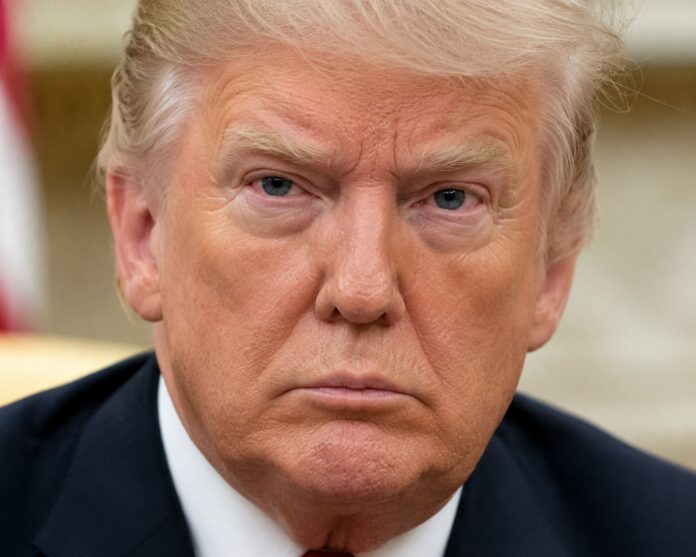 Matzav
Related stories
Matzav1 day agoPresident Donald Trump lashed out at members of the media Thursday night for highlighting empty seats at the Republican midterm convention in Dallas, insisting that the two-day gathering drew an overflow crowd and accusing journalists of deliberately searching the arena for vacant spots to photograph and report on.
The dispute over attendance became an unexpected theme of Trump’s closing appearance at the American Airlines Center, after several news organizations reported that substantial portions of the arena — particularly its upper levels — remained unoccupied during portions of the convention. The Wall Street Journal reported that the upper deck was nearly empty on Wednesday and that there were no large lines outside the arena. Other reporters at the event also documented blocks of vacant seats.
Trump disputed those accounts from the stage Thursday.
“No empty seats!” Trump announced to the crowd in Dallas, Texas, on Thursday. “The fake news, they searched the arena. There are thousands of people outside. They searched the arena for a seat. That’s why last night I said, ‘Please, don’t get up to go to the bathroom! Just sit.’”
The President then sharply criticized the journalists who had focused on the attendance issue, while making an exception for some members of the press.
“They’re fake people,” Trump said of reporters covering the matter. “They’re fake, horrible, horrible human beings. Not all. Not all. You have some fine journalists. Not too many — to be honest with you.”
The disagreement began during Wednesday’s opening night, when Trump repeatedly characterized the American Airlines Center as packed and said additional supporters were waiting outside. Journalists present at the venue reported a different picture, with visibly empty sections remaining during the program.
“We were packed last night,” the president reiterated. “We had thousands of people outside.”
No official attendance figure for the convention has been released by the Republican National Committee, making it difficult to independently establish precisely how many people attended either night. Photographs and reports from inside the arena, however, showed that portions of the seating remained vacant at various points.
The RNC had opened ticket applications to the public ahead of the event. According to reports from the convention, ticket requests were still being accepted and approved after the gathering had already begun Wednesday. Organizers were also observed encouraging people inside the building to move into available seats closer to the convention floor.
On Thursday, Trump sought to make his case visually, directing the crowd’s attention toward the arena’s seating areas and pointing to boxes that he said were full.
But while surveying the building himself, the President spotted an area that was not filled.
“I’ve got to do a little bit better in the back right there. I don’t like that little bit of skin that’s showing. I’m not happy with it. That’s not good. I shouldn’t have looked up there! No, but look at this arena. This is a big arena.”
The attendance controversy followed similar remarks Trump made before even arriving at the convention. Asked Wednesday about Republican candidates in competitive races who were not attending the gathering, Trump insisted that demand for the event was extremely strong and predicted that it would be sold out.
The American Airlines Center, home of the NBA’s Dallas Mavericks and NHL’s Dallas Stars, can accommodate roughly 20,000 spectators depending on its configuration. The Republican gathering was an unusual two-night midterm convention rather than the traditional presidential nominating convention held by the party every four years.
The event was designed to generate enthusiasm among Republican voters ahead of the Nov. 3 elections, with Trump urging his supporters during Wednesday’s lengthy keynote address to approach the midterms as though his own name were on the ballot.
The President returned Thursday for shorter closing remarks following Vice President JD Vance’s keynote address. The convention also featured Republican candidates, administration officials and other prominent conservative figures, while marking the first anniversary of the assassination of conservative activist Charlie Kirk.
Questions about the convention’s reach extended beyond the number of people physically inside the arena.
Television viewership for Wednesday night was relatively modest compared with some of Fox News’ regular programming. Fox News, the only one of the three major cable-news networks to carry Trump’s full address during the period in question, averaged approximately 2.5 million viewers between 9 p.m. and 11 p.m. Eastern, according to Nielsen figures cited in reports.
For comparison, Fox News said its late-night program “Gutfeld!” averaged approximately 2.5 million viewers during August.
Trump, however, remained focused Thursday on the in-person audience and his contention that the convention had attracted far more people than media coverage suggested.
The back-and-forth provided an unusual subplot to a convention intended primarily to focus attention on the approaching congressional elections, with Trump using part of his final appearance to wage a familiar battle with the press — this time over exactly how many people had come to see him.
{Matzav.com}

 Vos Iz Neias1 day ago
EIELSON AIR FORCE BASE, Alaska (AP) — Four fighter jets rose into the air over a French military base and settled into formation at the start of a 40-day flight taking them through the icy Arctic and steamy tropics before ending in a desert.
The aircraft left Istres air base in southern France on Tuesday and will travel 40,000 kilometers (25,000 miles), cross three continents and make nine stopovers, working with international partners along the route to demonstrate the value of alliances at a time when big powers such as China and the United States seem determined to go it alone.
The military exercise called Pegase 26 aims to project military might and prove the nuclear power can defend distant territories and allies by strengthening French cooperation in the air with strategic partners including Japan, South Korea, Indonesia and India.
Almost a year in the planning, the aircraft will be supported by three refueling planes, two transport aircraft and around 300 personnel overseen from a headquarters near Lyon in eastern France.
Showing commitment to law and freedom of navigation
“In practical terms, we fly together, we land together, we work together,” Alice Rufo, a deputy defense minister, said before the two single-seater and two twin-seater Rafale aircraft departed France.
“If we’re called upon to act together in the face of a threat, we need to be immediately interoperable,” Rufo said. “That doesn’t just happen. It must be prepared, and these exercises and missions allow us to prepare for that.”
Flying halfway around the world also will demonstrate France’s commitment to international law and the freedom of navigation in places where these principles face growing challenges such as the Middle East. The aircraft will fly in the Persian Gulf region via Qatar and end their journey in Egypt.
But along with political and practical advantages of navigating through complex new airspace in a range of temperatures, Pegase 26 is highly symbolic.
Aircraft experience new challenges over Greenland
In the early stage of the trip, the twin-engined jets headed for Alaska and passed over Greenland, where an Airbus A400M support plane capable of landing on ice was stationed. The flight from Istres to Alaska took nearly 11 hours, with the jets refueling midair five times to cover the vast distance without stopping.
U.S. President Donald Trump’s repeated threats to take control of Greenland have destabilized NATO, damaging confidence between allies meant to defend rather than attack each other. Greenland is a self-governing part of NATO member Denmark.
The flight exercise has been held annually since 2018, but the Pegase 26 commander, General Julien Sabènè, told The Associated Press this is “the first time we are heading up north, over Greenland, toward Alaska.”
“It’s important for us that we explore different routes,” he said. “We never know in case we need to go in the Indo-Pacific region, and there are thermals and it’s difficult to go the other way around. That gives us another option, going up north.”
Global warming also is making the Arctic more accessible to possible adversaries such as China and Russia.
“Climate change is changing the stakes and maritime routes are evolving,” Sabéné said. “There is a need for us to be present in the High North alongside our allies, and naturally alongside the Danes, who are an integral part of Greenland.”
Making a symbolic show of strength through partnership
The exercise also comes six months after President Emmanuel Macron offered to share France’s nuclear umbrella with his European partners as concern mounted about Trump’s reliability on security matters.
Some Rafale jets can be fitted with nuclear-armed missiles. They would probably be paired with the same Airbus A330 MRTT refueling planes to deliver those weapons over long distances, officials said.
To be clear, Pegase 26 is not a nuclear exercise. The fighter jets carry no real weapons, only mock conventional armaments adding weight and shifting aerodynamics to bring a more realistic edge to the drills. But pilots from France’s Strategic Air Force, which operates part of France’s nuclear deterrent, are involved.
The marathon flight also shows France can rapidly move combat aircraft between potential conflict zones in the Arctic, Pacific and Middle East, where many U.S. refueling planes are tied up with the Iran war, while sustaining operations from French bases.
At a time when great powers are questioning the value of multinational organizations and sometimes seeking to undermine them, Rufo said Pegase 26 proves France can exercise freedom of navigation while respecting international rules with the help of its allies and friends.
“Sovereignty can only be effectively exercised within a network of partnerships, and the exceptional number of partners involved in this mission demonstrates that,” she said.
 The Lakewood Scoop
Related stories

 Kollel Budget5 months ago
 The Lakewood Scoop5 months ago
 The Lakewood Scoop5 months ago
 The Lakewood Scoop5 months agoThe Lakewood Scoop1 day ago
In the words of Rav Gamliel Rabinovitch:
“Show Hashem that you are not only thinking about yourself… In this zechus, we should all be zoche to a Kesiva V’chasima Tova.”
In the words of Harav Moshe Elyashiv:
“These are families that have nothing all year. This time of the year they really need our help”
All year long, the families in Zichron Moshe Yerushlayim live with almost nothing. Every Shabbos is a financial stretch. And when Yom Tov arrives, with the cost of even the most basic needs — wine, chicken, produce — the pressure is overwhelming.
Operating under the auspices of Rav Gamliel Rabinovich, Rav Moshe Elyashiv and Rav Yitzchak Soloveitchik, Kupas Zichron Moshe will be distributing Yom Tov necessities to over 700 families, helping them celebrate Yom Tov with dignity and joy.
With heartfelt brachos for a year of yeshuos and bracha.
Related stories
Kollel Budget5 months agoThe Lakewood Scoop5 months agoThe Lakewood Scoop5 months agoThe Lakewood Scoop5 months ago JBizNews1 day ago
Asked about President Donald Trump’s proposal to dole out $5,000 to every adult American if Republicans win both chambers of Congress during the midterm elections, Florida Gov. Ron DeSantis warned that borrowing to spend would cause more inflation.
“What I would say is, if you are getting surplus revenue, you should cut people’s tax and return it to the people,” DeSantis said on Thursday. “What I don’t think you wanna do is borrow another … trillion and a half dollars and then just try to flood that into the economy, because that will lead to more inflation. That will lead to more debt,” he said, “and more inflation.”
With the election on the horizon, President Donald Trump declared during remarks at the Republicans’ midterm convention on Wednesday that “because of our tremendous strength and success economically, I will issue a dividend to every adult citizen in the United States of America for $5,000” if the GOP wins the House and Senate.
“The only caveat I have is that the dividend that we’re making must be spent in the United States of America,” Trump said. “So if the Republicans win, you win with us and you get $5,000. It will be called the Trump dividend,” he declared.
The U.S. national debt recently surpassed the $40 trillion mark.
DeSantis noted that it is becoming increasingly costly to service the U.S. national debt, predicting that the issue will “lead … to some upheavals, unfortunately,” adding, “I hope I’m wrong.”
The governor advocated for a Constitutional amendment to require a balanced federal budget.
“But the way it works now in Congress, their incentives are to add debt for short-term political benefit,” DeSantis said. “They never have to make tough decisions.”
Fox News Digital reached out to the White House for comment on Friday.
 Matzav
Related stories

 Jewish Breaking News5 months agoMatzav5 months ago
 CrownHeights.info5 months ago
 Vos Iz Neias6 months agoMatzav1 day ago
New York City motorists will increasingly encounter 15 mph speed limits around schools across the five boroughs, as the Department of Transportation moves ahead with a sweeping expansion that will eventually cover virtually every eligible school location in the city.
NYC DOT announced this week that it has already installed new 15 mph School Slow Zones at more than 200 school locations in 2026, with roughly 800 locations expected to receive the lower limits by the end of the year. The rollout represents the largest expansion to date under Sammy’s Law, which gave New York City greater authority to reduce speed limits on its streets.
The changes will ultimately extend considerably further. City officials say they intend to establish 15 mph limits at every eligible public, private, parochial and charter K-12 school location across the five boroughs by the end of Mayor Zohran Mamdani’s first term.
There are approximately 2,300 eligible school locations housing some 3,200 individual schools, since multiple schools sometimes share the same campus.
For drivers, the result will be a significant proliferation of streets where the familiar citywide 25 mph limit no longer applies. The standard speed limit on most New York City streets remains 25 mph unless signs indicate otherwise.
The city’s plans for 2026 call for converting roughly 700 existing 20 mph School Slow Zones to 15 mph and establishing approximately 100 additional 15 mph zones at schools where the current limit is 25 mph.
Combined with locations that had already received lower limits before this year, city officials said in March that the expansion would bring the overall number of school locations with 15 mph limits to approximately 1,300 by the end of 2026.
The administration says the lower limits are intended to reduce the severity of crashes involving children and other pedestrians. According to DOT, a pedestrian struck by a vehicle traveling 25 mph is more than three times as likely to suffer a serious injury as someone struck at 15 mph.
“Families spoke up after unimaginable loss to fight for Sammy’s Law and deliver our city the power to make our streets safer for New Yorkers,” Mamdani said when the larger rollout was announced earlier this year. “Today’s expansion of Slow Zones for schools across all five boroughs is just the beginning. Lower speeds save lives, and we will use every tool at our disposal to protect our neighbors as they move about our city.”
DOT Commissioner Mike Flynn said the agency is prioritizing areas based on safety data.
“Our school children and their families should feel safe and comfortable as they travel to and from class. Speeding is the leading cause of traffic deaths, and even a small speed reduction can mean the difference between life and death in a crash,” Flynn said. “These speed limit reductions will follow our data-driven Vision Zero approach to deliver the greatest safety impact.”
The lower speed limits will not simply appear overnight. Before implementing a new School Slow Zone, DOT must provide the relevant local community board with a 60-day notice-and-comment period. The agency is determining eligibility and prioritizing individual locations using crash and safety data, along with other planned street projects.
Sammy’s Law, enacted in 2024, gave New York City new authority to reduce speed limits below the longstanding 25 mph citywide standard. The legislation allows the city to establish lower limits on qualifying streets and designated slow zones, although certain roadways are excluded under the state law.
The law was named for 12-year-old Sammy Cohen Eckstein, who was struck and killed by a driver in Brooklyn in 2013. His family subsequently became prominent advocates for giving New York City greater authority to lower vehicle speeds.
The 15 mph signs are only one part of a broader effort to redesign streets surrounding schools.
DOT says it is implementing safety upgrades adjacent to more than 300 schools during 2026. Depending on the location, projects can include redesigned intersections, expanded pedestrian space, safer crossings, speed humps and other physical changes intended to force or encourage motorists to slow down.
The city is also expanding its Open Streets for Schools program. Seventy-seven school Open Streets are launching for the 2026-27 school year, allowing participating schools to temporarily restrict vehicle access during periods such as morning arrival, dismissal, recess and outdoor instruction.
One of the more unusual additions will appear in Tribeca, where DOT plans to install what it describes as New York City’s first gated Open Street outside a school.
A gate will be installed on Clarkson Street between Hudson and Varick streets as part of a larger redesign near City-As-School High School and M.S. 721. The concept was inspired by school streets in Paris that use gates to keep vehicles out during designated periods. The project will also add seating, increase pedestrian space, improve sight lines and crossings, and introduce design elements intended to slow traffic.
Other school-area projects are planned across the five boroughs, including work on Coney Island Avenue near P.S. 889 and M.S. 890 in Brooklyn; portions of Beach Channel Drive and Rockaway Beach Boulevard in Queens; and several Bronx corridors serving more than 10 schools.
The scale of the School Slow Zone program is expected to continue growing after this year.
Under the administration’s current plan, all approximately 2,300 eligible school locations are slated to have 15 mph limits by the end of 2029. Certain schools may not qualify because they are situated on private roads or along roadways exempted by Sammy’s Law, including some multi-lane streets outside Manhattan.
For New York motorists, the practical message is straightforward: drivers accustomed to the city’s 25 mph limit — or even the 20 mph limits previously posted around many schools — will need to pay increasingly close attention to School Slow Zone signs.
With hundreds more 15 mph zones scheduled to appear before the end of 2026 and thousands ultimately planned, 15 mph is set to become a far more common sight on streets surrounding New York City schools.
Related stories
Jewish Breaking News5 months agoMatzav5 months agoCrownHeights.info5 months agoVos Iz Neias6 months ago JBizNews1 day ago
By Duvi Honig
Founder & CEO, Orthodox Jewish Chamber of Commerce – JbizNews Editor
Nike, how did this work out for you?
You took one of the most powerful brands in America and tied it to Colin Kaepernick after his decision to kneel during the national anthem had already become one of the most divisive symbols in the country.
Millions of Americans saw that as disrespect toward the flag. Nike chose to make that controversy part of its brand.
Today, more than $200 billion in market value has been erased from Nike’s peak, and the stock has fallen to levels not seen in roughly 12 years.
No serious person should claim one advertising campaign caused all of that. Nike has real business problems — stronger competition, strategic mistakes, weakness in China, retail troubles and changing consumer habits.
But the lesson is still impossible to ignore.
Corporate America should look at Nike and ask a simple question:
What happens when you use your marketing power to divide the very people who built your success?
On September 11, that question carries more weight.
Twenty-five years ago, nearly 3,000 innocent people were murdered by terrorists on American soil. We remember the firefighters and police officers who ran into those buildings while everyone else was running out. We remember the families who never got to say goodbye.
We also remember what happened afterward.
The American flag was everywhere — on homes, businesses, fire trucks, bridges and in windows. For a moment, Americans who disagreed about almost everything remembered what united us.
We were Americans.
That is why today is the right day for Nike to look back.
Kaepernick said his protest was about racial injustice and police brutality. He had every right to say that.
Millions of Americans also had every right to feel insulted by kneeling during the national anthem.
Nike chose to make that controversy part of its brand. Millions of Americans saw it as disrespect for the flag and for the country that gave Nike the freedom to become Nike.
That was a mistake.
Not because companies should never have opinions. Not because Americans must agree.
It was a mistake because there is a difference between standing for something and using a brand to deepen division.
And that lesson is much bigger than Nike.
A company is not just a logo. It is trust.
It is the relationship between a business and the people who walk into the store, buy the shoes, own the stock and recommend the brand to their children.
When that trust is broken, customers have a voice.
Sometimes Americans speak at the ballot box.
Sometimes they speak publicly.
And sometimes they speak at the cash register.
That is the power of a free market.
At the Orthodox Jewish Chamber of Commerce, our mission has always been to unite people through commerce.
Business should build bridges. It should create jobs and opportunities. It should bring together people from different backgrounds, religions, communities and political views.
People who may never agree at a political rally can still sit across a conference table, do business together and build something.
That is the power corporate America should be using.
Not division.
Unity.
Nike now has an opportunity.
Own up.
Acknowledge that millions of Americans felt disrespected.
Apologize.
Then use the enormous platform Nike still has to do something meaningful.
Put real money behind bringing Americans together. Use your athletes, advertising dollars, stores and influence to honor the people who represent the best of this country.
Honor the firefighters who climbed those stairs on September 11.
Honor our police officers and first responders.
Honor our military families.
Honor the immigrants who came here with almost nothing and built lives, businesses and futures.
And honor the American flag.
Not because America is perfect, but because that flag represents the freedom to protest, the freedom to disagree, the freedom to build a business and the freedom to become one of the biggest companies in the world.
America gave Nike that opportunity.
Nike should remember it.
And every boardroom in America should be paying attention.
We are a strong nation. We are proud of our heritage, proud of our flag and proud of what the United States of America stands for.
Companies are free to take positions.
The American people are free to take positions too.
And when consumers believe a company has crossed the line, they can answer with their wallets.
That is not hatred.
That is the marketplace.
So on this 9/11, I am not calling for revenge against Nike.
I am calling for accountability.
Own the mistake. Apologize for the Kaepernick campaign. Respect the flag. Then use the same enormous marketing power that once helped divide Americans to bring them together.
That would send a message far beyond Nike: America is still proud of its flag, proud of its freedoms and proud of what this country makes possible.
Sometimes Americans speak at the ballot box. Sometimes they speak at the cash register. Corporate America would be wise to listen to both.
Never forget. 🇺🇸
JBizNews Desk | New York
© JBizNews.com. All rights reserved. This article is original reporting by JBizNews Desk. Unauthorized reproduction or redistribution is strictly prohibited.
 JBizNews1 day ago
Over the past three weeks, a pro-Bitcoin group called the Nakamoto Project has been using a decidedly old-school form of outreach to promote the digital currency: A series of print ads in the Wall Street Journal. Photos of the ads have appeared prominently on social media—perhaps proving the campaign to be effective—but they have also given rise to a mystery: Who is picking up the tab for placing ads in a national newspaper whose circulation is estimated to be more than half a million copies?
The ads in question first appeared in late August and, according to the Nakamoto Project, will run weekly for 12 weeks. The ads, a sample of which you can see below, feature messages like “read the fine print on the world’s most argued-about asset.”
Today’s ad in the WSJ. pic.twitter.com/Muva13Hmax
— The Nakamoto Project (@NakamotoProjct) August 26, 2026
The organization’s initiative includes an educational website, a series of six essays by “leading thinkers in Bitcoin,” six full-page print ads and 24 quarter-page print ads in the Wall Street Journal, according to one of the Nakamoto Project’s recent social media posts.
The Nakamoto Project’s ads could carry a standard, pre-discount price of about $2.17 million, based on The Wall Street Journal’s 2026 advertising rate card, which was reviewed by Fortune. That estimate includes roughly $181,000 for each of the six full-page color ads and $45,200 for each of the 24 quarter-page color ads. The rate card did not list prices for sponsored content, so the cost of the essays is unclear.
A representative for Dow Jones, the parent company of the Journal, said the newspaper could not disclose the terms of any specific advertising agreement. Still, the rate card suggests the project’s costs would be substantial even before any discounts are applied.
This price tag raises the question of how the Nakamoto Project, a little-known nonprofit founded in 2023 with three board members, was able to finance an initiative of this scale.
In a conversation with Fortune, the organization’s leaders said that the project’s purpose was to clear up misunderstandings about an asset that has become part of mainstream finance in recent years.
“We thought it was really important to create an honest… engagement with people that maybe are at the precipice of knowing Bitcoin by name, but can’t engage much more than that with their level of understanding,” said Nakamoto Project president Colin Brown, who cofounded the nonprofit with Troy Cross, the chief editor.
Bitcoin, a decentralized protocol, has no company or formal marketing budget behind it. But advocates with financial stakes in the cryptocurrency’s growth have long created groups and campaigns to influence how the public and policymakers see it.
The Nakamoto Project is the latest organization to launch such an effort focused on public awareness of Bitcoin.
The print initiative comes as the Nakamoto Project has maintained a limited social media presence. Its X account has just over 2,000 followers and has posted less than 10 times since its creation in July 2023.
Brown and Cross initially spoke with Fortune about the campaign’s educational mission, but did not respond to later questions about the project’s finances and operations.
The Nakamoto Project was founded in 2023 and is registered in Sheridan, Wyoming, as a tax-exempt 501(c)(3) organization. According to ProPublica’s Nonprofit Explorer database, the organization is classified under “educational institutions and related activities.”
Before founding the Nakamoto Project, Brown worked on national and global advertising campaigns for brands including Nike and 20th Century Fox. Cross, a longtime Bitcoin advocate, is a fellow at the Bitcoin Policy Institute, a research and advocacy think tank, and a philosophy professor at Reed College. Andrew Perkins, the project’s head of research, is also a professor of marketing and international business at Washington State University.
During its first year of operations, the project reported receiving $275,000 in contributions. While the IRS requires public charities to report certain major donors, federal law allows them to redact contributors’ names and addresses from public copies of the filing.
However, the public filing reviewed by Fortune lists just one contributor for 2023, suggesting the project’s initial funding came from a single source.
In the interview with Fortune, Brown said the initiative was “funded by the generosity of Bitcoiners at large,” claiming the nonprofit received “generous donations, both large and small, from people that are mission-aligned.”
Across 2023 and 2024, the organization reported spending more than $204,000. Of that, $180,457—more than 88%—went toward executive compensation and “contract labor,” while $12,313, or 6%, went to advertising and promotion.
Since then, the Nakamoto Project has reported no additional grants or donations in its publicly available filings, although its 2025 filing has not yet been made public.
Notably, the project’s tax return was prepared by Satoshi Pacioli Accounting Services, a Bitcoin-focused accounting firm named after Bitcoin’s pseudonymous creator, Satoshi Nakamoto, and Luca Pacioli, a Renaissance-era figure often called the father of accounting.
This story was originally featured on Fortune.com
 JBizNews
Related stories
 Israel National News10 days ago
 Matzav10 days ago
 JBizNews11 days ago
 Israel National News11 days agoJBizNews1 day ago
US Treasury Secretary Scott Bessent said on Thursday the Trump administration will sanction a large bank next week as it continues to apply economic pressure on Tehran to end a more than six-month US conflict with Iran.
He named neither the financial institution nor its country during his appearance on “Real America’s Voice,” but said the move would happen on Monday.
Bessent said the move was originally scheduled for Friday but was postponed because of the ceremonies marking the 25th anniversary of the September 11, 2001, attacks, the deadliest assault on US soil.
“We are just going to continue with this process until everyone stops dealing with this regime,” he said.
“We will make it so unprofitable that if you want to risk an extinction-level event for your company or for your person, your personal finances, then have at it. But we are coming for you.”
The United States has imposed a range of economic measures against Iran since the conflict began in February, targeting oil exports, shipping networks, weapons procurement channels, financial intermediaries, digital asset exchanges and aviation links.
The Trump administration escalated its campaign last month with what Bessent called “Operation Economic Outcast,” imposing sanctions on nearly 60 entities, individuals and vessels and expanding the scope of secondary sanctions on those doing business with Iran in sectors including shipping, aviation, technology, gold and digital assets.
Despite the increasing pressure on Iran, US President Donald Trump predicted on Wednesday that the war will not end until after November’s US midterm elections.
Related stories
Israel National News10 days agoMatzav10 days agoJBizNews11 days agoIsrael National News11 days ago Matzav
Related stories
Matzav1 day agoA 14-year-old Jewish boy traveling to Shacharis at his Orthodox Jewish school in London was slapped in the face by a man who allegedly told him, “I hate you and I hate people like you,” in the latest of several antisemitic incidents involving students near the school.
The attack occurred Thursday morning as the boy and two friends were riding a bus to Hasmonean High School in Hendon. The three boys were visibly Jewish, wearing yarmulkes and their school uniforms.
According to an account provided by the boy’s mother, a man believed to be in his 40s approached the three students, directed abusive language toward them and suddenly slapped one of the boys across the face.
When the stunned 14-year-old asked why he had struck him, the man responded, “I hate you and I hate people like you.”
The boy immediately went downstairs on the double-decker bus and informed the driver of what had happened. The driver stopped the bus and contacted police.
Several passengers who had witnessed the incident came forward on their own, telling the driver that they had seen the assault and providing their telephone numbers so they could give statements to investigators.
The boy also called his mother and received assistance from a member of the school administration who happened to be nearby.
London police are investigating the assault as a hate crime, but the suspect had not been arrested as of the latest report.
The incident has caused particular concern because it follows another attack involving students leaving the same Jewish school just last week. Police are investigating both incidents and have said that antisemitic behavior will not be tolerated and that authorities remain committed to confronting hate crimes.
The boy’s mother filed a police complaint and told B’Chadrei Chareidim that officers had handled the matter sensitively. She also expressed appreciation for the assistance provided by her son’s school.
“We were in shock, because nothing like this has ever happened to us,” the mother said. “I am someone who never hides my Judaism. I always say that everything will be okay, and this is the first time something like this has happened to us. They still haven’t arrested the person, so I don’t yet know exactly who he is, and therefore I don’t want to put any labels on him.”
Shomrim appealed to members of the public who may have witnessed the assault to provide information that could help investigators identify the attacker.
“Anyone who witnessed the incident is asked to contact the police. The suspect is described as a man believed to be in his 40s. Police are currently reviewing surveillance footage and interviewing the victims and witnesses in order to identify the suspect,” Shomrim said.
The attack comes amid heightened concern within Britain’s Jewish community over antisemitism and communal security, concerns that have intensified following the British government’s decision to impose new measures targeting Israeli communities in Yehudah and Shomron.
Earlier this week, British Foreign Secretary Ed Miliband rejected a warning from Britain’s Chief Rabbi, Rabbi Ephraim Mirvis, that the government’s decision could further increase the dangers facing British Jews.
Miliband, describing himself as a “proud British Jew,” said he disagreed with Rabbi Mirvis, who had characterized the government’s move as a “particularly dark day.”
Rabbi Mirvis strongly condemned the British decision, warning that measures directed against Israel can have consequences for Jewish communities far beyond the political arena.
“Gesture politics of this kind feeds an increasingly hostile discourse about Israel, and the cumulative impact of such punitive policies is to further embolden those, at home and abroad, who weaponise hatred against Jews,” Rabbi Mirvis said.
The Board of Deputies of British Jews also expressed alarm over the timing of the announcement immediately before Rosh Hashanah, saying it had landed at a particularly sensitive moment for British Jewry.
The organization said the decision comes as “concerns for the security of the community are at the highest levels and are being felt with particular intensity among British Jews.”
{Matzav.com}
 JBizNews
Related stories
 Vos Iz Neias1 day ago
 Vos Iz Neias2 days ago
 Vos Iz Neias17 days ago
 Vos Iz Neias1 month agoJBizNews1 day ago
Inflation remained elevated in August even as the pace of consumer price growth from a year ago remains elevated, as the Federal Reserve considers a potential interest rate hike next month.
The Bureau of Labor Statistics (BLS) said on Wednesday that the consumer price index (CPI) – a broad measure of how much everyday goods like gasoline, groceries and rent cost – increased 0.4% on a monthly basis and is up 3.4% from a year ago.
Those figures were in line with the estimates of economists polled by LSEG. The monthly data follows a reading of 0.1% in July, while the annual figure is unchanged from last month’s reading.
So-called core prices, which exclude volatile measurements of gasoline and groceries to better assess price growth trends, were up 0.3% from a month ago and are 2.4% higher year over year. The monthly figure was slightly hotter than the LSEG estimate, while the annual figure was in line with expectations.
The monthly figure represents a slight uptick after price growth was up 0.2% in July, while the annual figure is slightly cooler than last month’s 2.5% reading.
Related stories
Vos Iz Neias1 day agoVos Iz Neias2 days agoVos Iz Neias17 days agoVos Iz Neias1 month ago Matzav
Related stories
Matzav1 day agoOn this Erev Rosh Hashanah morning, the final day of 5786, we would like to thank our tens of thousands of devoted readers across the globe for visiting Matzav.com each day, for patronizing our advertisers, and for being part of the Matzav family.
Based on the number of readers and the response from our vast readership, this was the best year for Matzav yet! And be’ezras Hashem, 5787 will be even better.
Gratitude is extended to the writers and rabbonim whose Torah and hashkafah thoughts appear on the site regularly.
Special thanks to our reporters, writers and editors for providing the non-stop content that keeps Matzav.com pumping with news and the latest breaking stories, as we’ve been doing now for over two decades.
Thanks as well to the fantastic sites and publications that utilize our content for the benefit of others.
A thank you to our devoted graphic designers and technicians, particularly the remarkable team at Next Bracket, who are some of the most expert professionals in the field.
Thank you dear readers for making Matzav.com the #1 reliable Torah online newscenter.
We wish you and your families nachas, gezunt and parnassah during the coming year, 5787, which we pray and hope will be one of geulah and yeshuah for all of Klal Yisroel.
Kesivah vachasimah tovah.
Matzav.com
 Belaaz
Related stories
Cleveland Jewish News1 day ago Israel National News1 day ago
 Jewish Breaking News5 months ago
 Israel National News5 months agoBelaaz1 day ago
Germany’s federal prosecutor said Friday that seven men in Berlin have been charged over alleged membership in Hamas and accusations that they prepared a serious violent act that could threaten the state. The case centers on an alleged effort to obtain weapons inside Germany.
According to the prosecutor, the suspects were allegedly acting under instructions from senior Hamas figures. Investigators say they obtained a fully automatic rifle, 13 pistols, and more than 700 rounds of ammunition in preparation for a potential attack in Germany or Austria around October 2025.
The alleged targets included Israeli representatives, Jewish people, and individuals viewed as supporters of Israel, according to prosecutors.
The charges relate to alleged Hamas membership as well as preparations for a serious violent crime that could endanger Germany’s security.
The case remains under investigation, and the allegations against the seven men have not been proven in court.
Related stories
Cleveland Jewish News1 day agoIsrael National News1 day agoJewish Breaking News5 months agoIsrael National News5 months ago JBizNews1 day ago
Amanda Gerut here, pinch hitting for Allie. I was born into a family of sparse eyelashes. Some people have thick, natural doe eyes; for others it’s Maybelline; but for me nothing really worked. Mascara makes me look like spiders are climbing out of my eyeballs, but without darkened lashes, I don’t look particularly alive. I discovered lash extensions after I moved to Los Angeles in 2011 and I’ve been paying for them in hours and dollars on a biweekly basis ever since.
Enter the robot, made by a startup called Luum. Before Nathan Harding co-founded Luum, he co-founded Ekso Bionics, which built wearable robots that got stroke and spinal-cord patients rehabbing and relearning how to move after a disability. In that world, the wrong kind of robot can kill someone, said Luum CEO Jo Lawson.
Harding turned a gimlet-eyed focus on lashes after a mentor bought an extension franchise business and described the service to Harding—high-margin, addictive, and applied one hair at a time. Harding watched lash artistry on YouTube, and decided it sat right at the edge of human capability, and concluded it would be a great job for a robot, said Lawson. She joined Luum as president in 2023 after more than 15 years in marketing and product roles at Apple, PayPal, and Movado, and was named CEO in 2024, which allowed Harding to step back into the CTO seat. What sold her on the job, she said, was getting to work on something “magically weird”—a phrase used by Long Journey Ventures, the fund that led Luum’s Series A.
That round closed in 2024 and brought capital raised to $30 million, co-led by Artifact Capital and Boardman Bay Capital Management, with Ulta Beauty among Luum’s earlier backers. A convertible round since has brought the total to $36 million, said Luum CFO Tai Hsia. Gordie Nye—former CEO of the company that developed a fat-freezing procedure known as CoolSculpting—chairs the board.
The exoskeleton background, with a focus on safety, shows up in the way Lawson described the hardware. That’s when I went from curious to very intrigued. The arm is built so it physically can’t touch your closed eyelids, said Lawson, and the wands that tend to your lashes are flexible and featherlight, attached by magnets weak enough that if you flinch or someone bumps the machine, the wands pop off and the lash artist working with the robot can swap in a fresh pair and keep going.
“It feels like somebody is brushing your lashes,” Lawson said.
A full set of lashes in a salon with a human lash artist takes an hour and a half to two hours. Sometimes it’s even longer if you’re going for full-volume glam. Luum’s robot now works on both eyes simultaneously and can wrap it up in about an hour, said Lawson, so about half the time. A lash artist preps you, loads you in, consults you on the look, and does the finishing touches. Luum has about 150 terabytes of session data to train on, with the network getting faster as volume grows. The company continues to train its AI and aims to cut the appointment time to about a half an hour eventually. Luum has studios in Dallas, Newport Beach, and Oakland, and runs machines inside some Nordstrom and Ulta stores. The company employs three or four lash artists per robot, so the machine can run all day. (Lawson and Hsia declined to share revenue and financial figures.)
McKinsey pegs the core global beauty market—skin care, cosmetics, hair care, and fragrance—at $590 billion by 2030, growing 5% annually from $441 billion in 2024. Outside the core four, you’ve got spa services, injectables, men’s shaving, sun care, and supplements that add another $820 billion on top. Lawson says Luum is building a new category she calls “intelligent beauty services,” that ultimately won’t stop at lashes. There’s eyebrow threading and shaping, microneedling, and other services that could help whip your pores into shape, said Lawson.
“Lashes are our beachhead,” said Lawson. “We envision a world where anything that needs to be done in this space can be something that we automate, speed up, simplify and do safer, faster, more effectively, and more consistently.”
I had to consult an expert, my longtime lash artist, Julianna Crisafuli. (Full disclosure, she’s never used the Luum robot, and neither have I.) We discussed the possibilities during my regular appointment. She wondered about hooded eyes, monolids, and almond-shaped eyes that require some design to bring someone’s aesthetic goal to fruition. Crisafuli customizes lash designs as needed so that someone with hooded eyes (me) can still get cat-eye lash extensions without them feeling heavy and droopy.
She mostly worried about how safe it could be and pointed out that the prices online were higher than what she charges. Could she ever see herself investing time or resources in a robot?
“I’d be holding my breath the whole time,” she said, “wondering how it’s going to look, all the mistakes that could possibly be in there, and the lack of personalization to it.”
I’m keeping my standing two-week appointments for now, but I’m really curious about what these robots can do for my pores.
See you next time,
Amanda Gerut
[email protected]
Submit a deal for the Term Sheet newsletter here. Subscribe here.
This story was originally featured on Fortune.com
 Vos Iz Neias
Related stories
 Cleveland Jewish News1 day ago
 Yeshiva World News5 days ago
 JBizNews7 days ago
 Cleveland Jewish News8 days agoVos Iz Neias1 day ago
(AP) – In recent weeks, the United States has succeeded in loosening Iran’s grip over the Strait of Hormuz while virtually shutting down Iran’s own oil exports, accelerating its economic free fall.
But the war launched by the U.S. and Israel in February — intended to last a few weeks — is still far from over, and the stalemate is costly for both sides. An agreement reached in June quickly crumbled, with no sign of diplomatic progress since then. Low-level fighting persists, and the U.S. does not seem to have an exit strategy.
The mounting economic pressure on Iran has yet to stoke an uprising, and if its leaders are backed into a corner, they may opt for military escalation rather than capitulation. Their Houthi allies in Yemen have meanwhile stepped up attacks on Saudi Arabia, helping to push oil prices back up.
The price of a barrel of Brent crude, the international benchmark, surged above $100 this week, and diesel — heavily used in transport and farming — hit a record, potentially stoking inflation. U.S. President Donald Trump has acknowledged that gas prices are likely to stay high through the midterm congressional elections.
“Unfortunately, the U.S. is not winning in the war with Iran despite its limited success in loosening Iran’s grip over the strait and the devastating impact on Iran’s economy,” said Mona Yacoubian, a Middle East expert at the Center for Strategic and International Studies in Washington.
“Iran shows no sign of backing down, and instead has demonstrated a willingness to not only fight back, but escalate wherever it can. The war is likely to be protracted with no clear victor.”
Iran loses leverage as oil moves through the Strait of Hormuz
Iran effectively closed the Strait of Hormuz — through which a fifth of the world’s traded oil and gas transits in peacetime — in the opening days of the war, using the worldwide economic shock as leverage. Meanwhile, it continued to export its own oil, mainly to China.
But in recent weeks, the balance has reversed. A U.S. blockade has virtually halted Iran’s exports, while the American military has facilitated greater exports by Gulf countries, according to figures compiled by Homayoun Falakshahi, an oil expert at Kpler, a global trade monitor.
He found that Iran’s oil exports had dropped from 1.85 million barrels a day last spring to around 255,000 in August. Exports of non-Iranian oil rose from 300,000 barrels a day at the height of the war to 8.4 million in September, and exports through alternative routes took that number to 10.8 million.
U.S. Energy Secretary Chris Wright boasted of similar figures on Sunday, saying “we’re probably two-thirds or more of preconflict flows.” Non-Iranian exports were at around 14 million barrels a day before the war, according to Falakshahi.
But the increased flow depends on a major U.S. deployment in the strait that has strained the military’s resources. The unpopular war has already cost U.S. taxpayers more than $37.5 billion and left 18 U.S. service members dead, and is expected to weigh on Republicans in November’s election.
Tehran could escalate in other ways
The tightened blockade and new U.S. sanctions are already taking a heavy toll on Iran’s economy, driving up prices and causing even longer lines outside gas stations.
But so far, it’s shown no sign of pushing the country’s increasingly hard-line leaders to make concessions on the Strait of Hormuz, Iran’s disputed nuclear program or its support for armed groups in the region.
“Washington’s main problem is that it still lacks a theory of victory: More ships are getting through, and Iran is hurting, yet none of that has produced a political outcome,” said Ali Vaez, an Iran expert at the International Crisis Group think tank.
Iran has continued to attack ships in the strait, drawing limited U.S. strikes on its coastal areas and then responding with missile attacks on Arab countries hosting U.S. forces. Trump recently dismissed the conflict as “small potatoes.”
But with the U.S. supply of sophisticated interceptors showing strain, Iran could be tempted to escalate its attacks — or respond through regional proxies.
The Iran-backed Houthis launched a wave of attacks on Saudi oil facilities this week as part of a conflict that goes back more than a decade but has heated up in recent weeks. The Houthis are also attacking Saudi shipping, threatening its oil exports and a crucial trade route through the Bab el-Mandeb chokepoint leading to the Red Sea and the Suez Canal.
The Houthis have damaged Saudi Arabia’s Jizan refinery, a large supplier of diesel and jet fuel to Europe, Falakshahi said. The volume of Saudi oil passing through the Bab el-Mandeb bound for Asia has plunged from around 3.4 million barrels a day in June to just 128,000 in August, according to Kpler’s figures, though it has recovered slightly to some 700,000 barrels per day in September.
“Tehran has repeatedly signaled that it will respond to growing U.S. pressure by moving up the escalation ladder, not by backing down,” Danny Citrinowicz, a senior researcher at Israel’s Institute for National Security Studies and a former Israeli intelligence officer focused on Iran, wrote on X.
“Iran will not simply accept an indefinite maritime blockade, nor will it allow Washington to impose mounting economic costs without imposing costs of its own,” he wrote.
Related stories
Cleveland Jewish News1 day agoYeshiva World News5 days agoJBizNews7 days agoCleveland Jewish News8 days ago Vos Iz Neias
Related stories
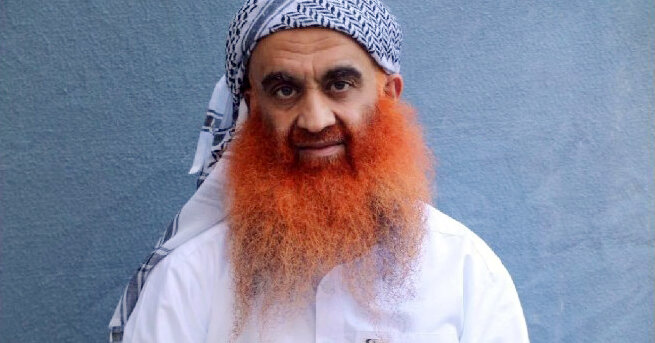 Matzav4 days agoMatzav14 days ago
 Jewish Breaking News16 days ago
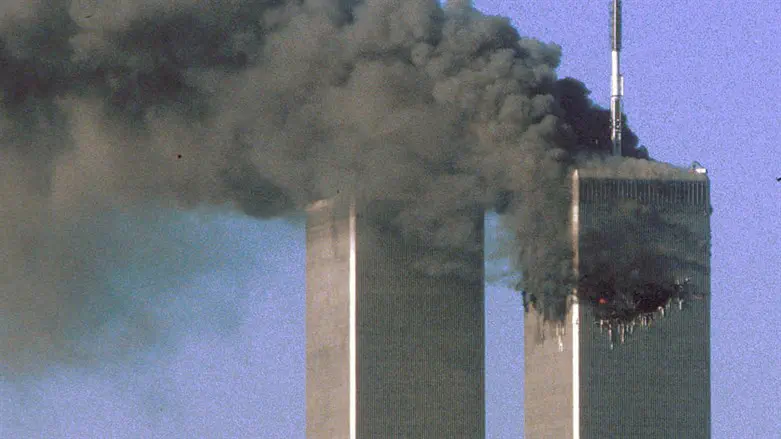 Israel National News16 days agoVos Iz Neias1 day ago
NEW YORK (AP) — Two decades after U.S. authorities locked Khalid Sheikh Mohammed away at a military detention center in Cuba, the purported mastermind of the Sept. 11 attacks sometimes seems barely any closer to being put on trial than the day he arrived.
A judge recently set a 2028 date for Mohammed to finally be tried before a military tribunal, but some lawyers predict it will never happen — not that year or any other year. They say the maze of legal issues that arose because Mohammed was tortured following his 2003 capture in Pakistan is too twisted to ever be straightened out.
A fleeting bid to put him on trial in a civilian court in New York City was shouted down years ago over security concerns.
A plea agreement that would have kept Mohammed imprisoned for life, but spared him from a possible execution, began to collapse shortly after it was announced in 2024, and finally died for good last year.
“It’s all contaminated by politics and the lack of accountability on torture,” said Joshua Dratel, an attorney who played a part in assuring that Mohammed has proper legal representation.
In late August, the U.S. military judge who set a June 5, 2028, trial date for Mohammed and three others charged in the Sept. 11 attacks ruled that prosecutors could not use an alleged confession he made to the FBI in 2007. Those statements were deemed tainted because Mohammed was subjected to “enhanced interrogation techniques” overseas, including the simulated drowning technique called waterboarding.
While the ruling was a blow to the prosecution, the U.S. government decided not to appeal, in part because doing so could have further delayed a possible trial.
Meanwhile, Mohammed remains jailed in Guantanamo Bay, where he was brought on Sept. 5, 2006, following more than three years in secret prisons in other countries.
Victims’ families still hope a trial will happen
Terry Strada, whose husband, Tom, died at the World Trade Center on Sept. 11, said that she and other people who lost family members still hope a trial will someday happen.
“We very much want to see this come to an end at some point. We do want to see justice served. It’s just as important as 25 years ago,” she said.
But Strada, the national chair of the group 9/11 Families United, also said she would rather have Mohammed rot at Guantanamo Bay indefinitely than get behind a resolution that would involve dropping the death penalty as a possibility. Strada said she worries that if Mohammed is not executed, future U.S. leaders might someday be tempted to swap him for Americans held prisoner elsewhere in the world.
The death penalty, she said, “fits the crime and it would prevent that from ever happening. And that’s important to me.”
Mohammed was captured in Pakistan in 2003, accused of developing and directing the 9/11 attacks, as a leader of the Islamic militant group al-Qaida. Some of the delays in his legal proceedings have stemmed from his treatment after he fell into U.S. control. A U.S. Senate report pointed to his extended torture in CIA custody, including 183 sessions of waterboarding.
Plans for a civilian trial were dropped
For a time in 2009, it seemed Mohammed was headed to New York after then-Attorney General Eric Holder announced plans to try him and four other men charged in the Sept. 11 attacks in a Manhattan courthouse just blocks from the World Trade Center site.
Then-President Barack Obama, who had pledged to close the Guantanamo detention center, said Mohammed would face “the most exacting demands of justice.”
Almost immediately, opposition arose. Some critics predicted Mohammed would use a trial as a platform to spread hateful views of America and its allies. Others cited security concerns, saying it could again make New York a terrorist target. Former New York City Mayor Rudy Giuliani, a Republican, called the plan unwise and said it showed “a lack of concern for the rights of the public.”
Plans for a civilian trial were dropped.
“It was a charade in many respects,” Dratel said.
The military tribunal system, he said, has proven itself to be a worse solution, unable to function efficiently, without a proper structure and without fidelity to federal courts.
“Each time you reach an impasse, no one knows what to do,” he said.
David Raskin, a Washington lawyer now in private practice who would have led the government’s prosecution of Mohammed in New York if it hadn’t been abandoned, said in an essay published in The Washington Post on Wednesday that he is confident a civilian trial would have ended with a conviction. The military commissions, on the other hand, “became a defense lawyer’s dream,” beset by “endless litigation over their legality and procedures.”
“I predict there will never be a completed military commission trial for Mohammed and the other Sept. 11 defendants,” he said.
Related stories
Matzav4 days agoMatzav14 days agoJewish Breaking News16 days agoIsrael National News16 days ago Matzav
Related stories
Matzav1 day ago[Video below.] Hillary Clinton declared Thursday that while she remains strongly supportive of both the United States and Israel, she “hates” the governments and policies of President Donald Trump and Israeli Prime Minister Bibi Netanyahu, while calling for Washington to take a tougher approach toward Israel if Israeli voters return Netanyahu to power.
The former secretary of state made the remarks during an appearance on MS NOW’s “Morning Joe,” where the discussion turned to Israel, the Middle East and the prospects for a different relationship between Washington and a future Israeli government.
“I have said repeatedly I love Israel and I hate Netanyahu’s government and his policies. I love America, and I hate Trump’s government and policies. I think it’s bad, in the first case for Israel, what’s happening, and I think it’s really bad for the United States, what’s happening,” Clinton told MS NOW’s “Morning Joe.”
Clinton then addressed a controversial report published this week by Haaretz alleging that UAE President Mohamed bin Zayed had personally warned Netanyahu shortly before the October 7, 2023, Hamas massacre that Hamas was preparing a major attack. Netanyahu has emphatically denied the allegation, while the UAE has declined to confirm or deny that such a conversation took place.
“I think we’ve got to be very clear, the messages we send, hopefully the Israeli people, especially after this bombshell that came out in the Israeli press, where Netanyahu had been literally called by Sheikh Mohammed, MBZ, from UAE, and warned that Hamas was planning something,” Clinton said.
“And either he didn’t believe it or he, it’s horrible to say, he wanted to see what they could plan so that then he could come down hard, and it would enhance his position.”
Clinton acknowledged that she did not know what Netanyahu was thinking at the time, but argued that the allegation, if accurate, represented a major leadership failure.
“I don’t know what his thinking was, but the bottom line, talk about a failure of imagination. This was a failure of leadership,” she continued. “This was a failure of protecting the people of Israel. He’s been told what was going to happen. So, if the Israelis want to vote for that again, then I think the United States has to take a very tough position.”
The White House pushed back against Clinton’s criticism by emphasizing the close working relationship between President Trump and Netanyahu and pointing to the military cooperation between the United States and Israel.
“President Trump has a strong relationship with Prime Minister Netanyahu, and Israel has always been a great ally to the United States. The Israel Defense Forces were incredible partners throughout Operation Epic Fury, which decimated the Iranian regime’s military capabilities in 38 short days,” a White House official told Fox News Digital.
The controversy cited by Clinton stems from reporting that bin Zayed warned Netanyahu approximately 10 days before the October 7 attack that Hamas was preparing a significant operation. The report has become a major political issue in Israel, but Netanyahu’s office has categorically rejected its central allegation.
“The press reports are false. No warning was given to the Prime Minister from the United Arab Emirates before October 7th. If there was any relevant information, it was passed through intelligence channels between the two countries,” the prime minister’s office posted to X.
The UAE Foreign Ministry, meanwhile, has said it does not comment on reports or speculation concerning conversations between government leaders, while noting that relevant intelligence is shared through established channels.
Netanyahu’s office did not immediately respond to a separate request for comment from Fox News Digital.
Clinton went on to say she believes Washington could establish a productive relationship with a different Israeli government and prime minister. She specifically called for stronger action against violence by Israeli settlers in the West Bank.
“I would hope that a new prime minister would crack down on settler violence in the West Bank,” she said. “There should be no impunity for that kind of violence. It is not just about the death and destruction of the Palestinians, their property and all the rest of it. Anytime you let people have that level of violence in a society that you don’t stop, that creeps into the whole society.”
Clinton argued that such violence poses dangers not only to Palestinians but to Israeli society itself, and suggested that the United States reconsider its approach depending on the outcome of Israel’s elections.
“So, it’s unfair, bad and wrong for the Palestinians,” Clinton added. “And it’s also very dangerous to Israel. So, yeah, I think let’s see what they vote for and see whether we can’t, you know, figure out how to have a new approach with a new government.”
The interview also turned to divisions within the Democratic Party and the growing influence of socialist ideas among some Democrats. Clinton argued that politicians advocating those positions should be required to explain and defend them rather than rely on political catchphrases.
“Let people defend the positions they’ve taken. And I think that would be good for the Democratic Party. It would be good for the country.
“Let them get out of the sloganeering and into the legislating and results-oriented impact.”


 Vos Iz Neias1 day ago
KYIV, Ukraine (AP) — More than half a million Russian troops have been killed in Ukraine since the start of Moscow’s full-scale invasion in February 2022, a senior British defense official said Friday.
The dead are part of 1.5 million Russian casualties in Ukraine, Air Chief Marshall Sir Richard Knighton, Chief of the U.K’s Defense Staff, said.
The U.K. figures roughly coincide with those published by the Ukrainian military. There was no immediate comment from Russian officials.
Moscow’s bigger army is struggling to make headway on the battlefield. Western officials and analysts say the Russian rate of advance has slowed significantly this year.
Russia’s armed forces have also lost an “enormous” amount of military materiel, Knighton told reporters. That includes more than 10,000 armored and protected vehicles, close to 3,000 air defense and artillery systems, and over 370 aircraft and helicopters, Knighton said.
He didn’t say what Ukraine’s losses were.
Neither Moscow nor Kyiv give regular updates on their battlefield losses.
Russian drones target Kyiv gas stations, aiming to rattle civilians
Russian drones targeted roadside gas stations in Kyiv for a second straight day Friday, as Moscow broadened its air war in what Ukrainian officials say is an effort to rattle civilians.
The attacks struck two Ukrnafta gas stations, killing two people and wounding six at one of them, the prosecutor’s office said.
Russian strikes on urban gas stations have intensified in recent months, mostly in regions near the front line in eastern and southern Ukraine. It is part of a campaign to disrupt civilian life and weaken morale that has also included attacks on food distribution hubs, sporadically leaving some supermarket shelves bare in the Ukrainian capital.
“Russia is systematically attacking places where it knows people will be spending their time going about their daily lives, seeking to maximize casualties, spread fear, and put pressure on Ukrainian society,” Foreign Minister Andrii Sybiha said on X late Thursday.
Authorities have urged residents not to linger near gas stations and other exposed infrastructure during air raid alerts.
Ukraine is urgently trying to improve its air defenses as Russia’s invasion stretches into its fifth year, and on Thursday won pledges of more support from Canada.
Russian shopping mall strikes kill 5 in central Ukraine
Pavlohrad, a city in central Ukraine, observed an official day of mourning Friday for five residents killed near shopping malls in broad daylight by Russian drones the previous day.
The attack also wounded 67 people, Sybiha said on X.
In the southern city of Zaporizhzhia, a 32-year-old woman and her 10-year-old son were wounded in an overnight Russian drone attack, Ukraine’s State Emergency Service said. The drones struck a nine-story apartment block and a shopping mall, it said.
Efforts to put out the blazes were slowed by the constant threat of repeat strikes, forcing firefighters to stop working and take shelter, it added.
Russia says it stopped 777 Ukrainian drones
Ukraine, meanwhile, has extended its own long-range drone campaign deep into Russia, straining air defenses across its bigger neighbor’s vast territory. On Thursday, its military reported hitting a refinery more than 3,000 kilometers (1,800 miles) away in Siberia as Kyiv tries to hurt Russia’s vital oil sector. Its strikes have caused fuel shortages in Russia, one of the world’s biggest energy producers.
Russia’s oil product exports hit record lows in August, and Moscow is importing fuel from South Korea and India, the Center for Research on Energy and Clean Air said in a report.
“Ukrainian strikes on Russia’s refining capacity have turned tables on the world’s once largest oil product exporter to see them start importing fuels, with imports surging to a record 172,000 metric tons (189,600 tons) in August — more than seven times the previous monthly high,” the Finland-registered nonprofit said Thursday.
Ukraine launched a major barrage overnight from Thursday to Friday, with the Russian Defense Ministry saying air defenses intercepted 777 Ukrainian drones over 16 Russian regions, as well as occupied Crimea and the waters of the Azov and the Caspian seas.
Two people were killed and three others wounded overnight in a Ukrainian drone attack on the Tula region south of Moscow, local officials said Friday.
A Ukrainian drone strike during the night started a fire at the Saratov oil refinery in southwestern Russia, Russian independent online outlet Astra said Friday. Kyiv has repeatedly targeted that refinery, which was last hit in early August.
Major online retailer Ozon said its logistics facility in the same city was struck and set ablaze by a Ukrainian drone, though no casualties were reported. Ozon is a competitor to Wildberries, whose facilities Ukraine has also targeted.
 Vos Iz Neias
Related stories
 Belaaz1 day ago
 JBizNews1 day ago
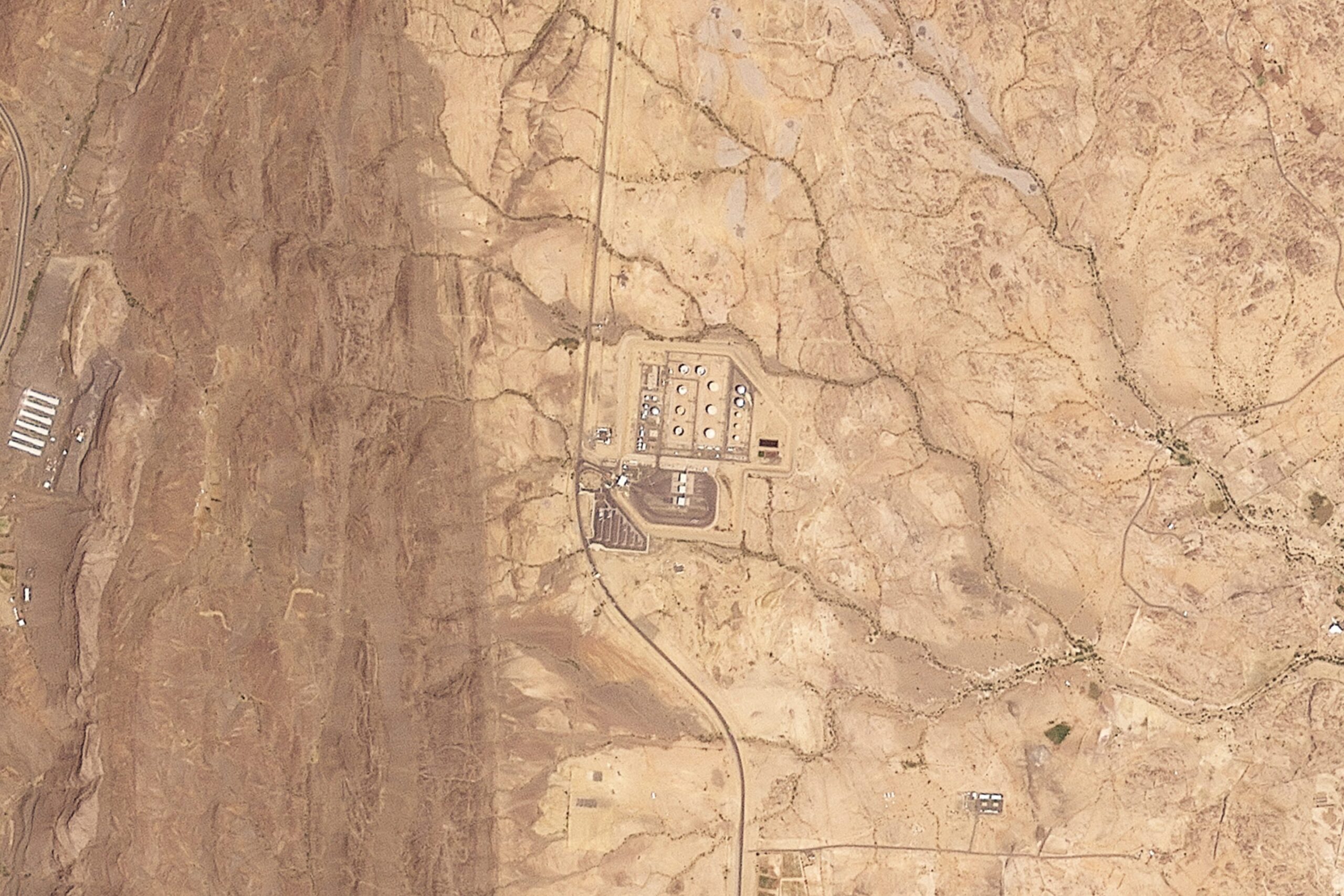 JBizNews3 days ago
 Vos Iz Neias3 days agoVos Iz Neias1 day ago
CHICAGO (AP) — Diesel prices in the U.S. hit yet another record on Friday, soaring past $6 a gallon on average as Washington’s war with Iran disrupts the world’s flow of fuel.
The national average of $6.05 is up from $5.85 last week and $3.70 this time last year, according to motor club AAA.
Higher diesel prices mean more expensive transportation for a long list of everyday goods. That’s because diesel is used for many freight and delivery networks. And some businesses have already passed along steeper costs to consumers in the form of added fees on online orders and packages in the mail.
Shoppers may feel more and more sticker shock, particularly in the grocery aisle. Perishable foods, like meat and produce, face one of the most immediate strains of expensive diesel because they need to be hauled in and restocked frequently — or may be harvested using farm equipment powered by the fuel.
It can take time for those costs to trickle down. But the surge in diesel prices doesn’t appear to be going away anytime soon.
Prices at the pump for diesel and regular gasoline — which hit $4.29 on average in the U.S. Friday — closely follow that of crude oil. And oil has renewed its rise recently. This week, both Brent, the international standard, and U.S. crude surpassed $100 a barrel for the first time in months as fighting between the U.S. and Iran escalated again.
Political ramifications may pile up in the meantime. President Donald Trump, who has repeatedly tried to downplay the effects of the Iran war, said that oil prices likely won’t come down until after November’s midterm elections.
What’s driving the latest jump for diesel
American diesel prices are now significantly higher than they were before the U.S. and Israel launched their war against Iran in late February, when the national average sat at about $3.76 per gallon per AAA. Prices quickly climbed as the cost of crude oil — the main ingredient in refined fuel like diesel, as well as gasoline — soared amid supply chain disruptions across the Middle East, notably with most tanker traffic bottlenecked in the key Strait of Hormuz.
The International Energy Agency reported Friday that Saudi oil production fell to a three-decade low last month due to Houthi attacks on its energy facilities.
And elsewhere, losses in the Middle East have been amplified by the war in Ukraine, as the IEA also noted Friday. Disruptions in Russia’s refining system stemming from intense Ukranian attacks have nearly halted product exports.
Despite prices cooling some during hopes for peace earlier in the summer, oil has now renewed its climb as fighting once more escalates. Brent crude, the international standard, was trading at more than $105 a barrel Friday, up from roughly $70 before the war.
When adjusted for inflation, however, prices have been higher in the past. Ahead of the 2008 financial crisis, for example, diesel hit about $4.74 a gallon, equivalent to $7.20 in 2026, according to the government’s latest data. And 2022’s then-record of nearly $5.82 — reached just months after Russia invaded Ukraine — would be about $6.56 this year when accounting for inflation.
That doesn’t take the pain away from today’s steep prices, which are already bringing ripple effects for the economy and wider costs of living. Drivers are feeling the pain with gasoline, too.
Friday’s average $4.29 for a gallon of regular unleaded is up from $2.98 before the Iran war, although still below the 2022 peak of nearly $5.02 a gallon nationwide.
Diesel has been more expensive than gasoline in the U.S. for decades, and its price has risen at a faster pace before. Some reasons include less flexibility in demand and diesel’s position in global commerce overall. Individual households may find ways to drive less when gas prices are high, for example, but there’s fewer immediate substitutes for networks that rely on diesel to haul goods worldwide.
All eyes on food
Diesel is integral to every part of the food supply chain. It powers farm equipment and fishing boats, as well as the trains and trucks headed to grocery stores.
Fuel accounts for roughly 15% to 30% of the total cost of food, according to the Independent Grocers Alliance, a grouping of 7,500 global supermarkets. So higher diesel costs often result in more expensive groceries, although it can take a while for energy shocks to wind their way through the supply chain.
Items that need to stay refrigerated while they’re transported are often the first to see prices rise, according to David Ortega, a professor of food economics and policy at Michigan State University. In July, for example, overall U.S. grocery prices were up 2.7% compared to a year prior, but seafood prices were up 7% and fresh fruit prices were up 4.9%.
Ortega cautioned other factors can be at play, too. Lettuce also faced higher transportation costs in July, but a drop in demand due to the cyclospora outbreak caused prices to fall.
Still, consumers could feel more of a squeeze the longer diesel prices remain high.
“Early on, much of the cost increase gets absorbed along the supply chain through existing freight contracts and retailer margins,” Ortega explained last week. “But as contracts reprice and fuel surcharges take hold, more of that cost makes its way to the grocery store.”
Fuel shocks range far and wide
Back in April, e-commerce giant Amazon rolled out a temporary 3.5% fuel and logistics surcharge on some third-party sellers. United Parcel Service, FedEx and the United States Postal Service also moved to add fees on some of the packages they ship earlier in the war, citing rising costs for fuel overall.
Experts warn that price hikes could mount the longer diesel remains expensive. A range of other products are also transported by diesel-powered networks, including clothing, cosmetics and furniture.
The ramifications extend beyond consumer goods. Some public transit buses and trains also run on diesel. And diesel generators are often used for backup or emergency power, if not central electricity sources in some remote parts of the world.
Experts warn the consequences could continue to deepen, particularly in African and Asian countries, which rely more on Middle East imports and have already been hit the hardest by energy shocks.
According to the latest data from Global Petrol Prices, diesel prices in Nigeria have surged over 90% since late February — followed by nearly 87% in Indonesia and 80% in Lebanon.
Price tags vary widely between countries, due to factors ranging from fuel taxes to local economic conditions. As of Monday, diesel prices in Nigeria were about $4.95 per gallon (1,730 naira per liter) on average. Meanwhile, the highest sticker price reported by Global Petrol Prices was in Hong Kong, where diesel costs have jumped almost 26% during the war and averaged at $17.78 a gallon (nearly 37 Hong Kong dollars per liter) Monday.
A long road of constrained supply — and perhaps higher and higher prices — could be ahead.
S&P Global Energy said Thursday it now doesn’t project crude oil production in the Middle East to return to prewar levels by the end of 2027.
“The market is not returning to calm, it is adjusting to the new normal,” said Jim Burkhard, VP and global head of crude oil research at S&P Global Energy, noting security and logistical challenges continue to limit oil flows.
Related stories
Belaaz1 day agoJBizNews1 day agoJBizNews3 days agoVos Iz Neias3 days ago
 The Lakewood Scoop1 day ago
The first report on the attacks moments after it happened – by WCBS:
The first plane hits – caught by a cameraman doing a documentary in Manhattan (Muted).
CNN VIDEO As It Happened – Part 1
CNN As It Happened – Part 2
Unique footage shot from the Hudson River
The following VIDEO was taken by a woman in her apartment-36 floors up and 500 yards from the North Tower. Viewer discretion is advised.
The 9/11 Tapes: The Story in the Air – From the NY Times (With Transcript)
A selection of audio recordings from the Federal Aviation Administration (F.A.A.), North American Aerospace Defense Command (Norad) and American Airlines from the morning of Sept. 11, 2001. The recordings, some of which have been published previously, are being released in a multimedia report originally intended to be part of the Sept. 11 Commission’s 2004 report.
Click here for the audio recordings.
AUDIO of Hatzolah recordings
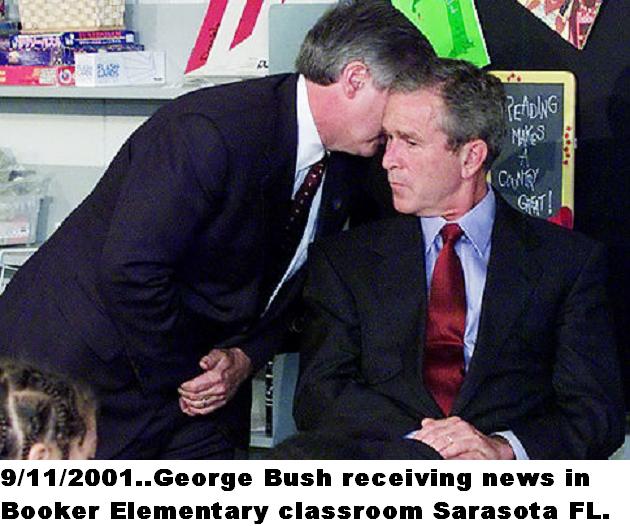 Yeshiva World News1 day ago
Former President George W. Bush outlines for the first time in a new documentary how events unfolded for him following the 9-11 attacks.
In the National Geographic Channel special, “George W. Bush: The 9-11 Interview,” the former President talks about the chaotic moments after the attacks and the reasoning behind decisions he made that day.
Bush reflects on being told about the attacks while visiting schoolchildren in Florida and the difficulty in getting accurate information in what he calls “the fog of war.” He also talks about returning to the White House to address Americans in the hours after the terrorist attacks.
Fearing a possible psychological boost for al-Qaeda, Bush said he, quote, “damn sure wasn’t going to give it from a bunker in Nebraska.”
The former President recalls the emotional visit to Ground Zero just three days after the World Trade Center Towers were destroyed.
He describes “a palpable bloodlust” among workers in the ruins who were encouraging him to retaliate against those behind the attacks.
 Vos Iz Neias
Related stories
 Israel National News1 day ago
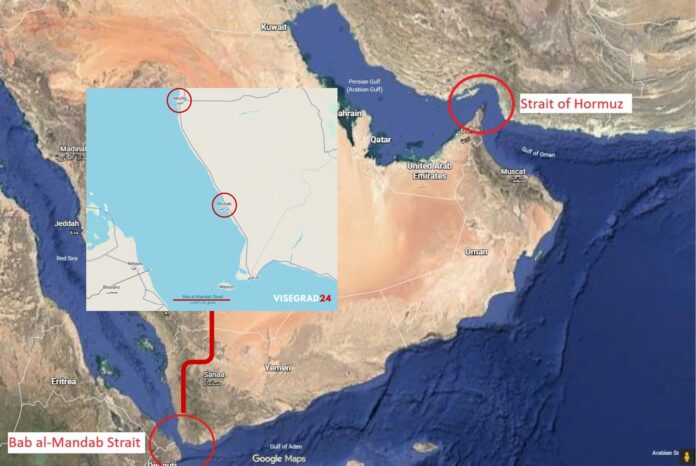 Vos Iz Neias2 days ago
 Israel National News2 days ago
 Yeshiva World News2 days agoVos Iz Neias1 day ago
New York (VINNEWS/Shira Miller) In forty-eight hours, the map of the Red Sea has been redrawn. Yemen’s Iranian-backed Houthi rebels captured the port city of Mocha on Thursday, and by Friday they had swept the entire Yemeni coastline, planting themselves on the shore directly opposite the Bab el-Mandeb Strait. Roughly 12 percent of the world’s oil and goods pass through that strait. So does every ship bound for Eilat. The southern gate of the Red Sea is now in the hands of a movement whose banner reads “Death to Israel, a Curse on the Jews.”
The fall of Mocha was confirmed to the Associated Press by Ahmed Baash, a commander of the National Resistance Forces loyal to Yemen’s government, and by Hazam al-Assad of the Houthis’ political bureau. What followed, according to Al Jazeera, was a collapse rather than a battle. Mocha airport and its general command headquarters fell. So did the Al-Amari camp, the naval bases, the Abu Musa and Ashari camps, and the Khalid ibn al-Walid base, the largest military installation in the region. Government forces abandoned Dhubab, south of Mocha and facing the strait’s narrowest point, moments before the city itself went under.
Hans Grundberg, the United Nations envoy to Yemen, did not soften the message to the Security Council. The nation, he said, faces the “harsh reality” of a return to war, and the consequences of this new and more dangerous phase will not remain within Yemen’s borders.
The Blockade Is No Longer a Threat. It Is a Fact.
The Houthis have been saying it for three years. They blockaded Eilat during the Gaza war and fired on ships whose ties to Israel were often vague or nonexistent. In June, as Iranian missiles rained on Israel, Houthi spokesman Yahya Saree proclaimed “a complete and total ban on maritime navigation on the Israeli enemy in the Red Sea” and declared every Israeli movement a military target.
Until this week, geography restrained the threat. The Houthis ruled from the mountains of the north, hundreds of kilometers from the strait. Now they own the beaches, the naval bases, and the launch sites. Anti-ship missiles, attack drones and explosive-laden boats fired from Dhubab reach the shipping lane in minutes. The proclaimed ban has become an enforceable siege. Eilat, gutted during the 2023–2025 campaign, will not reopen while this coastline remains in Houthi hands.
Iran Squeezes Both Gates
This is the fact that should alarm Jerusalem most. Since the United States and Israel struck Iran in February, Tehran has kept the Strait of Hormuz virtually closed. The world’s answer was Bab el-Mandeb: Saudi Aramco poured crude through its East-West pipeline to Red Sea terminals, and Gulf importers rerouted their lifelines through the strait. Iran’s proxies now sit astride both doors at once.
On Friday, satellite imagery cited by Reuters showed smoke near that very East-West pipeline. Riyadh has said nothing. If the Houthis are striking the pipeline that was built to escape Hormuz, then there is no escape route left. A Media Line analyst has already warned that the food and necessities of Kuwait, the UAE, Bahrain, Qatar and Saudi Arabia arrive by sea, and that airlifting goods is driving prices skyward. The Gulf states that quietly stand with Israel against Tehran will feel the pain first. Israel, fighting a multi-front war on borrowed money, will feel it next.
The Front Israel Cannot Reach
Of all Iran’s proxies, the Houthis are the hardest to kill. They waited a month after Feb. 28 before joining the war, then opened fire on southern Israel and vowed to bar the United States and Israel from using the Red Sea against Iran. “Our fingers are on the trigger,” Saree said. The trigger has now been pulled.
Yemen lies 2,000 kilometers from Israel. Every strike demands long-range aircraft and mid-air refueling. American and Israeli bombardments in 2024 and 2025 punished the Houthis and did not break them. Analysts have warned that a cornered Iran would use Bab el-Mandeb to relieve pressure on itself, and that is precisely what is unfolding. The coastal seizure hands Tehran maximum leverage on the one front where Israeli power is weakest, on the very day Israel announced the destruction of Hezbollah’s underground Ali Al-Taher fortress near Nabatieh and declared its southern Lebanon security zone complete. Israel’s army is committed in the north. Its enemies have opened the south.
Saudi Arabia Fires the First Shots Back
Riyadh has not waited for diplomacy. The Houthi-affiliated Al-Masirah channel reported two Saudi air strikes on Mocha airport, and Al Jazeera’s correspondent in Sanaa reported repeated Saudi strikes on Houthi positions across the city on Thursday and Friday, with a Yemeni government counteroffensive expected. Saudi Ambassador Abdulaziz Alwasil told the Security Council that the kingdom will defend its territorial integrity under the U.N. Charter and international law.
A full Saudi–Houthi war would drag Riyadh into open combat with Iran’s axis, an outcome that serves Israel’s interest and simultaneously threatens to turn the entire Red Sea into a battlefield. Egypt is already bleeding. The International Monetary Fund reported in July that Houthi attacks stripped $6 billion from Suez Canal revenues in 2024 alone, and the canal is one of Cairo’s last reliable sources of hard currency. A renewed collapse of Red Sea traffic weakens Egypt at the exact moment Israel needs it strong.
The Bottom Line
Two days ago the Houthis threatened the Red Sea. Today they hold its southern gate. Eilat is sealed, Israel’s costs are climbing, the Gulf’s lifelines are exposed, and the Islamic Republic has a chokehold that no Israeli air campaign has yet managed to loosen. Whether Saudi jets and Yemeni ground forces can reverse the advance in the coming days will decide a question far larger than Yemen: whether Bab el-Mandeb remains an international waterway, or becomes an Iranian one.
Related stories
Israel National News1 day agoVos Iz Neias2 days agoIsrael National News2 days agoYeshiva World News2 days ago Yeshiva World News1 day ago
The following are excerpts of a Wall Street Journal article, and re-posted from the YWN archives:
FIVE FLOORS ABOVE, Shimmy Biegeleisen phoned his wife from his office at money-management firm Fiduciary Trust International Inc. “There’s been an explosion next door,” the 42-year-old vice president said. “Don’t worry. I’m OK.”
After a few minutes, Mr. Biegeleisen grabbed his black canvas bag, walked past a cluster of cubicles and headed toward the stairwell. But when he reached the doorway — a step behind a project manager who worked for him — he stopped, leaned his big body against the open metal door and rummaged through his bag. “Whatever you’re looking for, it’s not important,” the manager told her boss. “Please come.” She started down the stairs.
THE WORD “FIDUCIARY” filled the caller-ID panel on the kitchen phone in the Biegeleisen home in the Flatbush section of Brooklyn. Miriam Biegeleisen knew it was her husband calling again from his office. “I love you,” he told her.
He hadn’t made it to the stairs when the wings of the second jet ripped diagonally through the south tower just four floors below Mr. Biegeleisen’s cubicle. Fire engulfed the tower’s stairwells. Mr. Biegeleisen was trapped.
Mrs. Biegeleisen handed the phone to Dovid Langer, a friend who volunteered for an ambulance service and had run over when he heard that ambulances had been dispatched to the towers.
“Dovid,” Mr. Biegeleisen told him, “take care of Miriam and take care of my children.” Mr. Langer heard a recording in the background saying over and over that the building was secure and that people should stay put. (A Port Authority spokesman said, “We are not aware of any recorded announcement made by building management.”) Mr. Biegeleisen continued: “Dovid, I’m not coming out of this.”
Mr. Langer connected Mr. Biegeleisen to Gary Gelbfish, a vascular surgeon and friend who was watching the towers burn on TV. “I’m having difficulty breathing,” Mr. Biegeleisen told him. Black smoke was filling the room.
“You’ve got to do two things,” the doctor said. “Stay low to the ground. And do you have a towel or a rag? Put water on it and put it over your mouth.” Twin
Mr. Biegeleisen walked past three cubicles to the water cooler. He wet a towel and raised it to his mouth. Then he walked back to his desk and lay down on the slate blue carpet in his black suede shoes, black pants, oxford shirt and black felt yarmulke. Mr. Biegeleisen was a Chassid, a devoted follower of the Belzer Rebbe, the leader of a rabbinic dynasty that dates to 1815.
“Is there a sprinkler?” Dr. Gelbfish asked. Mr. Biegeleisen looked up but couldn’t see through the smoke. He and the five colleagues trapped alongside him decided to try to get to the roof. Mr. Biegeleisen hung up the phone.
THE PHONE RANG in the Biegeleisen home. Again, “FIDUCIARY” flashed on the display. The intense heat had kept Shimmy Biegeleisen from reaching the roof. “We couldn’t even go into the hallway,” he said into the phone.
The Biegeleisen home was filling with worried friends and neighbors. Women clustered in the living room, trying to calm Mrs. Biegeleisen. Men paced in the kitchen, taking turns speaking to her husband. One phoned 911. They waited while Mr. Biegeleisen tried again to reach the roof.
He didn’t make it. At 9:45, he phoned home again. “Promise me you’ll look after Miriam,” he told one of his friends. “Tell Miriam I love her.” Lying on the floor beneath photographs of his five children that sat atop his filing cabinet, he now spoke of them and gave instructions for handling his finances.
Mr. Biegeleisen and his 19-year-old son Mordechai were supposed to travel in five days to Jerusalem to spend the Jewish new year with the Belzer Chassidim and meet with the Belzer Rebbe. Mr. Biegeleisen made the trip every few years at Rosh Hashanah. Most inspiring to him was the second night of the holiday, when the Rebbe read aloud the 24th Psalm.
Now, in a voice hoarse with smoke, Mr. Biegeleisen began to recite that psalm in Hebrew over the phone: “Of David a Psalm. The Lord’s is the earth and its fullness …”
The friend on the phone began to shake. He handed the phone to another friend, who urged Mr. Biegeleisen to break a window. “You can get some air and go to the roof,” the friend said. Mr. Biegeleisen called out to a colleague. “Let’s go! Let’s break the window!” At 9:59, the two men hauled a filing cabinet to the window. “I’m looking out the window now,” Mr. Biegeleisen said into the phone. Then he screamed: “Oh God!” The line went dead.
SEVEN DAYS AFTER her husband’s phone line went dead, Miriam Biegeleisen stood in synagogue on Rosh Hashanah murmuring a prayer about God and fate: “How many will pass from the earth and how many will be created. Who will live and who will die. … Who by water and who by fire.”
By tradition, she and her family would have begun their shiva, the weeklong mourning period for her husband, the day after his death. But no body had been found, and the Biegeleisens for days had held on to hope that Shimmy was alive. Now Shimmy’s father decided that they were ready to mourn. Before they could, it had to be established that Mrs. Biegeleisen wasn’t an agunah.
In Jewish law, an agunah is a woman who is separated from her husband and cannot remarry, either because he won’t grant her a divorce or because it isn’t known whether he is alive or dead. With no trace of a body, a rabbinic court must rule whether death can be assumed.
Minutes after Rosh Hashanah ended, Mr. Biegeleisen’s father phoned Efraim Fishel Hershkowitz in Brooklyn. The 76-year-old rabbi said he would convene with two other rabbis to decide the case at once. He asked that the men who had spoken to Mr. Biegeleisen on the day he disappeared come to the rabbi’s home. He also wanted a tape of the 911 call.
THREE RABBIS and six of Shimmy Biegeleisen’s friends gathered at the home of Rabbi Hershkowitz on Thursday, Sept. 20. It was the Fast of Gedalia, so the men sat down at the dining-room table with empty stomachs. The rabbis wore the long ear-locks, long black coats and wide-brim velvet hats of their European predecessors.
One of them opened a copy of the Yiddish newspaper Blat to a sequence of photographs of the towers’ end. In Yiddish, the rabbis discussed various logistics of the case: the floors the planes hit, how and when the buildings fell, the intensity of the fire, where Mr. Biegeleisen lay, what he said on the phone. They spoke with Mr. Biegeleisen’s friends about the phone call — and about Mr. Biegeleisen — then asked them to wait outside.
The rabbis deliberated for 10 minutes. Caller-ID repeatedly placed Mr. Biegeleisen at his Fiduciary office. The building fell at the precise moment Mr. Biegeleisen screamed. Mr. Biegeleisen’s relationship with the Belzer Rebbe attested to his character. They cited a case, in a 16th-century book of Jewish law, of a furnace of fire from which there is no escape. Mr. Biegeleisen’s was just such a case, they said. His death could be assumed. Mrs. Biegeleisen was not an agunah. The mourning could begin.
One of the rabbis went to the Biegeleisen home. He took a razor from his pocket and made cuts in the clothing of the male mourners — on the left for Mr. Biegeleisen’s three sons, on the right for his brother and father. Mrs. Biegeleisen, standing by the kitchen, said, “Is the psak [ruling] final?” It was. “It’s over,” she thought. “Shimmy is not coming back.”
AN ORTHODOX JEWISH woman came to the Biegeleisen home on Sunday, Sept. 23, the fourth day of shiva. Mrs. Biegeleisen, following Jewish law, sat on a low, hard chair. She didn’t know the woman visitor, who said, “My husband was also there.” Mrs. Biegeleisen understood that the woman had not yet been allowed to mourn. She was as yet an agunah.
For Mrs. Biegeleisen, knowing that she could remarry was hardly a comfort. “It’s not something I’m thinking of,” she said, her covered hair and engagement ring evidence of her 20 years of marriage. “When you live with only one person, it’s all you know.”
SHIMMY BIEGELEISEN’S FAMILY had almost finished mourning him when the phone rang. On the line was the Belzer Rebbe, Issachar Dov Rokeach, calling from Jerusalem.
Mr. Biegeleisen’s wife, five children, parents, brother and sister scurried upstairs to a closed room. They encircled a phone and put it on speaker. The 53-year-old Rebbe spoke quietly in Yiddish. He asked for the men and boys, one by one, and recited to each the Hebrew verse traditionally spoken to mourners: “May the Omnipresent console you among the other mourners of Zion and Jerusalem.”
Finished, the Rebbe said, “There are no words.” A dial tone reverberated in the room as the family echoed him, over and over: “There are no words. There are no words. There are no words.”
Yechi Zichro Boruch….
 Matzav
Related stories
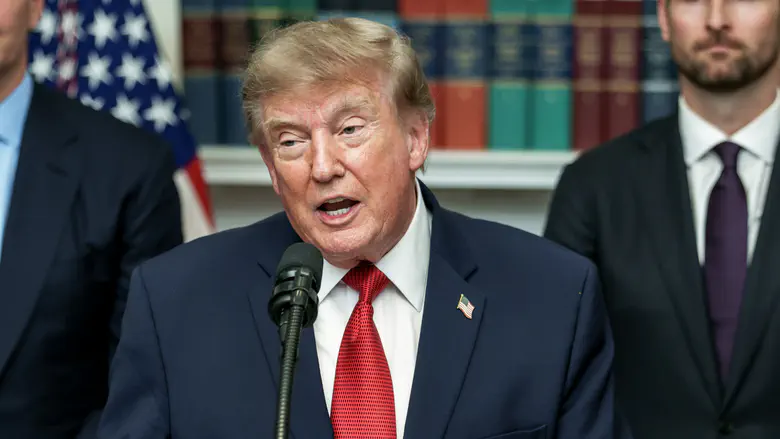 Israel National News1 day ago
 Matzav2 days ago
 Israel National News2 days agoMatzav3 days agoMatzav1 day ago
President Donald Trump said Thursday that he has no regrets about launching the war against Iran and would make the same decision again, arguing that military action was necessary to prevent Tehran from obtaining a nuclear weapon.
Speaking with Laura Ingraham on Fox News, Trump defended his handling of the conflict even as the war has stretched into its seventh month, driven up energy prices and become an increasingly prominent issue ahead of the November midterm elections.
“I don’t believe in the word regret. You can always question yourself a little bit. A few people have asked me that. If I had it to do again, I’d do exactly as I did. I took out their nuclear capability.”
.@POTUS: "I don't believe in the word 'regret.'" pic.twitter.com/l1ayOV09oO
— Rapid Response 47 (@RapidResponse47) September 10, 2026
Trump said he believed the consequences of allowing Iran to obtain a nuclear weapon would have been far more dangerous than those resulting from the war, contending that Tehran would have been willing to use such a weapon against Israel, other countries in the Middle East and potentially the United States.
“Supposing we were cruising and all of a sudden Iran has a nuclear weapon. They would use it. They’re crazy. I deal with them. They’re crazy. And they would use it,” he said. “They would have wiped out Israel. They would have wiped out the Middle East. And they would have started hitting a couple of our cities.”
Iran has consistently maintained that its nuclear program is intended for peaceful purposes and that it is not seeking a nuclear weapon. The United States and Israel have disputed Tehran’s assurances and have cited Iran’s nuclear activities as a central justification for military action.
Trump also pointed to Wall Street as evidence that the American economy has remained resilient despite the conflict, even as oil prices have climbed amid continued fighting and disruptions surrounding critical Middle Eastern shipping routes.
“The stock market right now is at the all-time high….during this whole little conflict, we call it a conflict, the stock market’s at an all-time high. The highest it’s ever been. Much higher than when I started. You know, when I started it was at 49,000. Now it’s at 53. It’s going to be 54 pretty soon. It’s going up. Continues to go up. Oil went up.”
Energy prices have nevertheless emerged as one of the most visible economic consequences of the conflict. Brent crude rose above $100 a barrel this week amid escalating U.S.-Iran hostilities and renewed concerns about shipping through the Strait of Hormuz.
During the interview, Trump also accused Iran of attempting to influence the upcoming American midterm elections because Tehran believes a change in political control in Washington could produce a more favorable U.S. policy.
“They’re trying to do anything possible to get me out, because they think the Democrats will let them essentially have a nuclear weapon. They’re not going to have a nuclear weapon.”
Trump has increasingly connected the course of the Iran war with the November elections. He said earlier this week that he expects the conflict to end after the midterms, while maintaining that Iran is trying to hold out in hopes of a change in the political environment in Washington.
The President’s declaration that he would make the same decision again came as tensions have intensified over Iran’s heavily fortified Pickaxe Mountain complex near Natanz.
Trump warned Tehran about the site during his appearance Wednesday at the Republican National Midterm Convention in Dallas, saying American officials had detected activity there.
“We notice there’s a little activity at Pickaxe. I would advise Iran not to get cute, because we will have to hit them very hard,” Trump said.
Pickaxe Mountain is located near Iran’s badly damaged Natanz uranium enrichment facility and contains two deeply buried tunnel complexes. Unlike several other Iranian nuclear facilities, the underground complex has not been struck during the current war.
Trump has been publicly threatening possible military action against Pickaxe Mountain since at least July, repeatedly warning that the United States will not permit Iran to use the site to preserve or rebuild its nuclear capabilities.
Those concerns received additional attention Thursday when International Atomic Energy Agency Director General Rafael Grossi confirmed that the U.N. nuclear watchdog has observed signs of new activity around the complex.
“There are some indications that there is movement around this construction site,” Grossi said. “We don’t have any concrete information as to activities that may be taking place there.”
The IAEA has not inspected the underground facility directly and is instead relying on remote imagery to assess developments there.
A separate satellite-imagery analysis released this week by the Center for Strategic and International Studies found a significant increase in construction at Pickaxe Mountain during 2026. Researchers reported reinforcement of tunnel entrances, road paving and other work around the sprawling underground facility.
Trump issued a similar warning about the facility last week.
“Iran will not have a nuclear weapon,” he told reporters at the Oval Office, adding, “We may hit Pickaxe very soon…if there was anything going on with Pickaxe.”
The President’s comments Thursday made clear that, despite the length and cost of the conflict and questions about its effect on the approaching midterm elections, he continues to stand behind his original decision to launch military action against Iran.
“If I had it to do again, I’d do exactly as I did,” Trump said.
Related stories
Israel National News1 day agoMatzav2 days agoIsrael National News2 days agoMatzav3 days ago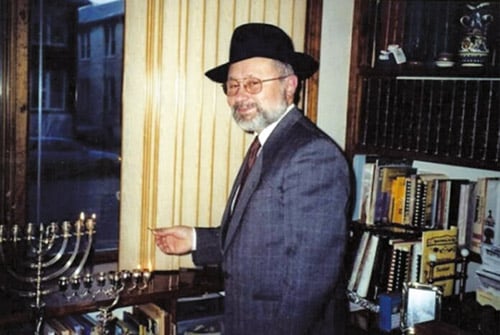 Yeshiva World News1 day ago
When the terror attack occurred, Avremel was fifty-five; his friend Ed, a quadriplegic, was forty-two. Both worked at Empire Blue Cross/Blue Shield as program analysts on the 27th floor of One World Trade Center.
By Chavie Zelmanowitz (sister-in-law), as told to Bayla Sheva Brenner
On the morning of 9/11, Avremel davened in the same shul with my husband, Yankel, which was unusual. Usually, whenever they said goodbye, they would shake hands. That morning, however, Avremel came toward Yankel and hugged him tightly before he left for work.
While driving home after taking me to work, Yankel heard that something had happened at the World Trade Center. He tried to call Avremel. I also tried. We couldn’t get through. Then Avremel called Yankel. He said, “I’m here with Ed. We’re waiting for help and then we’re going to leave.” Yankel called me and said, “I heard from Avremel–he’s going to leave.” I breathed a sigh of relief. Then I got a phone call from Avremel. I asked, “Where are you calling from? I thought you were on your way home.” He reassured me that the air was clear where they were, on the 27th floor. “I’m waiting here with Ed for someone to come help.” He said that Ed wanted to wait for a medical team, because in the past when people lifted him improperly, his bones would break.
Edward Beyea, who became disabled after a diving accident at age twenty-one, was a large man. He used a wheelchair with all kinds of contraptions. He had no arm or leg function, and operated his computer with a mouth stick. An aide accompanied him at all times. The normal routine was that the aide would bring him to work, set him up in his cubicle, and go up to the 43rd floor to the cafeteria. That’s where she was when the plane hit. There was water coming down, things were falling, smoke was filling the room. She immediately ran back down the staircase to the 27th floor and found the two of them together. Avremel assured her that he would stay with Ed and that she should leave. She barely made it out. Avremel is responsible for her survival.
Avremel told me, “The fireman is here and he wants me to move to another area.” That was the last we heard from him. No one had any idea that the buildings were going to go down. He didn’t stay to die; he stayed to help. That was his intention.
Avremel and Ed had worked together for twelve years. They traded books and tapes and played chess together. Avremel was a master carpenter; he built Ed a cigar stand and a book stand so that he would be able to read in bed. He used to visit Ed during his numerous hospitalizations. It was a friendship that culminated with this extraordinary act.
Initially our son-in-law made up a flyer; everyone was posting flyers for missing relatives. The flyer mentioned that Avremel was together with a quadriplegic friend. Immediately, we were bombarded by reporters. They wanted to hear details of the story. We were interviewed on a few news programs, at one point three in one day. A week after 9/11, our rav told us it was time to sit shivah. Rescuers were not finding anyone alive any longer. We knew Avremel had been in the building at the time. It was time to make a decision.
By Yankel (Jack) Zelmanowitz (brother), as told to Bayla Sheva Brenner
Avremel lived with us. When my parents went to Eretz Yisrael in 1973, just before the Yom Kippur War, he moved in. I was his big brother; I’m twelve and a half years older. We were very close. I took him into the textile business with me, and then he learned programming. He was really a wonderful human being. He had a lot of friends. Always friendly, always doing ma’asim tovim, favors for people, giving tzedakah, going to shiurim; everybody liked him. He was a simple guy who never looked for praise. His death made such a roshem, such an impression on people. Letters came in from people all over the world. A woman in Canada contacted us. She has a son with cerebral palsy who was fifteen-years-old at the time. She worried about him going into the workforce. “I hope I meet someone like Abe,” her son said.
That week, when President Bush spoke, he mentioned Avremel. He said: “We are here in the middle hour of our grief. So many have suffered so great a loss, and today we express our nation’s sorrow. . . . We have seen our national character in eloquent acts of sacrifice. Inside the World Trade Center, one man who could have saved himself stayed until the end at the side of his quadriplegic friend.”
My son, Chaim Shaul, was there when the president came the week of 9/11 to visit Ground Zero. He was told to stay behind to tell the story to the president. He called us and asked what he should do since it was erev Shabbos and time was short. We said, “Stay as long as you can, leaving yourself enough time to get home for Shabbos.” In the end, he had to leave before speaking with the president. We received a phone call from the president’s staff. “We’re looking for your son to meet the president,” they said.
On the first anniversary of 9/11, all of the victims’ families were at Ground Zero. The president spent time mingling with the families and made special time for us. He is a person with a heart; he is very compassionate. He didn’t know what to do for us.
Avremel’s actions that day are what defined him. He lived his entire life that way, always caring about people, always anticipating people’s needs. You wouldn’t have to ask Avremel for something; he’d understand that it had to be done and he’d go and do it. This was who he was. He was an extremely devoted son; his kibbud av va’eim was extraordinary. He never married or had children, but our children and grandchildren are following in his footsteps in their gemilut chasadim. How proud he would be to know that.
We were called upon to speak about Avremel very often–at shuls, dinners, et cetera. A library at a nearby yeshivah was dedicated to him. We were constantly on call; that helped us get through the initial period.
In August 2002, the police came to our home to inform us that they had identified Avremel’s remains. We were able to have a kevurah. He had always wanted to be buried in Israel; we asked someone to arrange for a plot on Har Zeisim. When we got there, we were amazed that he had found a plot available right at the foot of our parents’ graves.
In 2006, a street was dedicated to Avremel. The street, on the corner of East 35th Street and Kings Highway [in Brooklyn], our corner, was renamed Abe (Avremel) Zelmanowitz Way. One of the speakers at the dedication, Rabbi Shlomo Zucker, said it is so fitting that the street is called “way” rather than “lane,” “drive,” or “street,” because Avremel showed us the way to live, the way a person should conduct his life, and how he should interact with Hashem and his fellow man. That is his legacy. He led by example.
We have letters from people he worked with. One of his colleagues wrote, “We knew he was a religious man, but he never preached. He was always aware, thinking ahead, thinking of others.”
The effect that Avremel continues to have is amazing. After I heard the news about Bin Laden, I wanted to go down to Ground Zero. It was a relief; we felt a need to share it with those who had lost family members, to be close to them. While we were on the train to Manhattan, my son called us. He said he just got a call from NBC News. They wanted to interview us, find out about our feelings. Avremel’s story is out there.
While at Ground Zero, we must have given twelve or fifteen interviews. Reporters from all over sought us out, wanting to hear the story. We told them the story of Avremel. We always try to point out that it was an Orthodox Jew and a non-Jewish friend and this is what Avremel did because of his friendship.
The Shabbos before 9/11, Avremel had gone to a shiur. He was a very reserved person. He wasn’t pushy in any way. When the rav started to speak about Kiddush Hashem, Avremel interrupted him and said, “How could an ordinary person make a Kiddush Hashem?” He got an answer but wasn’t satisfied. Avremel interrupted him another time; again, the rav gave him an answer. Then he asked a third time. It wasn’t like Avremel to do that. Three days later, he got his answer.
Every rav has told us the same thing: it’s an obligation to perpetuate Avremel’s story. No matter how painful it is for us, we do it l’shem Shamayim. I feel it is our responsibility to perpetuate his Kiddush Hashem.
Chavie and Yankel Zelmanowitz live in Brooklyn, New York.
Excerpted from Jewish Action, fall 2011
 Yeshiva World News1 day ago
Edmund Glazer even laughed quietly. He was a calming, logical man, a problem solver, an unassuming gentleman for whom swearing was anathema. Even though he was the youngest of four siblings who were raised in Zambia and South Africa, with his ability to untangle life knots so adroitly, he was the family’s go-to guy. “Tell me more,” he would say, gently touching the other person’s arm. “What can I do to help?” Whenever he visited his sister, Beatrice Sandler, and her daughters, he would immediately stock their refrigerator with groceries and throw out the stale goods from his previous visit.
He and his wife, Candy, had recently moved into a house outside Boston. He would eagerly call his sister, hold up the phone and say exultantly, “Can you hear that babbling brook?”
In their dream house, Mr. Glazer, 41, fancied himself a handyman, and would take his young son, Nathan, on forays to Home Depot, hunting for the one tool that would improve his hapless skills.
If he was less than dazzling with wood, Mr. Glazer was a Mr. Fix-it at his company, MRV Communications, where he had risen to chief financial officer. On the evening of Sept. 10, he got a call from MRV’s home office in Los Angeles, asking for his help on a major project. In his obliging way, Mr. Glazer boarded Flight 11 the next morning.
Edmund Glazer, 41, was vice president of finance and administration and chief financial officer at MRV Communications, a Chatsworth, Calif.-based telecommunications company. On Tuesday, Glazer was on his way to the headquarters from his home in Wellesley, Mass.
“He called me to let me know that he had made it on the plane,” said his wife, Candy. “He said they were about to take off and he had to turn off the cell phone. I’m assuming nothing was going on then, because he sounded normal. We said our byes and he said he would call me when he got there [Los Angeles].”
Born in Zambia, Glazer moved to Los Angeles when he was 17 to attend the University of Southern California. “Everyone knows the U.S. has the best universities and he decided he wanted to study here,” said Candy Glazer. “He liked it so much he decided to stay.”
Profile courtesy of Chicago Tribune – Profile published in the NYT on June 2, 2002.
(YWN World Headquarters – NYC)
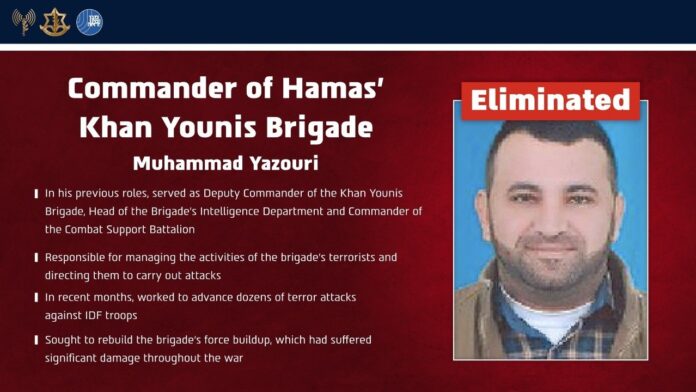 Vos Iz Neias
Related stories
Cleveland Jewish News7 hours ago Belaaz1 day ago
 Israel National News1 day ago
 Yeshiva World News10 days agoVos Iz Neias1 day ago
JERUSALEM (VINnews) — The Israel Defense Forces and Israel Security Agency announced Friday that they killed Terrorist Muhammad Yazouri, commander of Hamas’s Khan Younis Brigade, in a precision airstrike in the Khan Younis area of the Gaza Strip on Thursday night.
Yazouri had previously served as deputy commander of the brigade, commander of its combat support battalion, and head of its intelligence department before taking overall command, according to the joint IDF-ISA statement.
The military said Yazouri directed the brigade’s operatives and planned attacks against Israeli soldiers and civilians. In recent months, it added, he worked to advance dozens of attacks on IDF troops and to rebuild the brigade’s capabilities after heavy losses during the war.
The same strike also killed Terrorist Hudheifa Muammar, described as a company commander, and Muhammad Bahjat Rashi, another member of Hamas’s military wing in the Khan Younis Brigade.
The IDF said forces took steps before the strike to reduce the risk to civilians, including the use of precise munitions and aerial surveillance.
Troops under the Southern Command remain in the area in line with the existing agreement and will continue to act against immediate threats, the statement said.
Independent confirmation of the deaths from Hamas was not immediately available. Arab media reported that the strike occurred in the Hamad neighborhood north of Khan Younis and that a residential building later caught fire.
The announcement is part of a series of Israeli operations targeting Hamas commanders in southern Gaza while troops remain deployed under the terms of the ceasefire framework.
Related stories
Cleveland Jewish News7 hours agoBelaaz1 day agoIsrael National News1 day agoYeshiva World News10 days ago The Lakewood Scoop1 day ago
For thousands of families in our community, the enormous expense of Tishrei is simply too heavy to carry.
So Tomchei carries it for them.
But carrying Tishrei for almost 3,000 families means taking on a staggering $4,000,000 responsibility.
Tomchei can’t carry that weight alone. We need an entire community behind us.
WHO WILL TIP THE SCALES THIS TISHREI?
LAKEWOOD.
That means all of us.
Our neighbors are counting on Tomchei for the groceries and food they need to make Yom Tov. And Tomchei is counting on our community to make it possible.
As Elul draws to a close and Rosh Hashana is upon us, there could hardly be a greater zechus than helping another family enter Tishrei with dignity, joy, and everything they need for Yom Tov.
This is our community.
This is our responsibility.
And this is our opportunity.
THIS TISHREI, THIS ROSH HASHANAH, TIP THE SCALES.
Call to donate: 732.978.9901
 The Lakewood Scoop1 day ago
2X Tehillem! on Rosh Hashanah!! at Kever Rochel!!
This Rosh Hashanah, fulfill the powerful segulah,of having Sefer Tehillim completed twice at!!
**The Powerful Segulah!!
**
CLICK HERE!
2X Tehillem! on Rosh Hashanah at Kever Rochel
This Rosh Hashanah, fulfill the powerful segulah,of having Sefer Tehillim completed twice at!!
**The Powerful Segulah!!
**
CLICK HERE!
2X Tehillem! on Rosh Hashanah at Kever Rochel
This Rosh Hashanah, fulfill the powerful segulah,of having Sefer Tehillim completed twice at!!
**The Powerful Segulah!!
**
CLICK HERE!